Showing posts with label WWII. Show all posts

Sunday, June 16, 2024

The Last Hope (A Maggie Hope Mystery #11) by Susan Elia MacNeal

The Last Hope: A Maggie Hope Mystery
by Susan Elia MacNeal


I'm a little on the OCD side and although I closed The Children's War in December 2023, I find I can't not review the final book in the Maggie Hope series. So here goes...

The Last Hope is the eleventh and final (?) book in Susan Elia MacNeal's wonderful WWII mystery series featuring Maggie Hope. Maggie has had some scary adventures since the war began and she became an SOE agent to do her bit, but her final mission may just be the most difficult.

It’s January 1944 and no sooner has Maggie returned from Los Angeles with the love of her life, John Sterling, then she gets an early morning call from Kim Philly, head of the Iberian Section of MI-6. Word is that the Germans are working on a fission bomb that could erase a whole city from the face of the earth and it is suspected the Werner Heisenberg, a pioneer in quantum theory, may be behind their research. Maggie’s new mission is to travel to Madrid, Spain under the alias Paige Kelly (see Mr. Churchill's Secretary, Maggie Hope #1), where Heisenberg is giving a lecture and to assassinate him. But Maggie being the mathematician that she is decides that she needs to determine whether the Nazis have such a bomb or not. If they do, Heisenberg dies, if not, he lives.

Realizing that the war is not going well, and since Allied demand for an unconditional surrender is not an option, it is decided by Heinrich Himmler and General Walter Schellenberg that Germany’s only hope of survival would depend on negotiating a separate peace with the Allies sans that Soviet Union. The hope is this would keep communism out of western Europe. And now that information about the Final Solution is leaking out, one of their bargaining chips would be the lives of the remaining Jews. And Schellenberg has just the right contacts for getting the offer of a separate peace into the hands of Winston Churchill: Axis spies Coco Chanel and her current amor, Hans von Dincklage will be traveling to Madrid on the pretext of hearing Heisenberg’s lecture.

It turn out that Maggie as Paige Kelly owes Coco a favor after she saved Maggie’s life back in 1942 (see The Paris Spy, Maggie Hope #7) and Coco has every intention of calling the favor in, insisting that Maggie/Paige personally deliver the peace proposal including a handwritten letter from Coco herself directly into the hands of Winston Churchill.

And, of course, Maggie being Maggie, she attracts the attention of the famous bull fighter Juanito Belamonte, whose fame gives him all kinds of useful connections so that he can unwittingly help Maggie.

There's a lot going in in this novel that will keep you on the edge of your seat. Does Maggie assassinate Heisenberg? Obviously not (not a spoiler), but she has some very interesting conversations with him about quantum theory and his uncertainty principal. And the whole time she is carrying out her mission, Maggie has her personal life and her relationship with John Sterling very much on her mind.

The Last Hope was a bittersweet read. It was so good that I could hardly put it down, but then again, I didn’t want to finish it and say good bye to Maggie and her friends. I found it particularly interesting since I’ve take quantum theory courses and really thought that MacNeal did an excellent job making it accessible for those of us who are not physicists or mathematicians.

The story is loaded with names of real people and I found myself going to the internet to find out more about them. In fact, all the Maggie Hope books have been like that and I like a historical novel that gets my curiosity going. MacNeal is so great at incorporating her research seamlessly into her stories.

I’m going to miss Maggie, but I can highly recommend each and every one of her wartime adventures, but by 1944, she has certainly done more than her bit for the war effort.

So, good-bye, Maggie, good luck and marry John Sterling as soon as possible.

Thank you to Ballantine/RH and NetGalley for allowing me to read this E-ARC.

Saturday, October 1, 2022

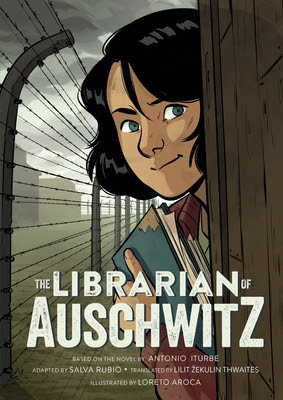
The Librarian of Auschwitz: The Graphic Novel based on the Novel by Antonio Iturbe, adapted by Salva Rubio, illustrated by Loreto Aroca, and translated by Lilit Žekulin Thwaites


Available January 3, 2023
I loved reading comics as a kid and I wasn't above reading a Classic Comic or two or maybe more instead of the book the comic was based on. In school, I was an undiagnosed dyslexic and reading was sometimes difficult. So it stands to reason that as an adult and a teacher, I'm a big fan of books done in graphic format. They are just what some readers need instead of a large and for them, for whatever reasons, unwieldy novel. And for others, they are just a fun way to read. But, the graphic needs to be well done, and in today's world, most of the time, they are. Which is why is pains me to say that I did not like The Librarian of Auschwitz: The Graphic Novel.

This graphic novel is the same story as the novel by the same name and written by Antonio Iturbe, so I'm not going to summarize it again. Suffice it to say it is the story of teenage Dita Adlerova, who was first sent to the Theresienstadt ghetto in Czechoslovakia with her parents and other Jews, and who were all later transferred to Auschwitz-Birkenau. There, they were living in a separate area of Birkenau, called BIIb and referred to as the Theresienstadt Family Camp. These Jewish prisoners were allowed to keep their clothing and their hair wasn't shaved, though living conditions were still as deplorable as in other parts of Auschwitz. If you haven't read the novel, you can read what I originally wrote HERE. The novel is a big book but one that is totally worth spending time with, IMHO. 

Back to the graphic. First, let me begin by saying I did like the art. I found the full color cells were clearly and cleanly drawn in such a way that it was easy to follow the story. The illustrator did a great job at capturing the full range of intense emotions felt by the prisoners of Auschwitz as well as the hate and disgust exhibited by their Nazi captors. Interestingly, none of the characters, Jewish, gay, or Nazi, were portrayed as stereotypical. 

And it wasn't so much that I found the graphic novel to be bad, just lacking. I read the novel back in 2017 and so I'd forgotten some details. Reading the graphic, I found myself confused about a few of the things that went on in Auschwitz and that impacted the main character, Dita, personally. I also didn't feel the importance of the eight books that made up the library was made plain, and how Dita so lovingly cared for them, nor did I feel the reverence with which the borrowers of these books felt for them. 

Some of the characters, like Dita and Fredy Hirsch, as based on the actual people, and of course, so are some of the Nazis like Adolf Eichmann and Josef Mengele, known as the Angel of Death for his experiments of the prisoners in Auschwitz. There is a great epilogue at the end of the book that does go into detail not just about what happened and the people involved.

Ultimately, though, I found this version of The Librarian of Auschwitz to be simplistic and a little stiff. I realize that taking a large novel and synthesizing it down to just 144 pages is not easy task and this was a valiant effort. It just didn't work for me. 

Tuesday, September 20, 2022

Mother Daughter Traitor Spy by Susan Elia MacNeal

Mother Daughter Traitor Spy is a home front novel like no other home front novel I've ever read. It begins in 1940 on such a high note as Veronica Grace, aspiring journalist, is graduating from Hunter College (my alma mater) and about to begin working as a guest editor for Mademoiselle magazine after winning their annual competition. 

But all that comes to a crashing end when Mademoiselle's editor in chief calls on graduation night and tells Veronica will not be welcomed as their guest editor after learning about an affair she had with a married man, who happened to be married to a woman, Mrs. Applebaum, whose father is a "titan of New York City publishing." In a call to Mrs. Applebaum, Veronica is told she will never get a job in publishing in New York City, and to just get out her the city.

When Veronica tells her mother and her Uncle Wally what happened, it is decided that she and her mother, Mrs. Violet "Vi" Engle Grace, would immediately leave NYC for Santa Monica, California. There, they could live in her uncle's summer cabin rent free. 

Vi's husband had been in the Navy, but she's been widowed for the last 6 years earlier. She's an accomplished seamstress and embroiderer and has considered opening her own atelier. Her parents were both born in Germany and needless to say, both Veronica and Vi look like perfect Aryan woman. 

It doesn't take long for the Grace women to be approached by some of the other woman of German descent, who wish to have Vi do some embroidery for them - swastika's and other Nazi symbols. Meanwhile, Veronica is having trouble getting a job in journalism and is referred to a Mr. Donald McDonnell who needs someone to take dictation and type. It turns out McDonnell and his wife Harriet produce a pro-Nazi tabloid and other Nazi propaganda. Veronica, who does not support the Nazis in any way, tries to report what she learns to the FBI, who don't seem very interested in Nazis, instead focusing on communists per instructions from J. Edgar Hoover. 

Discouraged and annoyed at the FBI, Vi makes a call to one of her husband's colleagues in the Navy, Commander Ezra Zabner, to tell him what they suspect about their new acquaintances. Zabner is interested and introduces Vi and Veronica to Ari Lewis. Lewis, along with his friend Jonah Rose, are trying to learn what fifth columnists like McDonnell and his fellow Nazis are up to and they enlist Veronica and Vi to gain the confidence of these traitors,while they are in reality spying on them and reporting back to Ari and Jonah. A dangerous job for this mother and daughter? You bet, but it makes for some very exciting reading. 

When I said that this book is a home front novel like no other, what I meant is that rather being a story  about fifth columnists and quislings, MacNeal takes the reader right into the heart of one such America First group to give them a clear picture of how those groups worked, their anti-Semitic beliefs, their efforts to keep America out of the war in Europe, and how they recruited more members through the connections that Veronica and Vi make once they get to California. Persuasion propaganda is an interest I developed as a student in Hunter College (thank you, Serafina Bathrick, "Propaganda and the Mass Media") and continue to have an interest in, so this novel was right up my alley. This is, to say the least, a well researched, well written novel that I found I couldn't put down.

Mother Daughter Traitor Spy is based on a real mother-daughter team, Sylvia and Grace Comfort, as are all the other main players, giving the story the in-depth sense of authenticity because so much of the Grace's undercover work and the content of America First's beliefs are taken from reality. Added to this is such a strong, almost cinematic sense of time and place, that I felt transported back to 1940s New York and California. MacNeal's use of fashion throughout adds even more flavor to the book's historicity.  

I have to admit that I was a little disappointed when I first heard that MacNeal's next book was going to be a stand alone novel and not a Maggie Hope mystery, which I've been enjoying since Maggie first appeared. But Mother Daughter Traitor Spy has turned out to be a thrilling spy novel about two courageous women involved in some extraordinary work, and yes, there is some love interest, too. By the end, I found myself wondering if MacNeal would perhaps grace her fans a sequel to Veronica and Vi's story. Maybe? 

Thank you, Katie Horn at Random House Group, for providing me with a copy of this novel to review.

Monday, September 12, 2022

Resist: One Girl's Fight Back Against the Nazis by Tom Palmer

A few years ago, I read a book called Dutch Girl: Audrey Hepburn and World War II by Robert Matzen, so I knew about her experiences during the war. What I didn't know when I started reading Resist, the new WWII book by Tom Palmer, was that it is a fictionalized story inspired by Audrey's life during the war. 

It's 1943, and Edda, 15, has a sheaf of illegal resistance newsletters stuffed inside her socks to be delivered to certain addresses. The delivery is her first her first resistance assignment and Edda is nervous, knowing if she were caught, it would mean death at the hands of the Nazis. Edda volunteers at the hospital, and had  asked Dr. Hendrik Visser't Hooft, a leading figure in the resistance, if she could help there, too. Years of studying ballet in England had given Edda an excellent memory, and she proved herself able to easily memorize the addresses for the newsletter delivery.

The Nazis had been occupying the Netherlands since 1940, forcing Edda's brother Alex to go into hiding to avoid being picked up by the Nazis and sent to a slave labor camp in Germany, and her Uncle Otto was one of 460 men who had been arrested and executed by the Nazis. So imagine Edda's stunned surprise when she sees her mother's name listed as a Nazi sympathiser in the newsletters she's carrying. How could Edda possible prove that her mother wasn't a collaborator?

When Dr. Visser't Hooft asked Edda if she would be interested in dancing as part of an evening of entertainment, a secret performance done after dark, to raise money to help people in hiding. she thinks this would help prove her mother's support for the resistance. But when she asks her mother's permission, Edda was told no, she could not participate, it is just too dangerous. After the Germans pick up her other brother Ian, 17, to send to Germany, Edda's mother has a change of heart and gives her permission to perform. On the way home from the performance, Edda finally asks her mother why she had been listed as someone not to be trusted and is relieved to learn that her mother feels it was a mistake to support Hitler and is now on the side of the resistance.

By 1944, the Dutch are hearing on illegal radios that the Allies are moving closer to Holland. But the Germans are getting desperate and are stealing most of the food for themselves and letting the Dutch starve. When the British finally arrive not far from Velp, everyone begins to hope the war will end for them soon. But the British are defeated, as is the hope of the Dutch. Then, one day, Edda is caught by German soldiers along with other girls her age. Afraid she would be sent to Germany like her brother Ian, Edda takes a chance and runs away, knowing how to avoid the soldiers because her resistance activity had taught her all she needed to know about the streets of Velp. 

When her mother hears what happened, Edda is sent to the cellar for her own safety with the rest of her family as the war continues above them. Early one morning, there's a knock on their front door,  and after her mother and grandfather go see who it is, they return with a box of food, apparently from the American army. Could it be that the war and the Nazi occupation in the Netherlands is finally coming to an end? And will Edda ever see her brother Ian again?

Resist is an interesting story, in part because I knew it was inspired by Audrey Hepburn's family and her resistance work. More importantly, however, Palmer shows his readers, without being too graphic, just what it was like for the Dutch people under Nazi occupation - the cruelty of the Nazi soldiers, the disregard for the lives of the Dutch people, and the extent of the starvation they were subjected to. 1944 was infamously known as the Hunger Winter. And just as importantly, the strength of the Dutch during that time. At one point, Edda, already an accomplished dancer, even gave ballet lessons to the local children. 

Palmer's portrayal of Edda is sensitive and I think true to who the real Audrey Hepburn was. He has brilliantly captured her thoughts, her fears for herself and her family, her anger at the Nazis for what they have done to her beloved country, friends and neighbors, and her need to resist the occupiers. These are the same qualities that followed Audrey Hepburn throughout her life, and lead her to do so much humanitarian work as well as acting.  

Back matter includes information about Audrey Hepburn as the inspiration for Edda, the occupation and starvation of the Netherlands, resistance activity there, a bit about Audrey Hepburn and Anne Frank, Audrey Hepburn and her work with UNICEF. and finally, Tom Palmer's research for this novel, including several biographies of Audrey Hepburn, and recommended children's books, such as Tamar by Mal Peet, among others. 

Resist is published by Barrington Stoke known for their books that are adapted for dyslexic and reluctant readers. and as a dyslexic, I can't recommend them highly enough.

Sunday, August 21, 2022

American Shoes: A Refugee's Story by Rosemarie Lengsfeld Turke and Garrett L. Turke

In 1930 Rosemarie Lengsfeld, affectionately called Rosel by her family, was born in New York City to parents who had emigrated to the United States from Germany and were awaiting their final citizenship papers. Despite that, they decided, in 1935 when Rosel was four-years-old, to return to Germany to visit family in Breslau. It was to be only a short stay, but lasted longer than expected, so when it came time to return to the US, the family discovered that their tickets would not be honored. Adolf Hitler, then Chancellor of Germany, had closed the borders so that German citizens could not leave the country. At first, Rosel enjoyed being with her extended family in Germany, and her parents soon welcomed baby Eleonore into the family. But when the war began, the family found themselves struggling to stay alive without enough food to eat amid bombing by the Allied Forces. 

Finally, in 1946, with the war over, Rosel received a letter telling her she could return to the United States. Convinced that this would include her parents and now nine-year-old Eleonore, the family showed up at the American Embassy and were told only Rosel, 15, could return home, since she was the only American citizen - her parents and sister were German citizens. 

Making a snap decision to go it alone and hopefully find a way to bring her parents and sister to the United States, Rosel finds herself traveling across the ocean on a 10 day trip aboard the SS Marine Flasher, a former troop transport ship along with other American citizens who were stuck in Germany and "surviving Jews and other displaced persons..." On board ship, Rosel meets the mysterious Liesel, another American with German parents, a few years older Rosel, who is traveling with her brother Kurt. She also meets David, a talented musician who lost his entire family in the Holocaust. As the ship gets closer and closer to the United States, Rosel begins to fear that no one will believe that she is American, that she will be branded as a Nazi because of her German accent. 

It is during this journey at night when she is alone in her bunk bed that the reader discovers what life was like for Rosel, her family and others living under the horrors of Hitler's dictatorship before and during the war. Interestingly, she never talked about her experiences until she was 85 years old and therefore it is all based on her memories, but told in the first person from her 15 year-old perspective, and, in my opinion, making her something of an unreliable narrator. Even so, it's hard to imagine a 15-year-old making the kind of decision Rosel was forced to make that day in the Embassy, leaving her parents and sister behind, traveling alone to who knows what future, and at the same time, dealing with the trauma of the war as it returned night after night on the trip to the US. But Rosel's story is definitely one of courage and a different kind of true WWII story in that it is told from the point of an American child. It is often not an easy book to read, but I found it hard to put down. 

American Shoes is a book that will appeal to readers interested in WWII, the post war experience, especially the experiences of Americans can in Nazi Germany, and war-related trauma. Back matter includes maps, a glossary, an author's commentary on WWI, WWII, and the Holocaust, and thoughts by the author's son about writing this book, as well as extensive Discussion Questions. 

Thursday, August 4, 2022

Mordechai Anielewicz: No to Despair by Rachel Hausfater, translated by Alison L. Strayer

Four hundred thousand Jews who had been living in and around Warsaw, Poland were herded into a ghetto created by the Nazis in the autumn of 1940.  Locked up in the overcrowded, unsanitary ghetto, people were cold, hungry, and sick, and death was everywhere. Most knew it was just a matter of time before they were sent to Treblinka and certain death. Feigele was a 12-year-old smuggler who was rescued by a young man one evening whole sneaking food back into the ghetto. In the summer of 1942, the Nazis initiated an Aktion, in which three hundred thousand Jews were rounded up and sent to Treblinka, including Feigele's entire family. Later, when she was 14, Feigele was recruited by her rescuer Mordechai Anielewicz to join his band of resisters and it is Feigele, devoted to Mordechai, who narrates the story of his final days in the Warsaw Ghetto. 

Knowing there was no chance of escaping the deportations that had finally begun to happen, Mordechai decided he would rather choose how he would die and go out with dignity than let the Nazis choose for him. And he wasn't the only one who felt that way. Soon, he had amassed an army of Jewish children between the ages of 13 and 24 who were still left in the ghetto and were willing to fight to the end. They were organized to find weapons outside the ghetto any way they could, and runners who were smuggling letters, provisions and guns into the ghetto. 

Mordechai was only 24 years old when he made his fateful decision on April 18, 1943. Knowing the Nazis were about to enter the ghetto, knowing that they would all die, that their struggle is hopeless, Mordechai refused to give into despair and declared war on the Germans. The next day, armed with tanks, machine guns, and planes overhead, 2,000 Nazi soldiers march into the ghetto and are repelled back by this small band of fighting Jews. No one was more surprised than Mordechai when the Nazis were repelled, and continued to retreat from the ghetto day after day, until the Nazis finally demolished it in May 1943.

Though this is a work of historical fiction, it is based on the real life of revolutionary Mordechai Anielewicz, one of the true hero of the Warsaw Uprising. Mordechai, Feigele tells the reader, had been bullied as a child and learned how to organize his friends and show their local tormentors that Jews can and will stand up for themselves when the need arises. And it was those skills he learned as a young boy that Mordechai called upon when he decided he would not let his Nazi captors choose the time and method of his death. 

Feigele's belief in and support for Mordechai never wavers and it is a testament to his courage that she was such a willing fighter along with the other revolutionaries in the ghetto. Additionally, her narration gives us a detailed picture of life in the ghetto, and the way people were forced to live. The story is well researched and Feigele's voice is quite compelling. I found I could not put the book down and read it in one sitting and even though I knew how the Warsaw Ghetto uprising ended, I found there were som facts I didn't know. 

Mordechai Anielewicx: No to Despair is a fascinating fictional biography that should appeal to anyone interested in the Holocaust, heroes of the Holocaust and Jewish history, as well as WWII. 

Tuesday, July 19, 2022

The Key to Deceit (An Electra McDonnell Novel #2) by Ashley Weaver

It's September 1940 and it's only been a few weeks since Ellie McDonnell helped the handsome, aristocratic Major Gabriel Ramsey break  into a house to retrieve some important blueprints before they could be given to the Nazis in A Peculiar Combination. Naturally, she's antsy for another chance to work with Major Ramsey, but first a little background information for those who haven't discovered this great series: Ellie was raised by her Irish Uncle Mick in London after her mother was arrested and imprisoned for supposedly killing Ellie's father, Uncle Mick's brother. Uncle Mick is a locksmith by day, and He, his three sons and Ellie were a safe crackers by night until Major Ramsey caught them in the act and gave the McDonnell family an ultimatum: live on the straight and narrow and help in the war effort or go to prison. I guess you can figure out which choice they made.

Luckily, Ellie doesn't have to wait long for the Major to need her safe cracking skills. A woman found dead floating in the Thames is wearing a curious bracelet - it's a thick cuff that is locked to the wearer's wrist. Ellie is a little queasy about picking the lock on the wrist of a dead woman and stalls by going over her clothing, which was new and expensive. Once Ellie has picked the lock open, they determine it contains a miniature camera. Major Ramsey dismisses Ellie and sends her home, but not for long. Turns out the clothing description helped them determine that the woman was doing something underhanded - there was a bag of precious gemstones hidden in her coat. 

Ellie and her sorta, kinda boyfriend Felix Lacey call on a pawnbroker friend to help them identify and figure out the source of the gems, the women, now identified as Myra Fields, had hidden in her coat. Myra was engaged in espionage for the Germans and the photographs she had taken would be very useful to the Germans should they ever begin bombing London. They also learn that she had been staying in a boarding house run by a Mrs. Paine. 

Ellie and Major Ramsey decide to visit the boarding house as an engaged couple and cousin of Myra's, to see what they can find. And in the midst of gathering evidence of a possible spy ring, the Nazis begin bombing London. Once bombing begins, not knowing who is part of the spy ring or how large it is makes the need to capture the spies taking pictures of possible bombing sites and their ring leader even more imperative. 

There's a lot going on in this novel and it moves at a pretty quick pace, but it is by no means overwhelming. In fact, some of it is a nice break from the mystery at hand. First, there is the relationship between Ellie and Major Ramsey. She is feisty, and can be a buster, while he is aristocratically uptight. Yet, there is chemistry brewing between them and Ellie's family would be pleased a punch to see her involved with him. And Ellie does think about it, but wait, what about Felix? He's so sweet and things could get more serious between them and he is more her sort, criminally speaking. Then, there is the case of Ellie's mother, who maintained her innocence right up until her death from the flu epidemic. Can Ellie find a way to clear her mother's name? And of course there are the everyday changes that war brings on in people's lives. I just love details. 

All in all, I found The Key to Deceit an enjoyable mystery, with lots of details and good plotting so that when the culprit was finally revealed, I was surprised.  The fact is that I was a little skeptical about the Electra McDonnell series when I first heard about it, but after reading these first two novels, I can't wait for the third book. 

Thank you, NetGalley, for supplying me with an EARC.

Monday, July 11, 2022

The Lion Above the Door by Onjali Q. Raúf

Every year for my birthday, I throw a few books I want to read into a shopping cart and say Happy Birthday to myself. One of the books I chose for my last birthday was The Lion About the Door. It's a contemporary WWII story by Onjali Q. Raúf, who have become a real favorite author of mine. 

Leo Kai Lim and his best friend Sangeeta Singh are both looking forward to their class trip to the RAF Museum and Rochester Cathedral (in Kent). They've been studying WWII in school and even though the two friends know that they are probably the only ones in their class who don't have a personal connection to anyone who fought in WWII, they are excited to see the planes on display. Leo's parents are from Singapore, and Sangreta is Indian descent. 

Leo and Sangeeta are the only two kids in their school who look like them and of course, there is a bully named Toby who never tires of going after Leo. He's kind of an Eddie Haskell character in that he acts sweet and innocent in front of teachers and parents, but all that changes in the school yard and sometimes in class. He makes fun of the Singaporean food Leo brings for lunch, pushes and shoves him and the morning of the school trip, Toby hits Leo hard several times with a tennis ball. As a bruise developed on his leg, Leo thinks about the bruise inside him that never seem to heal, getting hit over and over. Leo is convinced his inner bruise will only heal if "something big and unexpected and brilliant happened." But the chances of that happening were zero as far as he was concerned, after all, he and Sangeeta "were too different for brilliant things to ever happen to us. And the bruise knew it." (pg27) 

But imagine the surprise Leo gets when he sees the name Leo Kai Lim DFC and a golden lion above it carved into the marble with other names of other soldiers who were WWII heroes. Stunned by this discovery, Leo promises to find out all he can about this soldier. 

Back at school, Leo's teacher Mr. Scott announces that for Remembrance Day, their class has been selected to take part in TV's Real Kidz Rule competition, a program everyone loves. For Leo, it becomes the perfect opportunity to research all he can about Leo Kai Lim DFC and keep his promise. Unfortunately, finding information about this hero pilot of WWII turns out to be quite difficult. Sangeeta is also excited about the competition since it will give her an opportunity to research Indians who participated in the war for the British named Singh, as well as the contributions of Indian women. Could good things be coming Leo's way finally? Will his bruice have a chance to heal? Or is Leo headed for a big disappointment?

I really enjoyed reading The Lion Above the Door and found myself reluctant to put it down when I had to do other things. Leo's first-person narration is appealing and so endearing in its innocent truthfulness, even as Raúf threw themes of family and family history, cultural underrepresentation, contemporary and historical racism, perseverance, courage, and teamwork his way, but all with a sensitive hand and a combination of seriousness and humor. 

And because this is a Onjali Q. Raúf novel, there is one surprising turn of events when Olivia Morris, the coolest most popular girl in class offers to help Leo and one very zany episode when Leo and Sangeeta break into the RAF museum. 

I did like that Raúf allowed her characters to be flawed. For example, Leo had trouble with his dad's never standing up for himself or Leo until he learns why, and Mr. Scott is not always the most culturally sensitive person but he does learn to be more aware of it thanks to Leo and his project.

Back matter in this book includes information on racism and prejudice, now and during WWII, as well as the real forgotten heroes WWII included in this book.

The Lion Above the Door is one of my better birthday books and I highly recommend it to anyone who is interested in WWIIs ignored heroes, or for anyone concerned about cultural underrepresentation. Both Leo Kai Lims are heroes in my book. 

Tuesday, May 24, 2022

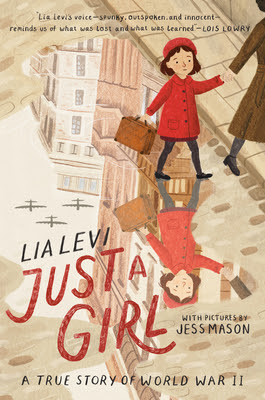
Just a Girl: A True Story of World War II by Lia Levi, pictures by Jess Mason, translated from the Italian by Sylvia Notini

Born in 1931 in Turin, Italy, Lia lived a pretty comfortable life with her parents, younger  sisters Gabriella and Vera, and Maria, their nanny. Lia was a shy girl so when Mussolini declared that Jewish children could no longer attend Italian schools, she is quite happy. That is, until she finds out that she would be attending a Jewish school. It isn't long before Lia's father loses his job because he is Jewish and the family is forced to live on their savings. 

When war is declared by Germany, Italy joins with Hitler and goes to war also. Within three hours of declaring war, French planes are dropping bombs in Turin. When Lia is in third grade, the family savings run out, and her Papa needs to find a job, but no one is allowed to hire Jews. The family decides to move to Milan, but when a promised job for Papa falls through, they are on the move again. This time, they are off to Rome.

Lia and her sisters have a grandmother who isn't Jewish and their first summer living in Rome, they are sent to stay with her during their summer vacation for three months. But the following summer, the war is getting closer to Rome, with the Americans landing in Sicily. And one night, they wake up to learn that Mussolini is no longer Italy's prime minister. Which should have been good news for Italy's Jews, except the Germans moved in and occupied the country. And where the Italians weren't always so good about enforcing Mussolini's laws, the Germans are quick to enforce Hitler's. 

Lia's parents decide to send her and her sisters to  live in a Catholic boarding school for safety's sake. By now, Lia is in her second year of middle school. She is given a false last name, Lenti instead of Levi, and must learn Catholic prayers. Then, in October, Lia's mother shows up at the school. She tells them that the Germans raided the Jewish quarter in Rome and took everyone away, but she doesn't know where her husband is. Luckily, they are all able to spend the rest of the war living at the boarding school.

This memoir, translated from the Italian by Sylvia Notini, is told in simple language though the deprivations, fears and anxieties the family experienced are made very clear. Graphic details are not included, and has caused one of my colleagues to complain that she felt it diminished the Holocaust. I don't agree. It is a unique story, but it is one person's actual experience and until Mussolini was removed from office, things were not as bad for Italian Jews as for Jews in Nazi occupied countries. 

I did like reading Lia Levi's recollections about living through the war. I thought she included a lot of small, but interesting details about what life was like for her family which are parts of history the books don't always tell you about. And Levi used two voices to tell her story - one is the first person account of young Lia and the other is the first person memories of the older Lia giving more information that the younger Lia wouldn't have known, but which helps readers to understand what was happening. My only complaint is that the timing was hard to follow. There aren't many dates mentioned and a timeline would have been very welcome. 

This is a poignant narrative, full of love, laugher, sadness, and loss, but an ideal way to introduce the Holocaust to young readers. And, right now, I think these stories need to be told and read.

Wednesday, May 18, 2022

Alias Anna: A True Story of Outwitting the Nazis by Susan Hood with Greg Dawson

When her 13-year-old granddaughter Aimée wrote her a letter asking about what life was like for her when she was the same age in 1940, Zhanna Arshanskaya Dawson didn't know how to answer her. There was so many long-buried horrors, so much humiliation, so much running to escape capture by the Nazis. But a granddaughter has a right to know and so that part of her family's history unfolds in this gripping free verse biography. 

Ukrainian born Zhanna was a headstrong little girl who used to love wandering the streets of Berdyansk, a resort town on the Sea of Azoz. One day, while wandering, she heard a small band playing music in a funeral procession and fell in love with what she heard. But the Arshanskaya home was already filled with the music of, among others, Rossini, Vizet and Tchaikovsky. Because Zhanna was so headstrong about wandering the streets, her father decided maybe piano lessons would rein her in. Soon the five year old was playing Chopin, Brahms and Beethoven. It didn't take long to realize that Zhanna had a true gift for music. 

But Joseph Stalin, the ruthless dictator of the Soviet Union, had a plan to modernize Ukraine and get rid of the old ways through starvation - in what was the "breadbasket of Europe" people were starving to death as part of Stalin's Five-Year Plan. When Zhanna was eight and her sister Frina was six, the family, having hit hard times, was forced to leave Berdyansk to live in Karkov. Yet, despite now living in poverty, their father had high hopes that both Zhanna and Frina could audition for two spots with scholarships at a renowned music conservatory. Both musically gifted girls were immediately accepted and it was here that Zhanna found her signature piece, Chopin's Fantaisie-Impromptu. This piece of sheet music became her most prized possession, carried all through WWII.

Musically things improved for the family, but financially things got worse and then, in 1941, the Nazis attacked the Soviet Union and the country was officially at war. The Germans wanted all of the Soviet Union, but without its Jews. Shortly after arriving in Kharkov, the Nazis order Jews to gather in the center of town to prepare for evacuation. In snow and numbing cold, the Jews, now prisoners of the Nazis, were marched through the streets to an abandoned tractor factory. After a few weeks of living in abysmal conditions, the prisoners were rounded up and march to Drobitsky Yar. Suspecting what was about to happen, Zhanna's father bribed a young guard to let her escape. When the guard looked away, her father whispered "I don't care what you do. Just live." It was the last time Zhanna saw her parents, but not her sister. 

Finding refuge at a friend's home, Zhanna was reunited with her sister. But Frina refused to talk about how she had gotten away and what happened to their family. Now, the sisters were on their own, and they could be easily recognized by the people in Kharkov who had been to their concerts. What they needed were new names and identity papers. But to get the papers, they would have to be admitted into an orphanage. It was easy to become Anna Morozova and her younger sister Marina, finding places in an orphanage was not so easy. But first, they had to get out of Kharkov. 

Could the sisters survive the war, running and hiding from the cold-blooded Nazis and collaborating Ukrainians, doing what needed to be done to "just live" as their father had said?

Susan Hood has a way of making a person's history come to life in her lyrical, well-researched verse biographies (see Lifeboat 12) Reader's come away knowing not just Zhanna and Frina's struggles and how they were able to survive, but also some needed background history of the Ukraine under Stalin and later, Hitler.  

Interwoven throughout the poems are quotes from Zhanna herself, taken from her oral history recorded by the William Breman Jewish Heritage Museum, as well as from interviews with her son, Greg Dawson. Other quotes used are well-documented in Hood's copious Back Matter. Most of Zhanna's story is written in free verse, I liked that Hood also included various poetic techniques and poetic forms, which always adds a certain level of energy and richness to a work written in verse that mirrors the musicality of the two talented sisters.   

And, of course, there are recent events in Ukraine that make us realize that the past is never past. The attempted invasion of the independent state of Ukraine by Russia has brought not just the geography of this nation to the fore, but also some of its history dating back to World War II when the Nazis invaded. For example, knowing that the Russians had bombed Ukraine's Holocaust memorial at Drobitsky Yar and reading about it in this book made me that much more aware of the dangers of greedy dictators (Stalin, Hitler and Putin) and the 16,000 Jews who were murdered in that ravine, including Zhanna and Frina's family, where the now damaged memorial stands in Kharkiv. 

Alias Anna: A True Story of Outwitting the Nazis is a true testament to the courage, cleverness, persistence, talent and strong will to survive of both Zhanna and Frina. And perhaps a warning from the past for us all to heed.

Saturday, March 19, 2022

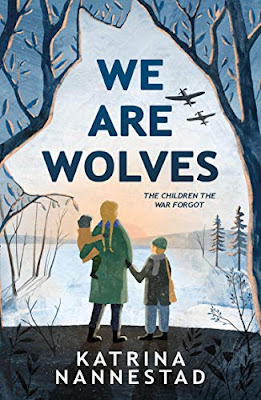
We Are Wolves by Katrina Nannestad

Despite the war, the Wolf family - Opa, Oma, Papa, Mama, Liesl, 11, Otto, 7, and baby Mia - had lived a relatively comfortable life in East Prussia. But now it is October 1944, the Russian army is advancing westward, and in desperation, Hitler has called up teen boys, older men, and those who are disabled to fight to save his Reich. Papa, who was injured in WWI, is drafted and by Christmas Eve, he is missing in action.

Soon after, the family learns that the Russian army has broken through German lines and are advancing in East Prussia. Everyone to told to quickly flee because it was well known that the Russians have been doing terrible things to German men, women, and children, as they advanced. Luckily, Opa manages to find an old car, but that only takes the family so far, and soon they are fleeing on foot in blizzard conditions with so many others. Soon, Opa and Oma decide they need to rest and will catch up with the family later. Opa tells them to head for the Vistula Lagoon and to try to get on a ship to Denmark.  Mama and the children get separated trying to cross the frozen lagoon on a sled, but by the time Liesl, Otto, and Mia make it to the other side, Mama has disappeared from the ice. 

Liesl had already promised Mama that no matter what, she would take care of the brother and sister. While staying in an abandoned house, they are discovered by some Russian soldiers. Luckily, one is a kind man and he takes them to a Russian army camp where they are treated with some kindness, but when Liesl realizes that the Captain has designs on taking Mia away from her and sending the baby to his wife in Russia, she knows it is time to take her siblings and run away. And the only place to run to is the forest. There, they discover they are not alone when they meet other homeless children trying to survive on their own in the woods and stay out of Russian hands. 

Life in the woods isn't easy, continually foraging for food and some measure of shelter. But long the way, they also meet Karl, who helps them learn the ropes, even if it sometimes means learning how to steal what they need to survive. Learning that there is food in Lithuania, Liesl and Karl decide they should try to get there and plan on jumping into a train as it moves out of the station. Karl and Otto make it, but Liesl, holding Mia, doesn't. Thinking she's lost Otto, Liesl is surprised when he comes running back, having jumped off the train. When they finally do make it to Lithuania, Mia is quite sick and Liesl isn't sure she will survive. But, they are taken in by a couple, Magdalena and Dovydas, who help nurse Mia back to health. And while their situation is comfortable and safe, Liesl wonders if they will ever be reunited with their family again. 

Nannestad's book highlights a phenomena that occurred toward the end of WWII when East Prussian children were separated from their parents for one reason or another as the Russian army advanced and took to living in the forests to survive. These homeless children became known as Wolfskinder or wolf children. Some were adopted by Lithuanians, despite harsh punishment by the Russians if they were found helping Germans, even if the Germans were only children.   

I thought We are Wolves did a great job at depicting the harsh conditions and difficulties the Wolf children faced from the moment their family decided to flee until they were finally taken in by kind Lithuanians. I liked the way Nannestad explored themes of family, courage, resilience, and identity (especially important given that the Wolf children had to have their names changed in Lithuania for safety's sake). I also like the way the name Wolf was capitalized on throughout the novel as Liesl kept reminding herself and her siblings that they were Wolfs, and each section was captioned using the word wolves, for example: Proud Wolves, Wild Wolves Vanishing Wolves.

The Wolfskinder may be a little known aspect of WWII, but given what is happening right now in the Ukraine, I believe We are Wolves will definitely resonate with today's readers, who are seeing for themselves what the ravages of war does to families. I highly recommend this book.

This book was purchased for my personal library.

Tuesday, March 8, 2022

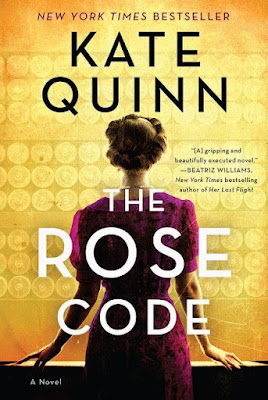
The Rose Code: A Novel by Kate Quinn

The Rose Code is one of those books I've been wanting to read ever since I first heard about it, but it just seemed like I could never find the time. Well, since I found myself with lots of time this past February, it was the first book I reached for. And I'm so glad I did.

The story revolves around three very different women who become friends after they begin working on code breaking at the Bletchley Park in Buckinghamshire, England during World War II. Mab (rather than Mable) Churt was born and raised in a cramped flat with a shared bathroom in Shoreditch in London's East End. Wanting more out of life than what her mother settled for, Mab worked hard to self-educate, reading the classics and she had even come in tops in typing and shorthand. Now, with war, she was ready to do her part for king and country.

Osla Kendall's upbringing couldn't be more different than Mab's. A society debutante, her mother hadn't really wanted her around, and had shipped her off to cousins in Canada. Now, Osla was back in London and dating a navy lieutenant named Philip Mountbatten (formerly Prince Philip of Greece). But once her mother cut off her allowance, Osla realizes she needs a job. Thanks to a German governess, Osla can speak fluent German and Philip suggests she use that skill to help the war effort.

After having mysterious interviews in London, Mab and Osla meet on the train the Bletchley, and instantly become friends, having received almost identical and very mysterious letters telling them where to go once they arrive. 

After another interview and signing the Official Secrets Act, the two women are taken to the Finch home where they will board while working at Bletchley. There, they meet Bethan Finch, the 23-yer-old daughter of their nosy, overbearing and overly critical landlady, Mrs. Finch. Meek and shy, Beth might have been beaten down by her mother, but she also is a whiz at crossword puzzles, able to finish the Sunday crossword in eight minutes. As Mab and Osla get settled into their respective jobs at Bletchley, they become more aware of what is going on in the Finch household, including the way Mrs. Finch abuses Beth. Thanks to Osla, Beth is soon working in Bletchley for expert cytologist Dilly Knox. 

Though Beth has always been shy and withdrawn, she shines at her job breaking codes at Bletchley. She even joins the book club that Mab and Osla start for the workers there. Then, on June 5th, 1944, as Beth is working on a difficult cipher file she had come to think of as Rose because the short messages reminded her of the way a rose's petals wrap it, she discovers that there was a traitor at Bletchley, but no matter what she says, no one believes her. The next day, as the Normandy Invasion was taking place, Beth finds herself committed to Clockwell Sanitarium for a supposed nervous breakdown. 

Now, it's 1947 and Beth is facing a lobotomy and desperately trying to get her former friends, Mab and Osla to come to her rescue. If they could decipher the Rose Code, they could expose the Bletchley traitor. But would they come? And if not, why not?

The Rose Code is a long, detailed, multi-layered novel and I couldn't put it down. The three main characters are so clearly defined and so deliciously flawed, as different from one another as they are united in their desire to do their part for the war effort. I loved the inclusion of real people like Dilly Knox and Prince Philip and even a mention of Alan Turing, but the other minors characters also fit the story so well. In fact, I became invested in everyone's story very quickly (even the horrible, abusing Mrs. Finch). Bletchley itself is so well depicted it felt like another character instead of just the place that brought everyone together for the sake of the story.

Beth, Mab, and Osla's stories unfold in alternating chapters, as well as in chapters where they all play a part. And the narrative covers two timelines - the war years, while the women were working at Bletchley, and 1947. Actually, 1947 covers only the weeks leading up to the royal wedding of Princess Elizabeth and Prince Philip (yup, Osla's old love interest). 

The Rose Code is a sophisticated, well plotted, well researched and well written novel My only objection is that I didn't really get why the traitor did what they did. I didn't like the character, but I also didn't suspect them yet I wasn't surprised when I found out who they were. 

The Rose Code was one of ten winning titles for ALA's 2021 Alex Award - adult books that also have appeal for young adult readers ages 12-18.

This book was purchased for my personal library.

Tuesday, February 15, 2022

The Light in Hidden Places by Sharon Cameron

I usually think of Sharon Cameron as a writer of science fiction not historical fiction, but she has really outdone herself with The Light in Hidden Places. It is a fictional account of the life of Stefania "Fusia" Podgorska and her yonger sister Helena who were ultimately named as Righteous Among Nations by Yad Vashem for hiding and saving the lives of 13 Jews during the Holocaust. 

At age 12, Fusia decides to leave her family's farm to live with the Diamants, a Jewish family that runs a grocery store in Przemsyl, Poland. Welcomed into the family, Fusia lives there for 3 happy years, during which a secret attraction developes between Catholic Fusia and Jewish Izio Diamant. But in September 1939, Poland is attacked and invaded by the Nazis and life changes for everyone. 

In April 1942, the Diamants are forced to move into the Przemsyl ghetto. Fusia is tasked with helping them survive by bringing what she could sneak in by squeezing through the fence. But then she learns that the Nazis have killed Izio, Grieving, Fusia decides to go back to the family farm. There she finds everyone gone, except her 6-year-old sister Helena, whom she brings back to Przemsyl with her. 

One night, in November 1942, Max Diamant shows up at Fusia's door and asks to stay the night. His parents and some of his siblings had already been rounded up in a Aktion, and sent to their deaths and he and his brother have escaped the ghetto. When they decide to stay with Fusia and Helena, Fusia realizes she needs a larger place for hiding them. She finds a small cottage and before she knows it, Fusia is hiding 13 Jews in it. Then, the Nazis build a hospital across the street and move three nurses into the cottage, as well. Fusia begins to panic, but the nurse only stay seven months. 

Fusia's story held me spellbound from start to finish. I kept thinking what a brave young woman she was to take the kinds of risks she continually chose to take for the family that had shown her so much more love and kindness than her own family had, spending her pay to by food for everyone, and risking death if caught. The novel reads like a taut drama, filled with tense moments and events throughout. Then I remember much of what I'm reading really happened.

Cameron's research for this story is impeccable. Through interviews, research trips to Poland and Stefania's own unpublished memoir, Cameron has woven together a coherent, reality-based Holocaust narrative. She includes extensive back matter, including photos and information about what happened to the Jews Fusia hid after the war ended and they were liberated.  

This book was gratefully received from Edelweiss+  

Friday, January 7, 2022

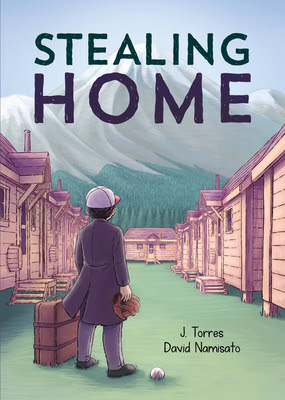
Stealing Home by J. Torres, illustrated by David Nmisato


Stealing Home by J. Torres,
illustrated by David Namisato
Kids Can Press, 2021, 112 pages

It's summer 1941 and the Asahi Baseball team is the pride of Powell Street in Vancouver, BC, "the champions of the Japanese community." For young Sandy Saito and his dad, Dr. Saito, that means going to games together and cheering their heroes on and later, playing catch in the backyard together. 

But all that changes on December 7, 1941 when the Japanese bomb Pearl Harbor. Suddenly, Sandy's dad was short tempered and didn't want to play catch anymore. The kids in school, who had been Sandy's friends, turn on him, calling him names and refusing to let any Japanese kids play baseball with them, even throwing rocks at them. 

Soon, Japanese persons are forced out of some areas of British Columbia and moved to "camps" in old, abandoned mining settlements, including the Saitos, but not before Dr. Saito goes out on a house call and doesn't come home. All his family knows is that the government sent him to "where he was needed most,"
leaving Mrs. Saito, Sandy and his younger brother Ty to cope with being relocated to an internment camp in the middle of the Canadian wilderness, with no electricity or running water. 

Adjusting to their new life isn't easy, but eventually Sandy and Ty make friends and have some fun. But it is all work for their mother and the other women, who need to find ways to keep their children warm in the coming winter, plus they now have to share their small shelter with another family, including a baby. However, it turns out that some of the players for the Asahi Baseball team are also at the camp. Is it possible that baseball can provide some sense of normalcy and happiness for Sandy and the other people in the camp?

J. Torres provides readers with a very clear picture of what life was like for Canadians of Japanese descent after the United States entered the war, in this graphic novel told in the first person from Sandy Saito's perspective. Interestingly, the Canada had entered the war immediately after Britain declared war on Germany on September 3, 1939 and yet had left Japanese persons living on its west coast along until Pearl Harbor. 

Torres has really captured the fear and confusion that Sandy felt about why things changed so abruptly because of events he doesn't completely understand, and his hurt feelings as his beloved father becomes more stressed and short-tempered. 

I find it interesting that baseball played such an important role in the lives of both Japanese Americans and Japanese Canadians during the war. Perhaps because it is a game of skill and both players and spectators can really get lost in, enabling them to escape their new reality of losing everything they had worked for and being put into slapped together internment camps in the middle of nowhere.

Stealing Home is a wonderful vehicle for introducing younger middle grade readers to this part of the history of WWII. I read a black and white ARC and so I can't comment on the final art, but the illustrations are detailed and not frighteningly graphic. 

You can learn more about the Asahi Baseball Team HERE

 This book was an eARC gratefully received from Edelweiss+

Sunday, January 2, 2022

The Blitz Bus by Glen Blackwell

The Blitz Bus by Glen Blackwell
Zoetrope Books, 2021, 218 pages
NetGalley E-ARC 

When his teacher assigns her class to write a fictional diary entry of a WWII evacuee, Jack, 12, just can't think of anything to write. Somehow, the war seems so long ago and he just can't relate. And now, he's going to be late meeting his best friend, Emmie Langford after school. Being a good friend, Emmie has been waiting at their bus stop when Jack finally shows up.

Everything seems normal until they reached their stop and notice a new blue storefront with a mannequin wearing a long coat and a gas mask in the window. Suddenly, there is a flash of light and it begins to rain heavily, so they head to the nearby Tube station for shelter, along with everyone else.

Everything at the Tube station feels like it's out of time, causing Emmie to think they are in the midst of a film set in 1940. But gradually she and Jack realize they have landed in the midst of a WWII air raid, instead, and that somehow they have traveled back in time. With no money, no food, and no friends, Jack and Emmie begin to try to figure out how they can return to their own time. Along the way, they become friends with Jan, a Polish boy who arrived in England a few years earlier on the Kindertransport. The three discover an old Anderson shelter behind a bombed and abandoned house as Jan helps them navigate this unfamiliar London. When they discover what appears someone trying to build a makeshift radio, they are convinced the mysterious boy/man they have noticed is a German spy. 

The German spy turns out to be Stan, who also arrived in London on the Kindertransport, but unlike Jan, whose foster family is quite kind, Stan's treats him terribly. As they become friends with Jan and Stan, can Jack and Emmie trust them with their secret and perhaps get some ideas of how they can return to the own time? Or will they be stranded in 1940 forever?

The Blitz Bus is an interesting time travel novel that points out how as things recede into history, they don't carry the same level of interest or impact that they once had. Jack may live in East London, which had been heavily bombed and damaged during the war, but he's interested in video games and football, not history. I thought that Blackwell portrayed what London in the Blitz was like quite well, layering it with the different experiences of the two Kindertransport kids, their loneliness and homesickness, emotions Jack comes to appreciate firsthand. 

The novel also points out how people were so suspicious of foreigners during the war that they often suspected them of being spies, just as Jack, Emmie, and Jan thought that about Stan. 

Interestingly, the Tube station that Emmie and Jack shelter in was the Bethnal Green Station which was destroyed in 1943, killing 173 people. Blackwell includes more about it in his back matter, that also includes information on the Kindertransport, and instructions for making the kind of radio out things found, similar to the radio Stan builds to listen to new about Poland. 

I have to admit that I was hoping that once they returned to their own time, Jack and Emmie would try to find out what happened to Jan and Stan, whether they were living, and if they were, did they remember their two time traveling friends? 

Readers looking for a time travel adventure, as well as those who enjoy historical fiction set in WWII will no doubt enjoy reading about Jack and Emmie's exploits in this imaginative novel.

This book was an eARC gratefully received from NetGalley

Thursday, November 25, 2021

Faceless by Kathryn Lasky

Imagine having the kind of face that is unrecognizable to people, a face that they just don't remember or recall even if they had been talking to you only minutes before. Now imagine how useful that forgettable face would be when it came to the art of spying. Well, that is the premise of Faceless. 

Alice Winfield, 12, her mother Posie, father Alan, and older sister Louise, 18, are part of a unique group of people with forgettable faces, "nonfaces that were like tabulae rasas or blank slates." (pg 6) And British Rasas had been serving their country as spies since the days of Henry VIII. Now, however, Louise has decided to leaving spying and have plastic surgery that would give her a recognizable face - something that Alice just can't understand.

But it's 1944, and before she has too much time to think too much about it, Alice is parachuting into Germany with her mother on her first real spying mission and joining her father in Berlin. Her mission is to spy on Adolf Hitler. Posing as a schoolgirl named Ute, Alice wins the Reichs Praktikum for a chance to be an intern in Hitler's household, going where he goes and assessing his mental health. Her mentor for this spy mission is Count Claus Schenk von Stauffenberg, Reichs hero and secretly part of Operation Valkyrie, the plot to kill Hitler, and now Alice is right in the thick of that conspiracy. 

In the midst of this intrigue Alice/Ute meets David, a starving Jewish boy who has been hiding out in the house his family used to lived in before they were deported. The house is now occupied by Colonel Ernst Schmelling, a high ranking Nazi. David has been eating scraps of food out of the Schmelling garbage cans to survive. Alice begins sneaking food to David and they gradually become friends. Oddly enough, David never forgets her, recognizing her face each time they meet. 

On top of all that, one day Alice is sure she has seen Louise among the crowds of people in Berlin. But what would she be doing there? Is she a double agent, or has she gone over to the other side? Whatever it is, Alice is determined to find Louise and confront her. 

With the war turning in the Allies favor, especially after the failure of Operation Valkyrie (not a spoiler, we all know what happened), and the success of the July 6, 1944 Normandy landings (D-Day), things are becoming quite dangerous as the tension mounts. 

It took me a while to get into this book, but once I did, I was hooked. The whole business about Rasa confused me at first, but once I realized it was a fiction, I just went with it. It was interesting to see the last days of the Third Reich through Alice's eyes, and Lasky included lots of good information about what it was like to be in Hitler's inner circle.

But there were some things that bothered me. It was a little to repetitive at times, especially in the beginning of the book. And I kept wondering how the local baker was about to bake such wonderful bread and cookies in 1944, when most people were starving (except Nazis, of course). There was also a big error on page 102, which I think was just a typo - it said that was the commandant of Auschwitz was Rudolf Hess, but it was actually Rudolf Höss. Rudolf Hess was a prisoner in the Tower of London in 1944. You can see how easy it is to confuse the two names, though. One last thing bothered me - on page 114 it says there isn't a cozy name for mother in German, but that's exactly was Mutti is. These things will definitely not spoil your reading of Faceless, but as a person with a PhD in Germanic Languages and Literature who's also a little OCD, I just couldn't let them go. However, despite these things, I really did enjoy reading this novel.

Faceless is a story that will appeal to readers who enjoy WWII fiction, historical fiction, and spy novels and I do recommend it.   

This book is recommended for readers age 9+
This book was a digital book gratefully received from NetGalley

Sunday, November 21, 2021

Rosie the Riveter: The Legacy of an American Icon written and illustrated by Sarah Dvojack


Rosie the Riveter: The Legacy of an American Icon
written and illustrated by Sarah Dvojack
Imprint, 2021, 40 pages

When America went to war in 1941, men enlisted in droves to defend their country. But that left the workforce at home depleted and America needed people to step up production of war materials of all kinds. Women were perfectly willing to fill that need and in 1942, American women pulled on some overalls, wrapped their hair in a scarf, slung on a tool belt, and the figure of Rosie the Riveter was born. 

Now, Sarah Dvojack has captured that image in her biography of Rosie and all the Rosies who can before and after WWII. Because there have always been Rosies, they were just the unsung heroes in history. But WWII changed all that. 

Not allowed to fight. pretty soon, Rosies were working not only in offices, but were riveting airplanes and war ships, traditionally jobs help by men, but now in the very capable hands of women.   

It didn't take long for the image of Rosie the Riveter to become an icon in WWII popular culture. There were songs, posters, magazine covers, even a movie about Rosie. She was the hero that kept the home front going all through the war. But then the men returned and wanted their jobs back. Dvojack writes that Rosie had become such a powerful symbol that women could use in their fight to remain part of the workforce and then Rosie became a movement, with rallying cry "We can do it!" 

If you look closely, you'll notice all the women and girls are wearing something red with white polkadots.
I really liked the way Dvojack brought Rosie into the present showing young readers that as a symbol for women she is relevant in all fields and not just as a riveter - that there's some Rosie in every job a woman does and all of her achievements.

Rosie the Riveter is a wonderful picture book for older reader introducing them to the home front in WWII, and exploring the why and way she is still so relevant in today's world. I particularly liked the pencil and subtle hued digitally colored illustrations. They are so clean and clear and so inviting. 

Back matter include more information about Women, Work, and War, as well as popular culture renditions of Rosie. Check out the end papers and pages 16-17 to find other Women Heroes depicted in this book, all of whom are identified on the copyright page.

This book is recommended for readers age 8+
This book was borrowed from the Queens Public Library

Sunday, October 31, 2021

Ruta Sepetys Between Shades of Gray: The Graphic Novel adapted by Andrew Donkin, art by Dave Kopka, colors by Brann Livesay

Ruta Sepetys Between Shades of Gray: The Graphic Novel
adapted by Andrew Donkin, art by Dave Kopka, colors by Brann Livesay
Philomel/Penguin Teen, 2021, 160 pages

I can't believe it has been 10 years since I first read Between Shades of Gray. It was one of those books that introduced me to a new aspect of WWII and it had such a profound influence on me when I read it, one that has stayed with me ever since. Although the novel is still certainly well worth reading, so is the new graphic novel about what happened to 15-year-old Lina Vilkas and her family. 

Lina is arrested by the Soviet secret police or NKVD along with her mother and younger brother, Jonas, taken from their home in Kaunas, Lithuania on the night of June 14, 1941. Loaded into a truck along with other families that had been rounded up, the Vilkas soon find themselves at a remote train station, where other truckloads of arrested Lithuanians are arriving. 

Everyone is put into crowded cattle cars that just sit there for days. During that time, Lina meets Andrius and the two sneak out together at night. Lina is hoping to find her father since they don't know what has happened to him. Just before the trains leave the station, she finds her father in another train.

The family is happy to know he is still alive even if they don't know what will happen to him. When their train finally leaves the station, they spend the next 42 days traveling to a remote area of Siberia, where they are forced to sign a paper that convicts them of crimes against the Soviet Union (their crime - simply being Lithuanian) and sentences them to 25 years of labor. 

Life in Siberia is hard, the winters are brutal and the degradations constantly inflicted by the Soviets make things even more difficult. Over time, Lina and Andrius find that they are attracted to each other, but often harsh conditions come between them. Eventually, they are separated when Lina and her family are sent to another prison camp in Siberia, where she finds life with Andrius even harsher. 


Lina manages to document everything that happens to her, her family, and everyone else using her artistic talent and drawing it all on whatever paper she could find and using whatever material she could draw with. She also manages to send letters to her father in another prison camp in the hope that they will reach him. But can her dream of her family being reunited after the war keep Lina's hopes and spirits up long enough to survive?

I'm always skeptical of novels that have been turned into graphic formats. It feels like a novel has so much depth that could easily get lost. But I am glad to say that Between Shades of Gray: The Graphic Novel has made the transition successfully and it is all thanks to the wonderful images that really capture so much of what happened to Lina and her family. The text is spare yet spot on, and the images are so detailed and should be throughly explored for what they have to say, too. Take, for example, this image of the chaos at the train station as truckloads of arrested Lithuanians are forced into the waiting cattle cars: 
The confusion, fear, harsh treatment and Soviet threat is all there on people's faces and in their body language.

Between Shades of Gray: The Graphic Novel is an excellent addition to the history WWII. The Soviet treatment of citizens of countries they occupied during WWII isn't as well known as the history of the cruel treatment of Jews and political enemies by the Nazis and a graphic novel just may be what some readers are most comfortable with, although I highly recommend the original novel, too. 

This book is recommended for readers age 13+
This book was an eARC gratefully received from NetGalley

Tuesday, September 28, 2021

The Girl Who Could Fix Anything: Beatrice Shilling, World War II Engineer by Mara Rockliff, illustrated by Daniel Duncan

The Girl Who Could Fix Anything by Mara Rockliff,
illustrated by Daniel Duncan
Candlewick Press, 2021, 48 pages
I love picture book biographies that introduce kids to people and their achievements that they might otherwise never hear anything about. Case in point is this new biography about Beatrice Shilling (1909-1990) and her important WWII engineering accomplishments. 

Beatrice always seemed to be the person who was different. As a girl, she preferred tools to sweets, enjoyed taking mechanical things apart and putting them back together, often improving them. Instead of a bike, Beatrice began saving for a motorcycle at age 10. 

When she was older, Beatrice was eventually hired as an apprentice by one of the few woman engineers, Miss Partridge, whose job it was to bring electricity to people. And it was Miss Partridge who encouraged Beatrice to go to university to study engineering. Not surprisingly, she was the only female in the class. And also not surprisingly, despite graduating with honors in electrical engineering, only the men in her class could find jobs. 

Beatrice had to settle for a job writing handbooks about plane engines (I used to write handbooks for computer users, so I know just how bored Beatrice must have been). But eventually, she was given a hands on job, and met George, a man much like Beatrice, who became her husband. Beatrice loved her new job, but her expertise was really put to the test when WWII began and the RAF were losing pilots and planes when their engines suddenly quit in the middle of a dive during a dogfight.

Could Beatrice figure out how to solve the problem in a timely, cost effective way that wouldn't require taking apart the planes engine? Of course she could - and did. 

The Girl Who Could Fix Anything is a wonderful picture book for older readers. Rockliff shows readers that here was intelligent, persistent woman who followed her passion, loved to find out how things worked, and found ways to fix or improve engineering problems, but who also made mistakes, something I think is important for young readers to know about. The writing is light but informative, and the technical details, for example, the fix Beatrice came up with for the RAF, are presented in an easy to understand manner. The subtly colored digitally created illustrations completely harmonize with the text. Back matter includes an Author's Note that provides more about the life of Beatrice Shilling, as well as Selected Sources.   

The Girl Who Could Fix Anything is a book that should be in every STEM home, classroom, and school library. Beatrice Shilling is an inspiration to young girls everywhere who might just be a little different from their peers, having an interest in engineering and how things work. 

This book is recommended for readers 7+
This book was eARC gratefully received from Edelweiss+