Showing posts with label Memoir. Show all posts

Tuesday, May 24, 2022

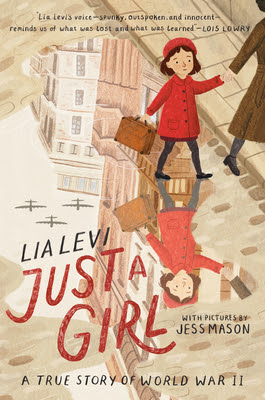
Just a Girl: A True Story of World War II by Lia Levi, pictures by Jess Mason, translated from the Italian by Sylvia Notini

Born in 1931 in Turin, Italy, Lia lived a pretty comfortable life with her parents, younger  sisters Gabriella and Vera, and Maria, their nanny. Lia was a shy girl so when Mussolini declared that Jewish children could no longer attend Italian schools, she is quite happy. That is, until she finds out that she would be attending a Jewish school. It isn't long before Lia's father loses his job because he is Jewish and the family is forced to live on their savings. 

When war is declared by Germany, Italy joins with Hitler and goes to war also. Within three hours of declaring war, French planes are dropping bombs in Turin. When Lia is in third grade, the family savings run out, and her Papa needs to find a job, but no one is allowed to hire Jews. The family decides to move to Milan, but when a promised job for Papa falls through, they are on the move again. This time, they are off to Rome.

Lia and her sisters have a grandmother who isn't Jewish and their first summer living in Rome, they are sent to stay with her during their summer vacation for three months. But the following summer, the war is getting closer to Rome, with the Americans landing in Sicily. And one night, they wake up to learn that Mussolini is no longer Italy's prime minister. Which should have been good news for Italy's Jews, except the Germans moved in and occupied the country. And where the Italians weren't always so good about enforcing Mussolini's laws, the Germans are quick to enforce Hitler's. 

Lia's parents decide to send her and her sisters to  live in a Catholic boarding school for safety's sake. By now, Lia is in her second year of middle school. She is given a false last name, Lenti instead of Levi, and must learn Catholic prayers. Then, in October, Lia's mother shows up at the school. She tells them that the Germans raided the Jewish quarter in Rome and took everyone away, but she doesn't know where her husband is. Luckily, they are all able to spend the rest of the war living at the boarding school.

This memoir, translated from the Italian by Sylvia Notini, is told in simple language though the deprivations, fears and anxieties the family experienced are made very clear. Graphic details are not included, and has caused one of my colleagues to complain that she felt it diminished the Holocaust. I don't agree. It is a unique story, but it is one person's actual experience and until Mussolini was removed from office, things were not as bad for Italian Jews as for Jews in Nazi occupied countries. 

I did like reading Lia Levi's recollections about living through the war. I thought she included a lot of small, but interesting details about what life was like for her family which are parts of history the books don't always tell you about. And Levi used two voices to tell her story - one is the first person account of young Lia and the other is the first person memories of the older Lia giving more information that the younger Lia wouldn't have known, but which helps readers to understand what was happening. My only complaint is that the timing was hard to follow. There aren't many dates mentioned and a timeline would have been very welcome. 

This is a poignant narrative, full of love, laugher, sadness, and loss, but an ideal way to introduce the Holocaust to young readers. And, right now, I think these stories need to be told and read.

Sunday, November 7, 2021

I Saw a Beautiful Woodpecker: The Diary of a Young Boy at the Outbreak of World War II by Michal Skibinski, illustrated by Ala Bankroft

I Saw a Beautiful Woodpecker: 
The Diary of a Young Boy at the Outbreak of World War II
by Michal Skibinsky, illustrated by Ala Bankroft,
translated from the Polish by Eliza Marciniak
Prestel Publishing, 2021, 128 pages

Here is an uncomplicated book that captures the summer before WWII began in the notebook of a young boy. Eight-year-old Michal was give a school assignment for the summer holidays to write one sentence in a notebook about something that happened to him each day. The purpose of the assignment was to provide a means for practicing his penmanship and being moved up to the next grade was contingent on faithfully keeping this notebook. Michal's entries begin on July 15, 1939 and end on September 12, 1939. There are not entries for every single day but there are entries for most of them. 

According to the note at the end of this book, Michal lived in Warsaw, Poland. At first, his entries sound like a wonderfully idyllic summer vacation and are about things he observed in nature, like the beautiful woodpecker he saw, and the people he spent time with - his parents, brother Rafal, their nanny, and their  grandparents. 

But gradually, Michal's entries begin to get darker, until September 1, 1939 when he notes that war has begun. On September 6, 1939, he writes that a bomb was dropped near where he was staying. Because he was limited to one sentence per day, readers can only speculate on how he must have felt that day.

What interesting to note about this book, however, is how innocent most of Michal's entries are, even as the adults in his family were fully aware of trouble coming and taking precautions to get him and his brother out of harm's way according to the note at the end of the book. On July 26, 1939, Michal writes that a plane flew over where he was staying (this is the cover image). On the surface, this seems innocent enough, but one wonders if it was a reconnaissance plane from Nazi Germany, given the coming invasion of Poland.

Each entry is a two-page spread containing the date and the entry, but set against the background of Ala Bankroft's incredible painted almost impressionist illustrations reflecting Michal's observations. The colors are bold greens, browns, and blues reflecting nature and as war arrives, become darker, almost black, losing most of their color.  

I Saw a Beautiful Woodpecker is an unique document of its time as experienced by a child who probably didn't know what war is or that it was on his doorstep, even as he began his entries. Yet, the truth of his experience is in the simple declarative sentences with which he seems to have unwittingly witnessed the coming war through his young, innocent eyes.  

This book would be a great classroom/home school addition for anyone teaching the history of WWII.    

This book is recommended for readers age 7+
This book was gratefully received from Casey Blackwell at Media Masters Publicity 

Monday, October 26, 2020

How I Learned Geography written and illustrated by Uri Shulevitz

How I Learned Geography 
written and illustrated by Uri Shulevitz
Farrar, Straus and Giroux, 2008, 32 pages

In his powerful memoir Chance, Escape from the Holocaust, recalls the time when his family was living in Turkestan and his family went to the market to buy bread, but came home with an enormous, colorful map instead. I found the story particularly interesting because I had read Uri Shulevitz's picture book How I Learned Geography when it first came out in 2008. 

In September, 1939, Uri and his family are forced to flee their home in Warsaw, Poland when the Nazis invade their country, leaving almost everything they owned behind. They flee far east, eventually coming to a city "...of houses made of clay, straw, and camel dung, surrounded by dusty steppes..." that was very hot in summer and very cold in winter.  

One day, Uri's father goes to the market to buy some bread. Late in the evening, he comes home but without any food for the family to eat. Instead he has bought a large, colorful map of the world. Angry, Uri and his mother both go to bed hungry, listening to the couple who lived with them in their small room smacking their lips while they eat what little bread they have. 

The next day, Uri's father hand the map, which covers the entire wall, and their "...cheerless room was flooded with color." Fascinated with it, Uri spends his days studying every detail of the map, even drawing it on whatever scrape of paper he could find. 
Thanks to that map and what looked like a foolish purchase, Uri finds escape from the difficult conditions he and his parents finds themselves in. Uri uses his imagination to travel far and wide, from deserts and snowy mountain tops, to the tropics and to big cities, spending ..."enchanted hours far, far from [their] hunger and misery." 

How I learned Geography is a poignantly written story, told in Shulevitz's straightforward, but spare language. He doesn't go into describing things in depth, allowing his own watercolor and ink illustrations to fill in the details for his. And they do - wonderfully well. Pay particular attention to the variety of facial  expressions and body language Shulevitz has captured. For instance, take a look at how Uri's father's changes in the three illustrations above.   

How I Learned Geography has a kind of Jack and the Beanstalk feeling to it, where an act of folly turns out to be just the thing that is needed. Uri's family ended up impoverished and hungry because of the Nazis invading their homeland, Jack's because of the giant stealing their possessions. The difference, of course, is that Uri's story is based on his life.

This book is recommended for readers age 6+
This book was borrowed from the NYPL

Monday, October 12, 2020

Chance: Escape from the Holocaust written and illustrated by Uri Shulevitz

If the name Uri Shulevitz sounds familiar to you, it is probably because he has won four Caldecott Medals in his career as a children's book writer and illustrator. What most people don't know is that Uri and his parents managed to escape the Holocaust by, as Uri writes, "blind chance deciding [their] fate." (pg 65)

Living in Warsaw, Poland with his parents, Uri is only 4-years-old and a budding artist specializing in stick figures when the Nazis begin bombing his country before they invade it. No longer feeling safe, first his father leaves and makes his way to Bialystok, then part of the Soviet Union. Finding a place to live and a job, he tries to return to his family, but is caught and returned to Bialystok. Instead of going back to them, he writes for Uri and his mother to join him. Traveling by smuggler's truck and on foot, mother and son make it to the Soviet Union, leaving all their family behind in Poland.

But when the Soviets order refugees to register for Russian citizenship, the Shulevitz family is denied because of Uri's name. The official is sure he was named after a well-known Zionist. When his father loses his job for not being a citizen, the family finds themselves without an income. Luckily, Uri's father finds another job, but soon, they are again forced to move, and find themselves in a labor camp in the Archangel region of Russia, when Uri is 5-years-old.

It is there that the Jewish people are told that they are no longer considered enemies of the Soviet Union now that the Germans are attempting to invade Russia, and that they are free to travel anywhere they wished. When Uri is 7-year-old, the family travels to Soviet Turkestan. They spend three year's there, often without any food in freezing cold winters and unbearably hoy summers, until the war finally ends. 

But just because the war is over, doesn't mean things return to what they once were. Instead, when the family goes back to Poland, they are greeted with rampant anti-Semitism and the sad news that  no other family has survived the Holocaust. Once again, they are on the move, ending up in a Displaced Persons camp in Bavaria. There, in 1946, Uri's father discovers that a brother is also still alive. and living in Paris. The Shulevitz's leave the DP camp for Paris. 

Although Uri Shulevitz's first person narrative gives a linear account of how he and his parents were lucky enough to not fall into the hands of the Germans, he does so through a series of linked vignettes and his own drawings.  And he chronicles what happened to them during that time, in such a way that it feels almost intimate, like his talking directly to you, and only you. And given how much the Shulevitz family experienced, it's hard to believe this chronicle only covers 8 years of Uri's life, from 4 to 12. 

Most of what he is relating is wrapped in anti-Semitism, hate, starvation, illness, separation and loss, but there are, of course, also moments of laughter, of kindness, of sharing and helping, reminding the reader that no matter how terrible war is, there are still some good people. What clearly stands out is just how much love this family had for each other. If they hadn't, they just might not have survived. Uri says one of the things that really sustained him was his mother's stories. And all through their ordeal, both his mother and father encouraged Uri to continue drawing.

Chance: Escape from the Holocaust is an interesting account in that it is almost devoid of Nazis. It is not the kind of Holocaust story we are accustomed to reading. But it does gives young readers yet another look at what being a Jewish family in Nazi occupied Europe and their enemy the Soviet Union was like. We keep learning more and more about the Holocaust, thanks to survivors like Uri sharing their stories. 

This book is recommended for readers age 9+
This book was an eARC gratefully received from the publisher.

Friday, April 10, 2020

On the Horizon by Lois Lowry, illustrated by Kenard Pak

On the Horizon by Lois Lowry,
illustrated by Kenard Pak
Houghton Mifflin Harcourt, 2020, 80 pages

Imagine looking at old family home movies and discovering something in the background that suddenly jolts memory and reflection. Well, that is exactly what happened to Lois Lowry when she had some of her family's old home movies restored and realized as a young child playing on Waikiki beach with her grandmother in 1940, her father's camera had also captured the USS Arizona in the distance heading to its berth in Pearl Harbor:
She Was There
We never saw the ship.
But she was there.

She was moving slowly
on the horizon, shrouded in the mist
that separated skies from seas
while we laughed, unknowing, in the breeze.

She carried more than 
twelve hundred men
on deck, or working down below.
We didn't look up. We didn't know.

It is only as an adult, Lowry says in her Author's Note, while showing the restored films to friends, that the USS Arizona is finally seen. As you probably already know, it sank when Pearl Harbor was attacked on December 7, 1941, and most of the sailors onboard were killed - among them, twin brothers, members of the ship's band, two brothers, one a survivor, one not but reunited years later in death.

From 1941, Lowry jumps to August 6, 1945 and the bombing of Hiroshima, and again highlighting individuals who were there - among them, a young boy named Koichi Seii, who would later become known as Allen Say, a child pulled from the rubble and reunited with his father, teenage girls running the trams, and a little boy on a red tricycle.
Hiroshima
The cloud appeared over the distant hill,
blossoming like strange new flowers in spring, 
opening, growing. But the world was still.
When the cloud appeared over the distant hill,
silence has fallen. There were no sounds until 
rain came. Not true rain, but black drops falling
from the cloud that appeared over a distant hill,
blossoming like strange new flowers in spring.

On the Horizon is written in three parts- the bombing of Pearl Harbor, the bombing of Hiroshima, and the Lowry family's life in post-war Japan - and uses a variety of poetic forms. One of the things that she has accomplished is to show the randomness of war - especially who lives and who dies (a randomness we are witnessing again as the Coronavirus chooses its victims).  It is perhaps one of the most affecting books I have read about WWII, and I found often myself tearing up as I read. I believe it is because of the way Lowry has brought the distant near. In this slender book of poems, she shows us that sometimes history can feel like one is looking at something far away on a misty horizon, but by giving face and voice to those who were there she brings it to the forefront, and history becomes closer, people become individual human beings. This is a book of poems I believe I will be returning to again and again.

Kenard Pak's black and while pencil and digital illustrations are a perfect compliment to each one of the poems.

You can find a useful Teacher's Guide HERE

This book is recommended for readers age 10+
This book was a EARC gratefully received from NetGalley

This is one of my favorite poems from On the Horizon:

Solace
The hospital ships had names that spoke of need:
Comfort
Hope
Solace
Mercy
Refuge

The carried the wounded and ill.

That morning, Solace was moored near the Arizona.
She sent her launches and stretchers across.
The harbor has a film of burning oil.
Scorched men were pulled one by one from the flames
and taken to Solace.

Saturday, January 4, 2020

My Survival: A Girl on Schindler's List, A Memoir by Rena Finder with Joshua M. Greene

Like most Americans, I first learned about Oskar Schindler and the 1,200 Jewish lives he was able to save watching Steven Spielberg's movie Schindler's List. And yes, I am sorry to say I have not yet read Thomas Keneally's 1982 book Schindler's Ark (published as Schindler's List in the US). However, you may recall a book published in 2013 called The Boy On the Wooden Box by Leon Leyson, who was a young Jewish boy working for Schindler. Now, we have this book by Rena Finder, who was a still a young girl when she was working for Oskar Schindler.

Rena, who maiden name was Ferber, had lived a pretty happy and comfortable life in Krakow, Poland with her parents Moses and Rosa Ferber. But all that changes in 1939 when the Nazis march into and occupy Poland and World War II begins. First, friends and neighbors begin to turn their backs on their former Jewish friends, and Krakow's Jews are faced with more overt acts of anti-Semitism, even as more and more restrictive laws are imposed by the Nazis. Jews are not longer allowed to go to school, the park, the movies, they are subject to a curfew, and forced to wear a blue and white armband with a Star of David on it signifying that they are Jewish. And soon enough, arrests and deportations of Jews to concentration camps begin.

In 1940, Rena and her parents are issued permits allowing them to remain in Krakow while her father works, but they are forced to leave their lovely apartment and move into the Krakow ghetto - 320 apartments for 3,000 people. Then, on December 31, 1942, Rena's father is arrested despite having a work permit. Sadly, Rena will never see her father again.

Not long after her father's arrest, liquidation of the Krakow ghetto begins and the ghetto's Jews are forced to march to Plaszów Concentration Camp, a march that includes Rena and her mother Rosa. There, they both end up working in Oskar Schindler's factory, a factory that had originally been located near the Krakow ghetto, where he could use cheap Jewish labor. But now that his labor was in Plaszów, they would have to walk 2 1/2 miles each way to get to and from work. Schindler convinces Plaszów's Commandant, Andrew Goeth, to allow him to build a subcamp for the factory's Jewish workers. Amazingly, Goeth agrees to allow this.

Rena's story is told in a very matter of fact way in the first person, but also in a very intimate voice that makes you feel that she is speaking directly to you, the reader. I've given you most of the historical background, but her story is naturally much more personal, recounting what life was life for Europe's Jews under the Nazis, including the fate of some of her family and friends. She also talks in harrowing detail what it was like when she and the other people working for Schindler were sent to Auschwitz-Birkenau in 1944. Luckily, Schindler was able to reclaim them thanks to his list of workers and take them to his new factory in Czechoslovakia. And unlike many real life Holocaust stories, Rena also talks about what her life was like after the war, meeting her husband and moving to America.

My Survival: A Girl on Schindler's List is a very accessible, age appropriate book, perfect for introducing young readers, and especially reluctant readers, to the Holocaust. Rena breaks down the different events on her personal life and how she was impacted by the things done to Jews under the Nazis. The pages of photographs of the Ferber/Finder families at the back of the book makes her story that much more real. Rena's "Closing Thoughts" bring the past into the present with her plea for today's youth to stand up for those people who are being targeted now, reminding us that genocide begins when people begin turn their backs on what is happening to others.

This book is recommended for readers age 10+
This book was purchased for my personal library.


Saturday, March 7, 2015

Unlikely Warrior: A Jewish Soldier in Hitler's Army by Georg Rauch, translated by Phyllis Rauch

There aren't many first hand accounts of men who fought as soldiers in the German army during World War II, particularly not for young adult readers, which makes Unlikely Warrior so much more compelling and interesting to read.  Georg Rauch really takes the reader inside this relatively unknown world and give us an opportunity to see what life was like on German side of things.  Georg divides his story into three distinct parts.

The first part deals with Rauch's training for the army and his family history.  In February 1943, 18 years old Vienna-born Georg doesn't really want to be a soldier in Hitler's army , but when his draft notice arrives, he has no choice.  Reporting for training, his radio building and Morse Code hobby skills means he can train as a radio operator and telegraphist.

Now, for most Germans being in the army wasn't anything special - every able bodied male was conscripted, especially after the heavy losses they suffered on the Eastern Front at Stalingrad - expect for one thing: in Hitler's German Reich, Georg Rauch was consider to be Jewish in Hitler's Reich: Georg's maternal grandmother was Jewish, which meant his mother was Jewish, and so was he.

Sent to train in Brno, Czechoslovakia, the now Funker (radio operator) Rauch is chosen along with a few other men to be promoted to officer status.  But because he is a Mischling (a person of mixed blood), Georg believes he will not be able to serve in officer capacity and reports this to this superior officer.

Not long after, Georg finds himself at the dreaded Eastern front as a radio and telegraph operator.  Ironically, Hitler's Jewish soldier is awarded the Iron Cross in August 1944.

The second part of Rauch's story covers the time he spent in Russian labor camps as a POW and this is the most difficult  section to read.  Shortly after receiving his medal,  Rauch is captured by the Russians and spends the rest of the war as a POW.  The details of being a prisoner of war are harrowing, but despite many close calls, starvation, illness and injury, Rauch manages to survive the war and the Russian POW camps, unlike many of his fellow soldiers.

Part Three covers the end of the war and Rauch's long trek home to find his hopefully still living family.  Each part of Rauch's wartime journey is an intriguing window into the life of a German soldier.  Being 1/4 Jewish doesn't really seem to impact his time at the front or as a POW, as much as his refusal to serve as an officer does.  On the other hand, it doesn't make Rauch feel like an enemy, and one certainly would not think of him as a Nazi, not if he is 1/4 Jewish, nor does he (or any of the German soldiers he writes about) ever behave with the kind of cruelty we associate with Hitler's soldiers and so it becomes easy to read his story and emphasize with it.

Georg Rauch's easy writing style pulls the readers right into his life and his open honesty about his himself and how he feels about everything is refreshing.  He has penned a fascinating memoir is based in part on his own recollections and in part on letters he had written to his mother while in the army, letters she carefully numbered and tucked away.  Because the letters were written in situ, they make Rauch's experiences sound much more immediate and realistic than had he written his story complete from memory.  To add to the authenticity of his story, photographs of Rauch and his family are included.  Rauch's wife Phyllis has done an excellent readable translation of Unlikely Warrior from the German, perhaps so well done because it was a labor of love.

After the war, Rauch went on to fulfill his dream of being an artist, living in Mexico with his wife, who translated his memoir.  Sadly, Georg Rauch passed away in 2006 and never saw this wonderful Young Adult version of his story in print.

This book is recommended for readers age 12+
This book was an EARC received from NetGalley

Thursday, November 21, 2013

The Boy on the Wooden Box by Leon Leyson

As a young boy growing up, Leib Lejzon was not so very different than other boys his age - he was energetic, mischievous, fun-loving and close to his family.  When he was 8, his father moved the family from Narewka, Poland to Krakow, away from extended family, but into better circumstances.  And Leib loved living in Krakow, paling about with his new friends and being as fun-loving and mischievous as ever.

But then the Nazis invaded Poland on September 1, 1939 and life changed for Leib and his family.  Little by little they were shut off from the rest of society as restrictions for Jews multiplied. Then one night two members of the Gestapo showed up at his family's  front door.  They smashed dishes, broke furniture and humiliated Leib's father, beating him repeatedly before imprisoning him for weeks.  Not long after being released, Leib's father was sent from his illegal job to an enamelware factory to crack open a safe for Oskar Schindler.

The family was relatively safe because of his father's job working for Oskar Schindler, even as the Nazis put even more restrictions on Jews.  Because of his age, Leib didn't have to wear a yellow star yet and could even pass for Aryan.  But eventually it was decided that only 15, 000 Jews would be allowed to remain in Krakow and they were forced into the newly created overcrowded ghetto.

His father and other Jews were allowed to continue working for Schindler, and eventually, Leib's older brother David was also taken on.  But when the first deportations started, Leib's other older brother Tsalig was arrested and put on a train.  The family never heard from him again, nor did they even learn what happened to brother Hersel, who has returned to Narewka.

When the remaining Jews in the ghetto were moved to a Plaszów Concentration Camp, under the command of Amon Goeth, Leib managed to get himself on Schindler's list, as did his mother Chanali and sister Pesza.  But life wasn't much better despite being a Schindler worker.  Goeth was known for his  sadistic brand of cruelty.  Schindler did what he could to sneak bits of extra food to his workers, and even managing to get his workers out of Plaszów, where they wouldn't have to deal with Goeth's random executions and deportations.

Leib maintains throughout the book that he and his surviving family members owed their lives to Oskar Schindler.  When they met again in 1965, Leib, was surprised that Schindler remembered him.  Malnutrition caused Leib to be very small for his age and he writes that Schindler always called him the boy on the wooden box as he worked at his workplace and that was how he remembered him.  

After the war, Leib and his parents moved to the United States and settled in Los Angeles.  He changed his name from Leib Lejzon to Leon Leyson, married and had children.  He writes that he did not speak about his Holocaust experiences for a long, long time.  The release of the film Schindler's List changed that.   Fortunately, he wrote his memoirs, adding to the now decreasing body of those who can bear witness to the tragedy that was the Holocaust.  Sadly, Leon Leyson passed away on January 14, 2013, the day after sending his finished manuscript to the publisher.

Anyone who has watched the film Schindler's List is familar with what happened to the Jews who worked for him.  Leon, who was one of the youngest Schindler Jew, takes us behind the movie and gives the readers a personal family history of love, resilience and survival.  Written in a very straightforward manner, Leyson reveals many emotions - fear, anger, confusion, but there is no sense of self-pity even as he describes unspeakable events.  

Besides an Epilogue written by Leon, there are some lovely tributes to him from his family at the back of the book, as well as 8 pages of photos.  Be sure to check them out.

The Boy on the Wooden Box is a book not to be missed.  It is recommended for middle grade readers and I think that is appropriate for this book.  Some passages are difficult but Leon doesn't include such graphic descriptions of what he experienced or witnessed that it would be too sensitive for readers that age.

This book is recommended for readers age 9+
This book was purchased for my personal library

You can read Leon Leyson's obituary HERE

You can see and hear Leon Leyson in this short YouTube video, taking about Schindler and his life under the Nazis.

Friday, January 6, 2012

Night by Elie Wiesel

"I believe that anyone who lived through an experience is duty bound to bear witness to it." — From Elie Wiesel: First Person Singular

In Night, Elie Wiesel bears witness to his experience of the Holocaust. Living what they thought was a safe existence in Sighet, Romania (Transylvania), the Wiesel family, like all the Orthodox Jewish families there, could not believe the reports of mass murder that came back to them from an eyewitness who had managed to escape the Nazis.

Then the spring of 1944 arrived in Sighet, and so did the German soldiers, billeting themselves among the residents there. At first, these Nazis were polite and considerate, and people still weren’t worried because radio reports said that the Russian Army was pushing westward, in their direction.

But, on the Seventh Night of Passover that year, everything changed. Jews were ordered to remain in their homes for three days, valuable were to be handed over and a yellow star was to be worn. Two ghettos were created, a small one where people stayed temporarily before being transported to camps, and a large one for longer stays. With each egregious act, the Jews of Sighet convinced themselves that it couldn’t get worse, but it did. The Wiesel family was among the last in Sighet to be transported to Auschwitz-Birkenau when the ghetto was finally liquidated.

They were put into cattle cars with 80 people in each and slowly traveled for days until they finally reached Auschwitz in Poland. There, during the selection process, Elie and his father were separated from his mother and youngest sister, Tzipora. He never saw them again. Elie and his father remained in Auschwitz for three weeks, before being sent to Buna, also called Auschwitz III. There, the inmates were put to work, most of them doing factory work for the German war effort.

Elie and his father remained there until January 1945, when all the inmates were forced on a death walk to a concentration camp in Germany, as the Red Army was only hours away from Buno. Elie ended up in Buchenwald Concentration Camp until April 11, 1945 when the camp was liberated.


Map of Auschwitz - areas in orange are the three areas
where Elie Wiesel and his father were held at different times.

Night is a book that answers Theodore Adorno’s question – how do you make poetry (art) after Auschwitz? In other words, how do you describe the indescribable?

Elie Wiesel did this in simply declarative sentences, using straightforward vocabulary.  And yet, he produces a picture of horrors that are almost impossible to imagine. For this reason, I think it is a benchmark for Holocaust memoir, along with Anne Frank’s The Diary of a Young Girl and Primo Levi’s If This is a Man.

I have always thought the title of the book, Night, came from this passage:
Never shall I forget that night, the first night in camp, which has turned my life into one long night, seven times curses and seven times sealed. (pg 34)

And it does, but it also refers to a biblical passage - Genesis 1:5 defining a day as starting at nightfall (which is why Jewish holidays always start at sundown):

"God called the light Day, and the darkness he called Night. And there was evening and there was morning, one day."
In this respect, even though the book describes the inhuman treatment of Jews by Nazis, Night also carries the message of hope in its title - there will always be a tomorrow.

I had read Night when I was in high school, but when Oprah Winfrey picked it for her Book Club Selection in January 2006, I reread this new and better translation, which, incidently, was done by Marion Wiesel, Mr. Wiesel’s wife. Thanks to Oprah, Night was read by 2,021,000 readers, many of whom might never have read it otherwise, according to a report in the Huffington Post It was the 3rd most popular book throughout her book club history.

Interestingly enough, although Elie Wiesel was awarded the Nobel Peace Prize in 1986, to date, Night has never been given any individual honors.

This book is recommended for readers age 14 and up.
This book was purchased for my personal library

Night - Elie Wiesel
Hill and Wang
2006
120 pages

The publisher offers a downloadable Reading Group Guide and Teacher’s Guide
Or see Oprah's Guide to Night (I used Oprah's guide to Anna Karenina and it was great - the guide and the book)

The following websites may be of interest to readers of Night:
Elie Wiesel: First Person Singular
The Story of Night

And you might want to visit The Elie Wiesel Foundation for Humanity  This foundation lost most of their assets,  $15.2 million,  thanks to Bernie Madoff, but they continue on in the same determined spirit that helped Elie Wiesel survive the Holocaust and they carry on with their youth focused programs promoting "acceptance, understanding and equality.

This is book 2 of my European Reading Challenge hosted by Rose City Reader

Wednesday, August 17, 2011

Lily Renée, Escape Artist: From Holocaust Survivor to Comic Book Pioneer by Trina Robbins, illustrated by Anne Timmons and Mo Oh

It seems only natural that the biography of a comic book artist should be told in a graphic book. Lily Renée Wilhelms was the 14 year old daughter of well to do Jewish parents in 1938 Vienna, Austria. The family had many friends in Vienna, but when Austria became part of Germany that year, they lost not just their friends, but eventually everything they owned.


In 1939, Lily was invited to by her English pen pal to come live with them. She became part of the Kindertransport before it ended in September 1939. England should have been a refuge for Lily, but her pen pal’s mother turned out to be a rather cruel woman who expected her to do all the housework and shopping. She also neglected to feed her during the day, so Lily was forced to live only on high tea in the evening.

Eventually she ran away and took work as a mother’s helper for various doctor’s families. But in 1940, England considered people of German and Austrian descent to be Enemy Aliens and they were placed in internment camps. Again, Lily was forced to run away, to London, where she is encouraged to turn herself in to the police. Because she is still a minor, Lily is again placed on another Kindertransport, this time to the United States.

Sadly, up until now, she had no idea what had become of her parents, but she is told that her parents are in now New York, so when her ship docked, the family is finally reunited.

Away from the war and the Nazis, the Wilhelms family begins to adjust to living in New York City. Lily works as an artist for catalogues, but soon her mother encourages her to apply for a job at Fiction House Comics. From there she worked her way up, from eraser to penciling a character named Jane Martin, to getting her own character, Senorita Rio.

As a long time lover of comic books, I thought this graphic memoir was quite well done. The story of Lily's life was clearly presented, and there were short but thorough explanation of some of the events that impacted the lives of her and her parents. My only problem was the timeline. Sometimes, I felt I was led to think some of Lily’s experiences lasted longer than they turned out to be.

At the end of the book is section called ‘More about Lily’s Story.’ This includes a short glossary of German to English terms that are used, followed by a section that gives the reader broader explanations of many of the different things in Lily’s world that they might not be familiar with, ranging from such topics as the difference between Nazi Concentration Camps and British Internment Camps to a description of the Automat, an inexpensive eatery that no longer exists.

The artwork in Lily Renée, Escape Artist: From Holocaust Survivor to Comic Book Pioneer is excellent. The drawings are clearly and cohesively done, portraying the events that impacted the Wilhelms family, as well as their reactions. The colors are vivid and somehow seem so appropriate for the period this memoir covers.

The author, Trina Robbins, is herself a comic book artist, one of the founders of the all-women’s comic book ‘Wimmen’s Comix.’ She is also a writer and historian of feminist pop culture. She is a co-founder of Friends of Lulu (of Little Lulu fame, my favorite comic book), which is dedicated to women and comics.

On the whole, I think that Lily Renée,Escape Artist : From Holocaust Survivor to Comic Book Pioneer would be an excellent story for middle grade readers who are curious or are learning about the Holocaust, and I would recommend this graphic biography to anyone with an interest.

This book is recommended for readers age 9-12.
The book was a received as an E-ARC from Netgalley.com. It will be released on 11/1/2011.

More information about Lily Renee may be found at Woman in Comics

Lily in 2007

Monday, January 10, 2011

Citizen 13660 by Miné Okubo

When I was a kid, I read comic books, lots of them and all kinds – everything from Archie to Superman. So I know the power of putting together graphics and text. And I have to confess, that when I was in school, we could still find Classics Illustrated* in second hand comic stores and I may have actually used one or two of these for book reports. But today, all kinds’ graphic books are available, of considerably better quality than Classics Illustrated were and very popular among readers of all ages. Now, more and more graphic books are being written and published that cover important aspects of history and, in the same way Art Spiegelman’s Maus books are used in schools to study the Holocaust, Miné Okubo’s Citizen 13660 is an ideal vehicle for presenting a different aspect of World War II to students.

Miné Okubo was studying in Europe on an art fellowship when war was declared in 1939. She managed to get herself to the home of some friends in Berne, Switzerland and after a long wait and many difficulties, finally obtained the necessary papers she needed to travel to France. From there, she set sail for the US on the last boat out of Bordeaux. Shortly after Miné arrived back in the United States, her mother passed away and she went to live with her brother, a student in Berkley, California.

Things went well for them, even when the US declared war on Japan after the attack on Pearl Harbor on December 7, 1941. But as suspicion and fear grew, President Roosevelt was forced to issue Executive Order 9022 in 1942. Miné was required to report for an interview that would lead to her eventual relocation in an internment camp: “As a result of the interview, my family name was reduced to No. 13660.” (pg 19 left below.) The Okubo siblings were then issued a number of tags to use for their belongings and themselves with this number.

They were scheduled to leave on May 1, 1942 for the Tanforan Assembly Center at the race track in San Bruno, California. At the camp they were assigned a former horse stall in a stable to use as their living quarters, with no privacy or conveniences (pg 35 below right.) It was here that Miné decided to use her talent as an artist to record the day to day life and small events in an internment camp.


On September 16, 1942, Miné and her brother were relocated again, this time to the Central Utah Relocation Center called Topaz. Conditions here were somewhat better, and eventually restrictions were loosened making life more bearable until they finally left.

Citizen 13660 is the first personal account of what life was like for people in a Japanese internment camp. It was originally published in 1946, but went out of print in the 1950s when people wanted to forget the war. By the 1960s and early 1970s many Sensi, or Japanese-Americans who were born in the camps, were incensed about what had happened to their parents and grandparents and that it had all been forgotten, brushed under the rug, so to speak. Wanting to understand more about their historical past in the US, these students were a moving force behind the establishment of Asian Studies programs as part of many university curriculums. One of the results of this was a reprinting of Citizen 13660 in 1973 and again in 1983.

The structure of the book is similar to a picture book. Each page has one graphic with text below it. Each graphic is done in black and white, some are done in great detail, and others are simpler, while text can range from one line to very extensive. Miné is in every graphic, reinforcing the idea that she has witnessed what she draws and writes, and never relies on rumor or hearsay. The loss of her family name for a number sets the tone of this memoir, which is decidedly impersonal factual reporting. Aside from the author, the reader never learns the name of any other person not even that of her brother reinforcing the feeling of invisibility the Miné must have felt. Ironically, this objective technique proves to be a very effective style for conveying the feelings of the internees, their anger, confusion, disgrace, humiliation, injustice, loss and even patriotism, resulting in a very emotional document about this period in American history. It is not surprising that this technique works for her – Miné Okubo once described herself as “a realist with a creative mind.”

The National Park Service has provided information on Tanforan Assembly Center at the National Park Service Confinement and Ethnicity

More information about the Topaz Internment Camp at the Topaz Museum

Miné Okubo passed away on February 10, 2001 and her obituary may be found at Miné Obuko; Her Art Told of Internment

This book is recommended for readers aged 12 and up.
This book was borrowed from the Hunter College Library.

For those who don’t know about Classics Illustrated, they were a series of comic books, which were adaptations of classic literature. I remember using this one in 7th grade (the other one was Black Beauty; I did go back and really read The Red Badge of Courage, but not Black Beauty)


Non-Fiction Monday is hosted this week by Tales from the Rushmore Kid