Showing posts with label Italy. Show all posts

Tuesday, May 24, 2022

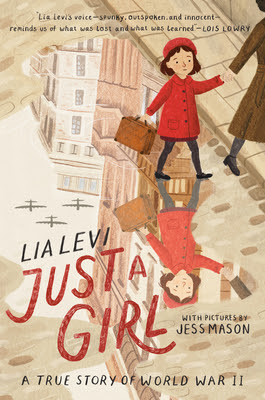
Just a Girl: A True Story of World War II by Lia Levi, pictures by Jess Mason, translated from the Italian by Sylvia Notini

Born in 1931 in Turin, Italy, Lia lived a pretty comfortable life with her parents, younger  sisters Gabriella and Vera, and Maria, their nanny. Lia was a shy girl so when Mussolini declared that Jewish children could no longer attend Italian schools, she is quite happy. That is, until she finds out that she would be attending a Jewish school. It isn't long before Lia's father loses his job because he is Jewish and the family is forced to live on their savings. 

When war is declared by Germany, Italy joins with Hitler and goes to war also. Within three hours of declaring war, French planes are dropping bombs in Turin. When Lia is in third grade, the family savings run out, and her Papa needs to find a job, but no one is allowed to hire Jews. The family decides to move to Milan, but when a promised job for Papa falls through, they are on the move again. This time, they are off to Rome.

Lia and her sisters have a grandmother who isn't Jewish and their first summer living in Rome, they are sent to stay with her during their summer vacation for three months. But the following summer, the war is getting closer to Rome, with the Americans landing in Sicily. And one night, they wake up to learn that Mussolini is no longer Italy's prime minister. Which should have been good news for Italy's Jews, except the Germans moved in and occupied the country. And where the Italians weren't always so good about enforcing Mussolini's laws, the Germans are quick to enforce Hitler's. 

Lia's parents decide to send her and her sisters to  live in a Catholic boarding school for safety's sake. By now, Lia is in her second year of middle school. She is given a false last name, Lenti instead of Levi, and must learn Catholic prayers. Then, in October, Lia's mother shows up at the school. She tells them that the Germans raided the Jewish quarter in Rome and took everyone away, but she doesn't know where her husband is. Luckily, they are all able to spend the rest of the war living at the boarding school.

This memoir, translated from the Italian by Sylvia Notini, is told in simple language though the deprivations, fears and anxieties the family experienced are made very clear. Graphic details are not included, and has caused one of my colleagues to complain that she felt it diminished the Holocaust. I don't agree. It is a unique story, but it is one person's actual experience and until Mussolini was removed from office, things were not as bad for Italian Jews as for Jews in Nazi occupied countries. 

I did like reading Lia Levi's recollections about living through the war. I thought she included a lot of small, but interesting details about what life was like for her family which are parts of history the books don't always tell you about. And Levi used two voices to tell her story - one is the first person account of young Lia and the other is the first person memories of the older Lia giving more information that the younger Lia wouldn't have known, but which helps readers to understand what was happening. My only complaint is that the timing was hard to follow. There aren't many dates mentioned and a timeline would have been very welcome. 

This is a poignant narrative, full of love, laugher, sadness, and loss, but an ideal way to introduce the Holocaust to young readers. And, right now, I think these stories need to be told and read.

Monday, July 12, 2021

Bartali's Bicycle: The True Story of Gino Bartali, Italy's Secret Hero by Megan Hoyt, illustrated by Iacopo Bruno

Bartali's Bicycle: The True Story of Gino Bartali, Italy's Secret Hero
written by Megan Hoyt, illustrated by Iacopo Bruno
Quill Tree Books/HarperCollins, 2021, 40 pages

For eight year, Gino Bartali rode his bicycle around Italy, memorizing trails and paths, winning races and collecting trophies and first-place ribbons. He was such a good racer that in 1938 Gino won the  grueling Tour de France. But it was after that race that Gino noticed things were changing at home in Italy.

Soldiers marched through Europe and soon the world was at war. Jews, who were blamed by some for Europe's ills, were rounded up and arrested. Gino had trouble believing the lies these leaders told about Jews. But Jews had already been denied any freedoms, and now they were being rounded up and arrested. Watching these abuses, Gino thought he needed to do something to help them. Summoned by Archbishop Elia Dalla Costa, Gino was asked if he wanted to become part of a network of Italians who were working to provide false identity papers to help Jews escape Italy and flee to countries like Switzerland and America. 

Despite being afraid, Gino began rolling up and hiding the forged identity papers in the hollows of his handlebars and other parts of his bike. He then began to use his cycling skills and the paths and trails all over Italy he had memorized earlier to pick up and deliver packages of these precious documents to anxious, startled families.  

But Gino did more that just deliver identity papers. For example, when Gino learned the soldiers were looking for his best friend's family, the Goldenbergs, he hid the whole family in his cellar for the duration of the war. Another time, capitalizing on his fame as a cyclist, Gino put on his racing clothes and headed to the train station where soldiers were herding arrested Jews into a train. Gino distracted the guards so that resistance workers could lead the Jews to different trains that would take them to safety. Another time, forced into the military, Gino used his uniform to find and help prisoners of war that were being held by the Italians. He led 49 English soldiers out to safety and no one took any notice of it. 

No one really knows how many people Gino helped to save. Some say more than 800, others dispute that figure. Gino never talked about his wartime activities and no records were kept by the resistance (for obvious reasons). Regardless, Gino has been named "Righteous Among Nations" by Yad Vasham, the Holocaust Remembrance Center in Israel for his wartime work helping to rescue Jews.

Bartali's Bicycle is a well-told, well-organized picture book for older readers that introduces this brave man to today's children. Discovering new heroes is always inspiring, and this one is made particularly so thanks to the accompanying illustrations, done in a style and subtle palette of colors appropriate to the period. Both author and illustrator gave an amazing amount of attention to detail that is unusual in a picture book, even a picture book biography like this one. 

Back matter includes a Timeline, a letter from Gino Bartali's granddaughter, Lisa Bartali, an Author's Note and an extensive list the the sources used by the author. 

Bartali's Bicycle: The True Story of Gino Bartali, Italy's Secret Hero would be an excellent addition to units on the Holocaust and World War II. And, in fact, you can download a free Teaching Guide for it from the publisher, HarperCollins, HERE   

This book is recommended for readers age 8+
This book was borrowed from the NYPL

Sunday, May 9, 2021

MMGM: In A Flash by Donna Jo Napoli

It's July 1940 and though there is a war going on, Simona, 8, and Carolina, 5, have just learned that they will be moving from Italy to Tokyo, Japan for perhaps a year or two. It's only been half a year since their mother died, and now they will be leaving their beloved Nonna, too, in four days. The father, a chef, has been offered a job at the Italian embassy, cooking for the Italian ambassador and his wife, both of whom refuse to eat Japanese food. 

Four days after arriving in Tokyo, Simona begins public school, not knowing the language or having any friends. But by December, she and Carolina have both learned enough Japanese to get by, though Simona still has no friends at school. And within a year, they are both fluent and quite assimilated into Japanese customs. Simona still has no real friends, except Aiko who refuses to acknowledge her at school. Although Simona and Carolina are the children of a servant, the Japanese kids believe they are rich and living luxuriously and that is why they are snubbed. 

When the United States is attacked by Japan and enters the war, everyone assumes America will easily be defeated by Japan. After all, Japan, Italy, and Germany had signed the Tripartite Pact in 1940 pledging to come to each other's aid should their country be attacked. But everything changes in 1943 when Italy surrenders to the Allies. Suddenly, Italians are Japan's enemy and they are all forced into an internment camp, where Simona and Carolina are separated from their father.   

The sisters are able to escape, and begin to make their way across the countryside. As they make their way though Japan, they are able to survive with the help of three women living together, including a manga artist, then with help from a blind washerwoman in Tokyo where their father used to bring the embassy's dirty sheets, and ultimately finding themselves in a Catholic mission in Hiroshima in the spring and summer of 1945.

In a Flash is, to say the least, a harrowing story to read, yet it is compelling and hard to put down as well. Napoli has certainly done her research on what it was like to live in Japan during WWII. What makes this story unique is that the it is written in the first person perspective, by a citizen of one of America's enemies living in a country of another enemy. But while Simona is Italian she isn't political, she is much more an observer and reporter of what she sees around her, often without understanding it. She may sometimes voice some of the propaganda she has been told about the United States, and often observes the behavioral result of Japan's propaganda in those around her, but she remains a child trying to make sure she and her sister survive.

It was difficult reading about the "patriotic" propaganda, but even more difficult was the incredible level of rationing and starvation inflicted on people in the name of victory because it was so realistically portrayed. On the other hand, Simona and Carolina's will to survive in the face of adversity is the stuff of great historical fiction.

I read a lot of Napoli's books and In a Flash is now one of my very favorites. There are a lot of themes and a lot of information to be gleaned from this compassionate thought-provoking, eye-opening novel.

Front matter consists of a map of Japan and back matter consists of a Postscript, Notes on Research, and an extensive Bibliography.

This book is recommended for readers age 10+
This book was borrowed from the NYPL

It's Marvelous Middle Grade Monday and you can see all of this week's wonderful MMGM books thanks to Greg at Always in the Middle

Wednesday, August 7, 2019

The Brave Cyclist: The True Story of a Holocaust Hero by Amalia Hoffman, illustrated by Chiara Fedele

Sometimes the most unlikely people find themselves in a situation that calls for action and bravery and they rise to the occasion. This is certainly the case of Tour de France champion Gino Bartali.

Born in Florence, Italy, Gino was a small, sickly boy who found release riding a bike, even if it was a rusty second hand bike. Before long, he could outrace his friends, even those with better bikes. In sixth grade, Gino decided to learn more about cycling, and got a part-time job with Oscar Casamanti, a man who repaired racing bikes. When he was invited to ride along with some racers through the Tuscan hills, Gino persevered even as some riders dropped out. Casamanti was so impressed, he recommended Gino take part in professional races.

At 17, he began training and racing more, and by age 21, Gino had become a powerful, winning racer. In 1938, he participated in the Tour de France and despite having an accident during the race, he still managed to win. By now, Benito Mussolini had declared himself Il Duce, the leader of Italy and a ally of Adolf Hitler. Mussolini declared Jewish citizens to be enemies of the state. Kids could no longer go to public school, or play in public parks, and their parents lost their jobs. Many Jews were arrested.

Then, in 1943, Gino received a mysterious telephone call from the archbishop of Florence, Cardinal Elia Dalla Costa. Could Gino help them? Riding his bike, Gino became a secret courier for the cardinal - making a 110-mile trip to deliver papers, photographs, and identification papers to a printer in Assisi, Italy, who then created forged identification papers that would be give to Jews in the hope that the papers would save their lives.

Gino carried on this important work until he was arrested in 1944, accused of selling guns to Mussolini's enemies. Released after 3 days, Gino went into hiding for a few months, until August 1, 1944 when the war ended in Italy and Italians were freed from Mussolini's grip.

And Gino? He went back to training for bike races, even winning the 1948 Tour de France again.

The Brave Cyclist is such an important story, and yet, one very few people knew about until now. Gino's story is a particularly important one when you realize that the punishment for helping Jews in any capacity was death, and not just for the helper, but often for their family as well. But Gino's story is also an inspiring one that proves the even one person can make a difference, that resistance can change people's fate. And the whole time Gino rode his bike great distances, often being stopped and searched by soldiers, delivering documents to be converted into forged identification papers, he had to keep his activities to himself. He could not even tell his wife so that if they were arrested, she wouldn't know anything.

In addition to an accessible written biography, Chiara Fedele's affecting illustrations are done in bright hues reflecting the happy days of cycling and racing, then switch to mostly dark hues reflecting the dark times of Mussolini's reign, complimenting and enhancing the text.

This is one of my favor illustrations. Gino has just been stopped and searched by soldiers,
now he's riding into the open field of the countryside, bringing freedom to some of Italy's Jewish citizens.
The Brave Cyclist is a picture book for older readers that is sure to generate some wonderful discussions among young readers about what they might do if they found themselves in the same circumstances as Gino.     

Author Amalia Hoffman has included an Afterword that goes into detail about Gino Bartali's life, and his heroic actions. In fact, she writes, that Gino was recognized as a Righteous Among the Nations by Yad Vashem in Israel, and what greater honor can there be but to be so acknowledged. You will also find an important Select Bibliography in the back matter for further investigation.

This book is recommended for readers age 8+
This book was provided to me by the publisher, Capstone Editions

Saturday, January 23, 2016

War in My Town by E. Graziani

Even as late as March 1940,  life in her small mountain village of Eglio, in northern Tuscany was still relatively pleasant for 11 year-old Bruna Pucci Guazzelli , despite the war in Europe and not having ever met her father, living in Brazil.  Bruno is the youngest of her siblings - two brothers - Cesar, 25; Alcide, 17;  and four sisters - Aurelia, 27; Eleonora, 23;  Pina, 21; Mery, 15.  Eglio is a village where everyone knows everyone else, and whenever hard times hit, the villagers rally to help one another.

But when Mussolini declared war on Britain that France on June 10, 1940, things all over Italy begin to change.  First, all the Italian men and eldest sons were drafted into the army.  For the Guazzelli family, that meant Cesar, followed by Alcide, who is sent to the Russian Front; meanwhile, for the eldest girls, it meant working away from home, either as cooks for other people, or for Eleonora, working in an orphanage.

At first, Bruna says, most Italians supported Mussolini and his alliance with Adolf Hitler, but as rationing, separation and hardship begin to take their toll on the home front, and after learning that even the Italian army fighting for Mussolini is so poorly supplied as the war escalates, people begin to turn against him.  In September, 1943, Mussolini is removed from power and Italy forms a new alliance with the Allies.

These are major events, but Bruna and the rest of the people of Eglio still remain relatively isolated from the fighting in Italy and the rest of Europe, mainly because Eglio is a far removed mountain village, so no one really expects anything to happen there.

Elio, Northern Tuscany, Italy
That is until the spring of 1944, when the Nazis arrive and life for the villagers changes drastically.  Elgio lay in a direct path of what was called the Gothic Line, one of the last fronts in WWII.  First, all food and blankets and even houses are taken by the German soldiers, and because they know where the Germans are, it doesn't take long for Allied bombing to begin.  But, when the villagers of Eglio are used as human shields in a last ditch effort by the Nazis, not everyone is lucky enough to survive the arrival of the Allies.

War in My Town is a fictionalized version of author E. Graziani's mother Bruna's true story.  It is told in the first person by the young Bruna, as she recounts the events that impacted her family and her neighbors between 1940 and 1945.

Bruna's personal story is emotional and compelling, but as the title indicates, it is really more about her town and the people who lived there.  That being said, I am sorry to say I found the writing style to be very dry and it was hard to stay focused.   I also found the  chronology of historical events to be confusing at times and found myself having  to backtrack a lot.

Despite that, I would still recommend this book simply because there aren't many narratives about life in Italy during WWII and since War in My Town is based on actual experience, it gives a more realistic picture of what life was like then.

This book is recommended for readers age 12+
This book was an EARC received from NetGalley

Monday, June 10, 2013

Hero on a Bicycle by Shirley Hughes

The events in Italy during WWII aren't often written about in kidlit.  To date, I have only written about two books where the action takes place in Italy.  The first was Stones in Water by Donna Jo Napoli, an MG story about an Italian boy rounded up in the cinema while watching an American cowboy movie and sent to work in a labor camp in Germany.  The second was the excellent picture book I Will Come Back for You by Marisabina Russo, about how a young Jewish girl and her family were helped to survive in hiding in Italy despite the strict anti-Semitic laws.

Well, now, thanks to the prolific British children's author Shirley Hughes, another story set in Italy had been told.  Hero on a Bicycle begins in 1944 in Florence.  Paolo Crivelli, 13, lives with his British mother Rosemary, older sister Constanza, 16, his now very old beloved dog Guido and his bicycle.  His Italian father is an outspoken anti-Fascist, forced into hiding so no one, not even his family, knows his whereabouts.

Now, with nothing to do since the schools are closed and his friends have all left Florence, Paolo sneaks out of the house every night and rides his bicycle around the city despite the curfew.  Meanwhile, his mother lies in bed worrying about whether he will make it home.

One night, Paolo is stopped by some rough looking men with rifles.  They have a message for his mother and want him to give it to her: they are in the area and will be getting in touch - tomorrow night if they can - the usual way.  The next night Paolo follows his mother as she heads to her meeting with the strangers.  As he watches, he realizes they are partisans and they want his mother to shelter two Allied airmen -a Brit and a Canadian - until they can get them to safety.

But there are rumors about Rosemary Crivelli and one Sunday, the Gestapo shows up and searches the house from top to bottom.  Luckily, the Crivelli's had a warning this was going to happen and were able to hide the airmen.  In fact, as the war in and around Florence heats up and the Allied forces get closer, the occupying German get more and more desperate and cruel.  And Paolo, who had earlier tried to join the partisans but was embarrassingly rejected, finally gets his wish do something for them when it is decided that he will be their guide to a safe house in the center of Florence.  But is a 13 year old boy up to the task of a grown man in order to save the lives of these two Allied airmen?

Hero on a Bicycle is a real coming of age novel, but I can't say it totally grabbed me.  I just didn't connect with any of the characters.  I actually found them to be flat. forced and quite frankly, unbelievable.    What was believable, however, were the descriptions of Florence and its surroundings, and the deprivations that the ordinary citizens suffered - for example, the Crivelli's were always hungry like everyone in WWII, while the best food went to the occupiers and it is interesting to read how careful Paolo was about protecting his bicycle tires, since there were no replacements if they got ruined.  Although, by 1944, I am surprised they were still OK given Paolo's heavy duty riding all the time.

And I am usually fond of books about partisans, but not this one.   I found Hughes' portrayal of them to be just plain of mean at time, especially towards a family and child of a man who is probably a fellow resistance fighter, as the family suspects he is.  And I thought they were a little to easy for Paolo to find, but not the Germans, which didn't make sense.

There are some pleasant surprises, though, and certainly some very heart-pounding moments, as when the German lieutenant, attracted to Constanza, finds a discarded Lucky Strike packet during his search of the house.  Or when Paolo must help the airmen and everything goes wrong.  This is a first novel for the 85 year old Hughes and I would still recommend Hero on a Bicycle in part because of its lovely Italian setting but with reservations as far as the plot goes.

A word about the illustrations at the head of every chapter:  Hughes is an artist and she had done these illustrations herself.  They are wonderful black and white pencil drawing, as you can see from this one of Paolo taking one of his nighttime excursions:


This book is recommended for readers age 10+
This book was borrowed from the NYPL

Be sure to check out the website dedicated to Hero on a Bicycle for more on this interesting novel, including some of the drawings she did during her post war trip to Italy and which she utilized for this novel.

This is book 7 of my 2013 Historical Fiction Reading Challenge hosted by Historical Tapestry.

Thursday, June 28, 2012

Stones in Water by Donna Jo Napoli

I picked up this book in a library book sale because it was about another one of those little known events that occurred during World War II: the snatching of Italian boys by Nazis and used as forced labor.  And also because the setting, at least in the beginning, was in Venice, Italy in the early 1940s, an unusual setting for most MG or YA novels.  The story centers on the friendship between 12 year old Roberto, a Catholic, and Samuele, a Jew.  It begins with the lure of seeing an American western film at the local movie theater proving to be too great for young Roberto to pass up.  Before long, however, not only is Roberto sneaking off to see the movie, but he is joined by his older brother Sergio, and friends Memo and Samuele.

The movie hasn't even begun when German soldiers swoop into the theater and round up all the boys.  Before they know what is happening, they are sorted by age so that Sergio and Roberto are separated from each other.  The boys are then put on trains heading north.  All through Italy, the trains picks up more and more boys.  Gradually, the trains head east to the Ukraine.  The whole operation appears to be such a perfectly planned operation.  A Western movie would and did draw only boys from the area, and no girls.  Non of the boys in any of the groups speak the same dialect, so there is little communication among them.  Soon, though, the boys realize the danger for Samuele, who is circumcised, so they change his name to Enzo and Roberto gives him his St. Christoper medal to wear.

Eventually, Roberto and Enzo end up in a labor camp, where all the boys are forced to build an airstrip for supply planes to land.  The work is hard and there is little food, and as winter comes the boys must find whatever rags they can use to try to keep from freezing, usually striping what they can off dead bodies - dead soldiers and prisoners alike were fair game.  At night, Enzo entertains Roberto with stories, most from the Old Testament, to keep his morale up.  The friends continue to support each other, so when another boy discovers that Enzo is Jewish and demands he give him most of his food ration, Robert shares his ration with his friend.

Throughout their captivity, Roberto worries about his parents and about getting home, but there seems to be no end in sight for the boys.  And to make matters worse, Enzo begins to weaken from the lack of food.  And to top it all off, with winter's snows, survival becomes more and more difficult for the boys.

Will they ever see home again?

This was the kind of coming of age story that really makes you realize what the concept 'coming of age' really means.  As you read Roberto's story, you can watch as he is transformed from a boy who had romanticized war to a thinking, feeling young man who realizes and appreciates the horrors of war without ever having been on a battlefield.  Yet, right from the beginning, Roberto and Samuele witness shocking Nazi brutality whenever boys tried to run away or when they fainted while working.  These were sobering lessons, and both boys heeded them in order to stay alive.

Stones in Water is a fast read, and for the most part it was excellent.  Some readers seem to feel that the end of the book didn't have a satisfactory conclusion, but I liked it.  Hinting at a sequel, I felt that Roberto has more in store for him than just going home.  And indeed, a sequel was written, Fire in the Hills, continuing Roberto's story.

One thing did bother me about Stones in Water.  It is based on reality, but I was sorry there was no Author's Note at the back of my copy to more fully explain the basis of the story, just an easy-to-miss brief mention in the acknowledgements.  It seems that Napoli has a friend, Guido Fullin, who was taken by the Nazis as a boy, just like Roberto was and Stones in Water is loosely based on him.  She did her own research but said no more about it.  I would have liked a list of further reading, if one can be done, about Italian boys being taken and used as forced labor despite Germany and Italy being aligned with each other during the war.  When I googled this topic, I didn't find much more than an interview with Donna Jo Napoli in which she reiterated what she wrote in her acknowledgements.  The interview may be found at Examiner.com

Despite this, Stones in Water is a very worthwhile story for readers young and old.

This book is recommended for readers age 10+
This book was purchased for my personal library.

Monday, December 26, 2011

I Will Come Back For You: a family in hiding during World War II by Marisabina Russo

I Will Come Back for You is one of the books that came out recently and was so highly recommended by reviewers.  It is a fictionalized story about Marisabina Russo’s real life Jewish family living in Italy during the Second World War.  The experience of Jews at that time and place is not the subject of many children’s books and so this is a welcome addition to the Holocaust body of work.

Everyday Nonna (Grandmother) changes her jewelry with the exception of her charm bracelet.  Like most charm bracelets, each charm represents one important aspect of Nonna’s life. The bracelet and the charms had been a gift from her daughter and prove to be an interesting way to talk about what happened to Nonna’s family during the war.

One day, while looking at the charms, her granddaughter expresses an interest in hearing the story behind each one – a donkey, a piano, a bicycle, a piglet, a barn, a spinning wheel and a ship – that hang on it.

Charm by charm Nonna’s story unfolds beginning with what life was life for her affluent Jewish family in Rome.  These were happy, busy times for the children. But one day things changed and anti-Jewish laws were passed, just as they had been in Germany.  Jews were no longer allowed to do the things they used to do or to go to places they had always enjoyed visiting after Italy aligned herself with Nazi Germany. 

Under these laws, Nonna’s papa was ordered to an internment camp, because he was a foreign born Jew.  But the family could visit every weekend, staying with a kind family in the village. 

As Nonna continues her story, charm by charm, she tells her granddaughter of the sad events surrounding her papa and how the family had to go into hiding themselves, and how, with the help of some very kind people they stayed safe until they were able to immigrate to the United States after the war ended.

This is a wonderful book for introducing young readers to one aspect of the Holocaust without being terribly frightening.  It is told in simple, straightforward language enhanced by simple but effective illustrations.  No illustrator is listed; however, the rather flat folk art type illustrations are done in watercolors. 

Russo has also included photographs of her own family in the endpapers from the 1930s and 1940s, and, in an afterward, she briefly tells the real story of her family, giving the fictionalized version of events its base in reality.  There is also a glossary for both Italian and English words to help understand some of the words and concepts used.    

This book is recommended for readers age 5-9
This book was borrowed from the Webster Branch of the NYPL

Book Trailer:


I Will Come Back For You: a family in hiding during World War II
Marisabina Russo
Schwartz & Wade
2011
40 Pages