Showing posts with label Realist Fiction. Show all posts

Tuesday, March 8, 2022

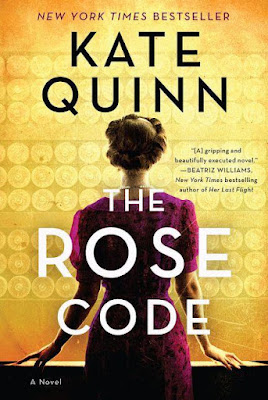
The Rose Code: A Novel by Kate Quinn

The Rose Code is one of those books I've been wanting to read ever since I first heard about it, but it just seemed like I could never find the time. Well, since I found myself with lots of time this past February, it was the first book I reached for. And I'm so glad I did.

The story revolves around three very different women who become friends after they begin working on code breaking at the Bletchley Park in Buckinghamshire, England during World War II. Mab (rather than Mable) Churt was born and raised in a cramped flat with a shared bathroom in Shoreditch in London's East End. Wanting more out of life than what her mother settled for, Mab worked hard to self-educate, reading the classics and she had even come in tops in typing and shorthand. Now, with war, she was ready to do her part for king and country.

Osla Kendall's upbringing couldn't be more different than Mab's. A society debutante, her mother hadn't really wanted her around, and had shipped her off to cousins in Canada. Now, Osla was back in London and dating a navy lieutenant named Philip Mountbatten (formerly Prince Philip of Greece). But once her mother cut off her allowance, Osla realizes she needs a job. Thanks to a German governess, Osla can speak fluent German and Philip suggests she use that skill to help the war effort.

After having mysterious interviews in London, Mab and Osla meet on the train the Bletchley, and instantly become friends, having received almost identical and very mysterious letters telling them where to go once they arrive. 

After another interview and signing the Official Secrets Act, the two women are taken to the Finch home where they will board while working at Bletchley. There, they meet Bethan Finch, the 23-yer-old daughter of their nosy, overbearing and overly critical landlady, Mrs. Finch. Meek and shy, Beth might have been beaten down by her mother, but she also is a whiz at crossword puzzles, able to finish the Sunday crossword in eight minutes. As Mab and Osla get settled into their respective jobs at Bletchley, they become more aware of what is going on in the Finch household, including the way Mrs. Finch abuses Beth. Thanks to Osla, Beth is soon working in Bletchley for expert cytologist Dilly Knox

Though Beth has always been shy and withdrawn, she shines at her job breaking codes at Bletchley. She even joins the book club that Mab and Osla start for the workers there. Then, on June 5th, 1944, as Beth is working on a difficult cipher file she had come to think of as Rose because the short messages reminded her of the way a rose's petals wrap it, she discovers that there was a traitor at Bletchley, but no matter what she says, no one believes her. The next day, as the Normandy Invasion was taking place, Beth finds herself committed to Clockwell Sanitarium for a supposed nervous breakdown. 

Now, it's 1947 and Beth is facing a lobotomy and desperately trying to get her former friends, Mab and Osla to come to her rescue. If they could decipher the Rose Code, they could expose the Bletchley traitor. But would they come? And if not, why not?

The Rose Code is a long, detailed, multi-layered novel and I couldn't put it down. The three main characters are so clearly defined and so deliciously flawed, as different from one another as they are united in their desire to do their part for the war effort. I loved the inclusion of real people like Dilly Knox and Prince Philip and even a mention of Alan Turing, but the other minors characters also fit the story so well. In fact, I became invested in everyone's story very quickly (even the horrible, abusing Mrs. Finch). Bletchley itself is so well depicted it felt like another character instead of just the place that brought everyone together for the sake of the story.

Beth, Mab, and Osla's stories unfold in alternating chapters, as well as in chapters where they all play a part. And the narrative covers two timelines - the war years, while the women were working at Bletchley, and 1947. Actually, 1947 covers only the weeks leading up to the royal wedding of Princess Elizabeth and Prince Philip (yup, Osla's old love interest). 

The Rose Code is a sophisticated, well plotted, well researched and well written novel My only objection is that I didn't really get why the traitor did what they did. I didn't like the character, but I also didn't suspect them yet I wasn't surprised when I found out who they were. 

The Rose Code was one of ten winning titles for ALA's 2021 Alex Award - adult books that also have appeal for young adult readers ages 12-18.

This book was purchased for my personal library.

Tuesday, December 14, 2021

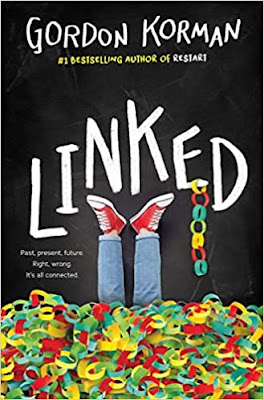
Linked by Gordon Korman

Just as he did in War Stories, Gordon Korman has brought WWII and the Holocaust into the present because, well, as William Faulkner reminds us the past is never past. The residents of Chokecherry, Colorado are reminded of that when a student, Michael Amorosa, discovers a large swastika painted on the atrium wall at Chokecherry Middle School. But who would do such a thing in this quiet very small town?

Chokecherry does have one thing happening that could put it on the map. After some dinosaur poop is discovered there, a group of paleontologists are sent to work on a dig hoping to find more dinosaur evidence. Among them is the Levinson family - the only Jewish family in town and daughter Dana Levinson is a student at the middle school, and who is very disturbed by the appearance of a swastika. 

Meanwhile, prankster Lincoln Rowley, 13 and called Link, and his friends are caught trying to dump 80 pounds of smelly dinosaur poop through the mail slot at the paleontologist's office in town. When Link is caught in the act, his father bans him playing any school sports. Link's father has a dream of turning Chokecherry into the next great tourist attraction, complete with a Disney-like amusement park. But no sooner is the first swastika washed away, but more of them begin showing up in various places around the school.

The school's answer to this is to hold a three week course in tolerance education, but the swastika's keep showing up and so does some surprising history. It seems Chokecherry was the scene of an incident in 1978 that involved KKK groups surrounding the town's foothills with burning crosses, referred to as the Night of a Thousand Flames. It's a subject Link's father does not want brought up, but talking to his parents about it reveals a surprising history in Link's family. His mother's mother, who is Catholic, is really Jewish, given to some French nuns for safety as a baby in 1941 when the Nazi's were occupying France and her parents were about to be arrested and sent to a concentration camp. Link, who up until now hadn't taken the swastikas seriously, is stunned by this news. If his great grandmother was Jewish, his grandmother is Jewish, that means he and his mother are technically Jewish, too. When Link begins to annoy Dana with question about Judaism, she suggests he get bar mitzvahed. Which he decides is a great idea and arranges lessons with the closest rabbi 100 miles away.

Meanwhile, it doesn't take long for a TikTok vlogger named ReelTok to latch on to the events in Chokecherry and start broadcasting right in the middle of town, hoping to stir things up. When ist becomes clear that the students are getting nothing out of the tolerance education they are being given, it's clear they need to do something else to counter the swastikas that are still showing up. Following the lead by the real school that collected 6 million paper clips, one for each Jewish person who perished in the Holocaust, the students at Chokecherry Middle School decide to make a paper chain with 6 million loops. It's an ambitious project and soon the whole school is behind it, gluing paper links together. But when they run out of construction paper in Chokecherry and the principal cancels the whole project, it feels like the person drawing the swastika's has won. But have they?

This is a Gordon Korman book so you know it is told from the perspective of different characters, with Link being at the center. It's not a format that always works, but Korman is a master at it and it work in his hands. It provides insight about each character, what they are thinking and how they are reacting to the events as they unfold, so it's very in-the-moment. 

Linked is told with a lot of Korman humor despite the seriousness of the Holocaust. The fact that the students are bored and turned off to the tolerance education but enthusiastic about the paper chain points to the fact that participatory learning might be better. At least, as a teacher, I think so, especially as the Holocaust recedes and students see it as just another topic in history. To his credit, Korman includes a lot of Holocaust history in this novel in such a way that the students really get they idea of what it was like. 

I loved how the theme of linking used. When you think about the novel, so many links come to mind. For example, Link's grandmother, who is still living, links past and present, while the fact that most people in Chokecherry think the racist Night of a Thousand Flames never happened links it to the importance of remembering those who perished in the Holocaust, signified by the loops of the paper chain. Other themes explored are identity, racism, redemption, community. Oh, yes, there is also a big surprise towards the end of the book. 

This book is recommended for readers age 10+
This book was borrowed from the NYPL

Sunday, May 23, 2021

MMGM: The Good War by Todd Strasser


The Good War by Todd Strasser
Delacorte Press/Random House, 2021, 192 pages

I was in college taking a Propaganda course when I read Todd Strasser's The Wave. It's a story about how readily people will give up their individual rights and personal freedom to become part of a dominating peer group in a classroom experiment designed to show students how Germans were persuaded to support Nazism. It was a simplified experiment, but the part that Strasser got right was that we are all responsible for our own actions and to question a leader and never follow him blindly. Now, we have The Good War in which Strasser gives readers a somewhat updated version of The Wave, but takes it to a virtual battlefield.

Ironville Middle School has had to cancel football for lack of funds and taking advantage of that, seventh grader Caleb Arnett had worked with math teacher Ms. B on a grant that provided state of the art gaming computers to the school. Now, for the first time, there would be an eSports club, despite the Principal's skepticism about gaming. Eight students show up for the inaugural meeting, including loner Zach Cook and bully Crosby Fugard, and soon a game is chosen and teams are formed. 

The game, The Good War or TGW for short, mimics the Allied and Axis forces in World War II. Emma Lopez is chosen to be team captain for the Allies, and has Caleb, Zach and Nathan on her team, while Gavin Morgenstern is the Axis captain with Crosby, Tyler and Mackenzie on his side. The eSports Club meets once a week after school, and it doesn't take long for the players to really get into it. Soon, the Axis players are all wearing Nazi type clothing and speaking in fake German accents. Sadly, most of the students don't really have an understanding of World War II and what happened. For them, it's just a video game.

Things really get out of hand when there is a malware attack during a club meeting that features Nazi symbols, leading to a fight between two opposing players. After all Caleb's hard work to get these computers, this the end of eSports Club?

The Good War is told in the third person alternating voices of Caleb, Zach, Emma, Nathan and Crosby. Each of these students have issues and it is interesting to see how they evolve over the course of 10 weeks. Caleb is overly extended thanks to his hovering parents who want him to excel in everything; loner Zach is a fidgety boy with multiple tics, but is a great skateboarder and gamer, while quiet Emma lives in her older sisters shadow, unable to stand up for herself. Crosby, who mother has cancer and is going through chemo, is the most vulnerable of the group. He plays TGW online with a white supremacist who is slowly radicalizing him. 

Through the members of the eSports Club, Strasser explores themes of bigotry, prejudice, the misuse of social media, racism, and bullying. While it is a little hard to believe that a middle school would allow students to play a game like The Good War, which is rated Mature, I could still suspend my disbelief for the sake of the story. And what about Ms. B's lack of leadership and control over the eSports Club? In my teaching life, I have met a few Ms. Bs, which is sad to say. 
 
I wrote a dissertation on how novels for girls were used to indoctrinate them into NSDAP thinking, so naturally, I found The Good War and The Wave to be interesting books that tackle the theme of indoctrination and belonging. There was a reason Hitler courted German youth but you might be surprised to learn that German parents weren't quite as supportive as we have been lead to believe. Which made me wonder, where were all the parents of the kids in the eSports club? 

This book is recommended for readers age 10+
This book was an eARC gratefully received from NetGalley

It's Marvelous Middle Grade Monday and you can see all of this week's wonderful MMGM books thanks to Greg at Always in the Middle

Sunday, May 16, 2021

MMGM: War and Millie McGonigle by Karen Cushman

It's 1941 and life has been difficult for Millie McGonigle''s family lately. First, there was the Depression. Her dad lost his job, and still hasn't found one. Younger sister Lily is sickly with lung problems and takes up all her mother's attention, while younger brother Pete, 5, wants all of Millie's attention. Then the war started in Eurpoe and Millie began worrying that the Nazis might just come over to San Diego and drop their bombs. To make matters worse, on Millie's twelfth birthday her beloved Gram Tillie suddenly passed away, but not before she gave Millie a blank notebook and told her "Things that seem lost or dead - keep them alive and safe in your book. Whatever is lost stays alive if we remember it." And so Millie turned her notebook into The Book of Dead Things, Mission Beach, San Diego, Californiz, 1941. Now, Millie combs the beach looking for all kinds of dead things to draw in her book. 

And then the news that Gram's cousin Edna would be coming to live with the McGonigle's and Millie would have to share her bed with her. Edna is a little off center, seemingly unaware of what's going on around her and that there is a war happening. One good thing that happens is the her nemesis Dicky (Icky) Fribble's aunt and cousin Rosie move in with his family. Rosie is older than Millie, but the two girls hit it off immediately.

Then Pearl Harbor is attacked and everything changes again. Her dad gets a job as a clerk in the Navy Exchange, unable to join the army because of a heart murmur, and her mom begins welding school. Now, there are air raid drills in school, heavy black curtains on the windows at night, and rationing. Soon, kids are playing war games and collecting metal, fat and newspapers for the war effort. And, of course, Japanese hatred soon rears its ugly head in none other than Icky Fribble and his mother. Through it all, Millie continues to add drawings of dead things to her notebook. 

War and Millie McGonigle is such an interesting story. It takes place between Saturday, September 20, 1941 and Sunday, February 28, 1942, mimicking Millie's diary entries, so most accountings are on Saturday and Sunday, with only a few on weekdays. 

Millie is a sensitive character, who wallows in grievances, afraid to let go and enjoy life, because what if... But, over the course of the novel, she begins to change and watching that happen at the pivotal age between childhood and being a teen is what makes her so interesting. Add a war to that time, and you have a lively, endearing character. And while Millie's obsession with her The Book of Dead Things sounds rather morbid at first, it becomes an exploration of what to value in life for her. 

Readers will find plenty of daily home front details in this character driven novel. But my favorite aspect of the book is that it is set at the beach at a time when it was not such an attraction for tourists. In that respect, it will remind readers of Jennifer L. Holms' books Turtle in Paradise and Full of Beans, even though they take place in Key West, Florida. They all share the same salty air, smelly seaweed, cawing seagulls atmosphere that is so beachy. Cushman has really nailed the setting aspect of the novel. 

Hand this to readers interested in historical fiction, WWII, tween girls, and anyone looking for a good home front story.

This book is recommended for readers age 9+
This book was an eBook gratefully received from NetGalley

It's Marvelous Middle Grade Monday and you can see all of this week's wonderful MMGM books thanks to Greg at Always in the Middle

Sunday, May 9, 2021

MMGM: In A Flash by Donna Jo Napoli

It's July 1940 and though there is a war going on, Simona, 8, and Carolina, 5, have just learned that they will be moving from Italy to Tokyo, Japan for perhaps a year or two. It's only been half a year since their mother died, and now they will be leaving their beloved Nonna, too, in four days. The father, a chef, has been offered a job at the Italian embassy, cooking for the Italian ambassador and his wife, both of whom refuse to eat Japanese food. 

Four days after arriving in Tokyo, Simona begins public school, not knowing the language or having any friends. But by December, she and Carolina have both learned enough Japanese to get by, though Simona still has no friends at school. And within a year, they are both fluent and quite assimilated into Japanese customs. Simona still has no real friends, except Aiko who refuses to acknowledge her at school. Although Simona and Carolina are the children of a servant, the Japanese kids believe they are rich and living luxuriously and that is why they are snubbed. 

When the United States is attacked by Japan and enters the war, everyone assumes America will easily be defeated by Japan. After all, Japan, Italy, and Germany had signed the Tripartite Pact in 1940 pledging to come to each other's aid should their country be attacked. But everything changes in 1943 when Italy surrenders to the Allies. Suddenly, Italians are Japan's enemy and they are all forced into an internment camp, where Simona and Carolina are separated from their father.   

The sisters are able to escape, and begin to make their way across the countryside. As they make their way though Japan, they are able to survive with the help of three women living together, including a manga artist, then with help from a blind washerwoman in Tokyo where their father used to bring the embassy's dirty sheets, and ultimately finding themselves in a Catholic mission in Hiroshima in the spring and summer of 1945.

In a Flash is, to say the least, a harrowing story to read, yet it is compelling and hard to put down as well. Napoli has certainly done her research on what it was like to live in Japan during WWII. What makes this story unique is that the it is written in the first person perspective, by a citizen of one of America's enemies living in a country of another enemy. But while Simona is Italian she isn't political, she is much more an observer and reporter of what she sees around her, often without understanding it. She may sometimes voice some of the propaganda she has been told about the United States, and often observes the behavioral result of Japan's propaganda in those around her, but she remains a child trying to make sure she and her sister survive.

It was difficult reading about the "patriotic" propaganda, but even more difficult was the incredible level of rationing and starvation inflicted on people in the name of victory because it was so realistically portrayed. On the other hand, Simona and Carolina's will to survive in the face of adversity is the stuff of great historical fiction.

I read a lot of Napoli's books and In a Flash is now one of my very favorites. There are a lot of themes and a lot of information to be gleaned from this compassionate thought-provoking, eye-opening novel.

Front matter consists of a map of Japan and back matter consists of a Postscript, Notes on Research, and an extensive Bibliography.

This book is recommended for readers age 10+
This book was borrowed from the NYPL

It's Marvelous Middle Grade Monday and you can see all of this week's wonderful MMGM books thanks to Greg at Always in the Middle

Wednesday, July 29, 2020

Great Escapes #1: Nazi Prison Camp Escape by Michael Burgan, illustrated by James Bernardin

Nine-year-old Bill Ash knew he wanted to be a pilot even before the day in 1927 when he saw Charles Lindbergh in Dallas, Texas. But the Depression hit his family hard and left little time to think about flying. Then, in 1939, war was declared in Europe and, wanting to fight Hitler, Bill went to Canada to join the Royal Air Force there. Turns out, Bill was a natural in the air.

By 1942, he was flying missions from England to Europe in a Spitfire. And he was successful, that is, until March 24, 1942, when his plane was fired on. He crash landed in France, and with the help of some kind French people and the French resistance, almost made it back to England via Spain. But almost doesn't count - Bill was discovered and arrested by the Gestapo in Paris.

Bill was questioned and tortured to give up the names of the people who helped him in France. Thinking about the young girl named Marthe who had helped him, Bill was able resist the many beatings by the Gestapo. Eventually, he was sent by cattle car headed to Germany. There he was sent to a Nazi prison camp for POWs called Stalag Luft III. 

Once he reached Stalag Luft III, the urge to escape was great. But the first attempt failed and Bill found himself spending two weeks in solitary confinement a/k/a the Cooler. Undaunted, Bill and some of his fellow POWs kept trying to escape, followed by two weeks in the Cooler and nothing to eat but bread and water. 

When Stalag Luft III became crowded, Bill and others were sent to another POW camp in Poland via cattle car, which proved to be yet another failed escape attempt. In Poland, Bill and 24 other men decided to dig a tunnel from inside the latrine. They figured the smell of the latrine would keep the fastidious German soldiers away. Finally, in March 1943, thirty-three men were ready to escape. And Bill did make it to freedom, until he was caught...again. After even more escape attempts, Bill found himself back in Stalag Luft III, where he discovered he was known as the Cooler King.

Back where he began life as a POW, there were more escape attempts until finally in 1944 came the good news that the Allies had landed in France, and by 1945, they were in Belgium on their way to Germany. Bill and the other prisoners were forced to march from Stalag Luft III to Spremberg, Germany, where they were loaded on to cattle cars. By now, Bill and other POWs were ill, and taken to a military hospital outside Bremen, Germany. By the time he had recovered, the British were shelling the camp Bill was in, not realizing there were POWs there. Bill made one last escape attempt. This time he succeeded and was able to tell the approaching British tanks just were they Germans had positioned their tanks. 

Finally, after 13 attempted escapes, the war was over for Bill Ash and he was a free man.

Bill Ash in his Spitfire meeting the
Canadian Prime Minister
Great Escapes
is a debut series and it is getting off to an exciting start with Nazi Prison Camp. Presenting Bill Ash's story in this short, but action-packed historical fiction novel is a great way to get reluctant readers reading as well as giving kids interested in WWII stories something different. After all, most kids know about Nazi concentration camps, but not much about what happened to POWs, and may have even just assumed they were immediately killed. 

There are sidebars to Bill's story in the first three chapters with information about The Depression, Concentration Camps, Spitfires and Other Aircraft of World War II, The Resistance to German Rule, andThe POWS of World War II. These are all topics readers will encounter throughout the novel. Sometimes I find sidebars intrusive in historical fiction. It was nice to read them at the beginning of Bill's story so that the exciting escapes weren't interrupted with information and readers already know what they need to know. And since it is a story about POWs, it is also a good way to introduce them to the Geneva Conventions that "spelled out how countries would treat prisoners of war."

There is a Selected Bibliography and an Author's Note in the back matter. A map is included at the beginning, but I wish it were a more detailed map to give young readers a sense of place and distance. Descriptions of Bill's escape attempts are detailed and riveting. Bill Ash's story is a survival story par excellence

This book is recommended for readers age 9+
This book was an EARC gratefully received from Edelweiss Plus

Bill Ash passed away in 2014 at the age of 96. You can read his informative obituary HERE 

Sunday, May 24, 2020

Hunger Winter: A World War II Novel by Rob Currie

It's 1944 and the Gestapo would like nothing more than to capture Dutch resistance leader Hans Ingelse. So far, Ingelse has managed to avoid capture and continue his resistance activities. But, since his wife had died two months earlier, the Gestapo now  have his three children in their sights. In the middle of the night, on November 11th, a neighbor risks his life to let 13-year-old Dirk Ingelse know that the Gestapo has arrested his older sister Els for her resistance activity, and now, they are on their way to the Ingelse home in Oosterbeek for Dirk and his 6-year-old sister Anna.

Luckily, papa had already begun to teach Dirk what to do in certain situations to avoid capture. Dirk wastes no time getting Anna up and out to begin the trek to their Tante Cora's house in Doorwerth, taking what little food they had. Meanwhile, Els is being held in an interrogation center in downtown Oosterbeek, and it doesn't take long for the torture to begin. The Gestapo is sure Els will break and tell them where her papa is, but she's stronger and more determined than they realize.

Dirk and Anna safely reach Tante Cora's the next day, and feel somewhat safe there, but hungry, since all food is confiscated by the Nazis. And they must still be cautious now that they are in danger of being picked up by the Gestapo. Instead, Dirk and Anna get picked up in a Nazi razzia, a roundup of any able-bodied person to work in munition factories. There, a sergeant decides to give Anna to a friend who had recently lost his daughter, as a replacement. Hearing that, Dirk is determined to escape, but how? The factory is so well guarded. Luckily, on November 22nd, the Allies begin to bomb that part of Holland. As the guards take cover, a bomb hits, giving Dirk and Anna an opportunity to escape - right into a minefield. But, Dirk figures out the path through the field and soon they are on their way to Oma and Opa's farm in Nijmegen. But, before they get there, Anna sprains her ankle, and they need to stop at a farmhouse near Driel. There, they are met by a elderly couple, and a Nazi officer holding them at gunpoint. He claims he wants to turn himself over to the Americans in Nijmegen, but is this just another trick to catch their papa?

Meanwhile, the Gestapo still hasn't gotten Els to talk, so they decide to amp up the torture, transferring her to a Luftwaffe base in Rotterdam on November 26th, just before the Allies dropped bombs on that city.

Will the Ingelse family survive capture and be reunited with papa, if he is even still alive? Now that the Americans have liberated Nijmegen and are pushing forward, the Nazis seem to be getting more and more desperate to capture Hans Ingelse, refusing to acknowledge that the German Reich might actually be losing the war.

Hunger Winter is certainly an action-packed novel, with very appealing characters that readers can root for (well, truth be told, I found Anna very annoying).  Personally, I would have liked a little more about Els, who is my favorite character. There's also a bit of mystery surrounding what has become of the children's father, and that isn't revealed until the end, and it quite a revelation, but readers never really get to know him.

I thought Currie really captured the starvation of the Dutch people due to the lack of food during the winter of 1944-1945. Tante Cora has Dirk dig up the bulbs in the garden for soup, there is a hint about the fate of her stolen dog that might not be caught by younger readers, trading valuables with farmers for food only to have it taken by the Nazis, and of course, collaborating with the Nazis for extra rations.

It did bother me that the Nazi officer Dirk and Anna meet at the farmhouse on their way to Oma and Opa's turns out to be someone their father went to school with. That was just more coincidence than my adult sensibility could accept, but probably not for my nine-year-old self, so I don't think younger middle grade readers will have a problem with it, either.

Back matter includes a section called What Really Happened?, an interview with the author, Rob Currie, Discussion Questions for teachers, and Key World War II Dates for the Netherlands, as well as maps. I read an ARC, with included everything but the maps.

Hunger Winter is a nice work of historical fiction and not many take place in the Netherlands for this age group. If I were teaching a WWII unit, I would pair it with Hilda van Stockum's The Winged Watchman, originally published in 1962, as a nice resistance compare and contrast component.

This book is recommended for readers age 8+
This book was an EARC gratefully received from NetGalley

Wednesday, October 23, 2019

Allies by Alan Gratz

Beginning just before dawn on June 6th, 1944 and ending close to midnight on the same day, Gratz weaves together six unrelated perspectives that bring the D-Day landings to life in all its chaotic, grim reality.

Private Dee Carpenter is a 16-year-old who lied about his age to get into the Army, but since they needed soldiers, the Army looked the other way. Dee and Sid Jacobstein became friends right from the start in boot camp. But Dee wonders what Sid, a Jewish American, would think if he found out Dee's truth.

Samira Zidane, 11, and  her mother Kenza are French Algerians working in the French Resistance. Six hours before the invasion begins, mother and daughter are on their way to deliver an important message about the invasion to the Resistance when Kenza is arrested and taken into custody by the Nazis. Samira delivers the message, and is determined to find and help her mother escape her captors.

James McKay, 19 and Sam Tremblay, a Cree Indian, are in the 1st Canadian Parachute Battalion and about to jump into the midst of the invasion. James decided to join the army after his home town of Winnipeg staged a mock Nazi invasion. Now, though, he is wondering what he is doing parachuting into France on D-Day. His pal Sam, despite being promoted to Lance Corporal, still faces insults and microaggressions as a First Person from the other men, who are white.

Bill Richards, 19, from Liverpool, England is a Private in the Royal Dragoons, and a tank driver just like his dad was in WWI. Bill was named after and is obsessed with William the Conquerer and determined to get to get to Bayeux, France to see the famous Bayeux Tapestry. But he was also obsessed with getting to Amiens, France where his father had carved "Jack Richards was here 1918" on a stone, and Bill was determined to add his name underneath.

Corporal Henry Allen, 20, is an African American medic in the 320th Barrage Balloon Battalion. And even though the United States military is segregated, Henry is on Omaha Beach, risking his life, dodging bullets and racist comments to save the lives of the mostly white soldiers shot and injured as the D-Day landings happen.

Monique Marchand, a 13-year-old French girl with an interest in medicine, was swimming with friends on Normandy Beach the day before the D-Day and ended up in the swimming hut on the beach during the invasion because of a forgotten bathing suit. When she notices an injured soldier, she leaves the hut to help him and that's when she meets Dorothy Powell, an American journalist for Collier's Magazine, there to write about the invasion.

There's not much more to say about this incredible book without giving too much away. Some of the people will live to see the end of the day, others won't, but all contribute to giving a broad view of this important day and what it was like. And Gratz doesn't hold back, so just know this is not a book for the faint at heart.

One of the things I really liked was how Gratz divided the day into the names of different operations. He explains in the back matter that some of the operation names are real, and some he made up to fit the story. Either way, it gives the reader a real sense of time passing and what might have happened. But be sure to read the Back Matter where you will find so much more information.

Gratz also includes a map to give readers a sense of place, since some of the landing units ended up in the wrong beach in all the chaos.
Click to enlarge
WOW! Allies is a great work of historical fiction by a great storyteller. I found myself spellbound from the first word of Allies to the last, but then again, I had the same experience with Gratz's other books, namely Prisoner 1065, Refugee, and Grenade.

This book is recommended for readers age 9+
Thank you, Scholastic Press, for providing me with a copy of this book.

Sunday, June 16, 2019

I Survived the Hindenburg Disaster, 1937 (I Survived Series #13) by Lauren Tarshis, illustrated by Scott Dawson

It's Monday, May 3rd, and Hugo Ballard, 11, is about to embark on an exciting journey flying from Germany to New Jersey on the Hindenburg, one of two zeppelins crossing the Atlantic Ocean in 1937. Hugo had already had one big adventure, living in Kenya with his mom, dad, and younger sister Gertie for a year. But now Gertie is sick with malaria and needs to get home to NYC for the right medicine as quickly as possible and the zeppelin could get the family there in only three days.

The Hindenburg is big, almost as big as the Titanic, but it's a highly flammable gas, hydrogen, that gets the zeppelin off the ground and flying. And that's a pretty scary thought for Hugo and Gertie, but almost immediately, Hugo makes a new friend, Martha Singer, or Marty as she prefers. Marty is a zeppelin pro, this is her eight Atlantic crossing in one, thanks to her dad who works for the company. "It's magical" she tells Hugo, and indeed, it seems to be so. Even Gertie is looking and feeling better.

The next morning, Tuesday, May 4th, at breakfast, however, Hugo's good feelings about being on the smooth-riding zeppelin with a new friend are somewhat diminished by the appearance of Nazi Colonel Joseph Kohl, known for his viciousness (even Gertie thinks he looks like a snake) and two other Nazi officers. When they leave, one of the passengers says that he believes the Nazis are looking for a spy on board the zeppelin.

On Wednesday, May 5th, the day before the zeppelin is scheduled to arrive at the airfield in New Jersey, Mr. Singer offers to show Hugo and his dad around the ship, even taking them into its main body, usually off limits to passengers. While there, Mr. Singer hears a terrible, unfamiliar growling noise. Alarmed, he starts to call the ship's captain, when Hugo realizes it is none other than their dog, Panya, who was put into the cargo hold for the trip. But their tour is interrupted with news that Gertie is once again very sick. After a long, scary night, Gertie's finally fever breaks and the only thing she wants is Panya.

But when Hugo sneaks down to get the dog, he sees someone else there. Is this the spy who is sneaking German secrets back to the United States? Apparently Colonel Kohl thinks so, too. After threatening Hugo with his gun, he manages to get away and get Panya to Gertie. But does an even deadlier fate await the Ballad family when the Hindenburg suddenly erupts in flames while landing?

A WWI Recruiting Poster
I Survived the Hindenburg Disaster, 1937 is, like all the I Survived books, very exciting with themes of courage, resilience, and the importance of family. And Tarshis is genius at being able to weave these into a gripping tale in the midst of a dangerous historical event without distorting any of the history. She has included lots of information within the story about zeppelins, how they work and their use, even during World War I when they were used to drop bombs on civilians in both France and England. I knew airplanes were used for that, but I didn't know about zeppelins.

Nor does she shy away from Nazi violence or cruelty and yet it is never gratuitous. In this novel, Colonel Kohl is portrayed as the kind of cold-blooded Nazi who would not think twice about shooting Hugo to get what he wants. But Tarshis also always makes sure to surround her protagonist with kind people, too, as she does here with Hugo's parents, Mr. Singer, and Marty. And her protagonists are also kind people. Hugo risks a lot to make his sister happy, but he knows what he has to do. And when the ship erupts in flames, his first thought is how to save his family.

Tarshis has also included even more information about zeppelins and the Hindenburg disaster in her back matter, beginning with the question "Would you want to ride on a zeppelin? To which my answer would be unequivocally no, thank you, although I do appreciate the excitement and spectacular views of such a ride. There is also a section about the possibilities of why the Hindenburg disaster happened (to this day, no one knows), More Hindenburg Facts, and a Selected Bibliography.

I Survived the Hindenburg Disaster, 1937 is one of four books that are focused on World War II, beginning with I Survived the Bombing of Pearl Harbor, 1941, I Survived the Nazi Invasion, 1944, and I Survived the Battle of D-Day, 1944. Each excellent and informative, and age appropriate.

This book is recommended for readers age 7+
This book was provided to me by the publisher, Scholastic Press

If you would like to know more about zeppelins, be sure to visit airships.net

And if you are curious about what Hugo saw on his tour of the Hindenburg, this is the best example of the inside of it I could find (you can even see the catwalk where Hugo had to walk to get Panya for Gertie):


Friday, April 19, 2019

My Best Friend: The Evacuee by Sally Morgan, illustrated by Gareth Conway

Young readers can follow two friends as they experience the first year and a half of World War II in completely different circumstances in this epistolary chapter book and discover just what it was like for kids at that time.

Londoners Harriet Hale, 11, and Teddy (Edward) Wilson, 10, have always been best friends and comic book lovers. In fact, they have even been working on their own comic book for a while now, working on it inside the Anderson shelter in Harriet's backyard. But Teddy has a secret and Harriet doesn't find out what it is until she receives a letter on 1st August 1940 and learns that her best friend has been evacuated to America. What a blow! Not only that, but he took Harriet's newest Beano comic book with him.

Meanwhile, Harriet is left in London, and although most of the other kids there have been evacuated to the countryside, Harriet is staying home with her mum. Soon, Harriet and Teddy begin corresponding with each other and their letter exchange is how readers learn what is going on in their lives.

Remaining in London means that Harriet must contend with the fear that Hitler is getting ready to invade the England. And that means that he has already begun to heavily boob London, even Buckingham Palace takes a hit. But for Harriet, the scariest is when the Underground shelter she and her mum are in takes a direct hit, and people begin stampeding out of the shelter, scaring her enough that for a while she refuses to shelter in the Underground whenever the air raid sirens go off.

For Teddy, life in Dayton, Ohio with the Mayer family isn't very eventful, but there is plenty to eat and no fear of invasion or bombs. There is also baseball, and while it's not cricket, it's still kind of fun for him. But even though the Mayer family really likes him, Teddy can't help but feel homesick. At first he believed he would be home by Christmas, but when that didn't happen the time stretched out longer and longer, until finally in 1945, he can return home.

The aren't many chapter books written about World War II, so I'm always curious to read one when I find it. I found My Best Friend: The Evacuee to be chock full of factual information and presented in such a way that an 11 year old would experience what is happening around them. Beside that direct hit on the Underground station where Harriet was, readers will learn how Teddy was able to be evacuated to America, and why that program had to be stopped when one of the ships was torpedoed in the Atlantic by a German submarine.

Sally Morgan has really captured the intensity of Harriet's fear and Teddy's homesickness, and has packed this story with historical facts that really make it an interesting work. It is a story that was written to commemorate the 80th anniversary of the start of WWII this year, and it is an excellent work for introducing young readers to this dark period on two different home fronts, without graphic descriptions. I like that Morgan pays homage to the women who did so much for the war effort, include Harriet's Aunt Lucy, who loves puzzles and is clearly working at code breaking at Bletchley, and her sister who may or may not be a land girl, but is definitely working on a farm.

There is lots of back matter, including a WWII timeline, and brief bios of relevant people from history who are mentioned in this book. 

My Best Friend: The Evacuee is an excellent addition to WWII books for young readers.

This book is recommended for 7+
This book was sent to me by the author, Sally Morgan


Tuesday, March 19, 2019

I Survived the Battle of D-Day, 1944 (I Survived Series #18) by Lauren Tarshis

Lauren Tarshis's I Survived series has introduced young readers to a variety of significant, but scary events that have occurred in both recent and distant history through a young eyewitness protagonist. With the same themes of courage and resilience the protagonist didn't realize they possessed, they become active participants in these events, providing the reader with an exciting fast-paced story and lots of historical background information. In her latest book, Tarshis takes her readers to France's Normandy coast just before and after the D-Day invasion on June 6, 1944.

Living there in the town of Le Roc, Paul Colbert, 11, has waited and waited for the Allied Forces to come and rescue France from the hands of the Nazis and end the war. After France had fallen to the Nazis in 1940, his father had been arrested and sent to a German prison camp; then his best friend Gerard and his family were arrested by the Nazis because they were Jewish and had disappeared. Later, Paul had seen his favorite teacher, Mr. Leon, being pursued and shot by Nazi soldiers for being in the resistance, and he watched in horror as his hero sank into a river.

But just as he is beginning to lose hope, it's Paul's turn to be a hero when he discovers an American paratrooper caught in a tree and injured. Paul knows that helping this man is dangerous if the Nazis catch him, especially with Nazis soldiers nearby looking for the paratrooper. But despite his fear, Paul climbs the tree and frees the American, whose name he learns is Sergeant Victor Lopez. But now, the wounded Victor needs a safe place to hide and Paul knows just where to take him. The old, crumbling Castle Le Roc isn't a place anyone wants to be in, what with the all the stories that told about it, and Paul knows how to get there so the Nazis don't discover them. So, imagine Paul's surprise when they are greeted at the castle by a man pointing a rifle at them.

Little does Paul realize that he has stumbled into a resistance hideout and that his life is about to change. Not only does he discover Mr. Leon is still alive and working for the resistance, but so is his mother. At the moment, resistance fighters all over France are waiting for the code that will let them know the D-Day invasion, what Mr. Leon called "the largest invasion by sea in the history of the world," is happening. And now even Paul has a part to play in it.

I Survived the Battle of D-Day, 1944 was written to commemorate the 75th anniversary of the D-Day invasion on June 6, 2019. It is the 18th novel in the I Survived series and like the 17 that came before it, it is an exciting novel that will not let readers down. And while the main focus is on the anticipated Allied invasion, the novel also introduces young readers to the important work of the French resistance and the dangers involved in that kind of work.

Some of the descriptions of Nazi cruelty toward their enemies, and some of the scenes of the Normandy coast during the invasion are a little more graphic than most books written for this age group, though none of it is gratuitous. But, as with all of the novels I've read in the I Survived series, the writing is excellent and completely accessible and there is lots of kid appeal. Paul is a sympathetic character, and readers will no doubt relate to his fears, but also cheer his bravery.

This is a serious story told about a dangerous time, but Tarshis includes some lightheartedness in the form of Ellie, the carrier pigeon who accompanied Victor to France and whose job it was to fly back to England and let them know he had arrived safely. But Ellie isn't about to abandon Victor, even after he is at Castle Le Roc. Good thing, she turns out to be a lifesaver and a real hero, too. 

Tarshis has included a lot of back matter for curious kids, including a letter from the author to her readers about writing this book, answers to some questions about D-Day, and other points of interest to young readers, an overview of the vehicles used for the invasion (which I also found very informative), a Timeline, a list of books for Further Reading and a Selected Bibliography.

I Survived the Battle of D-Day, 1944 is a solid edition to the I Survived series, and is sure to appeal to kids who like exciting stories, historical fiction and/or WWII novels.

This book is recommended for readers age 7+
This book was sent to me by the publisher, Scholastic Press

Sunday, December 2, 2018

Skyward: The Story of Female Pilots in WWII written and illustrated by Sally Deng

It's 1927 and three girls living in different countries - Hazel, a Chinese American living in San Francisco, Marlene living in the English countryside, and Lilya, living in a small town in Russia - all have the same dream - they want to fly. What could feel more freeing that being up in the heavens in a plane?

As time went by, their dream of flying still very much alive, the girls did learn how to pilot a plane and experience the joy they knew they would find in the air. Marlene learned first with the help of her brother, getting a pilot's license even before she got her driver's license. Encouraged by her father, Hazel took lessons whenever she had the money to pay for them, reading books about the science of flying in between. Lilya's family wanted her to become a doctor not a pilot, so she secretly joined a high school flying club, paying for flight time by working in a factory.

When war broke out in 1939, and men left jobs to fight, women wondered what they could do to help. For Hazel, Marlene, and Lilya, the answer may have been easy, but their respective governments weren't interested in female pilots. At least, not until things began to be desperate. In the US, pilot Jackie Cochran established the Women Airforce Service Pilots (WASP). Hazel and her friend Elizabeth "Bessie" Coleman, an African American pilot, both applied. Hazel was accepted into the WASPs, Bessie was rejected based on her race.

In England, Pauline Gower, the first woman to get a commercial pilot's license, was recruiting women for the Air Transport Auxiliary (ATA). Naturally, Marlene applied but almost didn't get accepted because of something looking wonky during her physical. But in the end, though, Marlene was able to join the ATA.

In Russia, Marina Raskova, the most famous aviatrix in that country, was also recruiting female pilots and Lilya was invited to Moscow for an interview. Lily felt like she was in a dream, until she was accepted into Raskova's program.

The three women spent the war years risking their lives flying for their countries. Deng follows their adventures in WWII, as they perform feats of bravery even as they face of danger,  racism, doubt, misogyny and a general lack of support and encouragement.

This is Sally Deng's debut children's book and she makes it clear from the very beginning that this is a work of creative fiction based on real events and real women. While the character of Hazel might be based on the real Hazel Ying Lee, who did fly for the WASPs in WWII, there is not reason to think that this is a partial biography about her, but rather the author's homage to Hazel and all the other women who flew for their countries in WWII. However, Bessie Coleman, Pauline Gower, Jackie Cochran, and Marina Raskova are not fictional characters.

That being said, I loved this book. The text is simple, straightforward and easy to follow, even as it transitions from one character to another. This is, of course, supported by the illustrations, which are quite simply wonderful. Deng's washed illustrations are done in a palette that is reminiscent of old WWII posters and other illustrations from the time period. They run the gamut of spot illustrations to two page full-color spreads. There are also full pages with spot illustrations that, as you can see below, reflect all three women as they train and relax, despite being separated by thousands of miles, and which serves to move the story along nicely:
When I ordered this book, I did it sight unseen because it sounded like something I would be interested in, but I didn't really know what to expect. Needless to say, I was not disappointed. It is a thoughtful work of fiction, with beautifully rendered illustrations, that highlights the contributions of women pilots in WWII through three representative characters.

I can't recommend this book highly enough.

This book is recommended for readers age 9+
This book was purchased for my personal library

Monday, October 15, 2018

Island War by Patricia Reilly Giff

It's September 1941 and 12-year-old Izzy is beside herself with excitement at the idea of going to the Aleutian Island that her recently deceased father loved so much. Traveling with her mother, an ornithologist who will be studying the island's rare birds, Izzy isn't too happy when she discovers that Matt, an older boy from school, is also traveling to the same island.

Matt isn't at all happy about leaving his mom and traveling to an Aleutian Island with this remote father. He would much rather be rowing around Long Island Sound and cheering on his mom at her swim meets. And an encounter with Izzy on the boat doesn't help his attitude.

On the island, Izzy meets Maria, and the two girls immediately become friends, as well as the friendly but nameless village dog.  Matt is given a kayak by his father, who is as remote as ever, holed up in his room all day long and giving Matt freedom to kayak and explore whenever he isn't in school.

But when the Japanese attack Pearl Harbor in December 1941, and the United States enters the war, things change quickly. One Sunday morning, not long after Izzy and Matt's first Christmas on the island, Japanese soldiers arrive, shooting out the windows of everyone's home and rounding the people up inside the church. Matt's father has just enough time to hide the radio he has been using for a government job. After ransacking the homes and taking all the food, the Japanese soldiers send everyone back to their homes. From then on, the men go fishing everyday, and the barest minimum of their catch is given to the people, the rest kept for the soldiers. When Maria comes down with scarlet fever, Izzy is on her own.

Watching Matt, Izzy learns how he sneaks out of the village, through the barb wire wrapped around it, and begins escaping for a few hours of freedom, too. Matt's father suspects they will all be sent to a Japanese prison camp, and in September 1942, it begins to look imminent. One night, while away from the village, Izzy sees Matt's father being forced onto the Japanese ship. After realizing everyone is gone, Izzy believes she is alone on the island. Matt, who was out kayaking, believes the same thing when he returns.

Izzy and the village dog, whom she names Willie, head to Matt's house and find food there. When Matt arrives and accuses her of stealing, the two agree to stay away from each other. But when Izzy discovers some Japanese soldiers are still on the island, she realizes it's time to hide. Maybe she and Matt can find the cave her father had loved and told her about. When Matt falls and breaks his leg, the two are forced together in a battle for survival even as the island becomes a battleground between the Japanese and the Americans.

Island War is, without a doubt, an exciting story. Based on the actual occupation of two Aleutian Islands during WWII, Giff has woven a gripping story about two young, very different teens fighting for survival in the face of harsh elements and enemy soldiers. Ironically, their survival is helped by their absent fathers. For Izzy, it was the cave her father loved that provides shelter against the bitter winter cold and snow, while Matt's father provided him with skills to navigate the icy waters around the islands, among other life-saving measures.

The novel is narrated in first-person alternating sections by Izzy and Matt, so the reader knows exactly how each feels about what is happening to them and how they feel about each other. Interestingly, neither character particularly appealed to me at first, Matt felt like a moody, resentful teen, and Izzy too flighty and impulsive. So I particularly liked seeing how both characters grew and matured as the story went along and how the two former enemies had to learn to work together, and even begin to caring about one another, becoming more likable to the reader.

I've read a number of Patricia Reilly Giff's wartime novels now. She takes a real event and cleverly creates a story around it, presenting what life was like at each time and place during the war. In reality, the people living on the two Aleutian Islands occupied by the Japanese were all sent to prison camps in Japan, so Izzy and Matt's experience is strictly from her imagination, but still believable and certainly thought provoking.

I would most definitely recommend this book to anyone interested in WWII or simply historical literature. For an interesting, diverse look at life on the home front during WWII, I recommend this quartet of books by Patricia Reilly Giff: Island War, Willow Run (a young girl finds herself living in a village created for the war effort), Gingersnap (a young girl goes to Brooklyn looking for her unknown grandmother) , and Genevieve's War (an American girl visiting her grandmother finds herself living on the French home front).

And you could definitely pair Island War with Samantha Seiple's nonfiction work Ghosts in the Fog: the Untold Story of Alaska's WWII Invasion for a well-rounded look at this little known part of WWII history.

Island War will be available on October 23, 2018

This book is recommended for readers age 9+
This book was an EARC received from Edelweiss Plus