Showing posts with label Graphic Novel. Show all posts

Saturday, October 1, 2022

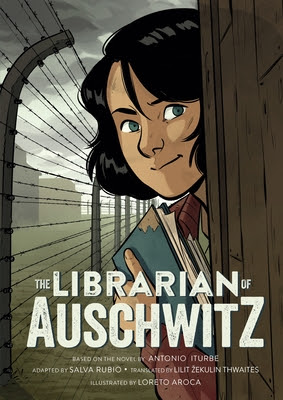
The Librarian of Auschwitz: The Graphic Novel based on the Novel by Antonio Iturbe, adapted by Salva Rubio, illustrated by Loreto Aroca, and translated by Lilit Žekulin Thwaites


Available January 3, 2023
I loved reading comics as a kid and I wasn't above reading a Classic Comic or two or maybe more instead of the book the comic was based on. In school, I was an undiagnosed dyslexic and reading was sometimes difficult. So it stands to reason that as an adult and a teacher, I'm a big fan of books done in graphic format. They are just what some readers need instead of a large and for them, for whatever reasons, unwieldy novel. And for others, they are just a fun way to read. But, the graphic needs to be well done, and in today's world, most of the time, they are. Which is why is pains me to say that I did not like The Librarian of Auschwitz: The Graphic Novel.

This graphic novel is the same story as the novel by the same name and written by Antonio Iturbe, so I'm not going to summarize it again. Suffice it to say it is the story of teenage Dita Adlerova, who was first sent to the Theresienstadt ghetto in Czechoslovakia with her parents and other Jews, and who were all later transferred to Auschwitz-Birkenau. There, they were living in a separate area of Birkenau, called BIIb and referred to as the Theresienstadt Family Camp. These Jewish prisoners were allowed to keep their clothing and their hair wasn't shaved, though living conditions were still as deplorable as in other parts of Auschwitz. If you haven't read the novel, you can read what I originally wrote HERE. The novel is a big book but one that is totally worth spending time with, IMHO. 

Back to the graphic. First, let me begin by saying I did like the art. I found the full color cells were clearly and cleanly drawn in such a way that it was easy to follow the story. The illustrator did a great job at capturing the full range of intense emotions felt by the prisoners of Auschwitz as well as the hate and disgust exhibited by their Nazi captors. Interestingly, none of the characters, Jewish, gay, or Nazi, were portrayed as stereotypical. 

And it wasn't so much that I found the graphic novel to be bad, just lacking. I read the novel back in 2017 and so I'd forgotten some details. Reading the graphic, I found myself confused about a few of the things that went on in Auschwitz and that impacted the main character, Dita, personally. I also didn't feel the importance of the eight books that made up the library was made plain, and how Dita so lovingly cared for them, nor did I feel the reverence with which the borrowers of these books felt for them. 

Some of the characters, like Dita and Fredy Hirsch, as based on the actual people, and of course, so are some of the Nazis like Adolf Eichmann and Josef Mengele, known as the Angel of Death for his experiments of the prisoners in Auschwitz. There is a great epilogue at the end of the book that does go into detail not just about what happened and the people involved.

Ultimately, though, I found this version of The Librarian of Auschwitz to be simplistic and a little stiff. I realize that taking a large novel and synthesizing it down to just 144 pages is not easy task and this was a valiant effort. It just didn't work for me. 

Thursday, September 24, 2020

Displacement written and illustrated by Kiku Hughes

It's 2016, and Japanese American Kiku, 16, and her mother are on vacation in San Francisco from their home in Seattle. Kiku's grandmother had lived in San Francisco before the attack on Pearl Harbor, followed by Executive Order 9066, calling for the roundup and incarceration of all people of Japanese descent living on the West Coast. After looking for house where they lived, Kiku's mother is disappointed to see it has been replaced with a mall. When she goes in to see what's there, Kiku stays outside and that's when the first displacement, as she calls them, happens.

Suddenly, Kiku finds herself in the audience of a violin recital where a young version of her grandmother, Ernestina Teranishi, is performing. Kiku didn't know her grandmother, but she did know that she had been a gifted violinist. Returning to the present, Kiku and her mother head to the hotel, and hear Donald Trump calling for a total shutdown of Muslims entering the US. 

Before leaving San Francisco, Kiku displaces again, this time after Executive Order 9066 has been issued and she finds herself in a line of people being watched by armed guards. Again, returning to the present and heading home to Seattle, Kiku realizes how little she knows about her own Japanese culture and history, in part because her grandmother never spoke to her mother about what happened to the Japanese Americans in the camps. 

Back in Seattle, Kiku displaces once again, finding herself reduced to being Number 19106, and traveling on the same bus as the Teranishi family, heading to Tanforan Assembly Center, a racetrack where the Japanese Americans are forced to live in horse stalls that still smell of manure. There, Kiku lives with a roommate, Aiko Mifune, right next door to the Teranishi family.

Kiku's first two displacements were for short periods of time, but now she finds herself living in the past for an extended time. This means that Kiku can learn something about her grandmother and great grandparents, but it enables author Kiku Hughes to show what went on behind the barbed wire and armed guards. The overcrowding, the poor quality of the food, the lack of privacy in the latrines and showers are part of daily life there, but so is the tenacious spirit of the Japanese people, who are determined to turn their living conditions into something better. Kiku even finds a love interest.

By the time Kiku is transferred to the Topaz Relocation Center in Utah, she knows she won't be returning to the present anytime soon, and determines to make the best of her situation. Once again, she finds herself living near her grandmother and even her love interest from Tanforan. The whole time she is torn as to whether or not to introduce herself to her grandmother, or merely to continue to observe her from afar. Life in Topaz is a real eye-opener for Kiku. People who had been productive and law-abiding are now incarcerated and deprived of their civil rights. When the government issues a loyalty questionnaire,  those who refuse to answer yes on questions 27 and 28, and renounce their Japanese ancestry, face harsh punishment, including Kiku friend Aiko. But after after someone was shot and killed, people really begin to worry about their safety. Does Kiku ever return to the present? Yes, of course, and at a very interesting point in her story. But does her experience in the past change her?  

Displacement is somewhat autobiographical for author Hughes, who also never knew the grandmother who had been in the internment camps during the war. Sending Kiku back in time enables her to show the personal and community trauma that was inflicted on people who had done nothing wrong. What I found most telling is Kiku's feelings of helplessness and her gradual acceptance of her incarceration. That was scary, given today's world. 

I think Hughes really captured Kiku's emotional truth, and through her, readers also know the emotional truth of her grandmother and all the other Japanese people who had been incarcerated for no other reason than their race. Though the word interned is generally used to describe what happened, Hughes chooses to use incarceration, given that people had no freedom and lived surrounded by barbed wire and armed guards, it really did resemble prison-like conditions. 

Displacement is one of the best graphic novels I have read about the Japanese American experience in WWII. You might want to pair it with George Takei's They Called Us Enemy.

You can find an interesting and enlightening interview with Kiku Hughes HERE 

This book is recommended for readers age 12+
This book was an eARC gratefully received NetGalley

Monday, August 24, 2020

Lizard in a Zoot Suit by Marco Finnegan

It's June 3, 1943 and twin Latinx sisters Flaca and Curata have just stumbled upon Dr. James Rogers, a naval geophysicist and a few sailors digging in their Mexican American Los Angeles neighborhood of Chavez Ravine. After almost getting into a fight with the sailors for lewd remarks directed at Curata, the sister return home. Later that night, after their mother falls asleep, the girls take the family pickup truck and head to downtown Los Angeles to hangout and party with friends, all of whom are part of the city's Zoot-suit culture. But when a sailor bumps into Curata, a fight begins. 

Some of the sailors chase Curata into a dead end alley. Scared and with no place to escape, a manhole cover opens and a large lizard-like creature climbs out and scares the sailors away. When Curata faints, the lizard takes her into the underground tunnel he came out of, followed by Flaca. And unknowingly also followed by one of the sailors working for Dr. Rogers, who immediately calls the scientist. 

The lizard doesn't speak, but seems to understand Curata and Flaca and takes them home through the tunnel. It turns out that the creature, whom they call Chulito, has become separated from his family. The next morning, they decide that he should be reunited with them, if they are even still alive. After all, they understand separation and loss, they lost their dad, a soldier, in the war. But the night before, police and servicemen beat and arrested the mainly Mexican American Zoot-suiters in Los Angeles, resulting in the start of the Zoot Suit Riots. 

Deciding to disguise the lizard, they put him in one of Flaca's Zoot suits. But before they even leave their neighborhood, they encounter Dr. Rogers and his sailors looking for Chulito. A fight ensues between the sailors and the Flaca and Curata's other Zoo-suit friends, but the sailors manage to capture the lizard. Desperate to get him back and help him find his family, the sisters get some help from a very unexpected person. But will they find Chulito?

Done in two tone panels of black and yellow, Lizard in a Zoot Suit is an interesting look at a particular time and place in history. At first, it seems like just an excitying historical science fiction story, until you discover that some of it is based on reality. Curata and Flaca are great characters. Curata wears skirts that she's rolled up to make shorter and has a real soft heart for animals, which is why Chulito appeals to her so much. Flaca has a hot temper when it comes to racist remarks, especially when directed at her and her sister, which is how she sometimes gets into fights, and dresses in Zoot-suits when they go out. Both are proud Mexican Americans, proud of their father's service despite losing him, and both are kind, caring teens. 

Right from the start, readers will know that Dr. James Rogers is a smarmy corrupt scientist looking to make a fast buck and a claim to fame on the back of Chulito, and the sailors he gets to help are all white and racists, and all to happy to go after Zoot-suiters with their fists. 

The result is a graphic novel that brings together the 1943 Zoot Suit Riots, the legend of an underground reptilian race living in tunnels under Los Angeles, and the treatment of the Latinx community displaced by housing discrimination. 

Written in English, Finnegan throws in lots of Spanish, most of which is easily understandable by context alone. I did look up pachucas, which in this case means Zoot-suiter. 

Pair Lizard in a Zoot Suit with Margarita Engle's verse novel Jazz Owls: A Novel of the Zoot Suit Riots for another perspective of Los Angeles' Zoot Suit culture and riots.

You might also be interested in reading about how author Marco Finnegan can up with the idea for his graphic novel. You can find it HERE

And you might also like to read about the real person looking for the underground reptilians. You can find it HERE 

This book is recommended for readers age 13+
This book was purchased for my personal library

Monday, June 15, 2020

Superman Smashes the Klan by Gene Luen Yang, art by Gurihiru

Superman was both a popular comic and radio show during World War II, but once the war was over, there were no more Nazis to fight. So, Superman's creators turned their sights to the home front and, at the request of the Anti Defamation League, they took on the KKK. Beginning on June 11, 1946, the radio show ran a 16 part story called "Clan of the Fiery Cross." Each episode was 15 minutes long and sponsored by Kellogg's Pep Cereal. The story proved to be extremely popular, except of course with the Klan, who encouraged members to boycott Kellogg's products. 

Flash forward to 2019. Leave it to Gene Luen Yang to take the story from the radio show and give it his own magical touch turning it into a graphic novel and making it as relevant today as it was in 1946. The premise is basically the same: a Chinese American family - Dr. Lee, his wife and two children, Tommy and Roberta - have just moved out of Chinatown and into a new house in the center of Metropolis. 

Roberta is a rather timid soul, not at all happy about leaving the comfort and safety of Chinatown. Tommy is much more outgoing, but the two siblings really care about and look our for each other 

High schooler Tommy loves to play baseball and is an ace pitcher. On a walk to explore their new neighborhood, he and Roberta meet neighbor Jimmy Olsen who just so happens to also coach a baseball team. But when Tommy beans star batter Chuck Riggs on the head with a baseball during a tryout, Chuck goes ballistic with racial slurs about the Lee siblings. Chuck is immediately fired from the team. At home, it turns out, Chuck's uncle Matt is head of the local Klan of the Fiery Kross and after hearing what happened, he decides it's time for Chuck's initiation into the terroristic activities of the Klan. Chuck's initiation is to help the Klan "burn away America's impurities" and drive the Lee's out. After a cross burning on their lawn and an attempt to burn their home, the Lee's African American neighbors, including Inspector William Henderson of the Metropolis police arrive to help put out the fires. The next morning, reporters Lois Lane and Clark Kent arrive to get the story for the Daily Planet.

Meanwhile, Superman is have problems of his own. The war may be over, but after Superman defeats Atom Man, avenger of the master race, he is left in a weakened state. Under the swastika bearing device that gives Atom Man is super strength is a green crystal (Kryptonite) that causes Superman to smell ash and rot and something else that is familiar, but he just can't remember what it is. The effect of the crystal on Superman continues, causing him to have strange dreamlike interactions with his parents who died when Krypton was destroyed. Suddenly plagued with self-doubt about his purpose and place as a foreigner on earth, Superman struggles with his identity.

Superman's struggle with his identity mirrors that of Roberta Lee's struggle to fit in and accept this part of Metropolis as her new home. Tommy is a great big brother to Roberta, and Jimmy Olsen, Clark Kent/Superman and Lois Lane all offer support as she struggles to find herself and fit in.

I really love a good Superman story and Superman Smashes the Klan is one of the best I've read. The story was originally issued in three limited edition comic books before the graphic novel was published, which is also divided into three chapters. Yang has diversified the characters more than the original 1946 radio program, and has made Roberta Lee and Superman the main protagonists. He has cleverly kept the story in the past yet the overriding issues haven't yet been resolved and the issues of identity and racism will definitely resonate with today's readers. Chuck and his uncle are perfect examples of how racism is passed on from one generation to another. Chuck almost becomes what his uncle wants, mostly because he is afraid to stand up to him for fear of what his uncle will do to him and his mom. Yang gives readers a Chuck who is at the point where he can become racist or reject it. His feelings of helplessness are so real and it's a hard choice for a kid to make. But I loved how Yang handled it.

One of the things Yang emphasizes is the importance of being a part of an accepting community. Tommy and even Roberta have supportive parents and they both find friendship immediately with the new baseball team Tommy joins. Roberta also find friendship and acceptance with Superman, who takes her under his cape, and Lois Lane, who becomes a kind of mentor for Roberta's writing aspirations. Yang also gives his characters much more agency than they were ever given in the old Superman stories. No longer passive "victims" of evil doers waiting for Superman to rescue them, they often take matters into their own hands to help themselves. 

The art for Superman Smashes the Klan was done by Gurihiru, a Japanese team of two women, Chifuyu Sasaki and Naoko Kawano, who have had lots of experience doing the artwork for a number of DC, Marvel, and Dark Horse comics. Their work here is done with a palette of bold and subtle colors, and each of the cells are clean and uncluttered, and really help move the story along. 

Be sure to read Yang's essay "Superman and Me" in the back matter. It is interesting, informative, historical and not what you might expect. 

Superman Smashes the Klan is everything I could want in a graphic novel and more. 

This book is recommended for readers age 12+
This book was purchased for my personal library

You can listen to the original 1946 radio version of "Clan of the Fiery Cross" HERE

Tuesday, March 3, 2020

Catherine's War by Julia Billet, illustrated by Claire Fauvel

**Contains Spoilers**
It's 1942 and Rachel Cohen, a Jewish teen, has been enrolled in the progressive Sèvres Children's Home just outside Paris for four months. It's also been months since she heard anything from her parents and has no idea where they are or what may have happened to them. Luckily, she loves being part of Sèvres, and is convinced that the kind husband and wife who run it, Penguin and Seagull, are part of the French resistance. Thanks to Penguin, Rachel has found an interest in and has a talent for taking photographs and he has lent her a Rolleiflex camera, and has even taught her how to develop the photos she takes.

But as the Nazi stronghold in France tighteneds, and Jews are required to wear yellow stars, the heads of  Sèvres refuse to force that on their Jewish students. Instead, the students are asked to change their names to ones that are more Christian sounding and are given false identity papers. Rachel becomes Catherine Colin.

But when the Nazis begin rounding up Jews, it becomes clear that Sèvres is no longer safe for its Jewish students, even with false papers, and plans are made for the students to be spread around France for their safety. Catherine alias Rachel is sent to a convent in Riom with a younger student named Alice, but not before she is gifted the school's precious Rolleiflex camera by Seagull, who tells her to take photos of everything she sees as testimony after the war.

In Riom, Catherine is forced to eat pork, take catechism classes and communion in order to keep her cover. Taking photos proves to be the thing that helps her through. Then, in town to get her photos developed, she meets Étienne, who lets her use his darkroom. Catherine and Étienne are strongly attracted to each other, but when the convent is reported to the Nazis, it is time for Catherine and Alice to move on.

Over the course of the Nazi occupation of France, Catherine and Alice are sent to a small farm in Limoges, then an orphanage in the Pyrenees, where she and Alice go their separate ways, and finally to another small farm. But when France is finally liberated by the Allies, Catherine returns to Paris, where she hopes to find her parents. Instead she finds their apartment trashed and no information about what happened to them. But she is able to reconnect with Seagull, Penguin, and Alice. In 1945, she is finally able to become Rachel Cohen again. Rachel now finds there is a great deal of interest in the photographs she had taken all through her travels during the Nazi occupation and is offered a show in an art gallery. And finally, she and Étienne also reconnect, and yes, they eventually marry and move to the United States.

Catherine's War is based on the real life experiences of the author's mother as a Jewish teen in France during WWII. It is a powerful coming of age story that interrogates questions of identity during a time of crisis, when who one is was all that the Nazis needed to arrest and send you away, often never to be heard from again, like Rachel's parents.

This is one of the best graphic novels I've read in a while. The story's text is clear, straightforward, and succinct, thanks to the excellent translation from the French by Ivanka Hahnenberger. Text and panels harmonize completely, making Rachel's story easy to follow despite so many characters and places. In her ink and watercolor panels, artist Claire Fauvel captures the differing emotions of the characters - fear, anger, happiness, loneliness, kindness - remarkably well, so that nothing is missed and there is no ambiguity. She used a palette of subtle dark grays, blues, and browns, which touches of brighter colors throughout. These dark colors reflect the dark times in which the story takes place.

When I was in college and living in the East Village in the early 1980s, I used to have an old Minolta SRT 101, that I absolutely adored. I also had a pen and ink drawing of it with the words "It's All in the Focus" written in the lens that a friend made for me. I learned a lot about life through my camera's lens, especially when the Aids crisis hit the village so hard then. For me, there is no question as to the power of art to bear witness and convey truth. I think this idea is brought to bear in an important conversation between Rachel and Étienne. He prefers portrait and landscapes while Rachel prefers more candid, in-the-moment daily life shots. The question becomes whose camera tells the greatest truth or do they both, but in different ways? Something to think about.

Back matter includes a map of Rachel's travels between 1942 and 1945, as well as some of the real photos taken by the author's mother, Tamo Cohen. There are also four pages of questions from readers with the author's answers.

Catherine's War is a story, as Julia Billet writes, "that reminds us that even when the wolves are howling death at your door, there are women and men who are still faithful to mankind." So, while this could be classified as a Holocaust story, it is also a resistance/survivor story. Either way, it is a graphic novel not to be missed.

This book is recommended for readers age 9+
This book was purchased for my personal library

Sunday, August 4, 2019

Sunday Funnies goes on a Blog Tour: Dear Justice League by Michael Northrop, illustrated by Gustavo Duarte

So, you all know how so many favorite Superheroes were a mainstay for American youth during WWII, right? Back then, the Justice League was formed and called the Justice Society of America (JSA), but eventually, morphed into the Justice League of America (JLA). In 2011, the JLA was reintroduced as the Justice League (JL), and that's pretty much where it stands today.*  The name may have been changed over time, but the members not so much - there's Superman, Batman, Wonder Woman, Hawkgirl, Aquaman, the Flash, Green Lantern, Cyborg.

All of this brings us to Dear Justice League. Here are America's great superheroes, seemingly perfect in every way, but haven't you ever wondered if their lives are really as perfect as they seem. Don't they have any faults, or screw up once in a while, maybe make a wrong decision, or perhaps even have some good advice for the rest of us?

Yes, they do and you can find it all between the covers of this delightfully silly, sometimes serious look at some of the Justice League's not so spectacular adventures as they answer emails from some of their fans.

One boy wants to know if Superman is super all the time, so Superman recounts a time he flew into a building because he was texting while flying (twf). This set off a series of hilarious events that he tries to handle all over Metropolis, ending in Superman getting a ticket for, what else, twf.


Does Wonder Woman have any advice for an 10-almost-11-year old? You bet she does, and it involves her 11th birthday and some cake.

Or how about Batman, always so brave, so fearless, has he ever been scared? asks a boy about to go to a new school and afraid he's going to be picked on the way he was at his old school.

Dear Justice League is divided into nine chapters, one for each Superheroes' story and a final chapter that ties it all together. There is a storyline running through each chapter that connects each story to the others involving a insectoid that escaped Hawkgirl's mighty mace. Insectoids are giant mantis-like alien bugs from the planet Molt-On and can replicate very quickly and easily so it's important for the Justice League to deal with them. But as insectoid's keep replicating exponentially, can they be stopped, even by Superheroes?

This is such a fun book to read, and I know young fans of the Justice League will love it. It has a very energetic, tongue-in-cheek text, but nothing really over the heads of young readers. And Duarte's colorful cartoon-like illustrations will no doubt appeal to kids. I liked that the Superheroes take the time to answer kid's email questions, and the way some of the stories circled back to the email writer to show how the advice they got helped them.

It seems that most kids go through a phase of being totally into Superheroes and this is geared perfectly for the age when that usually happens, a time when kids are out in the world because of school and activities and life is beginning to get more complicated and a little Superhero fantasy helps. I know my Kiddo went through a Superhero phase (and probably hasn't outgrown it yet, if truth be told).

Dear Justice League is a fun definite-must-read book for fans, and ideal for introducing kids to the Superhero realm, and might even hold appeal for reluctant readers.

This book is recommended for readers age 8+
This book was an EARC received from the publisher

Be sure to visit the other stops on the Dear Justice League Blog Tour:


*If you really want to read the complicated history of the Justice League, you can find it HERE

Wednesday, March 1, 2017

Seeking Refuge: a graphic novel by Irene N. Watts, illustrated by Kathryn E. Shoemaker

Back in 2014, I read and reviewed a trilogy by Irene N. Watts called Escape from Berlin. The first book, Good-bye, Marianne, tells the story of Marianne Kohn, 11, a young Jewish girl living in Berlin, with her mother. Her father has been missing since before Kristallnacht and her mother is working in an orphanage. It was through her work there that Marianne was able to secure a last minute place on the Kindertransport.

Seeking Refuge is the graphic form of the second book in the trilogy, which is called Remember Me, and picks up where Good-bye, Marianne leaves off.  Marianne has just arrived in London, where she is sent to live with the very wealthy and very snobbish Mr. and Mrs. Abercrombie Jones. Mrs. Abercrombie Jones immediately changes her name to Marianne* to Mary Ann, gives her a small room in the servants quarters and has her helping out around the house. Luckily, Marianne is allowed to go to school where she makes a friend named Bridget O'Malley. But when the two girls come up with a plan to find a someone who will sponsor Marianne's mother so she can also leave Germany for England, Mrs. Abercrombie Jones finds out and puts a stop to it, angry that she has been humiliated in front of her friends. Once the war begins, however, Marianne is evacuated out of London with the rest of her school and away from the Mrs. Abercrombie Jones.

From London, Marianne finds herself in Wales, but has a hard time finding a family that wants her. Finally, she finds herself in the home of a couple who have recently lost their daughter and expect Marianne to take her place - almost literally. When that doesn't work out, she is taken to another place, where she is met with a wonderful surprise.

I am a big fan of graphic novels. They are very appealing to reluctant readers and can be used in classrooms to supplement social studies classes. They are fast to read and don't require the kind of time as would a novel. Of course, that means that the graphic novel has to be done well, since it must convey the same information as a novel using a combination of words and illustration.

For that reason, I was very apprehensive about recommending Seeking Refuge at first. Even though I had read the novel, I was a little lost. I think I was a little put off by the fact that the illustrations are done in shades of gray and white, and that there is absolutely no other colors throughout. Ironically, for years whenever I thought about Nazi Germany and WWII, I thought about it in shades of gray. as though the sun never shone throughout the war and the Holocaust. Yet, the more I thought about what I was reading, the more I realized that here was a graphic novel that had actually succeeded in getting the story across and that the illustrations were perfect for the subject matter.

Both Watts and Shoemaker have created a story that really manages to convey the fear, the tension, the unease of a refugee arriving in a country where she is not really welcomed by everyone, and even looked down on by some. No one takes into consideration how a 11 year old girl might feel having just left her family behind in a dangerous place, never knowing if she will see them again, knowing no one in the foreign country that she was sent to for safety and not really understanding the language that well. It's pretty daunting, when you think about it. And hopefully, this is a book that will get young readers thinking, particularly in a time when we are seeing refugees seeking a safe place only to have the welcome mat pulled out from under them.

I did discover that an earlier graphic novel was published some years ago that tells the first story in the Escape from Berlin trilogy called Goodbye, Marianne which I know is still available but I haven't read it yet. I did think that Seeking Refuge stands on its own, but I would like to read the first graphic novel someday.

The book is recommended for readers age 9+
This book was purchased for my personal library
*In German, the final e has a soft uh sound, as in Emma


Monday, June 9, 2014

Gaijin: American Prisoner of War written and illustrated by Matt Faulkner

Koji Miyamoto, 13, his American mom and Japanese dad have been living a quiet life in San Francisco.  But when the Japanese attack Pearl Harbor on December 7, 1941 all that changes immediately.  Koji secretly fears his father may have been part of the attack since he was in Japan when it happened taking care of his sick father.  At school, he is picked on by a group of bullies, the trolley operator won't let him on the board and the government has taken away the family radio, insinuating that all Japanese are spies.

Finally, Koji's mom receives a letter saying that he is to be sent to a "relocation camp" which is nothing more than the Alameda Downs, a former racetrack.  His mother decides to go with him, but because she is white, not Japanese, she and the camp commander become friends.  Koji, who is called Gaijin (outsider) by the other Japanese boys finds himself getting bullied by them.  After getting caught fighting, an elderly old family friend man, Yoshi Asai,  takes Koji under his wing.  But after the two create a Victory Garden, the bullies go after it night after night.

Koji finds himself getting more and more angry as the days go by, at the government for putting them in horse stables and then treating them like they are all criminals; at the bullies for making him feel like he doesn't belong anywhere.  Pretty soon a rift develops between Koji and his mom, fueled by the bullies repeatedly calling her the camp floozy.

The bullies set up all kinds of dangerous tasks for Koji to do with the promise of belonging as his reward.  As the tasks get riskier, Koji faces the possibility of being sent to a very unpleasant correction facility alone.  Is his desire to belong or his anger so great that his is willing to risk that fate?  Or can the gentle elderly Mr. Yoshi Asai help keep Koji from getting into more trouble?

Gaijin: American Prisoner of War is based on a true story from author/illustrator Matt Faulkner's family, as he explains at the end of the story, making it personal and affecting.  Using the graphic novel format, allows the reader to see the anger, confusion, fear, all the understandable feelings of a young man forced to live the way the Miyamoto's were, and being treated like an enemy alien because of his race, not his citizenship.

The illustrations are done using watercolor and gouache in rich vibrant colors very reminiscent of the early 1940s.  Gouache is the perfect medium for this graphic novel, with its large bold energetic  images, sometimes only one to a pages, other times as many as five.  Much of the story comes through the illustrations, with little text but together they really capture every humiliating element of the internment of the Japanese in WWII.

The more I read graphic novels, the more I appreciate them.  When they are done well, as Gaijin is, they can be a way of introducing difficult topics to young readers and may serve as a way to interest reluctant readers.  

Another excellent book about this still not widely known about part of American history.

This book is recommended for readers age 9+
This book was bought for my personal library

Friday, April 25, 2014

Hidden: A Child's Story of the Holocaust by Loïc Dauvillier, illustrated by Marc Lizano

When Elsa, 6, discovers her grandmother, Dounia Cohen, crying one night, the little girl convinces her to talk about what's causing her tears.  And so, her grandma begins telling her about her own life when she was Elsa's age living in Paris.

Her best friend was Catherine and they both had a crush on Isaac, and all three went to the same school.  One day, when Dounia came home from school, her father was already there.  He told Dounia there were to become a family of sheriffs and soon a yellow star was sewn onto her clothes.  The next day, Isaac didn't show up for school and Dounia was told to sit in the back of the room, and learned that her star was meant to mark her as Jewish, not a sheriff.

When the police show up at the door one night, Dounia's parents put her into a hiding place and tell her to quietly wait for someone to come and get her.  When her neighbor comes, Dounia learns that her parents had been taken away, and the apartment ransacked.

The neighbors, Mr. and Mrs. Péricard, take care of Dounia in secret as long as they can, but eventually they learn that the police are planning a surprise visit to find her.  Dounia's name is changed to Simone Pierret, but before they can get away, someone spots Dounia.  She and Mrs. Péricard make it to the prearranged point for Dounia to be picked up and moved, but now Mrs. Péricard is also in danger and has no idea what happened to her husband.  The two are taken to the farm of an older woman named Germaine by Resistance workers.  Dounia had been told she must think of the Péricards as her parents, and now as Simone, she also becomes a young Catholic girl in order to keep her safe and hidden from the Nazis.

Dounia and Mrs. Péricard remain on the farm for the rest of the war, each wondering what became of their loved ones.

Hidden is the powerful story of a young girl who doesn't completely understand what is happening around her, why people suddenly dislike her and all other Jews so much and, most importantly, the sudden disappearance of so many people including her parents,   How does one deal with this?  Clearly, it took Dounia years to do that, since even her own son didn't know about his mother's experiences in Nazi occupation of France.

How does a young reader who is hearing about the Holocaust for possibly the first time deal with such a disturbing subject?  Clearly, a book about the Holocaust for kids, whether it is a graphic or traditional picture book, requires a very fine balance between story, information, and illustrations so that the story gives just the right amount of age appropriate information, but not so much that you frighten kids.  Hidden is a book that is so powerful in its simplicity, to honest in it telling that it definitely achieves this fine balance.

The translation by Alexis Siegel from the original French into English contains no ambiguities, and the dialogue flows comfortably and naturally.  I seem to be reading graphic novels about World War II and the Holocaust more and more lately, and they seem to be getting better and better.  The illustrations by Marc Lizano are reminiscent of a child's drawing, though the background is more sophisticated.  Still, the faces, even in their simplicity, really manage to convey a wide range of emotions - fear, sadness, anger, kindness, hate, love and ultimately even hope.  And the colorist, Greg Salsedo, really gives the illustrations a sense of the time, place and mood using his color palette.

Dounia's story is similar to that of many children in France.  In fact, in the Afterword, Hellen Kaufmann, president of the AJPN (Association Anonymes, Justes et Persecutés pendant la période nazie) writes that 84% of Jewish children living in France before the war survived because of people like Mrs. Péricard and Germaine and the Resistance workers who found safe homes for them were willing to risk their own lives to hide and protect these children from the Nazis and the collaborating French police.

This book is recommended for readers age 6+
This book was purchased for my personal library