Showing posts with label Survival. Show all posts

Monday, September 12, 2022

Resist: One Girl's Fight Back Against the Nazis by Tom Palmer

A few years ago, I read a book called Dutch Girl: Audrey Hepburn and World War II by Robert Matzen, so I knew about her experiences during the war. What I didn't know when I started reading Resist, the new WWII book by Tom Palmer, was that it is a fictionalized story inspired by Audrey's life during the war. 

It's 1943, and Edda, 15, has a sheaf of illegal resistance newsletters stuffed inside her socks to be delivered to certain addresses. The delivery is her first her first resistance assignment and Edda is nervous, knowing if she were caught, it would mean death at the hands of the Nazis. Edda volunteers at the hospital, and had  asked Dr. Hendrik Visser't Hooft, a leading figure in the resistance, if she could help there, too. Years of studying ballet in England had given Edda an excellent memory, and she proved herself able to easily memorize the addresses for the newsletter delivery.

The Nazis had been occupying the Netherlands since 1940, forcing Edda's brother Alex to go into hiding to avoid being picked up by the Nazis and sent to a slave labor camp in Germany, and her Uncle Otto was one of 460 men who had been arrested and executed by the Nazis. So imagine Edda's stunned surprise when she sees her mother's name listed as a Nazi sympathiser in the newsletters she's carrying. How could Edda possible prove that her mother wasn't a collaborator?

When Dr. Visser't Hooft asked Edda if she would be interested in dancing as part of an evening of entertainment, a secret performance done after dark, to raise money to help people in hiding. she thinks this would help prove her mother's support for the resistance. But when she asks her mother's permission, Edda was told no, she could not participate, it is just too dangerous. After the Germans pick up her other brother Ian, 17, to send to Germany, Edda's mother has a change of heart and gives her permission to perform. On the way home from the performance, Edda finally asks her mother why she had been listed as someone not to be trusted and is relieved to learn that her mother feels it was a mistake to support Hitler and is now on the side of the resistance.

By 1944, the Dutch are hearing on illegal radios that the Allies are moving closer to Holland. But the Germans are getting desperate and are stealing most of the food for themselves and letting the Dutch starve. When the British finally arrive not far from Velp, everyone begins to hope the war will end for them soon. But the British are defeated, as is the hope of the Dutch. Then, one day, Edda is caught by German soldiers along with other girls her age. Afraid she would be sent to Germany like her brother Ian, Edda takes a chance and runs away, knowing how to avoid the soldiers because her resistance activity had taught her all she needed to know about the streets of Velp. 

When her mother hears what happened, Edda is sent to the cellar for her own safety with the rest of her family as the war continues above them. Early one morning, there's a knock on their front door,  and after her mother and grandfather go see who it is, they return with a box of food, apparently from the American army. Could it be that the war and the Nazi occupation in the Netherlands is finally coming to an end? And will Edda ever see her brother Ian again?

Resist is an interesting story, in part because I knew it was inspired by Audrey Hepburn's family and her resistance work. More importantly, however, Palmer shows his readers, without being too graphic, just what it was like for the Dutch people under Nazi occupation - the cruelty of the Nazi soldiers, the disregard for the lives of the Dutch people, and the extent of the starvation they were subjected to. 1944 was infamously known as the Hunger Winter. And just as importantly, the strength of the Dutch during that time. At one point, Edda, already an accomplished dancer, even gave ballet lessons to the local children. 

Palmer's portrayal of Edda is sensitive and I think true to who the real Audrey Hepburn was. He has brilliantly captured her thoughts, her fears for herself and her family, her anger at the Nazis for what they have done to her beloved country, friends and neighbors, and her need to resist the occupiers. These are the same qualities that followed Audrey Hepburn throughout her life, and lead her to do so much humanitarian work as well as acting.  

Back matter includes information about Audrey Hepburn as the inspiration for Edda, the occupation and starvation of the Netherlands, resistance activity there, a bit about Audrey Hepburn and Anne Frank, Audrey Hepburn and her work with UNICEF. and finally, Tom Palmer's research for this novel, including several biographies of Audrey Hepburn, and recommended children's books, such as Tamar by Mal Peet, among others. 

Resist is published by Barrington Stoke known for their books that are adapted for dyslexic and reluctant readers. and as a dyslexic, I can't recommend them highly enough.

Saturday, March 19, 2022

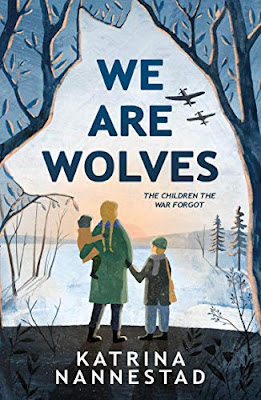
We Are Wolves by Katrina Nannestad

Despite the war, the Wolf family - Opa, Oma, Papa, Mama, Liesl, 11, Otto, 7, and baby Mia - had lived a relatively comfortable life in East Prussia. But now it is October 1944, the Russian army is advancing westward, and in desperation, Hitler has called up teen boys, older men, and those who are disabled to fight to save his Reich. Papa, who was injured in WWI, is drafted and by Christmas Eve, he is missing in action.

Soon after, the family learns that the Russian army has broken through German lines and are advancing in East Prussia. Everyone to told to quickly flee because it was well known that the Russians have been doing terrible things to German men, women, and children, as they advanced. Luckily, Opa manages to find an old car, but that only takes the family so far, and soon they are fleeing on foot in blizzard conditions with so many others. Soon, Opa and Oma decide they need to rest and will catch up with the family later. Opa tells them to head for the Vistula Lagoon and to try to get on a ship to Denmark.  Mama and the children get separated trying to cross the frozen lagoon on a sled, but by the time Liesl, Otto, and Mia make it to the other side, Mama has disappeared from the ice. 

Liesl had already promised Mama that no matter what, she would take care of the brother and sister. While staying in an abandoned house, they are discovered by some Russian soldiers. Luckily, one is a kind man and he takes them to a Russian army camp where they are treated with some kindness, but when Liesl realizes that the Captain has designs on taking Mia away from her and sending the baby to his wife in Russia, she knows it is time to take her siblings and run away. And the only place to run to is the forest. There, they discover they are not alone when they meet other homeless children trying to survive on their own in the woods and stay out of Russian hands. 

Life in the woods isn't easy, continually foraging for food and some measure of shelter. But long the way, they also meet Karl, who helps them learn the ropes, even if it sometimes means learning how to steal what they need to survive. Learning that there is food in Lithuania, Liesl and Karl decide they should try to get there and plan on jumping into a train as it moves out of the station. Karl and Otto make it, but Liesl, holding Mia, doesn't. Thinking she's lost Otto, Liesl is surprised when he comes running back, having jumped off the train. When they finally do make it to Lithuania, Mia is quite sick and Liesl isn't sure she will survive. But, they are taken in by a couple, Magdalena and Dovydas, who help nurse Mia back to health. And while their situation is comfortable and safe, Liesl wonders if they will ever be reunited with their family again. 

Nannestad's book highlights a phenomena that occurred toward the end of WWII when East Prussian children were separated from their parents for one reason or another as the Russian army advanced and took to living in the forests to survive. These homeless children became known as Wolfskinder or wolf children. Some were adopted by Lithuanians, despite harsh punishment by the Russians if they were found helping Germans, even if the Germans were only children.   

I thought We are Wolves did a great job at depicting the harsh conditions and difficulties the Wolf children faced from the moment their family decided to flee until they were finally taken in by kind Lithuanians. I liked the way Nannestad explored themes of family, courage, resilience, and identity (especially important given that the Wolf children had to have their names changed in Lithuania for safety's sake). I also like the way the name Wolf was capitalized on throughout the novel as Liesl kept reminding herself and her siblings that they were Wolfs, and each section was captioned using the word wolves, for example: Proud Wolves, Wild Wolves Vanishing Wolves.

The Wolfskinder may be a little known aspect of WWII, but given what is happening right now in the Ukraine, I believe We are Wolves will definitely resonate with today's readers, who are seeing for themselves what the ravages of war does to families. I highly recommend this book.

This book was purchased for my personal library.

Monday, October 18, 2021

Boy From Buchenwald: The True Story of a Holocaust Survivor by Robbie Waisman with Susan McClelland

Boy From Buchenwald: The True Story of a Holocaust Survivor
by Robbie Waisman with Susan McClelland
Bloomsbury, 2021, 288 pages

In 1942, 11-year-old Romek Waisman was marching to work at a munitions factory in Poland when a SS officer pulled him out of line and ordered him to get in a truck headed for a death camp. Like all the other men already in the truck, Romek had been ill. But fate stepped in and Romek was given another chance to live. 

In April, 1945, American troops liberated the Buchenwald Concentration Camp, where Romek had eventually been sent. He was one of a 1,000 children who had survived the Holocaust and placed under the protective services of the Oeuvre de Secours aux Enfants or OSE. In June 1945, Romek, along with 426 other boys, including Elie Wiesel, was sent by train to Écouis, France, where they could be rehabilitated. Ironically, the boys were dressed in Hitler Youth uniforms that had been found in a storage room in Buchenwald so that they could discard their striped lice infested camp pajamas. On the trip to Écouis, many of the French people who saw them, mistook who they were and began throwing rocks at them.

At Écouis, there was plenty of food, clean sheets and bathrooms, but after years of starvation and mistreatment, the boy were somewhat feral. That, combined with anger, caused them to behave violently at times, to steal, and to hoard. 

In between learning how to adjust to life after living under Nazi oppression for so long, Romek slowly regains memories of his loving family and his happy childhood before the Nazis invaded Poland and his experiences working in the munitions factory and later in Buchenwald. Throughout his ordeal, Romek held on to the idea that after the war and liberation, he would return to his home in Poland, where his family would all be there waiting for him. Much of his journey, then, is about coming to terms with the reality of what happened.

At one point, Romek's older sister is found and he journeys back to Germany to see her, but when she tells him she will be married soon and moving to Palestine, he returns to Écouis. There, he also meets a wealthy French couple Jean and Jane Brandt, who want him to meet their children. Jane begins taking Romek on cultural excursions, but when they offer to adopt him, he declines. 

After finally accepting the fact that only he and his sister survived, in 1948, at age 17, Romek emigrated to Canada, to begin a new chapter in his life and where he changed his name to Robert (Robbie) Waisman. Robbie married and had children, but it was many years before he could speak about his experiences under the Nazis. 

Boy From Buchenwald is a riveting read, and certainly one that is needed now as more and more survivors of Nazi atrocities are dying off. Robbie tells his story in an almost stream-of-consciousness manner, which might be confusing to some readers since it isn't always linear. And many of the incidents that Robbie writes about may also be difficult for them, but, despite that, this is a book that should be read and discussed. Robbie and his friends were so traumatized by what they experienced, yet they were still able to go on and lead productive lives. Ultimately, then, this book is quite inspiring and shows just how strong the human instinct to survive can be. 

Pair this book with Survivors Club: The True Story of a Very Young Prisoner of Auschwitz by Michael Bornstein for another important survivor story.

This book is recommended for readers age 10+
This book was an eARC gratefully received from NetGalley

Monday, August 30, 2021

A Boy is Not a Ghost by Edeet Ravel

Based on true events, this sequel to A Boy is Not a Bird continues the story of Natt Silver.  You may remember that Natt's father was arrested and sent to a gulag in Siberia after their Eastern European home came under Soviet occupation, and he was considered an enemy of the Soviet state.

Now, in the summer of 1941, Natt and his mother, along with 26 other people, have been traveling in a cattle car for more than six weeks after being arrested and are on their way to Siberia. The journey is nothing short of a lice-infested "Train of Horrors, finally ending in Novosibirsk, in southern Siberia. There, they are taken to an outdoor schoolyard where they will be staying. Natt is still haunted by the terrible thing he did after his father was arrested. His mother was told she could see his father through a window at a certain time, but when she and Natt walked by, Natt turned his head away from the window, an act he is sure he will never forgive himself for and is convinced his father won't either. 

Life in Siberia allows for a certain amount of movement, simply because escape is pretty much out of the question. But life is hard hard. There is never enough to eat, clothing is old, dirty, patched, and never warm enough. And each time their circumstances change, Natt thinks things can't get any worse, and yet they do. But Natt also makes friends wherever he goes, who can often help in get wants he wants. There is Irena, 18, who voluntarily travels to Siberia in the same cattle cart as Natt and the others, in order to try and find information about her exiled parents. Natt lives with her for a while when his mother is arrested for "stealing potatoes" after being set up by an official who needed to meet her arrest quota. And there is Olga and Peter, siblings who live in Novosibirsk and whose father has an important and useful-for-Natt job. And Gabi Mindru, 11, whose mother takes Natt in when Irena leaves to find her parents, and who nurses him back to health when he gets deathly ill. Through Gabi, Natt meets Igor, 16, whose father is an NKVD captain, but who also proves helpful to Natt, nevertheless. 

Like the first book, A Boy is Not a Ghost is an very readable novel, and narrated in the first person by Natt, who is as beguiling as ever. His story, which begins when Natt is 11-years-old ends towards the end of the war when he is 15, as you might have surmised, it is a book about fighting to survive every day against all odds. Natt, who often misread people and their motives in the first book, learns to make himself invisible, and to communicated in code and to understand when others communicate to him in code. I wrote about the first book that Natt held on to his innocence in part because there were always enough kind people in his life who really liked him, and though no longer as innocent as he once was, Natt is still an extremely likable  boyand people are often willing to help him.

He is still writing to his best friend Max in Switzerland, though he never hears from him and the reader never finds out if he made to safety. But Natt's letters are a wonderful shortcut vehicle for more giving information about what is happening with Natt and the other exiles in Siberia. 

Though it is a sequel, A Boy is Not a Ghost can be read as a stand alone novel, though I would recommend reading both books. The author, Edeet Ravel, has included a lot of information relevant to Natt's experiences under Soviet occupation in the book's back matter that I would also recommend reading. I read an eARC and did not see all of the chapter illustrations or map that will be in the published book. 

A Boy is Not a Ghost will be available on September 7, 2021. 

This book is recommended for readers age 9+
This book was an eARC gratefully received from Edelweiss+

Sunday, May 9, 2021

MMGM: In A Flash by Donna Jo Napoli

It's July 1940 and though there is a war going on, Simona, 8, and Carolina, 5, have just learned that they will be moving from Italy to Tokyo, Japan for perhaps a year or two. It's only been half a year since their mother died, and now they will be leaving their beloved Nonna, too, in four days. The father, a chef, has been offered a job at the Italian embassy, cooking for the Italian ambassador and his wife, both of whom refuse to eat Japanese food. 

Four days after arriving in Tokyo, Simona begins public school, not knowing the language or having any friends. But by December, she and Carolina have both learned enough Japanese to get by, though Simona still has no friends at school. And within a year, they are both fluent and quite assimilated into Japanese customs. Simona still has no real friends, except Aiko who refuses to acknowledge her at school. Although Simona and Carolina are the children of a servant, the Japanese kids believe they are rich and living luxuriously and that is why they are snubbed. 

When the United States is attacked by Japan and enters the war, everyone assumes America will easily be defeated by Japan. After all, Japan, Italy, and Germany had signed the Tripartite Pact in 1940 pledging to come to each other's aid should their country be attacked. But everything changes in 1943 when Italy surrenders to the Allies. Suddenly, Italians are Japan's enemy and they are all forced into an internment camp, where Simona and Carolina are separated from their father.   

The sisters are able to escape, and begin to make their way across the countryside. As they make their way though Japan, they are able to survive with the help of three women living together, including a manga artist, then with help from a blind washerwoman in Tokyo where their father used to bring the embassy's dirty sheets, and ultimately finding themselves in a Catholic mission in Hiroshima in the spring and summer of 1945.

In a Flash is, to say the least, a harrowing story to read, yet it is compelling and hard to put down as well. Napoli has certainly done her research on what it was like to live in Japan during WWII. What makes this story unique is that the it is written in the first person perspective, by a citizen of one of America's enemies living in a country of another enemy. But while Simona is Italian she isn't political, she is much more an observer and reporter of what she sees around her, often without understanding it. She may sometimes voice some of the propaganda she has been told about the United States, and often observes the behavioral result of Japan's propaganda in those around her, but she remains a child trying to make sure she and her sister survive.

It was difficult reading about the "patriotic" propaganda, but even more difficult was the incredible level of rationing and starvation inflicted on people in the name of victory because it was so realistically portrayed. On the other hand, Simona and Carolina's will to survive in the face of adversity is the stuff of great historical fiction.

I read a lot of Napoli's books and In a Flash is now one of my very favorites. There are a lot of themes and a lot of information to be gleaned from this compassionate thought-provoking, eye-opening novel.

Front matter consists of a map of Japan and back matter consists of a Postscript, Notes on Research, and an extensive Bibliography.

This book is recommended for readers age 10+
This book was borrowed from the NYPL

It's Marvelous Middle Grade Monday and you can see all of this week's wonderful MMGM books thanks to Greg at Always in the Middle

Tuesday, November 24, 2020

Attacked at Sea: A True World War II Story of a Family's Fight for Survival by Michael J. Tougias and Alison O'Leary

In 1941, the Downs family - father Ray, mother Ina, Lucille, 11, and Sonny, 8 - had hoped that by spending some time in Columbia, South America and Costa Rica in Central America, where Ray worked for the United Fruit Company, they would be able to save enough money to buy a house and new car when they returned to the United States. But now that the US had entered the war, they decided it was time to return to their home in Texas and their oldest son Terry, 14, who was staying with his grandparents. Ray also hoped to join the Marines when they were back in the U.S. 

On May12, 1942, the family set sail from Costa Rica on the SS Heredia, a luxury liner turner freighter. The Downs parents were somewhat concerned about the trip. German submarines had been hunting, attacking and sinking American ships in the Atlantic Ocean and along the eastern seaboard, and now they had begun to infiltrate the Caribbean and the Gulf of Mexico as well. 

The ship was equipped two mounted machine guns and Navy Armed Guards who kept watch 24 hours a day for German submarines. Sonny and Lucille were curious about everything on the ship and the crew willingly answered their questions. In fact, as the only two kids on board, they were treated somewhat specially by the captain and crew. 

Meanwhile, two German subs had entered the Gulf on the lookout for ships like the Heredia. Most of the Heredia's trip was uneventful, but close to home, the Navy guards thought they spotted something in the water and the captain decided to change course for Corpus Christi, Texas to see if he could get any information. The Downs family, ready to be home, wanted to get off the ship in Corpus Christi, which was closer to their home, but were not permitted to. They were scheduled to arrive in New Orleans the next day. 

That night, while the passengers were sleeping, the Heredia was hit with a torpedo, followed by more hits. The Downs family managed to make it out of their two staterooms together, but were separated by a rush of water on the deck that sent Ray, Ina and Sonny into the Gulf. 

All four family members survived being sent overboard. Eventually, Sonny found his father, and together with the captain and another passenger managed to get one of the ship's rafts in the water. Lucille was found on the ship by one of the crew who convinced her to jump overboard. Once they were in the water and together with other crew members, he fashioned a raft out of a hatch cover for her to sit on while they held it and swam away from the sinking ship. Ina landed in a slick of warm gooey oil that coated her face, eyes and the coat she had on. Unable to see very well, Ina clung to a piece of flotsam. 

The family spent 24 hours in the water before they were rescued, during which time they suffered from hypothermia, dehydration, and sharks swimming around them. The time spent in the water, hoping to be rescued in time, makes up the bulk of the book. 

The Downs Family

Attacked at Sea is a compelling story of courage and resilience, all the more so because it is not fiction. In fact, I could not put it down. Tougias and O'Leary present the events in the kind of objective journalistic style, including details that fiction might leave out. The writing style, though less emotional that fiction, feels all the more compelling. What is really interesting is the way Tougias told the story from the points of view of each family member individually, as well as the two German captains of the submarines patrolling the Gulf for ships to add to their records. 

Tougias and O'Leary also continue the story with somewhat detailed information of the aftermath of the sinking of the Heredia and the impact it had on the lives of those they wrote about. To date, only Sonny is the only family member still living.  

Back matter includes A Note from the Authors and an extensive Bibliography. Also included are photographs of the family, the German captains, the ship, and some crew. 

Attacked at Sea should appeal to anyone interested in exciting true WWII stories. 

This book is recommended for readers age 10+
This book was an EARC gratefully received from NetGalley 

Tuesday, May 15, 2018

The Promise by Pnina Bat Zvi and Margie Wolfe, illustrated by Isabella Cardinal

On the night that the Nazis took all the adults in their town away, sisters Rachel and Toby are separated from their parents but not before they are given a shoe paste tin with three gold coins in it. Not knowing what is going to happen to them, they are told to use the coins only if they have to, that they would know when the time was right. And most importantly, they must promise to try to always stay together.

Two years later, the sisters are now in Barrack 25 in Auschwitz, along with many other Jewish girls. Every other day, the girls build a wall of heavy fieldstone, and then, they tear it down only to begin again. When a girl gets sick, she is taken to the hospital and never seen again. Everyone in the barrack knows what has happened to her and do their best not to get sick, despite insufficient clothing, food, and bedding in bad weather.

When Rachel becomes ill, there is nothing Toby can do to prevent her from being taken to the hospital while she is working. Discovering Rachel gone when she returns, Toby knows she needs to do something quickly, or she will never see her sister again. Is this the right time to use the gold coins her parents gave them?

Using her wits, some clever planning, some luck, and the gold coins, Toby manages to get Rachel out of the hospital and back to the barrack. But the next day at roll call, she pays dearly for what she has done when the guard sees Rachel on line but not in her roll book. The guard whips Toby on her back with the leash of her dog, but she didn't send Rachel back to the hospital. Both sisters survive the war and walk out of Auschwitz together.

The Promise is a compelling and inspirational picture book for older readers about the importance of keeping promises, of family, and of the strength of sisterly love, particularly under the kinds of circumstances Toby and Rachel found themselves in trying to survive Auschwitz. And although it is a fictionalized biography, it is based on the real life experiences of sisters Toby, mother of author Margie Wolfe, and Rachel, mother of author Pnina Bat Zvi.

Photos of Toby and Rachel
The illustrations by Isabella Cardinal are done in a mixed-media of collage and photos together with textural drawings and finished in Photoshop, and really capture the emotions that sisters were feeling, and the anger and hate the guards had for them. The Holocaust was a very dark time in history and the illustrations aptly reflect that.

Holocaust picture books are always a difficult subject for young readers - how much graphic description to include. If too much is included there's the risk that the young reader will be so traumatized by what they read, that they never want to read about the Holocaust again. And although Toby and Rachel, like everyone in a Nazi concentration camp, faced beatings, brutality, starvation, and death everyday, Wolfe and her cousin Bat Zvi have managed to find a balance between the mistreatment and the love and resilience that kept these two sisters fighting for their lives.

The Promise is an important addition to the literature of the Holocaust, especially as it recedes into history. Keeping the Shoah alive by remembering it is so important now.

This book is recommended for readers age 8+
This book was an EARC received from NetGalley

You can read in interesting interview with authors Margie Wolfe and Pnina Bat Zvi and illustrator Isabella Cardinal HERE

Monday, May 7, 2018

The War Below by Marsha Forchuk Skrypuch

The novel Making Bombs for Hitler is the story of Lida Ferezuk, who was taken from her home in the Ukraine, put in a cattle car and sent to a slave labor camp, where she eventually ended up making bombs for the Nazis. In that same cattle car was Luka Barukovich, also taken from his home in Kyiv, Ukraine. Lida and Luka become friends and watch out for each other in the slave labor camp, but when the opportunity for escape arises, Luka decides to risk it at Lida's urging.

The War Below begins in 1943 with Luka hiding in a truckload of corpses, hoping to escape the camp, return to his home in Kyiv and find his father, who had been taken away by the Nazis and sent to Siberia. Now, wounded, wearing a hospital gown and bare foot, Luka jumps from the truck about two kilometers from the camp, in the rain, and finds his way to what appears to be an abandoned farm. The farm, however, is the home of Helmut and Margarete, an elderly couple who feed and clothe Luka, and urge him to remain with them until spring. But when he discovers that their son is a power-hungry officer from the camp he has just escaped, Luka decides it is time to leave.

By now, the Nazis are losing the war, and there is constant bombing around Luka by the British and Americans. Sticking to wooded areas, Luka meets Martina Chalupa, a girl who has been living and surviving in the woods for a while. The two decide to continue on together, and between Luka's knowledge of natural medicines and remedies (thanks to his pharmacist father) and Martina's survival skills, the two do well together.

Eventually, Luka and Martina run into members of the Ukrainian Insurgent Army, an underground (literally) resistance group. Both Luka and Martina decide to stay and fight with the resistance, Luka as a medical helper and Martina as a soldier. Luka stays with the resistance until the end of the war in 1945, when he is told to head west rather than east. Stalin has decided that if Russians and Ukrainians were captured by the Nazis, put to work and survived, they are traitors to the Soviet Union and are put to death.

Eventually, Luka makes his way to a displaced persons camp, where he begins searching for  his mother and his friend Lida, in the hope that they both survived the war. Eventually reunited with Lida in the DP camp, he is lured away again with the promise that his father has been found and is living in Kyiv. Anxious to see him, Luka boards a truck with other Ukrainians returning home. It very shortly turns out that they have been duped by NKVD (the Soviet secret police) and the plan is to kill them as traitors. But if you have read Making Bombs for Hitler, you pretty much know how Luka's story does not end on that truck.

The War Below, originally published under the name Underground Soldier, is every bit as solid a novel as Making Bombs for Hitler. Both books have been reissued, and they are part of a trilogy. The third book, called Stolen Child, is the story of what happens to Lida's younger sister Larissa, and, I am sorry to say, it is the only one I haven't read yet, but I am hoping it will be reissued as well.

Luka is a strong, resourceful, compassionate character, though he is also racked with guilt at not being able to save his friend David, killed in the Nazi massacre of Babi Yar in 1941, and at leaving Lida behind when he escaped the labor camp, and at not being able to help Martina more. Skrypuch very cleverly incorporates background information about what Luka experienced in Kyiv when the Nazis arrived, so that the reader really understands what is going on for him.

When I wrote about Making Bombs for Hitler, I said it was a real eye-opener for me in terms of what went on in the Nazi slave labor camps. I had the same reaction with The War Below. I haven't really read much about the Ukrainian Insurgent Army (UIA), and how they operated and found it fascinating. Yes, I've written about other resistance groups, but I find they are all unique (see Uncle Misha's Partisans by Yuri Suhl, also about the Ukrainian resistance)

The novel is narrated in the first person by Luka, and it is a captivating novel. From the moment I began reading, I couldn't put it down. And, although there is a lot of overlap with Making Bombs for Hitler, repeating information you might already know, it really doesn't take away from the story at all, but also means this can be read as a stand alone novel.

Skypuch is not afraid to confront and interrogate the cruelties of the Soviet and Nazi regimes, and I again feel that I should warn readers that there are some graphic descriptions that might not be suitable for some sensitive readers. But, I also have to say that the overall story is one that shouldn't be missed, mostly because the Eastern Front is not one most of us are terribly familiar with, though that is beginning to change.

Be sure to read the Author's Note at the back of the book, and you might also find the brief description of the certain historical events included in The War Below to be helpful.

This book is recommended for readers age 10+
This book is an ARC received from the publisher, Scholastic Press.

Thursday, October 26, 2017

Torpedoed! A World War II Story of a Sinking Passenger Ship and Two Children's Survival at Sea by Cheryl Mullenbach

When we think of ships being torpedoed in the Atlantic Ocean during WWII, we generally think of warships being sunk by Nazi submarines, or U-boats. In fact, the first ship sunk after England declared war on Germany on September 3, 1939 was a British passenger ship, the S.S. Athenia, attacked less then 10 hours later.

Mullenbach introduces her readers to the events that led to the sinking of the Athenia and the aftermath mainly through the experiences of two teens who were on the ship and survived. Russell Park, 11, lived in Philadelphia but was already an experienced traveler, who loved history and was fascinated by how things worked. Florence Kelly, 14, lived in Cleveland, loved big band music and going to the movies with her best friend on Saturdays. They were “…two ordinary American kids who weren’t thinking about the frightening actions of world leaders…” (pg 8) as they prepared for their European vacations in May 1939.

And though their summer vacations were cut short by world events, they had been wonderful. But, when Hitler invaded Poland on September 1,1939, Americans in Europe scrambled to book passage, hoping to return home before war began. Through a combination of circumstances, Russell, along with his parents, and Florence and her mother ended up on the same ship sailing home.  Both Russell and Florence were looking forward to returning home to family, friends, and the new school year. 

There were 1,102 passengers and 316 crew on board the Athenia when the ship began her journey across the Atlantic Ocean. At the same time, a German U-boat was also in the Atlantic, commanded by Oberleutnant Fritz Julius Lempe, and searching for ships carrying troops and war materials, which is what he supposedly thought the Athenia was doing when he gave the order to torpedo it.

Mullenbach covers a lot of ground in Torpedoed!  Placing Florence and Russell at the center of events, she manages to fit in a lot of historical information about what was happening in prewar Europe, as well as giving readers an up-close and personal account of the harrowing sinking and rescue of the Athenia’s survivors (128 people did not survive). She even follows up with information about the commander who mistakenly (?) bombed the Athenia. Mullenbach carefully crafts a detailed narrative of this ill-fated journey that is both gripping and so terrifying at times and completely accessible for young readers. And ironically, while their paths crossed several times, Florence and Russell never actually met before, during, or after the Athenia was sunk. 

Torpedoed! is a story that will certainly appeal to everyone, but especially to young readers interested in history, WWII, and nonfiction survivor accounts. Mullenbach has also included lots of photographs and maps to help orient readers, as well as a Time Line of events, Notes and a Bibliography for those interested in more information. 

Interestingly, the Athenia has recently been in the news once again. BBC reported that the remains of the ship may possibly have been discovered a few hundred miles from Ireland, on Rockall Bank. You can read about it HERE


This book is recommended for readers age 10+
This book was sent to me by the publisher, Chicago Review Press

Monday, April 4, 2016

Trapped Behind Nazi Lines: The Story of the U.S. Army Air Force Medical Evacuation Squadron by Eric Braun

Here is a little known harrowing story of courage and survival that could rival any novel written about WWII.

On November 8, 1943, a group of 13 Army medics, 13 Army nurses and a flight crew of 4, most in their late teens and early twenties, set off from Sicily on a plane bound for Bari, Italy to pick up some wounded British soldiers.  Almost immediately, the plane ran into trouble as they flew into a cold, harsh winter storm.  As the plane bucked and dove over the sea below, one of the nurses realized there were only 10 life vests for 30 people.  Then the radio went out and communication was no longer possible with anyone anywhere on the ground.  The plane flew in circles and began to run out of fuel.  As they attempted a landing in a valley, the plane was greeted with antiaircraft artillery.  When they finally crash landed, it was cold and rainy, no one was dressed for the weather or even  knew where they were, and on top of that, men with rifles were running towards them shouting in a language they did not understand.

One of the men spoke a little English and told the Americans they were in Albania.  Luckily for them, the Albanians were anti-Nazi guerrilla fighters, unluckily for them, the area was surrounded by German soldiers.  Not knowing if they could trust these partisans, the Americans nevertheless decided to follow them through the woods, and after hiking for hours in the pouring rain, arrived at the village of Gjolen.  There, they were feed some dry cornbread and sour white cheese.

Thus began the harrowing 63 day journey to reach their destination at Bari, Italy.  In-between, the meds and nurses had to hike between 600 and 1,000 miles in bitter cold, snowy weather to reach the Albania coast only 60 miles away.  Along the way, they were at the mercy of the partisans, some who were honest and treated them as kindly as possible under the circumstances. some not terribly trustworthy and others just scared villagers who would put them up for a night, but wanted them gone the next day.  Everyone knew that If anyone in Albania was caught helping the Allies, they would be immediately killed by the Nazis and their villages burned down - and there was proof all around them that this threat was real.

Trapped Behind Nazi Lines is an exciting account of this rescue of the flight crew and the 26 medical personnel of the 807th.  I have to be honest and say that given the obstacles these men and woman encountered, drawbacks like starvation, inadequate clothing, worm out shoes, I am in awe that every single one of the survived their ordeal.

Eric Braun used various sources, including books written by one of the medics and one of the nurses, to recreate a vivid, detailed account of what life was like for the two months these soldiers were caught behind enemy lines.  One of the things that surprised me was that for a country occupied by Nazi soldiers, there were some British SOE agents there who were able to help the Americans escape. The other surprise was the age of the medics and nurses.  I kept having to remind myself that these were really collage-age kids and not seasoned soldiers, yet they acted and reacted like more mature adults given the dangerous situations they found themselves in.

Trapped Behind Nazi Lines is a work of nonfiction that is sure to appeal to middle grade reader, and even YA readers who like history, but will also please kids looking for an action-packed story, all the more  exciting because it really happened.

Back matter included lots of photographs of the Americans, a map, a timeline, select bibliography, internet sites and more.

This book is recommended for readers age 9+
This book was an EARC received from NetGalley