Showing posts with label Picture Book for Older Readers. Show all posts

Wednesday, June 29, 2022

Bandoola: The Great Elephant Rescue written and illustrated by William Grill


Bandoola: The Great Elephant Rescue
written and illustrated by William Grill
Flying Eye Books, 2022, 80 pages

I wanted to read this book before I knew anything about it simply because it is about Asian elephants, I loved the colors and arrangement on the cover and it is by William Grill. What I didn't know is that it is also an interesting true World War II story, as much as it is about James Howard Williams and the elephant he bonded with. 

Grill begins by giving some background information about animal and forest life in Myanmar (formerly Burma) and the important role Asian elephants have always played in its economy, especially when it came to harvesting and transporting of timber. 
After serving in World War I, Williams applied for a job with the Bombay Burma Trading Corporation. He became the overseer involved in cutting down and transporting the giant teak trees found in Myanmar and responsible for 70 work elephants. Impressed by these animals, Williams took the time to learn all about them. Here Grill digresses with a series of 2 page spreads giving general information about elephants, facts about elephant behavior and history, a description of the demanding job of being a timber elephant, the job of the ooziers or the men who are elephant riders, trainers and keepers and an accounting of how the timber is transported, how elephants are captured and trained, and introduces readers to Po Toke. 

Po Toke was a young oozier who raised a young calf named Bandoola with a kindness and patience unusual for that time.. Po Toke introduced Williams to Bandoola and the three of them had an instant connection and bond. Seeing how well Bandoola responded to Po Toke's gentle training, he and Williams opened an elephant school devoted to training elephants compassionately. The school was soon followed by an elephant hospital. 

But, by now the Second World War had begun and in 1942, the Japanese began an invasion of Myanmar, putting elephants, ooziers and everyone else in the camp in danger. 
In 1944, Williams was order to evacuate and travel to Assam, India where he would be safe. But Williams wasn't willing to leave the elephants in his care to their fate at the hands of the Japanese army. It was decided that a party "of 64 women and children, 53 elephants, 40 armed soldiers, 90 ooziers and assistants, and four British military officers" would also leave the Myanmar jungle and travel to safety. To get to safety, they would face "190 kilometres [about 118 miles] of perilous jungles, with countless towering mountains, as well as the very real threat of attacks from tigers or human enemies." 
How did they get across those mountains? To help readers understand just what an arduous journey Williams and his party faced, Grill details the difficult terrain in a 2 page spread. The terrain was difficult, but a wall of rock felt like a real impasse. And Williams came up with an impossible plan - build an elephant stairway, with Bandoola leading the way. 

Amazingly, Williams' plan worked and the arrived in India three weeks after leaving Myanmar. 

I found this to be such a fascinating story that I've reread it a number of times, even renewing my library copy several times (I think it might be time to buy my own copy). The text is spare but no word is wasted, with Grill letting the illustrations tell half the story. Yet, he has really captured the bond between Williams, Po Toke and Bandoola. The escape and rescue of the elephants is a thrilling and scary part of the story, especially when I think about those magnificent animals walking on a narrow path on the side of the mountain, with a sheer drop if any had lost their footing.

Grills illustrations are done using color pencils and are mainly in shades of greens and yellows which really give you a sense of being in a jungle. Other pages are done in pinks and blues reflecting the jungle's amazing sunsets. Grill points out that Williams' compassionate approach to the training and care of elephants is still being used today, but that elephants are still not completely safe. But though the elephant population has diminished, Grill ends on a hopeful note for the future relationship of man and elephant. 

Back matter consists of an illustrated glossary, an appendix and suggestions for further reading, as well as a variety of websites. I highly recommend this book.

Monday, January 31, 2022

Love in the Library by Maggie Tokuda-Hall, illustrated by Yas Imamura


Love in the Library by Maggie Tokuda-Hall,
illustrated by Yas Imamura
Candlewick Press, 2022, 40 pages
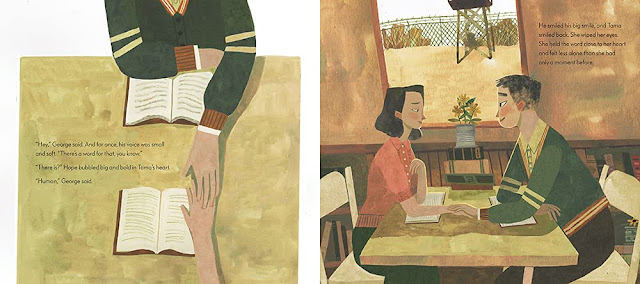
This is such a sweet fictionalized story of two people, the author's grandparents, who found love despite having been sent to Minidoka, a Japanese incarceration camp located in the middle of nowhere in Idaho after the nation of Japan attacked Pearl Harbor in 1941. 

Tama was a young woman who loves books and reading and who took a job as librarian in the camp library despite not knowing how to be a librarian. George was a young man who seemed to like books, because every day he was at the library door with a big stack of books to return.

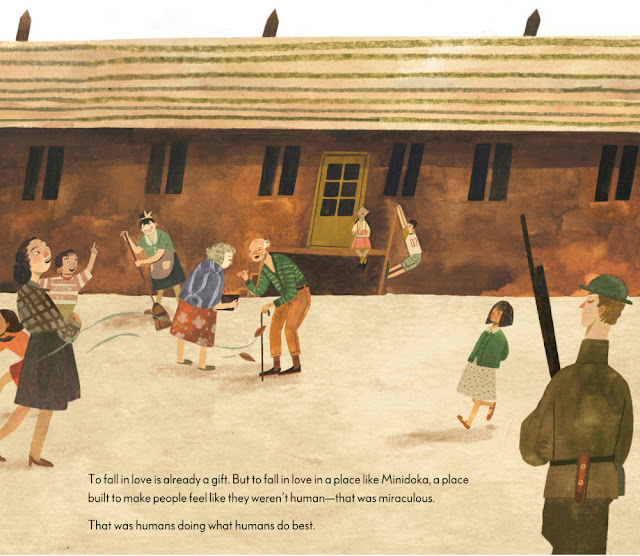
George and Tama, and all West Coast people of Japanese descent were sent to different incarceration camps despite having never committed a crime. Minidoka was unbearably hot in summer, and bitter cold in winter, and muddy in fall and spring because of rain. And there was virtually no privacy.

Tama loved to read and could get really lost in some of the books she read. But unlike George, Tama found it hard to smile, not at her books or the boys playing baseball outside the library. When George asked what was wrong, Tama couldn't find the right words to tell him. But George knows exactly the right word to describe what Tama was feeling: human. 

And that's when Tama discovered that the reason George spent so much time in the library wasn't because he was a big reader, but it was because of her. In a place that tried to dehumanize them, it was a miracle to fall in love in Minidoka, but that's just was George and Tama did. And it didn't take long for them to get married despite the terrible circumstances they were living in and had their first son in the camp. 

This is such a wonderful book for introducing young readers to what happened to people of Japanese descent once the United States entered WWII. The author never minimizes Tama's despair about how her life suddenly changed with her incarceration in Minidoka, or the terrible, unjust conditions under which people were forced to live, but she still manages to offer readers an optimistically hopeful story, all the more wonderful because it is based on a true story. 

The text is complimented by detailed gouache and watercolor illustrations, reminiscent of the period and done in a palette of desert browns and tans broken by the more colorful clothing the inhabitants had brought with them.  

Back matter consists of an Author's Note with more age appropriate information about how Japanese Americans were sent to the camps in the first place, and how it was done as well as more information on the real Tama and George.

Love in the Library would be a excellent addition to any school library or home library. And you can download a Teacher's Guide from the publisher HERE

This book was an eARC gratefully received from Candlewick Press

Sunday, November 21, 2021

Rosie the Riveter: The Legacy of an American Icon written and illustrated by Sarah Dvojack


Rosie the Riveter: The Legacy of an American Icon
written and illustrated by Sarah Dvojack
Imprint, 2021, 40 pages

When America went to war in 1941, men enlisted in droves to defend their country. But that left the workforce at home depleted and America needed people to step up production of war materials of all kinds. Women were perfectly willing to fill that need and in 1942, American women pulled on some overalls, wrapped their hair in a scarf, slung on a tool belt, and the figure of Rosie the Riveter was born. 

Now, Sarah Dvojack has captured that image in her biography of Rosie and all the Rosies who can before and after WWII. Because there have always been Rosies, they were just the unsung heroes in history. But WWII changed all that. 

Not allowed to fight. pretty soon, Rosies were working not only in offices, but were riveting airplanes and war ships, traditionally jobs help by men, but now in the very capable hands of women.   

It didn't take long for the image of Rosie the Riveter to become an icon in WWII popular culture. There were songs, posters, magazine covers, even a movie about Rosie. She was the hero that kept the home front going all through the war. But then the men returned and wanted their jobs back. Dvojack writes that Rosie had become such a powerful symbol that women could use in their fight to remain part of the workforce and then Rosie became a movement, with rallying cry "We can do it!" 

If you look closely, you'll notice all the women and girls are wearing something red with white polkadots.
I really liked the way Dvojack brought Rosie into the present showing young readers that as a symbol for women she is relevant in all fields and not just as a riveter - that there's some Rosie in every job a woman does and all of her achievements.

Rosie the Riveter is a wonderful picture book for older reader introducing them to the home front in WWII, and exploring the why and way she is still so relevant in today's world. I particularly liked the pencil and subtle hued digitally colored illustrations. They are so clean and clear and so inviting. 

Back matter include more information about Women, Work, and War, as well as popular culture renditions of Rosie. Check out the end papers and pages 16-17 to find other Women Heroes depicted in this book, all of whom are identified on the copyright page.

This book is recommended for readers age 8+
This book was borrowed from the Queens Public Library

Monday, November 15, 2021

How War Changed Rondo by Romana Romanyshyn and Andriy Lesiv

How War Changed Rondo
written and illustrated by 
Romana Romanyshyn and Andriy Lesiv
translated from the Ukrainian
Enchanted Lion Books, 2021, 40 pages

Three friends,  Danko, a bright light with a shiny transparent heart, Fabian, a red balloon dog with a knot for a nose, and Zirka, a paper origami bird covered with notes and sketches of his journeys, loved living in Rondo. Rondo was a place with clear air, where residents grew and tended flowers everywhere, and lived in distinctive houses. In other words, Rondo was a pretty great place to live.

Rondo was especially famous for its flowers and there large greenhouse where there was a collection of rare plants and flowers that could sing. Concerts were often held in the greenhouse, and the town anthem, Mozart's Rondo alla Turca, was always played for residents and visitors alike. 

One ordinary day, Danko and Fabian were on their way to meet Zirka, who had just returned from a trip with new stories. But, whispers had begun...war was on its way to Rondo and leaving a path of death and destruction everywhere it went. No one in Rondo knew what war was, but soon, everything there was dark and ugly. War planted black flowers (bombs) and prickly weeds so that no light could shine through, causing Rondo's beautiful flowers to stop singing. 

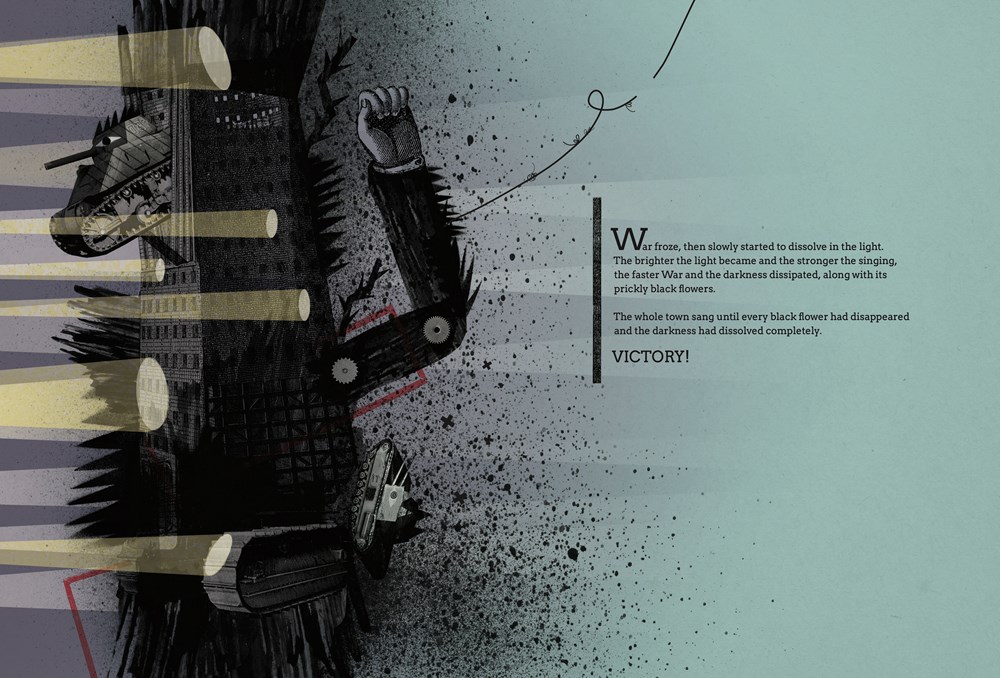
The three friends resisted war, but Danko, Fabian, and Zirka were all hit by the stones (bullets) that war sent out. How could the three friends ever defeat war, especially now that they were all wounded - Danko's heart had cracks, one of Fabian's legs was pierced by a prickly weed, and the edges of Zirka's wings were burned? When Danko decides to try to provide light to the flowers in the greenhouse, he realizes that war is afraid of light and so he, Fabian, and Zirka rally the other residents of Rondo in an effort to produce a powerful enough light to finally defeat war. 

War is finally defeated, and Rondo is repaired and rebuilt. The flowers in the greenhouse begin to sing again, but the poppies that had grown all around town no longer grew in different colors. Now, they only grow in one color - red.
    
The interesting thing about How the War Changed Rondo is that war itself isn't the focus, but rather how it impacts the lives of Rondo and its residents during and after the fighting is over. Here we see the lasting effects of injuries received in the war on Rondo. Because, even though Rondo is repaired, its residents of are forever changed. Now, they know what it is like when their beloved flowers stop singing, they will  have to live with sad memories of loved lost friends and relatives, as well as with the physical wounds that were inflicted on them by war, including Danko with his cracked heart, Fabian with his injured leg, and Zirka with his singed wings.  

The thing about war and children, like the residents of Rondo, is that they don't usually know or understand what war is, where it comes from or how it starts, but they do know the fear and destruction it brings with it. And that is something that will never leave them. In the end, readers might be left scratching their heads and wondering why would anyone want to have war. I'm adult and I still wonder that. 

Mixed-media illustrations in this picture book for older readers harmonize brilliantly with the text, going from pale green and a golden yellow to darkness followed by that same pale green with building tinged in a sooty black - another physical manifestation of the lasting impact of war. Interestingly enough, there are only two illustrations where a human arm is seen, first dropping bombs, later retreating, yet none of Rondo's citizens are human. It really brings out the point that only humans start wars. 

This book is recommended for readers age 8+
This book was purchased for my personal library

Sunday, November 7, 2021

I Saw a Beautiful Woodpecker: The Diary of a Young Boy at the Outbreak of World War II by Michal Skibinski, illustrated by Ala Bankroft

I Saw a Beautiful Woodpecker: 
The Diary of a Young Boy at the Outbreak of World War II
by Michal Skibinsky, illustrated by Ala Bankroft,
translated from the Polish by Eliza Marciniak
Prestel Publishing, 2021, 128 pages

Here is an uncomplicated book that captures the summer before WWII began in the notebook of a young boy. Eight-year-old Michal was give a school assignment for the summer holidays to write one sentence in a notebook about something that happened to him each day. The purpose of the assignment was to provide a means for practicing his penmanship and being moved up to the next grade was contingent on faithfully keeping this notebook. Michal's entries begin on July 15, 1939 and end on September 12, 1939. There are not entries for every single day but there are entries for most of them. 

According to the note at the end of this book, Michal lived in Warsaw, Poland. At first, his entries sound like a wonderfully idyllic summer vacation and are about things he observed in nature, like the beautiful woodpecker he saw, and the people he spent time with - his parents, brother Rafal, their nanny, and their  grandparents. 

But gradually, Michal's entries begin to get darker, until September 1, 1939 when he notes that war has begun. On September 6, 1939, he writes that a bomb was dropped near where he was staying. Because he was limited to one sentence per day, readers can only speculate on how he must have felt that day.

What interesting to note about this book, however, is how innocent most of Michal's entries are, even as the adults in his family were fully aware of trouble coming and taking precautions to get him and his brother out of harm's way according to the note at the end of the book. On July 26, 1939, Michal writes that a plane flew over where he was staying (this is the cover image). On the surface, this seems innocent enough, but one wonders if it was a reconnaissance plane from Nazi Germany, given the coming invasion of Poland.

Each entry is a two-page spread containing the date and the entry, but set against the background of Ala Bankroft's incredible painted almost impressionist illustrations reflecting Michal's observations. The colors are bold greens, browns, and blues reflecting nature and as war arrives, become darker, almost black, losing most of their color.  

I Saw a Beautiful Woodpecker is an unique document of its time as experienced by a child who probably didn't know what war is or that it was on his doorstep, even as he began his entries. Yet, the truth of his experience is in the simple declarative sentences with which he seems to have unwittingly witnessed the coming war through his young, innocent eyes.  

This book would be a great classroom/home school addition for anyone teaching the history of WWII.    

This book is recommended for readers age 7+
This book was gratefully received from Casey Blackwell at Media Masters Publicity 

Wednesday, October 13, 2021

War by José Jorge Letria, illustrated by André Letria, translated from the Portuguese by Elisa Amado

War is a thoughtful, honest though grim look at the common factors all wars share, from its first glimmerings to its end and beyond. 

l
War written by José Jorge Letria,
illustrated by André Letria, 
translated from the Portuguese by Elisa Amado
Greystone Kids, 2021, 64 pages

Beginning with black endpapers that lighten only slightly on the first two-page spread, readers will begin to realize that the idea of war begins in darkness by those who would capitalize on our fears, symbolized here by snakes, spiders, and other crawling insects creeping and slithering through a landscape of leafless trees. These fears are then picked up by a large black hawk who carries them to one who had a wish for war. 

And he who wishes for war, motivated by hate, ambition, and spite, internalizes those fears, then uses them to infect the people over whom he rules. Soon, as "war saddens, crushes, and silences," books are burned, factories are built for the war effort, and "war begets shadowy, iron children" who can easily be indoctrinated into becoming an army of obedient soldiers.

But, in the end, all wars leave behind nothing but silent destruction after all the bullets are shot, all the bombs are dropped, and most of the people are killed. But don't be fooled, war isn't over, just turn the page to another almost black wordless two-page spread that carries the shadows of people's fears, those same snakes, spider, and other crawling insects just waiting...for another person wishing for war and filled with hate, ambition, and spite.

Readers will find a powerful indictment of war in what appears to be a simply written, simply illustrated book that is anything but simple. The images are done in a somber palette of war-like browns, blacks, grays, and greens, and printed on heavy paper. There are 14 wordless double-page spreads, and 17 double-page spreads that contains one single sentence, which means that in only 17 sentences, all the horrors of war are emotionally  conveyed. Interestingly, though this book clearly is not about one particular war, there is much to it to compare with World War II. 

A thought-provoking, sober picture book for older readers, War will likely generate many conversations and questions from thoughtful readers when used in a class, library or home school setting. 

This book is recommended for readers age 7+
This book was purchased for my personal library

Tuesday, September 28, 2021

The Girl Who Could Fix Anything: Beatrice Shilling, World War II Engineer by Mara Rockliff, illustrated by Daniel Duncan

The Girl Who Could Fix Anything by Mara Rockliff,
illustrated by Daniel Duncan
Candlewick Press, 2021, 48 pages
I love picture book biographies that introduce kids to people and their achievements that they might otherwise never hear anything about. Case in point is this new biography about Beatrice Shilling (1909-1990) and her important WWII engineering accomplishments. 

Beatrice always seemed to be the person who was different. As a girl, she preferred tools to sweets, enjoyed taking mechanical things apart and putting them back together, often improving them. Instead of a bike, Beatrice began saving for a motorcycle at age 10. 

When she was older, Beatrice was eventually hired as an apprentice by one of the few woman engineers, Miss Partridge, whose job it was to bring electricity to people. And it was Miss Partridge who encouraged Beatrice to go to university to study engineering. Not surprisingly, she was the only female in the class. And also not surprisingly, despite graduating with honors in electrical engineering, only the men in her class could find jobs. 

Beatrice had to settle for a job writing handbooks about plane engines (I used to write handbooks for computer users, so I know just how bored Beatrice must have been). But eventually, she was given a hands on job, and met George, a man much like Beatrice, who became her husband. Beatrice loved her new job, but her expertise was really put to the test when WWII began and the RAF were losing pilots and planes when their engines suddenly quit in the middle of a dive during a dogfight.

Could Beatrice figure out how to solve the problem in a timely, cost effective way that wouldn't require taking apart the planes engine? Of course she could - and did. 

The Girl Who Could Fix Anything is a wonderful picture book for older readers. Rockliff shows readers that here was intelligent, persistent woman who followed her passion, loved to find out how things worked, and found ways to fix or improve engineering problems, but who also made mistakes, something I think is important for young readers to know about. The writing is light but informative, and the technical details, for example, the fix Beatrice came up with for the RAF, are presented in an easy to understand manner. The subtly colored digitally created illustrations completely harmonize with the text. Back matter includes an Author's Note that provides more about the life of Beatrice Shilling, as well as Selected Sources.   

The Girl Who Could Fix Anything is a book that should be in every STEM home, classroom, and school library. Beatrice Shilling is an inspiration to young girls everywhere who might just be a little different from their peers, having an interest in engineering and how things work. 

This book is recommended for readers 7+
This book was eARC gratefully received from Edelweiss+

Monday, July 12, 2021

Bartali's Bicycle: The True Story of Gino Bartali, Italy's Secret Hero by Megan Hoyt, illustrated by Iacopo Bruno

Bartali's Bicycle: The True Story of Gino Bartali, Italy's Secret Hero
written by Megan Hoyt, illustrated by Iacopo Bruno
Quill Tree Books/HarperCollins, 2021, 40 pages

For eight year, Gino Bartali rode his bicycle around Italy, memorizing trails and paths, winning races and collecting trophies and first-place ribbons. He was such a good racer that in 1938 Gino won the  grueling Tour de France. But it was after that race that Gino noticed things were changing at home in Italy.

Soldiers marched through Europe and soon the world was at war. Jews, who were blamed by some for Europe's ills, were rounded up and arrested. Gino had trouble believing the lies these leaders told about Jews. But Jews had already been denied any freedoms, and now they were being rounded up and arrested. Watching these abuses, Gino thought he needed to do something to help them. Summoned by Archbishop Elia Dalla Costa, Gino was asked if he wanted to become part of a network of Italians who were working to provide false identity papers to help Jews escape Italy and flee to countries like Switzerland and America. 

Despite being afraid, Gino began rolling up and hiding the forged identity papers in the hollows of his handlebars and other parts of his bike. He then began to use his cycling skills and the paths and trails all over Italy he had memorized earlier to pick up and deliver packages of these precious documents to anxious, startled families.  

But Gino did more that just deliver identity papers. For example, when Gino learned the soldiers were looking for his best friend's family, the Goldenbergs, he hid the whole family in his cellar for the duration of the war. Another time, capitalizing on his fame as a cyclist, Gino put on his racing clothes and headed to the train station where soldiers were herding arrested Jews into a train. Gino distracted the guards so that resistance workers could lead the Jews to different trains that would take them to safety. Another time, forced into the military, Gino used his uniform to find and help prisoners of war that were being held by the Italians. He led 49 English soldiers out to safety and no one took any notice of it. 

No one really knows how many people Gino helped to save. Some say more than 800, others dispute that figure. Gino never talked about his wartime activities and no records were kept by the resistance (for obvious reasons). Regardless, Gino has been named "Righteous Among Nations" by Yad Vasham, the Holocaust Remembrance Center in Israel for his wartime work helping to rescue Jews.

Bartali's Bicycle is a well-told, well-organized picture book for older readers that introduces this brave man to today's children. Discovering new heroes is always inspiring, and this one is made particularly so thanks to the accompanying illustrations, done in a style and subtle palette of colors appropriate to the period. Both author and illustrator gave an amazing amount of attention to detail that is unusual in a picture book, even a picture book biography like this one. 

Back matter includes a Timeline, a letter from Gino Bartali's granddaughter, Lisa Bartali, an Author's Note and an extensive list the the sources used by the author. 

Bartali's Bicycle: The True Story of Gino Bartali, Italy's Secret Hero would be an excellent addition to units on the Holocaust and World War II. And, in fact, you can download a free Teaching Guide for it from the publisher, HarperCollins, HERE   

This book is recommended for readers age 8+
This book was borrowed from the NYPL

Friday, March 19, 2021

Twenty-One Steps: Guarding the Tomb of the Unknown Soldier by Jeff Gottesfeld, illustrated by Matt Tavares

 
Twenty-One Steps: Guarding the Tomb of the Unknown Soldier
by Jeff Gottesfeld, illustrated by Matt Tavares
Candlewick Press, 2021, 32 pages

How many times have we watched an American president or a visiting foreign dignitary laying a wrath on the Tomb of the Unknown Soldier in Arlington National Cemetery and not really thought much about either the unknown soldier or the soldier guarding him? Maybe you've visited even the Tomb of the Unknown Soldier on a school trip to Washington, DC and have a photo you took somewhere on your phone. We may all think differently after reading this excellent picture book for older readers that focuses on this important monument honoring America's unknown fallen heroes and the select few who guard them.
             "I am an Unknown. I am one of many."

Told in the first person voice of one unknown soldier standing in place for all, he tells the reader about the many soldiers who were once the living and loved sons, fathers, husbands, brothers who fell in battle during WWI. When the war was over, most of them went home to families who would mourn them, burying them in graves that would remember and honor them. But for others, those were could not be identified, there was not place to honor the sacrifice they had made.

In 1921, our narrator was given a hero's funeral, laying in state in the Capital in Washington, DC, where mourners who had lost loved ones that never came home could grieve and find some sense of closure. Then, on November 11th, at 11 o'clock, our narrator's symbolic coffin was taken to Arlington National Cemetery for burial. From then on, the narrator says he was always alone. Over the years, people began to visit the hillcrest where the Tomb of the Unknown Soldier is, but, he says, it was mostly "for the view and not the meaning."


Then, at the stroke of midnight on July 2,1937, our unknown soldier was suddenly not longer alone. From then on, every day and night, in all kinds of weather, the sentinel guards were there, to honor the unknown fallen. Men and women from every race, religion and creed are part of the Tomb Guard. Marching back and forth in their vigil, each guard takes 21 steps in one direction, followed by 21 seconds of silence, then 21 steps back and 21 seconds of silence over and over on his watch and each step with its own click. To understand just how dedicated the Tomb Guard's are to their watch, readers are first introduced to The Sentinel's Creed.

Eventually, the remains of an unknown soldier from WWII, the Korean War and the Vietnam War were also laid to rest in the Tomb of the Unknown Soldier. Just like our WWI narrator, these fallen soldiers first lay in state at the Capital, and once again, mourners could make them their owe, because "[t]heir stories were different and the same." Interestingly, thanks to DNA, the soldier from the Vietnam War was identified and returned to his family. 


People still come to the Tomb of the Unknown Soldier, but now it is to pay honor and not to picnic and marvel at the view. 

Placing this history of the Tomb of the Unknown Soldier and the Tomb Guards in the voice of an nameless, faceless fallen soldier, Gottesfeld's text gives this book a personal measure of poignancy and melancholy that is rare in the picture book, even one for older readers. But at the same time, he brings a level of honor and reverence to it, as well. Readers will probably never watch a wreath laying at the Tomb of the Unknown Soldier the same way again. 

Matt Tavares illustrations, done with pencil and digitally painted, are both realistic and visceral at the same time, completely matching Gottesfeld's poetic text. Have some tissues handy as you read this beautifully done work. The dust jacket shows the Tomb of the Unknown Soldier and his guard in daytime, this is what you will find underneath:

This year will mark the 100th anniversary of the Tomb of the Unknown Solider. If you are looking for a picture book to share with your young readers this coming Memorial Day, this is definitely one of the better choices for that solemn day.

This book is recommended for readers age 7+
I received this book for free from Candlewick Press in exchange review. 

Monday, March 15, 2021

Code Breaker, Spy Hunter: How Elizebeth Friedman Changed the Course of Two World Wars by Laurie Wallmark, illustrated by Brooke Smart

Code Breaker, Spy Hunter: How Elizebeth Friedman Changed 
the Course of Two World Wars
by Laurie Wallmark, illustrated by Brooke Smart
Harry N. Abrams, 2021, 48 pages

This picture book for older readers tells the story of a remarkable woman who developed new code- making and breaking techniques, helped capture bootleggers, and even managed to catch a few Nazi spies. 

When she was a child, Elizebeth Smith loved poetry and Shakespeare was her favorite author. She appreciated the structure and patterns she noticed in his poetry. Not surprisingly, Elizebeth graduated college in 1915 with a degree in English Lit, but she also studied Latin, Greek, and German. 


Looking for a job in Chicago, Elizebeth was introduced to George Fabyan, a wealthy eccentric Shakespeare fan who invited her to become part of a group of researchers on his estate, Riverbank, who were looking for proof that Francis Bacon was the real writer of Shakespeare's plays. Her job was to look for secret messages left by Bacon in the plays. Who knew this job would eventually lead to Elizebeth's helping to capture Nazi spies?  

Well, Elizebeth never found any coded messages but she did find friendship in the person of William Friedman, a scientist. The two friends spent part of their time together devising secret notes and challenging each other to decode them. Soon, they were in love and married. 

When the United States entered WWI in 1917, Riverbank was converted to a code-breaking unit called the Riverbank Department of Ciphers. Elizebeth, William, and their cipher staff set about decoding enemy communications and developing new code-breaking techniques. 

After the war, Elizebeth went on the work for the Coast Guard. They needed help with smugglers who were hiding bootleg liquor and communicating with each other using coded messages. Could Elizebeth crack the codes, so the bootleggers could be caught? She could and did, often testifying at the trials of the smugglers.

When the United States entered WWII, Elizabeth's code-breaking skills were once again needed. In 1942, she joined the newly formed Office of Strategic Services (OSS) and began setting up a code-breaking unit. Yet, when her decoding talents helped with the capture of some Nazi spies, the FBI director took all the credit for himself. Nevertheless, Elizebeth carried on and helped put American Velvalee Dickinson in prison for spying for the Japanese by decoding her letters about buying "dolls." 

Then came Germany's Enigma code-making machine, which created seemingly unbreakable codes. Thanks to a lazy Enigma operator, Elizabeth and her staff were about to break the codes after months of hard work. They didn't know that in England, code-breaker Alan Turing had also broken the Enigma codes.  

I loved the way Elizebeth's own words were strategically worked into the stylized watercolor and gouache illustrations so readers can get a real sense of who Elizebeth was and what she thought about the groundbreaking work she did. I also loved the ribbons of coded messages the wrap around a number of pages like a lasso capturing secrets, including the Nazis that Elizebeth's decoded messages helped catch. And if you are interested in trying your hand at decoding. those ribbons are coded messages. Check out the back matter for help solving them.

Code Breaker, Spy Hunter is a fascinating biography about a woman who did so much and received so little credit for her hard work. It is packed with interesting information about Elizebeth's personal and professional life. 

Besides information about Codes and Ciphers, back matter includes a challenge to Crack The Code, information on Cryptography Today, a Timeline and a Selected Bibliography.   

You can also find some Activity Sheets to download courtesy of the publisher, Abrams Books HERE 

This book is recommended for readers age 8+
This book was borrowed from the Queens Public Library

Monday, February 22, 2021

Andrew Higgins and the Boats That Landed Victory in World War II by Nancy Rust and Carol Stubbs, illustrated by Brock Nicol

Andrew Higgins and the Boats That Landed Victory in World War II
written by Nancy Rust and Carol Stubbs,
illustrated by Brock Nicol
Pelican Publishing, 2020, 32 pages

How many times have we seen photos or film of that pivotal day, June 6, 1944 and the Normandy landings during WWII and focused only on the brave soldiers storming the beach, without giving a second thought to the odd looking boats that brought them there? Now you can get to know the man who delivered those soldiers and their equipment to the beaches of Normandy and who helped bring about the end of the war. 

Born in 1886 in Columbus, Nebraska, Andrew Higgins always loved boats, but and he loved a good challenge. When he was 12, Andrew built his first boat, a wrecked sailboat he found in the river by his house. Yet, after all his hard work, he found his rebuilt sailboat was too slow for his taste. So, he challenged himself to build a bigger, faster boat. Speed seems to have had a great deal of appeal to Andrew, but school didn't and so he quit and became solider, then a farmer, a truck driver, and later owned a lumberyard. But nothing satisfied him.

Andrew began designing boats when he opened a lumberyard in New Orleans, and needed something that could move his cut trees through the shallow waters there. Another challenge for Andrew, who designed a flat bottom boat to do the job. Naturally, as the lumber business slowed down, boat building became Andrew's main focus. In fact, he built such great boats for those shallow waters that his landing boats, a/k/a Higgins boats, could "crunch through driftwood, bounce over logs, climb a beach, ...wham up on a sloping concrete sea wall." They were so good that more and more people wanted them.

During WWII, Andrew made all kinds of boats for the military, including PT boats and Higgins boat with its drop down ramp that could be used for transporting soldiers and heavy equipment like tanks from large ships to beach shores. Andrew had to hire more workers to build his boats, and because he believed in a workforce that was diversified and treated people fairly, he hired women, people of color, then started a childcare center and a free clinic. Not only that, he paid equal pay for equal work. Andrew Higgins and his boats were a success story on the home front as well the as the fighting front lines.

Thanks to the Higgins Boat and their ability to move soldiers and large equipment even under the harshest circumstances, wars would be fought differently from then on. After the war, President Dwight Eisenhower said that Andrew Higgins was "the man who won the war" thanks to his Higgins Boat.

I had never heard of the Higgins Boat, even though pictures of it are so common. Yet, when I asked a friend whose father was in the Navy if she ever heard of a Higgins Boat, she knew exactly what it was and role it played in WWII, but she didn't know anything about the man who designed it. Hence, the need for a well done biography like this one. And in fact, I found Andrew Higgins and the Boats That Landed Victory in World War II not only informative, but really interesting. 

I loved this well-written, accessible picture book for older readers, but besides excellent writing, the text is extended and enhanced by the very detailed, very realistic painted illustrations by artist Brock Nicol. He chose a bright palette for the images of Andrew growing up and seeking his passion, and switched to a palette of army greens and browns for the WWII images. I think he really captured Andrew Higgins' life and his work as befits an American hero. 

Back Matter includes a Glossary, an Author's Note, and a list of Important Dates in the life of Andrew Higgins. You may also want to watch this interview from September 2020 with authors Nancy Rust and Carol Stubbs by curator Josh Schick at The National World War II Museum in New Orleans 


This book is recommended for readers age 7+
This book was an F&G gratefully received from the authors. 
An iconic image of a Higgins Boat on D-Day


Monday, January 18, 2021

Nicky & Vera: A Quiet Hero of the Holocaust and the Children He Rescued by Peter Sís

Nicky & Vera: A Quiet Hero of the Holocaust and 
the Children He Rescued
written and illustrated by Peter Sís
Norton Young Readers, 2021, 64 pages
Available January 26, 2021

I remember reading about Nicholas "Nicky" Winton (1909-2015) while I was doing some dissertation research on Czechoslovakia. Nicholas is credited with saving 669 children in 1938, separate and apart from those children saved through the Kindertransport program. Now, Nicholas's act of heroism has been made accessible to today's young readers, thanks by the very talented Czech-born American artist Peter Sís.

Sís begins Nicky's story with a brief biography of Nicky's early life. Then, in  December 1938, a friend of Nicky's told him to come to Prague, Czechoslovakia. Earlier, in October 1938, Adolf Hitler's army had marched into the Sudetenland on the Czechoslovakian border. As soon as he arrived in Prague, Nicky realized that something had to be done. The world would soon be at war, but he knew that England would accept children under 17 if sponsors could be found for them and travel could be arranged, and so he set to work.

In a town outside of Prague, 10-year-old Vera Diamantova's mother heard about an Englishman who was trying to get Jewish children out of harm's way, and her parents decided to see if Vera could be one of those children.

Nicky spent most of 1939 in Prague and London preparing everything that was needed to get the children out of Czechoslovakia - making lists and getting photographs of the children, finding train connections, getting visas and advertising for families to take them in. Nicky paid for all of this himself. 

Meanwhile, in March, 1939, Germany invaded the rest of Czechoslovakia, and Vera's family were told they must give up their home to the occupying German army. Finally, though, the day came for Vera to leave, and her father gave her a diary to record memories so they could read them after the war. Three days later, Vera arrived safely in London, one of the 669 children Nicky rescued.

After the war, Nicky lived a quiet life and no one would have learned about his act of heroism if his wife had not found his old records. Now, the world knows what this quiet, kind, unassuming man managed to accomplish against all odds. Sadly, when Vera returned to Czechoslovakia, she learned her parents and most of her family had perished in the Holocaust. 

Although I knew Nicky's story, there are lots of details I hadn't known before in this beautifully render picture book biography for older readers. And I loved the way Peter Sís intertwined Nicky's story with Vera's making it more personal and emotional, sensitive without being sentimental. 

Sís tells Nicky and Vera's stories using spare text and simple declarative sentences. Using stylized maps (see illustration above), cutaways, and color, the illustrations really moves the story along, providing a multitude of images to pour over and discuss. I'm sure you will notice immediately that blue is the dominant color for Vera, while a light green is used for Nicky, and gray for the Nazis. Two of my favorite illustrations show the readers the internal memories that are carried by Nicky after the war (above) and Vera arriving in London. I found this to be exceptionally moving and poignant.

Nicky & Vera: A Quiet Hero of the Holocaust and the Children He Rescued in a compelling look at these to lives. If you read the Author's Note, you will learn how and what motivated Peter Sís to write Nicky and Vera's stories. 

This book is recommended for readers age 7+
This book was gratefully received from Edelweiss+

Saturday, November 14, 2020

The House by the Lake: The True Story of a House, Its History, and the Four Families Who Made It Home by Thomas Harding, illustrated by Britta Teckentrup


The House by the Lake: The True Story of a House and the Four Families Who Made it Home
written by Thomas Harding, illustrated by Britta Teckentrup
Candlewick Press, 2020, 48 pages

We don't often think about the history of a house, and yet a building can actually be a silent but important witness to history. At least that's what author Thomas Harding must have thought when he wrote his first book about the house by the lake. Curious about a slice of family history, he began researching the summer house that was built by his great-grandfather, Dr. Alfred Alexander, on the outskirts of Berlin, Germany. The result was the 464-page book The House by the Lake: A Story of Germany. Published in 2015, it is the story of the five unrelated families who lived in the house through 100 years of 20th century Germany history. Amazingly, this fascinating history has been adapted into a very accessible picture book for older readers that loses none of the history and poignancy of the adult book. 


In 1927, Harding's grandparents and their four children moved into the house, spending happy days there, swimming in the lake, raising chickens, growing asparagus and listening to stories at night. But when the Nazis came into power, a group of soldiers forced the Alexander family out of their summer home, leaving it empty.

A year later, a new family moved in - a father, mother and two little boys. As the little boys grow older, they joined Hitlerjunge. But when the father was order to fight in Hitler's war, the family decided to leave the house altogether and run away.

With the war still raging, a husband and wife sought refuge in the empty house. It was a cold, bitter winter, but they were able to safe and stay warm in the house. But they too fled the house as the war ended when the Soviet army arrived, shooting at the house from the tanks, chipping the fireplace and breaking the windows.


Next came "the man with the fluffy hat" who fixed the damage done to the house by war and who made the house feel alive again with his children and their activities. But then, the man heard the sound of Soviet soldiers building a wall through the backyard of the house by the lake. Life became gray as the children were made to work and the man began to spy on this neighbors. 

After many years, the wall came down, but the man in the fluffy hat had aged and found it harder to take care of the house. After he died, it was 15 years before the house was once again fixed up by another young man until it shone like new. A picture of the young man's great-grandparents was hung over the fireplace and "Once again the house by the lake was happy."

Readers are probably not used to a building being a protagonist, and feel the story should be told from the point of view of the families that lived in the house instead. But this is the house's story more than it is their story, and like its human occupants, the house's history is organic and changing. I actually like that Harding kept the focus on the house. 

House as protagonist allows for some interesting symbolism. The freedom to come and go symbolized by open door of the first family contrasted to the key to the house in the hands of the Nazi soldier getting reader to close the house up and the loss of freedom. The key motif returns toward the end of the book when the last occupant, Harding himself, returns to the house, opening the door again.You might also notice the black cat that roams freely in first pages, last seen walking out the door, and returns at the end. The changing condition of the house over time is also symbolic of war and peace.

The text has an almost fairytale quality to it, while the mixed-media illustrations show more than the words say, filling in a lot of the details. The illustrations are textured and layered, with small and large details, even while they have an almost unfocused, dream-like feel to them. Happy times are captured is bright, colorful hues, while war and occupation are done in a much darker palette. 

The House by the Lake is a fascinating look at history through the lens of a stationary object and a valuable classroom tool for studying history. 

FYI: Who are all the un-named people who occupied the house? Short biographies of the four different occupants are included in the back matter. 

You can find a very useful Teacher's Guide for this book courtesy of the publisher HERE

This book is recommended for readers age 7+
This book was gratefully received from the publisher, Candlewick Press