Showing posts with label Jews. Show all posts

Wednesday, May 18, 2022

Alias Anna: A True Story of Outwitting the Nazis by Susan Hood with Greg Dawson

When her 13-year-old granddaughter Aimée wrote her a letter asking about what life was like for her when she was the same age in 1940, Zhanna Arshanskaya Dawson didn't know how to answer her. There was so many long-buried horrors, so much humiliation, so much running to escape capture by the Nazis. But a granddaughter has a right to know and so that part of her family's history unfolds in this gripping free verse biography. 

Ukrainian born Zhanna was a headstrong little girl who used to love wandering the streets of Berdyansk, a resort town on the Sea of Azoz. One day, while wandering, she heard a small band playing music in a funeral procession and fell in love with what she heard. But the Arshanskaya home was already filled with the music of, among others, Rossini, Vizet and Tchaikovsky. Because Zhanna was so headstrong about wandering the streets, her father decided maybe piano lessons would rein her in. Soon the five year old was playing Chopin, Brahms and Beethoven. It didn't take long to realize that Zhanna had a true gift for music. 

But Joseph Stalin, the ruthless dictator of the Soviet Union, had a plan to modernize Ukraine and get rid of the old ways through starvation - in what was the "breadbasket of Europe" people were starving to death as part of Stalin's Five-Year Plan. When Zhanna was eight and her sister Frina was six, the family, having hit hard times, was forced to leave Berdyansk to live in Karkov. Yet, despite now living in poverty, their father had high hopes that both Zhanna and Frina could audition for two spots with scholarships at a renowned music conservatory. Both musically gifted girls were immediately accepted and it was here that Zhanna found her signature piece, Chopin's Fantaisie-Impromptu. This piece of sheet music became her most prized possession, carried all through WWII.

Musically things improved for the family, but financially things got worse and then, in 1941, the Nazis attacked the Soviet Union and the country was officially at war. The Germans wanted all of the Soviet Union, but without its Jews. Shortly after arriving in Kharkov, the Nazis order Jews to gather in the center of town to prepare for evacuation. In snow and numbing cold, the Jews, now prisoners of the Nazis, were marched through the streets to an abandoned tractor factory. After a few weeks of living in abysmal conditions, the prisoners were rounded up and march to Drobitsky Yar. Suspecting what was about to happen, Zhanna's father bribed a young guard to let her escape. When the guard looked away, her father whispered "I don't care what you do. Just live." It was the last time Zhanna saw her parents, but not her sister. 

Finding refuge at a friend's home, Zhanna was reunited with her sister. But Frina refused to talk about how she had gotten away and what happened to their family. Now, the sisters were on their own, and they could be easily recognized by the people in Kharkov who had been to their concerts. What they needed were new names and identity papers. But to get the papers, they would have to be admitted into an orphanage. It was easy to become Anna Morozova and her younger sister Marina, finding places in an orphanage was not so easy. But first, they had to get out of Kharkov. 

Could the sisters survive the war, running and hiding from the cold-blooded Nazis and collaborating Ukrainians, doing what needed to be done to "just live" as their father had said?

Susan Hood has a way of making a person's history come to life in her lyrical, well-researched verse biographies (see Lifeboat 12) Reader's come away knowing not just Zhanna and Frina's struggles and how they were able to survive, but also some needed background history of the Ukraine under Stalin and later, Hitler.  

Interwoven throughout the poems are quotes from Zhanna herself, taken from her oral history recorded by the William Breman Jewish Heritage Museum, as well as from interviews with her son, Greg Dawson. Other quotes used are well-documented in Hood's copious Back Matter. Most of Zhanna's story is written in free verse, I liked that Hood also included various poetic techniques and poetic forms, which always adds a certain level of energy and richness to a work written in verse that mirrors the musicality of the two talented sisters.   

And, of course, there are recent events in Ukraine that make us realize that the past is never past. The attempted invasion of the independent state of Ukraine by Russia has brought not just the geography of this nation to the fore, but also some of its history dating back to World War II when the Nazis invaded. For example, knowing that the Russians had bombed Ukraine's Holocaust memorial at Drobitsky Yar and reading about it in this book made me that much more aware of the dangers of greedy dictators (Stalin, Hitler and Putin) and the 16,000 Jews who were murdered in that ravine, including Zhanna and Frina's family, where the now damaged memorial stands in Kharkiv. 

Alias Anna: A True Story of Outwitting the Nazis is a true testament to the courage, cleverness, persistence, talent and strong will to survive of both Zhanna and Frina. And perhaps a warning from the past for us all to heed.


Tuesday, February 15, 2022

The Light in Hidden Places by Sharon Cameron

I usually think of Sharon Cameron as a writer of science fiction not historical fiction, but she has really outdone herself with The Light in Hidden Places. It is a fictional account of the life of Stefania "Fusia" Podgorska and her yonger sister Helena who were ultimately named as Righteous Among Nations by Yad Vashem for hiding and saving the lives of 13 Jews during the Holocaust. 

At age 12, Fusia decides to leave her family's farm to live with the Diamants, a Jewish family that runs a grocery store in Przemsyl, Poland. Welcomed into the family, Fusia lives there for 3 happy years, during which a secret attraction developes between Catholic Fusia and Jewish Izio Diamant. But in September 1939, Poland is attacked and invaded by the Nazis and life changes for everyone. 

In April 1942, the Diamants are forced to move into the Przemsyl ghetto. Fusia is tasked with helping them survive by bringing what she could sneak in by squeezing through the fence. But then she learns that the Nazis have killed Izio, Grieving, Fusia decides to go back to the family farm. There she finds everyone gone, except her 6-year-old sister Helena, whom she brings back to Przemsyl with her. 

One night, in November 1942, Max Diamant shows up at Fusia's door and asks to stay the night. His parents and some of his siblings had already been rounded up in a Aktion, and sent to their deaths and he and his brother have escaped the ghetto. When they decide to stay with Fusia and Helena, Fusia realizes she needs a larger place for hiding them. She finds a small cottage and before she knows it, Fusia is hiding 13 Jews in it. Then, the Nazis build a hospital across the street and move three nurses into the cottage, as well. Fusia begins to panic, but the nurse only stay seven months. 

Fusia's story held me spellbound from start to finish. I kept thinking what a brave young woman she was to take the kinds of risks she continually chose to take for the family that had shown her so much more love and kindness than her own family had, spending her pay to by food for everyone, and risking death if caught. The novel reads like a taut drama, filled with tense moments and events throughout. Then I remember much of what I'm reading really happened.

Cameron's research for this story is impeccable. Through interviews, research trips to Poland and Stefania's own unpublished memoir, Cameron has woven together a coherent, reality-based Holocaust narrative. She includes extensive back matter, including photos and information about what happened to the Jews Fusia hid after the war ended and they were liberated.  

This book was gratefully received from Edelweiss+  

Sunday, January 16, 2022

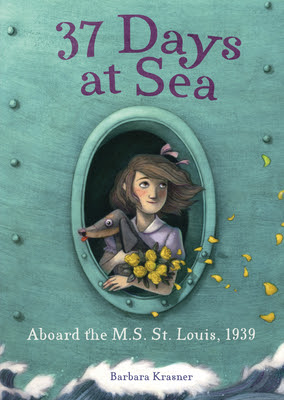
37 Days at Sea: Aboard the M.S. St. Louis, 1939 by Barbara Krasner

This is the second book by Barbara Krasner that I have read about the 938 European Jews who set sail in 1939 aboard the M.S. St. Louis hoping to escape the Nazis and find safety in Cuba. The first book was called Liesel's Ocean Voyage. It is a fictionalized story based on the real experiences of Liesel Joseph Loeb (1928-2013) and I highly recommend it, and in fact, I would read it in tandem with 37 Days at Sea to get a broader picture of a voyage that began with so much hope ended in such disappointment. 

Here, Krasner introduces readers to Ruthie Arons, 12, from Breslau, Germany. The decision to leave and eventually settle in America came shortly after Kristallnacht, when their beautiful home was ransacked by Nazis who broke into Jewish homes and businesses all over Germany, stealing, breaking and destroying everything in their path. 

Now, onboard the M.S. St. Louis, missing the family they had to leave behind, Ruthie, a somewhat mischievous girl thinks that  "Adventure/ across the Atlantic Ocean beckons." And indeed it does, when she quickly makes friends with Wolfie, a twelve-year-old Jewish boy traveling with his mother and whose father is already living in Havana.

Secure in the knowledge that they have the necessary papers to enter Cuba, people on the ship enjoy a wonderful voyage of good food, entertainment, and friendliness, including Captain Schroeder. And although the crew wear their NSDAP pins, there is a problem with only one, Kurt Steinfelder. Ruthie's mother suffers from seasickness and her father, an attorney, is busy with some other business, so that leaves her plenty of time to hang out with Wolfie, exploring the ship and getting into mischief: "Grown-up, watch out. We/ are a band of trouble,/ and by we, I mean/ Wolfie and me." (pg 24)

There is a, however, a very concrete reminder of what was left behind in Germany, when a group of men with shaved heads come on board and Ruthie's father must explain to her about concentration camps and the arrest of so many Jewish men on Kristallnacht, including him. Some were released, others sent to camps, released with the promise never to return.

After two weeks at sea, on the fifteenth day, the M.S. St. Louis enters Havana, Cuba but it doesn't take long to realize that there is more trouble ahead for these Jewish refugees. No one is allowed to disembark and enter Cuba, including Wolfie and his mother, even though his father is already there. Negotiations take place, the United States refuses to help and eventually the ship is forced to return to Europe. Needless to say, the trip back is nothing like the trip to Cuba.

37 Days at Sea is written in free verse from Ruthie's first person point of view, which gives it an interesting perspective. Ruthie may have experienced some of the cruelty of the Nazis in Breslau, but she was younger and her parents seem to have been able to shield her from some of the worst events. The trip to Cuba and the return to Europe makes this a kind of end of innocence story, but the beginning of understanding the seriousness of what was happening to the Jews in Europe for Ruthie (and hopefully today's reader).    

Krasner used a few different poetic forms, and although the free verse is sometimes a little off, it is still an important book for young readers, especially in the lower middle grades. She really knows how to build the excitement and expectation of landing in Cuba and being free to come and go as they please as the ship travels to its destination, and the disappointment and dejection the passengers feel when they are forced to go back. The first half of the books is devoted to the trip to Cuba, and the second half covers the trip back, which I think is an important part of the story to include. 

Back matter includes an Author's Note, a Timeline of Events, suggestions for Further Information including Films, Oral Testimonies, and Books.

This book was a digital version purchased for my personal library.

Monday, August 30, 2021

A Boy is Not a Ghost by Edeet Ravel

Based on true events, this sequel to A Boy is Not a Bird continues the story of Natt Silver.  You may remember that Natt's father was arrested and sent to a gulag in Siberia after their Eastern European home came under Soviet occupation, and he was considered an enemy of the Soviet state.

Now, in the summer of 1941, Natt and his mother, along with 26 other people, have been traveling in a cattle car for more than six weeks after being arrested and are on their way to Siberia. The journey is nothing short of a lice-infested "Train of Horrors, finally ending in Novosibirsk, in southern Siberia. There, they are taken to an outdoor schoolyard where they will be staying. Natt is still haunted by the terrible thing he did after his father was arrested. His mother was told she could see his father through a window at a certain time, but when she and Natt walked by, Natt turned his head away from the window, an act he is sure he will never forgive himself for and is convinced his father won't either. 

Life in Siberia allows for a certain amount of movement, simply because escape is pretty much out of the question. But life is hard hard. There is never enough to eat, clothing is old, dirty, patched, and never warm enough. And each time their circumstances change, Natt thinks things can't get any worse, and yet they do. But Natt also makes friends wherever he goes, who can often help in get wants he wants. There is Irena, 18, who voluntarily travels to Siberia in the same cattle cart as Natt and the others, in order to try and find information about her exiled parents. Natt lives with her for a while when his mother is arrested for "stealing potatoes" after being set up by an official who needed to meet her arrest quota. And there is Olga and Peter, siblings who live in Novosibirsk and whose father has an important and useful-for-Natt job. And Gabi Mindru, 11, whose mother takes Natt in when Irena leaves to find her parents, and who nurses him back to health when he gets deathly ill. Through Gabi, Natt meets Igor, 16, whose father is an NKVD captain, but who also proves helpful to Natt, nevertheless. 

Like the first book, A Boy is Not a Ghost is an very readable novel, and narrated in the first person by Natt, who is as beguiling as ever. His story, which begins when Natt is 11-years-old ends towards the end of the war when he is 15, as you might have surmised, it is a book about fighting to survive every day against all odds. Natt, who often misread people and their motives in the first book, learns to make himself invisible, and to communicated in code and to understand when others communicate to him in code. I wrote about the first book that Natt held on to his innocence in part because there were always enough kind people in his life who really liked him, and though no longer as innocent as he once was, Natt is still an extremely likable  boyand people are often willing to help him.

He is still writing to his best friend Max in Switzerland, though he never hears from him and the reader never finds out if he made to safety. But Natt's letters are a wonderful shortcut vehicle for more giving information about what is happening with Natt and the other exiles in Siberia. 

Though it is a sequel, A Boy is Not a Ghost can be read as a stand alone novel, though I would recommend reading both books. The author, Edeet Ravel, has included a lot of information relevant to Natt's experiences under Soviet occupation in the book's back matter that I would also recommend reading. I read an eARC and did not see all of the chapter illustrations or map that will be in the published book. 

A Boy is Not a Ghost will be available on September 7, 2021. 

This book is recommended for readers age 9+
This book was an eARC gratefully received from Edelweiss+

Tuesday, May 12, 2020

They Went Left by Monica Hesse

It's August 1945 and Zofia Lederman, 18, has been recently liberated from Gross Rosen Concentration Camp. She is recovering at a hospital, but is determined to return to her family's home to Sosnowiec, in what had been Poland before the Nazi invasion in 1939. After all the Jews there were rounded up, the Lederman were ultimately deported to Auschwitz. Only Zofia and her younger brother Abek, survived the selection process upon arrival, both ending up in Birkenau. Before they were separated, Zofia promised Abek she would find him at the end of the war.

Zofia is convinced that Abek is still alive and waiting for her at home. But home is no longer home, taken over by squatters and ransacked. And Abek isn't there, nor has he been seen in Sosnowiec since the war ended. Here, however, Zofia learns that prisoners from Auschwitz-Birkenau had been sent to either Bergen-Belsen or Dachau. And so early one morning, Zofia leaves Sosnowiec with some stolen money, a small suitcase and goes in search of Abek. 

Arriving in Munich, Germany in September, Zofia finds her way to Foehrenwald, an adults only displaced persons camp. Since Abek would only be 12 by now, there is no chance of finding him in there. But Zofia is give a bed in a cabin with two other girls - Breine and Esther. And she meets the reclusive, angry Josef, to whom she feels a compelling attraction, and who eventually becomes her lover.

Though at first standoffish, Zofia slowly begins to settle into life at Foehrenwald. Thanks to her family's prewar business making fashionable custom clothing for women, Zofia's is an experienced seamstress and finds a purpose in the camp altering clothing for the women there, including a wedding dress. And just as she begins to come to life again, a boy claiming to be Abek shows up at the camp looking for Zofia. 

There are several mysteries woven into Zofia's story, which begin to become apparent as she replays memories about her family, the roundup that ultimately brought them to Auschwitz, the selection process in which she and Abek were sent to the right, her dreams about the last time she saw him, her single-minded need to find him now and to finally be able to go home. This is all described in some of the most heartrending prose I've ever read:
"And when we got to Birkenau, there was another line dividing into two. In that line, the lucky people were sent to hard labor. The unlucky people - we could see the smoke. The smoke was the burning bodies of the unlucky people.
On this continent, I need to find only one person. I need to go home. I need to survive. I need to keep my brain working for only one person.
Because everyone else: Papa, Mama, Baba Rose, beautiful Aunt Maja - all of the, all of them, as the population of Sosnowiec was devastated - they went left." (pg. 14)
As Zofia begins to feel alive again in Foehrenwald, she also begins to unravel the mysteries hiding in her own memories, as well as truth hiding in the enigmatic Josef. Against this, Hesse provides the reader with a very realistic picture of what life was like in a displaced persons camp after the war ended. She has really captured the chaos of so many people looking for loved ones whom they had been separated from and now hoped had also survived life in concentration camps, like Miriam. She and her twin sister were victims of Nazi experiments, now she obsessively writes letters in the hope of finding her sister. And as Zofia discovers, anti-Semitism didn't stop just because the war ended. But Hesse also shows the kindness of people, like Sister Therese at Kloster Indersforg, a displaced persons camp for children, who gives Zofia just enough hope that Abek is alive to keep her going.

While Zofia looks for Abek, Hesse interrogates the idea of what home will be to people who have lost everything and almost everyone that they had identified as home before the war. Just before the Lederman family was rounded up, Zofia had embroidered the story of their family in alphabet form and sewn it into Abek's jacket, so he wouldn't forget. In one of her dreams, Zofia tells Abek: "When I find you again, we will fill our alphabet. And we will be whole, and everything will be fine. I promise I will find you." (pg. xiv) As Zofia rewrites this alphabet in a post war world, it looks very different, but will it become her way to find a new home and rebuild her family?     

That being said, no one was more surprised than I was when I got the the end of The Went Left and the mysteries were solved. I did not expect what I read. 

They Went Left is a book everyone should read.

You can find a great discussion guide provided by the publisher, LittleBrown, HERE

This book is recommended for readers age 13+
This book was an EARC gratefully received from Edelweiss+

Saturday, January 4, 2020

My Survival: A Girl on Schindler's List, A Memoir by Rena Finder with Joshua M. Greene

Like most Americans, I first learned about Oskar Schindler and the 1,200 Jewish lives he was able to save watching Steven Spielberg's movie Schindler's List. And yes, I am sorry to say I have not yet read Thomas Keneally's 1982 book Schindler's Ark (published as Schindler's List in the US). However, you may recall a book published in 2013 called The Boy On the Wooden Box by Leon Leyson, who was a young Jewish boy working for Schindler. Now, we have this book by Rena Finder, who was a still a young girl when she was working for Oskar Schindler.

Rena, who maiden name was Ferber, had lived a pretty happy and comfortable life in Krakow, Poland with her parents Moses and Rosa Ferber. But all that changes in 1939 when the Nazis march into and occupy Poland and World War II begins. First, friends and neighbors begin to turn their backs on their former Jewish friends, and Krakow's Jews are faced with more overt acts of anti-Semitism, even as more and more restrictive laws are imposed by the Nazis. Jews are not longer allowed to go to school, the park, the movies, they are subject to a curfew, and forced to wear a blue and white armband with a Star of David on it signifying that they are Jewish. And soon enough, arrests and deportations of Jews to concentration camps begin.

In 1940, Rena and her parents are issued permits allowing them to remain in Krakow while her father works, but they are forced to leave their lovely apartment and move into the Krakow ghetto - 320 apartments for 3,000 people. Then, on December 31, 1942, Rena's father is arrested despite having a work permit. Sadly, Rena will never see her father again.

Not long after her father's arrest, liquidation of the Krakow ghetto begins and the ghetto's Jews are forced to march to Plaszów Concentration Camp, a march that includes Rena and her mother Rosa. There, they both end up working in Oskar Schindler's factory, a factory that had originally been located near the Krakow ghetto, where he could use cheap Jewish labor. But now that his labor was in Plaszów, they would have to walk 2 1/2 miles each way to get to and from work. Schindler convinces Plaszów's Commandant, Andrew Goeth, to allow him to build a subcamp for the factory's Jewish workers. Amazingly, Goeth agrees to allow this.

Rena's story is told in a very matter of fact way in the first person, but also in a very intimate voice that makes you feel that she is speaking directly to you, the reader. I've given you most of the historical background, but her story is naturally much more personal, recounting what life was life for Europe's Jews under the Nazis, including the fate of some of her family and friends. She also talks in harrowing detail what it was like when she and the other people working for Schindler were sent to Auschwitz-Birkenau in 1944. Luckily, Schindler was able to reclaim them thanks to his list of workers and take them to his new factory in Czechoslovakia. And unlike many real life Holocaust stories, Rena also talks about what her life was like after the war, meeting her husband and moving to America.

My Survival: A Girl on Schindler's List is a very accessible, age appropriate book, perfect for introducing young readers, and especially reluctant readers, to the Holocaust. Rena breaks down the different events on her personal life and how she was impacted by the things done to Jews under the Nazis. The pages of photographs of the Ferber/Finder families at the back of the book makes her story that much more real. Rena's "Closing Thoughts" bring the past into the present with her plea for today's youth to stand up for those people who are being targeted now, reminding us that genocide begins when people begin turn their backs on what is happening to others.

This book is recommended for readers age 10+
This book was purchased for my personal library.


Saturday, March 7, 2015

Unlikely Warrior: A Jewish Soldier in Hitler's Army by Georg Rauch, translated by Phyllis Rauch

There aren't many first hand accounts of men who fought as soldiers in the German army during World War II, particularly not for young adult readers, which makes Unlikely Warrior so much more compelling and interesting to read.  Georg Rauch really takes the reader inside this relatively unknown world and give us an opportunity to see what life was like on German side of things.  Georg divides his story into three distinct parts.

The first part deals with Rauch's training for the army and his family history.  In February 1943, 18 years old Vienna-born Georg doesn't really want to be a soldier in Hitler's army , but when his draft notice arrives, he has no choice.  Reporting for training, his radio building and Morse Code hobby skills means he can train as a radio operator and telegraphist.

Now, for most Germans being in the army wasn't anything special - every able bodied male was conscripted, especially after the heavy losses they suffered on the Eastern Front at Stalingrad - expect for one thing: in Hitler's German Reich, Georg Rauch was consider to be Jewish in Hitler's Reich: Georg's maternal grandmother was Jewish, which meant his mother was Jewish, and so was he.

Sent to train in Brno, Czechoslovakia, the now Funker (radio operator) Rauch is chosen along with a few other men to be promoted to officer status.  But because he is a Mischling (a person of mixed blood), Georg believes he will not be able to serve in officer capacity and reports this to this superior officer.

Not long after, Georg finds himself at the dreaded Eastern front as a radio and telegraph operator.  Ironically, Hitler's Jewish soldier is awarded the Iron Cross in August 1944.

The second part of Rauch's story covers the time he spent in Russian labor camps as a POW and this is the most difficult  section to read.  Shortly after receiving his medal,  Rauch is captured by the Russians and spends the rest of the war as a POW.  The details of being a prisoner of war are harrowing, but despite many close calls, starvation, illness and injury, Rauch manages to survive the war and the Russian POW camps, unlike many of his fellow soldiers.

Part Three covers the end of the war and Rauch's long trek home to find his hopefully still living family.  Each part of Rauch's wartime journey is an intriguing window into the life of a German soldier.  Being 1/4 Jewish doesn't really seem to impact his time at the front or as a POW, as much as his refusal to serve as an officer does.  On the other hand, it doesn't make Rauch feel like an enemy, and one certainly would not think of him as a Nazi, not if he is 1/4 Jewish, nor does he (or any of the German soldiers he writes about) ever behave with the kind of cruelty we associate with Hitler's soldiers and so it becomes easy to read his story and emphasize with it.

Georg Rauch's easy writing style pulls the readers right into his life and his open honesty about his himself and how he feels about everything is refreshing.  He has penned a fascinating memoir is based in part on his own recollections and in part on letters he had written to his mother while in the army, letters she carefully numbered and tucked away.  Because the letters were written in situ, they make Rauch's experiences sound much more immediate and realistic than had he written his story complete from memory.  To add to the authenticity of his story, photographs of Rauch and his family are included.  Rauch's wife Phyllis has done an excellent readable translation of Unlikely Warrior from the German, perhaps so well done because it was a labor of love.

After the war, Rauch went on to fulfill his dream of being an artist, living in Mexico with his wife, who translated his memoir.  Sadly, Georg Rauch passed away in 2006 and never saw this wonderful Young Adult version of his story in print.

This book is recommended for readers age 12+
This book was an EARC received from NetGalley

Friday, April 6, 2012

The Devil's Arithmetic by Jane Yolen

Since tonight is the first night of Passover, I thought I would review a book that is appropriate to the season.  I chose The Devil's Arithmetic because, like the Passover story, it is also about the importance of remembering who you are and where you came from.

Hannah Stern, 12 but almost 13, is a happy girl living in New Rochelle with her parents and little brother, except that she doesn't want to go to her family's Passover Seder.  Bored and apathetic, Hannah is tired of hearing her grandfather's stories about the past, including those about the concentration camp where he spent part of his youth.  But this year's Passover holds a big surprise for Hannah.

When she goes to open the door to let Elijah in, Hannah suddenly finds herself transported back in time to a Polish shetl in 1942, where her name is Chaya Abramowitz and she is living with her Aunt Gitl and Uncle Schmuel.  Hannah learns that Chaya parents have recently died and she has been very sick.  The next day, Chaya goes with her family to another shetl where Uncle Schmuel is to be married.  But before that can happen, the entire residents of both shetls are rounded up by Nazi soldiers and sent on a days long train ride in a cattle car to a concentration/extermination camp.

Before she knows it, the men and women are separated, their clothes are taken away, their hair is shaved off and a number is tattooed on their left arms.  Chaya and Aunt Gitl are assigned to a barracks and give jobs to do.

Working in the kitchen, Chaya meets Rivka, a wise ten year old who has survived life in the camp for a year and knows how to do things to avoid being "chosen" by the camp commandant for "processing."  So far, Chaya, Rivka and their other friends have been lucky, but can their luck hold out?  And will Chaya ever become Hannah again and return to her present day family?

The Devil's Arithmetic is a wonderfully well-written middle grade novel.  The randomness of life for Jews under the Nazis is captured so well, as it the horror their methods, yet not to the point where it is so graphic it would turn kids away from the book or from learning about the Holocaust, but it does help understand at least the how of what happened.

And yes, Hannah does remember what she had learned about the Holocaust in school and home, but little by little she finds her memory fading.  Even her present day family begins to recede from her memory.  And she does try to warn everyone about what happened to Jews in the Holocaust, but they find it so outlandish that they can't comprehend what she says.  And who could blame them?

While Hannah's experiences in the concentration camp point to the importance of remembering, they also demonstrates the perils of forgetting, a good lesson for us all to think about during this holiday season. 

This book is recommended for readers age 10 and up
This book was purchased for my personal library

Be sure to visit Jane Yolen's website for more on The Devil's Arithmetic, including lesson plans, poems, and an interview with Kirsten Dunst about being in the movie version of the book.

The Devil's Arithmetic has received the following honors:
The National Jewish Book Award
The Sydney Taylor Award
The Maud Hart Lovelace Book Award
Nebula Honor Book
1992 Kentucky Bluegrass Master List
1991-92 Florida Children's Book Award nomination
Rebecca Caudill Young Readers' Book Award

Wednesday, April 27, 2011

From the Archives #10: Strangers at the Farm School by Josephine Elder


Last December, Charlotte over at Charlotte's Library reviewed a book by Josephine Elder called Erica wins Through, reminding me of a book I have by the same author stuck away in my bookshelves. The other day I dug out my copy of Strangers at the Farm School by Josephine Elder and reread it.

This is the third and last installment of Elder’s Farm School books. The Farm School is a very unconventional school, in which a student may pursue the things they are really interested in, besides their academic subjects. Students must also help with the running of the farm part of the school with chores like caring for animals or working in the fields.

The story opens in September 1938, just as the new term is starting. The school is expecting two Jewish refugee children from Germany, brother and sister Hans and Johanna Schiff. Their father, a successful lawyer, was arrested by the Gestapo and placed in a concentration camp, their mother remained in Germany to try to obtain his release, their friends were forbidden to have anything to do with them and they were no longer allowed to attend school. So their mother sends them to England as part of what appears to be the Kindertransport program.

On arrival in London, they are taken to a center where they are given clothing to wear. They are appalled that the items are used, accustomed as they were to much finer clothing. Then they were hustled to a train and journeye to Sutton Malherbe, the village where the Farm School is located. Mrs. Forrester, who along with her husband, owns and runs the Farm School, welcomes them with open arms, but the children are a bit distant because of their recent experiences in Germany.

The next day is a busy one, with new arrivals, dormitory assignments and exploring the farm. Johanna is happy to learn she may be able to help take care of some calves, but Hans becomes quite indignant when told he could help with the pigs. The other kids don’t understand his attitude until he explains that to a Jew, a pig is an unclean animal. But Hans is also angry and insulted that they are expected to do any kind of work usual to a farm, feeling he is above that kind of labor.

Johanna quickly adjusts to life at the farm school, and particularly enjoys doing the farm work that is expected of her. She gets along with the other girls, even developing a GP (Grand Pash or crush) on Annis Beck, herself a senior student and the school president. But, remembering how things were in Germany, she never lets herself get very friendly with the other kids, despite her loneliness. She is very thrilled when she is asked if she would like to play field hockey, since playing games in Germany had been forbidden for Jews.

At first, Hans does not make even this much adjustment. He cannot get past his anger at the English, who were Germany’s enemy in World War I and responsible for the death of his uncle and wounding of his father. While out walking with Johanna, and airing his grievances, the pair comes across some Gypsies harvesting the hops fields. The Gypsies are very friendly and it eventually comes out that they have also been to Germany and plan on returning. One of the woman in a caravan gives them a charm before they leave, telling them that as long as they are friends with gypsies, the charm will bring them good luck. Though seen by Annis returning to school, they deny having gone to see the gypsies. That night, both children wake up in the night very sick and are asked to they ate any little green apples. Thinking about the charm, they say no, even though they had been given some apples by the Gypsies. Hans is convinced the English have tried to poison them and makes plans to go back to Germany with the Gypsies. But they don’t get far before they are soon found by a search party from school.

As the school year goes forward, even Hans begins to adjust as much as he can. He discoveres that Annis is working with the school bee hives and asks if he can work with them too. This work excites him for the first time. He never really makes friends at the school, nor does he seem to want to, but Johanna does eventually find a girl her own age to be friends with. There is even a happy ending for Hans and Johanna, in fact for all the characters.

Hans and Johanna are only one story thread running through this novel. The reader also follows the story of Dan as he tries to overcome his deep fear of horses and riding; of Annis as she learns to drive in case there is a war; and of Kitty Forrester, Annis’ best friend and daughter of the school owners as she embarks on her chosen path in life. All of the characters are drawn well and well-rounded.

Though old, this is not a difficult book to get hold of and it does give a good picture of life and attitudes in pre-war Britain and Germany, for example, the Gypsies are referred to as gippos, which was a common derogatory term for them, and the description of the humiliation of Herr Schiff and other men by ordinary Germans before being sent to a concentration camp is disturbingly realistic.  I would definitely recommend Strangers at the Farm School to anyone interested in this historical period.

The Kindertransport that appears to have brought Hans and Johanna to England was a rescue operation which saved the lives of 10,000 Jewish children. The children were sent to England by their parents from 1938-1939, most arriving at Liverpool Street Station, just as Hans and Johanna did. From there they were placed in forster homes and schools. Though what is described in the book resembles the Kindertransport operation, it is never called that and in fact, transports didn’t begin until December 1938 not September 1938, the date of the novel’s opening. Nevertheless, Elder seems to have gotten her facts otherwise correct.

An excellent book and documentary, Into the Arms of Strangers: Stories of the Kindertransport recounts the experiences of many of the people who were part of the Kindertransport program.

Below is a statue commemorating the Kindertransport program at the Liverpool Street Station in London, sculpted by Frank Meisler:


This is book 6 of my British Books Challenge hosted by The Bookette
This is book 7 of my Forgotten Treasures Challenge hosted by Retroreduxs Reviews

Thursday, December 2, 2010

Some Holiday Books - Chanukah

The holiday season has officially begun. And along with it is my first Holiday Readathon running from December 2nd to 5th and all I needed to do was make a pledge for charity. My pledge is 5¢ per page read to the Salvation Army and a can of food for each book read to a local food bank.
You too can sign up at Holiday Readathon

I am beginning the Readathon with books for Chanukah because last night was the first night of Chanukah and the world’s largest Menorah was lit at Grand Army Plaza in Manhattan (59th Street and Fifth Avenue.) Chanukah is a joyous festival of lights, hope and miracles. And last night we did have a bit of a miracle when the horrible rain and strong winds stopped just in time for the lighting. If you would like to know more about this holiday, including how to make and play with a Dreidel and why children receive Chanukah Gelt, be sure to visit Chanukah on the Net

The Power of Light: Eight Stories for Hanukkah by Isaac Bashevis Singer, illustrated by Irene Lieblich.
There is one story for each night of Chanukah in this book. The sixth story, called “The Power of Light,” is about two young teens, David, 14 and Rebecca, 13, hiding from the Nazis in the Warsaw Ghetto after it was bombed and burned. They had been hiding for a long time because Rebecca was afraid to leave even though remaining there was also dangerous. But their story is one of courage and strength discovered in the glow of a miraculously found candle on the first night of Chanukah. They decide to bank on the miracle and travel through the sewers of Warsaw seeking partisans who could help them escape to Israel. Singer is a master storyteller and the stories in this book are – well – masterful.

Menorah in the Night Sky: a Miracle of Chanukah by Jacques J.M. Shore, illustrated by S. Kim Glassman.
This is a story about two young boys, Zev, age 12 and David, age 11. The boys are best friends, separated from their families in Auschwitz and working in a factory separating shoes. Homesick and sad, David did not want to remember the Chanukah celebrations he had had with his family before the war. Zev wanted to help David with a miracle of hope, but all he could do was tell David to look up in the winter sky, light their found, but forbidden candle and pretend they were lighting a Menorah. That night a bright star appeared as if it were the first candle on the Menorah. But could such a thing happen again and again for 8 nights? Well, it is the season of light and miracles.

One Yellow Daffodil: a Hanukkah Story by David A. Adler, pictures by Lloyd Bloom. Morris Kaplan is a florist, an older man who lives alone. Two children pass by his store every day and buy flowers on Fridays for Shabbes. When they come in on a Tuesday and buy flowers for Chanukah, Morris tells them that he had celebrated Chanukah when he was young, but not anymore. The next day the children invite him to their home to light candles and have dinner. When he leaves later that night, he pulls out a box of the only family mementos he owns, which includes the Menorah his family used back in Poland when he was a boy. The next day, he returns to the children’s apartment with the Menorah and tells them about being taken with his family to Auschwitz and how he ultimately came to possess his family’s Menorah. Morris is the only survivor in his family, his parents, brother and two sisters all perished. He believes that he survived because just when all hope was gone, he saw a daffodil blooming in the camp, and decided that like the daffodil, he too could survive in a place that offered no other hope.

The Tie Man’s Miracle: a Chanukah Tale by Steven Schnur, illustrated by Stephen T. Johnson. Mr. Hoffman is a door to door tie salesman, who shows up on a cold, snowy night with his tattered box of ties but with no overcoat. It is the last night of Chanukah and 7 year old Seth is annoyed because he is afraid Mr. Hoffman will delay their celebration. But Seth’s parents insist that Mr. Hoffman stay and he tells them how he lost his own family, two boys, three girls and his wife, during the war. After he leaves, Seth goes into the living room to look at the candles, which have all burnt down. He wishes that the tie man be given his family back. Suddenly the room goes dark, except for nine columns of smoke from the Menorah, which braid around each other. At the same time, Seth thinks he hears voices calling “Papa, Papa.” Even though Seth looks out for tie man everyday after that, he is never seen again. Did Seth’s wish come true and was the tie man reunited with his family? It is for the reader to decide.

By the Hanukkah Light by Sheldon Oberman, illustrated by Neil Waldman.
This is a story about the way one family celebrates Chanukah every year. It begins when Rachel and her grandfather clean the Hanukkiah, or Menorah. On the first night, after the candle was lit, grandpa always tells the story of the Maccabbees exactly the way his grandfather had told it to him. Next, he tells the story of Hanukkiah that had belonged to his family but was left behind when they fled the destruction of their homes, school and temples by the Nazis. Later, while grandpa was still an American soldier, he returned to the destroyed home of his family, and found the Menorah buried in the ashes. This is a true miracle that his family celebrates every year.

Nine Spoons: a Chanukah Story by Marci Stillerman, illustrated by Pesach Gerber.
This is my favorite story. Every year, when Oma’s family celebrates Chanukah, she tells them the story of the Children’s Menorah. One winter, in the concentration where she was, her bunk-mate, Raizel, said that Chanukah was coming. Raizel was an artist and wanted to find a way to help the children in the barracks celebrate the holiday. She comes up with the idea of making a Menorah out of spoons, but spoons were prized possessions among the people in the camp. Nevertheless, in various, often surreptitious ways, nines spoons were collected; Raizel twisted the handles around a stem, with the bowls of the spoons facing upwards and attached it to a piece of wood. The spoons were filled with stolen kitchen oil and lit with stolen thread twisted into wicks. After the war, Oma had kept the Menorah and the children used it every year to remember how this miracle happened under such dangerous conditions. This was based on a true story, told to the author by the woman survivor who brought the Menorah with her after the war when she came to the US.

These books are all part of my personal library.
Total for 12/2/2010 6 Books
                           239 pages

Monday, November 22, 2010

In Defiance of Hitler: the Secret Mission of Varian Fry by Carla Killough McClafferty

Most people have heard of Oskar Schindler, the ethnic German who saved 1,200 Jews from certain death at the hands of the Nazis by employing them in his enamelware/ammunition factory, thanks to Thomas Keneally’s book Schindler’s List and Steven Spielberg’s movie based on the book. But not many have heard of Varian Fry, the 32 year old American who went to Marseilles, France in August 1940 to help rescue refugees stranded there after France fell to the Nazis. Many of these refugees had fled to France from Hitler’s Germany during the 1930s.

McClafferty details Fry’s mission beginning with a mob attack on Jews that he had witnessed on 15 July 1935 in Berlin, Germany. This left a deeply disturbing impression of Fry, and in 1940, three days after the armistice was signed between Germany and France, he attended a luncheon in NY about the situation of refugees. A collection was made at the luncheon that raised $3,000 and a private organization called the Emergency Rescue Committee or ERC was formed. Its purpose was to rescue Jews and non-Jews who were enemies of the German state and who were also well-known artists, scientists, musicians, and politicians. The list of almost 200 names included people like Marc Chagall, Max Ernst, Pablo Picasso, Henri Matisse and Lion Feuchtwanger. Feuchtwanger was a German writer who had written the first book about the life of a Jewish family in Berlin under the Nazis in 1933 called The Oppermanns (Die Geschwister Oppermann).

Taking the list of names and the $3000 donation money, Fry volunteered to go see what he could do about getting these renowned refugees out of occupied France. The job proved to be more than anyone had thought it would be. First, there was the problem of finding the people on the list, who were more than likely living scattered around the south of France under assumed names or, like Feuchtwanger, were in a French concentration camp awaiting deportation. And there was the problem of everyone having the right papers at the same time. Each family member had to have exit and entrance visas with the same dates, as well as travel visas to go through other countries. A valid passport was required everywhere and since all German Jews had become stateless with the passage of the Nuremburg Laws in 1935, they did not have and could not obtain a valid passport.

McClafferty describes in a very clear easy to understand way the complex problems Fry faced when he arrived in Marseilles and his trials and errors as he learned how to work around all the difficulties, done mostly with the help of very clever people and a lot of deception. And she chronicles the deterioration of Fry’s marriage as he became more involved with what he was doing. Fry began to believe that he was indispensable to the rescue operation, and this led not only to more problems with his wife, but also with the ERC. Fry’s original mission was to last only for a month, but by the end of that time he was too involved with what he was doing, and delayed his departure. Eventually, word go around Marseilles that he was there to help rescue people, and other refugees, ordinary people not on the list, began to show up outside his hotel. These people could only be helped with day to day expenses, not gotten out of France. So many refugees came to Fry that he had to hire some help and ultimately set up a relief organization called the American Relief Center or ARC.

It is unfortunate but in the end Fry was fired by the ERC and finally escorted out of France by the police in 1941. Yet he had accomplished much, getting at least 2,000 people out of France and away from the Nazis. In 1967, Fry was awarded the Cross of Chevalier of the Legion of Honor by France and was the first American named “Righteous among the Nations” in Israel in 1996, an honor give to non-Jews who helped Jews during the Holocaust.

This is an excellent look at a very courageous man, and McClafferty has done a commendable job detailing what is probably unfamiliar information to young readers. The story of Varian Fry and his refugees almost reads like a novel because of all the deceptions and clandestine exploits they were involved in to accomplish their job. McClafferty has included a detailed appendix and bibliography at the end for further exploration of this interesting man. She doesn’t say it, but her description of Fry when he returned home sounded very much like a man suffering from Post Traumatic Stress Syndrome, understandably given some the things he witnessed and the fear and tension he lived with for so many months, as did everyone under Nazi domination.

This book is recommended for readers age 9-14.
This book was borrowed from the 67th Street Branch of the New York Public Library.

In Defiance of Hitler: the Secret Mission of Varian Fry received the following well deserved honors:
2008 Society of School Librarians International Book Award Honor Book
2009 Orbis Pictus Recommended Title
2009 CCBC Choice (University of Wisconsin)

More information about Varian Fry may be found at the following websites:
http://www.almondseed.com/vfry/
http://www.holocaust-trc.org/fry.htm

Non-Fiction Monday is hosted this week by Practically Paradise

Monday, September 20, 2010

The Grand Mosque of Paris. A Story of How Muslims Rescued Jews during the Holocaust by Karen Gray Ruelle and Deborah Durland DeDaix

The Grand Mosque of Paris is a little known but important story, just like the The Cigarette Sellers of Three Crosses Square was; a book about people helping others in a time of great peril. The central theme of The Grand Mosque can be summed up in the Islamic hadith* and a Jewish proverb quoted by Ruelle and DeDaix:

“Save one life, and it is as if you’ve saved all of humanity.”
The Grand Mosque of Paris was opened in 1926 on land donated by the French government in tribute to the many Muslims of her North African colonies who fought and died for France in World War I. At the time, most of the mosque’s members were Kabyle Muslims, Berbers from Kabylia in Algeria. It is a large place with both religious and social areas, including living accommodations, so that many people can be within it’s walls at any given time. When the Nazis invaded Paris in 1940 and began their roundups of Jews for deportation, it did not take long for the rector of the mosque, Si Kaddour Bengharrit, to realize that the Muslim community could do something to help the Jews – they had both the space and the means to do this. And so the Muslims of the Grand Mosque began to rescue Jews, and within three months of the Nazi occupation of Paris, the rector and his congregation were suspected of and warned against helping anyone escape to safety.

The story is well done and well researched but the authors also write that attempts to verify much of what they found for this book were not terribly successful:
Writing about clandestine events that took place at a time of turmoil involving people who had an oral rather than a written tradition, and with many of the participants having now passed away, presents many difficulties.” (pg34)
Yet, there is enough evidence to prove that it happened and Ruell and DeDaix present the story in part by using examples of people who had been helped. One such person was Salim Halali, a Berber Jew from Algeria, studying in Paris to become a singer. Salim found refuge in the mosque and received a “Certificate of Conversion” from the rector. The rector even had a stonecutter called in to carve a false gravestone with Salim’s family name on it for authenticity. Although Salim remained at the mosque until the war was over, most of the people who received help did not stay as long. In fact, only those Jews who also looked North African were able to stay in the mosque for more than a few days, since it was easy for them to pass as Muslims. Those who did not look North African had to be guided out to safety as quickly as possible.

According to Ruell and DeDaix, the Muslims had a real advantage as far as the Nazis were concerned. Though the mosque was suspected of helping Jews, the Nazis didn’t target its members for it because they feared an uprising of Muslims in Northern Africa and the Germans were already fighting the Allies there. And on the occasions when the Nazis did show up to search the mosque, the members had various ways of delaying their entrance, giving the people inside time to hide. In addition, though the authors do not indicate whether or not they were actually sick or orphans, many of the Jewish children brought to the mosque were sent to Muslim clinics outside Paris to protect them from the Nazis. These clinics were run by a Tunisian Dr. named Ahmed Somia. There, they administered to the children as well as Allied pilots, parachutists and even spies who found themselves injured and trapped in France.

The Muslim helpers had many ways of doing what they needed to do in order to help the Jews. Ruell and DeDaix explain that as members of the French Resistance, the Kabyles could safely carry messages and instructions written in their native language which was difficult and understood only by other Kabyles. As businessmen, they were also able to sneak people into the mosque with the help of their deliverymen using a three-wheeled bicycle with a large bin in front. Once inside the mosque, the members could provide the escapees with whatever they needed until they could be secreted out through a complicated series of tunnels. These tunnels, sometimes compared to the American Underground Railroad, were the result of stones quarried underground for constructing the buildings in Paris centuries ago. The Jews would then be led through the tunnels to the River Seine and put on to barges. There, the Jews were hidden in the large barrels that were used for delivering wine to Paris.

The authors also did the illustrations for this book and they are simply lovely, providing a real sense of the story. The Grand Mosque is, in reality, a truly beautiful place and the illustrations capture much of the artistry of the North African craftsmen who built the mosque. The illustrations give the sense of an oasis of peace and calm and safety in a world gone mad.

This is a highly recommendable book, containing a lot in this interesting and touching information. I think it would be a wonderful addition to a class learning about the Holocaust. There is an excellent teacher’s guide provided by the publisher, Holiday House, for use with this book at

http://www.holidayhouse.com/docs/TheGrandMosqueEdGuideFINAL.Web.pdf

*A hadith is a saying attributed in some way to the Prophet Muhammad.

Non-Fiction Monday is hosted this week by  http://blog.wrappedinfoil.com/2010/09/nonfiction-monday-for-september-20-2010/


Monday, September 6, 2010

The Champion of Children: the story of Janusz Korczak by Tomek Bogacki

This is an interesting, inspiring book about a doctor who devoted his life to helping children.

Korczak was born in 1878 in Warsaw, Poland. Though his parents were well off for part of his childhood, Korczak was very aware of the poverty and suffering of other less fortunate children in Warsaw. When he was 11 years old, his father became ill and his family began to struggle because he could no longer work. Korczak tutored to help out and when he went off to university, he knew he wanted to devote his life to helping children as a doctor.

Soon Dr. Korczak was a well-known, well-respected writer of articles explaining his ideas about education and orphanages. When he was asked to be director of a new Jewish orphanage, Korczak jumped at the chance because “he wanted to do more than make children well, he wanted to change their lives.” (pg 10)

The orphanage was opened in 1912 and was very democratically run. For example, the children governed themselves, decided on punishments, and participated in discussions about problems that were encountered within the orphanage. But Korczak also believed children should have fun. He always told them stories, and played games with them. Every summer, the kids went to a camp in the countryside. Korczak also wrote and published books for children and adults, his most famous being King Matt the First.

When the Nazis invaded Poland and forced all Jews to live in the ghetto they had created, Korczak , his staff and his orphans were forced to live in a single crowded room. Life was difficult and the children became thin and sickly. Korczak would roam the streets of the ghetto, scrounging around for food, medical supplies and anything else they might be able to use.

On 6 August 1942, the Nazis ordered Korczak and the children to the train station, to be transported to Treblinka extermination camp. It has been written by many who witnessed the procession through the streets about the quiet dignified manner with which Korczak and his children conducted themselves. Though nothing could save them from their horrible fate, Korczak’s ideas about and success with children continue to be inspirational. As Bogacki notes at the end to the story:

In honor of Korczak’s work, the United Nations declared 1979 the International Year of the Child. The United Nations Convention on the Rights of the Child, created in 1989, was strongly influenced by Korczak’s theories.
Bogacki both wrote and illustrated this beautiful picture book depicting the life of Janusz Korczak. He was influenced by stories his grandmother had told him about this remarkable doctor.

The Champion of Children: the Story of Janusz Korczak received the following honors:

2009 National Jewish Book Award – Finalist
2010 Sydney Taylor Notable Books for Older Readers

Non-Fiction Monday is hosted this week by http://missrumphiuseffect.blogspot.com/2010/09/nonfiction-monday-is-here.html

Sunday, August 29, 2010

Once (Book #1 in the Felix and Zelda Family of Books) by Morris Gleitzman


Once I read a story about a 10 year old Jewish boy named Felix who lived in Poland in 1942 and I felt a terrible sadness as I read.

Once is very poignantly narrated by Felix. He tells the reader that he had been placed in a Catholic orphanage by his parents, booksellers in Poland, and has lived there for three years. He also tells the reader that he likes to make up stories and is considered by others to be quite good at it. Felix always carries a notebook in which he writes down his stories and hides it inside his shirt for safekeeping. Once he found a whole carrot in his soup and told himself that it was a sign that his Mum and Dad were coming back to get him. But they never show up. When Nazis suddenly show up at the orphanage to burn the books in the library, Felix remembers the time they destroyed the books in his parent’s bookshop and reasons with himself that the Nazis are only after books. He decides to leave the orphanage and find his Mum and Dad, to warn them that their books are in danger.

As Felix goes along looking for his parents, he starts to tell himself stories about what he sees. For example, a few days after he begins his journey, Felix comes across an empty house, with the kitchen stove still burning and half eaten meals on the table. He tells himself a story about the people who live there and why they have left so suddenly:
In the distance I hear faint gunshots.
Of course. That explains it. They’re out hunting. They must have seen some rabbits, grabbed their guns and gone after them in a big hurry. (pg33)
The reader of course knows why the house is empty and what the gunshots are even if Felix doesn’t.

Felix is a clever boy who not only creates his own stories, he also uses the knowledge he has acquired from other stories he is familiar with. As his search for his Mum and Dad takes Felix towards an unnamed city, he sees a house on fire and the bloody owners lying outside on the ground. Not sure if they are dead or alive, he picks up a feather and holds it in front of their noses: “It is how you tell if people are dead. I read it in a book once.” (pg.55) This is also the house where he finds six year old Zelda and the place where a very scary suspicion of reality begins to occur to Felix:
A little kid. What sort of people would kill a little kid just for the sake of some books? A horrible thought grows in my throbbing head. What if us Jews aren’t being bullied just because of books? What if it’s because of something else? (pg 56)
Felix continues his journey now accompanied by the traumatized Zelda, to whom he continuously tells stories. As they continue on towards the unnamed city, they run into a large group of weary men, women and children walking along the road, all wearing armbands with Jewish stars, and being escorted by Nazi soldiers. At first, Felix thinks they are all Jewish book owners. Forced by the Nazis to join the group, another bit of reality scarily intrudes into Felix’s thoughts after asking one of the men if he is a book lover, then wishes he hadn’t:
Not just because I’ve made a suffering Jewish man feel upset at the sight of a crazy kid. Also because I’ve got a horrible suspicion I know the answer to the question.
Maybe it’s not just our books the Nazis hate.
Maybe it’s us.
When Felix and Zelda finally arrive in the city, they are taken into hiding by a dentist who is already taking care of several other children whose parents have been put on transport trains. The dentist, Barney, is a character modeled after a man who actually did take care of Jewish orphans. Janusz Korczak was a Jewish children’s doctor and well known author. When the Nazis rounded up the orphans he was caring for to transport them to Treblinka, they offer Korczak sanctuary. He refused to leave the children, choosing instead to go to his death with them. In his Afterword to Once, Gleitzman explains that Korczak became his hero after reading about him.

Once is the story Felix tells us about his life as a child in this particular time and place in the history of the Holocaust. His journey to find his Mum and Dad also turns out to be Felix’s journey from innocence to realization about the situation of Jews under the Nazis. The book is geared for readers aged 11 and up and I would highly recommend it for that age group. Younger readers, even those who have high reading levels, may still find it too disturbing.

I was told that I would want to immediately read the next two books, Then and Now, in the trilogy Gleitzman has written about Felix and that has certainly turned out to be the case. Unfortunately, they are not available in the US yet.

For another review of Once, see:
http://fourthmusketeer.blogspot.com/2010/06/book-review-once-by-morris-gleitzman.html

Penguin has published an excellent teacher’s guide for Once at:
http://www.penguin.co.nz/webfiles/PenguinGroupNZ/files/OnceTeachNotes.pdf

So much of Once centers around the idea of storytellers and storytelling. It reminded me of the poster that bore a message President Roosevelt sent to the American people about the Nazi book burnings.


For more information on this poster  see:

Monday, August 2, 2010

Anne Frank: her Life in Words and Pictures by Menno Metselaar and Ruud van der Rol, translated by Arnold J. Pomerans.

Like most people, I read Anne Frank: the Diary of a Young Girl when I was about 11 years old. Over the years, I have read various other works about Anne and her family, about life in the annex hiding from the Nazis and later in Bergen-Belsen concentration camp. But I knew very little about her life before Anne went into hiding. This is one of the reasons why I found Anne Frank Her Life in Words and Pictures so interesting.

This is a small book - its size is and shape imitates the size and shape of Anne’s diary. It is divided into six sections chronicling Anne’s life, and each section includes abundant photos. It begins with 1925-1933 A German Girl, covering the marriage of Otto Frank and Edith Holländer in 1925, the birth of sister Margot in 1926, the birth of Anne in 1929, as well as Hitler’s activities and ultimate seizure of power in 1933. The year 1933 Leaving Germany, stands alone. With Hitler now in power, anti-Semitism and discrimination against Jews is sanctioned and the Franks decide to leave Germany for Amsterdam. The third section, 1934-1939 At Home in the Netherlands, show Anne and Margot happily at play and at school, while back in Germany Hitler prepares for war. By 1940-1942 War and Occupation, life has changed dramatically in the Netherlands, which is invaded by Hitler on 10 May 1940. The Nazis make life for Jews there very difficult; nevertheless Anne and Margot continue to attend school and see friends, as the photos show. The last section personally about Anne and her family is 1942-1944 In Hiding. When Margo receives a notice that she must report to a work camp in Germany, the family decide to go into hiding. Otto and Edith Frank knew that it was just a question of time before they would be forced to do this and had prepared the attic above the offices where Otto Frank has his business. In 1944, a still unknown person reported the hiding place and all eight occupants were arrested. After the arrest, the contents of the annex were sent to Germany. The photos here take the reader through the now empty rooms to show where and how all the occupants had lived in such a small space. It also includes excerpts from the diary that Anne received for her 13th birthday while in hiding and pictures of some of pages showing Anne’s entries. Betrayal, arrest and the fate of the family is covered in 1944-1945 The End. In August, the family is temporarily sent to Westerbrook camp, then in September to Auschwitz, where the women are separated from Otto Frank. In October, Anne and Margot are sent to Bergen-Belsen, but Edith Frank remains in Auschwitz and starves to death. This section is about life after arrest and includes pictures of transport trains, the selection process upon arrival at a camp of who lives and who dies, of people being marched to the gas chambers, and life in and around the barracks including eyewitness accounts by people who survived. It is, quite naturally, the most difficult section to see. The rest of the book, 1945 and After - The Legacy, deals with Otto Frank’s search for his children after the war, then learning of their deaths and receiving the diary from Miep Gies and its subsequent publication.

The Holocaust is a difficult subject and it is hard to know how much information is appropriate for children. Surely they should learn about it and Anne Frank is the iconic representative of the 1.5 million Jewish children who died in the Holocaust. But Anne was much more than an icon, which is why this book is so phenomenal. So many of the family’s personal photos somehow survived the Holocaust and we see Anne as an individual, a girl who wanted people to remember her name – as a writer.

Anne Frank Her Life in Words and Pictures is an excellent book in its own right, or in conjunction with The Diary of a Young Girl. The layout makes the time period very understandable and the text is geared appropriately towards readers between 9 and 15. One disturbing feature of the book, which I do not believe was intentional, is that it shows how many close calls there were where the fate of Anne and her sister may have been different. Saddest of these is at the end. Anne and Margot died of typhus in March 1945; Bergen-Belsen was liberated 15 April 1945. Their father had been freed from Auschwitz in January 1945, six weeks before the girls died, but he didn’t know where they were.

For information about the Anne Frank Museum in Amsterdam see: http://www.annefrank.org/en/
A virtual tour of the annex is also available online at
http://www.annefrank.org/en/Anne-Franks-History/
In 2003, I went down to United States Holocaust Memorial Museum to see an exhibit there about Anne Frank the Writer. It was one of the most moving exhibits I have ever seen. There is an online exhibition of this at
http://www.ushmm.org/museum/exhibit/online/af/htmlsite/

YouTube offers a variety of images about Anne, at

http://www.youtube.com/annefrank

The Anne Frank House in Amsterdam, which originally published Anne Frank: her Life in Words and Pictures, has created a graphic biography that will be available in the US on 14 September 2010.


Non-Fiction Monday is hosted is hosted this week by Three Turtles and Their Pet Librarian