Showing posts with label Warsaw Ghetto. Show all posts

Thursday, August 4, 2022

Mordechai Anielewicz: No to Despair by Rachel Hausfater, translated by Alison L. Strayer

Four hundred thousand Jews who had been living in and around Warsaw, Poland were herded into a ghetto created by the Nazis in the autumn of 1940.  Locked up in the overcrowded, unsanitary ghetto, people were cold, hungry, and sick, and death was everywhere. Most knew it was just a matter of time before they were sent to Treblinka and certain death. Feigele was a 12-year-old smuggler who was rescued by a young man one evening whole sneaking food back into the ghetto. In the summer of 1942, the Nazis initiated an Aktion, in which three hundred thousand Jews were rounded up and sent to Treblinka, including Feigele's entire family. Later, when she was 14, Feigele was recruited by her rescuer Mordechai Anielewicz to join his band of resisters and it is Feigele, devoted to Mordechai, who narrates the story of his final days in the Warsaw Ghetto. 

Knowing there was no chance of escaping the deportations that had finally begun to happen, Mordechai decided he would rather choose how he would die and go out with dignity than let the Nazis choose for him. And he wasn't the only one who felt that way. Soon, he had amassed an army of Jewish children between the ages of 13 and 24 who were still left in the ghetto and were willing to fight to the end. They were organized to find weapons outside the ghetto any way they could, and runners who were smuggling letters, provisions and guns into the ghetto. 

Mordechai was only 24 years old when he made his fateful decision on April 18, 1943. Knowing the Nazis were about to enter the ghetto, knowing that they would all die, that their struggle is hopeless, Mordechai refused to give into despair and declared war on the Germans. The next day, armed with tanks, machine guns, and planes overhead, 2,000 Nazi soldiers march into the ghetto and are repelled back by this small band of fighting Jews. No one was more surprised than Mordechai when the Nazis were repelled, and continued to retreat from the ghetto day after day, until the Nazis finally demolished it in May 1943.

Though this is a work of historical fiction, it is based on the real life of revolutionary Mordechai Anielewicz, one of the true hero of the Warsaw Uprising. Mordechai, Feigele tells the reader, had been bullied as a child and learned how to organize his friends and show their local tormentors that Jews can and will stand up for themselves when the need arises. And it was those skills he learned as a young boy that Mordechai called upon when he decided he would not let his Nazi captors choose the time and method of his death. 

Feigele's belief in and support for Mordechai never wavers and it is a testament to his courage that she was such a willing fighter along with the other revolutionaries in the ghetto. Additionally, her narration gives us a detailed picture of life in the ghetto, and the way people were forced to live. The story is well researched and Feigele's voice is quite compelling. I found I could not put the book down and read it in one sitting and even though I knew how the Warsaw Ghetto uprising ended, I found there were som facts I didn't know. 

Mordechai Anielewicx: No to Despair is a fascinating fictional biography that should appeal to anyone interested in the Holocaust, heroes of the Holocaust and Jewish history, as well as WWII. 

Monday, January 4, 2021

Resistance by Jennifer A. Nielsen

Until the Nazis invaded Poland in 1938, Chaya Lindner had lived a relatively good life in Krakow with her parents, her younger brother, Yitzchak, and much younger sister Sarah. By 1940, the Nazis had placed so many restrictions on Jews living in Poland until finally they were all ordered to leave their homes and move into the Podgorze Ghetto, where they were forced to live four families to an apartment. But for Chaya, it meant being on the next Nazi train out of Poland. Instead, Chaya set off on a long journey, leaving Krakow to stay with her grandmother.  

After three days of wandering, Chaya passed a place with a familiar name. Shimshon and Gusta Draenger, who had been the leaders of her Jewish scout group, Akiva, live on a farm nearby. Chaya is invited to stay on the farm, helping out with the work, and learning more about what was happening to the Jews in Poland until one day, a man name Dolek brings her bad news from the Podgorze Ghetto - 8-year-old had been sent to Belzec, a death camp, and Yitzchak, 12,  has disappeared.  

Chaya's Akiva group on the farm decide it's time to take decisive action to resist the Nazis however they can. And because Chaya can pass for Polish with her long blond, light complexion and her ability to speak fluent Polish, she immediately volunteers to be a courier for the Jewish resistance. With false identity papers, Chaya becomes Helena Nowak, a Polish Catholic who can now pass into and out of the ghettos, smuggling food and medical supplies to the people in desperate need there, goods obtained through raids of German supplies that Chaya also participates in. 

But when Chaya is paired with the inexperienced Esther Karolinski, she is less than happy. Esther brings her own baggage to the resistance - her father is a hated Judenrat in the Warsaw Ghetto who has had to make lists of names for deportation. At first, Chaya feels that Esther is a liability to her own resistance work, but as time goes by and they work together, going from ghetto to ghetto, Esther feels more like a partner than a problem. And she proves herself to be especially helpful once she and Chaya find themselves inside the Warsaw Ghetto as the Jewish resistance begins to prepare for their uprising there. 

Resistance is an engaging novel, action-packed but not gratuitously so. Motivated by the death of her sister and disappearance of her brother, the book's purpose is to highlight the courageous life of teenage Chaya, and the dangers she faced on a daily basis, knowing that capture would mean torture and death for her by the Nazis. But it is also a testament to faith in God - something the Nazis have successfully caused her to question: "What good is faith if you're dead?" (pg 139) So Chaya fight is on two fronts - physical and spiritual. 

Chaya is a well-drawn character, with all the mixed emotions - anger, compassion, and ideology - you would expect from a teen living under Nazi threat. No one else is given her depth, although Esther comes close. And, like others who have read this book, I would have liked to know more about Esther. 

Though Resistance is a Holocaust story, it takes place away from the Nazi death camps, and is set in several of the ghettos the Nazis forced Jews to live in. Nielsen has not shied away from the horrors of those ghettos, of people dying of starvation, Nazi cruelty, and the horrendous living conditions. Nor does she ignore the Jews who volunteered to be part of a ghettos Judenrat, as Esther's father was, and who become almost a cruel as the Nazis thinking it will save them and their families. This is a very realistic novel, but Chaya's story is also a compelling one. 

And although Chaya's story is fiction, there is much that is based in reality in this book. Nielsen breaks it all down in her Afterword, which I highly recommend reading.

This book is recommended for readers age 10+
This book was an ARC received from the publisher, Scholastic Press

Sunday, January 14, 2018

Wordwings by Sydelle Pearl

It’s January 1941 and Rivke Rosenfeld, 12, is living in the small sanctuary of a synagogue within the walls of the Warsaw Ghetto with her younger sisters, Tsipoyre and Sorele. Both their parents and their Bubbie (grandmother) have died of typhus, and now they are cared for by their Zadye, their grandfather. 

Despite the cold, and secretly at night, while everyone is sleeping, Rivke is moved to begin recording what life for the Jews in the Ghetto is like at the hands of the Nazis. It is a risky thing to do, and she knows full well she could be killed on the spot if such a record were ever found. Yet, Rivke is propelled to take this risk after witnessing German soldiers cruelly shaving off Zayde’s beard with a knife, and then attacking other Jews in the street, including the man Rivke calls the Peddler of Wind.  Rivke begins keeping her diary in the margins of a book of Hans Christian Anderson stories given to her by Batya, the children’s librarian in the Ghetto, stories that Rivke loves.

One day, Rivke asks the Peddler of Wind what he carries in the sack he always has with him. He answers wind wishes, and just as she asks if he has any fairytale wind, there is a strong wind begins to blow. Scared, Sorele begins to cry, and Rivke starts telling a story of her own about a young Polish boy who loved to blow the Shofar on RoshHaShanah. By the end of the story, everyone is spellbound, and it is clear the Rivke, a lover of stories, has found her own voice as a storyteller.

The story, one of hope, becomes known among the Jews in the Ghetto as the “The Jewish Geese.”
Batya, who has already recruited Rivke to help with the secret children’s library, introduces her to Dr. Emanuel Ringelbaum. Feeling her story is too important to lose, he has Rivke write it down. Later, it
is made into a book for the library, with illustrations by Gela Seksztajn, an artist who works with and draws picture of the children in the Ghetto. Rivke learns that Dr. Ringelbaum is head of a secret project called the Warsaw Ghetto Archive, intended to be a collection of artifacts about what is happening in the Ghetto, and which will ultimately be buried for safe keeping until the war is over.


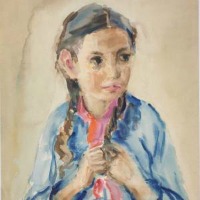
Portrait of a girl by Gela Seksztajn found in
the Ringelbaum Archive
Wordwings is one of those books that is going to stay with me for a long time because there is so much in it to to think about. One the one hand, Rivke’s story is a factual accounting of what life was like in the Warsaw Ghetto - the starvation, the disease, the fear, the inhuman treatment of Jews by the Nazis, but it is also about the importance of family, hope in the midst of despair, the secret kitchen at Nowolipki 68 serving food smugglers have brought in, underground resistance to Nazi oppressors, and the power that stories have to help get us through difficult times. Or, as Rivke says, “…if you let your heart listen to the stories, then their magic will bring a light to your eyes and energy to your step. And pretend bread is better than no bread at all.” (pg 110)

And the fact is that within the Ghetto, and as terrible as conditions were, a cultural life did thrive for the people who were forced to live there. That is made clear in Wordwings with the inclusion of Rivke’s storytelling, Batya’s library, and Dr. Ringelbaum’s Archive, both of which really existed.  

One of the things I liked is the way Pearl has so seamlessly combined fiction and reality. Those Rivke, her sisters and Zadye are fictional characters, they continually interact with people like Batya, Gela, Dr. Janusz Korczak who ran the Orphans Home, and Dr. Ringelbaum. When you read the Author’s Note at the end of the book, you will learn more about the persons included included in the novel and their fate.

Wordwings is written completely from Rivke’s point of view in the first person (after all, it is her diary), and her diary runs from 9 January 1941 to 9 May 1941. The ending may feel a bit abrupt, until you remember that the diary ends, not because of anything historical happening, but because Rivke has reached the end of the Hans Christian Anderson book, and it was time to put it into the Archive. 

I highly recommend Wordwings to anyone interested in the Holocaust, WWII, or simply historical fiction. It is a valuable addition to the literature of the Holocaust, and has been named a Notable Book for Older Readers by the 2018 Sydney Taylor Book Award Committee.

This book is recommended for readers age 13+
I wish to thank Sydelle Pearl and Guernica Editions for providing me with a review copy of this book.

You can learn more about the Warsaw Ghetto at the Jewish Virtual Library.

You can discover more about Dr. Ringelbaum and the archive by visiting the online Yad Vashem exhibit about it.

Besides Hans Christian Anderson, Yiddish storyteller I. L. Peretz is also mentioned, and you can find out more about him at the Jewish Virtual Library

I was sorry I didn’t pay more attention to the places Rivke mentions in Wordwings, but you may want to do that. If so, here is a useful street map of the Warsaw Ghetto:
MAP:
Encyclopaedia Judaica (1971): Warsaw, vol. 16, col. 347-348. 
(FYI: the Warsaw Ghetto existed from October 31, 1940 to September 21, 1942, the final day of deportations to Treblinka, and also Yom Kippur). 


Tuesday, July 12, 2016

Irena Sendler and the Children of the Warsaw Ghetto by Susan Goldman Rubin, illustrated by Bill Farnsworth

I know I've done a number of nonfiction books about Irena Sendler or fiction in which she played a part.  It seems to me that while they all tell the basic story of how Irena entered the Warsaw Ghetto during WWII to help the Jewish children there, they all add new information about this remarkable woman.  Irena Sendler and the Children of the Warsaw Ghetto is not exception, and is filled with information for the older picture book readers.

After the merciless bombing of Warsaw by the German Luftwaffe in 1939, Irena, then a deeply religious young Catholic social worker, did her best to help the wounded and needy.  Because of bombings all over Poland, Warsaw began to see an increase in refugees arriving and needing help. Unfortunately, the Germans also arrived, occupying what remained of Warsaw.  Concerned, Irena joined the Polish resistance movement.  With a crew made up of her girlfriends, Irena helped care for the Jews in Warsaw, targets of the Nazi occupiers, providing food and false documents so they could get help.

In 1940, as the Germans rounded up more and more Jews, forcing them to live in increasingly cramped quarters behind the brick and barbed wire wall they were forced to build and that formed the Warsaw Ghetto, conditions quickly deteriorated. Capitalizing on the Nazi's fear of epidemics, Irena and her friends dressed as a nurses and entered the ghetto.  Inside, people, including children, were begging for food, sleeping in doorways and dying in the streets.

In 1942, the Nazis began to round up Jews for deportation to Treblinka, a death camp.  Irena realized it was time to do something about saving the Jewish children in the ghetto.  But how?

Using the code name "Sister Jolanta,"  Irena joined an underground organization, code named Zegota, As part of this group, Irena, along with trusted friends, commanded the Department of Help for Jewish Children.  But the group knew that good intentions wouldn't rescue children, that each rescue had to be minutely planned and carried out down to the smallest detail.  And one by one, Irena and her helpers managed to convince the parents of almost 400 Jewish babies and children to allow her to smuggle them out of the ghetto and to places of safety - with no guarantees.

Irena kept meticulous records of who the children were and where they were sent.  Amazingly, after she was captured and tortured by the Nazis, Irena never gave anything away.  And just before her execution, the resistance, with some costly inside help, managed to rescue her.  Sadly, her days of working for the resistance were over, as she also had to go into hiding, in a safe house she at used for Jewish children in the Warsaw Zoo.  The list of the children's real identities were buried in a glass jar under a tree in a friend's and survived the war and was turned over to the Jewish Committee.    

Each time I read a nonfiction work by Susan Goldman Rubin, I am amazed at how much information she is able to include without overwhelming the reader with too many facts and dates, but giving them just what they need to understand the events she is writing about.  And Irena Sendler and the Children of the Warsaw Ghetto, a picture book for older readers, is not exception.

Written in a very readable documentary style, readers will feel the tension and danger these brave people in the Polish resistance faced every day, the indecision of parents asked to trust Irena with the lives of their children, and the confusion of some of the older kids.  What seems like the unimaginable, becomes real in this well-done, well-researched book, perhaps because Rubin included the words not only of Irena Sendler, but also of some of the babies or children who survived.  I think that's what gives this a sense of reality that some of accounts of Irena Sendler lack.

Those were such dark days and the oil-painted illustrations by Bill Farnsworth reflect them perfectly. Farnsworth's illustrations force the reader to look more closely at what is going on and when you do, you realize how well he has captured the danger and tension of those terrible days.

Be sure to read the Afterword for more information about Irena Sendler's life after WWII, when the Communist Government of Poland suppressed any knowledge of what she had done.  There is also lots of good back matter for anyone who wants to explore her amazingly courageous work further.

The publisher, Holiday House, has made available a very useful Educator's Guide that you can download HERE

This book is recommended for readers age 8+
This book was borrowed from the NYPL

Tuesday, August 18, 2015

The Safest Lie by Angela Cerrito

On the day that Jolanta brings a little food, some used clothing and a few vaccinations against typhoid fever to 9 year old Anna Bauman's youth circle in the Warsaw Ghetto, she decides to go home with Anna.  Quietly talking to her parents, Anna knows something is up.

After Jolanta drops off a paper for Anna's mother one morning, she begins to stay home as her mother makes her memorize a new name and other information.  Soon, she is no longer Jewish Anna Bauman, rather she is Catholic Anna Karwolska.  A few days later, Anna and her parents go to a home in the ghetto, where Anna is washed clean of ghetto dirt, and soon the leader of her youth circle, Mrs. Rechtman, shows up to take her away.

Wearing a new school uniform, Anna and Mrs. Rechtman go to the administration building, a building that straddles the ghetto and the streets beyond it.  Swiftly, Anna is passed to a woman who takes her into an office, where she must hide under the desk and wait for someone to come and get her.  The wait is long, but finally a teenage girl carrying a large box arrives and tells Anna to follow her.  They walk out of the building to the streets beyond the ghetto.  From here, Anna travels with the girl to a farmhouse, where she is surprised to find out that the box she and the girl carried so carefully contains a baby that has also been smuggled out of the Ghetto.

At the farmhouse, Anna is taught the traditions, the prayers and the catechism every Catholic child would know, including when to stand or kneel in church.  She is drilled over and over, until she responds automatically to being Ann Karwolska.  Afraid she is going to forget who she is and who her family are, Anna only allows herself to be Anna Bauman at night when she is alone in bed.

Eventually, Anna is sent to a Catholic orphanage away from Warsaw.  Keeping her secret, Anna adjusts to like in the orphanage, even though one girl, named Klara, seems to be out to get her.  Does Klara know her secret?  Hopefully not, because one day, Nazis arrive at the orphanage, pillage it and steal all the food that the nuns used for feeding the children, but not before terrorizing everyone.

Eventually, Anna is fostered out to a family that really welcomes her, and where she feels somewhat safe and comfortable.  Yet, Anna still makes it a point to remember who she is and where she came from when she is alone at night, never telling anyone her secret.  But, as Anna discovers, Stephan, Sophia and their son Jerzy are harboring a secret of their own - a very dangerous secret.

If you have ever wondered what happened to the children that Irena Sendler smuggled out of the Warsaw Ghetto, this is the book for you.  Based on fact, Angela Cerrito has imagined the life of one young girl who survives the Holocaust thanks to the courageous efforts of Sendler and the network of people who were helping her.  It is clear from the start that the lady Anna knows as Jolanta is one of the code named used by Sendler.

And while The Safest Lie doesn't have a lot a action, it does have a lot of suspense, nail-biting tension and shows the reader just how careful and clandestine people in the resistance needed to be.  Anna's story is fictional, but Cerrito has certainly captured all the tension, fear, constant hunger, and suffering that the Jewish children experienced during the Holocaust.  But she also shows the difficulty and mixed emotions parents must have felt when their children were offered the possibility of safety if they were willing to temporarily give them up.

The Safest Lie is a work of historical fiction but it is based on the hundreds of transcripted interviews with children who survived the Holocaust that Cerrito read and which give the novel its sense of authenticity.  Be sure to read Cerrito's Author's Note at the end of the book about her meeting Irena Sendler

There is an extensive Educator's Guide for The Safest Lie available to download from the publisher, Holiday House


This book is recommended for readers age 9+
This book was an ARC received from the publisher.

Sunday, March 22, 2015

Mister Doctor: Janusz Korczak & The Orphans of the Warsaw Ghetto by Irène Cohen-Janca, art by Maurizio A.C. Quarello

Janusz Korczak was a well-known, well-respected children's pediatrician in Poland in the early part of the 1900s.  Among his many accomplishments, he had founded an orphanage to care for some of Warsaw's young Jewish orphans. He loved children and would often regale his charges with stories he made up, including the now classic tale of King Matt the First, as well as looking after their health and cheering them up with their needed it.  And the children loved him back, affectionately calling him Mister Doctor.

On November 29, 1940, all the orphans living in the big orphanage at 92 Krochmalha Street in Warsaw, Poland were ordered to leave by the Nazis.  Accompanied by Mister Doctor and his assistant Madam Stefa, all of the children walked to the ghetto that would be their new home for a while carrying their meager belongings, softly singing, and the flag of King Matt the First.

Their new home is small, located within a two block radius, surrounded by barbed wire and armed watchman, their living quarters are cramped and dirty.  When their wagon full of potatoes were confiscated by the Nazis, Mister Doctor put on his WWI uniform and went to Gestapo headquarters, where he was laughed at, ridiculed, beaten and temporarily arrested.

Life in the ghetto grew more and more crowded as more Jews were brought in, food became scarcer and scarcer, with men, women and children dying in the streets everyday from starvation and disease.  Finally, in August 1942, the children were ordered to the train station and from there to a concentration camp and death.  But Mister Doctor was offered his freedom, after all, he was a famous doctor.  Instead, he refused and choose to accompany his children on this final journey.

The story Mister Doctor is told by a young boy named Simon to a younger, newly arrived orphan named Mietek.  Simon describes in detail how the orphanage was run, how the children were educated and how Mister Doctor took such special care of all of them.  At the same time, Simon is talking about past, he also gives detailed information to the reader about what is going on in their present situation.  Cohen-Janca has really captured the sense of longing and nostalgia in Simon's voice when he talks about life in the orphanage before the Nazis invaded Poland, and the fear and apprehension he feels about what is to come.

The story told here is a fictional reimagining of what happened to Dr. Janusz Korczak and the children in his care, but based on the true story of what happened to them during the Holocaust.  Pay particular attention to the last three paragraphs of this book and ask yourself who wrote them and why?

Like Michael Morpurgo's Half A Man, this book also looks like a chapter book with only 68 pages a simple narrative style and many illustrations, but it is also deceptively complicated and really for a middle grade reader.

The realistic black and white illustrations set against a marbled peach background are a precise reflection of the words that Cohen-Janca has written, and give the reader a real-to-life sense of the children, the doctor and their lives from 1940 to 1942.  Little touches, like the figure of Puss in Boots leaping over the barbed-wire fence of the ghetto as Simon talks about how that cat and his courageous deeds always gave the orphans courage.  But there is a subtext that says the Nazis can take away housing, food, dignity, but not the stories that means so much and help the get kids through very difficult times.

This is a powerfully poignant story that shouldn't be missed.  Additionally, at the end of Mister Doctor is information about the real Janusz Korczak, whose real name was Henryk Goldszmit, followed by a briefbut useful list of Further Reading and Resources, Children's Books by Janusz Korczak, Resources for Parents and Teachers and Related Links.

Mister Doctor was translated by Paula Ayer

This book is recommended for readers age 9+
This book was an E-ARC received from NetGalley

Monday, October 28, 2013

The War Within These Walls by Aline Sax, illustrated by Caryl Strzelecki, translated by Laura Watkinson

The War Within These Walls is a slim graphic novel based on a real event.  Narrated by teenage protagonist Misha, it follows the fate of his Jewish family living in Poland at the start of WWII.  Little by little the Nazis made life untenable for the Jews in Poland.  Eventually, the Jews were all moved into various ghettos around Poland, Misha and his family found themselves living the the Warsaw Ghetto.

With little food and people dying of starvation every day, Misha begins to sneak out of the ghetto at night to find food to smuggle in for his family.  Soon, his younger sister Janina starts following him and when he insists she stop when the Nazis were starting to hang smugglers, she leaves the ghetto on her own and doesn't return.

Then, the Nazis announced that the Jews were going to be resettled in the east to have a better life.  People thought that might be a good thing until the freight trains with only cattle cars arrive.  As the Nazis swarmed the ghetto to find anyone who tried to hide, Misha realizes that they were going east to be killed not resettled.

Hiding from the Nazis during the raid, Misha meets a young man named Mordechai Anielewicz and his life as a Jewish resistance fighter begins.  As he meets other Jews in the resistance, Misha feels a sense of renewed hope.  The Nazis planned to liquidate the ghetto on April 19, 1942, a date that coincided with the Jewish holiday of Passover.  But they were never expecting to meet resistance, but Misha, Mordechai and the other Jews for back, culminating in what we know call the Warsaw Ghetto Uprising.

Using sparse test accompanied by stark black and white pencil, pen and ink illustrations against a black or white pages, The War Within These Walls is one of the most powerful books I have read about the Holocaust and the Warsaw Ghetto.  The slim design of the physical really imparts the sense of how increasing narrow the Nazis made world for the Jews in Europe, while the height reminded me of how Misha saw the freedom of birds who had the freedom could just fly away from the ghetto.

And it is a grim novel, full of despair, but how could it not be.  One of the most poignant parts of the story was the disappearance of Janina after she runs away from the ghetto.  I could really feel Misha's agony not knowing what happened to her - did she survive or was she captured and killed?   Like so many many Jewish families caught in the the Nazi reign of terror who never saw their loved ones again and never learned what became of them.

By the end, I could really see how Misha and the other resistance workers saw hope in what they were doing even though it proably would spell certain death for them.

This is a heart breaking novel in its very simplicity, but not to be missed for mature teen readers interested in the Holocaust and WWII.

This book is recommended for mature readers age 14+
This book was purchased for my personal library

At the end of The War Within These Walls, there is a short biography about Mordechai Anielewicz, who was indeed the leader of the resistance within the Warsaw Ghetto.  He was born in 1919 and killed on May 8, 1943 during the Uprising.  He was only around 24 uears old at the time.

You can also read more about this hero of the Holocaust HERE


This is book 11 of my 2013 Historical Fiction Reading Challenge hosted by Historical Tapestry
This is book 6 of my 2013 European Reading Challenge hosted by Rose City Reader

Friday, September 6, 2013

The Cats in Krasinski Square by Karen Hesse, illustrated by Wendy Watson

When I first started this blog, I reviewed a book called The Cigarette Sellers of Three Crosses Square by Joseph Ziemian.  It was the first of many books about the Warsaw Ghetto that I have reviewed here and these stories about the brave individuals who were part of the resistance never has ceased to awe me.

So when I found The Cats of Krasinski by Karen Hesse on the library shelf, I thought Wonderful! A nice picture book for older readers who may already have some familiarity with the Holocaust to introduce them to the Warsaw Ghetto and Jewish Resistance in WWII.

As we know, lots of Jewish children of all ages often escaped the Ghetto and lived openly right under the Gestapo's nose, passing for Aryan.  Whenever they were able, they smuggled food and other necessities back to family and friends still behind the Ghetto wall.

In Hesse's story, two sisters have escaped the Ghetto and are living hand to mouth in Warsaw.  The younger sister has befriended the cats that became homeless when their owners were rounded up to live in the Ghetto.  Her older sister, Mira, is working with the resistance.  They are expecting some food to arrive by train, carried by other resistance workers, to be stuffed into the holes in the Ghetto wall where it can be found by the Jews still living there.

But word comes that the Gestapo knows about the plan and will be waiting at the train station with trained dogs to arrest the resistance workers and confiscate the food.  The young girl gets an idea to distract the Gestapo's dogs when the train arrives.  And it works, thanks to the cat of Krasinski Square.   The cats are gathered up and let loose just as the train arrives.

The Cats of Krasinksi Square is an uplifting age appropriate story that has a lot to say to young readers not only about courage and taking risks,  but that sometimes kids can come up with ideas that actually work.   Told in sparse, lyrical free verse, the story is enhanced by the corresponding illustrations by Wendy Watson.  Watson used washed out muted colors in pencil, ink and watercolor that certainly evoke the place and period in her beautifully rendered illustrations.  

I thought that putting a merry-go-round in Krasinski Square at the the beginning and end of the book was an interesting touch.  Carousels are such iconic symbols of happy children having fun, yet here it is juxtaposed with and accentuating the deplorable conditions that the Nazis forced upon the Jewish children.  It makes a very telling comment.


This story is, as Hesse writes in her Author's Note, based on a real event involving cats outsmarting the Gestapo at the train station in Warsaw that caught her attention when she read about it.  There is also a historical note about the Warsaw Ghetto and Jewish Resistance that anyone not very familiar with these might want to read.

This book is recommended for readers age 7+
This book was borrowed from the NYPL

Monday, October 24, 2011

Irena’s Jars of Secrets by Marcia Vaughan

Marcia Vaughan's book, Irena's Jars of Secrets, is an informative look at the life of a brave, young resistance worker in the face of great danger.

Irena Sendler was a pretty young girl living in Warsaw, Poland when the Nazis invaded her country. Late in 1940, they forced Warsaw’s more than 400,000 Jews into some crowded, run down buildings, separated from the rest of that city by a 7 foot brick wall the Nazis had built, where they began their fight for survival in the Warsaw Ghetto.

Irena Sendler, a young social worker, and the daughter of a physician who had been willing to treat poor Jews during a Typhus outbreak years earlier, decided to follow in her father's footsteps and try to help ease the suffering of the Jews behind the wall.

Against this background, Vaughan tells the story of this remarkable young woman who risked her own life over and over to try to save others. By now, most of us know about Irena smuggling activities – bringing clothing, food and medical supplies into the ghetto, and sneaking children out and to safety. To keep track of the children, whose names had to be changed so they could pass as Christians, she wrote down their real name and their false identity and buried them in jars in the hope that they could some day be reunited with their families.

Irena’s smuggling activities came to an end when she was betrayed to the Gestapo in 1943. She was sentenced to death but, despite being tortured, never betrayed any her secrets, including the location of the jars that had the potential to destroy so many lives in the hands of the Nazis.

Irena Sendler as a young girl
Vaughan’s biography about Irena Sendler is presented in very accessible language, detailing how she began her work on her own, and later joining Zegota, a secret organization for helping Jews. She also includes some personalized narratives of Jews deciding to send their child into the unknown with Irena, rather than face deportation. Vaughan gives a real sense of the despair, desperation and even the ambivalence these parents must have felt about turning their children over to Irena without a real guarantee of their safety.

The narrative is enhanced by the excellent oil paintings of illustrator Ron Mazellan throughout the book. Mazellan paintings reflect the dark uncertain times that people experienced under the Nazis. Yet, for all their emotional content, the paintings are done in a kind of soft focus, powerful without being frightening and detracting from the narrative.

Irena’s Jars of Secrets is an excellent addition to the ever growing body of Holocaust literature for younger readers. I think it is important that children know there were some people acting unselfishly and courageously amid so much cruelty. This important story is a must read for anyone teaching or just interested in the Holocaust.

This book is recommended for readers age 6-11
This book was a received as an E-ARC from Netgalley.com

Yad Vashem named Irena as one of The Righteous Among The Nations in 1965

Irena Sendler's obituary from the New York Times
(I had a teacher in junior high who told us to always read the obits in the newspaper because you can learn so much about a person there and it has really been true, which is why I sometimes include them)

Non-Fiction Monday is hosted this week by Apple with Many Seeds


Irena's Jars of Secrets
Marcia Vaughan
Lee & Low
Available 11/1/2011
40 Pages

Monday, September 6, 2010

The Champion of Children: the story of Janusz Korczak by Tomek Bogacki

This is an interesting, inspiring book about a doctor who devoted his life to helping children.

Korczak was born in 1878 in Warsaw, Poland. Though his parents were well off for part of his childhood, Korczak was very aware of the poverty and suffering of other less fortunate children in Warsaw. When he was 11 years old, his father became ill and his family began to struggle because he could no longer work. Korczak tutored to help out and when he went off to university, he knew he wanted to devote his life to helping children as a doctor.

Soon Dr. Korczak was a well-known, well-respected writer of articles explaining his ideas about education and orphanages. When he was asked to be director of a new Jewish orphanage, Korczak jumped at the chance because “he wanted to do more than make children well, he wanted to change their lives.” (pg 10)

The orphanage was opened in 1912 and was very democratically run. For example, the children governed themselves, decided on punishments, and participated in discussions about problems that were encountered within the orphanage. But Korczak also believed children should have fun. He always told them stories, and played games with them. Every summer, the kids went to a camp in the countryside. Korczak also wrote and published books for children and adults, his most famous being King Matt the First.

When the Nazis invaded Poland and forced all Jews to live in the ghetto they had created, Korczak , his staff and his orphans were forced to live in a single crowded room. Life was difficult and the children became thin and sickly. Korczak would roam the streets of the ghetto, scrounging around for food, medical supplies and anything else they might be able to use.

On 6 August 1942, the Nazis ordered Korczak and the children to the train station, to be transported to Treblinka extermination camp. It has been written by many who witnessed the procession through the streets about the quiet dignified manner with which Korczak and his children conducted themselves. Though nothing could save them from their horrible fate, Korczak’s ideas about and success with children continue to be inspirational. As Bogacki notes at the end to the story:

In honor of Korczak’s work, the United Nations declared 1979 the International Year of the Child. The United Nations Convention on the Rights of the Child, created in 1989, was strongly influenced by Korczak’s theories.
Bogacki both wrote and illustrated this beautiful picture book depicting the life of Janusz Korczak. He was influenced by stories his grandmother had told him about this remarkable doctor.

The Champion of Children: the Story of Janusz Korczak received the following honors:

2009 National Jewish Book Award – Finalist
2010 Sydney Taylor Notable Books for Older Readers

Non-Fiction Monday is hosted this week by http://missrumphiuseffect.blogspot.com/2010/09/nonfiction-monday-is-here.html

Monday, August 9, 2010

The Cigarette Sellers of Three Crosses Square by Joseph Ziemian, translated by Janina David

This is a true story about a group of Jewish orphans who survived outside the walls of the Warsaw Ghetto by selling cigarettes to Germans on the Aryan side of the city. Of these children, Ziemian writes on page 25
This group of Jewish children, wandering around under the very noses of a thousand policemen, gendarmes, Gestapo men and ordinary spies, constituted an unexplained and inexplicable phenomenon, no less mysterious for being real.

After the ghetto was established in 1940, some of the older kids would sneak out by various means to obtain additional food for their hungry families to supplement the meager rations given they were. These children would beg on the Aryan side and sometimes be given food by kind women, or they would sell family possessions to get money to buy bread. It was a hard and risky life for such young people.

Ziemian was part of the underground Jewish Resistance Movement in Warsaw and possessed a false ID card that gave him freedom of movement. He tells the story of Bull, whose real name Ignacy, the leader of the cigarette sellers. Bull’s life was relatively good in the ghetto until the Germans began their roundup of Jews for the first deportation to Treblinka in the summer of 1942. Right off, his father was killed by a German gendarme for possessing a packet of saccharine. Bull was seized from the street and put on a deportation train, but managed to escape from the moving train. When he returned home, he realized that his entire family was gone. He left the ghetto, hiding among a contingent of Jewish workers, but was forced to return at nightfall. He was again seized and put on another deportation train. Again he escaped. The contingent of workers welcomed him back and gave him a false work permit. He began selling possessions from the ghetto for people in exchange for food to bring back to them. One day, Bull noticed a group of four Jewish children. They found themselves under the care of Bull and the workers, until one day the workers were rounded up and deported. Bull again managed to escape, again found work as an apprentice cobbler and continued to smuggle food into the ghetto, only this time the loaves of bread also camouflaged guns. On the first night of Passover in 1943, the Germans attempted to carry out another mass deportation. This time they were met with armed resistance (the Warsaw Uprising). Again Bull found himself captured for deportation and for a fourth time he managed to escape, but suffered a serious leg injury. When his leg was healed enough to walk and he was back on the streets of Warsaw again, he met his first four cigarette sellers, who wanted him to stay with them:
“Yes, yes. I’ll work with you,” promised Bull. His arrival at the Three Crosses Square was the start of a new life for the children. Bull had authority. In their eyes he was grownup and experienced, and he became their leader. (pg 76)

Altogether, there were about 20 cigarette sellers, about five of them girls. After Ziemian befriended them, they also received false ID papers. They were continuously helped out by kind Polish women, but were dogged by “schmalzers” (blackmailers who would denounce Jews to the German authorities unless their demands were met.) Life continued to be hard, a matter of day to day survival, sleeping and eating wherever and whatever they could. Ziemian wrote about their ability to survive
After their escape from the ghetto they led an adventurous and independent existence on the Aryan side of Warsaw. Sentenced to death, hounded and harried at every step, they found a way of surviving in the jungle of the occupation. They knew how to defend themselves and how to fight for their existence; they knew – unlike so many adults – how to help each other. (pg 10-11)

There is much more to the story of The Cigarette Sellers of Three Crosses Square, including that of little Bolus, age 7 and the youngest member of the group. It is a book written for young adult readers, but because of some of the graphic content, I would recommend it to more mature YA readers. It is also a translation from the Polish and sometimes it reads a bit awkwardly, but that doesn’t really interfere with the overall story.

Ziemian never uses anyone’s last name, which I assumed was for privacy reasons, since all the survivors were still living at the time he wrote the book. Three of the cigarette sellers did not live to see the end of the war, and he does tell the reader their full names as an act of remembrance. Most of those who did survive moved to Israel after the war, but a few went to Canada. All were successful in their adult endeavors. But the point of this book is not what became of the children later in life, but it is about their survival under extraordinary circumstances and that is what makes it worth reading. It is also very interesting that, aside from this book, there is very little information about the cigarette sellers and their amazing story.
Below are some of the photographs Joseph Ziemian had a photographer in the Three Crosses Square take of the cigarette sellers


Non-Fiction Monday is hosted this week by http://www.momsinspirelearning.com/