Showing posts with label Post WW II. Show all posts

Sunday, August 21, 2022

American Shoes: A Refugee's Story by Rosemarie Lengsfeld Turke and Garrett L. Turke

In 1930 Rosemarie Lengsfeld, affectionately called Rosel by her family, was born in New York City to parents who had emigrated to the United States from Germany and were awaiting their final citizenship papers. Despite that, they decided, in 1935 when Rosel was four-years-old, to return to Germany to visit family in Breslau. It was to be only a short stay, but lasted longer than expected, so when it came time to return to the US, the family discovered that their tickets would not be honored. Adolf Hitler, then Chancellor of Germany, had closed the borders so that German citizens could not leave the country. At first, Rosel enjoyed being with her extended family in Germany, and her parents soon welcomed baby Eleonore into the family. But when the war began, the family found themselves struggling to stay alive without enough food to eat amid bombing by the Allied Forces. 

Finally, in 1946, with the war over, Rosel received a letter telling her she could return to the United States. Convinced that this would include her parents and now nine-year-old Eleonore, the family showed up at the American Embassy and were told only Rosel, 15, could return home, since she was the only American citizen - her parents and sister were German citizens. 

Making a snap decision to go it alone and hopefully find a way to bring her parents and sister to the United States, Rosel finds herself traveling across the ocean on a 10 day trip aboard the SS Marine Flasher, a former troop transport ship along with other American citizens who were stuck in Germany and "surviving Jews and other displaced persons..." On board ship, Rosel meets the mysterious Liesel, another American with German parents, a few years older Rosel, who is traveling with her brother Kurt. She also meets David, a talented musician who lost his entire family in the Holocaust. As the ship gets closer and closer to the United States, Rosel begins to fear that no one will believe that she is American, that she will be branded as a Nazi because of her German accent. 

It is during this journey at night when she is alone in her bunk bed that the reader discovers what life was like for Rosel, her family and others living under the horrors of Hitler's dictatorship before and during the war. Interestingly, she never talked about her experiences until she was 85 years old and therefore it is all based on her memories, but told in the first person from her 15 year-old perspective, and, in my opinion, making her something of an unreliable narrator. Even so, it's hard to imagine a 15-year-old making the kind of decision Rosel was forced to make that day in the Embassy, leaving her parents and sister behind, traveling alone to who knows what future, and at the same time, dealing with the trauma of the war as it returned night after night on the trip to the US. But Rosel's story is definitely one of courage and a different kind of true WWII story in that it is told from the point of an American child. It is often not an easy book to read, but I found it hard to put down. 

American Shoes is a book that will appeal to readers interested in WWII, the post war experience, especially the experiences of Americans can in Nazi Germany, and war-related trauma. Back matter includes maps, a glossary, an author's commentary on WWI, WWII, and the Holocaust, and thoughts by the author's son about writing this book, as well as extensive Discussion Questions. 

Tuesday, August 10, 2021

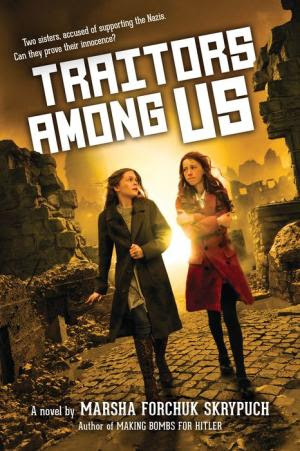
Traitors Among Us by Marsha Forchuk Skrypuch

Traitors Among Us is the third book in the story of Krystia and Maria Fediuk, two Ukrainian sisters who had been separated when the Nazis occupied their country beginning in 1942. Maria, who was then 11-years-old, had decided to leave their home in Viteretz to work in the German Reich and hopefully be able to send money home to her sister Krystia, then 12-years-old and mother. 

Now, it is June 1945, the war is over and the reunited sisters, Krystia, now 16, and Maria, now 14, have just arrived, exhausted, at an American refugee camp in Karlsfeld, Germany and are feeling somewhat safe and hopeful for the first time in years. The girls are hoping to be able to travel to Toronto, Canada to live with their mother's sister Auntie Stefa and her husband Uncle George.    

But Krystia and Maria's initial feelings of safety are short lived when Sophie Huber arrives in their barracks using the name of Maria's friend Blanka Holata, who had done slave labor with Maria on the Huber farm. Sophie was a Hitler girl, and rather a staunch, cold-hearted believer in Hitler and his Reich. And, yes, when Russian soldiers show up at their barracks, kidnaping anyone they believe had betrayed the Soviet Union during the war, Sophie can't denounce Krystia and Maria as Nazi collaborators quickly enough in an attempt to save herself. An attempt that doesn't work - the Soviets know who she is and suspect her of being a Werewolf, part of an underground network of Hitler youth working to bring the Nazis back to power.

Krystia and Maria find themselves in the back of a truck with a man, Elias, and his son Finn, a woman named Olga and her baby Piotr, as well as Sophie. Along the way, they learn that Elias and Finn are Volksdeutsche or ethnic Germans who originally lived in the Ukraine but were moved from their home by the Nazis in order to Germanize Poland early in their occupation of that country. Olga has British papers, but was arrested became her father had joined the White Army during the Russian Revolution, to fight the communist takeover, but Olga's husband had fought with the Nazis to defeat the Soviets (be sure to read the author's notes at the end for more historical information).

Eventually, the truck arrives at an interrogation house in Soviet occupied Germany. And it doesn't take long for the Soviets to begin their interrogations, torture, and even stage a fake execution of Maria to get Krystia to sign a fake confession. When she continues to refuse to sign their confession, the Soviet soldiers finally let Maria go but tell her to report to the train station where she will be taken to a Soviet labor camp. Maria is taken in by Birgit, who lives in the basement of a bombed building. Birgit has been bringing food to the Soviets at the interrogation house hoping to eventually be able to rescue her grandson, Mychailo, being held prisoner there, too. With two prisoners released (Elias is also free, but not Finn), and four still being held and tortured, can a rescue attempt possible be successful in such a heavily guarded, locked and barb wired building? 

Traitors Among Us is a fascinating story and a great conclusion the the trilogy about Krystia and Maria. As she always does, Skrypuch brings a lot of history into her narrative that unravels so seamlessly while, at the same time, she weaves together a story that is readable, believable and so realistic. My only complaint is the same as Ms. Yingling's - it all ended to abruptly and I wanted to know more. But isn't that often a problem when great stories end?

There are some graphic depictions in this novel, but only to the extent to give readers a real sense of what was happening at the time, yet not to such an extent that middle graders would be freaked out by it. I did like that in the middle of trying to save their lives and escape, Maria feels resentment at being treated like a helpless younger sister, and Krystia's constant need to protect her. Sibling resentments added an almost normal touch to their otherwise treacherous situation. I also loved how Maria used her sewing skills to make two pairs of underpants out of a Nazi flag - sort of like poetic justice.

Just as the second book in this trilogy, Trapped in Hitler's Web, worked as a stand alone novel, thanks to Skrypuch's including just enough background information from the first book, Don't Tell the Nazis, Traitors Among Us also works as a stand alone novel, with just enough information from books 1 and 2, though I recommend reading all of them. They are just that good. I started Traitors Among Us one evening and sat up until about 3:30 AM reading to the end, because I couldn't put it down and needed to know what Krystia and Maria's fate was going to be. 

Traitors Among Us will be available September 7th, 2021, giving readers just enough time to read books 1 and 2 before then, if they haven't already. 

This book is recommended for readers age 9+
This book was an eARC received from Edelweiss+

Tuesday, May 4, 2021

After the War: From Auschwitz to Ambleside by Tom Palmer

Tom Palmer used to write books for kids about sports like rugby and football (soccer), but more recently he has turned his storytelling skills to historical fiction. Last year, I read D-Day Dog, a story I found to be very informative, as does the present-day protagonist Jack. This year, I was intrigued to read After the War after hearing about it for an event on World Book Day, March 4, 2021 in connection with the Anne Frank Trust. 

After the War is a fictionalized story based on true events that happened after the war ended. In 1945, 300 Jewish children who had survived life in a Nazi concentration camp during the Holocaust were sent directly to the Lake District in England. 

It's summer 1945 when 15-year-old Yossi, and his two friends Mordecai and Leo arrive in England in one of 10 planes, each carrying 30 young Holocaust survivors. They have been told they are safe now, that they will all have enough to eat and a room of their own with a bed and electricity, and most importantly, there will be no guards. But after six years in a concentration camp, could they really trust that? 

Arriving at the Calgarth Estates on Lake Windmere, where they will live for the next few months, the children find it difficult to trust people and what they say, and to give up the survival habits that kept them alive in Auschwitz, especially when it comes to food. So despite there always being enough to eat, Yossi, Leo, and Mordedai stuff as much food as they can into their pockets to save for later - just in case there isn't enough food then. 

Slowly, however, they begin to gain weight, becoming healthier and stronger. They even begin to develop trust again, thanks to the the kindness of the people of the Lake District and those in charge of them at Lake Windmere. Soon, they are back in school and learning English, and since their stay is only temporary, they also need to start thinking about the future and what they will do. The Red Cross arrives visits to obtain information about the children's families in order to try to reunite them with relatives who might have also survived. Yossi hopes that they will find his father, whom he wants to believe is still alive, even though they were separated on a death march towards the end of the war. Yossi watched as his younger sisters and mother went to the gas chambers the night they arrived in Auschwitz, but he and his father were selected to work. 

Hoping against hope that the Red Cross will find his father, Yossi is unable to think about moving on. The three friends, who have become family to each other, want to stay together, but can't agree on how to do that. Mordecai, who is deeply religious, wants to join the Jewish community in Leeds after they reached out to the children at Lake Windmere, while Leo wants to go to Palestine, believing they would be safest there. 

But recovery and recuperation aren't as easy as clean sheets and enough to eat. Yossi, who is the main protagonist, is haunted by his memories of the things he witnessed before the war in Poland after the Nazis invaded and life first in the ghetto and later in Auschwitz. These memories are seamlessly woven into the story as incidents in Yossi's present ignite flashbacks in his past. Sensitive and caring, Yossi has a minor breakdown one day when he seems to have given up and, not seeing any point to it, refuses to get out of bed. Laying there, he recalls his father's words "...if we let ourselves go, the Germans will think they are right, that we are not human." His father believed that getting up and washing every morning in Auschwitz was an act of defiance, of resistance to the Nazis, and Yossi determines it is still true. Will the memory of his father give Yossi what he needs to be able to get up and move on?  

People sometimes forget that when a war ends, it isn't over, that there are always serious after effects. In this short, very readable novel, those after effects are clearly presented. Palmer depicts the children's survivor behavior in their present circumstances, relating it back to what happened in the concentration camps in the most heartbreakingly poignant way. And while he doesn't graphically describe the cruelty and the atrocities committed by the Nazis against Jewish men, women, and children, he gives enough detail that readers can get a clear picture of what happened then and the challenges the children now face.

After the War is a powerful book about courage, friendship, hope and resilience and I can't recommend it highly enough.

Be sure to visit Tom Palmer's After the War webpage for more information, including a link to read the first chapter, a link to hear about his researching and writing After the War and so much more.

Although After the War is fiction, you can find more information about the children who were brought to Lake Windmere at the The Lake District Holocaust Project HERE (BTW, 10% of author royalites are donated to The Lake District Holocaust Project). 

After the War is published by Barrington Stoke in a dyslexic friendly font, layout, spacing and page tint that makes it easier to read (and since I'm dyslexic, I can honestly say it does). 

This book is recommended for readers age 10+
This book was purchased for my personal library

Monday, June 15, 2020

Superman Smashes the Klan by Gene Luen Yang, art by Gurihiru

Superman was both a popular comic and radio show during World War II, but once the war was over, there were no more Nazis to fight. So, Superman's creators turned their sights to the home front and, at the request of the Anti Defamation League, they took on the KKK. Beginning on June 11, 1946, the radio show ran a 16 part story called "Clan of the Fiery Cross." Each episode was 15 minutes long and sponsored by Kellogg's Pep Cereal. The story proved to be extremely popular, except of course with the Klan, who encouraged members to boycott Kellogg's products. 

Flash forward to 2019. Leave it to Gene Luen Yang to take the story from the radio show and give it his own magical touch turning it into a graphic novel and making it as relevant today as it was in 1946. The premise is basically the same: a Chinese American family - Dr. Lee, his wife and two children, Tommy and Roberta - have just moved out of Chinatown and into a new house in the center of Metropolis. 

Roberta is a rather timid soul, not at all happy about leaving the comfort and safety of Chinatown. Tommy is much more outgoing, but the two siblings really care about and look our for each other 

High schooler Tommy loves to play baseball and is an ace pitcher. On a walk to explore their new neighborhood, he and Roberta meet neighbor Jimmy Olsen who just so happens to also coach a baseball team. But when Tommy beans star batter Chuck Riggs on the head with a baseball during a tryout, Chuck goes ballistic with racial slurs about the Lee siblings. Chuck is immediately fired from the team. At home, it turns out, Chuck's uncle Matt is head of the local Klan of the Fiery Kross and after hearing what happened, he decides it's time for Chuck's initiation into the terroristic activities of the Klan. Chuck's initiation is to help the Klan "burn away America's impurities" and drive the Lee's out. After a cross burning on their lawn and an attempt to burn their home, the Lee's African American neighbors, including Inspector William Henderson of the Metropolis police arrive to help put out the fires. The next morning, reporters Lois Lane and Clark Kent arrive to get the story for the Daily Planet.

Meanwhile, Superman is have problems of his own. The war may be over, but after Superman defeats Atom Man, avenger of the master race, he is left in a weakened state. Under the swastika bearing device that gives Atom Man is super strength is a green crystal (Kryptonite) that causes Superman to smell ash and rot and something else that is familiar, but he just can't remember what it is. The effect of the crystal on Superman continues, causing him to have strange dreamlike interactions with his parents who died when Krypton was destroyed. Suddenly plagued with self-doubt about his purpose and place as a foreigner on earth, Superman struggles with his identity.

Superman's struggle with his identity mirrors that of Roberta Lee's struggle to fit in and accept this part of Metropolis as her new home. Tommy is a great big brother to Roberta, and Jimmy Olsen, Clark Kent/Superman and Lois Lane all offer support as she struggles to find herself and fit in.

I really love a good Superman story and Superman Smashes the Klan is one of the best I've read. The story was originally issued in three limited edition comic books before the graphic novel was published, which is also divided into three chapters. Yang has diversified the characters more than the original 1946 radio program, and has made Roberta Lee and Superman the main protagonists. He has cleverly kept the story in the past yet the overriding issues haven't yet been resolved and the issues of identity and racism will definitely resonate with today's readers. Chuck and his uncle are perfect examples of how racism is passed on from one generation to another. Chuck almost becomes what his uncle wants, mostly because he is afraid to stand up to him for fear of what his uncle will do to him and his mom. Yang gives readers a Chuck who is at the point where he can become racist or reject it. His feelings of helplessness are so real and it's a hard choice for a kid to make. But I loved how Yang handled it.

One of the things Yang emphasizes is the importance of being a part of an accepting community. Tommy and even Roberta have supportive parents and they both find friendship immediately with the new baseball team Tommy joins. Roberta also find friendship and acceptance with Superman, who takes her under his cape, and Lois Lane, who becomes a kind of mentor for Roberta's writing aspirations. Yang also gives his characters much more agency than they were ever given in the old Superman stories. No longer passive "victims" of evil doers waiting for Superman to rescue them, they often take matters into their own hands to help themselves. 

The art for Superman Smashes the Klan was done by Gurihiru, a Japanese team of two women, Chifuyu Sasaki and Naoko Kawano, who have had lots of experience doing the artwork for a number of DC, Marvel, and Dark Horse comics. Their work here is done with a palette of bold and subtle colors, and each of the cells are clean and uncluttered, and really help move the story along. 

Be sure to read Yang's essay "Superman and Me" in the back matter. It is interesting, informative, historical and not what you might expect. 

Superman Smashes the Klan is everything I could want in a graphic novel and more. 

This book is recommended for readers age 12+
This book was purchased for my personal library

You can listen to the original 1946 radio version of "Clan of the Fiery Cross" HERE

Tuesday, May 12, 2020

They Went Left by Monica Hesse

It's August 1945 and Zofia Lederman, 18, has been recently liberated from Gross Rosen Concentration Camp. She is recovering at a hospital, but is determined to return to her family's home to Sosnowiec, in what had been Poland before the Nazi invasion in 1939. After all the Jews there were rounded up, the Lederman were ultimately deported to Auschwitz. Only Zofia and her younger brother Abek, survived the selection process upon arrival, both ending up in Birkenau. Before they were separated, Zofia promised Abek she would find him at the end of the war.

Zofia is convinced that Abek is still alive and waiting for her at home. But home is no longer home, taken over by squatters and ransacked. And Abek isn't there, nor has he been seen in Sosnowiec since the war ended. Here, however, Zofia learns that prisoners from Auschwitz-Birkenau had been sent to either Bergen-Belsen or Dachau. And so early one morning, Zofia leaves Sosnowiec with some stolen money, a small suitcase and goes in search of Abek. 

Arriving in Munich, Germany in September, Zofia finds her way to Foehrenwald, an adults only displaced persons camp. Since Abek would only be 12 by now, there is no chance of finding him in there. But Zofia is give a bed in a cabin with two other girls - Breine and Esther. And she meets the reclusive, angry Josef, to whom she feels a compelling attraction, and who eventually becomes her lover.

Though at first standoffish, Zofia slowly begins to settle into life at Foehrenwald. Thanks to her family's prewar business making fashionable custom clothing for women, Zofia's is an experienced seamstress and finds a purpose in the camp altering clothing for the women there, including a wedding dress. And just as she begins to come to life again, a boy claiming to be Abek shows up at the camp looking for Zofia. 

There are several mysteries woven into Zofia's story, which begin to become apparent as she replays memories about her family, the roundup that ultimately brought them to Auschwitz, the selection process in which she and Abek were sent to the right, her dreams about the last time she saw him, her single-minded need to find him now and to finally be able to go home. This is all described in some of the most heartrending prose I've ever read:
"And when we got to Birkenau, there was another line dividing into two. In that line, the lucky people were sent to hard labor. The unlucky people - we could see the smoke. The smoke was the burning bodies of the unlucky people.
On this continent, I need to find only one person. I need to go home. I need to survive. I need to keep my brain working for only one person.
Because everyone else: Papa, Mama, Baba Rose, beautiful Aunt Maja - all of the, all of them, as the population of Sosnowiec was devastated - they went left." (pg. 14)
As Zofia begins to feel alive again in Foehrenwald, she also begins to unravel the mysteries hiding in her own memories, as well as truth hiding in the enigmatic Josef. Against this, Hesse provides the reader with a very realistic picture of what life was like in a displaced persons camp after the war ended. She has really captured the chaos of so many people looking for loved ones whom they had been separated from and now hoped had also survived life in concentration camps, like Miriam. She and her twin sister were victims of Nazi experiments, now she obsessively writes letters in the hope of finding her sister. And as Zofia discovers, anti-Semitism didn't stop just because the war ended. But Hesse also shows the kindness of people, like Sister Therese at Kloster Indersforg, a displaced persons camp for children, who gives Zofia just enough hope that Abek is alive to keep her going.

While Zofia looks for Abek, Hesse interrogates the idea of what home will be to people who have lost everything and almost everyone that they had identified as home before the war. Just before the Lederman family was rounded up, Zofia had embroidered the story of their family in alphabet form and sewn it into Abek's jacket, so he wouldn't forget. In one of her dreams, Zofia tells Abek: "When I find you again, we will fill our alphabet. And we will be whole, and everything will be fine. I promise I will find you." (pg. xiv) As Zofia rewrites this alphabet in a post war world, it looks very different, but will it become her way to find a new home and rebuild her family?     

That being said, no one was more surprised than I was when I got the the end of The Went Left and the mysteries were solved. I did not expect what I read. 

They Went Left is a book everyone should read.

You can find a great discussion guide provided by the publisher, LittleBrown, HERE

This book is recommended for readers age 13+
This book was an EARC gratefully received from Edelweiss+

Thursday, April 23, 2020

Blue Skies by Anne Bustard

It's 1948 and the war has been over for three years, but not for 11-year-old Glory Bea Bennett. She's been hoping for a miracle - that her beloved MIA father, who was last seen alive storming Omaha Beach during the Normandy invasion on June 6, 1944 and is now presumed dead, will someday still come home. And it looks like Glory Bea is going to get her miracle...at least that's what she thinks.

Grateful to the United States for helping to liberate France from Nazi occupation, the French people have are sending 49 boxcars* on what is called the Merci Train, all filled with gifts for the United States. And one of those boxcars is going to travel through and briefly stop at Glory Bea's small town of Gladiola, Texas. Slowly, as the town begins to prepare a celebration for the train's arrival, Glory Bea allows herself to become more and more convinced that her dad will be on that boxcar stopping on Valentines Day, which also happens to be her parent's wedding anniversary. She's sure just wants to surprise her and her mom. After all, why else would the Merci Train stop in Gladiola, and wouldn't it be just like her dad to plan a big surprise like that? she thinks.

There's only one problem - now her dad's best Army buddy, Randall Horton, has arrived in town to visit with the Bennett family and Glory Bea is not happy about the fact that he is spending a lot of  time with her mother, laughing, going out, and just enjoying each other's company. Angry and resentful, it seems the more Glory Bea tries to make his visit unpleasant, the longer Randall stays.

Glory Bea keeps her idea about her dad's return to herself, only telling her best friend Ruby Jane about it. Meanwhile, she begins to prepare for his homecoming, but now it looks like Randall is planning to settle down in Gladiola. Well, once her dad is home, her mother will lose all interest in Randall.

But when the Merci Train finally arrives in Gladiola, Glory Bea's miracle is definitely not what she expected.

Blue Skies is an interesting work of historical fiction that really shows the extent to which WWII impacted the lives of those who lived through it long after the fighting ended and that finally by 1949, people were beginning to finally move on with their lives. And while I loved the idea of bringing the Merci Train into the story, I did have a hard time with Glory Bea's holding on to the idea her dad was still alive but just hadn't come home yet for such a long time.

That being said, I still really liked this novel. There's so much going on beside Glory Bea's obsession. Her grandmother is a matchmaker, and she's trying to follow in her footsteps matching Ruby Jane and neighbor Ben Truman, and totally missing Ben's real crush.

An important side story in the book is that of Ben's father who returned from the war a changed man, suffering from PTSD. When Randell Horton arrives in town, and goes to visit Mr. Truman, just being able to talk about the war with someone who was there finally begins his healing, but there's no doubt he has a long road ahead of him.

One of the things I really enjoy when reading historical fiction are the little everyday things that are included, giving the reader a real sense of what life was life for kids back then. For example, the way movies play such a big part in the lives of Glory Bea and Ruby Jane, and the tradition of going to the soda fountain for Dr. Pepper floats afterwards.

Bustard has also really captured the patriotic spirit of places like Gladiola after the war. It's a small, friendly community where everyone knows and look out for each other. This is very evident in the parade that is being planned for the Merci Train's stop there or when Glory Bea and Ben hop on a train without a ticket.

I have to admit that at first I found Glory Bea an annoying, self-centered character, but as I read on I began to feel more empathy for her. I can understand the difficulty of losing a parent that you feel so attached to as a child. It happened to me, and it happened to my Kiddo, and life is hard for a long time. Coming to terms with loss can be a hard, sad journey, but Bustard allows Glory Bea to have her journey her way.

If you have read or are planning to read Blue Skies, you can find a list of interesting resources and links, including an Educator's Guide, HERE. There's even a playlist of songs from that time period (one of my favorite things is an author's playlist for historical fiction).

If you are looking for a compelling middle grade book about WWII and its aftermath, you can't go wrong with Blue Skies.

This book is recommended for readers age 9+
This book was gratefully received from the publisher, Simon & Schuster

* There were 49 Merci boxcars in all - one for each state and a 49th for the District of Columbia and Hawaii to share. The Merci train, also called the French Gratitude Train, was sent as a thank you not only for America's part in the liberation of France, but also for the more than 700 boxcars of much needed supplies on The American Friendship Train sent to France in 1947.


Sunday, August 18, 2019

A Place to Belong by Cynthia Kadohata

We always like to think that this country fought heroically in WWII but the truth is that this country didn't always act very admirably, and in fact, it sometimes acted down right unconstitutionally. Which is why, on Saturday, January 12, 1946, 12-year-old Hanako Tachibana, her brother Akira, age 5, and their parents have just arrived in Japan after a long journey from Tule Lake Concentration Camp in northern California.

Having lost their home, their restaurant, their possessions, even Hanako's cat, the Tachibana family were living in internment camps since 1942, after President Roosevelt had signed Executive Order 9066. They had ended up in Tule Lake in 1943 because Mr. Tachibana had refused to answer yes to one of two loyalty questions on a government questionnaire designed to separate loyal from disloyal Japanese American men. Ultimately, Hanako's parents decided renounced their American citizenship when pressed to do so by the government and the family was repatriated to Japan at the end of the war, a country neither Hanako nor Akira had ever been to before. 

Hanako expects Japan to look as beautiful as it had in pictures she had seen, but the reality is a Japan that is as broken and poverty-stricken as she feels. Traveling to her paternal grandparents, tenant farmers living just outside of Hiroshima and struggling to survive, Hanako witnesses soldiers and civilians, dirty, disheveled, often crippled, begging for something to eat, as well as the destruction all around her, blackened trees, buildings and homes turned to rubble, all as a result of the atom bomb that had been dropped there by the Americans.

At her grandparents home, Jiichan (grandfather) and Baachan (grandmother) welcome the family with open arms and unconditional love, despite not even having enough to eat for themselves. Hanako helps out as much as she can working in the fields, but soon finds herself in school, where she is treated like an outsider. Although she can get by speaking Japanese, her reading and writing are almost non-existence, as is her skill using an abacus. Even her long braid is cause for criticism among the other girls. 

Hanako is a sensitive, observant, questioning girl, who is growing up too quickly, but is stuck in the past and afraid of the future. One of the first things Jiichan teaches her is that the way to move forward is through kintsukuroi, which is a way of repairing broken pottery using lacquer dusted with gold, so the repaired pottery is even more beautiful than it had originally been. The trauma of having lost everything has caused Hanako to question who she is, where she belongs, and what she now believes in. She may feel like a broken piece of pottery, but Hanako figures life is more complicated than a repaired bowl.

Eventually, however, Hanako's parents decide that they would like to return to America and begin working with an American civil rights lawyer, Wayne Collins, to make that happen. Mr. Collins is putting together a class action suit to help those who were repatriated to Japan after the war to regain their citizenship and return to America. But when her parents petition is refused, the family is forced to make some hard decisions. Yet, through everything that has happened to her family, Hanako finally begins to understand her grandfather's lesson on kinsukuroi, and learns that in life gold can take many forms, and that understanding is just what she needs to be able to move forward with her life.

I won't lie, A Place to Belong is a difficult book to read. Not because of the writing, which is beautifully straightforward. Or the characters, which are drawn so well you feel like you really know them. What makes it difficult is the reality of what happens, and knowing that Hanako's life is broken because of war, because of who she is and what is done to her by her own country - the United States. In addition, descriptions of children and adults begging in the streets, of people starving and disfigured in the aftermath of the atomic bomb, of black markets taking advantage of desperate people offer a disturbing, yet realistic look at post-war Japan even as Hanako tries to piece together just who she is amid the wreckage within and around her.

A Place to Belong is historical fiction based on real events. All men of Japanese ancestry really were required to complete the so-called "loyalty questionnaire" in 1943 and they, along with their families, were sent to Tule Lake Concentration Camp if they were deemed disloyal based on their answers. Tule Lake was a harsh, cruel place where inmates were treated like prisoners and many, like Hanako's family, were deported to Japan after the war.

A Place to Belong should be read by anyone interested in WWII history, however, I think readers will definitely see parallels to much of what is happening in our world today. Be sure to read Kadahata's Afterword for more information about Wayne Collins and the work he did on behalf of wronged Japanese Americans.

You can download a reading guide for A Place to Belong from the publisher, Simon & Schuster, HERE

You might want to pair A Place to Belong with No-No Boy by John Okada. No-No Boy looks at the post-war life of a Japanese American boy who answered no to both of the loyalty questions, but did not give up his citizenship.

This book is recommended for readers age 10+
This book was provided to me by the publisher, Simon & Schuster, with gratitude

View of barracks with Castle Rock in the background, Mar. 20, 1946, Tule Lake concentration camp, California.. (2015, July 17). Densho Encyclopedia. Retrieved 08:05, August 17, 2019 from https://encyclopedia.densho.org/sources/en-denshopd-i37-00239-1/.

Saturday, July 13, 2019

Stolen Girl by Marsha Forchuk Skrypuch

**This review contains a spoiler at the end**

Ever since the war had ended, Ukrainian born Nadia Kravchuck and her adoptive mother Marusia have been living in a displaced persons camp in Europe. But now it's 1950 and 12-year-old Nadia has just arrived in Canada with her mother Marusia to join her  adoptive father Ivan, already living in Brantford, Ontario. On her first night in her new home, several people come to visit and Nadia is introduced to Mychailo, a fellow Ukrainian immigrant with whom she will be attending school and receiving English lessons at a neighbor's house.

Unfortunately, Nadia is also plagued with nightmares and flashbacks, none of which make sense to her at first, although she feels that they have something to do with her past, a past she doesn't remember. She knows that although Ivan and Marusia aren't her real parents that they love her as if she were their own child. But who is she really? When Mychailo tells her that she doesn't sound Ukrainian and that she looks like a Nazi to him, Nadia worries that maybe that's who she really is. But Mychailo also seems like her, taking her to the library,  and reminding her to call Ivan and Marusia mother and father, or the Canadian authorities will take her away. 

Disturbed by that she might indeed be a Nazi, the nightmares and flashbacks increase, often triggered by what seem to be totally unrelated things, and finally Nadia remembers that her name used to be Gretchen Himmel and that she was a member of a Nazi family.

Later, on the first day of school, Marusia presents Nadia with a new ethnic-looking outfit that she had handmade her, despite working long, hard hours on her farm job. At school, the teacher is kind, but when a boy says she looks like a Nazi, she runs away in humiliation. Luckily, another new girl named Linda sits next to Nadia in class and the two become best friends.

Nadia eventually begins to adjust to her new life, but continues to be plagued by flashbacks to her past, causing her a great deal of confusion. Little by little, however, the puzzle pieces begin to fit together and form a picture of her life as Gretchen Himmel, daughter of a high ranking Nazi official, his cold, distance wife and his other daughter Eva. But the dreams and flashbacks continue, leading Nadia to believe that Gretchen Himmel is not her real identity. And gradually, more puzzle pieces fit together, finally falling into place through the most innocuous of triggers - a piece of candy. 

Stolen Girl is one of the most emotionally draining books I've read, and knowing before hand who Nadia really is didn't lessen the tension one bit. The novel centers around Nadia's Post Traumatic Stress Disorder or PTSD and the way it manifests in her after her traumatic wartime experiences. It has to one of the hardest conditions to successfully write about in a young person for young readers to really understand, but Skrypuch has managed to do just that in the ways Nadia's past reveals itself to her through her dreams and flashbacks.

                                                               **Spoiler Alert**
Stolen Girl is also one of the most compelling books I've read about the Lebornsborn Program. With her blond hair, blue eyes and young age, Nadia was a perfect Aryan-looking fit for this Nazi program designed to strengthen the Hitler's master race. Children like her were kidnapped, sent to Germany to be Germanized and than adopted by a Nazi family. Interestingly, other children who did not fit the Aryan picture were sent to labor camps, and Skrypuch gives hints about who Nadia/Gretchen really is when she sees a girl in an German labor camp of Ostarbeiters (workers from Eastern Europe) who looks just like her, and is in return noticed by the same girl. 

If you read Making Bombs for Hitler, you already know some of Nadia"s story and why she was recognized by the young Ostarbeiter. You may recall from that book that in 1943, after the Nazis shot their mother and the Jews she had been hiding, Lida, 8, and her younger sister Larissa, 5, were kidnapped from their grandmother's home in the Ukraine and sent by cattle car to Germany, along with all the other Ukrainian children the Nazis took. Days later, arriving at a slave labor camp in Germany, Lida and Larissa were forcibly separated from one another, and from that point the story follows only Lida's life in the labor camp. If you haven't already read Making Bombs for Hitler, and the other companion book, The War Below), I highly recommend it. Stolen Girl, the companion to Lida's story, is the story of what happened to Larissa after being taken from her sister. 

Stolen Girl is gripping novel that demonstrates how the trauma of war lives on long after the war has ended. It's a suspenseful, visceral journey that proves once again Skrypuch's talent for bringing difficult stories to life. 

This book is recommended readers age 9+
This book was purchased for my personal library


Be sure to check out the other Marvelous Middle Grade Monday offerings, now being carried on by Greg at Always in the Middle.

Thursday, February 21, 2019

The Golden Tresses of the Dead (a Flavia de Luce Mystery #10) by Alan Bradley

It's autumn 1952, and although Flavia de Luce and her sisters, Feely (Ophelia) and Daffy (Daphne) are still distraught over the loss of their father less than a year ago, the Buckshaw household is getting ready for Feely's marriage to Dieter. Dieter, you may remember, was a former prisoner of war, a German pilot shot down over England by RAF pilot Reggie Mould. Now, Reggie is Dieter's best man at his nuptials.

All goes well at the wedding until Feely makes the first cut of her wedding cake, and discovers a severed human finger where the slice used to be. Feely's subsequent hysterics naturally gives Flavia a chance to wrap the finger in a napkin and whisk it away to her laboratory upstairs, where she is soon joined by Dogger, who had previously been her father's valet and loyal family's servant. You may recall that at the end of Book #9, The Grave's a Fine and Private Place, Flavia and Dogger had gone professional, establishing Arthur W. Dogger & Associates, Discreet Investigations. Needless to say, they immediately begin investigating the finger and lose no time in identifying it as belonging to a famous guitarist, Mme. Adriana Castelnuovo.

Before they get too far with the mystery of how Mme. Castelnuovo's severed finger ended up in Feely's wedding cake, they are hired by a Mrs. Anastasia Prill. Mrs. Prill believes that several letters of a delicate nature have been stolen from her home. Her father, Dr. Augustus Brocken had been a homeopathic practitioner and the developer of Brocken's Balsamic Electuary, a miracle cure all balm, which made him oodles of money. Now, though, the elderly Dr. Brocken has been living in an unresponsive state in Gollingford Abbey, a very expensive private hospital. But no sooner do they begin piecing together the clues to the missing letters then Mrs. Prill is found dead in her home, a suspicious cup of coffee nearby.

In the middle of all this, Flavia's friend and wife of the vicar, Cynthia Richardson, asks if two missionaries from Africa, Miss Doris Pursemaker and Miss Ardella Stonebrook, can stay at Buckshaw for a while, a request to which Flavia grudging agrees. It doesn't take long for Flavia and Dogger to wonder if the severed finger, the Brocken family's intrigues and the two missionaries are somehow connected to each other.

Flavia, who has been acutely feeling Feely's departure from Buckshaw, "Feely, with whom I had been engaged in an eternal joust since the day of my birth; Feely whom I always loved; Feely whom I sometimes hated" (pg 32), stoically throws herself into investigating these new mysteries as a way of avoiding this new loss in her life.

And Bradley writes this novel with the same zeal with which he has always approached his Flavia novels. And now he has given Flavia a foil in the form of Undine, her younger orphaned cousin now living in Buckshaw. Undine has always felt like an intruder there, treated more like an annoyance than someone who might have some good detection ideas, and she has been trying to prove herself to Flavia the whole time she has been living in Buckshaw. Will she ever get Flavia's respect?

Bradley has a way of incorporating interesting bits of trivia into his novels and this one is no different. I found the idea of the London Necropolis Company fascinating and I suspect fans of Flavia will too. And riding the same rails from Waterloo Station to Brookwood that this one famous funeral train traveled on is the first official act of Arthur W. Dogger & Associates and seems just so absolutely appropriate.

The Golden Tresses of the Dead is as delightful to read as all the previous books. It is supposed to be the last Flavia de Luce novel, but boy, it sure doesn't feel that way and let's hope it isn't.

This book is recommended for readers age 12+
This book is an EARC received from NetGalley

Sunday, February 17, 2019

MMGM: The Unsung Hero of Birdsong, USA by Brenda Woods

It's the summer of 1946 and in Birdsong, South Carolina, Gabriel Haberlin has just tuned 12 and received a brand new Schwinn Autocycle Deluxe for his birthday. Excited to test it out and show his friend Patrick, Gabe sets off not paying too much attention to a stoplight ahead of him that has just turned red, and it's too late for him to swerve out of the way of an oncoming car. Lucky for Gabe, someone pushes him out of way just in time.

That someone is Meriwether Hunter, a black man looking for work. Gabe, so grateful to him not just for saving his life, but for fixing his mangled bike on the spot, convinces his father, owner of a garage that is listed in The Negro Motorist Green Book, to give Meriwether a job fixing cars. It seems Meriwether is a genius at fixing things. The only problem is that the other mechanic, Lucas Shaw, really doesn't like black people and rumor has it that he either belongs to the Ku Klux Klan or at least has friends who belong.

Gabe's mother has always thought of Birdsong as a "peaceful, pretty place" but that's because the Haberlins are white. For the black people living on "The Other Side," Birdsong is a segregated, potentially dangerous place, as Gabe discovers when he befriends Meriwether. And as they spend more time together, Gabe begins to look around him and see just how life really is for those living on The Other Side: his school so much better than the school the black children go to, he has access to the public library, while Meriwether's daughter Abigail, an avid reader at 10, can only use the makeshift library in her church, and Gabe begins to notice the large number of signs everywhere saying Whites Only, and the way white people refer to African American adult men as "boy" or "uncle" and women as "auntie," including his friend Patrick.

But a mystery surrounds just how Meriwether learned his excellent mechanical skills fixing cars, and why he refuses to answer when asked about it. When Gabe returns from Charleston after attending a July 4th parade honoring local servicemen who fought in WWII, including Gabe's Uncle Earl who was at the Battle of the Bulge, Meriwether's truth comes out. He, too, had fought in WWII as part of the all-black 761st Tank Battalion a/k/a the Black Panthers, had also been at the Battle of the Bulge, and had proven himself as a great mechanic throughout his service. Gabe learns not only are there no parades for African American veterans who served honorably in the war, in the south, they are also being advised not to let people know about their service so as not to bring harm to themselves or their family.

Everything comes to a head when a mysterious package shows up on Meriwether's doorstep putting the family in grave danger.

As I started reading, I thought it was interesting that Brenda Woods wrote this from a white boy's point of view. But as I kept reading, I realized that this story couldn't be told any other way. By looking at the injustice and inequality that African American were subjected to in the Jim Crow south through Gabe's awakening eyes, Woods was able to create a richly layered story.

Despite growing up in a home where he was taught to "treat all folks, regardless of color, with courtesy and respect. And be as good a person as you can be" (pg 50), Gabe's friendship with Meriwether that summer of 1946 is a real coming of age summer where the truth of injustice and inequality becomes an undeniable reality to him.

And through Gabe, Meriwether's story becomes all the more poignant and, for the reader, all the more informative. For example, the fact that Uncle Earl participates in a big parade celebrating the white veterans makes the lack of a parade for black veterans that much more painful for Meriwether. It really highlights how during the war American lives were in the same danger as the white soldiers, that they were fighting every bit as hard as them and that many fell in action as well, and yet they received not honors when they returned home accorded white soldiers, only threats to their lives.

Meriwether Hunter's story really shows how the war may have ended for the world, but another fight, the fight for justice and equality, continued for African American veterans.

Woods has written a novel that is both serious and often amusing, especially when Gabe gets together with his camera toting, slang using cousin Tink. And to underscore his coming of age, his crushes on a local girl and on Tink's liberal neighbor from NYC. I loved Meriwether's daughter Abigail, who was not afraid to speak her mind and I know in my heart of hearts that if these were real people, the future Gabe and Abigail would be out there in the midst of the Civil Rights Movement fighting for change.

This book is recommended for readers age 9+
This book was purchased for my personal library

You can read an interesting article by Brenda Woods about The Unsung Hero of Birdsong, USA HERE

And if you would like more information about the treatment of African American veterans after WWII, the following may be helpful:

"More Likely to be Attacked Than Honored": Changing the Way We Remember Black Soldiers by Douglas Walter Bristol, Jr.,

The Tragic, Forgotten History of Black Veterans by Peter C. Baker,

Lynching in America: Targeting Black Veterans from the Equal Justice Initiative

Be sure to check out the other Marvelous Middle Grade Monday offerings, now being carried on by Greg at Always in the Middle.


Friday, April 20, 2018

Ruby in the Ruins written and illustrated by Shirley Hughes

I mentioned in my review of Voices from the Second World War that writer/artist Shirley Hughes was one of the people who contributed her wartime experiences to that excellent collection of oral histories, and that she had also written a book based on them (see Whistling in the Dark).

Ruby in the Ruins is Hughes' latest picture book, one that takes place just at the end of WWII. Everyone in Ruby's London neighborhood is celebrating the end of the war with block parties, including Ruby and her Mum. 

But, though the fighting may have ended, the memory of the Blitz is still fresh in their minds. There were all those nights when the air raid sirens went off, and people were supposed to go to their nearest shelter. And kids had been sent out of London for safety, but Ruby and her Mum stayed - just in case her dad, who is in the army, got leave and could come home to visit for a visit. 


Those scary days and nights may be in the past, but all around her, Ruby sees houses had been bombed and blackened, and now they were fenced off piles of rubble that need to be cleared up. And while Ruby's friends have already welcomed their dads home from the war, she and her mum have to wait a long time for her dad.

When Ruby's dad finally does come home, Mum welcomes him with open arms, but Ruby doesn't know what to say to him. And besides that, now everything has changed. Ruby sleeps in the small attic room instead of with Mum, and  has forgotten that her tall dad takes up lots of space. Not only that, but she continues to feel rather shy around him.


But when her Mum allows Ruby to go off with two neighbor boys that she knows, they decide to explore the fenced off ruins of some bombed out buildings. When an accident happens, it proves to be just the catalyst that helps Ruby overcome her resentment and shyness towards her dad.


The detailed illustrations are done in ink, watercolor, and gouache, and, because Hughes has drawn them from her own memory of the war, have a real air of authenticity about them. The bombing damage to London's buildings was extensive and the fascination of playing in the rubble must have been irresistible for kids at that time, just as Hughes depicts, but also dangerous.

Ruby in the Ruins is a charming story with a pleasing ending, but it never become sugary sweet. What it does do, as Shirley Hughes always does so well, it look at the end of the war from the point of view of a child who world suddenly changes. The war is over, its no longer just Ruby and her Mum, and she experiences an expectable awkwardness when her Dad returns after being has been gone for such a long period of time. Post war picture books are in short supply, and I can't recommend this one enough.

Ruby in the Ruins will be available in the U.S. on May 8, 2018

This book is recommended for readers age 5+
This book was provided to me by the publisher, Candlewick Press

Friday, February 16, 2018

The Grave's a Fine and Private Place ( a Flavia de Luce Mystery #9) by Alan Bradley

This is the 9th Flavia de Luce mystery and the 6th book I've reviewed here. Of course, I do know it is now June 1952, Flavia has turned 12, and that aside from the odd mentions, WWII no longer plays much of a part in the stories.

As I said, it is June 1952, and six months have gone by since Haviland de Luce, father of Flavia and her sisters Feely (Ophelia) and Daffy (Daphne), passed away after an illness. Though the family estate, Buckshaw, was left to Flavia, her Aunt Felicity, bully and tyrant, arrives from London and decides it is to be sold and Flavia will go to London to live with her. Given six months to mourn, Flavia, Feely, and Daffy, are on a trip planned by faithful retainer Dogger, where, after punting along a river, they land in the village of Volesthorpe, near the notorious St.-Mildred's-in-the-Marsh church. It was here that Canon Whitbread allegedly poisoned three ladies in his congregation with the communion chalice, for which he was hanged. Yes, Dogger certainly does know his Flavia, poisons are her thing.

But when Flavia fishes out the Canon's son Orlando from the river by the church, new questions arise. Flavia cleverly manages to get some stomach fluid from the corpse for later analysis before the arrival of Constable Otter. As clever as he is unfriendly, Constable Otter quickly lets her know that her help is absolutely unwanted, an attitude that causes Flavia's suspicious nature to be on guard.

Away from her own well equipped chemistry lab at Buckshaw, Flavia and Dogger find they must improvise in order to carry out the investigation into Orlando's death. Luckily, Dogger, who seems to have an abundance of all kinds of knowledge, also turns out to be a genius at using whatever is at hand. I loved how Dogger made an improvised microscope (pg 85), especially clever and amusing after Otter condescendingly manplained to Flavia what a microscope is (pg 45). Still, Flavia is disappointed that Orlando wasn't poisoned, but she has become more and more aware that there are, nevertheless, sinister things under foot in Volesthorpe, and she is determined to get to the bottom of them all. And, as it turns out, there is plenty to get to the bottom of.

When I first began reading The Grave's a Fine and Private Place, I was feeling a little disappointed. It definitely has a slightly different feel to it than the previous 8 books. But as I got further into the story, I began to enjoy it as much as the other Flavia books, but it never lost the feeling of difference. I've thought about it and this is what I think:

The Grave's a Fine and Private Place is the next to the last Flavia de Luce mystery and, at 12, Flavia is entering adolescence. No longer a child, she is maturing and it shows - kudos to Bradley for portraying the subtle ways in which this happens. I realized it had actually began in book 8, Thrice the Brinded Cat Hath Mew'd after Flavia returned to Buckshaw from boarding school in Canada. Most notable is the way she now sees Dogger as more of an person in his own right and an equal and less as a servant, and there are changes in her relationship with her sisters, particularly Daffy, whose literary passions turn out to be pretty useful for solving murders. Don't get me wrong, Flavia is still as enthusiastic about solving murders, performing chemical experiments and learning about poisons as ever she was, but now her life is expanding.

Being away from the confines of Buckshaw and Bishop's Lacy also allows Bradley to bring in more varied but no less eccentric characters. There is Orlando Whitbread's mentor Poppy Mandrill, former actress now confined to a wheelchair; Arven Palmer, the landlord of the Oak and Pheasant and his wife, Greta Palmer; three roustabouts from the traveling Shadrach's Circus and Menagerie as well as the proprietor, Mrs. "Dreadnought" Dandyman; the village's undertaker F. T. Nightingale, whose son Hob befriends Flavia; and last but not least, Dogger's old friend (?) Claire Tetlock - each with their own secrets to be uncovered.

Like most of Bradley's plots, this one will require you to suspend your disbelief, not because he has delved into fantasy, just into things improbable, exciting but improbable. But is wouldn't be a Flavia de Luce mystery if the improbable were left out, would it?- then it would just be a book about a girl who likes chemistry. If you love a little off the wall, somewhat noir mystery with unconventional characters, this is the book/series for you.

This book is recommended for readers age 13+
This book was an EARC received from NetGalley 

Wednesday, January 24, 2018

Candy Bomber: The Story of the Berlin Airlift's "Chocolate Pilot" by Michael O. Tunnell

When I was young, I thought that when a war ended, everything simply went back to being normal. Then my dad took me to England and Wales to meet his family and, even after all those years since WWII had ended, there were still so many places where you could see war damage. That trip changed my whole perspective on war, as I realized that recovery was just not that easy.

Nowhere is the aftermath of war more telling and poignant than in the story of the Candy Bomber and the Berlin Airlift. In Candy Bomber, Michael Tunnell gives a brief, but excellent accounting of events that led to the Berlin Airlift. After WWII had ended, Germany was divided up into four occupied zones. Berlin, which suffered heavy bombing towards the end of the war, was right in the middle of the Soviet zone, and was divided in half - the eastern half was occupied by the Soviets, the western half of Berlin was occupied by the Allied powers.

The Soviets, in an effort to drive the western powers out of their half of Berlin, cut off supply routes for desperately needed shipments of food. To keep western Berliners from starving, the RAF launched Operation Plainfare, while the Americans began Operation Vittles in 1948. One of the American pilots who flew foodstuffs to Tempelhof Central Airport in Berlin was Lt. Gail Halvorsen, whose life was changed during one of his deliveries thanks to two sticks of Doublemint gum.

There were always groups of kids around the fence of the airport whenever Halvorsen landed, and one day he walked over to them. A few knew snatches of English, and told him what their life was like. Before leaving, he pulled two sticks of gum from his pocket, broke them in half and gave them to some to the kids. Realizing that the kids probably hadn't had any sweets in a long, long, time, if ever, Halvorsen decided to try dropping candy from his plane. But with so many planes landing in Tempelhof, how would the children know his plane? The answer was simple - he would wiggle his wings for them.

It wasn't long before Halvorsen became known to Berlin children as Oncle Wackelflügel (Uncle Wiggly Wings) or der Schokoladen-flieger, as kids anxiously awaited his candy drops. Pretty soon, his buddies began donating their own sweet rations, and as more parachutes were dropped, Halvorsen's simple plan just kept growing. Soon, donations of candy from around the world began arriving at the Rhein-Main Air Force Base, where he was stationed. Then, the whole operation was nicknamed Operation Little Vittles and Lt. Gail Halvorsen was catapulted into fame as a media figure.

The Berlin Airlift ran from June 24, 1948 to May 12, 1949, but for Candy Bomber Gail Halvorsen, his fame has lasted a lifetime.

Tunnell has put together a comprehensive biography of both Gail Halvorsen and the Berlin Airlift, incorporating anecdotes of kids who had received candy, letters and drawings Halvorsen received from kids during the airlift, and lots of photographs, attesting to his fame during and after the airlift. There are also maps to half kids understand how things evolved after the war, showing the odd way Germany and Berlin were divided up.


The story of Candy Bomber Gail Halvorsen was a little remembered story, but one that certainly should appeal to young readers. At a time when heroes are really needed, I couldn't help but think about what a wonderful role model Halversen is, demonstrating how one person can make such a difference in the lives of people. And adding to this touching story is the fact that 2018 marks the 70th anniversary of the Berlin Airlift.

This book is recommended for readers age 9+
This book was purchased for my personal library


Tuesday, November 28, 2017

Suspect Red by L.M. Elliot

It’s June 1953, the Cold War is in full swing, Julius and Ethel Rosenberg’s have just been executed on charges of committing espionage, and under the influence of Senator Eugene McCarthy (R-WI), certain books deemed to have secret communist themes are being removed from the State Department, and overseas embassies. 

Now, though, summer vacation has just begun and Richard Bradley, 14, can finally get away from the bullies at school and lose himself in the pile of books he’s put together, beginning with a reread his favorite Robin Hood. Well, until his mom takes it away now that it has been determined too subversive, and she would know, since Richard’s dad is. K a G-man, working for the FBI under J. Edgar Hoover, who seems to agree with everything Senator McCarthy says. But Richard’s father also is suffering from PTSD as a result of his wartime service, and Richard seems to be the only one who realizes it. And he is trying to redeem himself after a failed FBI mission that Hoover blames him for. 

When Richard and his mother visit a new neighbor,Teresa White, from Czechoslovakia who’s married to an American in the State Department, he meets her son Vladimir, a confident 14 year old who had lived in Prague and London during the war. Vladimir is a musician at heart, but he’s also an ardent reader like Richard, and though his taste in books is more sophisticated, he’s also willing to lend his books.

The two become friends, and while everyone in the White family is rather bohemian in their taste for art and left leaning politically, Richard soon begins to notice some suspicious things regarding Vlad’s mom. Perhaps he has been reading too many books like Herb Philbrick’s FBI espionage novel I Led Two Lives, but soon Richard is sure Mrs. White is involved in some kind of spying. Not sure what exactly it is all about, he talks to his dad, who advises him to think like a G-man and report back to him if he notices anything suspicious.

It’s exciting to think of himself as a spy, but Richard also feels disloyal towards Vlad. When school begin in September, Richard is sure Vlad will leave him flat and make friends with the other boys. While he is relieved when that doesn’t happen, Richard is still wrestling with his conscience about spying on Vlad’s family when he notices what appears to be really incriminating evidence. Telling his dad what he observed, Richard realizes that for the first time he and his dad are having the kinds of talks he has always longed to have - real father/son talks.

But when Vlad tells Richard in confidence what is really going on with his mom, Richard knows he has to tell his dad. But is it too late for that?

Suspect Red covers one year, from June 1953 to June 1954. It’s an important coming of age year in Richard’s life, where he learns the meaning and value of a good friendship and the consequences of betraying it, and in the life of the United States, when it allows itself to be influenced by one person with an agenda. The chapters are done by month, and each one includes documentary information at the beginning, relating to the politics of that month.

Richard was a very interesting character. I could see where he is standing with one foot in the kind of conventional life style his parents have and one in the unconventional life the White family lives, and trying to decide where he belonged. Both life styles seem to appeal to him. Luckily, McCarthy started to lose his hold over the US in 1953, so I could imagine Richard finding a way of blending of the best of both. Elliot is also spot on with her depiction of kind of indecisiveness and questioning Richard is wrestling with, as well as he struggle to figure out what the right thing to do is. And it's all muddied by his desire to have a relationship with his dad. 

Pay attention to Ginny, Richard’s 9 year old sister. She has courage, confidence, and charm and her ambition is to become an Inquiring Camera Girl a la Jacqueline Kennedy. Besides Kennedy, Ginny has also managed to befriend Ladybird Johnson, and she’s culled lots of helpful information from a bunch of Washington’s other elite women. A novel about Ginny would be very different than Richard’s story.


On the whole, I though Elliot really captured the communist paranoia that gripped people during these early years of the Cold War. These lots of little details to add to the story and give it a certain realistic quality. I can remember my parents talking about how terrible McCarthy and the Senate hearings he held were, even years after they were over. 

This book is recommended for readers age 10+
This book was an EARC received from NetGalley

Tuesday, October 31, 2017

Maybe (Book #6 in the Felix and Zelda family of books) by Morris Gleitzman

When last I left Felix and Gabriek in Soon, Book 5 of the Felix and Zelda family of books, I wrote that I hadn’t really gotten a sense of closure when I finished reading but perhaps that is as it should be. WWII was over and I was pretty sure it was the last in the Felix and Zelda series. Well, as you can see, I was wrong.  

Maybe is the 6th and next to the last book in the series (how do I know there’s going to be a 7th? Because I read that all-important Dear Reader from Morris Gleitzman at the end of the book).

It’s 1946, and Felix is 14 years old. He and Gabriek are traveling back to Gabriek’s farm with a very pregnant Anya. What a surprise when they arrive and discover a group of men rebuilding the farmhouse the Nazis had burned it down in After (Book 4). A neighbor has claimed the land as his own, and soon Felix, Gabriek, and Anya are on the run again. Anti-Jewish hate is still strong, and Gabriek is considered a traitor for having hidden Felix during the war. 

In an attempt to straighten things out, Felix, Gabriek, and Anya go to town, where they are soon surrounded by a large, angry mob, including Felix’s old enemy, the sadistic Cyryl (Then, Book 2). A fight breaks out and both Felix and Gabriek are seriously injured before it is broken up by an Australian air man and his female driver, a woman named Celeste. Unfortunately, the Australian is seriously shot, but with his partisan training as Dr. Zajek’s medical assistant (After, Book 4), Felix is able to save him before being knocked unconscious himself. 

When he wakes up, Felix finds he is at an air base set up by the Australian Air Force along with Anya and a still unconscious and seriously injured Gabriek. Eventually, the three are able to leave hospital and stay with Celeste, who has her own war horror story. Felix is introduced to a man named Ken who wants to take him back to Australia as a war survivor to show Australians what they were fighting and dying for, and to help repopulate the country after suffering so much loss of life in the war. Felix isn’t too keen on the plan because he would have to leave Gabriek and Anya behind until he completely healed and she has her baby. 

Nevertheless, Felix reluctantly agrees to fly to Australia on condition that Gabriek, Celeste, Anya and the baby will follow by ship as soon as possible. The plane is a Lancaster, a heavy British bomber, and it doesn’t take long to discover that there is a stowaway on board. And while Felix and Anya finally think they are on their way to a safe place, their story is far from over. And once again, Felix is faced with a life and death decision similar to the one he made in Once, Book1, when he and 6 year old Zelda jumped from the train that was taking them to a concentration camp and certain death. Will Felix and Anya survive their jump?

Maybe can be read as a stand alone novel or in the sequence in which it was written. Gleitzman includes enough background information for readers new to the series to know what they need to know about Felix, Gabriek, and Anya’s past. And he continues exploring themes of family, friendship, as well as the aftermath of war (including kindness, hate, help, loss, and revenge), and now, emigrating to a new country. 

You would think that by the sixth book about the same character the appeal and quality would have worn thin, if not worn out. Not so with the Felix and Zelda family of books, as Gleitzman calls them. Felix is four years older than when the series began, and yet, he is still the same optimist with an good helping of naivety thrown in despite the fact that his life has been full of false hopes and lots of  maybes so far. And I can’t help but wonder why he isn’t angry, bitter, and resentful given what he has gone through and the people he has loved and lost. It is a credit to Gleitzman’s writing that the series is still so vibrant, and even more relevant in today’s world where intolerance of others is on the rise.

It has been an interesting journey with Felix and the various people he met along the way. I am looking forward to reading Always, the 7th and final book, in which Gleitzman says he will bring Felix’s story full circle. I can't help but wonder how.

Maybe has already been released in Australia and Britain, but not yet in the United States. Once again, I was anxious to read it, and bought a copy from Book Depository (hooray for free delivery worldwide), and couldn't put it down once I started reading.

This book is recommended for readers age 12+
This book was purchased for my personal library


The First 5 Books in the Felix and Zelda Series