Showing posts with label Racism. Show all posts

Monday, July 11, 2022

The Lion Above the Door by Onjali Q. Raúf

Every year for my birthday, I throw a few books I want to read into a shopping cart and say Happy Birthday to myself. One of the books I chose for my last birthday was The Lion About the Door. It's a contemporary WWII story by Onjali Q. Raúf, who have become a real favorite author of mine. 

Leo Kai Lim and his best friend Sangeeta Singh are both looking forward to their class trip to the RAF Museum and Rochester Cathedral (in Kent). They've been studying WWII in school and even though the two friends know that they are probably the only ones in their class who don't have a personal connection to anyone who fought in WWII, they are excited to see the planes on display. Leo's parents are from Singapore, and Sangreta is Indian descent. 

Leo and Sangeeta are the only two kids in their school who look like them and of course, there is a bully named Toby who never tires of going after Leo. He's kind of an Eddie Haskell character in that he acts sweet and innocent in front of teachers and parents, but all that changes in the school yard and sometimes in class. He makes fun of the Singaporean food Leo brings for lunch, pushes and shoves him and the morning of the school trip, Toby hits Leo hard several times with a tennis ball. As a bruise developed on his leg, Leo thinks about the bruise inside him that never seem to heal, getting hit over and over. Leo is convinced his inner bruise will only heal if "something big and unexpected and brilliant happened." But the chances of that happening were zero as far as he was concerned, after all, he and Sangeeta "were too different for brilliant things to ever happen to us. And the bruise knew it." (pg27) 

But imagine the surprise Leo gets when he sees the name Leo Kai Lim DFC and a golden lion above it carved into the marble with other names of other soldiers who were WWII heroes. Stunned by this discovery, Leo promises to find out all he can about this soldier. 

Back at school, Leo's teacher Mr. Scott announces that for Remembrance Day, their class has been selected to take part in TV's Real Kidz Rule competition, a program everyone loves. For Leo, it becomes the perfect opportunity to research all he can about Leo Kai Lim DFC and keep his promise. Unfortunately, finding information about this hero pilot of WWII turns out to be quite difficult. Sangeeta is also excited about the competition since it will give her an opportunity to research Indians who participated in the war for the British named Singh, as well as the contributions of Indian women. Could good things be coming Leo's way finally? Will his bruice have a chance to heal? Or is Leo headed for a big disappointment?

I really enjoyed reading The Lion Above the Door and found myself reluctant to put it down when I had to do other things. Leo's first-person narration is appealing and so endearing in its innocent truthfulness, even as Raúf threw themes of family and family history, cultural underrepresentation, contemporary and historical racism, perseverance, courage, and teamwork his way, but all with a sensitive hand and a combination of seriousness and humor. 

And because this is a Onjali Q. Raúf novel, there is one surprising turn of events when Olivia Morris, the coolest most popular girl in class offers to help Leo and one very zany episode when Leo and Sangeeta break into the RAF museum. 

I did like that Raúf allowed her characters to be flawed. For example, Leo had trouble with his dad's never standing up for himself or Leo until he learns why, and Mr. Scott is not always the most culturally sensitive person but he does learn to be more aware of it thanks to Leo and his project.

Back matter in this book includes information on racism and prejudice, now and during WWII, as well as the real forgotten heroes WWII included in this book.

The Lion Above the Door is one of my better birthday books and I highly recommend it to anyone who is interested in WWIIs ignored heroes, or for anyone concerned about cultural underrepresentation. Both Leo Kai Lims are heroes in my book. 

Tuesday, December 14, 2021

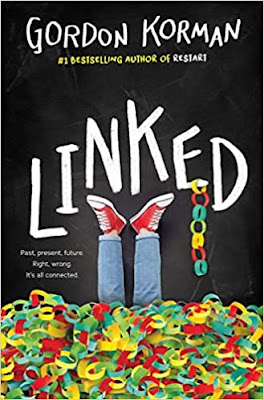
Linked by Gordon Korman

Just as he did in War Stories, Gordon Korman has brought WWII and the Holocaust into the present because, well, as William Faulkner reminds us the past is never past. The residents of Chokecherry, Colorado are reminded of that when a student, Michael Amorosa, discovers a large swastika painted on the atrium wall at Chokecherry Middle School. But who would do such a thing in this quiet very small town?

Chokecherry does have one thing happening that could put it on the map. After some dinosaur poop is discovered there, a group of paleontologists are sent to work on a dig hoping to find more dinosaur evidence. Among them is the Levinson family - the only Jewish family in town and daughter Dana Levinson is a student at the middle school, and who is very disturbed by the appearance of a swastika. 

Meanwhile, prankster Lincoln Rowley, 13 and called Link, and his friends are caught trying to dump 80 pounds of smelly dinosaur poop through the mail slot at the paleontologist's office in town. When Link is caught in the act, his father bans him playing any school sports. Link's father has a dream of turning Chokecherry into the next great tourist attraction, complete with a Disney-like amusement park. But no sooner is the first swastika washed away, but more of them begin showing up in various places around the school.

The school's answer to this is to hold a three week course in tolerance education, but the swastika's keep showing up and so does some surprising history. It seems Chokecherry was the scene of an incident in 1978 that involved KKK groups surrounding the town's foothills with burning crosses, referred to as the Night of a Thousand Flames. It's a subject Link's father does not want brought up, but talking to his parents about it reveals a surprising history in Link's family. His mother's mother, who is Catholic, is really Jewish, given to some French nuns for safety as a baby in 1941 when the Nazi's were occupying France and her parents were about to be arrested and sent to a concentration camp. Link, who up until now hadn't taken the swastikas seriously, is stunned by this news. If his great grandmother was Jewish, his grandmother is Jewish, that means he and his mother are technically Jewish, too. When Link begins to annoy Dana with question about Judaism, she suggests he get bar mitzvahed. Which he decides is a great idea and arranges lessons with the closest rabbi 100 miles away.

Meanwhile, it doesn't take long for a TikTok vlogger named ReelTok to latch on to the events in Chokecherry and start broadcasting right in the middle of town, hoping to stir things up. When ist becomes clear that the students are getting nothing out of the tolerance education they are being given, it's clear they need to do something else to counter the swastikas that are still showing up. Following the lead by the real school that collected 6 million paper clips, one for each Jewish person who perished in the Holocaust, the students at Chokecherry Middle School decide to make a paper chain with 6 million loops. It's an ambitious project and soon the whole school is behind it, gluing paper links together. But when they run out of construction paper in Chokecherry and the principal cancels the whole project, it feels like the person drawing the swastika's has won. But have they?

This is a Gordon Korman book so you know it is told from the perspective of different characters, with Link being at the center. It's not a format that always works, but Korman is a master at it and it work in his hands. It provides insight about each character, what they are thinking and how they are reacting to the events as they unfold, so it's very in-the-moment. 

Linked is told with a lot of Korman humor despite the seriousness of the Holocaust. The fact that the students are bored and turned off to the tolerance education but enthusiastic about the paper chain points to the fact that participatory learning might be better. At least, as a teacher, I think so, especially as the Holocaust recedes and students see it as just another topic in history. To his credit, Korman includes a lot of Holocaust history in this novel in such a way that the students really get they idea of what it was like. 

I loved how the theme of linking used. When you think about the novel, so many links come to mind. For example, Link's grandmother, who is still living, links past and present, while the fact that most people in Chokecherry think the racist Night of a Thousand Flames never happened links it to the importance of remembering those who perished in the Holocaust, signified by the loops of the paper chain. Other themes explored are identity, racism, redemption, community. Oh, yes, there is also a big surprise towards the end of the book. 

This book is recommended for readers age 10+
This book was borrowed from the NYPL

Monday, August 24, 2020

Lizard in a Zoot Suit by Marco Finnegan

It's June 3, 1943 and twin Latinx sisters Flaca and Curata have just stumbled upon Dr. James Rogers, a naval geophysicist and a few sailors digging in their Mexican American Los Angeles neighborhood of Chavez Ravine. After almost getting into a fight with the sailors for lewd remarks directed at Curata, the sister return home. Later that night, after their mother falls asleep, the girls take the family pickup truck and head to downtown Los Angeles to hangout and party with friends, all of whom are part of the city's Zoot-suit culture. But when a sailor bumps into Curata, a fight begins. 

Some of the sailors chase Curata into a dead end alley. Scared and with no place to escape, a manhole cover opens and a large lizard-like creature climbs out and scares the sailors away. When Curata faints, the lizard takes her into the underground tunnel he came out of, followed by Flaca. And unknowingly also followed by one of the sailors working for Dr. Rogers, who immediately calls the scientist. 

The lizard doesn't speak, but seems to understand Curata and Flaca and takes them home through the tunnel. It turns out that the creature, whom they call Chulito, has become separated from his family. The next morning, they decide that he should be reunited with them, if they are even still alive. After all, they understand separation and loss, they lost their dad, a soldier, in the war. But the night before, police and servicemen beat and arrested the mainly Mexican American Zoot-suiters in Los Angeles, resulting in the start of the Zoot Suit Riots. 

Deciding to disguise the lizard, they put him in one of Flaca's Zoot suits. But before they even leave their neighborhood, they encounter Dr. Rogers and his sailors looking for Chulito. A fight ensues between the sailors and the Flaca and Curata's other Zoo-suit friends, but the sailors manage to capture the lizard. Desperate to get him back and help him find his family, the sisters get some help from a very unexpected person. But will they find Chulito?

Done in two tone panels of black and yellow, Lizard in a Zoot Suit is an interesting look at a particular time and place in history. At first, it seems like just an excitying historical science fiction story, until you discover that some of it is based on reality. Curata and Flaca are great characters. Curata wears skirts that she's rolled up to make shorter and has a real soft heart for animals, which is why Chulito appeals to her so much. Flaca has a hot temper when it comes to racist remarks, especially when directed at her and her sister, which is how she sometimes gets into fights, and dresses in Zoot-suits when they go out. Both are proud Mexican Americans, proud of their father's service despite losing him, and both are kind, caring teens. 

Right from the start, readers will know that Dr. James Rogers is a smarmy corrupt scientist looking to make a fast buck and a claim to fame on the back of Chulito, and the sailors he gets to help are all white and racists, and all to happy to go after Zoot-suiters with their fists. 

The result is a graphic novel that brings together the 1943 Zoot Suit Riots, the legend of an underground reptilian race living in tunnels under Los Angeles, and the treatment of the Latinx community displaced by housing discrimination. 

Written in English, Finnegan throws in lots of Spanish, most of which is easily understandable by context alone. I did look up pachucas, which in this case means Zoot-suiter. 

Pair Lizard in a Zoot Suit with Margarita Engle's verse novel Jazz Owls: A Novel of the Zoot Suit Riots for another perspective of Los Angeles' Zoot Suit culture and riots.

You might also be interested in reading about how author Marco Finnegan can up with the idea for his graphic novel. You can find it HERE

And you might also like to read about the real person looking for the underground reptilians. You can find it HERE 

This book is recommended for readers age 13+
This book was purchased for my personal library

Monday, June 15, 2020

Superman Smashes the Klan by Gene Luen Yang, art by Gurihiru

Superman was both a popular comic and radio show during World War II, but once the war was over, there were no more Nazis to fight. So, Superman's creators turned their sights to the home front and, at the request of the Anti Defamation League, they took on the KKK. Beginning on June 11, 1946, the radio show ran a 16 part story called "Clan of the Fiery Cross." Each episode was 15 minutes long and sponsored by Kellogg's Pep Cereal. The story proved to be extremely popular, except of course with the Klan, who encouraged members to boycott Kellogg's products. 

Flash forward to 2019. Leave it to Gene Luen Yang to take the story from the radio show and give it his own magical touch turning it into a graphic novel and making it as relevant today as it was in 1946. The premise is basically the same: a Chinese American family - Dr. Lee, his wife and two children, Tommy and Roberta - have just moved out of Chinatown and into a new house in the center of Metropolis. 

Roberta is a rather timid soul, not at all happy about leaving the comfort and safety of Chinatown. Tommy is much more outgoing, but the two siblings really care about and look our for each other 

High schooler Tommy loves to play baseball and is an ace pitcher. On a walk to explore their new neighborhood, he and Roberta meet neighbor Jimmy Olsen who just so happens to also coach a baseball team. But when Tommy beans star batter Chuck Riggs on the head with a baseball during a tryout, Chuck goes ballistic with racial slurs about the Lee siblings. Chuck is immediately fired from the team. At home, it turns out, Chuck's uncle Matt is head of the local Klan of the Fiery Kross and after hearing what happened, he decides it's time for Chuck's initiation into the terroristic activities of the Klan. Chuck's initiation is to help the Klan "burn away America's impurities" and drive the Lee's out. After a cross burning on their lawn and an attempt to burn their home, the Lee's African American neighbors, including Inspector William Henderson of the Metropolis police arrive to help put out the fires. The next morning, reporters Lois Lane and Clark Kent arrive to get the story for the Daily Planet.

Meanwhile, Superman is have problems of his own. The war may be over, but after Superman defeats Atom Man, avenger of the master race, he is left in a weakened state. Under the swastika bearing device that gives Atom Man is super strength is a green crystal (Kryptonite) that causes Superman to smell ash and rot and something else that is familiar, but he just can't remember what it is. The effect of the crystal on Superman continues, causing him to have strange dreamlike interactions with his parents who died when Krypton was destroyed. Suddenly plagued with self-doubt about his purpose and place as a foreigner on earth, Superman struggles with his identity.

Superman's struggle with his identity mirrors that of Roberta Lee's struggle to fit in and accept this part of Metropolis as her new home. Tommy is a great big brother to Roberta, and Jimmy Olsen, Clark Kent/Superman and Lois Lane all offer support as she struggles to find herself and fit in.

I really love a good Superman story and Superman Smashes the Klan is one of the best I've read. The story was originally issued in three limited edition comic books before the graphic novel was published, which is also divided into three chapters. Yang has diversified the characters more than the original 1946 radio program, and has made Roberta Lee and Superman the main protagonists. He has cleverly kept the story in the past yet the overriding issues haven't yet been resolved and the issues of identity and racism will definitely resonate with today's readers. Chuck and his uncle are perfect examples of how racism is passed on from one generation to another. Chuck almost becomes what his uncle wants, mostly because he is afraid to stand up to him for fear of what his uncle will do to him and his mom. Yang gives readers a Chuck who is at the point where he can become racist or reject it. His feelings of helplessness are so real and it's a hard choice for a kid to make. But I loved how Yang handled it.

One of the things Yang emphasizes is the importance of being a part of an accepting community. Tommy and even Roberta have supportive parents and they both find friendship immediately with the new baseball team Tommy joins. Roberta also find friendship and acceptance with Superman, who takes her under his cape, and Lois Lane, who becomes a kind of mentor for Roberta's writing aspirations. Yang also gives his characters much more agency than they were ever given in the old Superman stories. No longer passive "victims" of evil doers waiting for Superman to rescue them, they often take matters into their own hands to help themselves. 

The art for Superman Smashes the Klan was done by Gurihiru, a Japanese team of two women, Chifuyu Sasaki and Naoko Kawano, who have had lots of experience doing the artwork for a number of DC, Marvel, and Dark Horse comics. Their work here is done with a palette of bold and subtle colors, and each of the cells are clean and uncluttered, and really help move the story along. 

Be sure to read Yang's essay "Superman and Me" in the back matter. It is interesting, informative, historical and not what you might expect. 

Superman Smashes the Klan is everything I could want in a graphic novel and more. 

This book is recommended for readers age 12+
This book was purchased for my personal library

You can listen to the original 1946 radio version of "Clan of the Fiery Cross" HERE

Tuesday, March 27, 2018

A Change of Heart by Alice Walsh, art by Erin Bennett Banks

This is the story of a young African American hero, Lanier Phillips, who survived the sinking of his ship, the USS Truxtun, caused by a storm off the coast of Newfoundland. 

To help readers understand Lanier, Walsh begins his story with his childhood. He grew up in Georgia, in the 1930s, living under the constant threat of the Ku Klux Klan and Jim Crow laws. Watching the homes, schools, and barns of his black neighbors being burned to the ground, barred from enjoying the same privileges as white people, and always fearing for his life, bitterness and resentment grew inside Lanier.

When the United States entered WWII, Lanier decided to join the Navy in the hope of escaping racism. Sadly, he discovered that life in the Navy wasn't any different than life back in Georgia. Black sailors were given separate sleeping quarters from the white sailors, and were required to eat their meals standing up in the pantry. Forbidden from eating in the same mess hall as the white sailors, Lanier was also required to serve them their meals and wash the dishes, do their laundry, and shine their shoes. Bitterness and resentment were eating him up.

Then, on February 18, 1942, the USS Truxtun ran into a fierce winter storm, colliding with the jagged, steep cliffs off Newfoundland. As the ship began to sink, lifeboats full of white sailors tried to make it to land in the storm, but most of the boats didn't make it. Finally, it was the time for the black sailors to try to reach land, but the boats were gone and all they had were rafts. Lanier had to quickly decide to go or stay. Would black soldiers be welcomed by the residents, or would they do something else to them?

In the end, Lanier climbed into a raft that capsized, throwing him in the sea. Lanier made it to the shore, and collapsed from exhaustion. When he woke up, Lanier discovered he was in Newfoundland, where he was taken in and nursed back to health by a local woman, Violet Pike. Many of the people who helped the sailors from the USS Truxtun had never seen a black man before, and they also didn't seem to have any of the prejudices he was so accustomed to. In fact, he was treated with respect and dignity by his rescuers. When it came time to leave their home, Lanier felt that because of the kindness he had experienced, he had lost the bitterness and resentment that had always been with him.

A Change of Heart almost sounds like it should be someone's idea of historical fiction depicting the transformation of an African American man when he finally treated him with love, respect, and compassion after living a life of discrimination and fear because of the color of his skin. And yet, it is a true story. Lanier Phillips always considered his experience with the Newfoundlanders the catalyst that changed his life. Lanier went on to have a successful career in the Navy as a sonar technician, and also became a Civil Rights pioneer with Martin Luther King, Jr.

A Change of Heart is a heartwarming, inspiring picture book for older readers that palpably depicts the racism and fear of Lanier's early life in contrast to the way he was treated in Newfoundland, and shows how one experience can really help a person to see things differently. Adding to this uplifting story are the oil painted illustrations done in Erin Bennett Banks' signature angular style.

Be sure to read the About Lanier Phillips at the back of the book to learn more about this remarkable man.

This book is recommended for readers age 7+
This book was purchased for my personal library

Tuesday, March 22, 2016

A Tiny Piece of Sky by Shawn K. Stout

It's only June, but the summer of 1939 does not look very promising as far as Frankie Baum, 11, is concerned.  Her sister and best friend Joan, "the just-barely-older of the two," is getting to spend the summer at Aunt Dottie's farm in New Jersey, where Frankie is sure she will be having the best summer ever, while she's stuck at home in Hagerstown, MD with older sister Elizabeth, called Princess by their parents.

And ever worse, Frankie is expected to work in her father's newly purchased restaurant, a long neglected Alpine-style relict of years ago, now with only weeks to get it cleaned up and running again to become his dream of "An Eating Place of Wide Renown."  Opening day is planned for July 5th.  Sure enough, at the restaurant, Frankie is sent to the kitchen to work, a dirty, messy job, while Princess gets to work the cash register.

Frankie is vaguely aware of war talk among the townspeople, of anti-German feelings that are beginning to brew, but she has never really considered her family to be German, even though her father's parents immigrated from Germany.  But when Hermann Baum is approached by the cigar smoking president of the Chamber of Commerce, Mr. Sullen Waterford Price, and refuses to let himself be bullied into becoming at paid member of the chamber, he makes a formidable enemy, one all too aware of his German roots.

Price is also running for mayor of Hagerstown, so when Hermann also refuses to put his election poster in his front window, Price begins looking for just the dirty information he needs to start spreading rumors that Hermann Baum is quite possibly a spy and Nazi sympathizer.

To make matters even more complicated, Hermann decides to throw his own  pre-opening day Fourth of July party for friends, family and even his African American staff and their families.  Hermann has always treated his kitchen staff fairly, despite living in a state where Jim Crow is in effect.  That, coupled with the German flyer that has mysteriously fallen into the hands of Mr. Price, are all that is needed for a boycott of Hermann's party.

Frankie has overheard quite a bit while working in the kitchen, and decides to do some investigating of her own about what is going on.  But she also finds herself doubting her father's innocence.  When no one shows up at her father's party, she goes to the town's celebration to try and find out what is going on.  When Hermann shows up looking for her, he collapses.  And the Baum family's life is changed forever.

A Tiny Piece of Sky is a wonderful coming of age story.  Frankie's character develops slowly over the course of the novel as she encounters different people and situations.  The story is told in the third person by an omniscient narrator in a rather conversational style, and who seems to be right in the thick of things, more aware of what is going on in the world than Frankie is.  To get some of Frankie and even Joan's mindset, there are also first person letters they write to each other, which tend to create more mystery about Hermann Baum's heritage than information.

The story takes place over June, July and August 1939.  There aren't many pre-World War II home front stories for young readers, making this all that much more interesting.  Stout looks at both racism and xenophobia through the lens of Frankie's summer.  Frankie hasn't really paid attention to the racism and discrimination towards the African American community in Hagerstown, until she starts working in the restaurant.  But the character of Mr. Stannum, the restaurant's new manager, opens her eyes when she witnesses the way he treats the black kitchen staff with such cruelty and contempt, even refusing to allow them to use the bathroom he uses.  

You  also don't find many books for young readers that are about the kind of treatment that German Americans experienced in the 1930s and 1940s as the possibility of war with Germany became more of a possibility.  Most people don't realize they were also discriminated against. though to a far lesser extent than Japanese Americans.  What makes this an interesting theme here is that Stout shows how easily people can change their attitudes towards of friends and even fathers when doubt begins to take hold.  For that reason,  A Tiny Piece of Sky is not just good historical fiction, but also resonates so loudly in today's world. 

The other part of what makes A Tiny Piece of Sky such an interesting, realistic novel is that much of the material comes from Shawn Stout's own family and the restaurant they owned in Hagerstown, which she writes about in her Author's Note at the end of the novel.  Be sure to read it when you read this excellent novel.

Teachers can find an extensive Teaching Guide for A Tiny Piece of Sky HERE

This book is recommended for readers age 9+
This book was borrowed from the NYPL

Used with permission: the original menu from Shawn Stout's grandparent's restaurant.
Click to enlarge and check out the prices listed.