Showing posts with label YA. Show all posts

Saturday, October 1, 2022

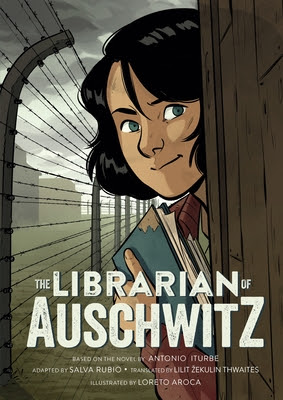
The Librarian of Auschwitz: The Graphic Novel based on the Novel by Antonio Iturbe, adapted by Salva Rubio, illustrated by Loreto Aroca, and translated by Lilit Žekulin Thwaites


Available January 3, 2023
I loved reading comics as a kid and I wasn't above reading a Classic Comic or two or maybe more instead of the book the comic was based on. In school, I was an undiagnosed dyslexic and reading was sometimes difficult. So it stands to reason that as an adult and a teacher, I'm a big fan of books done in graphic format. They are just what some readers need instead of a large and for them, for whatever reasons, unwieldy novel. And for others, they are just a fun way to read. But, the graphic needs to be well done, and in today's world, most of the time, they are. Which is why is pains me to say that I did not like The Librarian of Auschwitz: The Graphic Novel.

This graphic novel is the same story as the novel by the same name and written by Antonio Iturbe, so I'm not going to summarize it again. Suffice it to say it is the story of teenage Dita Adlerova, who was first sent to the Theresienstadt ghetto in Czechoslovakia with her parents and other Jews, and who were all later transferred to Auschwitz-Birkenau. There, they were living in a separate area of Birkenau, called BIIb and referred to as the Theresienstadt Family Camp. These Jewish prisoners were allowed to keep their clothing and their hair wasn't shaved, though living conditions were still as deplorable as in other parts of Auschwitz. If you haven't read the novel, you can read what I originally wrote HERE. The novel is a big book but one that is totally worth spending time with, IMHO. 

Back to the graphic. First, let me begin by saying I did like the art. I found the full color cells were clearly and cleanly drawn in such a way that it was easy to follow the story. The illustrator did a great job at capturing the full range of intense emotions felt by the prisoners of Auschwitz as well as the hate and disgust exhibited by their Nazi captors. Interestingly, none of the characters, Jewish, gay, or Nazi, were portrayed as stereotypical. 

And it wasn't so much that I found the graphic novel to be bad, just lacking. I read the novel back in 2017 and so I'd forgotten some details. Reading the graphic, I found myself confused about a few of the things that went on in Auschwitz and that impacted the main character, Dita, personally. I also didn't feel the importance of the eight books that made up the library was made plain, and how Dita so lovingly cared for them, nor did I feel the reverence with which the borrowers of these books felt for them. 

Some of the characters, like Dita and Fredy Hirsch, as based on the actual people, and of course, so are some of the Nazis like Adolf Eichmann and Josef Mengele, known as the Angel of Death for his experiments of the prisoners in Auschwitz. There is a great epilogue at the end of the book that does go into detail not just about what happened and the people involved.

Ultimately, though, I found this version of The Librarian of Auschwitz to be simplistic and a little stiff. I realize that taking a large novel and synthesizing it down to just 144 pages is not easy task and this was a valiant effort. It just didn't work for me. 

Sunday, August 21, 2022

American Shoes: A Refugee's Story by Rosemarie Lengsfeld Turke and Garrett L. Turke

In 1930 Rosemarie Lengsfeld, affectionately called Rosel by her family, was born in New York City to parents who had emigrated to the United States from Germany and were awaiting their final citizenship papers. Despite that, they decided, in 1935 when Rosel was four-years-old, to return to Germany to visit family in Breslau. It was to be only a short stay, but lasted longer than expected, so when it came time to return to the US, the family discovered that their tickets would not be honored. Adolf Hitler, then Chancellor of Germany, had closed the borders so that German citizens could not leave the country. At first, Rosel enjoyed being with her extended family in Germany, and her parents soon welcomed baby Eleonore into the family. But when the war began, the family found themselves struggling to stay alive without enough food to eat amid bombing by the Allied Forces. 

Finally, in 1946, with the war over, Rosel received a letter telling her she could return to the United States. Convinced that this would include her parents and now nine-year-old Eleonore, the family showed up at the American Embassy and were told only Rosel, 15, could return home, since she was the only American citizen - her parents and sister were German citizens. 

Making a snap decision to go it alone and hopefully find a way to bring her parents and sister to the United States, Rosel finds herself traveling across the ocean on a 10 day trip aboard the SS Marine Flasher, a former troop transport ship along with other American citizens who were stuck in Germany and "surviving Jews and other displaced persons..." On board ship, Rosel meets the mysterious Liesel, another American with German parents, a few years older Rosel, who is traveling with her brother Kurt. She also meets David, a talented musician who lost his entire family in the Holocaust. As the ship gets closer and closer to the United States, Rosel begins to fear that no one will believe that she is American, that she will be branded as a Nazi because of her German accent. 

It is during this journey at night when she is alone in her bunk bed that the reader discovers what life was like for Rosel, her family and others living under the horrors of Hitler's dictatorship before and during the war. Interestingly, she never talked about her experiences until she was 85 years old and therefore it is all based on her memories, but told in the first person from her 15 year-old perspective, and, in my opinion, making her something of an unreliable narrator. Even so, it's hard to imagine a 15-year-old making the kind of decision Rosel was forced to make that day in the Embassy, leaving her parents and sister behind, traveling alone to who knows what future, and at the same time, dealing with the trauma of the war as it returned night after night on the trip to the US. But Rosel's story is definitely one of courage and a different kind of true WWII story in that it is told from the point of an American child. It is often not an easy book to read, but I found it hard to put down. 

American Shoes is a book that will appeal to readers interested in WWII, the post war experience, especially the experiences of Americans can in Nazi Germany, and war-related trauma. Back matter includes maps, a glossary, an author's commentary on WWI, WWII, and the Holocaust, and thoughts by the author's son about writing this book, as well as extensive Discussion Questions. 

Friday, May 6, 2022

Great or Nothing by Joy McCullough, Caroline Tung Richmond, Tess Sharpe and Jessica Spotswood

My first memory of Louisa May Alcott's Little Women is my older sister sitting in an easy chair in the living room and crying her eyes out while reading the book. When I asked why she was crying, she just said "You'll see." And I did indeed  discover why a few years later when I read Little Women in fourth grade. And I've never re-read it. But I have been enjoying some of the new retellings like So Many Beginnings by Bethany C. Murrow, More to the Story by Hena Khan, and Meg, Jo, Beth and Amy by Rey Terciero, among others. The latest retelling, Great or Nothing, takes place during a war like the original, but this time it is World War II.

The story begins in the spring of 1942. The United States has entered the war and people are still adjusting to the change. And that includes the March sisters, who are also still reeling from the recent death of their sister Beth. Now, their father is has enlisted as a Navy chaplain, Marmee is overly involved in charity work, and Laurie is a pilot stationed overseas. Laurie had asked Jo to marry him before he left, but she said no. Jo loved Laurie just not romantically. Then, she and Meg had harsh words. Jo couldn't understand why Meg would give up everything for math teacher John Brooke, and Meg couldn't understand why Jo had refused to marry Laurie. 

Unable to write after Beth's death and needing to get out of the house after her fight with Meg, Jo is living in a boarding house, while working in a factory producing airplanes. But when she meets Life reporter Charlotte "Charlie" Yates, and helps her write a story about the airplane factory, she realizes that she also needs to sort out her feelings for Charlie.

Meanwhile, Meg is still at home with Marmee, continuing to teach, content to wait for John, whom Amy called "that boring old fuddy-duddy," to come home and to get married. But when an old "friend" decides Meg needs to party, to have some fun, and to meet other more exciting men, she begins to question whether she would really be happy in a quiet marriage with John.  

Amy, who has been crushing in Laurie since she was a child, is supposed to be studying art in Montreal. Instead, unknown to her family, she has decided to join the Red Cross. At first turned down for being too young, Amy fortuitously finds another girl's application and uses that at another recruiting station, where she is accepted. After training, Amy is sent overseas with other recruits to work in a mobile canteen, where they serve coffee and donuts to American servicemen in London. And she runs smack into Laurie.  

And Beth? She's there, a spectral poetic voice following her sisters adventures, providing insight, and giving unheard, unheeded advice about life in between the chapters. 

Needless to say, as the story unfolds, it is clear that each sister has some big problems to deal with and some big challenges they need to overcome while navigating the war and their profound grief. 

I really enjoyed reading Great or Nothing, finding it a thoughtful, appealing story that could be seen as simply a YA wartime romantic novel, but it is actually more elevated than that. Racial and sexist issues are introduced in both Meg and Amy's stories. Meg has a student who is Japanese American and Amy encounters an African American soldier who is not totally accepted by everyone, including Amy's friend Edie. And then there is Jo, who finally figures out who she is and why she didn't have romantic feelings for Laurie.  

I also enjoyed some of the details included, like Victory Gardens, Victory Red lipstick, and of course, how women arranged their hair in Victory rolls, as well as the impact that shortages and rationing had on everyone. There isn't a lot of action to this story, but plenty of coming-of-age drama. And if I remember right, there wasn't much action in the original Little Women. I also felt that the original message about the importance of family bonds wasn't lost in this novel, even though the March sisters were scattered for much of the story. Sometime, you just need to get away from the security of home family to find yourself and appreciate what you have.  

The story is told in alternating chapters, each character written by a different author who a different voice and point of view to each of the March sisters. In case you are wondering who wrote who - Beth is written by poet Joy McCullough, Amy by Caroline Tung Richmond, Jo by Tess Sharpe and Meg by Jessica Spotswood.  

Lastly, there are some delightfully wonderful Easter eggs to be found throughout Great or Northing. Happy hunting!

Tuesday, February 15, 2022

The Light in Hidden Places by Sharon Cameron

I usually think of Sharon Cameron as a writer of science fiction not historical fiction, but she has really outdone herself with The Light in Hidden Places. It is a fictional account of the life of Stefania "Fusia" Podgorska and her yonger sister Helena who were ultimately named as Righteous Among Nations by Yad Vashem for hiding and saving the lives of 13 Jews during the Holocaust. 

At age 12, Fusia decides to leave her family's farm to live with the Diamants, a Jewish family that runs a grocery store in Przemsyl, Poland. Welcomed into the family, Fusia lives there for 3 happy years, during which a secret attraction developes between Catholic Fusia and Jewish Izio Diamant. But in September 1939, Poland is attacked and invaded by the Nazis and life changes for everyone. 

In April 1942, the Diamants are forced to move into the Przemsyl ghetto. Fusia is tasked with helping them survive by bringing what she could sneak in by squeezing through the fence. But then she learns that the Nazis have killed Izio, Grieving, Fusia decides to go back to the family farm. There she finds everyone gone, except her 6-year-old sister Helena, whom she brings back to Przemsyl with her. 

One night, in November 1942, Max Diamant shows up at Fusia's door and asks to stay the night. His parents and some of his siblings had already been rounded up in a Aktion, and sent to their deaths and he and his brother have escaped the ghetto. When they decide to stay with Fusia and Helena, Fusia realizes she needs a larger place for hiding them. She finds a small cottage and before she knows it, Fusia is hiding 13 Jews in it. Then, the Nazis build a hospital across the street and move three nurses into the cottage, as well. Fusia begins to panic, but the nurse only stay seven months. 

Fusia's story held me spellbound from start to finish. I kept thinking what a brave young woman she was to take the kinds of risks she continually chose to take for the family that had shown her so much more love and kindness than her own family had, spending her pay to by food for everyone, and risking death if caught. The novel reads like a taut drama, filled with tense moments and events throughout. Then I remember much of what I'm reading really happened.

Cameron's research for this story is impeccable. Through interviews, research trips to Poland and Stefania's own unpublished memoir, Cameron has woven together a coherent, reality-based Holocaust narrative. She includes extensive back matter, including photos and information about what happened to the Jews Fusia hid after the war ended and they were liberated.  

This book was gratefully received from Edelweiss+  

Sunday, October 31, 2021

Ruta Sepetys Between Shades of Gray: The Graphic Novel adapted by Andrew Donkin, art by Dave Kopka, colors by Brann Livesay

Ruta Sepetys Between Shades of Gray: The Graphic Novel
adapted by Andrew Donkin, art by Dave Kopka, colors by Brann Livesay
Philomel/Penguin Teen, 2021, 160 pages

I can't believe it has been 10 years since I first read Between Shades of Gray. It was one of those books that introduced me to a new aspect of WWII and it had such a profound influence on me when I read it, one that has stayed with me ever since. Although the novel is still certainly well worth reading, so is the new graphic novel about what happened to 15-year-old Lina Vilkas and her family. 

Lina is arrested by the Soviet secret police or NKVD along with her mother and younger brother, Jonas, taken from their home in Kaunas, Lithuania on the night of June 14, 1941. Loaded into a truck along with other families that had been rounded up, the Vilkas soon find themselves at a remote train station, where other truckloads of arrested Lithuanians are arriving. 

Everyone is put into crowded cattle cars that just sit there for days. During that time, Lina meets Andrius and the two sneak out together at night. Lina is hoping to find her father since they don't know what has happened to him. Just before the trains leave the station, she finds her father in another train.

The family is happy to know he is still alive even if they don't know what will happen to him. When their train finally leaves the station, they spend the next 42 days traveling to a remote area of Siberia, where they are forced to sign a paper that convicts them of crimes against the Soviet Union (their crime - simply being Lithuanian) and sentences them to 25 years of labor. 

Life in Siberia is hard, the winters are brutal and the degradations constantly inflicted by the Soviets make things even more difficult. Over time, Lina and Andrius find that they are attracted to each other, but often harsh conditions come between them. Eventually, they are separated when Lina and her family are sent to another prison camp in Siberia, where she finds life with Andrius even harsher. 


Lina manages to document everything that happens to her, her family, and everyone else using her artistic talent and drawing it all on whatever paper she could find and using whatever material she could draw with. She also manages to send letters to her father in another prison camp in the hope that they will reach him. But can her dream of her family being reunited after the war keep Lina's hopes and spirits up long enough to survive?

I'm always skeptical of novels that have been turned into graphic formats. It feels like a novel has so much depth that could easily get lost. But I am glad to say that Between Shades of Gray: The Graphic Novel has made the transition successfully and it is all thanks to the wonderful images that really capture so much of what happened to Lina and her family. The text is spare yet spot on, and the images are so detailed and should be throughly explored for what they have to say, too. Take, for example, this image of the chaos at the train station as truckloads of arrested Lithuanians are forced into the waiting cattle cars: 
The confusion, fear, harsh treatment and Soviet threat is all there on people's faces and in their body language.

Between Shades of Gray: The Graphic Novel is an excellent addition to the history WWII. The Soviet treatment of citizens of countries they occupied during WWII isn't as well known as the history of the cruel treatment of Jews and political enemies by the Nazis and a graphic novel just may be what some readers are most comfortable with, although I highly recommend the original novel, too. 

This book is recommended for readers age 13+
This book was an eARC gratefully received from NetGalley

Wednesday, June 30, 2021

The Summer of Lost Letters by Hannah Reynolds

When a box of her O'ma's stuff arrives at the house addressed to her mother, Abby Schoenberg, 17, can't resist opening it. Inside, she finds a stack of love letters addressed to her O'ma, Ruth Goldman, living in New York City from someone named Edward living on Nantucket island, and who refuses to send Ruth a necklace she has asked to be returned to her. Not knowing much about her O'ma's past other than that she came alone from Germany as a 4-year-old shortly after Kristallnacht. Now, Abby is determined to discover more about her O'ma's life - who is Edward, why was he writing love letters to her in the 1950s and what happened to the necklace, which her Grandmother obviously never got back. 

After doing some research, Abby discovers the letter writer is Edward Barbanel, who mentions a place called Golden Doors on Nantucket. Luckily, Abby lands a job working in a bookstore on the island, and a room shared with a girl named Jane, with whom she immediately becomes friends. And yes, everyone she meets knows the very wealthy Barbanel family, who are having a party at which Abby is invited to help serve. Naturally, her curiosity overcomes her and she is caught snooping around by Noah Barbanel, 18 and the handsome grandson of Edward. 

To try to keep his family's personal business private and to protect his grandparents, Noah agrees to help Abby with her search to discover more about her O'ma and her family history. O'ma never talked about her parents and all the Schoenberg's knew was that they have perished in Auschwitz, but who they were and where they lived had always been a mystery. 

In between her job at the bookstore and her attempts to discover more about her O'ma, there are parties on the beach, sailing, ice cream and new friends, even Shabbat dinner with the Barbanel family. Abby hadn't been looking forward to this summer with her friends away, but decides to take the advice of best friend Niko who tells her to go crazy, be bold, have some chutzpah. And that is just what Abby does. 

The Summer of Lost Letters is a contemporary romance with some interesting historical fiction and some interesting historical facts throughout the novel and Reynolds has incorporated it all easily into the story. I thought it was interesting how she introduced some of the chapters with Edward's love letters almost as a portend of what is going to happen. I also thought that never getting to know who Ruth Goldman responded to the letters or what she felt was a great way to keep the mystery going. Of course, readers can  surmise her feelings for Edward by the fact of keeping the letters, despite having married another man (whom she did in fact love, too). 

At first the tension and bickering in between getting along really well was kind of fun as Abby and Noah dances around their attraction to each other. But after a certain point, I honestly felt that this could have used some editing when I found myself muttering "oh my God, own it already." Others may find this kind of dance appealing.  

In the end. all is revealed and I never saw it coming - and I really liked that. The end could come across as a little to pat, but that was fine with me. After all, this is a great summer romance to read, enjoy, and learn a few things.

This book is recommend for readers age 12+
This book was an eARC gratefully received from NetGalley

Tuesday, December 8, 2020

Strongman: The Rise of Five Dictators and the Fall of Democracy by Kenneth C. Davis

Germany's constitution, written at the end of WWI, was one of the most democratic charters ever produced. It isn't surprising, then, that Kenneth Davis begins his comprehensive history of five 20th century dictators with the story of how Adolf Hitler used Germany's new democratic constitution to become the absolute ruler one of the world's most repressive and destructive governments - and the way it was done was completely constitutionally correct.

Davis then devotes a chapter to the history of democracy from antiquity to the American Revolution, pointing out just how fragile the concept of democracy is, especially when its enemies seek to dismantle democratic governments and solidify power for themselves. What follows is a biography of five dictators, Benito Mussolini, Adolf Hitler, Joseph Stalin, Mao Zedong, and Saddim Hussein, and their power grabs.

Davis shows that in their early lives, none of the Strongman - dictators who used any and every means possible to acquire power - showed any sign of what they were to become. Most had nondescript early beginnings, often with doting mothers and cruel fathers. Yet, all became charismatic figures, convincing people to support and follow them and to even commit atrocities in the name of their individual ideologies.

Following a short biography of their early lives, Davis traces the influences surrounding their rise to power, their seizure of power and their political philosophies for ruling their respective countries. Davis shows how each used propaganda to manipulate their citizens. For example, Mussolini recognized the need to control mass media and the beneficial use of fascist propaganda films shown in movie theaters, a lesson that the other four dictators learned all to well. And all found it important to mobilize young people with an eye to the future, such as the Mussolini's Vanguards, the Hitler Youth, Stalin's Young Pioneers, Mao's Red Guard, Hussein's Lion Cubs. 

Davis don't analyze these five dictatorships, nor does he compare them to each other. Rather, each is designed to serve as a warning - democracy can disappear so easily, all it takes is one antiestablishment populist leader claiming he speaks for the people and promising to return power to them. As Davis shows, they begin to dismantle democracy and move towards authoritarianism and he gives for warning signs:

1- Rejection of the democratic rules of the game;
2- Denial of the legitimacy of political opponents;
3- Toleration of encouragement of violence;
4- Readiness to curtail civil liberties of opponents, including the media.

If these warning signs so familiar or recognizable, you can see why this is not just an important historical lesson, but a timely work of our own time.

But Davis doesn't leave the reader feeling helpless in the face of a potential charismatic dictator. Indeed he gives the reader a blueprint of the Strongman's playbook for getting power and what to expect once he is in power. Most importantly, Davis tells the reader not to fall into the trap of thinking it can't happen again - because it can.

At the beginning of each biography, readers will find a time line tracing each dictator's life in the context of the place and times in which he lived and his rise to power. There are also a wide range of photographs throughout the book. Back matter includes an extensive Bibliography, including general and dictator-specific reading for further investigation. 

Davis has written an very readable, very relevant work that easily serves as a jumping off point for anyone interested in government, politics and the rise and fall of political systems.    

This book is recommended for readers age 12+
This book was gratefully received from Casey Blackwell at Media Masters Publicity

Thursday, September 24, 2020

Displacement written and illustrated by Kiku Hughes

It's 2016, and Japanese American Kiku, 16, and her mother are on vacation in San Francisco from their home in Seattle. Kiku's grandmother had lived in San Francisco before the attack on Pearl Harbor, followed by Executive Order 9066, calling for the roundup and incarceration of all people of Japanese descent living on the West Coast. After looking for house where they lived, Kiku's mother is disappointed to see it has been replaced with a mall. When she goes in to see what's there, Kiku stays outside and that's when the first displacement, as she calls them, happens.

Suddenly, Kiku finds herself in the audience of a violin recital where a young version of her grandmother, Ernestina Teranishi, is performing. Kiku didn't know her grandmother, but she did know that she had been a gifted violinist. Returning to the present, Kiku and her mother head to the hotel, and hear Donald Trump calling for a total shutdown of Muslims entering the US. 

Before leaving San Francisco, Kiku displaces again, this time after Executive Order 9066 has been issued and she finds herself in a line of people being watched by armed guards. Again, returning to the present and heading home to Seattle, Kiku realizes how little she knows about her own Japanese culture and history, in part because her grandmother never spoke to her mother about what happened to the Japanese Americans in the camps. 

Back in Seattle, Kiku displaces once again, finding herself reduced to being Number 19106, and traveling on the same bus as the Teranishi family, heading to Tanforan Assembly Center, a racetrack where the Japanese Americans are forced to live in horse stalls that still smell of manure. There, Kiku lives with a roommate, Aiko Mifune, right next door to the Teranishi family.

Kiku's first two displacements were for short periods of time, but now she finds herself living in the past for an extended time. This means that Kiku can learn something about her grandmother and great grandparents, but it enables author Kiku Hughes to show what went on behind the barbed wire and armed guards. The overcrowding, the poor quality of the food, the lack of privacy in the latrines and showers are part of daily life there, but so is the tenacious spirit of the Japanese people, who are determined to turn their living conditions into something better. Kiku even finds a love interest.

By the time Kiku is transferred to the Topaz Relocation Center in Utah, she knows she won't be returning to the present anytime soon, and determines to make the best of her situation. Once again, she finds herself living near her grandmother and even her love interest from Tanforan. The whole time she is torn as to whether or not to introduce herself to her grandmother, or merely to continue to observe her from afar. Life in Topaz is a real eye-opener for Kiku. People who had been productive and law-abiding are now incarcerated and deprived of their civil rights. When the government issues a loyalty questionnaire,  those who refuse to answer yes on questions 27 and 28, and renounce their Japanese ancestry, face harsh punishment, including Kiku friend Aiko. But after after someone was shot and killed, people really begin to worry about their safety. Does Kiku ever return to the present? Yes, of course, and at a very interesting point in her story. But does her experience in the past change her?  

Displacement is somewhat autobiographical for author Hughes, who also never knew the grandmother who had been in the internment camps during the war. Sending Kiku back in time enables her to show the personal and community trauma that was inflicted on people who had done nothing wrong. What I found most telling is Kiku's feelings of helplessness and her gradual acceptance of her incarceration. That was scary, given today's world. 

I think Hughes really captured Kiku's emotional truth, and through her, readers also know the emotional truth of her grandmother and all the other Japanese people who had been incarcerated for no other reason than their race. Though the word interned is generally used to describe what happened, Hughes chooses to use incarceration, given that people had no freedom and lived surrounded by barbed wire and armed guards, it really did resemble prison-like conditions. 

Displacement is one of the best graphic novels I have read about the Japanese American experience in WWII. You might want to pair it with George Takei's They Called Us Enemy.

You can find an interesting and enlightening interview with Kiku Hughes HERE 

This book is recommended for readers age 12+
This book was an eARC gratefully received NetGalley

Tuesday, September 15, 2020

The Assignment by Liza M. Wiemer

It's senior year for Logan March and Cade Crawford, students at Riviere HS in upstate New York and they are thrilled to be in the same history class with their favorite teacher, popular Mr. Bartley. But they find themselves shocked and appalled when Mr. Bartley gives them a assignment which they find unacceptable. The assignment is to debate the Nazi's Final Solution by researching the Wannsee Conference held on January 20, 1942 during which the fate of Europe's Jews was decided and then taking a side for or against the decision to exterminate all Jews. And rather than having students choose their own position, they are randomly assigned pro or con. 

While some of the kids in their class immediately begin to embrace their inner Nazi, Logan and Cade are open and clear about their opposition to the assignment, and they flat out refuse to do it. After speaking with Principal McNeil, they receive an email saying that he and Mr. Bartley would like to meet with them.  Before that happens, Cade and Logan head up to Fort Ontario, where the Safe Haven Museum and Education Center is located. a place known for having harbored 982 Jewish refugees from August 1944 to February 1946. There, Logan and Cade work on an alternative assignment based on this rescue to bring with them when they meet with Principal McNeil and Mr. Bartley.

Although Mr. Bartley agrees to offer their assignment as an alternative for students who feel the way Logan and Cade do, the two friends are still not satisfied. After talking to her father, who tells Logan about an organization called Humanity for Peace and Justice, she and Cade must decide if and how far they are willing to take their opposition to the Wannsee Conference assignment into the public realm.

Although the novel is centered on the assignment to debate the fate of Europe's Jewish population as if the students were Nazis sitting around that table in Wannsee, there is a lot going on. Naturally, an assignment like this would bring out the best and the worst in students, as well as those who have no real opinion, and Wiemer hasn't ignored them. The novel is told from different perspectives, including Principal McNeil and Mr. Bartley, and gives readers some needed insight into the thinking of these different characters, though the majority of the novel is told from the point of view of Logan and Cade.  

Neither Logan or Cade are Jewish. I didn't actually find Logan to be a very interesting character except for her passionate stand on the assignment. Her father is a professor, and not terribly available to her, nor are they struggling financially. Cade is much more interesting. His family runs the Lake Ontario Inn and his parents are very dependent on his help to keep things going and it's clear they have money problems. Cade used to be very close to his grandfather before he passed away. He and Cade's grandmother came from Poland before WWII, and before he died, he told Cade about something that happened in Poland that plays strongly into Cade's decision to oppose the assignment. 

The Assignment is based on actual events and students, which I remember reading about when it went public. And I remember that my reaction, as a teacher, as someone who wrote a dissertation on an aspect of the Third Reich, and as a human, was that this was not an assignment to give to any student. Yes, teach them about the Holocaust, including the Wannsee Conference, but don't make them take sides in a debate about genocide. And I felt the same way as I read this novel. 

At one point, Mr. Bartley shows his class the movie Conspiracy . This was an HBO film from 2001 that re-enacted the Wannsee Conference with several well-known and well-liked actors playing the parts of the Nazis. It's a tough film to watch, and I'm not sure I would show it to high school students, certainly not without a trigger warning. 

The Assignment an excellently written book and it will undoubtedly get readers thinking about what they might have done under the same circumstances. And it is definitely a book that will resonate in today's world. While I read, I kept thinking about William Faulkner's line, "The past is never dead. it's not even past." What do you think?

This book is recommended for readers age 13+
This book was an eARC received from NetGalley

Author Liza Wiemer published an Opinion piece that you might be interested in reading. You can find it HERE

The New York Times recently (September 11, 2020) published an article about the 982 refugees who lived in Fort Ontario in Oswego, NY. You can read it HERE

Monday, August 24, 2020

Lizard in a Zoot Suit by Marco Finnegan

It's June 3, 1943 and twin Latinx sisters Flaca and Curata have just stumbled upon Dr. James Rogers, a naval geophysicist and a few sailors digging in their Mexican American Los Angeles neighborhood of Chavez Ravine. After almost getting into a fight with the sailors for lewd remarks directed at Curata, the sister return home. Later that night, after their mother falls asleep, the girls take the family pickup truck and head to downtown Los Angeles to hangout and party with friends, all of whom are part of the city's Zoot-suit culture. But when a sailor bumps into Curata, a fight begins. 

Some of the sailors chase Curata into a dead end alley. Scared and with no place to escape, a manhole cover opens and a large lizard-like creature climbs out and scares the sailors away. When Curata faints, the lizard takes her into the underground tunnel he came out of, followed by Flaca. And unknowingly also followed by one of the sailors working for Dr. Rogers, who immediately calls the scientist. 

The lizard doesn't speak, but seems to understand Curata and Flaca and takes them home through the tunnel. It turns out that the creature, whom they call Chulito, has become separated from his family. The next morning, they decide that he should be reunited with them, if they are even still alive. After all, they understand separation and loss, they lost their dad, a soldier, in the war. But the night before, police and servicemen beat and arrested the mainly Mexican American Zoot-suiters in Los Angeles, resulting in the start of the Zoot Suit Riots. 

Deciding to disguise the lizard, they put him in one of Flaca's Zoot suits. But before they even leave their neighborhood, they encounter Dr. Rogers and his sailors looking for Chulito. A fight ensues between the sailors and the Flaca and Curata's other Zoo-suit friends, but the sailors manage to capture the lizard. Desperate to get him back and help him find his family, the sisters get some help from a very unexpected person. But will they find Chulito?

Done in two tone panels of black and yellow, Lizard in a Zoot Suit is an interesting look at a particular time and place in history. At first, it seems like just an excitying historical science fiction story, until you discover that some of it is based on reality. Curata and Flaca are great characters. Curata wears skirts that she's rolled up to make shorter and has a real soft heart for animals, which is why Chulito appeals to her so much. Flaca has a hot temper when it comes to racist remarks, especially when directed at her and her sister, which is how she sometimes gets into fights, and dresses in Zoot-suits when they go out. Both are proud Mexican Americans, proud of their father's service despite losing him, and both are kind, caring teens. 

Right from the start, readers will know that Dr. James Rogers is a smarmy corrupt scientist looking to make a fast buck and a claim to fame on the back of Chulito, and the sailors he gets to help are all white and racists, and all to happy to go after Zoot-suiters with their fists. 

The result is a graphic novel that brings together the 1943 Zoot Suit Riots, the legend of an underground reptilian race living in tunnels under Los Angeles, and the treatment of the Latinx community displaced by housing discrimination. 

Written in English, Finnegan throws in lots of Spanish, most of which is easily understandable by context alone. I did look up pachucas, which in this case means Zoot-suiter. 

Pair Lizard in a Zoot Suit with Margarita Engle's verse novel Jazz Owls: A Novel of the Zoot Suit Riots for another perspective of Los Angeles' Zoot Suit culture and riots.

You might also be interested in reading about how author Marco Finnegan can up with the idea for his graphic novel. You can find it HERE

And you might also like to read about the real person looking for the underground reptilians. You can find it HERE 

This book is recommended for readers age 13+
This book was purchased for my personal library

Wednesday, August 12, 2020

Thirteen Doorways, Wolves Behind Them All by Laura Ruby

This is the story of Francesca "Frankie" Mazza, narrated by Pearl, a teenage ghost who feels just a little bit closer to life when she is around Frankie. Frankie is a 14-year-old Italian American living in an Catholic orphanage run by the Sisters of Our Lady of Perpetual Sorrow in Chicago with her younger sister Toni and her older brother Vito. The Mazza children aren't orphans, but were placed in the Guardian Angels Orphanage by their father, a shoemaker, after the death of their mother. And every visiting Sunday, he showa up bearing meatball sandwiches, spaghetti with butter, a apple for each and sometimes a new pair of shoes. Then one Sunday, he visits with news that he and his new wife would be moving to Colorado, and he would be taking Vito with him, but leaving the girls at the orphanage.

Left behind, and missing Vito, Frankie withdraws into herself for a while, at which point Pearl's story begins to unfold. Pearl is convinced she died as a result of the 1918 influenza pandemic that swept the world. And she has acquired a ghostly fox for company as she roams around the orphanage, the shores of Lake Michigan, reads The Hobbit over the shoulder of a library patron, where Pearl meets Marguerite, an African American ghost who can actually knock books off shelves. Like Frankie and Pearl, Marguerite also has a tragic story and also like them, her story slowly unfolds.

Once Frankie begins to join her friends again, she finds herself working in the kitchen, preparing meals for the nuns. And that's where she meets and falls in love with Sam. And the feeling is mutual. But Sam is almost 18-years-old and once war is declared in Europe, it is just a matter of time until, like Vito, he is drafted and sent to fight Hitler.

When the nuns discover what went on between Frankie and Sam, she is harshly punished, and then she and Toni are kicked out of the orphanage. Living with their father, their stepmother, and three of her children just may be a deal breaker for Frankie.

Thirteen Doorways doesn't just take the reader on a journey through the problematic and tragic lives of Frankie, Pearl, and Marguerite, to their individual ends, it also challenges the reader to think about the doorways we are confronted with in life and what might lie behind them. As events in their lives are recalled, as doorways are opened, wolves are revealed. Do we open the door and go through, not knowing what can happen, but taking control of our lives and our experiences or do we deny ourselves agency, staying ensconced in a life not really lived, however abusive and unhappy it may be?

Ruby has written a novel that is populated by a whole host of characters besides Frankie, Pearl, and Marguerite, who all play a part in their stories to greater or lesser but always relevant degrees. In doing so, to my mind, at least, Ruby just may have redefined the old Henry James' notion of the "loose baggy monster' and given it dignity and literary value.

Though not a book about WWII, it does, nevertheless, frame the world that Frankie lives in and the world that Pearl haunts. And in doing so, Ruby gives the reader some real insight about what life was like during those years, especially for poor Americans.

I began reading Thirteen Doorways slowly, much more slowly than I usually read books, savoring every word. But I found Ruby's writing so beautiful, so lyrical, so mesmerizing that it didn't take long before I realized I couldn't put it down. It may not be everyone's cup of tea, but for those who like this kind of tale, I can't recommend it highly enough for so many reasons.

This book is recommended for readers age 13+
This book was purchased for my personal library

Tuesday, June 30, 2020

The Paper Girl of Paris by Jordyn Taylor

In this novel told in alternating voices, one in the present, one is the past, the lives of two teenage girls have interesting parallels. 

No one was more surprised than 16-year-old New Jersey native Alice Prewitt to discover she had inherited an apartment in Paris' 9th Arrondissement from her beloved Gram, Chloe. Surprised because it is an apartment that had oddly never ever been mentioned, not to Alice, nor to Gram's daughter, Alice's mother. And it's not just any apartment, as Alice, her mom and dad discover, but what turns out to be a virtual time capsule of her Gram's family from the 1930s and 1940s. And the surprises don't stop there.

Going through some old photos in the apartment, Alice discovers that her Gram also had a sister named Adalyn Bonhomme that no one knew about. But why had Gram never mentioned a sister or the at-one-time-so-elegant apartment? Returning to the apartment a few days later to do more exploring, Alice is excited to find Adalyn's diary which she had begun on May 30, 1940. Writing about the Nazi occupation of France, Adalyn sounds ready to resist however she can.  But when Alice finds some magazine clippings with happy pictures of Adalyn dressed in high fashion and partying and a newspaper photo to her sitting in an expensive restaurant with six men wearing Nazi armbands, she finds her discoveries hard to process. Could Adalyn have been a Nazi collaborator? 

Yet, the deeper Alice digs into the lives of the Bonhomme family during the war, the clearer a picture of a dysfunctional family emerges. Adalyn and Chloe's father is a WWI veteran who suffers from PTSD, has basically withdrawn from life, and everyone must tiptoe around him so as not to upset him. Their mother is the image of privilege, buying costly rationed items on the black market, and attending society parties. The two sisters are very close, but as Adalyn's wartime resistance activities increase, she worries that Chloe's outspokenness and her distain for the Nazis will jeopardize the family. Meanwhile, she finds herself very attracted to Luc who is the leader of her resistance group, and who doesn't seem to feel the same attraction for Adalyn.

Alice's family is just as dysfunctional. The family tiptoes around Alice's mother's depression.  It's understandable that she would be depressed after just losing her mother, and then discovering the Paris apartment was left to her daughter instead of her, but it's also clear she has been depressed off and on Alice's whole life. I thought her father was kind of passive, content to wait out his wife's depressions, not wanting to upset her and waiting for her to ask for help, which she never does. As Alice says her "family's first language is small talk" so important issues are never addressed. Sadly, he doesn't seem to see what this is doing to Alice. Alice retreats to a cafe to do her family research,where she meets her love interest Paul, a student and aspiring artist. 

I really wanted to like The Paper Girl of Paris more than I did. But I felt there was just too much going on and it began to feel chaotic. I would have loved a story about Adalyn, her family and her resistance work. I really liked all of the historical elements in Adalyn's part of the story and how the diary gives a nice picture of life, which is then expanded in Adalyn's own narration. I think that these two things easily could have been presented without Alice's intervention.

So I'm sorry to say that I could have lived without Alice's story all together. She just wasn't as compelling a character as Adalyn. I thing Alice's story would make a nice novel about a contemporary girl dealing with a passive father and depressed mother. Her character turns the book into something of a mystery that needs solving, but it could have just as easily unfolded with that. I just felt that in The Paper Girl of Paris, she added nothing beyond being a plot device to get to Adalyn's more interesting story and her narration felt intrusive.   

Should you read The Paper Girl of Paris? Yes, if you like historical fiction wrapped in a mystery. 

This book is recommended for readers age 13+
This book was borrowed from the Queens Public Library

Tuesday, April 30, 2019

White Rose by Kip Wilson

The people I tend to admire most are the ordinary citizens who find themselves in extraordinary circumstances and who act bravely in the face of danger. Which probably explains why I like resistance stories do much. One of those people who has always been high one my list is Sophie Scholl, the young German university student who stood up to the Nazis and paid with her life. So naturally, I was pretty excited when I read that a novel in verse about Sophie and the other members of the White Rose resistance was being published. And when I was offered an ARC of Kip Wilson's work, I jumped at the chance to read it. I was not disappointed. Wilson definitely did Sophie justice in this fictionalized biography.

Told in free verse, Wilson opens her fictionalized biography of Sophie with her arrest in 1943 and her first interrogation by the Gestapo, then immediately sends the reader back to 1935 and happier, almost carefree days with her large, loving family. At first, Sophie and older brother Hans are willing members of the Hitler youth - she in the Bund Deutsche Mädel (BDM) and he in the Hitlerjugend (HJ). But as more restrictions are imposed on Germans, and especially on German Jews, Sophie begins to see Hitler's regime for what they really are.

By the time she's at university with Hans, Sophie has done much soul-searching, worrying that her silence makes her complicit in the regime's shameful actions, and now she desires only to do the right thing - to stand up for her beliefs. Soon, a leaflet comes her way, and judging by the inky fingers on Hans's hands, she suspects he has something to do with it, and angered that he has used her idea:

"Duplicating leaflets and sharing
them with the world -
this was my idea.

My own brother excluded
me, probably thinking,
She's only a girl." (pg. 139)

Calling themselves the White Rose, Sophie is determined to be part of her brother's resistance group and work on the anti-Nazi leaflets they produce. Once she is finally let in, her job is to make sure the leaflets get into the hands of an many people as possible, including some influential people.

While the Sophie and the other members of the White Rose work against the Third Reich, readers also follow the efforts of Robert Mohr, the Gestapo investigator who is determined to find and arrest the traitors who are "the masterminds of this plot" to undermine the Nazi government. We hear from Hans, Christoph Probst, who was executed along with Sophie and Hans, Sophie's friend Fritz, even Jakob Schmid, the school custodian who turned them in, and more, making this a really in-depth, well-rounded narration. But one of the things I really liked was how Wilson shows readers that Sophie, Hans and their friends were also typical kids, getting together and listening to music and just enjoying each other's company. Their passion and their friendships are kind of things that makes them so easy to identify with.

Although, Wilson arranged White Rose in a non-linear way, going back and forth in time to present events relevant to understanding how and why the Scholl siblings did what they did, it is not at all confusing, but rather heightens the tension and at the same time, makes the actions of the White Rose all the more inspiring.

Of course, we know how things turn out for Sophie and the White Rose resistance, but Wilson has nevertheless created a nail-biting story that gives some insight based on extensive research into what the key figures might have been thinking and feeling, both the pursued and the pursuers. 

Sophie Scholl never regretted what she did, and went to her death believing that the world would take notice of what she did, learn from it, and carry on the work of defeating the Nazis:

"Because I am
courageous and
matter-of-fact
about what I hope will happen now:

That the world will see
and the world will know
and the world
will
make
them
stop." (pg. 332)

Sadly, that didn't happen in Nazi Germany but because White Rose is such a well-done work of historical fiction, it will hopefully resonate with readers in today's world.

Wilson's back matter includes a list of the Dramatis Personae, a Glossary of German words and phrases used, a list of Selected Sources for more investigation, and an Author's Note.

You can also find a Reader's Guide that uses both White Rose by Kip Wilson and We Will Not Be Silent: The White Rose Student Resistance Movement that Defied Adolf Hitler by Russell Freedman courtesy of Versify Books.

This book is recommended for readers age 12+
This book was sent to my by the publisher, Versify

Tuesday, July 10, 2018

Jazz Owls: A Novel About the Zoot Suit Riots by Margarita Engle, art by Rudy Gutierrez


It's 1942 in Los Angeles, California. America hasn't been in World War II very long, but already the country is doing maximum war effort work. And that includes Mexican American sisters Marisela, 16, and Lorena, 14, who work long, exhausting days in a cannery, canning fruits and vegetables that will be sent to the armed forces overseas. But when night comes, the sisters are escorted to the local USO by their younger brother Ray, 12, to dance the night away with navy recruits on leave before they ship out to fight in the Pacific. Oldest brother Nicolás is off fighting somewhere in the where.

Rau may only be 12, but he already identifies as a zoot suiter, wearing the large jacket and loose pants, he calls drapes, that are their signature style and giving dancers plenty of room for dancing the jitterbugging and lindy hop. One night, after dropping his sisters off at the USO, Ray heads to a private party at a place called the Williams Ranch. A fight breaks out there and some members from "the 38th Street gang" leave but later return to get revenge. Ray is beaten up pretty badly, and another teen named José Díaz is found with stab wounds, and dies the next day. Ray is arrested along with members of the gang.

Reporters slant the story about the so-called "Mexican Problem" and the zoot suiters in such a way that they influence their readers against them for being unpatriotic. First, because they are Mexican, and second, they feel the large amount of fabric in a zoot suit is a waste and should be used for the war effort instead. Eventually released, Ray and the other zoot suiters are now seen by police, reporters, and civilians as baby gangsters.

Meanwhile, Marisela meets an Afro Cuban musician named Manolito and the two fall in love and want to get married, but California's anti-miscegenation laws of 1941 prohibit them from doing that. Ironically, Marisela, though of Mexican descent and hated by whites for that, is still considered "white" under this law, and can even marry a white person, but not a person of African descent.

Tensions increase over the next 10 months, during which time the family learns that Nicolás is now Missing in Action. The trial for the murder of José Díaz also concludes with a conviction of "a bunch of Mexican kids" sent to San Quentin for life.

The convictions only serve to outrage the white sailors nearby, and one night they go on a rampage, terrorizing Mexican Americans, publicly beating and stripping any zoot suiters they find of their drapes and burning them, including Ray. Even though the police see what is happening, they do nothing to stop it, ultimately arresting a hundred kids and only two sailors.

Angry at the pervasive discrimination they experience and the unimaginable violence they witness against the Mexican American community, and the poor working conditions at the canneries and factories they employ them, especially when so many have family members fighting in a war for freedom, the Zoot Suit Riots have a profound impact on the future of all three siblings.

Jazz Owls tells the story of a not very well known part of American history. is a novel told in free verse. It is told mainly in the voices of Marisela, Lorena, and Ray, and to a lesser extent, by their Papá, Mami, Abuela, different reporters, sailors, police, and even the spirit of José Díaz. It sounds confusing, particularly since this is a relatively small volume, but each is realized to the extent that they need to be and plays a pivotal part in the narrative.

Jazz Owls is a work of historical fiction based on real events and gives readers a window into the lives of patriotic Mexican Americans living in California during World War II. By interrupting and interrogating the predominate narrative in much the same way that books about the lives of African Americans, Japanese Americans, and Chinese Americans do, it draws attention not only to the roles they played in helping to win the war, but also the unmitigated bigotry they were made to deal with on a daily basis.

Ray calls zoot suits drapes, and whenever I look at Rudy Gutierrez' incredibly expressive illustration on the cover of Jazz Owls I can see exactly what he means, it is sheer drape and one of the most striking covers I've seen in a long time.

Jazz Owls is a much needed addition to the body literature about WWII historical fiction based on a real event, and I believe today's readers may be surprised at how much the story of a Mexican American family and the racial hate they faced that led to the Zoot Suit Riots will most certainly resonate with them.

This book is recommended for readers age 12+
This book was borrowed from the NYPL


Tuesday, October 31, 2017

Maybe (Book #6 in the Felix and Zelda family of books) by Morris Gleitzman

When last I left Felix and Gabriek in Soon, Book 5 of the Felix and Zelda family of books, I wrote that I hadn’t really gotten a sense of closure when I finished reading but perhaps that is as it should be. WWII was over and I was pretty sure it was the last in the Felix and Zelda series. Well, as you can see, I was wrong.  

Maybe is the 6th and next to the last book in the series (how do I know there’s going to be a 7th? Because I read that all-important Dear Reader from Morris Gleitzman at the end of the book).

It’s 1946, and Felix is 14 years old. He and Gabriek are traveling back to Gabriek’s farm with a very pregnant Anya. What a surprise when they arrive and discover a group of men rebuilding the farmhouse the Nazis had burned it down in After (Book 4). A neighbor has claimed the land as his own, and soon Felix, Gabriek, and Anya are on the run again. Anti-Jewish hate is still strong, and Gabriek is considered a traitor for having hidden Felix during the war. 

In an attempt to straighten things out, Felix, Gabriek, and Anya go to town, where they are soon surrounded by a large, angry mob, including Felix’s old enemy, the sadistic Cyryl (Then, Book 2). A fight breaks out and both Felix and Gabriek are seriously injured before it is broken up by an Australian air man and his female driver, a woman named Celeste. Unfortunately, the Australian is seriously shot, but with his partisan training as Dr. Zajek’s medical assistant (After, Book 4), Felix is able to save him before being knocked unconscious himself. 

When he wakes up, Felix finds he is at an air base set up by the Australian Air Force along with Anya and a still unconscious and seriously injured Gabriek. Eventually, the three are able to leave hospital and stay with Celeste, who has her own war horror story. Felix is introduced to a man named Ken who wants to take him back to Australia as a war survivor to show Australians what they were fighting and dying for, and to help repopulate the country after suffering so much loss of life in the war. Felix isn’t too keen on the plan because he would have to leave Gabriek and Anya behind until he completely healed and she has her baby. 

Nevertheless, Felix reluctantly agrees to fly to Australia on condition that Gabriek, Celeste, Anya and the baby will follow by ship as soon as possible. The plane is a Lancaster, a heavy British bomber, and it doesn’t take long to discover that there is a stowaway on board. And while Felix and Anya finally think they are on their way to a safe place, their story is far from over. And once again, Felix is faced with a life and death decision similar to the one he made in Once, Book1, when he and 6 year old Zelda jumped from the train that was taking them to a concentration camp and certain death. Will Felix and Anya survive their jump?

Maybe can be read as a stand alone novel or in the sequence in which it was written. Gleitzman includes enough background information for readers new to the series to know what they need to know about Felix, Gabriek, and Anya’s past. And he continues exploring themes of family, friendship, as well as the aftermath of war (including kindness, hate, help, loss, and revenge), and now, emigrating to a new country. 

You would think that by the sixth book about the same character the appeal and quality would have worn thin, if not worn out. Not so with the Felix and Zelda family of books, as Gleitzman calls them. Felix is four years older than when the series began, and yet, he is still the same optimist with an good helping of naivety thrown in despite the fact that his life has been full of false hopes and lots of  maybes so far. And I can’t help but wonder why he isn’t angry, bitter, and resentful given what he has gone through and the people he has loved and lost. It is a credit to Gleitzman’s writing that the series is still so vibrant, and even more relevant in today’s world where intolerance of others is on the rise.

It has been an interesting journey with Felix and the various people he met along the way. I am looking forward to reading Always, the 7th and final book, in which Gleitzman says he will bring Felix’s story full circle. I can't help but wonder how.

Maybe has already been released in Australia and Britain, but not yet in the United States. Once again, I was anxious to read it, and bought a copy from Book Depository (hooray for free delivery worldwide), and couldn't put it down once I started reading.

This book is recommended for readers age 12+
This book was purchased for my personal library


The First 5 Books in the Felix and Zelda Series

Sunday, October 1, 2017

Among the Red Stars by Gwen C. Katz

Inspired by her hero Marina Raskova, Valka Koroleva, 18, wants nothing more than to fly for her country, the Soviet Union. Already a pilot, Valka’s first attempts to join the Red Army Air Force or VVS (Voyenno-Vozdushnye Sily) are initially turned down, but by September 1941, things have changed and they put out a call for qualified female pilots. 

And Valka is beside herself to learn that Marina Raskova will be in charge of the women pilots, and to be accepted into the initial training program Aviation Group 122 along with her cousin Iskra Koroleva, 21. 

Meanwhile, Valka’s childhood friend Pasha Danilin, 17, has been conscripted and is serving as a radioman in the Red Army. As enthusiastic as Valka is fight the fascists, Pasha is just the opposite. A sensitive person, who hears the sounds of the world in different colors, Pasha is just not cut out for war.

Valka’s cousin Iskra, with whom she is very close, is the daughter of “wreckers,” who were accused of sabotaging the 1937 census. They were arrested and imprisoned, and this fact follows and causes problems for Iskra, even in the VVS.  

The majority of the novel is focused on pilot Valka and navigator Iskra’s experiences on the ground and in the air, with a great deal of attention given to the sexism that the women pilots had to deal with while proving themselves to excellent aviators and brave fighters. Not that dropping bombs on enemies is done easily - Valka and Iskra are fully aware that they are taking lives.

Most of the action is told through an exchange of letters between Valka and Pasha, which also allows for orienting the reader timewise. Not only does the reader get a clear picture of what is going on, but they also get a lot of factual background information. This is one of those books that prompted me to look up people, places, and events that are included, to find out more. 

Katz also develops the feelings that Pasha and Valka have for each other, taking them from friendship to a deeper love. I hate to use the word romance here as some have,  because that might lead some readers to think this is a romance novel, when in reality it is excellent historical fiction with a romantic sub-story.

Among the Red Stars is a nice blend of fiction and reality. Through Valka and Iskra, Katz  traces the difficulties faced in creating the training Aviation Group 122 that later became the three regiments - the 586th, the 587th, and the 588th. Mixed among her fictional characters are some real heroic women aviators who fought and even lost their lives in WWII. And Katz does not hold back on some of her descriptions of the fighting - air and ground. 

Among the Red Stars is an exciting debut novel, occasionally bogged down by the descriptions, but otherwise very well worth reading, especially if you like historical fiction, or have an interest in WWII history, women’s history, aviation. Katz includes more information about Aviation Group 122 and the fate of some of the Russian women who flew in WWII.

FYI: the success of the Russian women aviators of the 588th Night Bomber Regiment, in which Valka and Iskra serve, earned them the name Nachthexen or Night Witches by the Germans.  

Pair this with Flygirl by Sherrie L. Smith and Code Name Verity by Elizabeth Wein for an interesting comparison of fictional representations of female pilot experiences in WWII. 

For anyone interested in more information about the women who flew for the Soviet Union in WWII, these two were recommended by Gwen Katz, author of Among the Red Stars. They are A Dance with Death: Soviet Airwomen in WWII by Anne Noggle, published by Texas A&M University Press, 1994, 2007; and Wings, Women, and War: Soviet Airwomen in World War II Combat by Reina Pennington, University Press of Kansas, 2007. 

This book is recommended for readers age 13+
This book was a ARC provided by the author


This is the kind of plane the 588th flew in the nightly bombings.
It was made of canvas and wood
Source: By Douzeff - Own work, CC BY-SA 3.0 

Tuesday, April 18, 2017

Night Witches: A Novel of World War II by Kathryn Lasky

It 1941, and the Nazi have just begun Operation Barbarossa, their invasion of Russia. Nazi soldier have surrounded Stalingrad on three sides (the fourth side is the Volga River), making it impossible for people and supplies to get in or out of the city. After her mother was killed by a Nazi sniper, Valentina Petrovna Baskova, or Valya, 16, sees no reason for not joining her sister Tatyana as a Night Witch, a fighter pilot with the 588th Regiment. Her father, a pilot, hasn't been heard from since he left to fight, and is MIA.

With the help of Yuri, an old classmate now turned Russian sniper, Valya sets off for the river where ferries are rumored to be taking people across in the morning. Unfortunately, so many people are fleeing Stalingrad, that Valya is unable to get on the ferry, and ends up unwillingly manning antiaircraft guns in Trench 301 run by another school friend, Anna.

Valya is stuck fighting in the Trench 301, always looking up into the night sky and wondering if one the Night Witches she sees could be her sister, making her long to be part of it all the more. But no one in the Trench 301 really believes a 16 year old can fly a plane. Finally, it is again rumored that civilians will be allowed to cross it. Valya makes it to the docks, but just as she is about to board, Yuri shows up and pulls her away, saving her life.

It's in the dead of winter that Valya finally makes it across the frozen river, escorted by Yuri, who seems to know exactly where the secreted 588th Regiment is located. At last, Valya makes it to Night Witches, and finds her sister Tatyana. And despite all she has already been through, her real adventure as a Night Witch has only just begun.

Night Witches is a pretty exciting, fast-paced story with perhaps a little poetic license.  Valya is a strong female main character, who exhibits plenty of level-headed self-confidence even in a dangerous situation, yet retains the impulsiveness of her age.  I have to admit, however, her jealousy and the way she constantly compared herself to her older sister annoyed me (um, too close to home, perhaps?). Still, the very strong bond between the sisters which becomes all the more evident when Tatyana's plane is shot down and Valya refuses to believe she could be dead and vows to find her.

The story of the Night Witches is not a familiar story to today's readers, and Lasky's book certainly has a great deal of appeal going for it. Since most WWII books for young readers focus on the home front, the war in European theater, and to a lesser extent, the war in the Pacific theater, Lasky has included some information as part of the narrative to give readers some sense of context. But, the use of female fighter pilots was such an unusual phenomenon in WWII, that I would have liked Back Matter with some addition information about the Night Witches and perhaps suggestions for further reading.

While there is some strong language, and some of the fighting is a bit graphic, especially while Valya is fighting in Trench 301, it isn't overly done. My first introduction to Russia's women pilots was in an old book called Comrades of the Air (1942) by Dorothy Carter, a story about a female pilot in the ATA who ferries a plane to Russia, so it is nice to read a book from a Russian perspective.

Did you think that Valya was too young to fly? Here is an interesting article about Russia's Night Witches from The Atlantic magazine about the real women pilots who actually did range in age from 17 to 26.

I really enjoyed this book but one thing bothered me. At some point, Valya refers to the popular slogan in England "Keep Calm and Carry On." This was one of three posters the government issued to boost morale. But it was only supposed to be used in case of invasion, which never happened. For more about this, see my post of 2012 Keep Calm and (fill in the blank).

This book is recommended for readers age 13+
This book was an EARC received from Edelweiss/Above the Treeline

Since Night Witches is a YA novel, may I recommend two works of nonfiction as supplements for those interested in these brave pilots that were recommended to me by Gwen Katz, author of the upcoming novel Among the Red Stars (also about the Night Witches. They are A Dance with Death: Soviet Airwomen in WWII by Anne Noggle, published by Texas A&M University Press, 1994, 2007; and Wings, Women, and War: Soviet Airwomen in World War II Combat by Reina Pennington, University Press of Kansas, 2007.