Showing posts with label Mystery. Show all posts

Tuesday, July 19, 2022

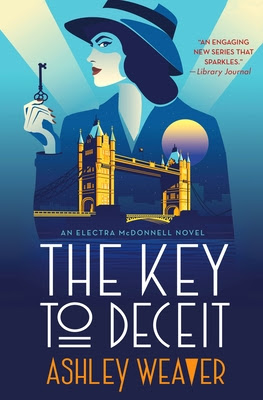
The Key to Deceit (An Electra McDonnell Novel #2) by Ashley Weaver

It's September 1940 and it's only been a few weeks since Ellie McDonnell helped the handsome, aristocratic Major Gabriel Ramsey break  into a house to retrieve some important blueprints before they could be given to the Nazis in A Peculiar Combination. Naturally, she's antsy for another chance to work with Major Ramsey, but first a little background information for those who haven't discovered this great series: Ellie was raised by her Irish Uncle Mick in London after her mother was arrested and imprisoned for supposedly killing Ellie's father, Uncle Mick's brother. Uncle Mick is a locksmith by day, and He, his three sons and Ellie were a safe crackers by night until Major Ramsey caught them in the act and gave the McDonnell family an ultimatum: live on the straight and narrow and help in the war effort or go to prison. I guess you can figure out which choice they made.

Luckily, Ellie doesn't have to wait long for the Major to need her safe cracking skills. A woman found dead floating in the Thames is wearing a curious bracelet - it's a thick cuff that is locked to the wearer's wrist. Ellie is a little queasy about picking the lock on the wrist of a dead woman and stalls by going over her clothing, which was new and expensive. Once Ellie has picked the lock open, they determine it contains a miniature camera. Major Ramsey dismisses Ellie and sends her home, but not for long. Turns out the clothing description helped them determine that the woman was doing something underhanded - there was a bag of precious gemstones hidden in her coat. 

Ellie and her sorta, kinda boyfriend Felix Lacey call on a pawnbroker friend to help them identify and figure out the source of the gems, the women, now identified as Myra Fields, had hidden in her coat. Myra was engaged in espionage for the Germans and the photographs she had taken would be very useful to the Germans should they ever begin bombing London. They also learn that she had been staying in a boarding house run by a Mrs. Paine. 

Ellie and Major Ramsey decide to visit the boarding house as an engaged couple and cousin of Myra's, to see what they can find. And in the midst of gathering evidence of a possible spy ring, the Nazis begin bombing London. Once bombing begins, not knowing who is part of the spy ring or how large it is makes the need to capture the spies taking pictures of possible bombing sites and their ring leader even more imperative. 

There's a lot going on in this novel and it moves at a pretty quick pace, but it is by no means overwhelming. In fact, some of it is a nice break from the mystery at hand. First, there is the relationship between Ellie and Major Ramsey. She is feisty, and can be a buster, while he is aristocratically uptight. Yet, there is chemistry brewing between them and Ellie's family would be pleased a punch to see her involved with him. And Ellie does think about it, but wait, what about Felix? He's so sweet and things could get more serious between them and he is more her sort, criminally speaking. Then, there is the case of Ellie's mother, who maintained her innocence right up until her death from the flu epidemic. Can Ellie find a way to clear her mother's name? And of course there are the everyday changes that war brings on in people's lives. I just love details. 

All in all, I found The Key to Deceit an enjoyable mystery, with lots of details and good plotting so that when the culprit was finally revealed, I was surprised.  The fact is that I was a little skeptical about the Electra McDonnell series when I first heard about it, but after reading these first two novels, I can't wait for the third book. 

Thank you, NetGalley, for supplying me with an EARC.

Saturday, April 30, 2022

A Sunlit Weapon (a Maisie Dobbs Mystery #17) by Jacqueline Winspear

It's October 1942, and Maisie Dobbs is now Mrs. Scott, having married her American beau Mark Scott, investigator with the U.S. Department of Justice and not a political attaché in the American embassy. And now that the United States has entered the war, Maisie just might need her husband's help with her new case. 

Jo Hardy is pilot with the Air Transport Auxiliary, or ATA, ferrying planes wherever they are needed in England. While flying a Spitfire to Biggin Hill in Kent, she heard a sound in the plane aft, as if she were hit by a bullet. Sure enough, circling back, Jo noticed a man standing outside a barn with a gun aimed skyward. A few days later, Jo and her friend Diana returned to the area, and to Jo's surprise, she discovered an African American soldier, Private Matthias Crittenden, bound and gagged. Taking him back to Biggin Hill, the soldier was immediately taken by the American MPs. It seems his white companion, Private Charles Stone, is missing and they think Mattias may have killed him. 

Jo's fiancee had been killed when his plane had crashed in the countryside. Now, after being shot at herself, and then hearing that another ATA pilot had crashed on her way to Biggin Hill two days later, Jo has her suspicions about what might have happened. And she turns to Maisie Dobbs in hopes of getting some answers.  As she begins her investigation, there seems to be two plotlines going on - who is shooting at planes and what happened to Michael Stone.  And the more Maisie investigates, the more these two plotlines begin to come together. 

Into the mix of plotlines comes Eleanor Roosevelt, in England to a goodwill tour and to meet with women doing war work, such as the pilots of ATA. This is a visit that Mark Scott is involved in, making sure that security is tight because there is a evidence of German plot to kill Mrs. Roosevelt. 

At the same time, Anna, Maisie's adopted daughter, has gone from being a happy 7-year-old who loved going to school and had lots of friends there to being a clingy, unhappy child with bruises on her body and who has lost all her friends and no longer likes school. It is another problem for Maisie to get to the bottom of. 

I found this 17th Maisie Dobbs mystery to be every bit as compelling and as rich and vibrant as the previous novels in this series. In fact, I actually found myself liking Maisie more and in a different way than she was in the previous books. Maisie seemed happier and less formal than before. Perhaps it is her American husband, and/or her adopted Italian daughter. whatever it is, I really like it. 

And because the American military are now in England, it is a good opportunity to explore racism and  segregation in the United States, both at home and abroad. I thought Winspear did a pretty good job of showing how the English were accepting of Black Americans in ways that the US, including the military abroad, were not, but also how the English had their own issues about race when Maisie's daughter became a target because of her dark hair and olive complexion, and assumed to be something she isn't. 

Winspear nicely brought in the work of the ferry pilots, showing the dangers these woman faced every time they got into a plane that carried no weapons they could use should they be attacked by a German plane, or even someone on the ground. And readers meet a group of Land Girls working on a farm to help with those chores. I was glad that the farmer they worked for turned out to be a good guy instead of one who took advantage of these young women. I loved all the little details Winspear threw in about both of these wartime jobs. 

On the whole, A Sunlit Weapon is imminently readable and I am still amazed at how, after 17 books, each one still feels fresh and exciting. I can't wait to read #18. 

Tuesday, March 8, 2022

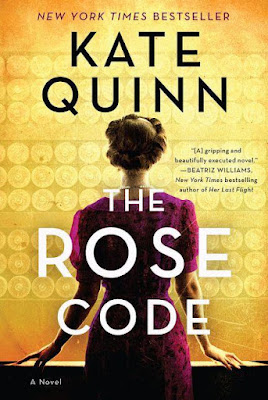
The Rose Code: A Novel by Kate Quinn

The Rose Code is one of those books I've been wanting to read ever since I first heard about it, but it just seemed like I could never find the time. Well, since I found myself with lots of time this past February, it was the first book I reached for. And I'm so glad I did.

The story revolves around three very different women who become friends after they begin working on code breaking at the Bletchley Park in Buckinghamshire, England during World War II. Mab (rather than Mable) Churt was born and raised in a cramped flat with a shared bathroom in Shoreditch in London's East End. Wanting more out of life than what her mother settled for, Mab worked hard to self-educate, reading the classics and she had even come in tops in typing and shorthand. Now, with war, she was ready to do her part for king and country.

Osla Kendall's upbringing couldn't be more different than Mab's. A society debutante, her mother hadn't really wanted her around, and had shipped her off to cousins in Canada. Now, Osla was back in London and dating a navy lieutenant named Philip Mountbatten (formerly Prince Philip of Greece). But once her mother cut off her allowance, Osla realizes she needs a job. Thanks to a German governess, Osla can speak fluent German and Philip suggests she use that skill to help the war effort.

After having mysterious interviews in London, Mab and Osla meet on the train the Bletchley, and instantly become friends, having received almost identical and very mysterious letters telling them where to go once they arrive. 

After another interview and signing the Official Secrets Act, the two women are taken to the Finch home where they will board while working at Bletchley. There, they meet Bethan Finch, the 23-yer-old daughter of their nosy, overbearing and overly critical landlady, Mrs. Finch. Meek and shy, Beth might have been beaten down by her mother, but she also is a whiz at crossword puzzles, able to finish the Sunday crossword in eight minutes. As Mab and Osla get settled into their respective jobs at Bletchley, they become more aware of what is going on in the Finch household, including the way Mrs. Finch abuses Beth. Thanks to Osla, Beth is soon working in Bletchley for expert cytologist Dilly Knox. 

Though Beth has always been shy and withdrawn, she shines at her job breaking codes at Bletchley. She even joins the book club that Mab and Osla start for the workers there. Then, on June 5th, 1944, as Beth is working on a difficult cipher file she had come to think of as Rose because the short messages reminded her of the way a rose's petals wrap it, she discovers that there was a traitor at Bletchley, but no matter what she says, no one believes her. The next day, as the Normandy Invasion was taking place, Beth finds herself committed to Clockwell Sanitarium for a supposed nervous breakdown. 

Now, it's 1947 and Beth is facing a lobotomy and desperately trying to get her former friends, Mab and Osla to come to her rescue. If they could decipher the Rose Code, they could expose the Bletchley traitor. But would they come? And if not, why not?

The Rose Code is a long, detailed, multi-layered novel and I couldn't put it down. The three main characters are so clearly defined and so deliciously flawed, as different from one another as they are united in their desire to do their part for the war effort. I loved the inclusion of real people like Dilly Knox and Prince Philip and even a mention of Alan Turing, but the other minors characters also fit the story so well. In fact, I became invested in everyone's story very quickly (even the horrible, abusing Mrs. Finch). Bletchley itself is so well depicted it felt like another character instead of just the place that brought everyone together for the sake of the story.

Beth, Mab, and Osla's stories unfold in alternating chapters, as well as in chapters where they all play a part. And the narrative covers two timelines - the war years, while the women were working at Bletchley, and 1947. Actually, 1947 covers only the weeks leading up to the royal wedding of Princess Elizabeth and Prince Philip (yup, Osla's old love interest). 

The Rose Code is a sophisticated, well plotted, well researched and well written novel My only objection is that I didn't really get why the traitor did what they did. I didn't like the character, but I also didn't suspect them yet I wasn't surprised when I found out who they were. 

The Rose Code was one of ten winning titles for ALA's 2021 Alex Award - adult books that also have appeal for young adult readers ages 12-18.

This book was purchased for my personal library.

Saturday, July 31, 2021

The Hollywood Spy (a Maggie Hope Mystery #10) by Susan Elia MacNeal

It's hard to believe I've just finished the 10th Maggie Hope mystery. It feels like I read the very first book, Mr. Churchill's Secretary, just yesterday. And yes, Maggie has had some incredible adventures since then. But now she is off to Hollywood, California to help her old friend John Sterling solve the mystery of his fiancée's death. You may recall that at one time John had been Maggie's love interest. Later,as an RAF Pilot, he had been shot down over Germany. John was originally presumed dead, he did return to England. No longer able to fly, he was an aide to Winston Churchill, until Mrs. Roosevelt's Confidante, when he leaves at Christmastime 1941 for Hollywood to work for Walt Disney, hoping to develop a gremlin story idea he has. 

It's now July 1943 and solving a murder in sunny Hollywood, California couldn't be more different than Maggie's dangerous bomb-defusing work in war-torn London. Now, Maggie is staying at the plush Chateau Marmont on Sunset Boulevard with her old friend Sara Sanderson, a ballet dancer who has a small part in a film that George Balanchine is choreographing. 

But Hollywood isn't as sunny as Maggie first thought. America has been in the war since December 1941 and the country has mobilized - more or less - to support the war effort. But, there is also pollution from the nearby factories,  Zoot Suit clashes between Mexican Americans and whites in the Navy, crooked cops, Ku Klux Klan and Nazi supporters, and, of course, the death of Gloria Hutton, John's fiancée. When Gloria was found dead in the swimming pool of the Garden of Allah Hotel after a party, her death was ruled an accident. But Gloria was also involved in a high profile divorce from her husband of a few months, Titus Hutton, that involved a hefty financial settlement for her. 

As Maggie investigates Gloria's death, she discovers there have been other suspicious deaths, all linked to a sedition trial of some Nazis in Sacramento. Gloria had been promised protection because she was afraid the if the Nazis discovered she had testified, her life would be in danger. After all, she had worked as a secretary for one of the Nazi leaders in Los Angeles. 

Needless to say, this is an exciting novel. It can be tough to keep a series fresh and interesting, but MacNeal has put Maggie into so many different eventful global situations that each novel retains its own crispness. And honestly, I was ready for a little glitzy glamour in Maggie's life after the darkness of the  last book, The King's Justice. Am I ready for a redo of Maggie and John? I don't know and if Susan Elia MacNeal knows, she wasn't telling in this book. 

I did like that we learned a little more about Maggie's Aunt Edith, a forward thinking woman, and her partner Olive. I always picture Aunt Edith as an old woman wrapped up in math problems, but was happy to hear about her war work. It made her feel more lively and energetic. I hope we readers really get to know her better someday.

There is a lot of American history in this novel and I think readers may be surprised at how much unrest and racism there was back them. One of the things I like about this series, and it's also very true in The Hollywood Spy is the amount of authentic flavoring that is always a part of a Maggie Hope mystery. People, places, songs and movies play their part in bringing the time period to life for readers. And I think more than any other Maggie Hope mystery, this one will really resonate in today's world. 

What's next for Maggie Hope? Well, there is a bit of a hint at the end of the book, but I guess fans will just have to wait and see. I hope it's not a long wait.

This book is recommended for readers 14+
This book was an eARC received from NetGalley

Sunday, July 4, 2021

The Valley of Lost Secrets by Lesley Parr

It's 1939 and England is at war with Germany. For Jimmy Travers, 12, and his younger brother Ronnie, 6, that means evacuation, leaving their dad and Nan behind in London for a village called Llanbryn in South Wales along with the rest of their school to be taken in by strangers. Jimmy's best mate Duff and his sister are chosen right away, and even Florence Campbell, a girl no one wants to have anything to do with because she and her clothing are always so dirty, is chosen before Jimmy and Ronnie.

Jimmy has been worried that he and Ronnie will be separated, chosen by different families, but luckily, a woman named Gwen Thomas decides she will take the brothers in even though she only wanted on child. Gwen and her husband, Alun, who works long hours in the Llanbryn coal mine, have no children of their own but are very kind to the boys, even though Jimmy refuses to accept them as Aunty Gwen and Uncle Alun, believing he will be home by Christmas. On the other hand, Ronnie adapts easily to valley life and seems to adore Aunty Gwen right off the bat.

One day, feeling sorry for himself, Jimmy takes off and finds a good climbing tree in the middle of a field.  And that's when he discovers a skull in a large gap in the tree. Scared, Jimmy takes off, but runs into the Vicar who seems to have a real dislike for Mr. and Mrs. Thomas. And that's when he discovers that Duff is living with the Vicar. 

It's a while before Jimmy sees his friend Duff, and much to his dismay, Duff has changed. Hanging around with the Vicar's son Jack and three other boys, the five of them go around bullying other kids. But to his real amazement, the next time Jimmy sees Florence, her hair, body and clothing are clean, she's happy and helping out in a shop, where the owner, Mrs. Hughes, is teaching her how to make Welsh Cakes. 

Jimmy returns to the tree, and to his surprise, is discovered by Ronnie, who has followed him. When he shows Ronnie the skull, it scares him and he wets himself. Naturally, that's when they run into Duff and his new gang, but it's Florence who punches Jack in the face defending Ronnie and leading to a new friendship between her and Jimmy.

When money goes missing from the Vicar's church, St. Michael's, people suspect it was stolen by the evacuees. It's clear they are welcomed by some people in Llanbryn, but not others and that there is a deep division between the people who go the St. Michael's and those who go to chapel, like the Thomas and the Hughes families. 

But it's the skull in the tree that holds Jimmy's attention, a secret he shares with Ronnie and Florence. When Jack's gang finds Ronnie at the tree by himself, they decide to kidnap him. Making a slip about the skull, they try to get that information out of him. Luckily, Jimmy and Florence find Ronnie before they hurt him too badly. Later, when Duff tries to pal up to him again, Jimmy knows he's being played and gives his former friend incorrect information about the skull. 

But Jimmy is still determined to find out who the skull belongs to and why is it in the tree? And perhaps, of all people, Alun Thomas has the answer. 

This is one of those stories that drew me in immediately. First, I love a story set in South Wales, and second, I love a good evacuee story and this is certainly that. I was happy that Gwen and Alun turned out to be kind and caring, even if there was some resentment in the village about the London evacuees. And Jimmy is an interesting character, unhappy about leaving his dad and Nan, resistant to letting himself settle in too comfortably with the Thomases, and very affectionate and protective of his younger brother.  

The Valley of Lost Secrets is a debut novel for Lesley Parr and clearly she knows her setting. Llanbryn is a fictional village, but it could easily have been Pontycymmer, where my dad grew up. My dad was raised chapel like the Thomases and Hughes families, and I'm not sure American readers will understand the difference between church and chapel that is talked about but that is a small part of the story and probably won't cause any lost of interest in Jimmy's story. 

Though this is a really great middle grade adventure/mystery with plenty of humor, Parr has explored some important themes in this novel, such as what makes a family and a community, forgiveness and acceptance, loss and guilt, courage and cowardice. The Valley of Lost Secrets is perfect for fans of Nina Bawden's Carrie's War, Michelle Magorian's Good Night, Mr. Tom, Emma Carroll's Letters from the Lighthouse, Kate Albus's A Place to Hang the Moon, and Kimberly Brubaker Bradley's The War That Saved My Life - all evacuation stories, all unique.

This book was purchased for my personal library.

Thursday, June 3, 2021

A Peculiar Combination (An Electra McDonnell Novel #1) by Ashley Weaver

It's August 1940, Britain is at war with Germany, the Blitz hasn't begun yet, and so, Ellie McDonnell, 24, and her Uncle Mick thought it would be safe to break into the deserted home of some wealthy Londoners and rob their safe. Sure, they had done this plenty of times before. Uncle Mick is a locksmith by day, and cracking open people's safes at night was more like a hobby than theft, and niece Ellie is a natural. Only this time, they get caught and it isn't by the London police. Instead, they were take to a large townhouse in Belgravia, now occupied by the military under the command of the quite arrogant Major Gabriel Ramsey. After some interrogation about how they crack safes, Ellie and Uncle Mick are given a proposition - prison or help the Major break into a safe containing some stolen classified blueprints having to do with national security and retrieve them before they are given over to the enemy. 

It sounds like a simple enough job, so Ellie and Uncle Mick accept the proposition - after all, they are patriots who want to do their bit for the war effort. In fact, Ellie's cousins Toby and Colm are already serving their country. So the deal is, Ellie and Major Ramsey will break into a house and get the documents, while Uncle Mick is help as collateral. Everything goes well except the papers are gone and the person in whose safe they were has been murdered.

Having carried out their part of the deal made with Major Ramsey, Ellie and Uncle are released with a promise to live on the straight and narrow for the duration. But then Ellie gets called back to Major Ramsey's office who needs her safecracking skills once again. Ramsey is convinced that the documents will be handed over at a party and lecture on Chinese porcelain to a potential conspirator with German ties. There are any number of possible suspects, but thanks to Ellie's pickpocketing skills, they are able to glean enough information on what appears to be a solid lead. 

Meanwhile, a prickly relationship is growing between Major Ramsey and Ellie. And the fact that an old ex-girlfriend of his may be mixed up in the conspiracy to pass documents to the Germans doesn't help matters. Ramsey is uptight, formal, and slow to trust Ellie, whereas Ellie takes her tasks seriously, but can be feisty and a real buster when she wants to be, though her teasing adds some much needed humor to their relationship and their mission. Don't get me wrong - there are also enough serious and even dangerous moments. 

On the whole, I really enjoyed this first novel in what looks to become a series. It may seem wrong for the main character to be a criminal, after all, they are usually the pursued not the pursuer. But right from the start, Ellie and Uncle Mick are forced to mend their ways (permanently? I doubt it). And although more than one person is killed, the novel inn't graphic, putting into the cozy class. 

A Peculiar Combination lives up to it ironic title and more, and will have readers wanting even more by the time they reach novel's end. 

This book is recommended for mystery fans age 14+
This book was an eARC gratefully received from NetGalley

Saturday, April 10, 2021

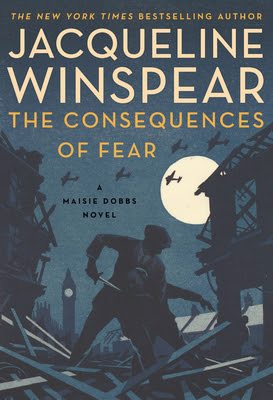
The Consequences of Fear (a Maisie Dobbs Mystery #16) by Jacqueline Winspear

It's October 1941, Britain has been at war with Germany for two years with no end in sight, and Londoners are still being bombed and dealing with the aftermath. For 12-year-old Freddie Hackett, the fastest runner in school, it means running messages to and from agents all over London, to earn a few shillings that his cruel father will spend in the local pub. But when Freddie witnesses a murder one night while running a message, only to deliver the message to the man who had done the killing, he's terrified and needs to tell someone about what he saw. And he knows just who to talk to.

Meanwhile, Maisie Dobbs has been enjoying motherhood ever since adopting Anna, the young evacuee who has been staying with Maisie's father and stepmother in Kent. But Maisie is also realizing that she has fallen in love with Mark Scott, the American agent from the Department of Justice that she worked with for the British Intelligence services under Robbie MacFarlane, senior detective with Scotland Yard's Special Branch. Yet, as much as Maisie might want to spend most of her life in Kent taking care of Anna, she decides to take Freddie Hackett's case pro bono, after finding out that Scotland Yard doesn't believe him and discovering blood at the site of the murder. 

In the midst of her investigation, Maisie accompanies MacFarlane to Scotland where they are to test and evaluate twenty British recruits and a few French volunteers, all wanting to become overseas intelligence agents. But when Maisie meets Major André Chaput, there to observe the French recruits, she is sure that he is the murderer that Freddie Hackett described in such detail, including the deep ridges on either side of his face and the patch of pale skin under his eye. Could it possibly be a coincidence? MacFarlane has been annoyed at Maisie for taking on the Freddie Hackett case to begin with, but when she brings up her thoughts about Major Chaput, he immediately sends her back to London.

Once again, Maisie has a lot on her plate, but now that Anna and Mark have come into her life, you can really feel how torn she is between them and the happiness they bring her and her work, which brings its own satisfaction. Added to all that is Freddie Hackett, a child with a cruel alcoholic father who has had to grow up to fast in order to take care of his mother and younger sister, Grace, who has Down Syndrome. We all know Maisie is a softy when it comes to children and so, not surprisingly, she also manages to find the Hackett family a safe place to live away from Mr. Hackett while things are sorted out. 

I have a feeling this may be a pivotal novel in the life and career of Maisie Dobbs. Throughout the novel, she contemplates the possibility of turning her business over to Billy, her right hand man, marrying Mark Scott and being a full-time mother to Anna. Maybe that's why this novel wasn't as exciting as previous novels. Which is fine, I still enjoyed reading it. But now I really wonder what's in store for Maisie. I have to admit, I was crushed when Alan Bradley ended his Flavia de Luce series, but there are a few more war years left, so hopefully we aren't that close to saying good-bye to Maisie. 

This book is recommended for readers age 14+
This book was an eARC gratefully received from NetGalley

Saturday, April 4, 2020

The King's Justice (a Maggie Hope Mystery #9) by Susan Elia MacNeal

I can't believe this is the ninth Maggie Hope mystery I've read. It seems like just yesterday I was reading #1 - Mr. Churchill's Secretary - and yet, it was back in 2012.

Maggie Hope has always been like such an intelligent, level-headed pillar of strength to me, but in The King's Justice we see a different side of Maggie, a more devil-may-care woman and who could blame her given all she has been through already.

It's now March 1943 and Nicholas Reitter, the Jack-the-Ripper copycat serial killer known as the Blackout Beast, and whose last victim was almost Maggie, has been sentenced to death for his crimes (see The Queen's Accomplice, Maggie Hope Mystery #6). Not sure she can ever put her experience with the Blackout Beast behind her, Maggie has refused to have anything more to do with spying for Churchill's SOE and is no longer working for MI5. Even DCI James Durgin, whom she is dating, can't change her mind, not even to help find a valuable stolen Stradivarius violin. 

Instead, Maggie has has taken up traveling around London on a rickety motorcycle, smoking and drinking too much, and volunteering to work with the 107th Tunneling Company of the Royal Engineers, defusing bombs that were dropped by the Luftwaffe during the Blitz. Known as the "Suicide Squad" it is a troop of conscientious objectors, most of whom are Itailan COs. 

But now, it seems there is another serial killer on the loose in London, one quickly nicknamed Jimmy Greenteeth. A number of suitcases full of clean white bones have been found during low tide in the Thames River, along with a white feather. Could the bones belong to London's conscientious objectors, possibly even friends of Maggie? But none of the men not showing up for work have been reported missing. Durgin is stumped and Maggie still refuses to help him solve the case.

But then, just days before his execution, Nicholas Reitter, now being held in the Tower of London,  claims he can help the police fine this new serial killer, but the only person he will speak to is Maggie Hope. And there's a condition attached to his information - Reitter wants a Royal Pardon from His Majesty, King George VI to stop his execution. Knowing this pardon will never happen, and angry with Durgin that he won't warn the COs about the white feathers found with the bones, Maggie ultimately finds herself involved in the Jimmy Greenteeth case when the young man she has been training, Milo Tucci, goes missing.

Perhaps not quite as action-packed as past Maggie Hope adventures, The King's Justice is nevertheless an exciting, complicated mystery. At first I thought that there would be a problem with linking this book up to a past story and using a specific events and recurring characters. I wondered if new readers might get lost unless there is enough background info given without spoiling too much of the action in each story. Not to worry - new readers don't need to know all the details from The Queen's Accomplice, but could well be inspired to begin reading Maggie's mysteries from the very beginning,  or just Book #6.

Old friends of Maggie, like myself, will enjoy her new adventure and, without giving anything away, you know what we are all hoping for in Maggie Hope #10, given how this ends.

One of the things I like really like about Maggie Hope mysteries is the attention to detail author Susan Elia MacNeal gives to presenting an in-depth picture of wartime London in her descriptions, and in this one particularly, the treatment of conscientious objectors, and enemy aliens, as well as in her use of British history, i.e. Jimmy Greenteeth is named after Jenny Greenteeth, a character in English folklore who would pulled people into a river and drowned them (and allows MacNeal to interrogate gendered ideas about who is capable of killing).

I am almost never disappointed when reading a Maggie Hope mystery, and now, I can't wait to see what #10 brings for her.

This book is recommended for readers age 13+
This book was an EARC gratefully received from NetGalley

Monday, April 15, 2019

Our Castle by the Sea by Lucy Strange

This is a novel that is so atmospheric and so spell binding, that I couldn't put it down. It begins with the legend of the Daughters of Stone and the Wyrm, the treacherous sandbank that caused boats to sink. According to the legend, four daughters bargained their souls away for the safe return of their fathers, lost at sea and sunk by the Wyrm in a days-long dense fog. The Wyrm returned their fathers, but the daughters were turned to stone, and now stand in a semi circle on the edge of a cliff in front of a lighthouse overlooking the English Channel.

Petra Zimmermann Smith, 12,  has always imagines that the stones were just like her family - her lighthouse keeper Pa, her German Mutti, her older sister Magda, or Mags, and herself. It's been an almost idyllic life but now World War II has just begun. Soon, there is talk of evacuations, gas masks are being given out and the government is requiring that they paint their beautiful lighthouse green from top to bottom to try to camouflage it from enemy planes. And it doesn't take long for the people of Stonegate village who had always been their friends and neighbors to turn on Pet's family with fear and suspicion because of Mutti being German and, then, sure enough, things begin to take a strange turn.

Pet's idyllic life begins to unravel as a series of disturbing acts of sabotage begin to happen in the village. At home, Mags is acting particularly secretive, disappearing for whole days at a time. And Pet fears that something is up with Mutti, who has begun taking early morning walks alone, and Pa is acting quite secretive and distanced. Pet is fearful that the family bond, once so strong, seems to be eroding before her eyes and she doesn't know why:
"We had always been such a close family, we had always trusted each other, but secrets had started to seep in the gaps between us. And now, like water freezing in the cracked surface of a stone, those secrets were growing colder, harder, starting to force us apart."

Then Mutti, known for her drawing, is classified as an enemy alien, arrested and indefinitely interned "as a matter of national security..." after a package is intercepted containing hand-drawn incriminating maps, charts and records Stonegate village. But when Mutti confesses to being a traitor, even at the risk of a death sentence, Pet begins to question everything she ever believed about her beloved family.

Our Castle by the Sea is definitely not your typical WWII novel, and yet everything is there, dogfights between the RAF and Luftwaffe pilots over the channel, the possible appearance of a German submarine off the Kent coast, the mistreatment and internment of anyone who is German and Italian, the heroic rescue of British and French soldiers from Dunkirk, even some Fifth Columnist and quisling activity, and a setting that is a character in its own right. And as characters go, Pet is hardly what you would expect - afraid of the enemy planes flying over head, living in the shadow of her spirited and determined sister, a girl who prefers the isolation of the lighthouse and her drawing pad and pencils. and who relates to the story of the Daughters of Stone perhaps a little too much.

But what elevates this novel to a thriller is Pet's fascination with the legend of the Daughters of Stone, a legend she relates to a little too much, and her suspicions and the assumptions she makes about her own family. It is a novel where no one is who they appear to be but its hard to know if they are up to good nor something else and Pet, with no one she can trust to turn to, is on her own to figure it all out.

All through Our Castle by the Sea, I kept thinking there was going to be some magical realism because of the high level of suspense wrapped around the legend, but what I got was so much better. Instead of magical realism, Strange uses Pet's sensory feelings to heighten the perception of unreality and other worldliness that pervade her thinking, all the while keeping her in reality.

My only regret about Our Castle by the Sea is that I can't read it again for the first time and once more savor the mystery of it all.

You can download an excellent Teaching Guide for this book courtesy of the publisher, Chicken House.

Our Castle by the Sea will be available in the United States on April 30, 2019

This book is recommended for readers age 9+
This book was an EARC received from Edelweiss+

Tuesday, March 26, 2019

The American Agent (a Maisie Dobbs Mystery #15) by Jacqueline Winspear

It's September, 1940, and the German Luftwaffe is blitzing bombs down on London nightly. Maisie, who you may recall was a nurse on the battlefields in France during WWI, and her best friend Priscilla Partridge have volunteered to be ambulance drivers, doing what they can night after night to help the injured. One night, a young American journalist, Catherine Saxon, rides along with Maisie and Priscilla. Catherine is writing accounts of the Blitz for Americans and is hoping to become one of "Murrow's Boys" - American reporters based in London, working for Edward R. Murrow on BBC radio.

Unfortunately, the next day, Maisie learns that Catherine Saxon has been murdered and her old friend Robert MacFarlane of Scotland Yard wants Maisie to be part of the investigation to find out who killed her and why. Oh, and he wants Maisie to work with Mark Scott, an American agent attached to the Department of Justice. And yes, if you've been keeping up with Maisie, this is the same Mark Scott with whom she worked and had a bit of a flirtation in Journey to Munich (Maisie Dobbs #12).

The investigation of Catherine Saxon's murder is complicated by a number of things. For one, her father is a wealthy isolationist American senator with whom she never got along and who has cut her off completely for not doing what he wanted her to do - be a wife in an advantageous marriage. And Mark Scott, for all his flirtiness, doesn't really seem interested in solving Catherine Saxon's murder, disappearing and showing up at odd times so that Maisie is left to wonder what he's up to. And, of course, Maisie is still in the midst of trying to adopt her orphaned evacuee Anna, which she would much rather focus on. Anna is still living with Maisie's father and step mother at Chelstone, the family farm, and having meltdowns whenever Maisie needs to return to London. And as if these things aren't bad enough, one night while driving their ambulance, Priscilla is very seriously burned while rescuing some children in a bombed house.

Maisie has a lot of personal stuff to contend with in this novel, but luckily, for all his disappearing during the Catherine Saxon investigation, Mark always reappears just when Maisie needs him to. Could it be that these two are ready to take their previous flirtation to another level? But why can't she discover anything about him? Is he somehow up to no good? What's his connection to Ambassador Joseph Kennedy, also an isolationist and Nazi appeaser? And will her job as an investigator jeopardize her chances of adopting Anna? As Maisie interviews the women in Catherine's life, including her best friend Jennifer Barrington and her husband, is she beginning to look at her own life differently?

Looking at these questions, you can see that this is an intriguing book, and a more personal and introspective one than the last few Maisie Dobbs' novels I've reviewed. In addition, Jacqueline Winspear has really captured just what London was like during the Blitz, with fires all around, lives and homes lost, the smell of fires burning everywhere, buildings sandbagged and barb wired, barrage balloons in the air and "where tension was threaded into the fabric of life" but where "people prided themselves on their ability to carry on as normal." There's even a bit of humor. Whenever the V-formation of Luftwaffe bombers fly over Chelstone, next-door neighbor Mr. Avis "could be seen shaking his fist and shouting at the sky, before aiming his rifle towards the bombers," a gesture nicely summed up by Mark Scott "You know, you've gotta love you Brits."

Winspear includes a Prologue that consists of reports by journalists about London in the days just before and after the Blitz begins on the night of September 7, 1940. This nicely sets the stage for not only Catherine Saxon's murder, but also for what Maisie and all Londoners faced on a nightly basis while carrying on as normally as possible during the day. The inclusion of Edward Murrow and other journalists reporting to Americans about the Blitz, as well as different isolationist politicians, will certainly resonate with today's readers. But in the end, you will be very surprised at 'who done it' and why. I know I was.

The American Agent is definitely my favorite Maisie Dobbs so far and I can't wait for the next adventure.

This book is recommended for readers age 14+
This book was an EARC gratefully received from EdelweissPlus

Thursday, February 21, 2019

The Golden Tresses of the Dead (a Flavia de Luce Mystery #10) by Alan Bradley

It's autumn 1952, and although Flavia de Luce and her sisters, Feely (Ophelia) and Daffy (Daphne) are still distraught over the loss of their father less than a year ago, the Buckshaw household is getting ready for Feely's marriage to Dieter. Dieter, you may remember, was a former prisoner of war, a German pilot shot down over England by RAF pilot Reggie Mould. Now, Reggie is Dieter's best man at his nuptials.

All goes well at the wedding until Feely makes the first cut of her wedding cake, and discovers a severed human finger where the slice used to be. Feely's subsequent hysterics naturally gives Flavia a chance to wrap the finger in a napkin and whisk it away to her laboratory upstairs, where she is soon joined by Dogger, who had previously been her father's valet and loyal family's servant. You may recall that at the end of Book #9, The Grave's a Fine and Private Place, Flavia and Dogger had gone professional, establishing Arthur W. Dogger & Associates, Discreet Investigations. Needless to say, they immediately begin investigating the finger and lose no time in identifying it as belonging to a famous guitarist, Mme. Adriana Castelnuovo.

Before they get too far with the mystery of how Mme. Castelnuovo's severed finger ended up in Feely's wedding cake, they are hired by a Mrs. Anastasia Prill. Mrs. Prill believes that several letters of a delicate nature have been stolen from her home. Her father, Dr. Augustus Brocken had been a homeopathic practitioner and the developer of Brocken's Balsamic Electuary, a miracle cure all balm, which made him oodles of money. Now, though, the elderly Dr. Brocken has been living in an unresponsive state in Gollingford Abbey, a very expensive private hospital. But no sooner do they begin piecing together the clues to the missing letters then Mrs. Prill is found dead in her home, a suspicious cup of coffee nearby.

In the middle of all this, Flavia's friend and wife of the vicar, Cynthia Richardson, asks if two missionaries from Africa, Miss Doris Pursemaker and Miss Ardella Stonebrook, can stay at Buckshaw for a while, a request to which Flavia grudging agrees. It doesn't take long for Flavia and Dogger to wonder if the severed finger, the Brocken family's intrigues and the two missionaries are somehow connected to each other.

Flavia, who has been acutely feeling Feely's departure from Buckshaw, "Feely, with whom I had been engaged in an eternal joust since the day of my birth; Feely whom I always loved; Feely whom I sometimes hated" (pg 32), stoically throws herself into investigating these new mysteries as a way of avoiding this new loss in her life.

And Bradley writes this novel with the same zeal with which he has always approached his Flavia novels. And now he has given Flavia a foil in the form of Undine, her younger orphaned cousin now living in Buckshaw. Undine has always felt like an intruder there, treated more like an annoyance than someone who might have some good detection ideas, and she has been trying to prove herself to Flavia the whole time she has been living in Buckshaw. Will she ever get Flavia's respect?

Bradley has a way of incorporating interesting bits of trivia into his novels and this one is no different. I found the idea of the London Necropolis Company fascinating and I suspect fans of Flavia will too. And riding the same rails from Waterloo Station to Brookwood that this one famous funeral train traveled on is the first official act of Arthur W. Dogger & Associates and seems just so absolutely appropriate.

The Golden Tresses of the Dead is as delightful to read as all the previous books. It is supposed to be the last Flavia de Luce novel, but boy, it sure doesn't feel that way and let's hope it isn't.

This book is recommended for readers age 12+
This book is an EARC received from NetGalley

Sunday, February 10, 2019

#MMGM: How I Became a Spy: A Mystery of WWII London by Deborah Hopkinson

It's 1944, American servicemen have arrived in London and everyone is talking about the pending invasion of France to break the Nazi stronghold in Europe and end Hitler's reign. London is being bombed once again by the Germans, and for Bertie Bradshaw, 13, and his rescue dog Little Roo, it means finally being old enough to become a messenger for the Civil Defense post in his neighborhood.

One night, as the air raid sirens begin, Bertie bumps into an American girl in a blue coat about his age, who drops a little red notebook. Bertie picks it up to return, but the girl has already run off and so has Little Roo, down a different street and straight to a unconscious woman laying on the sidewalk. Determining that she isn't a bomb victim, Bertie reports the incident to his Civil Defense post, but when they return to the spot where the women was laying, she is nowhere in sight. What could have happened to this mysterious lady?

Back home, Bertie pulls out the red notebook to see if he could find the owner's name. Instead, he finds notes made by someone in training with the SOE (Special Operations Executive) to become a spy. Fascinated by what has been written, Bertie keeps reading until suddenly the writer begins using random letters that just look like gibberish. Thinking it might be a cipher, Bertie decides to talk to his best friend David, a German Jewish boy who had come to London in 1939 on the Kindertransport, and is a Sherlock Holmes fan who also happens knows all about ciphers.

The next day, a Saturday, Bertie and Little Roo head over to where most of the Americans are staying hoping to find the girl in the blue coat. Realizing it was a long shot, the two begin walking when Bertie notices that he is being following by a man. Dodging the man, Bertie decides to follow him instead and is led right to Baker Street, to a place called the Inter-Services Research Bureau. Thinking this might just be the SOE offices he read about in the notebook, there's no time to investigate what it's all about because suddenly his arm was grabbed by none other than the American girl in the blue coat, demanding he return the red notebook immediately. But why? A 13-year-old girl can't be training to become a spy, can she? But how is the notebook connected to this American girl named Eleanor Shea?

Right from the start there's a lot going on in this exciting mystery/adventure novel. It turns out that Eleanor knows that the notebook belongs to Violette Romy, a former French tutor of hers. David is able to help with some of the cipher in the notebook, but not all of it. As secrets about the impending top secret invasion and the French Resistance are revealed to the three friends, they also discover a series of double crosses and traitors putting both Violette's life and the liberation of Europe from the Nazis in jeopardy.

But that still leaves a question about the identity of the unconscious lady and the man following Bertie. Mystery abounds.

I loved reading How I Became a Spy. Not only is it full of historical references, but for added interest and authenticity, Hopkinson has also peopled it with some real, if not necessarily, familiar people, such as General Dwight Eisenhower, Leo Marks, a SOE code maker, and she modeled the character of Warden Ita, of the Civil Defense after the real air-raid warden E. Ita Ekpenyon, who was born in Nigeria. The story is narrated by Bertie, who is a lively character despite living with the memory of his paralyzing fear during the Blitz that caused injury to his older brother, Will and who alway feels like he has disappointed his father.

The novel takes place over the course of one week, beginning on Friday, February 18, 1944 and ending on Thursday, February 24, 1944, plus an Epilogue dated Sunday, July 2, 1944. The one week perimeter adds to the excitement and tension of needing to decode the pages written in cipher and then getting the information into the hands of the right people.

The bombing of London by the Luftwaffe in 1944, often referred to as the "Baby Blitz" isn't generally the setting for historical fiction, let alone that written for middle graders, making this a great addition to the body of home front literature.

One of my favorite things about How I Became a Spy is that Hopkinson has included four different ciphers scattered throughout the book, allowing readers to learn about some of the different kinds of ciphers they work alone with Bertie, David, and Eleanor. There is a Simple Substitution Cipher, a Caesar Cipher, a Atbash Cipher, and a Mixed-Alphabet Cipher. And at one point, they make and use a Cipher Wheel. I really liked this hands on activity for kids to try.

How I Became a Spy is an engaging historical fiction novel with engaging characters that will surely have wide-spread appeal. I can't recommend it highly enough.

This book is recommended for readers age 9+
This book was provided to me by the author

Be sure to check out the other Marvelous Middle Grade Monday offerings, now being carried on at Always in the Middle. 

Friday, August 17, 2018

The Prisoner in the Castle (a Maggie Hope Mystery #8) by Susan Elia MacNeal

In a homage to Agatha Christie's novel And Then There Were None, comes the eight installment in the Maggie Hope series. And it's a good one.

It's November 1942, and for almost five months now, SOE agent Maggie Hope has been held as a sequestered prisoner in a castle on the deserted Isle of Scarra in Scotland. Sure, she has freedom to move around around the castle and the island, since no one lives there but their jailer Captain Evans and the McNaughton family that helps out in the castle, but it also means no phone calls or letters or communication of any kind with the outside world. And Maggie isn't alone on the island. In fact, there are nine other agents, all sequestered because they, like Maggie, know high level wartime secrets that the Special Operations Executive believes they might inadvertently let fall into the wrong hands.

The agents are well taken care on the island. Once a month, a boat arrives with their Jungian psychologist Dr. Charles Jaeger and whatever supplies are needed, but staying only a very short time.

Into this already sinister setting comes SOE agent Camilla Oddell, sent to the island after killing another agent during a training drill. Naturally, once the first body is discovered, that of Captain Evans, she immediately comes under Maggie's suspicions. But why? What would be her motive? Breaking into Captain Evans' office, the agents use his radio to call Arisaig House, command center for SOE agent training, but before they can come to get his body, another death is discovered.

As more agents are murdered, it becomes clear to Maggie that the murderer is one of the agents. When a severe storm hits the island, lasting for days, and making it impossible for a boat from Arisaig House to come, Maggie realizes that there is also a German spy, who could be living in the castle or hiding elsewhere. Can she discover what is happening before she becomes a victim?

Meanwhile in London, the trial of the Blackout Beast (See The Queen's Accomplice, Maggie Hope #6) begins, and in a surprise move, Nicolas Reitter, the accused murderer, pleads not guilty. Now, the case will go to trial and Maggie is the only living witness. Detective Chief Inspector James Durgin, who has more than a professional interest in Maggie, must now try to find the sequestered agent, or Reitter will go free.

Yes, for a "locked room" or rather a deserted island mystery, there's a lot going on here. MacNeal has imbued this novel with an interesting, eclectic cast of characters, all reflecting the kind diverse backgrounds of the real agents in the SOE, and then some. Readers get a real sense of each one, even those that don't last very long. 

And this is a novel where the setting plays a much of a role as each character. Killoch Castle, where they all live, has a really storied history of its own. Built in 1900, it is a large and ugly Tudor style structure, a mix of "Victorian and Edwardian excess," and populated by a large collection of taxidermied wild animals. It had been the hunting lodge of a wealthy man with a big ego named Marcus Killoch, reputed to be quite the playboy in his day, but who is said to have killed ten of his invited guests one night, and then himself.

There certainly seems to be parallels between Killoch's murders, the murders of SOE agents, and Christi's And Then There Were None, but like all good mystery writers, MacNeal gives The Prisoner in the Castle her own spin.

I enjoyed reading this novel as much as I have enjoyed all the Maggie Hope mysteries. This one was very different, in that Maggie is very frustrated at not being able to use her training for the war effort (be careful what you wish for, Maggie), and yet it was still war related and exciting. And I have to admit, I was surprised by who turned out to be the killer and who was the spy. And they weren't the only surprises. And a surprise ending is always a good thing in a mystery.

This book is recommended for readers age 14+
This book was a EARC received from NetGalley

For your information, I am including the cast of the island characters, because in the beginning I found I had to make a list to keep them straight until I got to know them better:

The SOE Prisoners:
Maggie Hope
Dr Sayid Inayat khan (a nod to the real spy whose name was Noor Inayat Khan?)
Teddy Crane - older, arthritic
Ramsey Novak - mute
Quentin Asquith - gay
Anna O'Malley - scrappy, mousy and (to me) annoying
Helene Poole-Smythe - showgirl who married rich, and a flirt
Leonard Kingsley - admirer of Helene
Ian Lansbury - having affair with Helene and the first to go missing
Torvald Hagan - a little person
Camilla Oddell - the last agent to arrive on on the island

Captain Evans - their kind jailer

Dr. Charles Jaeger - their shrink
Captain MacLean 

The Three McNaughtons
Angus
Fiona
Murdo - their son

Tuesday, July 24, 2018

The Turnkey of Highgate Cemetery by Allison Rushby

It's December 1940 and London is being bombed night after night by the German Luftwaffe. In Highgate Cemetery, however, the souls who are buried there are, for the most part, at peace, thanks to Flossie Birdwhistle, 12. Flossie had died of rheumatic fever, and now served as the turnkey or keeper of the key, of Highgate. It is her job to make sure everyone stays peacefully at rest there. As turnkey, Flossie must stay awake and can even leave the cemetery, sometimes visiting the Golden Galley atop St. Paul's Cathedral, a tranquil place overlooking London until the war began. But one December night, she runs into someone else up there - a man who was clearly dead and part of the spirit world, though not a turnkey, and dressed in the uniform of a Nazi officer and carrying a strange looking round glass object. When he sees Flossie, he quickly flees.

Confused, Flossie decides to visit her friend Ada, the Turnkey of Tower Hamlets cemetery. No sooner does she tell Ada what she saw, than the Turnkey of Brompton Cemetery shows up with at least 100 souls dressed in the uniform of the *Chelsea Pensioners. The men are there because of the Blitz, but are soon drawn into the mystery of the Nazi officer in the SS uniform carrying the mysterious round object.

On a quick trip to the Invalids' Cemetery in Berlin, Flossie learns from the Turnkey there that the officer is part of the Ahnenerbe. But what is that? Is the officer a German spy? How can that be if he's already dead? And why does he know who Flossie is?

The Turnkey of Highgate Cemetery is indeed a mystery...and historical fiction...and a ghost story.  And yet it just didn't grab me until Flossie sees the SS officer on the dome of St. Paul's. A ghostly Nazi looking out at the bombing of London by the Luftwaffe reminded me that the the Nazi's, particularly Heinrich Himmler, head of the SS, had been interested in finding the "spiritual" roots of Germanic or Aryan heritage. That made this a definite game changer.

Flossie may only be a 12 year old protagonist, but she's smart and unrelenting in her pursuit of solving the mystery of the Nazi, especially after it becomes personal. But she's also compassionate and cares very much about the souls at rest in Highgate, as evidenced in the sub-storyline about Grace, a young girl injured in the Blitz who straddles life and death while trying to find her family. I could have lived without Grace's story, but I think it would have made a great sequel to this novel.

Highgate Cemetery is such a perfect setting for this story. It's creepy enough to make me never want to be there at night, but the spirits from all the London cemeteries are not the least bit scary:

Highgate Cemetery, London
The story does take a few unexpected turns that I didn't see coming and I liked that a lot. In fact, a lot of people have compared this novel to Neil Gaiman's Coraline and The Graveyard Book, and I suppose they are similar in a way, but I think The Turnkey of Highgate Cemetery does a good job of holding its own.

I also thought that Rushby did a spot on job of presenting the Blitz in all its horror, and I liked Flossie's visits to the war rooms of the British and the Nazis, but I think one of my favorite things was the presence of the helpful Chelsea Pensioners in their tricorn hats and bright red coats. Which reminds me: The Turnkey of Highgate Cemetery was originally published in Britain, and there may be some bits that young American readers don't not know about. Some of them are covered in the Author's Note, but not the Pensioners (see note below).

All in all, however, The Turnkey of Highgate Cemetery is a great novel for anyone interested in WWII fiction, fans of ghost stories, and those who like a really good mystery.

This book is recommended for readers age 9+
This book was sent to me by the publisher, Candlewick Press

*Chelsea Pensioners - according to Wikipedia, they are soldiers who are residents of the Royal Hospital Chelsea, a retirement home for former members of the British Army.


Wednesday, May 2, 2018

To Die But Once (a Maisie Dobbs Mystery #14) by Jacqueline Winspear

It's May 1940 and, while Britain is at war with Germany, nothing much has happened so far on the home front, except lots of talk about the possibility of England being invaded, and continued preparations for the war. But now that the so-called phony war has ended, things are heating up.

For 15 year-old Joe Coombes, already an apprentice for Yates and Sons, painters and decorators, it now means a job painting the buildings at every RAF airfield in the country with a special new fire-retardant paint. But the vapors from the paint give Joe headaches, and when he is found dead from an apparent fall, it's all chalked up to being a suicide rather than the fatal blow on the head he received from the two men following him as Joe was out walking one night (NOT a spoiler - it happens in the Prologue).

Joe's parents, owners of a local pub, ask Maisie to investigate what happened to their son, and Maisie readily accepts, having watched all the Coombes children, Joe, Archie, and Vivian, grow up in their close-knit family. The family has always been well provided for, but now, with the war finally beginning to heat up, Maisie notices that both Archie and Vivian are living better than most people, always wearing fashionable clothing, having nice living conditions, and even smoking expensive cigarettes from packs of 20 instead of cheap Woodbines, "sold by the one's and two's" and not even bothering to finish them.

Luckily, Maisie still has gas coupons, so she drives several times down to Hampshire with her assistant Billy Beale, the last known area Joe had worked in, and begins questioning everyone who had contact with Joe, including his fellow workers, his landlady and the air force. Everyone liked Joe, but no one can help much. And Maisie notices that she is now being followed by a car with darkened windows, all the way back to London.

Meanwhile, Maisie's best friend Priscilla Partridge has been having a problem with her middle son, Tim, ever since his older brother joined the RAF. Tim also wants to be involved in doing work for the war effort, but is still too young. She asks Maisie is Tim might visit Chelstone, Maisie's country home inherited from her deceased husband. The hope is that Maisie can talk to him, her father will keep him busy with farm chores, and her young evacuee Anna, 5, will be thrilled to have him there as she recovers from measles. 

The war in Europe isn't going well for the British and French, and they soon learn that the British Expeditionary Forces (BEF) are being driven to the coast of Dunkirk by the German Army and are basically sitting ducks for the Luftwaffe. But when a call goes out for any craft that can cross the English Channel in an attempt to rescue the stranded soldiers, Tim and his friend Gordon Sanderson suddenly go missing as does one of Mr. Sanderson's boats.

As if the death of Joe Coombes and the possibility that Tim went to Dunkirk as part of the rescue flotilla isn't enough, Maisie has also decided to begin looking into the possibility of adopting Anna, though things don't look good for her as a single woman. 

And just how does that nice man living in the same building as Maisie's office fit into the plot?

I really enjoyed this Maisie Dobbs mystery. There is lots of interesting every day information about life on the home front included as the Germans get closer and closer to the English Channel and the possibility of invasion become real. Invasion was something people really worried about during WWII, with good reason, considering the number of countries Hitler had already invaded. On top of that, there is worry about the sons who have already enlisted and are fighting in France - Billy's son Billy Jr. in the army, Tom Partridge flying in the RAF, both boys Maisie is quite fond of.

I found the mystery interesting and there were quite a few surprises I don't see coming - which I like in novel. And the subplot of the missing Tim allows Winspear to include a lot of information about events in the spring of 1940, just before the Battle of Britain began.

And as much as I loved reading the three Maisie Dobbs novels that take place just before and during WWII, and plan to read any future mysteries of hers in this time period, this novel made me realize that I don't much care for Maisie's character. I find she is too perfect and that she has too much of a flat affect - she never gets angry, or has a good laugh, or a good cry. Sometimes, when she thinks about her late husband and the child she lost, there is a sense of tearless sadness, or when she is with Anna a kind of motherliness about her, but even at that, I don't get a feeling of warmth. Odd that, to like the books in a series so much, but not the main character. Even odder, it doesn't spoil the novels for me at all.

What I did find interesting, and you may as well, is that the the story of young Joe Coombes is based in part on Winspear's father's WWII experiences as an apprentice painting building at military airfields with a new fire retardant emulsion. You can read what Winspear writes about this on her website HERE.

I hope you enjoy this book as much as I did, and I can't wait to see what Maisie's next novel will bring.

This book is recommend for readers age 14+
This book was an EARC received from EdelweissPlus

Friday, February 16, 2018

The Grave's a Fine and Private Place ( a Flavia de Luce Mystery #9) by Alan Bradley

This is the 9th Flavia de Luce mystery and the 6th book I've reviewed here. Of course, I do know it is now June 1952, Flavia has turned 12, and that aside from the odd mentions, WWII no longer plays much of a part in the stories.

As I said, it is June 1952, and six months have gone by since Haviland de Luce, father of Flavia and her sisters Feely (Ophelia) and Daffy (Daphne), passed away after an illness. Though the family estate, Buckshaw, was left to Flavia, her Aunt Felicity, bully and tyrant, arrives from London and decides it is to be sold and Flavia will go to London to live with her. Given six months to mourn, Flavia, Feely, and Daffy, are on a trip planned by faithful retainer Dogger, where, after punting along a river, they land in the village of Volesthorpe, near the notorious St.-Mildred's-in-the-Marsh church. It was here that Canon Whitbread allegedly poisoned three ladies in his congregation with the communion chalice, for which he was hanged. Yes, Dogger certainly does know his Flavia, poisons are her thing.

But when Flavia fishes out the Canon's son Orlando from the river by the church, new questions arise. Flavia cleverly manages to get some stomach fluid from the corpse for later analysis before the arrival of Constable Otter. As clever as he is unfriendly, Constable Otter quickly lets her know that her help is absolutely unwanted, an attitude that causes Flavia's suspicious nature to be on guard.

Away from her own well equipped chemistry lab at Buckshaw, Flavia and Dogger find they must improvise in order to carry out the investigation into Orlando's death. Luckily, Dogger, who seems to have an abundance of all kinds of knowledge, also turns out to be a genius at using whatever is at hand. I loved how Dogger made an improvised microscope (pg 85), especially clever and amusing after Otter condescendingly manplained to Flavia what a microscope is (pg 45). Still, Flavia is disappointed that Orlando wasn't poisoned, but she has become more and more aware that there are, nevertheless, sinister things under foot in Volesthorpe, and she is determined to get to the bottom of them all. And, as it turns out, there is plenty to get to the bottom of.

When I first began reading The Grave's a Fine and Private Place, I was feeling a little disappointed. It definitely has a slightly different feel to it than the previous 8 books. But as I got further into the story, I began to enjoy it as much as the other Flavia books, but it never lost the feeling of difference. I've thought about it and this is what I think:

The Grave's a Fine and Private Place is the next to the last Flavia de Luce mystery and, at 12, Flavia is entering adolescence. No longer a child, she is maturing and it shows - kudos to Bradley for portraying the subtle ways in which this happens. I realized it had actually began in book 8, Thrice the Brinded Cat Hath Mew'd after Flavia returned to Buckshaw from boarding school in Canada. Most notable is the way she now sees Dogger as more of an person in his own right and an equal and less as a servant, and there are changes in her relationship with her sisters, particularly Daffy, whose literary passions turn out to be pretty useful for solving murders. Don't get me wrong, Flavia is still as enthusiastic about solving murders, performing chemical experiments and learning about poisons as ever she was, but now her life is expanding.

Being away from the confines of Buckshaw and Bishop's Lacy also allows Bradley to bring in more varied but no less eccentric characters. There is Orlando Whitbread's mentor Poppy Mandrill, former actress now confined to a wheelchair; Arven Palmer, the landlord of the Oak and Pheasant and his wife, Greta Palmer; three roustabouts from the traveling Shadrach's Circus and Menagerie as well as the proprietor, Mrs. "Dreadnought" Dandyman; the village's undertaker F. T. Nightingale, whose son Hob befriends Flavia; and last but not least, Dogger's old friend (?) Claire Tetlock - each with their own secrets to be uncovered.

Like most of Bradley's plots, this one will require you to suspend your disbelief, not because he has delved into fantasy, just into things improbable, exciting but improbable. But is wouldn't be a Flavia de Luce mystery if the improbable were left out, would it?- then it would just be a book about a girl who likes chemistry. If you love a little off the wall, somewhat noir mystery with unconventional characters, this is the book/series for you.

This book is recommended for readers age 13+
This book was an EARC received from NetGalley 

Wednesday, September 6, 2017

The Paris Spy (a Maggie Hope Mystery #7) by Susan Elia MacNeal

When last we left Maggie Hope, her college friend Sarah Sanderson and her old boyfriend Hugh Thompson, both now Special Operations Executive (SOE) agents, were preparing to go to France to work undercover, while Maggie was excitedly expecting her newly discovered half sister, Elise Hess, to arrive in London from Germany.

It is now June 1942 when The Paris Spy opens and France has be under German occupation since June 1940 and the Nazis have quite comfortably ensconced themselves in Paris, enjoying the finer things the city has to offer. 

Sarah and Hugh, code named Sabine Severin and Hubert Taillier respectively, have also arrived in Paris, she as a dancer, he as a cellist to work undercover as part of a Paris ballet company. Their assignment is to collect a bag of sand sample SOE agent Erica Calvert had collected from the beaches of Normandy, France, in preparation for the proposed invasion and it is imperative that those sample not get into the hands of the Nazis. 

Maggie has also arrived in Paris hoping for discover what happened to her half sister. Elise never showed up in London, as planned.

More importantly, however, she is there to try to discover what happened to SOE agent Erica Calvert - is she dead? Alive? Compromised? Her radio transmittals have been coming through to England but without the required security check. And what about her sand samples? 

After months of waiting in the home of two resistance workers, Maggie has finally received her forged identity papers, becoming Paige Kelly from Ireland, in Paris to shop for her trousseau. Ireland was neutral during the war and so Maggie is free to move around as she pleases. She immediately checks into the Hôtel Ritz, now headquarters for the German Luftwaffe, and home to designer Coco Chanel, who in reality did live there for 37 years, including the war years, and who immediately befriends Maggie, who just happens to be wearing a Chanel suit when they meet.

And to add to the danger of simply operating in an occupied area, the Nazis seem to know exactly who the SOE agents are and what they are doing in France, which can only mean one thing - there is a mole in SOE. But who can it be? And will Maggie find out before all the SOE agents’ lives are put in jepardy?

There is a lot going on inThe Paris Spy. There’s mystery and intrigue mixed with the really odd glamour that was Paris after the Nazis arrived. MacNeal has really captured the two sides of the German officers who were running operations there. On the surface, they demanded the finer things associated with France - lots of champagne, the finest foods, and the best accommodations. Below the surface, the level of physical and mental cruelty is stunning. 

And in-between is Coco Chanel. Chanel has long been suspected of being a Nazi collaborator. MacNeal’s depiction of her is ambiguous at best, and it is up to the reader to decide whether or not she is a Nazi spy, or a double agent in The Paris Spy. Of course, there is the whispered comment Chanel made to Maggie on page 245…   

I personally felt this was a particularly interesting novel. Although Maggie has rubbed shoulders with all kinds of big players from WWII - from the Queen and Winston Churchill to President and Mrs. Roosevelt, among others -  I felt like this was a more thought provoking story and not just a good historical fiction mystery. Not because Maggie, Sarah, or Hugh have changed, but there was more of an insider’s look into how and why things were done and events that unfolded in it. 

The Paris Spy is sure to please fans of Maggie and, aside from maybe not totally understanding how Elise Hess comes into the picture, it can be read as a stand alone historical fiction novel, not just as part of a mystery series.

I am now eagerly looking forward to Maggie Hope #8

This book is recommended for readers age 14+
This book was an EARC received from NetGalley

Tuesday, August 15, 2017

In This Grave Hour (a Maisie Dobbs Mystery #13) by Jacqueline Winspear

It’s September 3, 1939 and just as Prime Minister Neville Chamberlain announces over the radio that England has declared war on Germany, Maisie has a strange visitor. Dr. Francesca Thomas, a former member of the WWI Belgian resistance group La Dame Blanche and who, through her association with the British Secret Service, is the person who trained Maisie in all things spy in book #13 - Journey to Munich, wants her to investigate the assassination-like death of Frederick Addens. Addens seems to be just an ordinary engineer working at St. Pancras station, but he is also a Belgian refugee who escaped to England during WWI and never returned to his homeland.

Soon after Maisie begins her investigation of Frederick Addens, more Belgian expats who arrived in England with him are also killed, executed in the exact same way as he was. But the victims just don’t seem to have anything in common with each other besides being Belgian expats.

Given that, Maisie decides to take a clandestine trip to Belgian to see if she can find any  information or answers as to why these particular people were killed. Maisie enlists the help of her old friend from the Secret Service Robbie MacFarlane, who manages to get her on a transport plane. And despite having a very small window of opportunity to investigate in Belgian, Maisie does indeed discover the information she needs to solve her case.

There is, of course, another story thread that is much more personal. Maisie’s country home, inherited from the deceased husband, has received two rather boisterous brothers evacuated from London, and one 5 year-old girl named Anna. Maisie enlists the help of her dad and stepmother for the boys, but no one seems to know where Anna came from. They only know that she was evacuated from London with the rest of the kids heading to Kent, and now she refuses to speak or let go of the small suitcase she arrived with. Finding herself getting too attached to the little girl, Maisie decides to give her assistant Billy Beale the job of finding out who Anna is and where she came from. 

In the end, both mysteries are solved. Though I found the motive for the murder of the Belgian refugees a bit thin, the rest of the novel is a really solid mystery and worth reading, especially if you are a Maisie Dobbs fan already. In mysteries, it is always the excitement of the investigation that I enjoy most, so that a rather lame motive didn’t bother me, and only occupies a small portion of the book. The thread concerning Anna was interesting, emotional and somewhat predictable, yet oddly satisfying. 

What I did like was seeing how Winspear has really done some spot on research regarding what the English home front was like during those early days of the war and her depictions are as interesting as they are authentic. The book takes place during what was called the “Phony War.” This was the first nine months after war was declared, and people were at the ready, but nothing was happening. The Blitzkrieg came later, in April 1940. That characters keep forgetting their gas masks when they go out is probably more true to life than not. Blackout curtains, cheap tea biscuits, mothers retrieving their evacuated children, and lack of petrol are just some of the things Winspear captures during this quiet period of the war, but sadly, the actual fact that people killed dachshunds and german shepherds because they are German dog breeds is also included.

I highly recommend In This Grave Hour for lovers of mysteries that are borderline cozy. I call it borderline because there are some mildly graphic depictions that may upset some sensitive readers. It took me a while to really get into the Maisie Dobbs’ mysteries, but once I started, I was hooked. Needless to say, now I am looking forward to Maisie Dobbs #14, To Die But Once, but, alas, I will have to wait until next year to read it.

This book is recommended for readers age 14+
This book was an EARC received from Edelweiss+