Showing posts with label Auschwitz. Show all posts

Saturday, October 1, 2022

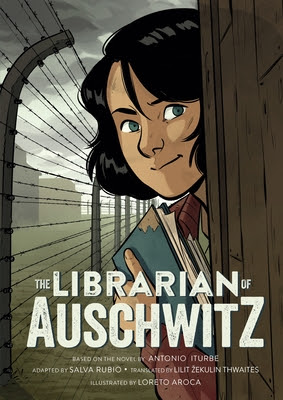
The Librarian of Auschwitz: The Graphic Novel based on the Novel by Antonio Iturbe, adapted by Salva Rubio, illustrated by Loreto Aroca, and translated by Lilit Žekulin Thwaites


Available January 3, 2023
I loved reading comics as a kid and I wasn't above reading a Classic Comic or two or maybe more instead of the book the comic was based on. In school, I was an undiagnosed dyslexic and reading was sometimes difficult. So it stands to reason that as an adult and a teacher, I'm a big fan of books done in graphic format. They are just what some readers need instead of a large and for them, for whatever reasons, unwieldy novel. And for others, they are just a fun way to read. But, the graphic needs to be well done, and in today's world, most of the time, they are. Which is why is pains me to say that I did not like The Librarian of Auschwitz: The Graphic Novel.

This graphic novel is the same story as the novel by the same name and written by Antonio Iturbe, so I'm not going to summarize it again. Suffice it to say it is the story of teenage Dita Adlerova, who was first sent to the Theresienstadt ghetto in Czechoslovakia with her parents and other Jews, and who were all later transferred to Auschwitz-Birkenau. There, they were living in a separate area of Birkenau, called BIIb and referred to as the Theresienstadt Family Camp. These Jewish prisoners were allowed to keep their clothing and their hair wasn't shaved, though living conditions were still as deplorable as in other parts of Auschwitz. If you haven't read the novel, you can read what I originally wrote HERE. The novel is a big book but one that is totally worth spending time with, IMHO. 

Back to the graphic. First, let me begin by saying I did like the art. I found the full color cells were clearly and cleanly drawn in such a way that it was easy to follow the story. The illustrator did a great job at capturing the full range of intense emotions felt by the prisoners of Auschwitz as well as the hate and disgust exhibited by their Nazi captors. Interestingly, none of the characters, Jewish, gay, or Nazi, were portrayed as stereotypical. 

And it wasn't so much that I found the graphic novel to be bad, just lacking. I read the novel back in 2017 and so I'd forgotten some details. Reading the graphic, I found myself confused about a few of the things that went on in Auschwitz and that impacted the main character, Dita, personally. I also didn't feel the importance of the eight books that made up the library was made plain, and how Dita so lovingly cared for them, nor did I feel the reverence with which the borrowers of these books felt for them. 

Some of the characters, like Dita and Fredy Hirsch, as based on the actual people, and of course, so are some of the Nazis like Adolf Eichmann and Josef Mengele, known as the Angel of Death for his experiments of the prisoners in Auschwitz. There is a great epilogue at the end of the book that does go into detail not just about what happened and the people involved.

Ultimately, though, I found this version of The Librarian of Auschwitz to be simplistic and a little stiff. I realize that taking a large novel and synthesizing it down to just 144 pages is not easy task and this was a valiant effort. It just didn't work for me. 

Tuesday, October 10, 2017

The Librarian of Auschwitz by Antonio Iturbe, translated by Lilit Thwaites

In December 1943, Dita Adlerova, 14, along with her parents and 5,000 other Jewish prisoners arrived at Auschwitz-Birkenau from the Theresienstadt ghetto (also referred to as Terezín) in Czechoslovakia. Unlike most of the Jews who were transported to Auschwitz-Birkenau, this transport arrived with the notation SB - Sonderbehandlung. No one really knew what was meant by special treatment, but they were put into one of nine separate camps in Birkenau, called BIIb, and referred to as the Theresienstadt Family Camp. These prisoners were allowed to keep their clothing and their hair wasn’t shaved, although living conditions were just a deplorable as elsewhere in Auschwitz.

Thanks for Fredy Hirsch, the prisoner in charge of the children, Dita becomes an assistant in Block 31, a barracks that has been converted into a space for children during the day so that their parents can work. It is also a place that houses a secret school which includes a library of eight books that have been smuggled in by other prisoners and are in various states of disrepair. Dita’s job is to care for the books every day - removing them from their hiding place, delivering them to the teachers, and carefully putting them back into their hiding place. Dita takes her job so seriously, that when a surprise inspection that includes Dr. Josef Mengele happens, she risks everything to hide the books under her smock. 

But later that day, Dita runs into Mengele again,and she believes that he seems to know that she was hiding something that morning. He tells her he will be watching her from now on. His threat informs Dita’s life in Auschwitz with additional fear from then on, yet it doesn’t stop her from continuing her job as the librarian. 

The Librarian of Auschwitz is a powerful novel with a brilliant blending of fact and fiction. It is told mostly in the present tense, and I think the writing style may remind you of The Book Thief, especially the voice of the omniscient narrator who knows what has happened as well as what will happen. And I have to be honest and say it is a difficult book to read at times, but then, so are all books about the Holocaust.

Several of the characters are based on real people. Most of the Nazis in charge of Auschwitz, like Josef Mengele, the Doctor of Death, and Rudolf Höss, the camp commandant. The main character, Dita Adlerova, reflects the experiences of the real librarian of Auschwitz, Dita Polach Kraus, whom Iturbe interviewed in Israel when he was researching this novel. Iturbe also includes the stories of Fredy Hirsch, Rudi Rosenberg, and SS First Officer Viktor Pestek. Hirsch and Rosenberg were prisoners in Auschwitz, while Pestek was a guard who fell in love with a young Jewish girl. Other characters in the novel are strictly fictional, but whether real or fictional, each one contributes to the overall picture that Iturbe draws of this section of Auschwitz, an anomaly in what was a place where most people were sent to be killed upon arrival. 

And Dita's story is certainly an exemplary one. In the midst of so much heartbreak and horror, Dita derives a real sense of strength and purpose as the librarian, coming up with ways to improve the delivery of the fragile books to teachers, and carefully repairing them each day when they are returned. And, with the help of Fredy Hirsch, her sense of purpose develops into a way that Dita is able to cope with her own overwhelming fear, learning to accept it as part of who she is, and by recognizing it, she is able to overcome it and go on despite everything.

Thus, Iturbe’s draws Dita as a study of courage in the face of fear, and it becomes all the more poignant and admirable as she faces the horrors of Auschwitz, and later Bergen-Belsen. And while the actual atrocities that were endemic in the Nazi’s concentration camps and their treatment of Jews are difficult to fully capture in words alone, readers should know that Iturbe doesn’t hold back, that some of what he writes is quite graphic. 

Though fear, hunger, cold, death, cruelty, and loss of loved ones are the daily experiences of Dita and the other prisoners in Auschwitz and Bergen-Belsen, ultimately The Librarian of Auschwitz is a life-affirming novel that manages to end on a note of hope for the future.

A Teacher's Guide for The Librarian of Auschwitz is available from the publisher, Henry Holt and Co. (BYR) HERE

This book is recommended for readers age 13+
This book was an ARC received from the publisher

Map of Auschwitz II (Birkenau) showing Theresienstadt Family Camp BIIb and Block 31 where the secret school was held


Tuesday, June 6, 2017

Survivors Club: The True Story of a Very Young Prisoner of Auschwitz by Michael Bornstein and Debbie Bornstein Holinstat

Imagine going to the movies one day in the 1980s with your daughter and seeing yourself in the movie you are watching. That’s exactly what happened to Michael Bornstein and his daughter Debbie. The movie was The Chosen and in one scene, two young Jewish boys are watching a newsreel showing footage of the liberation of children from Auschwitz, and there right at the front of the line of children, was Michael Bornstein, age 4.   

Like so many Holocaust survivors, Michael Bornstein never really spoke about his childhood during the Holocaust, even after seeing himself as part of a movie. But, years later, Michael began to realize that his survival was a indeed miracle, and after doing a Google search, he also realized that the liberation images were (and sadly still are) being manipulated by Holocaust deniers to prove that it was all a Jewish lie, or that the Jews made up stories about their children being killed on arrival at Auschwitz, or that it was just a labor camp and not a death camp. Michael decided it was time to tell the story of the Bornstein family.

Michael begins his narrative in September 1939, a year before he was born, when German planes dropped bombs on the small village of Żarki, Poland where the Bornsteins lived, killing residents and destroying homes and synagogue.  Almost immediately, the village was invaded by Nazi solders who went from house to house collecting anything of value from Jewish families, including the Bornsteins. Luckily, Michael’s father, Israel Bornstein, managed to bury some valuables in the backyard including a Kaddish cup, a family heirloom.  

Jews who weren’t shot immediately were rounded up and put into the Jewish ghetto in Żarki, where Michael was born. His father was made head of the Jewish Council, with the difficult job of deciding who would be sent to die in a death camp and who wouldn’t be. Interestingly, although the head of the local Gestapo, Officer Schmitt, was an incredibly cold-hearted man, Zarki remained a somewhat open ghetto, allowing the remaining Jews to conduct some trade with the local Polish residents. It didn’t hurt that Israel was able to continually bribe him to save many lives, as well.  

One of the things that really struck me was the strength of the Bornstein family, Israel, wife Sophie, grandmother Dora, older brother Samuel and now Michael is so evident throughout the narrative. In the face of deportations of fellow Jews, hunger, cold, and sickness, the family struggled but remained strong and faithful. Once it was decided that the Zarki ghetto would be liquidated, and all Jews sent to Treblinka, Schmitt made an exception of Israel and his family, who were sent to a labor camp instead.

Unfortunately, in July 1944, the Bornsteins were all sent to Auschwitz. Sophie, Dora and Michael were immediately separated from Israel and Samuel and it wasn’t until much later that Sophie learned the fate of her husband and son. Michael was only four years old by then, and sent to live in the Kinderlager, where older kids stole his food but also gave him some points that helped him survive. Eventually, Sophie snuck him into the women’s barracks where she and Dora were, and he remained there, even after she was sent to another labor camp. It was illness that ultimately saved Michael’s life. As the Russian Army approached Auschwitz, the Germans rounded up the remaining Jewish prisoners and began what is known as the Death March to cover their atrocities. Michael was left in the infirmary and survived with his grandmother, Dora. 

The aftermath of the war, and the reunion of the remaining members of the Bornstein and of Sophie’s Jonisch family, and forming the family's Survivor Club, takes up the rest of Michael’s narrative. One story that I found particularly poignant is that of Michael’s cousin Ruth Jonisch, who found herself in a Catholic Convent, had her name changed to Kristina, and who had to be taught to hate Jews in order to survive. The years after being reunited with the Jonisch family are very interesting reading.

By now, you must be wondering how Michael knows so much about the time before he was born and the years he lived under the Nazis, given his age at the time. Most of his story is the result of research and interviews with family members. So while it isn’t actually a first hand account, it is still a compelling story about strength, some lucky coincidences, and mostly about family love.

There is a section of photographs, a Glossary and a Bornstein Family Who's Who also included in the back matter. And be sure to read Michael Bornstein's illuminating Preface and Afterword, as well.

Interestingly, the review of the movie, The Chosen, written by Janet Maslin and published April 30, 1982 in the New York Times, ended with these warning: 
''The Chosen'' is rated PG (''Parental Guidance Suggested''). It contains brief but graphic footage of the liberation of concentration-camp inmates after World War II." 

I feel I need to echo that warning: 

Survivor’s Club is a very readable nonfiction narrative, but there are some graphic descriptions of the Nazi treatment of the Jews in it that may be difficult for some sensitive readers. 

This book is recommended for readers age 10+
This book was an ARC received from the publisher, Farrar Straus Giroux

Friday, October 10, 2014

Playing for the Commandant by Suzy Zail

In spring 1944, Hungary was occupied by German soldiers and in the city of Debrecen, a ghetto was formed at the end of April.  Thinking her family was lucky because their apartment fell within the walls of the ghetto, Hanna Mendel continued to believe she would be able to attend Budapest Conservatorium of Music, where she had just been selected for a hard won place as a piano student.

But in the middle of a night in June 1944, a knock on the door by officers informed them that the Mendel family,  parents, high-spirited, defiant older sister Erika and Hanna, 15,  was ordered to assemble outside the synagogue at 8 the next morning.   Before leaving, Hanna rips the C-sharp from her beloved piano and takes it with her.  The next morning the Mendels, along with all of Debrecen's Jews, begin their long trip to Auschwitz-Birkenau Concentration Camp.

Once they arrive at Auschwitz, the family is split up, but luckily Hanna, Erika and their mother are able to stay together in the same barrack, even sharing a bunk.  Put to work in the quarry, one day Hanna sees her music teacher playing piano with an ensemble made of up inmates and called the Birkenau Women's Orchestra.  Piri thinks that maybe she can get Hanna a place in it.

When that doesn't work out, Hanna is sent to audition with five other inmates for the camp's cruel commandant.  Believing she doesn't stand a chance at being chosen, the commandant leave the choice to his totally disinterested son, Karl Jager, who points to Hanna.

Day after day, Hanna trudges to the commandant's house to await the order to play for him and any guests he may have.  The only perks to playing for the commandant is a warm shower everyday (the commandant detests dirt), shoes, a warm coat and a warm house while she's there.  The only extra food is leftovers she must steal and risk getting caught and shot.

Gradually, however, she discovers that Karl Jager harbors his own dangerous secrets and is not as disinterested or as indifferent as she originally thought.  When he treats her kindly, Hanna finds herself more and more attracted to him.  But returning to the barrack at the end of each day, she sees that her mother and Erika are cold, starving and barely surviving.  To make matters worse, her mother, who had started going mad during the roundup in Debrecen, is having more and more trouble surviving the selections each time they are done.

Their one hope is that the Red Army is really moving east as rumored around the camp and that they arrive in time.

Playing for the Commandant is certainly a very readable book.  I read it in one day.  It is told in the first person by Hanna, a very observant 15 year old and on many levels her voice rings true.  Her descriptions of the camp, of the cruelty inflicted on innocent people are spot on.  When she talks about the lice, the smells, the moldy bread or about how skeleton thin her sister and the other women are becoming, you can clearly see and smell what she is describing.

Despite everything, Hanna'a father had told her to survive at any cost to tell the world what happened to the Jews of Europe and so, she is determined to do what her father wanted.

But when she talks about the danger of stealing scraps of leftover food, or of  living under the pressure of always having to please the commandant, Hanna's fate feels just as capricious or dangerous as her fellow inmates.  For example, when the gardener, a Jew, steps on the grave of the commandant's dog, he is shot in the head for it.  But, when a girl at the commandant's house drops a tray with tea and cakes on it, I thought for sure that when she is removed from the house, she is also killed, but she shows up later, and I have to admit, I was surprised to see her again in the novel.

But, Hanna's growing romance with Karl is very most disturbing and a real flaw in the novel.  I guess I thought Hanna should be thinking more about food than a boy.  She didn't get that much more to eat than her sister, and what she got, she shared with Erika.  Also, at one point, Hanna gets angry at the people, ordinary farmers, who watch her walk to and from the commandant's house every day and do nothing.  I got mad at Karl for being against what the Nazis were doing to the Jews, but who passively sits by and watches it all happen.  I would be curious to know how others feel about this part of an otherwise good novel.  

Yet, despite this criticism, in the end, I thought that Playing for the Commandant is definitely worth reading for its message of survival and hope, but not for its gratuitous romance.

This book is recommended for readers age 12+
This was an EARC received from NetGalley

Though Playing for the Commandant is a complete work of fiction, Jews actually were often used to play music for the Nazis.  Here is the obituary of Natalie Karp, a famous pianist who played for Amon Goeth's birthday on December 9, 1943.  She and her sister allowed to live because of the beautiful piano playing that night.  Goeth was the cruel commandant of the Kraków-Plaszów Concentrtion Camp in Poland (you may recall Goeth from Schindler's List).

This is book 7 of my 2014 European Reading Challenge hosted by Rose City Reader
This is book 12 of my 2014 Historical Fiction Reading Challenge hosted by Historical Tapestry


Sunday, September 28, 2014

The Magician of Auschwitz by Kathy Kacer, illustrated by Gillian Newland

Werner Reich is just a young boy when he arrives alone at Auschwitz.  His father had died a few years before, he was separated from his mother when the Nazis took her and his older sister was supposedly hiding in plain sight with a Christian family.

Werner may be young but he quickly assesses that the best chance to survive Auschwitz is to appear not to be weak.  So, climbing up to the third rung of  the triple decker bunks in his barracks, scared and lonely, Werner meets his bunk mate, Herr Herbert Levin.

By day, Werner and the other men and boys stand hours for roll call, then move heavy rocks from one place to another, eat the watery soup and stale bread, then try to sleep so they can do this all over again the next day.

One night, however, the guards come in and wake Herr Levin up, demanding magic.  Giving him a deck of cards, Herr Levin performs all kinds of magic tricks for the guards entertainment.  His magic also delights Werner, who thinks Herr Levin might be favored with an extra piece of bread, but his thinking is quickly straightened out by his bunk mate.  "This is not a game and it is not a show…if I displease the guards, if I fail in my magic, if I run out of tricks, if they tire of me…my life will be over."  Werner quickly grasps the capriciousness of life in a concentration camp.

Then one night, Herr Levin teaches Werner how to do a card trick, one just for Werner only.  Magic helped keep Herr Levin alive in Auschwitz so far, maybe it will help Werner, too, he tells the boy.

Eventually the two are separated, and towards the end of the war, Werner is forced to walk on a Death March from Auschwitz to Germany, a walk he survives.  Herr Levin also survives, but the two have no idea what happened to the other.

Werner remained interested in magic throughout his adult life, performing tricks for his family and friends after marrying and migrating to the United States.  But he never found out what happened to Herr Levin until one day he was reading a trade magazine about magic…

and discovered that his Auschwitz bunk mate Herr Levin was none other that the renowned Nivelli the Magician, eminent pre-war magician known all over Europe and who, after the war ended, had been performing in the United States.

It must be so difficult to write books for young readers about the Holocaust that aren't too scary, too grime, too graphic, but istis doable and many parents and teachers find that they are a sensitive way to introduce the heinous circumstances of the Holocaust to their kids.  Canadian author Kathy Kacer, who has written many books for young readers about the Holocaust, seems to instinctively know how to make a Holocaust book accessible and informative without frightening young readers.  And she has done just that in The Magician of Auschwitz, a picture book for older readers.

What makes The Magician of Auschwitz such a fascinating story it that it shows so clearly how one small act of kindness can make such a difference in a person's life - in this case, maybe even helping to save it.   The themes of hope and friendship forbidden in a place where often it really was (understandably) every man for himself are reflected in the muted, subdued illustrations, almost as though they are being hidden from the Nazi captors.

The watercolor illustrations by Gillian Newland are indeed dark and foreboding grays, blacks, browns and gray-green, reflecting life in a concentration camp, with only small touches of red on the playing cards and the swastika on the guards armbands.

Though based on the experiences of the real Werner Reich and Herbert Levin or Nivelli the Magician, however, this is a fictional retelling of their story, told from Werner's point of view.  As a biographical picture book for older readers, there should have been more souces in the back matter than just the author's one extensive "How it Happened" explanation.  However, readers will still enjoy reading this and seeing the accompanying photographs of Werner as a youth and as an older man.  Sadly there is only one photographs of Herr Levin and his wife.

You might find the trailer for The Magician of Auschwitz by the author of interest:


This book is recommended for readers age 7+
This book was obtained from the publisher

Friday, January 6, 2012

Night by Elie Wiesel

"I believe that anyone who lived through an experience is duty bound to bear witness to it." — From Elie Wiesel: First Person Singular

In Night, Elie Wiesel bears witness to his experience of the Holocaust. Living what they thought was a safe existence in Sighet, Romania (Transylvania), the Wiesel family, like all the Orthodox Jewish families there, could not believe the reports of mass murder that came back to them from an eyewitness who had managed to escape the Nazis.

Then the spring of 1944 arrived in Sighet, and so did the German soldiers, billeting themselves among the residents there. At first, these Nazis were polite and considerate, and people still weren’t worried because radio reports said that the Russian Army was pushing westward, in their direction.

But, on the Seventh Night of Passover that year, everything changed. Jews were ordered to remain in their homes for three days, valuable were to be handed over and a yellow star was to be worn. Two ghettos were created, a small one where people stayed temporarily before being transported to camps, and a large one for longer stays. With each egregious act, the Jews of Sighet convinced themselves that it couldn’t get worse, but it did. The Wiesel family was among the last in Sighet to be transported to Auschwitz-Birkenau when the ghetto was finally liquidated.

They were put into cattle cars with 80 people in each and slowly traveled for days until they finally reached Auschwitz in Poland. There, during the selection process, Elie and his father were separated from his mother and youngest sister, Tzipora. He never saw them again. Elie and his father remained in Auschwitz for three weeks, before being sent to Buna, also called Auschwitz III. There, the inmates were put to work, most of them doing factory work for the German war effort.

Elie and his father remained there until January 1945, when all the inmates were forced on a death walk to a concentration camp in Germany, as the Red Army was only hours away from Buno. Elie ended up in Buchenwald Concentration Camp until April 11, 1945 when the camp was liberated.


Map of Auschwitz - areas in orange are the three areas
where Elie Wiesel and his father were held at different times.

Night is a book that answers Theodore Adorno’s question – how do you make poetry (art) after Auschwitz? In other words, how do you describe the indescribable?

Elie Wiesel did this in simply declarative sentences, using straightforward vocabulary.  And yet, he produces a picture of horrors that are almost impossible to imagine. For this reason, I think it is a benchmark for Holocaust memoir, along with Anne Frank’s The Diary of a Young Girl and Primo Levi’s If This is a Man.

I have always thought the title of the book, Night, came from this passage:
Never shall I forget that night, the first night in camp, which has turned my life into one long night, seven times curses and seven times sealed. (pg 34)

And it does, but it also refers to a biblical passage - Genesis 1:5 defining a day as starting at nightfall (which is why Jewish holidays always start at sundown):

"God called the light Day, and the darkness he called Night. And there was evening and there was morning, one day."
In this respect, even though the book describes the inhuman treatment of Jews by Nazis, Night also carries the message of hope in its title - there will always be a tomorrow.

I had read Night when I was in high school, but when Oprah Winfrey picked it for her Book Club Selection in January 2006, I reread this new and better translation, which, incidently, was done by Marion Wiesel, Mr. Wiesel’s wife. Thanks to Oprah, Night was read by 2,021,000 readers, many of whom might never have read it otherwise, according to a report in the Huffington Post It was the 3rd most popular book throughout her book club history.

Interestingly enough, although Elie Wiesel was awarded the Nobel Peace Prize in 1986, to date, Night has never been given any individual honors.

This book is recommended for readers age 14 and up.
This book was purchased for my personal library

Night - Elie Wiesel
Hill and Wang
2006
120 pages

The publisher offers a downloadable Reading Group Guide and Teacher’s Guide
Or see Oprah's Guide to Night (I used Oprah's guide to Anna Karenina and it was great - the guide and the book)

The following websites may be of interest to readers of Night:
Elie Wiesel: First Person Singular
The Story of Night

And you might want to visit The Elie Wiesel Foundation for Humanity  This foundation lost most of their assets,  $15.2 million,  thanks to Bernie Madoff, but they continue on in the same determined spirit that helped Elie Wiesel survive the Holocaust and they carry on with their youth focused programs promoting "acceptance, understanding and equality.

This is book 2 of my European Reading Challenge hosted by Rose City Reader

Monday, August 29, 2011

Surviving the Angel of Death: the Story of a Mengele Twin in Auschwitz by Eva Mozes Kor and Lisa Rojany Bucceri

Almost from the moment 10 year old twins Eva and Miriam Mozes stepped out of the cattle car that brought them to Auschwitz, they were separated from their mother, father, and older sisters, never to see them again. Eva comments over and over on the constant smell that permeated Auschwitz from the gas chambers, but even as she instinctively knows that this is the fateful death that the rest of her family had immediately met, she continues to hope they could somehow survive.

The girls were put into a barracks with all the other twins chosen for the sadistic, inhuman medical experiments of Dr. Josef Mengele, the Angel of Death. Eva, the stronger of the twins, takes it upon herself to look after and care for her sister Miriam. Like all of Mengele’s twins, Eva and Miriam were allowed to keep the clothing they arrived in, as well as their hair, but they were forced to scrounge and “organize” for anything else that would help them survive, even as they were being experimented on.

The strength and resourcefulness of these two girls amazed me. Once day, for example, Eva was given a shot that Miriam was not also given. During the night, she began to run a high fever, within 48 hours her legs were swollen and covered with red patches. Despite the pain and chills these caused, Eva was determined to stand for roll call and not go to the infirmary, since the only way out of it was death and they knew that if one twin died, the other would be killed. She missed roll call thanks to an air raid, but was soon sent to the infirmary to die anyway. On a visit with other doctors, Mengele indicated she had only two weeks to live. But Eva was determined not to be sent to the gas chamber, even though she was not fed or given water. Desperately thirsty, each night, she would crawl on all fours to the end of the infirmary barracks to a water faucet, determined to live. After two weeks, Eva’s high fever broke. But she had to learn how to manipulate the thermometer to fool Mengele into thinking her temperature was normal. Unfortunately, when Eva returned to the barracks and Miriam, she discovered that, because the doctors believed that she would die, her sister had been subjected to injections that caused to her to quite listless and which ultimately stunted the growth of her kidneys.

Both of these 10 year old sisters managed to stay alive in Auschwitz, despite Mengele’s horrendous genetic experiments. Their story is a testament to courage and determination, which will, hopefully, be especially interesting to young readers. And, although I am a firm believer in forgiveness, even I am amazed that Eva was able to eventually find it within herself to forgive Mengele. I’m not sure I could or would go that far. Mengele, after all, was the arbiter of life and death at Auschwitz.

Surviving the Angel of Death: the Story of a Mengele Twin in Auschwitz is told in a straightforward manner, neither too graphic to scare readers nor so sketchy that it diminishes the level of cruel, heartless treatment Mengele’s twins were subjected to. The writing style is intimate and informal, as though Eva Mozes were telling her story to Lisa Rojany Bucceri and I was allowed to listen in. It never gets pedantic, and there is never a sense of self-pity. I suspect Eva is still the same strong feisty fighter now that she was at 10. The book also contains a number of personal family photos of the Mozes family, some from before the war, some from after, as well as pictures their life after the war. There are also general photographs of Auschwitz.

After the war, Eva lived in Israel for a while, and then moved to Terre Haute, Indiana with her husband, Michael Kor, another concentration camp survivor and with whom she had two children. She still lives in Terre Haute, where she founded the Candles Holocaust Museum in 1995.
 
This book is highly recommended for readers age 12 and up.
The book was a received as an E-ARC from Netgalley.com.

An excellent and extensive Teacher’s Guide to Surviving the Angel of Death: the Story of a Mengele Twin in Auschwitz, created by Natalie Dias Lorenzi, is also available.

Ara Pacis Initiative presents an interesting profile of Eva that appeared in Vanity Fair Italia in 2010.

NB The photo on the cover of this book was taken by the Russians when they liberated Auschwitz.  The photo shows Eva on the left and Miriam on the right.  It was, however, a staged photo-op, in which the twins were told to wear the striped clothing of Auschwitz prisoners, something Mengele's twins did not have to do.

Non-Fiction Monday is hosted this week by Capstone Connect

Monday, June 6, 2011

If I Should Die before I Wake by Han Nolan

Hilary Burke, 16, is an angry girl. She is angry at her mother for not being there for her while she was a child. And she is angry at her father for dying when she was 5. Hilary blames his death on his Jewish boss, believing that he skimped on construction material causing the building her father worked in to collapse. So she is angry at all Jews and has focused it on her Jewish neighbors including their son, Simon Schulmann, for being part of a happy, close family.

To deal with all this anger, Hilary joins a group of Neo-Nazis called the Great Warriors. But then, irony of ironies, Hilary is almost fatally injured in a motorcycle crash with her Neo-Nazi boyfriend, Brad, and ends up in a Jewish hospital. Now, unable to speak or move, she is at the mercy of her own mind, and the only thing she can see is the face of an older woman looking at her.

Suddenly, in the midst of her angry internal anti-Semitic tirade, Hilary feels herself spinning backwards. When she stops spinning, she finds herself in Nazi-occupied Poland, where her name is Chana Bergman and she is somehow in possession of all of this girl’s memories. She is on her way to school with a best friend, when the two are stopped by Nazis and Hilary/Chana is forced to spend the day washing steps with her own brand new woolen tights. On her way home, she finds her beloved father has been suspended from a tree with his coat by a group of laughing Nazis. It is his punishment for not shoveling a pile of dirt fast enough. Hilary/Chana picks up the shovel and does the job, hoping the Nazis will let her father go, but in the end, they just shoot him to death anyway.

Hilary’s memories continue to swing between the past and present. In the present, Hilary continues her hateful rhetoric about Jews, in the past, as Chana, she is on the receiving end of this same hateful rhetoric from the Nazis. And each time she is in the present, she continues to only see the face of the elderly woman looking at her.

Slowly, Chana becomes the dominant memory for Hilary. Living at home with her are her grandparents, Bubbe and Zayde, her mother, older brother Jakub, sister Anya, 6, and the baby Nadzia. Rumor has reached the family that the Nazis are rounding up Jews and the family is preparing the give up Nadzia to a non-Jewish family that will protect her.

Shortly after Nadzia is gone, the family is rounded up and moved into one room in the Lodz Ghetto. The horrors of the ghetto are sometimes described by Chana in very graphic detail, as are the struggles of the family to stay alive. Sadly, Zadye eventually dies, then Chana’s mother and sister are rounded up for deportation and we never hear about them again. Jakub, who has gotten involved in smuggling people out of the ghetto, eventually helps Chana and Bubbe escape, but Chana is recognized by an old schoolmate, who thinks that turning her in will get her better treatment.

Chana and Bubbe are interrogated by the Nazis trying to find out who they got their illegal papers from, but neither one breaks. Eventually, they both end up in Auschwitz.

Yes, you do find out who the older woman is that Hilary keeps seeing and the story does have a bit of a surprise ending, which has already been ‘spoiled’ online, but I don’t read any reviews about books until I have finished reading them. Even so, I have to confess, it wasn’t a hard ending to figure out before I was halfway through the book, yet it still doesn’t detract from the story of Chana and the novel’s impact.

I found this book to have an interesting premise by adding the Neo-Nazi element. Hilary wasn’t really a Neo-Nazi at heart, but it shows how easily a person can be drawn into something like that when they don’t feel there is anywhere else to turn and they are made to feel important to the cause. Often, it is really no different then the way children were drawn into the Hitler Youth in 1930s Germany. And although this book may feel a little dated since we don’t hear much about Neo-Nazis anymore, but don’t be fooled by that – they are still out there.

Some people have compared If I Should Die before I Wake to The Devil’s Arithmetic by Jane Yolen. I have not read this book yet, because I thought the movie was so awful, I was turned off to it, but do plan to read very soon. I suspect the real similarity is the time travel back to Nazi-occupied Poland.

All in all, I found this to be a truly worthwhile novel and would highly recommend it, though maybe not to middle grade readers, or even for that matter, to immature YA age readers because of the disturbing, graphic descriptions.

If I Should Die before I Wake won the following well-deserved honors:
1995 International Reading Association/Children's Book Council Book Award
1995 New York Public Library Book for the Teen Age
1999 A YALSA Popular Paperback for Young Adults

This book is recommended for readers age 13 and up.
This novel was purchased for my personal library.

More information on the Lodz Ghetto can be found at Jewish Virtual Library

More information on Auschwitz can be found at PBS Auschwitz: Inside the Nazi State and any number of other responsible websites.

Friday, January 14, 2011

Gentlehands by M.E. Kerr

This novel begins like a typical teenage love story. “Buddy” William Raymond Boyle is a 16 year old boy from a lower middle class family, living in a small village near Montauk, Long Island, NY, where his father is the local policeman. Buddy works part time in a soda shop for a pot-head named Kick Richards, where he sees Skye Pennington whenever she comes into the shop. Skye is the daughter of an oil mogul, who summers with her family at their beachfront estate. Attracted by Buddy’s good looks and her own root-for-the-underdog nature, Skye agrees to go out with him.

Buddy is completely impressed by the Pennington estate and the lavish, carefree life-style they live. He had to thumb three rides to get the estate for his date with Skye; the Pennington’s have 6 cars in their garage, including a Rolls Royce and a Jensen. But Buddy isn’t the only fish out of water at the Pennington’s. While waiting for Skye to finish getting ready for their date, Buddy meets Nick De Lucca, a short, bald man wearing yellow tinted glasses, a hearing aid that seems always to need adjusting and holding a fake cigarette to help him quit smoking. De Lucca is a journalist and guest of Mrs. Pennington, a collector of underdogs just like her daughter.

To impress Skye, Buddy does the only thing he can think of – visit his maternal grandfather in Montauk, a man Buddy barely knows and who is estranged from his mother. Frank Trenker is a cultured, sophisticated man, one who listens to music, loves animals and lives in an impressive house at the end of a long private driveway. The house is filled with books, paintings and antiques – all things the Skye is completely comfortable with while poor Buddy doesn’t have a clue about any of them. When they arrive, Madam Butterfly is playing on the stereo, one of Skye’s favorites. Skye is completely impressed by Buddy’s grandfather, as he had hoped she would be.

Buddy is blinded by his feelings for Skye and lives for the moment he can call her. When he promises his father that he will take his younger brother swimming, the promise is forgotten the moment Skye asks him to come over to see her. His feelings for her and his disregard of his brother begin to cause a riff between Buddy and his father, and even though Buddy knows he is in trouble, he is unable to do anything about it, other than go running whenever Skye calls.

Sunday comes and Buddy is supposed to take his brother fishing, but lies and promises something special when he comes back from seeing Skye. Once there, he can’t bring himself to leave. That night, as Skye and her friends are sitting around a bonfire on the beachfront part of the Pennington estate, Mr. De Lucca wanders over and joins them. It isn’t long before some anti-Semitic joke is casually made, causing everyone to laugh but De Lucca. This is followed by a girl’s poem about an alcoholic boyfriend she one had. De Lucca then begins to recite a poem he said was written by a 15 year old girl called Gentlehands. It is about an SS guard who plays the aria O dolci mani or gentlehands from the opera Tosca to torment the Italian prisoners and whom they nicknamed Gentlehands. The girl is his murdered cousin. She had been a prisoner in Auschwitz when this man was a guard there. Everyone has assumed that DeLucca was Italian, and are quite surprised when he tells them that he is, in fact, an Italian Jew. Upset, Skye tells Buddy she has to get away.

A few days later, they decide to drive out to visit Buddy’s grandfather again. The music for the evening is La Traviata, another of Skye’s favorites. They are offered a glass of wine, but only Buddy accepts. Skye and Trenker have a long conversation about expensive pipes and he tells her that his pipe is hand-carved block meerschaum imported from Turkey, costing about $8,000. Trenker also tells them about his one love, a woman he had lived with in Cuba and who had died before he could marry her. The two kids are, by now, completely impressed with Trenker. By the end of the evening, Buddy has had too much to drink and has to stay with his grandfather, while Skye drives herself home. Buddy ends up staying there for four days, using his grandfather’s jeep to go to work and visit Skye.

On her third visit to Montauk, Trenker plays the opera Tosca. At the end, she explains to Buddy that they are singing the aria O, dolci mani or O gentle hands, the same thing the SS guard played at Auschwitz Somewhat freaked, she lets slip that De Lucca has been sitting outside Trenker’s house, watching it, but Trenker just shrugs it off. Soon after this night, DeLucca publishes a story in the newspaper accusing Frank Trenker of Montauk of being an SS guard that tortured and killed people in Auschwitz, including his cousin. His proof is irrefutable.

If this story began like a typical teenage love story, it doesn’t end like one. It was, in fact, a very disturbing story. Kerr plays around a lot with the idea of appearance and reality with a good dose of irony and asks the reader to look at their own definitions of what, for them, is a good person. Basing our definition of a good person on those who appear to be refined, knowledgeable and sophisticated and whose possessions reflect this can be very seductive, as they were for Buddy. But what happens when harsh reality comes knocking and it doesn’t fit this picture? That is what Buddy must contend with in this coming of age novel

The story seemed to drag somewhat in the beginning, but that appears to be Kerr’s style. There is a lot of time spent on Buddy’s relationship with his family and with Skye. I felt it was a little too much time. Then, all of a sudden, things really moved. The flat, expository style at the beginning increased to a sharp contrast at the height of the story, only to slip into a sort of flatness again at the end. But that reflects the rhythm of life.- most days just go along and then, boom, an event of some kind breaks the sameness of ours days for a while, then back to going along, hopefully changed and wiser.

I always find that when I read Kerr’s books, I can’t put them down. This was also true of Gentlehands, making it a book I would highly recommend.

This book is recommended for readers age 12 and up.
This book was borrowed from the Hunter College Library.

Gentlehands was honored with the following well deserved awards
1966-1992 ALA Best of the Best Books
1978 ALA Notable Children’s Books
1978 ALA Best Books for Young Adults
1978 School Library Journal Best Children’s Books
1978 Christopher Award winner
1978 NYT Best Children’s Books
1993 cited for Margaret A. Edwards Award

More information about M E Kerr may be found at M. E. Kerr and Mary James

This is book 1 of my YA of the 80s and 90s Challenge hosted by The Book Vixen
This is book 2 of my YA Historical Fiction Challenge hosted by YA Bliss

Monday, December 13, 2010

Parallel Journeys by Eleanor Ayer with Helen Waterford and Alfons Heck

The early lives of Alfons Heck and Helen Katz and their individual experience of Hitler’s sway are the subject of this book. Alfons was born in1928, in Wittlich, Germany, a town near the French border and in the heart of the Mosel wine country. He was still a young boy when Hitler came to power and knew no other way of life than Nazism. By the time he was old enough to join the Hitler Youth at age 10, he had been fully indoctrinated in and completely accepted Nazi dogma. Helen was older, born in 1909 in Frankfurt, Germany. In 1933, she married Siegfried Wohlfarth. When the first new laws were passed discriminating against Jews, Siegfried lost his job and Helen was forced to leave university.


By 1935, things were considerably worse for Jews in Germany. Helen and Siegfried decided to leave and went to live in Amsterdam, Holland. In 1937, their daughter Doris was born. Less than a year later, Alfons was sworn into the Jungvolk , the junior branch of the Hitler Youth. After Kristallnacht, or the night of the broken glass on November 9, 1939, Helen and Siegfried were able to get Helen’s brother Fred to England and later the US, and their parents to Holland. But other Jews were not so fortunate.

When the Nazis invaded Holland in 1940, the Wohlfarths knew their safety would be in jeopardy from then on and they realized that they would have to do something. In July, 1942, they received a letter telling them to report at the train station for “resettlement to the East.” They bought themselves a little more time in Holland by having a doctor remove Siegfried’s healthy appendix. Through the Dutch Resistance, they were able to find a Christian family who was willing to take in Doris and protect her from the Nazis. With Doris safe, Siegfried and Helen decided to go into hiding, again with help of the Dutch resistance. Meanwhile, Alfons had been accepted into the elite Flieger Hitler-Jugend, where he would start training first in glider flying and later as a Luftwaffe pilot. Alfons loved flying and became youngest top-rated glider pilot in all Germany.

Eventually the Wohlfarth’s were discovered in their hiding place. On September 3, 1944 they were put on a train and sent to Auschwitz. Their arrival at this camp was the last time Helen saw Siegfried. It wasn’t until many years later that his death on December 5, 1944 in Stutthof concentration camp was confirmed for her. Helen stayed in Auschwitz for two months and was relocated to Kratzau, a work camp in Poland. She remained there until the Russian Army liberated the camp. She decided to go find her daughter, despite being sick and weak, and, wearing a pair of men’s dress shoes she had been given by the Red Cross, she started walking across Europe to Amsterdam. By the end of the war, Alfrons never made it to the Luftwaffe, but he did achieve the highest rank possible in the Hitler Youth.

Alfons and Helen both ended up living in California, and after reading an article Alfons had written in a newspaper, Helen got in touch with him. In 1979, they formed a partnership, speaking to groups of people about Nazi Germany and the Holocaust. Their only criterion for their collaboration was complete honesty. I can only imagine how much courage it must have taken for these two people to stand in front of audiences and tell their stories.

In 1985, Alfons Heck published a book about his life called A Child of Hitler: Germany in the Days When God Wore a Swastika. In 1987, Helen, whose real name was Herta Katz, published a book about her life called Commitment to the Dead: One Woman’s Journey toward Understanding. These books are not for young readers. However, using excerpts from each of them to trace the parallel, but very different journeys of Helen and Alfons, Ayer has produced a very informative and engrossing book for a younger reader. She has filled in their personal stories, which are compelling on their own, with historical details. The book is intense, but never overwhelming. It is clear both Helen and Alfons continued to bear the scars of their youth under Hitler’s domination, although they both tried very hard to come to terms with their separate pasts. But can one ever come to terms with this period in history? I did find that sometimes, when reading the sections on Alfons, I had to remind myself that he was still a child turned into a boy soldier, along with so many others, by the end of the war. And even after Nazi Germany fell, he was not yet a man, just a 16 year old boy who wanted to go back to school. Not that youth exonerates Alfons of the things he did, but it points to the vulnerability of young people to the attraction of a charismatic leader.

My only problem with Parallel Journeys was the timeline. Hitler’s 12 year reign is a period I am pretty familiar with, but found myself getting confused in the book timewise and had to go back and reread parts to figure out the timing. It seemed to me that I was reading about 1942, and suddenly it jumped to 1944, with no reference in between. I understand it can be complicated, made more so by the two different lives Ayer is writing about and not a debilitating confusion and certainly did not diminish the real life stories of Alfons and Helen. Perhaps a timeline at the end of the book would be helpful.
 
Alfons died in 2005 and his obituary may be found at The Boston Globe

Helen died in 1996 at age 86.  A short obituary may be found at Los Angeles Times
Helen may be heard describing the day she sent her daughter into hiding in Holland at United States Holocaust Memorial Museum
 
Scholastic has provided a useful online teacher’s guide at Parallel Journeys Discussion Guide
 
This book is recommended for readers’ age 9 and 12. 
This book was purchased for my personal library. 

Non-Fiction Monday is hosted this week by  Books Together