Showing posts with label African Americans. Show all posts

Wednesday, October 30, 2019

Infinite Hope: A Black Artists' Journey from World War II to Peace, an Autobiography by Ashley Bryan

Infinite Hope: A Black Artists' Journey from World War II to Peace,
an Autobiography by Ashley Bryan
Caitlyn Dlouhy Books, 2019, 112 pages
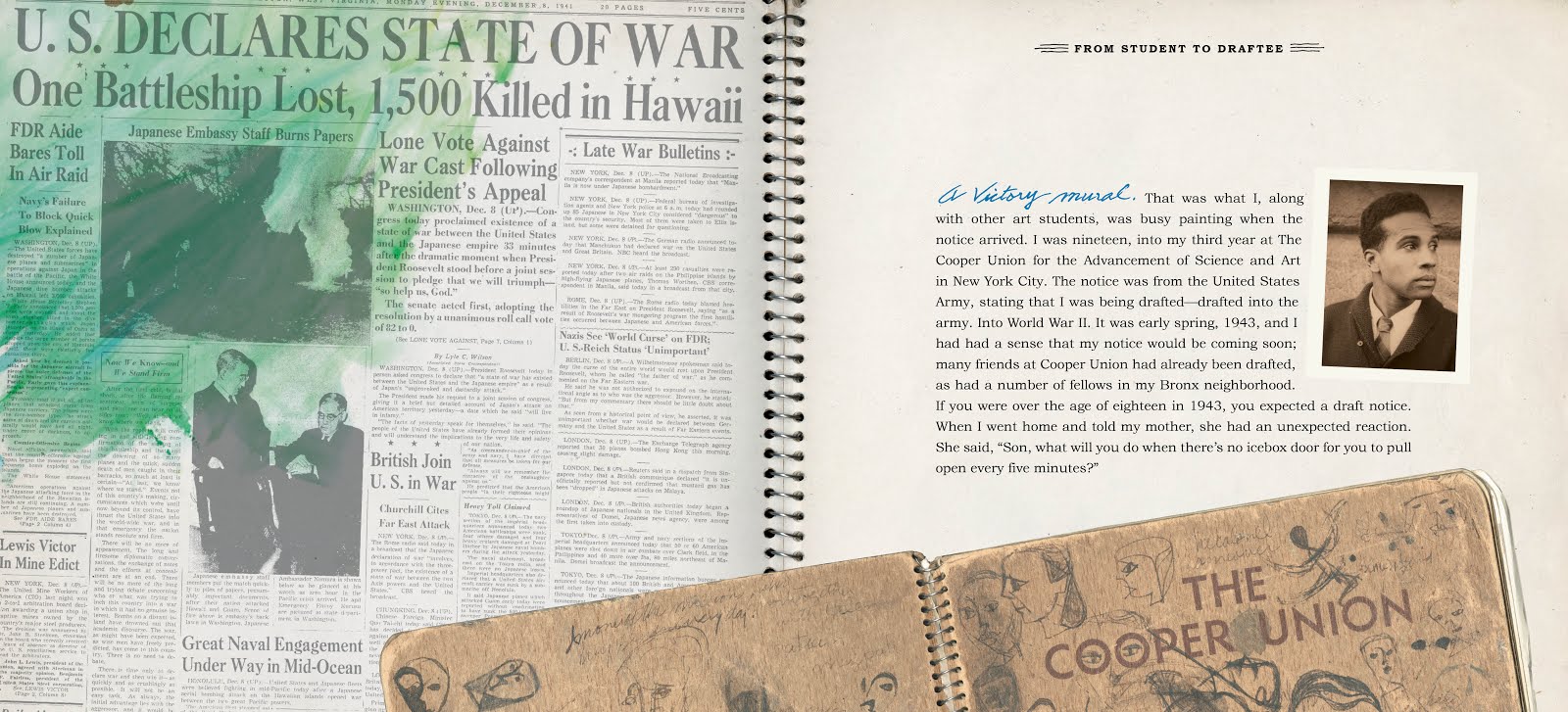
I've always been such an admirer of Ashley Bryan's work for young readers, so I was really interested when I heard he had written a book about his World War II experiences. Born and raised in Bronx,  New York, Ashley was a 19-year-old art student at the prestigious art college Cooper Union in Manhattan when, in 1943, he received his draft notice. The United States had already been at war since December 7, 1941, when Japan attacked the U.S. naval base at Pearl Harbor in Hawaii so he had been expecting to be drafted.


Though he had experienced prejudice growing up, the Army was the first time Ashley had ever experienced overt segregation and it began right at the start of his military career. He was quickly assigned to the 502nd Port Battalion, Company C and made up of only Black soldiers, where he became a winch operator. Stationed in Boston, his job was to load and unload supplies of all kinds on or off ships. In Boston, Ashley makes friends with some of the local kids, drawing with them and sharing cokes.

After a few months, the 502nd was sent to Glasgow, Scotland, where Ashley continued working as a stevedore loading and unloading supply ships. And the Scottish people, Ashley notes, welcomed the Black soldiers warmly and treated them like equals despite the Army's continued attempts to enforce their segregation policy by working the stevedores such long hours, making them too tired to venture out and socialize with the welcoming Scots. However, Ashley's battalion commander, Colonel James Pierce had a real appreciation for the arts, and gave Ashley permission able to attend the Glasgow School of Art. Not only that, but Colonel Pierce also created the 502nd Port Battalion band after noticing the many gifted musicians among the stevedores.

Ashley's time in Glasgow came to an end too quickly for him, and on June 2, 1944, the 502nd Port Battalion found themselves heading for the coast of Normandy and the invasion they had spent so much time preparing for.


Ashley's ship was anchored off the Normandy coast, at Omaha Beach where, beside loading and unloading ships, his battalion was to invade and clear the beach of land mines, a dangerous job give to the Black soldiers, many of whom lost their lives when mines exploded. Then they were ordered to dig foxholes where they would sleep and could take cover from enemy fire, and also to send up huge barrage balloons to make it difficult for the German Luftwaffe to attack for above.


All the while, Ashley carried paper and drawing materials with him, recording all that he witnessed. And yet, all of those drawings were carefully put away for most of Ashley's live, because, like many soldiers, he simply did not want to speak about or be reminded of his wartime experiences: "In a sense, I hid those drawings away just as I hid my experiences from those three years." (pg. 97) And it has taken for Ashley almost a lifetime to be able to finally confront his wartime experiences.

Using spare prose, and told in the first person as though he is speaking directly to you, Ashley allows his words, his illustrations and his letters to tell his story, together with photographs of the time that he's overlaid with sketches. And he manages to give readers an intimate view of what WWII was like for him and other black soldiers, to capture all the horrors of war, and the racism and injustice he and his fellow blacks soldiers were subjected to, always given the lowest, the meanest, often the most dangerous jobs to do, but also he records acts of camaraderie, kindnesses and genuine friendship.

I've gone over this book again and again, captivated by all of the boldly painted illustrations made from his sketches. It is easy to see how art helped him through those terrible years: "What gave me faith and direction was my art. In my knapsack, in my gas mask, I kept paper, pens, and pencils." (pg. 60) These sketches and illustrations are now a treasure trove of information to add to the history of African Americans in this country, and the history of WWII in general.

You can also hear Ashley Bryan speak about his WWII exhibit and his experience as a stevedore during the Battle of Normandy HERE

Pair this book with Courage Has No Color: the True Story of the Triple Nickles, America's First Black Paratroopers by Tanya Lee Stone, where you will also find some of Ashley Bryan's wartime sketches.

Infinite Hope is an autobiography not to be missed.

This book is recommended for readers age 10+
This book was purchased for my personal library

Sunday, March 3, 2019

Standing Up Against Hate: How Black Women in the Army Helped Change the Course of WWII by Mary Cronk Farrell

I've just reread Mare's War by Tanita S. Davis, a novel about one woman who had enlisted in the Women's Army Corps during WWII and was part of the 6888th Central Postal Directory Battalion. I've always thought that the author had really captured the difficulties of being an African American woman in the armed services at that time. And now, Mary Cronk Farrell has written a book that explores these difficulties in depth and introduces readers to some of the courageous African American women who served their country with determination, dignity and patriotism.

Farrell begins with the creation of the Women's Auxiliary Army Corps in May 1942. Though women in the WAAC were not considered to be military personnel and so they had no rank, no entitlements for dependents, and received less pay than men in the military, women signed up anyway, wanting to do their patriotic duty for their country. Thanks to the efforts of Eleanor Roosevelt and Civil Rights leader Dr. Mary McLeod Bethune, black women were also allowed to join and train for positions of rank, and a number of women were recruited from different colleges around the country for officer training.

After training, African American women like Lieutenant Charity Adams were assigned a command of enlisted women of color ready to begin basic training. These were women who wanted to serve their country, but they also "saw the army as an opportunity to better their life, find adventure, or see the world." (pg. 49)
Major Charity Adams
What officers and enlisted black women hadn't really counted on was the army's policy of segregation. While discrimination wasn't tolerated, the army continued the practice of separating black and white soldiers under the idea of separate but equal. But, as Farrell shows, it was definitely separate, but it wasn't equal. For example, after basic training, black WAACs sent to southern bases were ordered to do menial tasks, such are cleaning toilets, scrubbing floors, and stacking beds. If they objected, they were given even more grunt work to do, such as washing the walls in the laundry, and doing the laundry - all jobs that had not been approved for WAACs to do. Sometimes, there was even talk of a court-martial for such insubordination. What is interesting is that Farrell looks at the responses of the African American women when they were faced with Jim Crow laws, prejudice, segregation, and ordered to do menial tasks, interviewing several of the women who served and were still living while she was writing this book.

A good potion of the book is devoted the 6888th Central Postal Directory Battalion (aka the Six Triple Eight), the only female African American battalion to serve overseas and under the leadership of Major Charity Adams. In February 1945, more than 800 members in the 6888th were sent to Birmingham, England to sort through "six airplane hangars, piled to the ceiling with bags of mail," letters and packages that had been piling up for months (pg. 4) These WACs* knew it was important work, soldiers needed their mail from home and the women worked under the slogan "no mail, low morale." After their mission in England was finished, the 6888th moved on to Paris, France.
The 6888th arriving in England
Standing Up Against Hate is a book about service and honor that will draw in young readers and keep them. It is informative and reader accessible, with personal accounts that bring the history of African American women serving in the army vividly to life. Complimenting and supporting these accounts are copious archival photographs, many of which include the women interviewed.

If you've ever read a book by Mary Cronk Farrell, you know that she is a careful researcher, and talented craftswoman at telling a true story. Though much in this book is a positive look at the women and their accomplishments, it is also concerned with institutionalized racism and discrimination that faced both black men and women in the armed services during WWII. Nor, does Farrell does not shy away from describing some of the degrading treatment personally directed by individual women - not just by southern white male officers, but by fellow white WACS, and civilians, male and female, while riding buses and trains, called names and at times, badly beaten. Yet, they continued to serve with dignity.

Did the WAC provide the hoped for opportunity to better their life, find adventure, or see the world? You be the judge!

Farrell supplements her text with an abundance of photos and newspaper articles, many of which I had seen before. Back matter includes an Author's Note, a Glossary, a Time Line, Notes, and a Select Bibliography.

There is a teaching guide available on the author's website for this outstanding book.

Standing Up Against Hate is a book I couldn't put down and I can't recommend it highly enough for both middle and high school age readers. There is just so much to learn from it. Enhance your readers experience by pairing this with Mare's War.

This book is recommended for readers age 10+
This book was an ARC sent to me by the published, Abrams BFYR

*The Women's Auxiliary Army Corps (WAAC) became the Women's Army Corps (WAC) on July 1, 1943 when it was changed to active duty status.

Sunday, February 17, 2019

MMGM: The Unsung Hero of Birdsong, USA by Brenda Woods

It's the summer of 1946 and in Birdsong, South Carolina, Gabriel Haberlin has just tuned 12 and received a brand new Schwinn Autocycle Deluxe for his birthday. Excited to test it out and show his friend Patrick, Gabe sets off not paying too much attention to a stoplight ahead of him that has just turned red, and it's too late for him to swerve out of the way of an oncoming car. Lucky for Gabe, someone pushes him out of way just in time.

That someone is Meriwether Hunter, a black man looking for work. Gabe, so grateful to him not just for saving his life, but for fixing his mangled bike on the spot, convinces his father, owner of a garage that is listed in The Negro Motorist Green Book, to give Meriwether a job fixing cars. It seems Meriwether is a genius at fixing things. The only problem is that the other mechanic, Lucas Shaw, really doesn't like black people and rumor has it that he either belongs to the Ku Klux Klan or at least has friends who belong.

Gabe's mother has always thought of Birdsong as a "peaceful, pretty place" but that's because the Haberlins are white. For the black people living on "The Other Side," Birdsong is a segregated, potentially dangerous place, as Gabe discovers when he befriends Meriwether. And as they spend more time together, Gabe begins to look around him and see just how life really is for those living on The Other Side: his school so much better than the school the black children go to, he has access to the public library, while Meriwether's daughter Abigail, an avid reader at 10, can only use the makeshift library in her church, and Gabe begins to notice the large number of signs everywhere saying Whites Only, and the way white people refer to African American adult men as "boy" or "uncle" and women as "auntie," including his friend Patrick.

But a mystery surrounds just how Meriwether learned his excellent mechanical skills fixing cars, and why he refuses to answer when asked about it. When Gabe returns from Charleston after attending a July 4th parade honoring local servicemen who fought in WWII, including Gabe's Uncle Earl who was at the Battle of the Bulge, Meriwether's truth comes out. He, too, had fought in WWII as part of the all-black 761st Tank Battalion a/k/a the Black Panthers, had also been at the Battle of the Bulge, and had proven himself as a great mechanic throughout his service. Gabe learns not only are there no parades for African American veterans who served honorably in the war, in the south, they are also being advised not to let people know about their service so as not to bring harm to themselves or their family.

Everything comes to a head when a mysterious package shows up on Meriwether's doorstep putting the family in grave danger.

As I started reading, I thought it was interesting that Brenda Woods wrote this from a white boy's point of view. But as I kept reading, I realized that this story couldn't be told any other way. By looking at the injustice and inequality that African American were subjected to in the Jim Crow south through Gabe's awakening eyes, Woods was able to create a richly layered story.

Despite growing up in a home where he was taught to "treat all folks, regardless of color, with courtesy and respect. And be as good a person as you can be" (pg 50), Gabe's friendship with Meriwether that summer of 1946 is a real coming of age summer where the truth of injustice and inequality becomes an undeniable reality to him.

And through Gabe, Meriwether's story becomes all the more poignant and, for the reader, all the more informative. For example, the fact that Uncle Earl participates in a big parade celebrating the white veterans makes the lack of a parade for black veterans that much more painful for Meriwether. It really highlights how during the war American lives were in the same danger as the white soldiers, that they were fighting every bit as hard as them and that many fell in action as well, and yet they received not honors when they returned home accorded white soldiers, only threats to their lives.

Meriwether Hunter's story really shows how the war may have ended for the world, but another fight, the fight for justice and equality, continued for African American veterans.

Woods has written a novel that is both serious and often amusing, especially when Gabe gets together with his camera toting, slang using cousin Tink. And to underscore his coming of age, his crushes on a local girl and on Tink's liberal neighbor from NYC. I loved Meriwether's daughter Abigail, who was not afraid to speak her mind and I know in my heart of hearts that if these were real people, the future Gabe and Abigail would be out there in the midst of the Civil Rights Movement fighting for change.

This book is recommended for readers age 9+
This book was purchased for my personal library

You can read an interesting article by Brenda Woods about The Unsung Hero of Birdsong, USA HERE

And if you would like more information about the treatment of African American veterans after WWII, the following may be helpful:

"More Likely to be Attacked Than Honored": Changing the Way We Remember Black Soldiers by Douglas Walter Bristol, Jr.,

The Tragic, Forgotten History of Black Veterans by Peter C. Baker,

Lynching in America: Targeting Black Veterans from the Equal Justice Initiative

Be sure to check out the other Marvelous Middle Grade Monday offerings, now being carried on by Greg at Always in the Middle.


Friday, June 22, 2018

The Length of a String by Elissa Brent Weissman

Twelve-year-old Imani Mandel was told she could have anything she wanted as her Bat Mitzvah gift. And she knows just what she wants, but she's too afraid to ask for it. Imani was adopted and now she is wondering about her biological parents and wants to know who she is and who they are. It's especially important to her since she is a young black girl and her parents are a white Jewish couple, albeit very loving parents.

As part of their Bat Mitzvah preparations, everyone in Imani's hebrew school class must do a Holocaust project, an assignment she has found to be pretty uninspiring. That is until she finds the diary.

Imani knew her great grandmother Anna has come to America from Luxembourg when she was young, but when the Rabbi at her funeral mentions something about her new family, Imani begins to wonder if Anna had also been adopted. Later, Imani is told that Anna had left all her books to her, her younger brother Jaime, and a younger cousin, Isabel. While sorting through the books, Imani finds the diary that Anna begun on the ship to the United States in August 1941 (and which she had conveniently translated the Luxembourgish entries into English in 1950).

As she reads the diary, Imani learns about Anna's life with her twin Belle, her parents, older brother Kurt, and young siblings, Mina, Greta and Oliver, about life in Nazi-occupied Luxembourg, and, despite have sponsors in the US, about how they were forced to make a last minute when the passeur* suddenly jacked up the cost of false papers and passage, allowing only one person to travel to New York and safety instead of two.

Anna was taken in by a couple, Max and Hannah, living in Bensonhurst, Brooklyn. Max was a furrier, working in the garment district for his two uncles, who has escaped the Russian pogroms as young men. Anna's first friend is a boy named Freddy, who helps her pick up English pretty quickly, teaches her the kind of street games played by kids, and even introduces her to the Coney Island Cyclone. Anna records all of this in her diary hoping to share it with Belle if and when she and the rest of her family arrive in NY. Sadly, Imani already knows that Anna's family has perished in the Holocaust, making her yearning all the more poignant.

As Imani reads her diary, she decides to make Luxembourg during the Holocaust her hebrew school project with the help of Anna's diary. Using Anna's story as a way to speak to her own parents about finding out who she is seems like a good idea, but she is still too scared to talk to her parents about it. It takes a surprising discovery for Imani to finally open up about what she wants. 

In the end, both Anna and Imani have to learn that their identity is not necessarily jsut a matter of a biological connection, as much as it is feeling a deep connected to one's family, traditions, and history. A word about the title: it is the answer to the question how long is a piece of string? and length is unknown, variable or infinite. Here, the Anna and Imani's connection to their families is unmeasurable.

This was an interesting story about identity, though I felt that a little more about Imani being black could have been included with the same conclusion. Her Jewish roots were definitely privileged over her African American roots and I couldn't help but wonder what Imani sees when she looks in the mirror.  Deep down inside, I also felt that, in real life, this would be an issue that will return in Imani's future.

I have to agree with Ms. Yingling when she says she wished the book had followed Anna's story and Imani's had been it's own story. Both would have felt richer and more full-bodied then combining them. I did want to know more about Anna's family in Luxembourg. Did they ever receive the package that Anna and Hannah sent to them? Were they really forced into the Lodz Ghetto, as the people in shul speculated?

And I wanted to know why Imani was given up for adoption. And why her adoptive mother kept the name her biological mother gave her. Weissman writes they both mean Faith, but I would have expected her Jewish mother to change it to Faith, but she didn't. 

I did like the fact that Weissman included enough about Imani's life so that the reader knows she is also just a kid on the verge of becoming a teen. There are tennis games (Imani is quite a good player), a best friend, other friends, parties, boys, crushes, and all the usual interests of a girl who is 12 going on 13.

While some things make this novel feel a bit incomplete, which is too bad, I still think it is an important book about adoption and family and definitely recommend it to young readers.

This book is recommended for readers age 10+
This book was borrowed from the NYPL

*A passeur was a person who smuggled people out of Nazi-occupied territories. They were often resistance fighters who escorted down pilots to safety, as well as Jews. Here, the impression is that the passeur isn't a very honorable person. Though some passeurs were heroes, after the war, there were also charges that some has profited from the desperation of the people they were helping to escape.

Tuesday, March 27, 2018

A Change of Heart by Alice Walsh, art by Erin Bennett Banks

This is the story of a young African American hero, Lanier Phillips, who survived the sinking of his ship, the USS Truxtun, caused by a storm off the coast of Newfoundland. 

To help readers understand Lanier, Walsh begins his story with his childhood. He grew up in Georgia, in the 1930s, living under the constant threat of the Ku Klux Klan and Jim Crow laws. Watching the homes, schools, and barns of his black neighbors being burned to the ground, barred from enjoying the same privileges as white people, and always fearing for his life, bitterness and resentment grew inside Lanier.

When the United States entered WWII, Lanier decided to join the Navy in the hope of escaping racism. Sadly, he discovered that life in the Navy wasn't any different than life back in Georgia. Black sailors were given separate sleeping quarters from the white sailors, and were required to eat their meals standing up in the pantry. Forbidden from eating in the same mess hall as the white sailors, Lanier was also required to serve them their meals and wash the dishes, do their laundry, and shine their shoes. Bitterness and resentment were eating him up.

Then, on February 18, 1942, the USS Truxtun ran into a fierce winter storm, colliding with the jagged, steep cliffs off Newfoundland. As the ship began to sink, lifeboats full of white sailors tried to make it to land in the storm, but most of the boats didn't make it. Finally, it was the time for the black sailors to try to reach land, but the boats were gone and all they had were rafts. Lanier had to quickly decide to go or stay. Would black soldiers be welcomed by the residents, or would they do something else to them?

In the end, Lanier climbed into a raft that capsized, throwing him in the sea. Lanier made it to the shore, and collapsed from exhaustion. When he woke up, Lanier discovered he was in Newfoundland, where he was taken in and nursed back to health by a local woman, Violet Pike. Many of the people who helped the sailors from the USS Truxtun had never seen a black man before, and they also didn't seem to have any of the prejudices he was so accustomed to. In fact, he was treated with respect and dignity by his rescuers. When it came time to leave their home, Lanier felt that because of the kindness he had experienced, he had lost the bitterness and resentment that had always been with him.

A Change of Heart almost sounds like it should be someone's idea of historical fiction depicting the transformation of an African American man when he finally treated him with love, respect, and compassion after living a life of discrimination and fear because of the color of his skin. And yet, it is a true story. Lanier Phillips always considered his experience with the Newfoundlanders the catalyst that changed his life. Lanier went on to have a successful career in the Navy as a sonar technician, and also became a Civil Rights pioneer with Martin Luther King, Jr.

A Change of Heart is a heartwarming, inspiring picture book for older readers that palpably depicts the racism and fear of Lanier's early life in contrast to the way he was treated in Newfoundland, and shows how one experience can really help a person to see things differently. Adding to this uplifting story are the oil painted illustrations done in Erin Bennett Banks' signature angular style.

Be sure to read the About Lanier Phillips at the back of the book to learn more about this remarkable man.

This book is recommended for readers age 7+
This book was purchased for my personal library

Wednesday, February 7, 2018

The United States v. Jackie Robinson by Sudipta Bardhan-Quallen, illustrated by R. Gregory Christie

When most of us think about Jackie Robinson, it's in the context of his breaking the color barrier by becoming the first African American man to play major league baseball, joining the Brooklyn Dodgers in 1947. Jackie was a great baseball player, and I have that on authority of everyone I knew growing up in Brooklyn who remembered the day the Dodgers won the 1955 World Series. They say there literally was dancing in the streets that day. But baseball wasn't the first time Jackie challenged segregation's accepted status quo.

In The United States v. Jackie Robinson, Sudipta Bardhan-Quallen looks past his life as a Dodger, and focuses on his early experiences growing up in segregated Pasadena, California and, later, his life in the United States Army.

As a boy in Pasadena, Jackie's mother Mallie had taught her children to stand up for what was right, even if that was difficult to do. Mallie lived by example, refusing to be bullied out of the white neighborhood the Robinson had moved into. Jackie loved sports and was a great athlete in school, and as his parents had hoped, he was recruited to play for UCLA. And although he was a one of the country's most successful college athletes, people still saw him as a black man, including his teammates and coach. Discouraged that only white players could become professional athletes, Jackie left college and joined the army when the United States entered WWII.

And it was in the army that Jackie faced his greatest challenge. It turned out that the army was no different for Jackie than Pasadena and college had been. When he joined up, the army was still segregated, and Jackie was forced to deal with discrimination every day. When he tried to join the baseball team, he was told in no uncertain terms that he could only play on the 'colored team' which simply did not exist.

Then, in 1944, the army was ordered to end segregation on all military posts and buses. So, when Jackie sat in the middle of an army bus and refused to move to the back when the white driver demanded that he do so, it was Jackie who was arrested and who faced a court-martial. Like his mother, Jackie stood up for what was right, and after five hours of testimony by different people, he received a not-guilty verdict.

Bardhan-Quallen presents Jackie Robinson's early life clearly and concisely, making it fully accessible in this picture book for older readers. She has not only captured Jackie's learned sense of justice and fair play, but also the fact that changing laws doesn't change people's learned prejudices, as readers will see in the book. And while this may be a work of historical nonfiction, the message in it will resonate in today's world. Nevertheless, kids will certainly discover a hero in Jackie Robinson, a courageous man who lived life with quiet dignity and integrity coupled with a firm belief in standing up for what is right. 

R. Gregory Christie's straightforward acryla gouache illustrations also reflect the quiet dignity of Jackie Robinson's life, and they also carry their own powerful message to the reader. 

Bardhan-Quallen has included a timeline of both Jackie's life and events that impacted it. She also has an important Author's Note for understanding what the times were like during Jackie's life, and a Bibliography for further exploration.

The United States v. Jackie Robinson is an inspiring depiction of this lesser known episode in Jackie Robinson's life.

This book is recommended for readers age 7+
This book was purchased for my personal library

Wednesday, July 6, 2016

Skating with the Statue of Liberty by Susan Lynn Meyer

Skating with the Statue of Liberty continues the story of Gustave Becker begun in Black Radishes.  Gustave, now 12, and his family, along with his cousin Jean-Paul and his mother, all French Jews who have finally gotten American visas to leave Nazi-occupied Europe and sail to America.  It's January 1942, and the ship the family is sailing must dock in Baltimore to avoid the Nazi U-boats patrolling the waters around New York City.  Gustave is disappointed that the Statue of Liberty won't be his first view of America, but arriving in the US is his first taste of freedom since before WWII began.

However, life isn't all that easy for the Becker family in NYC.  After staying with kind relatives, they find a small, affordable one room apartment with a shared bathroom on West 91st Street in Manhattan.  His father must settle for a low-paying job a as janitor in a department store, and his mother ends up sewing decorations onto hats.   Gustave begins school at Joan of Arc Junior High school, hoping the name is fortuitous for him in his new school, home and country.

School issn't too bad for Gustave, who already knows a little English, with except for his homeroom teacher, Mrs. McAdams, who believes that raising her voice at him will make Gustave understand her better.  And she also decides that his name is too foreign and begins to call him Gus.  He does have one African American student in his class, September Rose, but he doesn't understand why she keeps her distance.  Eventually they do become friends, and face some nasty physical and verbal incidents because of it.

Gustave's English improves quickly, and he even gets an after-school job delivering laundry.  He and his cousin Jean-Paul, who now lives with his mother at a relative's home in the Bronx, join a French boy scout troop run by a French priest and a French rabbi, the same rabbi who has begum preparing the two cousins for their Bar Mitzvahs. And through his friendship with September Rose, Gustave learns about the Double V campaign in which her older brother Alan and his friends are involved.

But Gustave also worries about his friend Marcel in hiding back in France.  Luckily, he is able to write to his friend Nicole in Saint-Georges, France, whose father is in the French Resistance, so there is always hope that there will be good news about Marcel.

I had very mixed feelings about this novel.  There is no real conflict in it, really.  It is mostly about Gustave's assimilation into American life.  And while that is very interesting and realistic, it isn't very exciting.  In fact, the whole issue around the Double V campaign, including the demonstration staged by Alan and his friends outside a department store in Harlem that refuses to hire African Americans is actually the most exciting part of the book and, I think, it should have been a story in its own right.

On the other hand, and perhaps because my dad was an immigrant, I personally liked reading about Gustave's life in America, perhaps because it is inspired on the author's father's real experiences after arriving in this country.  For sure, America isn't portrayed perfect and even Gustave faces incidents of racism and anti-Semitism, but for the most part, he does make friends and has a nice support system in his family, Boy Scouts and school.  I certainly appreciate his mixed feelings about which country to give his loyalty to and how that is resolved.  

Themes of friendship, family, refugees, racism, hate, and acceptance make this historical fiction novel as relevant in today's world as in 1942.  It is a quiet, almost gentle novel that will give young readers a real appreciation of what their family may have lived through coming to a new, unfamiliar country, finding a place in it and giving back as productive members of society.

This book is recommended for readers age 9+
This book was borrowed from the NYPL

Did the Statue of Liberty really skate in this book?  Of course not, but you'll have to read to the end to find out where the title comes from.

Gustave lived on the Upper West Side of Manhattan, just as Meyer's father did.  His school, Joan of Arc Junior High School on West 93rd Street, is referred to in the book as a "skyscraper school" which only means that it was built up not out because of rising property values.  But it is also a real school, now landmarked and on the NY Art Deco Registry.  As you can see, it is an unusual school:


Gustave also spends a lot of time at the Joan of Arc statue in Riverside Park, at the end of West 93rd Street.  It is also a famous landmark and you can read all about it at one of my favorite blogs, Daytonian in Manhattan (he has better photos)

Tuesday, May 3, 2016

You Can Fly: The Tuskegee Airman by Carole Boston Weatherford, illustrated by Jeffery Boston Weatherford

What is it like to be a black man and to want something so badly you are willing to put up with racial discrimination, willing to buck the system and prove those who think you lack the intelligence to fly a plane wrong, so very wrong?  What was it like to become a Tuskegee Airman?

In a series of thirty-three poems, Carole Boston Weatherford answers these questions, writing the history of this distinguished band of brothers, the African American pilots who fought for victory on two fronts, one in Europe against Nazism and one at home against racism.

Using a composite "you" that not only addresses the Tuskegee airmen as a whole, but also and immediately invites the reader into their midst, Weatherford begins her history-in-verse, capturing the big and small personal and shared moments and events that mark this period in America.

Weatherford skillfully orchestrates this complex history, beginning with a young boy's desire to fly to becoming one of 2,000 black pilots in the 1938 newly formed Civilian Pilot Training Program - 2,000 out of a total of 400,00 - sent to Tuskegee Institute. Training is rigorous, cadets knowing that

"The eyes of your country are on you;
the hopes of your people
rest on your shoulder."  (pg 10-11)

She then takes the reader along as the men learn and practice their new skills, even as they must still deal with racism and Jim Crow laws at every turn, knowing

"In this war, the enemy is you.
In 1941 and 1942, eleven black men -
if you count the three boys -
were lynched in the United States."  (pg 19)

Weatherford deftly goes beyond the Tuskegee program to include the ways in which other black Americans did what they could to counter the racism of the home front, acts that give impetus to their own training. There is a poem dedicated to Dorie Miller, the Navy cook who was awarded the Navy Cross for his heroic actions during the attack on Pearl Harbor; another recounts boxer Joe Louis's victories in the ring, his benefit matches to raise money for army and navy relief funds, and his convincing the War Department to admit him and Jackie Robinson to Officer Candidate School

"along with thirteen other men
whom racist policies had barred."  (pg 30)

In another poem, readers learn that singer Lena Horne refused to go on USO tours that barred black servicemen.  And refusing to perform in white-only establishments, too,

"Now Lena pays her own way
to perform for the troops.  When she visits Tuskegee,
she sings, perches on planes, and poses for photos.
How could you not fall for Lena?"  (pg 50)

As the child of a WWII nurse, I personally love that Weatherford even offers up a poem paying homage to the Tuskegee Army Airfield Nurses, finally giving this most unsung group of military nurses some of their due: "it really takes a good nurse to KEEP 'EM FLYING."  (pg 13)

This free verse history is probably one of the best books I have read about the Tuskegee Airmen, simply because there is so much meaning and information to be culled from each poem, yet they are rather sparely written, making each word used important and expressive.  And it all works.

The black and white illustrations were done in collaboration with Weatherford's son, Jeffery Boston Weatherford, an artist in his own right.  For You Can Fly, Jeffery used a technique called scratchboard, which results a much more dramatic illustration than just using, for example, black and white paint/india ink or charcoal on white paper.  Scratchboard results in a textured illustration and these compliment the poems so beautifully, as you can see


I have to admit I am a big fan of Carole Boston Weatherford's free verse histories.  When she came to Bank Street this year, to accept the 2016 Flora Stieglitz Straus Award for nonfiction for her amazing book Voice of Freedom: Fannie Lou Hamer: Spirit of the Civil Rights Movement, I'm afraid I may have shamelessly fangirled.  So naturally, I was really looking forward to reading this new history-in-verse and let me say, it does not disappoint and I highly recommend it.

Do not miss the Epilogue or the interesting back matter that includes an Author's Note, an extensive Timeline, and a variety of Resources for Further Reading.

This book is recommended for readers age 9+
This book was sent to me by the publisher, Atheneum BFYR

Wednesday, May 13, 2015

Dead in the Water (World War II Book 2) by Chris Lynch

Hank and Theo McCallum are about as close as brothers can be, so when it looks like war is inevitable, their plan is to enlist in the navy together.  That way, they can look out for each other.  Except their father isn't having any of that - his thinking is that it would only take one torpedo to kill both his sons.  Before they even leave the house to enlist, it Hank for the navy, Theo for….the Army Air Corps.

A few weeks later, Hank and Theo are off to the Navy and Army, and it isn't long after boot camp that Hank finds himself on the aircraft carrier USS Yorktown, heading to the Pacific Ocean after the bombing of Pearl Harbor.  On board the Yorktown, Hank is an airedale, which means his duties are plane-handling on the flight deck, doing everything except flying the aircraft he takes care of.  But Hank also has a reputation for always wanting to throw a little ball.  Before the Navy, Hank and Theo were all about baseball, and when they left for the war, Theo gave his well-used glove to Hank.  Now, with two gloves and a ball, Hank was always looking for someone to throw with during down time.

Once in the Pacific, the Yorktown doesn't see any real action until after a visit to Pearl Harbor.  Seeing the aftermath of the attack there, however, finally makes the war real for Hank, but he has absolute faith that the US will win.  Meantime, he meets a throwing partner, who actually has a few baseball tricks he can teach Hank, who is pretty good himself.  Mess Attendant First Class Bradford had played in the Negro Leagues before the war, but now he is generally stuck below deck, serving the pilots, sleeping far down in the ship, even below the torpedoes, because of the Navy's policy of racial segregation.

Hank and Bradford soon become friends and throwing buddies, often joined by two of the pilots whose planes Hank services whenever they fly missions.  At first, the Yorktown and its partner ship the Lexington still don't see much action, but a bad attack on the ships causes the Lexington to sink and the Yorktown to have to limp back to Pearl Harbor for repairs.

With time on their hands, Hank, Bradford and their two pilot friends decide to head to Waikiki Beach, even though Bradford isn't allowed to be there because he is African American.  When two policemen try to get them to leave, they refuse and they prevail.

Soon the Yorktown is really to sail again, headed for Midway Island and a life and death battle with the Japanese.  Once again, the Yorktown is hit, and sinks.  Can Hank survive a sinking ship?

Dead in the Water is narrated by Hank and although he and Theo are close, we don't really ever know how Theo is doing.  This is Hank's story (Theo is book 3).  Lynch always manages to make his narrators so believable and so historically real sounding, and Hank is no different.  He has a real 1940s way of speaking.  My only complaint is that there is too much baseball involved.  On the other hand, Lynch doesn't overdo it on the military stuff, including combat details.  There's just enough description and not too, too detailed on that front.

At first, I was afraid that taking on the racism that black sailors faced in the Navy (in fact, in all the Armed Forces in WWII), might be a bit over the top in a book like this, but it really works and he manages to make his points quite nicely, the beach incident is packed with tension.  I did find it a little surprising that Hank, baseball obsessed as he is, never heard of the Negro Leagues, and the Newark Eagles, for which Bradford played.

Dead in the Water is the third Chris Lynch book I've read, and I have to be honest and say they have all been very good.  The story flows nicely, they are historically correct, and most important to me, Lynch doesn't glorify war.

 And, of course, now I am curious to know what happened to Hank and his friends.

This book is recommended for readers age 11+
This book was an EARC received from NetGalley

Tuesday, February 24, 2015

Harlem Hellfighters by J. Patrick Lewis and Gary Kelly

February is Black History Month and this year's theme is A Century of Black Life, History, and Culture.  It is a good time to look back and reflect on the changes and contributions of African Americans to the fabric of American life in the last century.  

For example, more and more we are learning about the achievements of African American soldiers in World War II.  Books like The Port Chicago 50: Disaster, Mutiny and the Fight for Civil Rights by Steve Sheinkin,  Courage Has No Color: The True Story of the Triple Nickles by Tanya Lee Stone, Double Victory: How African American Women Broke the Race and Gender Barriers to Help Win World War II by Cheryl Mullenbach, and The Double V Campaign: African Americans and World War II by Michael L. Cooper all highlight the contributions these courageous Americans made in the fight for democracy even as they were being denied their basic civil rights.

Now, J. Patrick Lewis and Gary Kelly, the same duo who produced the lovely book And the Soldiers Sang, about the Christmas Truce in 1914 during World War I, have written a book introducing us to the brave and talented unsung heroes of the 15thNew York National Guard, which was later federalized as the 369th Infantry Regiment, soldier that the Germans dubbed the Harlem Hellfighters. "because of their tenacity."

In beautifully lyrical prose, Lewis tells how bandleader James "Big Jim" Reese Europe was recruited to organize a new black regiment in New York.  Traveling around in an open air double-decker bus, his band played on the upper level, while the new recruits lined up below.  Willing to fight like any American, enthusiastic patriotism may have motivated these young men, but racism at home, and in the army resulted in segregation while training and doing the kind of grunt work not given to white soldiers in Europe, even as they entertained tired soldiers with [Jim] Europe's big band jazz sounds.

Each page tells small stories of the 369th: their heroics, homesickness, the bitter cold, the lynchings back home, the fighting on the French front lines.  Extending the narrative are Gary Kelly's dark pastel illustrations.  Kelly's visual representations of the men of the 369th Infantry are both haunting and beautiful.   He has used a palette of earth tones and grays, so appropriate for the battlefields and uniforms of war, but with color in the images of patriotism, such as flags and recruiting posters, and highlighting the reasons we go to war.   Some of Kelly's image may take your breath away with their stark depiction of, for example, the hanging figures, victims of a lynching, or the irony of the shadowy faces of people in a slave ship hull, shackles around their necks, on their voyage to America and slavery next to a soldier heading to Europe to fight for freedom and democracy.

Harlem Hellfighters is an exquisitely rendered labor of love, but readers may find it a little disjointed in places.  Lewis's fact are right, though, and he also includes a Bibliography for readers who might want to know more or those who just want more straightforward nonfiction books about the 369th Regiment.

As a picture book for older readers, Harlem Hellfighters would pair very nicely with Walter Dean Myer's impeccable researched and detailed book The Harlem Hellfighters: When Pride Met Courage written with Bill Miles.  Myer's gives a broader, more historical view of these valiant men.  These would extend and compliment each other adding to our understanding and appreciation of what life was like for African American soldiers in World War I.

Both books is recommended for readers age 10+
Harlem Hellfighters was bought for my personal library


February is Black History Month

Monday, March 3, 2014

The Port Chicago 50: Disaster, Mutiny and the Fight for Civil Rights by Steve Sheinkin

When the United States went to war in 1941, a lot of people immediately signed up to serve their country.  After all, they were Americans and their country was now in peril.  And so millions of Americans went to war to fight to defend the freedoms they enjoyed so much.  African Americans signed up to defend their country as well, but things weren't quite the same for them.  Instead of receiving the honor and respect they deserved, African Americans faced the same discrimination and segregation in the armed forces that they had lived with in civilian life.  And, naturally, they were given the lowest jobs available.  In the Navy, that usually meant serving in the mess as a cook or being on permanent clean up detail.

But in 1943, the Navy sent a group of African Americans to Port Chicago in northern California.  There, they loaded huge cargoes of ammunition onto waiting ships.  The men immediately noticed that only African Americans were doing this potentially dangerous job, although they had to be supervised by white Naval officers, since the Navy didn't have an black officers.

Then, on July 17, 1944 at 10:18 PM, as a second shift of men were loading the ammunition, an explosion occurred that was felt for miles around and which killed 320 men instantly.  Among that number were 202 African Americans.  At first, everyone thought the explosion was an enemy attack, but they soon realized what had happened.

A few weeks after being moved to another port, the surviving men were ordered back to loading ammunition.  Afraid of what had happened to their friends at Port Chicago, 258 African American sailors refused to obey the order.  In fact, they were willing to obey any other order, but that one.   After being told to pack their gear, they were crowded onto a prison barge.  Eventually, most of the men would return to their jobs.  In the end, 50 sailors would be charged with mutiny and court marshaled.  And in the trial that followed, they would be found guilty, even though it was clear that the trial was biased, the judge taking the word of the white officers over that of the black sailors.

NAACP lawyer Thurgood Marshall watched the trial closely and when the guilty verdict was announced, immediately started preparing an appeal.  And though the appeal was not successful, the 50 sailors were eventually returned to active service, though they carried the stigma of mutiny throughout their lives.

And yet, Steven Sheinkin contends, these 50 sailors did more for changing the civil rights of African Americans serving their country than they are given credit for, eventually helping to remove the practice of discrimination and segregation in ALL branches of the armed services.

Sheinkin has done it again.  First with Bomb: the Race to Build - and Steal - the World's Most Dangerous Weapon, now with The Port Chicago 50: Disaster, Mutiny and the Fight for Civil Rights.  The moment I started reading it, I couldn't put it down.  Sheinkin has once again written an exciting nonfiction narrative about a little know part of American history.  In The Port Chicago 50, he brings to life many of the men involved, especially Joe Small, whom the Navy considered to be the ringleader of the mutiny.  You will meet other unforgettable men in this book, some heroic, some a bit scoundrelly.   But they will all rivet you to their story.

As with all good nonfiction, there are plenty of photographs throughout the book, along with the names of each of the 50 sailors listed in the front matter.  Back matter includes extensive source notes, as well as works cited, a list of oral histories and documentaries used and the records of the U.S. Navy regarding the Port Chicago explosion and subsequent trial.

The Port Chicago 50 is a well written, well documented addition to the history of African Americans, their history of the Navy and the history of Civil Rights and a book not to be missed.

This book is recommended for readers age 12+
This book was borrowed from the NYPL

Monday, February 3, 2014

Susan Marcus Bends the Rules by Jane Cutler

It all happened because of the war.  If it hadn't been for the war, Susan Marcus's dad wouldn't have lost his job when his boss's son was killed in action.  And Susan wouldn't have had to move to St. Louis, Missouri because of her dad's new job, leaving behind her best friend Marv and his sister Rose in the Bronx, probably never to see them again.

And when they got to St. Louis, it didn't seem like their were any kids on her new block until one day there was knock on the door, a girl her age bearing a plate of homemade welcome cookies.  Marlene lives just down the street from Susan, with her mother and little sister Liz and her two grandmothers.  Now friends, Susan and Marlene begin playing together, except when Marlene is off with her other friends.  That's when Susan meets Loretta, the black girl who secretly lives in the basement with her mother in Susan's building.  Secretly, because Jim Crow laws forbide blacks and whites to live in the same building.  And before long, Susan learns the Loretta's mother Irene is pretending to be Luther, the building's janitor.  But as Susan's father explains, it's hard to find a place to live because of the war, so mum's the word about Irene.

Summer in St. Louis is hot and sticky.  One day,  Loretta invites Marlene and Susan into her makeshift home in the basement where it remains cool and comfortable.  The three girls become secret friends and often play games there.  One hot Sunday, Susan, her parents, Marlene and Liz head over to the town swimming pool.  Before they leave, Susan asks if Loretta can come along.  Her dad says no, but he will explain later.  A week later, Susan remembers to ask about that day and learns about Jim Crow.

Jim Crow makes her angry, and she wants to do something but what?  Meantime, Susan also feels the bite of prejudice when one of Marlene's grandmothers makes disparaing remarks about Susan's family being Jewish.  Now, Susan is even more determined to do something.

The three girls concoct a plan that isn't exactly against Jim Crow laws, it just bends them a little by doing something that people just don't do.  The buses in St. Louis are integrated to the point where people can sit anyplace they want.  But by what might be called silent mutual agreement, blacks and whites never sit together.  The plan is to ride side by side: Marlene, Loretta, Susan.  And they plan to integrate one restaurant - the small Chinese restaurant that Susan and her parents liked to eat in after going to the movies.

But when the girls witness just how cruel and dangerous hated can be, have they biten off more than they can chew with their plan?

For the most part, I like Susan Marcus Bends the Rules.  I liked the idea of bending not breaking the law in this case, because breaking could have had some serious consequences and not by law enforcement.  This is a mild, though engaging novel, long on period details.  Just hanging out and talking, roller skating, playing monopoly and jacks are all things girls did back in 1943.  Not having to worry about blackout curtains or air raid sirens because the enemy would never get as far as the middle of the country to bomb it where also nice touches that I have forgotten about.  Men sittting around listening to ball games on the radio, while women playing bridge, kids not being closely watched as they are today also added to the historical realism of the novel.

I thought the characterization of Susan worked, but her family and friends were not terribly well fleshed out.  They felt very two dimentional to me and are what I think of as 'functional characters' - existing for the purpose of moving Susan's story along, but not really developed themselves.  I should mention, despite this, the characterization of Loretta was well handled and avoided the usual stereotypical depiction of African American.  She and her mother may have been poor, but they didn't speak in a dialect that was incomprehensible and seems to be the way people believe all African Americans spoke in the past.

I thought it was interesting that the strongest expressions of hate and bigotry in the novel is against the Chinese people who owned the restaurant and others who owned the Chinese Laundry and who were mistaken for being Japanese.  I would have expected to see it against the Loretta because she is African American or even Susan because she is a Jewish girl from New York (with an accent she is trying to lose), particulary since it is Jim Crow laws they are bending.  Too confusing for young readers?  Maybe, but it would work nicely in school as a supplemental text about WW2.  It could help begin lots of conversations about life on the home front.

In the long run, Susan Marcus Bends the Rules has enough merit to recommend it and will probably be very well liked by the age group it is meant for.

This book is recommended for readers age 9+
This book is an E-ARC recieved from NetGalley

This book is supposed to be available in March 2014 but it appears to be available now.

Saturday, October 5, 2013

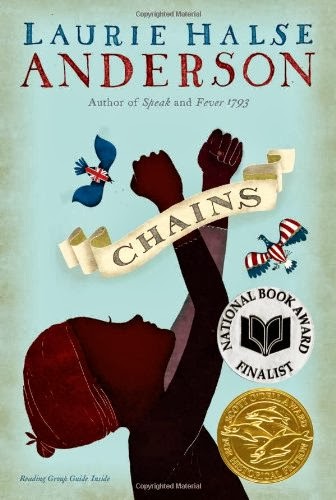
Chains by Laurie Halse Anderson

I bought Chains ages ago, but never got around to reading it.  It was actually the book that motivated me to participate in the 2013 American Revolution Reading Challenge over at War Through the Generations.  And yet, it still sat on the shelf.  So naturally, when Anna and Serena, the hosts of War Through the Generations, announced that there was going to be a Chains read-along, I jumped at the chance to sign up.  AND I AM SO GLAD I DID!  But now that I have read the book, I can't understand what took me so long.

Chains is the story of a young slave girl who yearns for freedom.  Isabel, 13, and her younger sister Ruth are quickly sold by a greedy nephew for the money they will bring after their somewhat benevolent owner, Miss Fitch, passes away.  But Miss Fitch had promised them freedom after her death and Isabel can't get that promise out of her head.

Now, as the American Revolution begins, the sisters find themselves in a Loyalist household in New York City at the mercy of a cruel mistress, Mrs. Lockton.  The Locktons, who know their bread is buttered on the side of the Loyalist and King George III, despise the Patriots who want independence from and everything they stand for.

It isn't long before Isabel meets Curzon, a slave working for the Patriots, and known for the red tricorn hat he is always seen wearing.  Curzon convinces Isabel to spy on Mr. Lockton, and report anything she hears that might be useful to the Patriots.  Isabel isn't very enthusiastic about doing this, but when she is given the devastating news that Mrs. Lockton has sold Ruth, she changes her mind.  It had just been discovered that Ruth suffers from seizures and the very ignorant, superstitious Mrs. Lockton believes that they are a sign that the devil is in Ruth.

Curson proves to be a good friend to Isabel, although she has very mixed feelings about him, the war between the Patriots and the Loyalists and which side would be most beneficial to her in terms of getting her freedom.

As the war heats up, so does Isabel's determination to find her sister and, as she is told by an elderly slave known as Grandfather, to find the way to cross her own River Jordan* to freedom.

Chains is written in the first person, so we always know exactly what is going on in Isabel's mind, how she perceives everything around her and, most poignantly, how she feels about the things that happen to her.  But by spying on Mr. Lockton and his friends, we are also given a certain amount of insight into the Loyalist side of things.

Isabel is a very strong willed girl and Mrs. Lockton knows it and is determined to break that will and so she is constantly trying to tighten the chains of slavery that bind Isabel.  Yet, it takes a while for the realization that Mrs. Lockton cannot chain her soul to really sink in to Isabel's consciousness, even though all her actions had always already proven it to be true.  Her strength in the face of Mrs. Lockton, her wavering between the Patriots and the Loyalists, her determination and her innate sense of kindness despite everything all make Isabel such an exemplary protagonist.

In fact, Anderson has created a whole cast of characters in Chains who play their parts to perfection.  Set against the backdrop of New York City,  Anderson has written a brilliantly crafted novel in which the fictional walk through the historical and it is spot on.  Anderson has even turned New York into a character in its own right, by staying true to the history of the time (NB: I used to teach New York history to my 4th graders and it was my favorite thing to teach).

One of the things I really liked about Chains were the quotes used at the beginning of each chapter.  These quotes are from actual sources of the time that help situate the reader and gives the novel a real feeling of authenticity.

I don't think I could possibly recommend this book highly enough.

This book is recommended for readers aged 14+
This book was purchased for my personal library

Laurie Halse Anderson has excellent teaching resources for Chains, including a section on how to put on a colonial tea (with some really good recipes).  You can find it HERE

This is book 3 of my 2013 American Revolution Reading Challenge hosted by War Through the Generations

This is book 10 of my 2013 Historical Fiction Reading Challenge hosted by Historical Tapestry

*I was talking to a friend about Chains and she said she didn't get the River Jordan reference, which is a reference to the God's command that after the death of Moses, Joshua would lead the Israelites out of slavery in Egypt to freedom in the promised land by crossing the River Jordan.

Monday, September 30, 2013

Invasion by Walter Dean Myers

Invasion is Walter Dean Myers latest war novel.  It begins on May 14, 1944 as American troops are preparing for the D-Day invasion of France, which they know will happen but they don't know when.  It is narrated by the main character, Josiah "Woody" Wedgewood, who is with the 29th Infantry Division.  During practice, Woody runs into an old friend from home, Marcus Perry, an African American soldier in the all black Transportation Corps.

The story follows Woody before, during and after the invasion.  Throughout, Woody describes his feelings, his fearsand his loneliness.  These feelings finally prompt him to write home to a girl, Vernelle Ring, that he likes but who doesn't know it.

But the main part of the story is really about fighting to win back Europe from the Nazis and Woody provides some pretty graphic descriptions of what happens on a battlefield.  Walter Dean Myers does not romanticize the war nor does he spare the reader.  Invasion is rough, raw and detailed, as is some of the language used by the men.  According to his Author's Note, Myers wanted his readers to understand that the "...basic truth about war is that it is unbelievably brutal..."  He has certainly succeeded in that purpose.

I did have one problem with Invasion.  I found there was the real lack of camaraderie among the soldiers who formed the 29th Infantry Division.  It almost felt like they were each other's enemy.  Woody felt more like a distanced observer of his comrades, recording their behavior as an onlooker, not a participant.  Granted when men he knew were killed, he felt really felt the loss, but it was related more to his own fate than the fate of the dead soldier.

Marcus Perry, Woody's friend from back home in Virginia, appears briefly three times in this novel.  Naturally, because the Armed Forces were segregated in WWII, they couldn't serve together and probably wouldn't see each other very often, and, in reality, most likely never.  But Invasion is also a prequel to two of WDM's previous books about war.  Fallen Angels is about the Vietnam war, and focuses on Richard Perry, son of Marcus Perry.  Sunrise over Fallujah follows Robin Perry, nephew of Richard Perry, as he goes to war in Iraq following the September 11th attack on the US.  

Invasion is a fast-paced novel, though some of Woody's detailed descriptions of unimportant things could have been edited down somewhat.  I never really connected with any of the characters, and really didn't feel there was much to Woody, and his comrades felt like shadowy figures.  I was sorry about this because I think WDM's message is important.  I suspect, however, readers will find this a much more exciting book than I did.  And I certainly think it is a worthwhile novel to read.

This book is recommended for readers age 12+
This book was an ARC received at BEA

Tuesday, September 3, 2013

Coming On Home Soon by Jacqueline Woodson, illustrated by E.B. Lewis

When Ada Ruth's Mama decides to go to Chicago to earn some money to send home, Ada Ruth must stay home with her Grandma.  Yet as the days pass, and no letter or money comes from Chicago, Ada Ruth misses her Mama more and more.  But Grandma reassures her that Mama with be coming on home soon and to just keep writing to her.

When Ada Ruth finds a kitten at the door one cold snowy morning, Grandma tells her she can't keep it,  there isn't enough food for themselves with the war going on. let alone a kitten.  But she lets Ada Ruth give her some milk anyway.

After a while, with no word from Mama, even Grandma feels like crying.

Day after day, Ada Ruth and her Grandma go about their lives, listening to the war news on the radio, hunting for food in the woods behind the house, always  followed by the kitten, and missing Mama and hoping for a letter.

Until, finally, one comes.  And sure enough, there's money and the news that Mama will really be coming on home soon.

In this gentle, yet powerful story Jacquelline Woodson has poignantly captured the fear, the worry and the loneliness of a young girl left behind when her mother must leave home for a job, a not uncommon occurrence in WWII.  The story is set in the middle of a very cold winter, metaphorically expressing the warmth that Ada Ruth associates with her mother and which is now missing from their home.  But, the soft warm of the kitten keeps the memory of her mother's warmth alive for Ada Ruth.  Their anticipated renion ends the story on a happy, hopeful note.

The text is completely supported by the realistic watercolor illustrations by E.B. Lewis, that are so expressive of the time and place that this story.  I loved Ada Ruth's saddle shoes, so popular at the time.  And the color palette used, in rich tones of browns, blues and icy whites, also reflects the sense of country living in the dead of winter.

Woodson has subtly given us a glimpse of one of the ways that the war effected the lives of African American woman and children on the home front in this story.  Ada Ruth's experience of the war was, unfortunately, not uncommon.  When men went to fight in WWII, it created a shortage of workers and opened opportunities for women to take over their jobs and earn better money than they normally would have been paid.  Here, Ada Ruth's Mama went to Chicago and worked for the railroad, washing train cars.  Pullman in Chicago had begun to hire black men in the 1930s, but by 1944, as the war went on, the company faced a shortage of workers and began to hire black woman as well.

This book is recommended for readers age 6+
This book was borrowed from the NYPL

Thursday, February 21, 2013

Courage Has No Color: The True Story of the Triple Nickles by Tanya Lee Stone

I first heard about the Triple Nickles when I read the book Jump into the Sky by Shelly Pearsall, the story of a young African American boy whose father was a paratrooper in 555th Parachute Infantry Battalion, or the Triple Nickles.

Now, Tanya Lee Stone's Courage Has No Color tells the true story of the Triple Nickels, America's first and only all black unit of paratroopers in World War II.  She begins their story by describing in graphic detail what it feels like to jump out of an airplane and parachute back to earth, to give you an idea of the level of courage it takes to be a paratrooper.  It is not something I think I would want to ever do.    

From there she writes about the kind of treatment black soldiers received in the military: segregated and relegated to service work and treated like servants.  It was demeaning and demoralizing to the men who joined the military to fight for their country and freedom.  One man, Walter Morris, a first sergeant in charge of Service Company of The Parachute School, saw how being treated like servants was affecting the men serving under him.  Morris devised a plan to teach his men how to feel like soldiers again.  It was his plan to teach them what they needed to know to become paratroopers.  And so after the white serviceman were finished practicing for the day, and the black servicemen arrived to start cleaning up after them, they also began their training.  And someone noticed how well they learned what was needed to become a successful paratrooper.  Pretty soon, the First Lady Eleanor Roosevelt, long a proponent of equality, got into the act.

In 1941, The 99th Pursuit Squadron, or the Tuskegee Airmen, was formed and the men trained to be the country's first African American aviators.  And in 1943, these airmen were finally sent into combat overseas.   But the 555th Paratrooper Infantry Battalion was finally formed in February 1943.  Though trained as paratroopers, the Triple Nickles would never be used in combat, instead they were sent to Oregon to fight fires.  Turns out those fires were started by balloons sent over by Japan for that very purpose.

All of this and much more about the people and history of the 555th is detailed in Courage Has No Color, including an in-depth explanation of how they got their name - yes, there more to it than just 555.  It is a fascinating book covering this little known aspect of the United States military and World War II and an exceptional contribute to the history of African Americans in this country.

Stone has done an exemplary job of gathering primary source material, including interviews with some the of members of the 555th and lots of archival photographs, to bring to life the courage and heroism of these men and their accomplishments even against all odds.  Included is a very eyeopening timeline of the desegregation and the Triple Nickles,

Sadly, the United States Military was not desegregated until 1950.

This book is recommended for readers age 10+
This book was obtained from the publisher

Oh yes, remember that description of jumping out of an airplane I mentioned, well, you too can experience what it is like to be a paratrooper by reading it here.

A very useful teaching guide including Common Core connections, can be downloaded here.

Thursday, February 7, 2013

Double Victory: How African American Women Broke Race and Gender Barriers to Help Win World War II by Cheryl Mullenbach

February is Black History Month and way back in 2011, I looked at a book about African American soldiers in World War II called The Double V Campaign: African Americans and World War II by Michael L. Cooper.  The Double V Campaign demanded that African Americans who were risking their lives fighting for freedom and democracy abroad should be given full civil rights at home - Victory at home AND abroad.   Cooper's book is an interesting, well-researched book, but it doesn't tell the whole story of the Double Victory Campaign.  The Double V campaign was also waged on the home front, and women played a very important part.

In her book, Double Victory: How African American Women Broke Race and Gender Barriers to Help Win World War II, Cheryl Mullenbach brings together the lives and work of a number of strong, brave women in four areas: women who worked in the war industry,  women who became political activists, women in the military, volunteers and of course, women in entertainment.

Here are only a few of the many stories covered in Mullenbach's book:
High school teacher Layle Lane was asked by A. Philip Randolph, a Civil Righs leader, to help organize a March on Washington in 1941 to end discrimination in employment, since most defense plants would not hire African Americans.  The march never happened, but Lane was in on the talks with President Roosevelt that led to the issuance of Executive Order Number 8802, which meant if you discriminate, the Fair Employment Practices Committee can investigate you.  It wasn't perfect, but it was a start.

Pauli Murray, a female law student, let students from Howard University in peaceful direct action sit-in at a restaurant that refused to serve African Americans.  Three by three the students entered, sat and asked for service.  When that was refused, they stayed seated and began to quietly study.  Police couldn't arrest them because by not being served, they weren't breaking the law.  The owner closed for the day, but when he reopened the next day, the students held a peaceful picket outside and after a few days of lost business, the Whites Only sign came down.

The women who joined the WAAC (Women's Army Auxiliary Corps) once it was opened to African Americans discovered the racism and segregation followed them into the military, just as it had followed men of color.  Nevertheless, the women soldered on and succeeded.  And eventually, Charity Adams even became the first African American woman officer in the WAACs and commanded the 6888th Central Postal Battalion (see Mare's War by Tanita Davis for an interesting and accurate fictional account of one women's experience in the 6888th).

Star power carries a lot of weight and in WWII it was not different.  When the Hollywood Victory Campaign was formed, actress Hattie McDaniel was asked to be in charge of "Negro talent" section.  Hattie, who had won an Academy Award in 1940 for playing Mammy in Gone with the Wind, helped to organize black entertainers to perform in the segregated all black units of the armed forces.  This work required the entertainers would need to meet frequently, usually at Hattie's house.  But she lived in a restricted area, meaning no blacks allowed.  So when the white homeowners filed a legal complaint, Hattie fought back and won.

Lena Horne, one of my favorite singers, was a favorite during the 1930s and 1940s and she was also part of the Hollywood Victory Campaign.  Mullenbach tells about the time on a southern USO tour, Lena performed one night to a white only audience, and the next morning in the mess hall, she was to perform for the black soldiers.  But in the front row were German POWs.   She left the stage, stood in front of the black soldiers, back to the Germans and sang.  She ended up quitting the USO tour over this, but continued entertaining soldiers throughout the war.

These are just a few of the many interesting women included in Double Victory: How African American Women Broke Race and Gender Barriers to Help Win World War II.  It is a well-researched, nicely presented book with lots of supporting photographs and detailed back matter.   It is intelligently written, yet very accessible for young readers.  The fact that she introduces us to ordinary women doing extraordinary things in wartime makes it all the more valuable.  And while it is good to know that anyone can make a difference, not just famous people, it is also nice to read about the contributions of so many African American women, which are often overlooked.

Kathryn Atwood started a narrative about women and their courageous acts in WWII in her work Women Heroes of World War II and Cheryl Mullenbach has extended that narrative to include African American women in Double Victory: How African American Women Broke Race and Gender Barriers to Help Win World War II.

This book is recommended for readers age 12+
This book was an E-ARC from Net Galley

For more on the Double Victory Campaign, see Newspapers - The Pittsburgh Courier and
Fighting For Democracy - African Americans