Showing posts with label Middle Grade/YA. Show all posts

Friday, June 11, 2021

Ensnared in the Wolf's Lair: Inside the 1944 Plot to Kill Hitler and the Ghost Children of His Revenge by Ann Bausum

One of the things I've learned after reading a number of books by Ann Bausum is that you can always count on her to write a compelling, well-researched book. She really knows how to present the participants, lay out the timeline, and contextualize the meaning of each historical event she tackles. And she has done it again in this book about the  Valkyrie plot to kill Adolf Hitler, in what could otherwise be a confusing event in the history of Nazi Germany. But then, Bausum takes the story further and tells the reader what happened later to the children of the people involved in the plot.

Bausum begins her account with a detailed account of Adolf Hitler's rise in popularity and his seizure of power after the death of President Paul von Hindenburg in 1934. From the beginning, Hitler used fear and brutality to maintain control over the German people, and his predilection for retaliation meant little dissent among the people. But by 1943, some prominent Germans, among the *Count Claus von Stauffenberg, Cäsar von Hofacker and Friedrich-Wilhelm von Hase, began to realize that Hitler had to be stopped. 

A plot to kill Hitler and overthrow his regime was planned, adapting the name Valkyrie. The plan was simple enough - von Stauffenberg would carry a briefcase with a bomb in it to a July 20, 1944 meeting at Hitler's Wolf's Lair retreat. He would excuse himself, but leave the briefcase behind. Unfortunately, the planned assassination  failed and the conspirators were quickly captured, put to death and cremated.  

But what about the families of the dead conspirators? Here is where Bausum shines a light on what is probably an almost unknown part of this story. The deadly fate of the conspirators wasn't enough for Hitler, who insisted on broadly applying a policy of Sippenhaft or family arrest to their "families, including spouses, children, siblings, parents and other relatives" (pg. 70) and put SS leader Heinrich Himmler in charge if it.

Over 700 family members were arrested, and then,  children were separated from adults and taken to a former youth retreat called Borntal located in the secluded town of Bad Sachsa. There, they were traumatized even further. All family mementoes, including photographs and personal items, were removed from their suitcases, they were given new last names, and although they were marginally taken care of by staff, they were forbidden to speak to any outsiders. 

What happened to these children, nicknamed the Ghost Children by the community around them, is really the main focus of this book. Using the diary kept by one of the children, Christa von Hofsacker, interviews with a number of the detainees still living, and extensive research, Bausum gives readers a detailed window into just what these children suffered without even knowing why it was happening to them. 

As much as I know about Nazi Germany, the story of these Ghost Children was new to me. I did know about the Sippenhaft policy, but has just assumed it didn't involve children, who could have been re-educated the same way the Nazis re-educated Jewish children who looked Aryan from conquered countries. Instead, they followed a policy of erasure, isolation and harassment. 

To help readers, Bausum includes a map of Europe on July 20, 1944, copious photographs, including many of the families of the conspirators before the assassination attempt, and extensive back matter. There is a timeline of the rise and fall of Nazi Germany and Adolf Hitler, a list of the Borntal's Sippenhaft Families, a Resource Guide,  A Note from the Author, and a detailed Bibliography, among other resources. Bausum also has a number of classroom suggestions to use in conjunction with this book, which you can find HERE.

Ensnared in the Wolf's Lair is a book for readers interested history, World War II, and/or Nazi Germany.

This book is recommended for readers age 10+
This book was an eARC gratefully received from Karen Wadsworth at Media Masters Publicity

*Here is an interesting fact I learned when I was writing about Fliegerinnen or women pilots in Nazi Germany. As part of the Sippenhaft policy, relatives of Count Claus von Stauffenberg were also arrested, including his older twin brothers Berthold and Alexander. Alexander, who was not part of the conspiracy, was married to Melitta Schiller, a half Jewish, half Aryan aviator. She had been awarded the Iron Cross in 1943, arrested in the 1944 Sippenhalf roundup, but later released. Melitta tested dive bombers for the Luftwaffe, and was shot down by an American fighter plane in 1945. 


Monday, February 8, 2021

We Must Not Forget: Holocaust Stories of Survival and Resistance by Deborah Hopkinson

Exactly one year ago, I reviewed We Had To Be Brave: Escaping the Nazis on the Kindertransport by Deborah Hopkinson. In that book, Hopkinson used the Kindertransport stories of real children to show today's readers what life was like under Nazi oppression and the difficult choices parents had to make to keep their children safe. 

Hopkinson's newest book, We Must Not Forget, looks at the ways in which Jewish children and teens survived the Holocaust despite the Nazis best efforts to rid Europe of its Jewish population. The book is divided into three parts, each part covering a country that the Nazis invaded and occupied. Part One: "Fleeing from Evil, Hiding from Horror" includes stories from Germany and the Netherlands; Part Two: "Families Torn Apart" looks at stories from France; and Part Three: "Desperation and Defiance" are stories from Poland. Within each part is a short introduction to each person, followed by pertinent key dates and a photo album relating to each individual country. 

Using personal testimonies, letters, oral histories, memoirs and archival photographs, Hopkinson has provided a wide variety of experiences and perspectives on what each person profiled lived through. Hopkinson skillfully weaves these personal stories of each Jewish family with information about the rise of Hitler and the Nazis in Germany, and their invasion and occupation in the Netherlands, France, and Poland needed to understand the desperate fight to survive that Jews in those countries were in.

And fight they did. German teenager Fred Angress, living in the Netherlands with his family, was able to get a position with the Jewish Council after his father was arrested, never to be seen again. His job not only delayed Fred's own deportation, but Fred found ways to help as many Jews as he could, including smuggling them out of the gathering place where deportation began.

In France, Oeuvre de Secours aux Enfants or OSE homes where set up for Jewish children and teens where Alfred and Ernest Moritz went after a stranger told their mother to get them away from the registration line they were on where names and addresses of all Jews in their area were recorded and get them to safety. At the OSE home they went to, Alfred and Ernest were give false ID papers and ration cards. Ultimately, the brothers ended up living with a French peasant woman and passing for Christian until France was liberated.

Other children, like Ruth Oppenheimer and her older sister Hannah were sent to England on the Kindertransport. One brother was already living in South America, the other in the United States. Younger sibling Michael was rescued by a Quaker organization, and finally, younger sister Feo was taken to live in an OSE home. All six Oppenheimer siblings survived the Holocaust, but sadly their parents perished in Auschwitz.

Sisters Gertrud and Herta Michelsohn were deported from Germany to the Riga Ghetto in Latvia in 1941 with their parents. After their parents were sent to a death camp, the sisters found strength to go on with each other, even surviving a winter death march in 1944. Eventually, they ended up in Sweden, survivors of the Holocaust.

After her family was forced to move into the Nowogródek ghetto in what was then Poland, Paula Burger's mother made her promise to look after her little brother Isaac if anything happened to her parents. After they disappeared, Paula learned that her father had made arrangements to have his children smuggled out of the ghetto. One night, in the fall of 1942, that's exactly what happened. Paula and Isaac were taken to their father, where he was in hiding in the forest after joining the Bielski partisans. The Bielski's were a large family with 12 children. The partisan unit was formed after their parents and two brothers were killed by the Nazis. Led by eldest brother Tuvia Bielski, the partisans sabotaged the Nazis, blowing up trains and bridges, as well as going after collaborators and informers. Paula, Isaac, and their father remained in hiding with the Bielski partisans until July 1944 when the area was liberated by the Soviet army.   

These are just some of the survivors readers will meet in this fascinating, well-researched book. Each of the 12 people profiled have their own unique story of survival to tell, though each lost loved one, killed by the Nazis. It's sometimes hard to grasp the magnitude of the Holocaust and its victims, but reading these eyewitness personal accounts helps to bring what happened closer to us now that so many survivors are no longer living. And thanks to Hopkinson's in-depth knowledge of the Holocaust, she is able to make what can feel like a very complicated subject much more comprehensible. 

There are copious  photographs throughout each part, as well an invitation to "Look, Listen, Remember" at the end of each profile, where readers can listen to survivors tell their story. Extensive back matter includes a Glossary, a Timeline of WWII, a list of Museum Websites and Online Resources to explore, Oral Histories, Articles, and Interviews by and about the people in this book, an extensive Bibliography and of course, source notes (because Deborah is a truly consummate researcher).

And if you think these stories are just in the past, I would suggest you reconsider. After all, the past is never past. Nationalistic right wing extremism is on the rise in Europe and the United States and once again, Jews are being singled out. Let these stories serve an a reminder and a warning.

This book is recommended for readers age 10+
This book was gratefully received from the author 

Monday, January 4, 2021

Resistance by Jennifer A. Nielsen

Until the Nazis invaded Poland in 1938, Chaya Lindner had lived a relatively good life in Krakow with her parents, her younger brother, Yitzchak, and much younger sister Sarah. By 1940, the Nazis had placed so many restrictions on Jews living in Poland until finally they were all ordered to leave their homes and move into the Podgorze Ghetto, where they were forced to live four families to an apartment. But for Chaya, it meant being on the next Nazi train out of Poland. Instead, Chaya set off on a long journey, leaving Krakow to stay with her grandmother.  

After three days of wandering, Chaya passed a place with a familiar name. Shimshon and Gusta Draenger, who had been the leaders of her Jewish scout group, Akiva, live on a farm nearby. Chaya is invited to stay on the farm, helping out with the work, and learning more about what was happening to the Jews in Poland until one day, a man name Dolek brings her bad news from the Podgorze Ghetto - 8-year-old had been sent to Belzec, a death camp, and Yitzchak, 12,  has disappeared.  

Chaya's Akiva group on the farm decide it's time to take decisive action to resist the Nazis however they can. And because Chaya can pass for Polish with her long blond, light complexion and her ability to speak fluent Polish, she immediately volunteers to be a courier for the Jewish resistance. With false identity papers, Chaya becomes Helena Nowak, a Polish Catholic who can now pass into and out of the ghettos, smuggling food and medical supplies to the people in desperate need there, goods obtained through raids of German supplies that Chaya also participates in. 

But when Chaya is paired with the inexperienced Esther Karolinski, she is less than happy. Esther brings her own baggage to the resistance - her father is a hated Judenrat in the Warsaw Ghetto who has had to make lists of names for deportation. At first, Chaya feels that Esther is a liability to her own resistance work, but as time goes by and they work together, going from ghetto to ghetto, Esther feels more like a partner than a problem. And she proves herself to be especially helpful once she and Chaya find themselves inside the Warsaw Ghetto as the Jewish resistance begins to prepare for their uprising there. 

Resistance is an engaging novel, action-packed but not gratuitously so. Motivated by the death of her sister and disappearance of her brother, the book's purpose is to highlight the courageous life of teenage Chaya, and the dangers she faced on a daily basis, knowing that capture would mean torture and death for her by the Nazis. But it is also a testament to faith in God - something the Nazis have successfully caused her to question: "What good is faith if you're dead?" (pg 139) So Chaya fight is on two fronts - physical and spiritual. 

Chaya is a well-drawn character, with all the mixed emotions - anger, compassion, and ideology - you would expect from a teen living under Nazi threat. No one else is given her depth, although Esther comes close. And, like others who have read this book, I would have liked to know more about Esther. 

Though Resistance is a Holocaust story, it takes place away from the Nazi death camps, and is set in several of the ghettos the Nazis forced Jews to live in. Nielsen has not shied away from the horrors of those ghettos, of people dying of starvation, Nazi cruelty, and the horrendous living conditions. Nor does she ignore the Jews who volunteered to be part of a ghettos Judenrat, as Esther's father was, and who become almost a cruel as the Nazis thinking it will save them and their families. This is a very realistic novel, but Chaya's story is also a compelling one. 

And although Chaya's story is fiction, there is much that is based in reality in this book. Nielsen breaks it all down in her Afterword, which I highly recommend reading.

This book is recommended for readers age 10+
This book was an ARC received from the publisher, Scholastic Press

Tuesday, June 2, 2020

Firebird by Elizabeth Wein

"I am not a traitor" or so claims Anastasia Viktorovna Nabokova, Nastia for short. She is accused of landing her plan in German held territory and although it held personal risks for her, her action defied Stalin's Order Number 227 issued July 1942, disallowing retreat by demanding "Not one step backward." But Nastia did it anyway. Is she a traitor? After you read her story, you can be the judge.

Nastia had just finished high school and working as a instructor at the Leningrad Youth Aeroclub, the only woman except for the Chief Flight Instructor, on the day that Germany begins her invasion of the Soviet Union. Nastia, along with her fellow (male) pilots immediately go to enlist, but while the men are accepted, she is sent back to the Aeroclub to train more pilots. There, the Chief tells her to write to Marina Raskova, a famous Russian pilot who has access to Stalin, if she wants to fly in the war.

Fighting is in Nastia's blood. Her parents were both important participants in the 1917 Russian Revolution, fighting in the Red Army, and her father had been the driver of the wagon that transported the bodies Czar Nicholas II, and his family after they were executed. And although Anastasia was the name of the Czar's youngest daughter, Nastia's parents named her that because of its meaning - rebirth.

As the German's push forward, the pilots are forced to evacuate the Aeroclub and their training planes are taken to a safe place. Nastia and the Chief end up in Moscow. There, they are finally allowed to fly in the war, and the Chief chooses Nastia to be her wingman (meaning Nastia will be positioned behind the Chief's plane). But when the Chief makes a decision to ram a German plane after she runs out of ammunition, Nastia must make a snap decision as well when she sees her parachuting out of her plane and being shot at - land and help the Chief or return to the air base. It's pretty clear from the opening line of this novella what Nastia's choice is. What isn't clear? What Nastia discovers when she lands. Boy howdy, I did not see that coming.

Narrated in the first person by Nastia, Firebird unfolds as an exciting novella as she defends her actions to the tribunal who will determine her fate. It is a short, easy to read book, written in five parts plus a Prologue. The time frame is short, only running from early summer 1941 to spring/summer 1942, but it is a year of change, loss, success and growth for Nastia.

As her story unfolds, Wein has managed to include enough actual history and information about the Russian Revolution and the assassination of the Romanov family so that readers who may not be familiar with it won't get lost or lose interest in Nastia's story. In addition, Nastia is not part of the famous Russian Night Witches who were trained by Marina Raskova, but Wein does acknowledge them in Firebird.  Be sure to read the Author's Note where Wein separates the facts from fiction she used in the novella.

Nastia is a great character, and Wein really brings her to life, but I particularly love her descriptions of the Chief from her bleach blond hair and make up put on like armor to her men's clothing and fancy French corset - what an enigma!

Firebird is another book published by Barrington Stoke. Barrington Stoke publishes books that are adapted for dyslexic and reluctant readers. I've read a number of their books now, and I highly recommend them for ALL readers.

Pair this with Elizabeth Wein's book White Eagles, a book about the Polish Air Force Reserve and the twin brother and sister who volunteer to fly for them during WWII. These will appeal to anyone with in interest in aviation and/or WWII.

This book is recommended for readers age 9+
This book was purchased for my personal library

Tuesday, December 12, 2017

From the Archives #29: Comrades of the Air by Dorothy Carter


                      ***Contains Spoilers***

I’ve been laid up with an injury lately and was looking for a comfort read among my old 1940s wartime novels, and just as I reached for The Highland Twins at the Chalet School, I noticed Dorothy Carter’s book Comrades of the Air. Since I have read two books about Russian women pilots in WWII this year, Night Witches by Kathryn Lasky and Among the Red Stars by Gwen C. Katz, I pulled it out instead and decided to reread it - it was not exactly a comfort read but it is exciting.

Dorothy Carter wrote six books about Marise Duncan, a young aviatrix, and her flying adventures. The first three novels take place before the war, and the last three involve Marise in some wartime activity. In Sword of the Air, for instance, Marise is ferrying planes to France and finds herself spying for British Intelligence by working in a Messerschmitt factory (and becoming fluent in German rather quickly). In the third book, Marise Flies South, she is flying bombers to Australia and finds herself tackling the Japanese. Both of these books are difficult to find and when you do, they usually cost a fortune. I don't own either one.

Comrades of the Air is the second of the wartime novels, also hard to find, and also expensive. The story begins when Marise discovers that some of her male pilot friends are leaving for Russia on a secret mission. Marise’s dad works for British Intelligence and is away somewhere on assignment, while her mom stays home taking care of some evacuees. Not to be left out, Marise convinces her superiors that she is quite capable of ferrying a much needed plane to an aerodrome in Russia. The Russians are short supplies since since the Nazis are attempting to invade Russia.

Arriving at an aerodrome near Moscow, Marise meets siblings Katya and Ivan Vanevska. Though neither are pilots, the do fly combat missions, she as an air gunner, Ivan as a navigator. And much to Marise’s surprise, not only are her pilot friends based at the same aerodrome, but so is her father, Captain Duncan. Unfortunately, their reunion is short lived when the aerodrome is attacked by the Nazis and Captain Duncan is knocked unconscious and seriously injured. After the attack, the four remaining undamaged planes are quickly loaded up with personnel and take off. Marise flies one of the planes with Katya as gunner and Ivan as navigator, and her still unconscious father.

But when the planes are attacked by enemy aircraft, and Marise’s plane is damaged, she is forced to land on the coast of the White Sea. After camouflaging the plane, the group builds a shelter to protect them from the elements and any chance of being seen by the enemy. Food is scarce, so while Ivan is out hunting, he comes upon an enemy outpost. They witness a steamer being attacked by a German U-boat and soon rescue a Swedish woman and her two children, the only apparent survivors. 

It now becomes clear that they will have to leave and try walk the 80 or so miles to Archangel. But before leaving, Marise manages to steal some food from the Nazis under cover of darkness. Having built a kind of sledge to transport Captain Duncan, the group takes off. Luckily, the falling snow covers their tracks. Eventually, they run into a woodsman who takes them in and feeds them. After sometime, he leads them to the nearest village, about 15 miles away. Unfortunately, the village is occupied by Nazis, who are stealing warm clothes, blankets and food from the villagers to be sent back to Germany. The woodsman returns to his cabin, and sure enough the group is captured by the Nazis. The Swedish woman and her children, however, are sent out into the cold, while the rest of the group is placed under arrest (they are taken in by a woman villager).

Meanwhile, Marise’s pilot friends have finally figured out that her plane never arrived after the evacuation of the Moscow aerodrome, and decide it’s time to start searching. 

Having pillaged the village and rested, the Germany convoy is ready to leave, and the plan is to send their prisoners to Germany to be questioned by the Gestapo. Under heavy guard, it looks like there is no possibility of escape, especially with Captain Duncan so badly injured. But, when a plane is spotted overheard, Marise guesses from the way it is being flown, it can be no one other than her friend Jim Grant. Flying low, the plane causes considerable damage to the convoy. Unfortunately the plane is also shot down and while everyone else assumes the pilot is dead, Marise is convinced that if it is really Jim Grant, he has survived. Thanks to the attack and damage, the Nazis are distracted trying to get things up and running again, so a plan is formulated for Marise to escape the lorry they are being held in to look for Jim. 

Sure enough, Jim has survived and Marise finds him. The two come up with a plan to rescue Captain Duncan, Katya, and Ivan using ammunition Marise had taken from a damaged lorry. Marisa finds her way back to the lorry with the prisoners, and the plan is that she will drive it away from the convoy as quickly as she can, while Jim uses the stolen ammunition to attack the Germans. It all going according to plan, but suddenly the noise from the attack stops and there is again the fear that Jim had been killed. But no, Jim had radioed the aerodrome when he saw the convoy and given them directions to it, not knowing that Marise and the other were also in one of the lorries.  

Far fetched as it sounds the plan actually works, the Allied bombers attack the convoy and everyone escapes with their lives. Back home in England, Marise tells her mother that going through the experiences has with Katya and Ivan, they are now comrades - comrades of the air.

Although Comrades of the Air has a pretty preposterous plot, it is still a fun, fast novel. Carter seems to have been aware that women pilots in Russia, unlike their English counterparts, took part in combat, information Marise is surprised to learn. Interestingly, Carter never refers to Russia as the Soviet Union, even though the Revolution is mentioned, and Katya is an enthusiastic supporter of it and a true comrade.

Dorothy Carter, whose real name was Eileen Marsh was a prolific writer who wrote under a number of pen names.  According to Stephen Bigger’s post about her on his blog 1930-1960, Eileen Marsh wrote 120 books between 1935 and 1948 under 16 different names. You might also be interested in Stephen's blog post about Comrades of the Air, too. If you even see any of the three wartime Marise Duncan novels at a reasonable price, you might want to snatch them up. 

This book is recommended for readers age 10+
This book was purchased for my personal library

Tuesday, November 28, 2017

Suspect Red by L.M. Elliot

It’s June 1953, the Cold War is in full swing, Julius and Ethel Rosenberg’s have just been executed on charges of committing espionage, and under the influence of Senator Eugene McCarthy (R-WI), certain books deemed to have secret communist themes are being removed from the State Department, and overseas embassies. 

Now, though, summer vacation has just begun and Richard Bradley, 14, can finally get away from the bullies at school and lose himself in the pile of books he’s put together, beginning with a reread his favorite Robin Hood. Well, until his mom takes it away now that it has been determined too subversive, and she would know, since Richard’s dad is. K a G-man, working for the FBI under J. Edgar Hoover, who seems to agree with everything Senator McCarthy says. But Richard’s father also is suffering from PTSD as a result of his wartime service, and Richard seems to be the only one who realizes it. And he is trying to redeem himself after a failed FBI mission that Hoover blames him for. 

When Richard and his mother visit a new neighbor,Teresa White, from Czechoslovakia who’s married to an American in the State Department, he meets her son Vladimir, a confident 14 year old who had lived in Prague and London during the war. Vladimir is a musician at heart, but he’s also an ardent reader like Richard, and though his taste in books is more sophisticated, he’s also willing to lend his books.

The two become friends, and while everyone in the White family is rather bohemian in their taste for art and left leaning politically, Richard soon begins to notice some suspicious things regarding Vlad’s mom. Perhaps he has been reading too many books like Herb Philbrick’s FBI espionage novel I Led Two Lives, but soon Richard is sure Mrs. White is involved in some kind of spying. Not sure what exactly it is all about, he talks to his dad, who advises him to think like a G-man and report back to him if he notices anything suspicious.

It’s exciting to think of himself as a spy, but Richard also feels disloyal towards Vlad. When school begin in September, Richard is sure Vlad will leave him flat and make friends with the other boys. While he is relieved when that doesn’t happen, Richard is still wrestling with his conscience about spying on Vlad’s family when he notices what appears to be really incriminating evidence. Telling his dad what he observed, Richard realizes that for the first time he and his dad are having the kinds of talks he has always longed to have - real father/son talks.

But when Vlad tells Richard in confidence what is really going on with his mom, Richard knows he has to tell his dad. But is it too late for that?

Suspect Red covers one year, from June 1953 to June 1954. It’s an important coming of age year in Richard’s life, where he learns the meaning and value of a good friendship and the consequences of betraying it, and in the life of the United States, when it allows itself to be influenced by one person with an agenda. The chapters are done by month, and each one includes documentary information at the beginning, relating to the politics of that month.

Richard was a very interesting character. I could see where he is standing with one foot in the kind of conventional life style his parents have and one in the unconventional life the White family lives, and trying to decide where he belonged. Both life styles seem to appeal to him. Luckily, McCarthy started to lose his hold over the US in 1953, so I could imagine Richard finding a way of blending of the best of both. Elliot is also spot on with her depiction of kind of indecisiveness and questioning Richard is wrestling with, as well as he struggle to figure out what the right thing to do is. And it's all muddied by his desire to have a relationship with his dad. 

Pay attention to Ginny, Richard’s 9 year old sister. She has courage, confidence, and charm and her ambition is to become an Inquiring Camera Girl a la Jacqueline Kennedy. Besides Kennedy, Ginny has also managed to befriend Ladybird Johnson, and she’s culled lots of helpful information from a bunch of Washington’s other elite women. A novel about Ginny would be very different than Richard’s story.


On the whole, I though Elliot really captured the communist paranoia that gripped people during these early years of the Cold War. These lots of little details to add to the story and give it a certain realistic quality. I can remember my parents talking about how terrible McCarthy and the Senate hearings he held were, even years after they were over. 

This book is recommended for readers age 10+
This book was an EARC received from NetGalley

Tuesday, June 6, 2017

Survivors Club: The True Story of a Very Young Prisoner of Auschwitz by Michael Bornstein and Debbie Bornstein Holinstat

Imagine going to the movies one day in the 1980s with your daughter and seeing yourself in the movie you are watching. That’s exactly what happened to Michael Bornstein and his daughter Debbie. The movie was The Chosen and in one scene, two young Jewish boys are watching a newsreel showing footage of the liberation of children from Auschwitz, and there right at the front of the line of children, was Michael Bornstein, age 4.   

Like so many Holocaust survivors, Michael Bornstein never really spoke about his childhood during the Holocaust, even after seeing himself as part of a movie. But, years later, Michael began to realize that his survival was a indeed miracle, and after doing a Google search, he also realized that the liberation images were (and sadly still are) being manipulated by Holocaust deniers to prove that it was all a Jewish lie, or that the Jews made up stories about their children being killed on arrival at Auschwitz, or that it was just a labor camp and not a death camp. Michael decided it was time to tell the story of the Bornstein family.

Michael begins his narrative in September 1939, a year before he was born, when German planes dropped bombs on the small village of Żarki, Poland where the Bornsteins lived, killing residents and destroying homes and synagogue.  Almost immediately, the village was invaded by Nazi solders who went from house to house collecting anything of value from Jewish families, including the Bornsteins. Luckily, Michael’s father, Israel Bornstein, managed to bury some valuables in the backyard including a Kaddish cup, a family heirloom.  

Jews who weren’t shot immediately were rounded up and put into the Jewish ghetto in Żarki, where Michael was born. His father was made head of the Jewish Council, with the difficult job of deciding who would be sent to die in a death camp and who wouldn’t be. Interestingly, although the head of the local Gestapo, Officer Schmitt, was an incredibly cold-hearted man, Zarki remained a somewhat open ghetto, allowing the remaining Jews to conduct some trade with the local Polish residents. It didn’t hurt that Israel was able to continually bribe him to save many lives, as well.  

One of the things that really struck me was the strength of the Bornstein family, Israel, wife Sophie, grandmother Dora, older brother Samuel and now Michael is so evident throughout the narrative. In the face of deportations of fellow Jews, hunger, cold, and sickness, the family struggled but remained strong and faithful. Once it was decided that the Zarki ghetto would be liquidated, and all Jews sent to Treblinka, Schmitt made an exception of Israel and his family, who were sent to a labor camp instead.

Unfortunately, in July 1944, the Bornsteins were all sent to Auschwitz. Sophie, Dora and Michael were immediately separated from Israel and Samuel and it wasn’t until much later that Sophie learned the fate of her husband and son. Michael was only four years old by then, and sent to live in the Kinderlager, where older kids stole his food but also gave him some points that helped him survive. Eventually, Sophie snuck him into the women’s barracks where she and Dora were, and he remained there, even after she was sent to another labor camp. It was illness that ultimately saved Michael’s life. As the Russian Army approached Auschwitz, the Germans rounded up the remaining Jewish prisoners and began what is known as the Death March to cover their atrocities. Michael was left in the infirmary and survived with his grandmother, Dora. 

The aftermath of the war, and the reunion of the remaining members of the Bornstein and of Sophie’s Jonisch family, and forming the family's Survivor Club, takes up the rest of Michael’s narrative. One story that I found particularly poignant is that of Michael’s cousin Ruth Jonisch, who found herself in a Catholic Convent, had her name changed to Kristina, and who had to be taught to hate Jews in order to survive. The years after being reunited with the Jonisch family are very interesting reading.

By now, you must be wondering how Michael knows so much about the time before he was born and the years he lived under the Nazis, given his age at the time. Most of his story is the result of research and interviews with family members. So while it isn’t actually a first hand account, it is still a compelling story about strength, some lucky coincidences, and mostly about family love.

There is a section of photographs, a Glossary and a Bornstein Family Who's Who also included in the back matter. And be sure to read Michael Bornstein's illuminating Preface and Afterword, as well.

Interestingly, the review of the movie, The Chosen, written by Janet Maslin and published April 30, 1982 in the New York Times, ended with these warning: 
''The Chosen'' is rated PG (''Parental Guidance Suggested''). It contains brief but graphic footage of the liberation of concentration-camp inmates after World War II." 

I feel I need to echo that warning: 

Survivor’s Club is a very readable nonfiction narrative, but there are some graphic descriptions of the Nazi treatment of the Jews in it that may be difficult for some sensitive readers. 

This book is recommended for readers age 10+
This book was an ARC received from the publisher, Farrar Straus Giroux

Monday, October 31, 2016

The Holocaust: The Origins, Events, and Remarkable Tales of Survival by Philip Steele

I have to be honest and say that I am never sure about books like this.  I have thought long and hard about this book that introduces readers to the Holocaust using charts, pictures, maps, and brief text.  Philip Steele, the author of many well received nonfiction children's books, begins this history of the Holocaust by introducing his readers to Jewish roots and religion in the Middle East and the diaspora, followed by a short history of Jews in Europe.  All of it leads up the WWI, the aftermath of Germany losing the war, the rise of Adolf Hitler and his Nazi Party and how Jews were blamed for everything that was wrong in Germany.

Interestingly, Steele also includes a section of the books published for young German readers and posters extolling the idea that Germans are a master race.  I found this section particularly interesting since popular fiction for young girls in the Third Reich was the topic of my dissertation.  In fact, much of his focus is on the impact of the Nazi's racism on young people - Jewish and non-Jewish.

Everything about the Holocaust is covered in this book, including the aftermath of World War II, and the trials of those who participated in the extermination of 6,000,000 Jews in their attempt to rid Europe (and later the world) of the entire race of Jews, the later establishment of the state of Israel, and calls that genocide should never happen again.  And as Steele writes, never again also means "offering a safe refuge to victims of war and persecution" instead of country's turning their backs on Europe's Jews when they needed so much help.

So why was I hesitant about this book?  It is, after all, an introductory book, but still part of me felt it painted such a broad picture that young readers would not fully grasp the gravity of what was happening at the time.  And, although the information seems factually correct to me, I felt it should have been sourced better.  There was only a Glossary, and picture credits.  No Bibliography, no suggestions for further reading, or websites for more information.

But then someone sent me this link to YouTube and I realized that a picture book for older readers like this one in a library or classroom might be an important addition after all, at least as a starting point:


I'm still stunned.

This book is recommended for readers age 12+
This book was provided to my by the publisher, Scholastic Press.

Monday, May 9, 2016

Girl in the Blue Coat by Monika Hesse

It's 1943, and Hanneke Bakker, 18, has been working as a black market runner in Nazi-occupied Amsterdam for quite a while now and she is good at what she does.  Finding and delivering her customer's requests in the basket of her old bicycle allows Hanneke to keep herself and her parents safe and provided for in a city where everything is rationed.  And since she looks like "the girl Hitler is dreaming of to put on his Aryan posters," Hanneke prides herself on being able to charm her way out of any impromptu Nazi searches.

As Hanneke makes the rounds, delivers her goods, she wills herself to remain distant from her customers, no matter how hard they try to befriend her.  But, one day, after delivering the usual black-market tea to her recently widowed customer, Mrs. Janssen, Hanneke is asked to find something different.  In fact, Mrs. Janssen has been harboring a 15 year old Jewish girl named Mirjam Roodvelt in her pantry.  Mirjam had shown up at her door, pale and wearing a too small sky blue coat, after the Nazis had found and killed her family and Mrs. Janssen's husband for hiding them in his factory.  But now, Mirjam has gone missing and Mrs. Janssen would like Hanneke to find her, a job she believes the young woman can do, given her black market skills.

At first reluctant to accept Mrs. Janssen's request, little by little Hanneke finds herself drawn into the mystery of Mirjam's disappearance.  Visiting the Jewish Lyceum where Mirjam went to school, Hanneke is spotted by a woman who works there.  The woman turns out to be Judith, a friend of Hanneke's brother Ollie.  Both are part of the Dutch resistance.  And now, so is Hanneke, whether she wants to be or not.

At the same time she is looking for Mirjam, Hanneke is dealing with her own complicated war-time heartaches. Her best friend from childhood, Elsbeth, has fallen in love with and married a member of the Gestapo, putting a wedge in the friendship.  And Hanneke is trying to cope with the guilt she feels over the loss of her boyfriend Bas, killed in 1940 trying to defend Holland against the Nazi invasion.
Now part of the Dutch resistance, Hanneke discovers just how much she doesn't know about what is going on around her.  It turns out that Mrs. Janssen isn't the only one of her black market customers who are hiding Jews from the Nazis, and that their beautiful movie theater has been turned into a deportation center. Thinking that perhaps she can find Mirjam there, she arranges a visit with Judith to meet her cousin Mina, an acquaintance of Mirjam's.

As Hanneke begins to put together the puzzle that is Mirjam's disappearance, she begins to understand more and more what is going on around her, and how much she has missed by focusing only on Bas and Elsbeth, not even seeking closure, but allowing her to keep her eyes closed.

Does Hanneke find the girl in the blue coat?  And can she come to terms with her own guilt and loss? Girl in the Blue Coat is a complicate story, but one that you will most likely find difficult to put down.

To begin with, Hanneke is a nicely flawed character.  Though her intentions may be good, she acts impulsively, and because she hasn't paid attention to what is happening around her, she often unwittingly puts herself and others in peril.  

And to be truthful, the book is a little flawed as well.  For instance, I never quite figured out why Hanneke decides to look for Mirjam, it just sort of happened.  Was it curiosity?  An attempt to assuage her guilt over Bas?  An inner drive to see if she were as good at her job as she thought she was?  As Hanneke uncovers the ways in which so many others try to sabotage the Nazis and save as many Jews as they can, I asked myself whether her initial motivation to find Mirjam really matters and decided it didn't.  What matters is that she accepts the challenge and that is the first step towards her own healing and enlightenment.  

Narrated in the first person by Hanneke, readers will find themselves completely engrossed as they accompany her on her coming-of-age journey towards self-discovery and recovery.

This book is recommended for readers age 12+
This book was an EARC received from NetGalley

Monday, April 4, 2016

Trapped Behind Nazi Lines: The Story of the U.S. Army Air Force Medical Evacuation Squadron by Eric Braun

Here is a little known harrowing story of courage and survival that could rival any novel written about WWII.

On November 8, 1943, a group of 13 Army medics, 13 Army nurses and a flight crew of 4, most in their late teens and early twenties, set off from Sicily on a plane bound for Bari, Italy to pick up some wounded British soldiers.  Almost immediately, the plane ran into trouble as they flew into a cold, harsh winter storm.  As the plane bucked and dove over the sea below, one of the nurses realized there were only 10 life vests for 30 people.  Then the radio went out and communication was no longer possible with anyone anywhere on the ground.  The plane flew in circles and began to run out of fuel.  As they attempted a landing in a valley, the plane was greeted with antiaircraft artillery.  When they finally crash landed, it was cold and rainy, no one was dressed for the weather or even  knew where they were, and on top of that, men with rifles were running towards them shouting in a language they did not understand.

One of the men spoke a little English and told the Americans they were in Albania.  Luckily for them, the Albanians were anti-Nazi guerrilla fighters, unluckily for them, the area was surrounded by German soldiers.  Not knowing if they could trust these partisans, the Americans nevertheless decided to follow them through the woods, and after hiking for hours in the pouring rain, arrived at the village of Gjolen.  There, they were feed some dry cornbread and sour white cheese.

Thus began the harrowing 63 day journey to reach their destination at Bari, Italy.  In-between, the meds and nurses had to hike between 600 and 1,000 miles in bitter cold, snowy weather to reach the Albania coast only 60 miles away.  Along the way, they were at the mercy of the partisans, some who were honest and treated them as kindly as possible under the circumstances. some not terribly trustworthy and others just scared villagers who would put them up for a night, but wanted them gone the next day.  Everyone knew that If anyone in Albania was caught helping the Allies, they would be immediately killed by the Nazis and their villages burned down - and there was proof all around them that this threat was real.

Trapped Behind Nazi Lines is an exciting account of this rescue of the flight crew and the 26 medical personnel of the 807th.  I have to be honest and say that given the obstacles these men and woman encountered, drawbacks like starvation, inadequate clothing, worm out shoes, I am in awe that every single one of the survived their ordeal.

Eric Braun used various sources, including books written by one of the medics and one of the nurses, to recreate a vivid, detailed account of what life was like for the two months these soldiers were caught behind enemy lines.  One of the things that surprised me was that for a country occupied by Nazi soldiers, there were some British SOE agents there who were able to help the Americans escape. The other surprise was the age of the medics and nurses.  I kept having to remind myself that these were really collage-age kids and not seasoned soldiers, yet they acted and reacted like more mature adults given the dangerous situations they found themselves in.

Trapped Behind Nazi Lines is a work of nonfiction that is sure to appeal to middle grade reader, and even YA readers who like history, but will also please kids looking for an action-packed story, all the more  exciting because it really happened.

Back matter included lots of photographs of the Americans, a map, a timeline, select bibliography, internet sites and more.

This book is recommended for readers age 9+
This book was an EARC received from NetGalley

Monday, March 7, 2016

Franklin D. Roosevelt's Presidency by Linda Crotta Brennan

Franklin D. Roosevelt was elected President in 1932 and served until his untimely death in 1945.   When he came into office, the country was in the throes of the worst depression the world had suffered to date; at his death the country was just coming to the end of World War II.  So much happened during Roosevelt's presidency and Linda Crotta Brennan has chronicled it all in this slim, but informative book.  

Brennan begins with some background information including a brief account of Roosevelt's childhood and education, his famous family (President Theodore Roosevelt and Franklin's future wife Eleanor were distance relatives) and his early rise into the political scene.  But in 1921, Roosevelt was diagnosed with polio and though most people thought that his career in politics was over, Roosevelt was determined to continue on his planned course in politics.

In 1929, the stock market crash sent the country into a depression, with people hungry and out of work everywhere.  President Hubert Hoover did little to help the country get on it feet again, and in 1932, Roosevelt was elected president, taking over the reigns from Hoover.

Elected to four terms in office, Brennan explains how Roosevelt led the country out of the depression with a variety of social programs for putting people back to work.  Not all of these programs were welcomed by Congress and he was forced to issue Executive Orders a total of 3,522 times.  Before the depression was completely over, however, the world was at war, and Roosevelt once again had to come up with some clever ways to help Britain, while keeping the United States out of the conflict.

But on December 7, 1941, the Japanese attacked Pearl Harbor and the US entered the war.  Roosevelt's time in office was often met with dissension in Congress and with the people, but his presidency was really marred by Executive Order 3066, forcing Japanese American to be removed to internment camps.

The book ends with Roosevelt's sudden death and the swearing in of Harry Truman as the next president and his first few months in office.  

Franklin D. Roosevelt's Presidency is chock full of information about our 32nd President, some of it already known, some of it a behind the scenes look at his life.  There are abundant archival photographs and insets that offer additional information, including on one polio, a disease many kids may not even know about anymore.  It is a very well researched work, ideal for upper level middle graders and high school kids studying American History.  The language and explanations are straightforward and easy to understand, including some complex concepts.

The back matter includes a timeline, source notes, a Glossary, and Selected Bibliography along with Further Information.

This book is recommended for readers age 11+
This book was an EARC received from NetGalley

Friday, January 8, 2016

The Liberators (World War II Book 4) by Chris Lynch

As much as he loved playing baseball, when the Eastern Shore League suspended operations in 1941 for the duration of the war, player Nick Nardini could understand why: "I guess it just seemed suddenly really dumb to have the fittest guys in America playin' ballgames when the rest of the world was out there killing each other in a war that was without a doubt gonna eventually include the USA."

Nick convinces his best friend and teammate Zachary Kleko to join the marines with him, despite the fact that Kleko has a girlfriend and the promise of a job at a plant in Ypsilanti, MI manufacturing B-24 Liberators (heavy bombers) for when the US enters the war.  Nick's idea is that they will go through basic training and the war on the buddy system.

Nick and Zach are first sent to Parris Island, SC for seven weeks of basic training, and then paramarine training at Camp Lejeune, NC, where they learn to how to parachute jump within 16 weeks.  Finally, after all those gruelling weeks and weeks of training, the two friends and the rest of their 650 troop Second Parachute Battalion set sail for the Pacific on an LST (Landing Ship, Tank) carrying supplies, including vehicles and ammunition.  They arrive at the pacific island of Vella Levella, recently won back from the Japanese with the help of New Zealand soldiers, but the enemy isn't finished there.  As the men and supplies are disembarking, Nick and Zach get their first taste of real fighting, attacked from above by enemy dive bombers,  who finally drop a 500 pound bomb on the LST.  Their job on Vella Lavella is to protect the airstrip there, strategically important for the Allies (the battle was fought in 1943, to give you a sense of time).

From Vella, they are sent to Choiseul Island, where they encounter 5,000 Japanese soldiers to their 650 troops.  The mission is to divert enemy attention (and men), so that the Third Marine Division can land at Bourgainville. It's a dangerous mission, code named Operation Blissful, especially because the Second Parachute Battalion will truly be on their own, without any backup.  Naturally, after making their slow, wet way through the jungle, they again encounter the enemy.  After that, there is a lot more fighting in store for Nick and his fellow Marines on different islands.  Eventually, though, Nick finds himself in a hospital with dengue fever, malaria and early stage jungle rot.  After six weeks, he is reunited with his battalion, heading for Okinawa, and another brutal battle, cut short by the bombing of Hiroshima and Nagasaki, ending the war in the Pacific theater.

Their next job is to enter Japan on a POW recovery mission.  Lynch brings his WWII series full circle when Nick and Zach find Hank McCallum, who recognizes Nick from past ballgames.  Hank, you may remember from Dead in the Water Book 2, was on the USS Yorktown when it took a direct hit and sank at Midway.  Now, with the war over, these three baseball players are ready to return to civilian life and the game they all love so much.  

After reading and reviewing all the books in this series, there isn't much new I can say about them.  The Liberators is every bit as well written and researched as the other three books.  The main characters are all minor league baseball players on teams that make up the Eastern Shore Division, but they are all so different from each other that they really stand out as individuals.

Lynch's writing is sharp, and has the kind of snappy way of speaking that you find in many movies made between 1939 and 1945, whether or not they were war movies (I've often wondered if real people ever spoke like that).  His books are powerful and exciting, but some of the details he include, while realistic, will not make many young readers yearn to be part of a war.  The Liberators is narrated in the first person by Nick, following the same format used in all of Lynch's war books, including his Vietnam series, so the reader gets first hand experience of the action.

As much as I dislike looking at books through a gender lens, I really think that this World War II series (and the Vietnam series) will appeal more to boys than most girls, especially since there are very few females in them, and none with a major role (I don't think Lynch is a chauvinist, I think that the male perspective is simply what he knows best).

If you are looking for good realistic historical fiction about WWII, this is a series that is sure to appeal to you.

This book is recommended for readers 11+
This was an EARC received from Edelweiss/Above the Treeline

This should give you an idea of just where Nick and Zach were sent:


Saturday, September 12, 2015

Courage & Defiance: Stories of Spies, Saboteurs, and Survivors in World War II Denmark by Deborah Hopkinson

On April 9, 1940, the Nazis invaded Denmark.  Caught off guard, the Danish military was no match for the invading Germans, and the government easily surrendered.  At first, daily life continued almost normally, except for the constant presence of armed soldiers and gestapo everywhere.  But soon, things changed and for the next five years, the peaceful Danish people lived under the yoke of military domination, the constant threat of starvation, and for Jewish citizens, the very real prospect of deportation and death.  But not all Danes were willing to accept their country's surrender and submit to life under occupation and it wasn't long before ordinary citizens became clandestine resisters to the Nazis.

In her newest book, Courage & Defiance, Deborah Hopkinson once again uses her considerable talent  as a writer and researcher to explore the Danish resistance.  Looking at the Nazi occupation of Denmark in chronological order from the first days to the last, Hopkinson introduces the reader to some remarkable people and events.

There is, for example, Niels Skov, a 20 year old apprentice toolmaker, who found himself so surprised, angry and ashamed that people went about their business after the invasion, that he resolved to fight back.  The invaders may haven been mostly apprehensive young men like himself, but they were destroying everything Niels loved about Denmark.  And so, much like the boys in the Churchill Club, Niels began his resistance activities by roaming the streets of Copenhagen seeking out Nazi vehicles he could sabotage- blowing them up and setting them on fire.

Another story Hopkinson explores in detail is that of Jørgen Kieler, a 20 year old medical student who was also outraged by the invasion and ashamed and saddened by Denmark's easy capitulation to the Nazis.  Knowing he needed to do something to resist them, it wasn't until 1943 that Jørgen, his siblings and friends decided to write an illegal anti-Nazi underground newsheet, Frit Danmark, aimed a fellow students.  But soon, writing wasn't enough, and Jørgen became a saboteur as part of the Holger Danske 2 resistance group.

And Jørgen wasn't the only Kieler to act against the Nazis.  Hopkinson introduces readers to his sister Elsebet, who wanted to protest the occupation of her country, but was a pacifist.  When the rumors spread that there was going to be a roundup of Danish Jews, Elsebet, along with the Kieler's friend Klaus Rønholt, traveled around the countryside asking for donations from farms and landowners to help fund a rescue of as many Jews as possible.

And then there is Tommy Sneum, a flight lieutenant in Denmark's air force.  After Denmark's defeat, Tommy left the military and became a one man resistance plan.  Realizing the German's had some kind of early warning system in place around Denmark to warm if any enemy planes are approaching,   Tommy made it his business to find out where these systems were and get the information to Great Britain ASAP.

These are just some of the brave Danes that Hopkinson writes about in this compelling new work.  The book is so well-written and organized, not to mention thought provoking, that it reads as though it were a spy novel, except the people are real and the events really did happen.

Good nonfiction about people, places and events is always so welcomed when it is done well.  And I have been very fortunate to have read some truly remarkable nonfiction for this blog.  Deborah Hopkinson's (Knit Your Bit: A World War I Story) new book becomes a most welcomed addition to those already available.

Books about the resistance activities always begs the question can one person make a difference especially against such a large, powerful, well armed often unscrupulous force that made up the Nazi regime?   I suspect that the resisters you will meet in Courage & Defiance as well as the 7, 220 Jews who were able to escape Denmark with their help just before the Nazis would have rounded them up for deportation would have to say that yes, one person can and did make a difference.


Be sure to visit the other participants on the Courage & Defiance Blog Tour

This book is recommended for readers age 9+
This book was provided by the publisher through Edelweis Above The Treeline

Tuesday, June 2, 2015

Tropical Secrets: Holocaust Refugees in Cuba by Margarita Engle

This free verse novel, written from a first person perspective by three separate and distinct voices, introduces the reader to Daniel, a 13 year old German Jewish refugee who held the hand of his grandfather as he died on Kristalnacht; Paloma, the 12 year old daughter of a corrupt Cuban official who determines, for a high price, who gets a visa to enter Cuba.  Paloma also works at a shelter to help the refugees adjust to their new surroundings; and David, an elderly Russian Jew who fled his country in the 1920s because of pogroms and with whom Daniel is able to communicate in Yiddish.

The novel begins in June 1939 and, as each of these three characters tell their story, the reader also learns that Daniel's parents are musicians who decided to save Daniel because they could only scrape together enough money to pay for one ticket on a ship and send him away from the Nazis.  It was his and their hope that they would be reunited in New York someday.  

Paloma, ashamed of her father's abuse of power and the high price he charges desperate people for a visa, works with the American Quakers in Cuba to help people find shelter and provide them with food and clothing more suitable to a warm climate.

David, who hands out ice cream and food to the refugees with Paloma, befriends Daniel and convinces him to take off the heavy winter coat he brought from home, and metaphorically shedding his old life.  Over time, Daniel, David and Paloma become friends and David helps Daniel begin to move on with his life, though never forgetting his parents.  

In December 1941, when Japan attacks Pearl Harbor, paranoia that Germany has sent spies to Cuba increases and the Cuban government orders all non-Jewish Germans to be arrested.  The three friends watch husbands and wives torn from each other because one spouse is Jewish and the other is Christan, and think of the oldest couple in the shelter.  Having crossed Europe together, hiding from Nazis any way they could, Miriam, a Jew, and Marcos, a Christian, are about to be separated in what should have been their place of safety.  Are Paloma, Daniel and David willing to risk everything to help this elderly couple hide from the police?  Does the fear of German spies mean that ships from Germany will now be turned away from Cuba?

Despite being written in free verse, each one of three characters begins to really come to life as they tell their thoughts and secrets and share the different obstacles they must face and overcome, but each is also willing to do what they can to help others in the difficult times and circumstances they find themselves in.    

This is the fourth book I've read about the experience of Jews fleeing Europe and Hitler's cruelty, seeking refuge in Cuba.  This book covers a three year period, from June 1939 to April 1942.  Read carefully, because Engle packs a lot of information about life in Cuba during that time as the characters speak.  There is both corruption and kindness to be found, as well as the anti-Semitic propaganda campaign launched by Germany in Cuba; the eventual turning away of other ships and forcing them to return to Germany and death, and the rounding up of Christians married to Jews and believed to be spies.  Engle includes that and more in her spare, yet graceful poetic style.

There are a lot of excellent stories written about the experience of people during the Holocaust, but not many about the experience of Jews and Cuba.  Books like Tropical Secrets give us another side of what life was like for Jews living under Hitler and their desperate attempts to escape - sometimes successfully, sometimes not.  Ships like Daniels continued to be turned away from the US and Canada, and even though Cuba eventually did the same, it did provide a relatively safe haven for 65,000 refugees.

Be sure to read the Author's Note at the end of the book to learn more about Cuba in WWII.

Tropical Secrets is a very moving novel about family, friendship, tolerance, love, and survival.

A reading guide can be downloaded HERE

This book is recommended for readers age 11+
This book was borrowed from the NYPL


Saturday, October 5, 2013

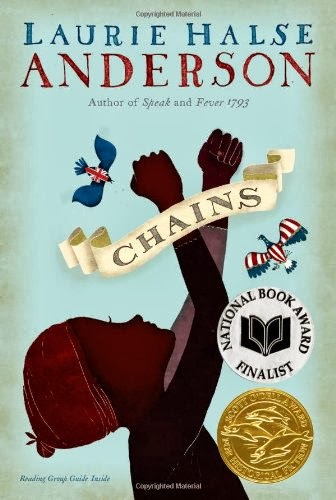
Chains by Laurie Halse Anderson

I bought Chains ages ago, but never got around to reading it.  It was actually the book that motivated me to participate in the 2013 American Revolution Reading Challenge over at War Through the Generations.  And yet, it still sat on the shelf.  So naturally, when Anna and Serena, the hosts of War Through the Generations, announced that there was going to be a Chains read-along, I jumped at the chance to sign up.  AND I AM SO GLAD I DID!  But now that I have read the book, I can't understand what took me so long.

Chains is the story of a young slave girl who yearns for freedom.  Isabel, 13, and her younger sister Ruth are quickly sold by a greedy nephew for the money they will bring after their somewhat benevolent owner, Miss Fitch, passes away.  But Miss Fitch had promised them freedom after her death and Isabel can't get that promise out of her head.

Now, as the American Revolution begins, the sisters find themselves in a Loyalist household in New York City at the mercy of a cruel mistress, Mrs. Lockton.  The Locktons, who know their bread is buttered on the side of the Loyalist and King George III, despise the Patriots who want independence from and everything they stand for.

It isn't long before Isabel meets Curzon, a slave working for the Patriots, and known for the red tricorn hat he is always seen wearing.  Curzon convinces Isabel to spy on Mr. Lockton, and report anything she hears that might be useful to the Patriots.  Isabel isn't very enthusiastic about doing this, but when she is given the devastating news that Mrs. Lockton has sold Ruth, she changes her mind.  It had just been discovered that Ruth suffers from seizures and the very ignorant, superstitious Mrs. Lockton believes that they are a sign that the devil is in Ruth.

Curson proves to be a good friend to Isabel, although she has very mixed feelings about him, the war between the Patriots and the Loyalists and which side would be most beneficial to her in terms of getting her freedom.

As the war heats up, so does Isabel's determination to find her sister and, as she is told by an elderly slave known as Grandfather, to find the way to cross her own River Jordan* to freedom.

Chains is written in the first person, so we always know exactly what is going on in Isabel's mind, how she perceives everything around her and, most poignantly, how she feels about the things that happen to her.  But by spying on Mr. Lockton and his friends, we are also given a certain amount of insight into the Loyalist side of things.

Isabel is a very strong willed girl and Mrs. Lockton knows it and is determined to break that will and so she is constantly trying to tighten the chains of slavery that bind Isabel.  Yet, it takes a while for the realization that Mrs. Lockton cannot chain her soul to really sink in to Isabel's consciousness, even though all her actions had always already proven it to be true.  Her strength in the face of Mrs. Lockton, her wavering between the Patriots and the Loyalists, her determination and her innate sense of kindness despite everything all make Isabel such an exemplary protagonist.

In fact, Anderson has created a whole cast of characters in Chains who play their parts to perfection.  Set against the backdrop of New York City,  Anderson has written a brilliantly crafted novel in which the fictional walk through the historical and it is spot on.  Anderson has even turned New York into a character in its own right, by staying true to the history of the time (NB: I used to teach New York history to my 4th graders and it was my favorite thing to teach).

One of the things I really liked about Chains were the quotes used at the beginning of each chapter.  These quotes are from actual sources of the time that help situate the reader and gives the novel a real feeling of authenticity.

I don't think I could possibly recommend this book highly enough.

This book is recommended for readers aged 14+
This book was purchased for my personal library

Laurie Halse Anderson has excellent teaching resources for Chains, including a section on how to put on a colonial tea (with some really good recipes).  You can find it HERE

This is book 3 of my 2013 American Revolution Reading Challenge hosted by War Through the Generations

This is book 10 of my 2013 Historical Fiction Reading Challenge hosted by Historical Tapestry

*I was talking to a friend about Chains and she said she didn't get the River Jordan reference, which is a reference to the God's command that after the death of Moses, Joshua would lead the Israelites out of slavery in Egypt to freedom in the promised land by crossing the River Jordan.