Showing posts with label Non-Fiction Monday. Show all posts

Monday, July 28, 2014

Eyewitness World War I by Simon Adams, photography by Andy Crawford

Today marks the 100th anniversary of the start of World War I.  I have to be honest and say this I don't really know much about this war except what I learned in school, or from a few books I have read.  And I have always felt that when your knowledge is lacking on a particular topic, begin learning about it by looking at a good overview, then you can look more closely at particular areas that might be interesting to you.

So, when I realized this anniversary was coming up, I decided to begin with one of DK's Eyewitness books.  Eyewitness World War I begins with an introduction to Europe at the beginning of the 20th century, explains who the major powers were and well as the major conflicts that created alliances that would prove to be important in 1914 and the beginning of World War I.

The war was a result of the assassination of Archduke Franz Ferdinand, the heir to the Austro-Hungarian throne.  He was shot in Sarajevo, Bosnia.  Bosnia was claimed by Serbia, so naturally Austria-Hungary blamed Serbia for the assignation and declared war on them on July 28, 1014.  Immediately, countries began to chose side - Germany supported Austria-Hungary, Russia supported Serbia, France supported Russia, then Britain declared war on Germany for invading Belgium.  The US didn't enter the war until April 6, 1917.

Each important aspect of the war is cover, usually in two page spreads, with lots of photographs supporting the text.  Readers will learn about how people signed up to fight, the most important battles, the role of women, the use of air power for the first time in a war:

Source: DK Eyewitness 

Other topics included are Life in the Trenches, the War at Sea, and the use of one the worst weapons of this war - the Gas Attack.  I have always been interested in spying and code breaking, so I was happy to see pages devoted to Espionage:

Source: DK Eyewitness

World War I made good use of carrier pigeons, using up to 500,000 of them according to this page of the book, for espionage and often for sending messages from behind enemy lines.

Back matter to Eyewitness World War I includes more facts, a Q&A, a list of important people and places, where to go to find out more, places and websites to visit, a Glossary and in Index.

If you have a young reader developing an interest in war books, Eyewitness World War I would be a good introduction for them.  And if you are a classroom or home schooling teacher, this is one you will definitely want as a resource for students.  I use my Eyewitness World War II book all the time, and kids really like all the photographs of what people and things looked like.  I'll be placing Eyewitness World War I with it for their use, since WWI is on the agenda for the next next year.

This book is recommended for readers age 8+
This book was purchased for my personal library

It's Nonfiction Monday, be sure to visit today's Round Up of other nonfiction books for kids and teens


Thursday, February 21, 2013

Courage Has No Color: The True Story of the Triple Nickles by Tanya Lee Stone

I first heard about the Triple Nickles when I read the book Jump into the Sky by Shelly Pearsall, the story of a young African American boy whose father was a paratrooper in 555th Parachute Infantry Battalion, or the Triple Nickles.

Now, Tanya Lee Stone's Courage Has No Color tells the true story of the Triple Nickels, America's first and only all black unit of paratroopers in World War II.  She begins their story by describing in graphic detail what it feels like to jump out of an airplane and parachute back to earth, to give you an idea of the level of courage it takes to be a paratrooper.  It is not something I think I would want to ever do.    

From there she writes about the kind of treatment black soldiers received in the military: segregated and relegated to service work and treated like servants.  It was demeaning and demoralizing to the men who joined the military to fight for their country and freedom.  One man, Walter Morris, a first sergeant in charge of Service Company of The Parachute School, saw how being treated like servants was affecting the men serving under him.  Morris devised a plan to teach his men how to feel like soldiers again.  It was his plan to teach them what they needed to know to become paratroopers.  And so after the white serviceman were finished practicing for the day, and the black servicemen arrived to start cleaning up after them, they also began their training.  And someone noticed how well they learned what was needed to become a successful paratrooper.  Pretty soon, the First Lady Eleanor Roosevelt, long a proponent of equality, got into the act.

In 1941, The 99th Pursuit Squadron, or the Tuskegee Airmen, was formed and the men trained to be the country's first African American aviators.  And in 1943, these airmen were finally sent into combat overseas.   But the 555th Paratrooper Infantry Battalion was finally formed in February 1943.  Though trained as paratroopers, the Triple Nickles would never be used in combat, instead they were sent to Oregon to fight fires.  Turns out those fires were started by balloons sent over by Japan for that very purpose.

All of this and much more about the people and history of the 555th is detailed in Courage Has No Color, including an in-depth explanation of how they got their name - yes, there more to it than just 555.  It is a fascinating book covering this little known aspect of the United States military and World War II and an exceptional contribute to the history of African Americans in this country.

Stone has done an exemplary job of gathering primary source material, including interviews with some the of members of the 555th and lots of archival photographs, to bring to life the courage and heroism of these men and their accomplishments even against all odds.  Included is a very eyeopening timeline of the desegregation and the Triple Nickles,

Sadly, the United States Military was not desegregated until 1950.

This book is recommended for readers age 10+
This book was obtained from the publisher

Oh yes, remember that description of jumping out of an airplane I mentioned, well, you too can experience what it is like to be a paratrooper by reading it here.

A very useful teaching guide including Common Core connections, can be downloaded here.

Monday, February 11, 2013

His Name was Raoul Wallenberg: Courage, Rescue and Mystery During World War II by Louise Borden

In January, I was very pleased to learn that Louise Borden and her book His Name Was Raoul Wallenberg had been named winner of the 2013 Sydney Taylor Book Award for Older Readers by the Association of Jewish Libraries.  The Sydney Taylor Book Awards are given annually to those outstanding works that authentically portray the Jewish experience.

Born into a relatively well-to-do family of bankers in Stockholm, Sweden in 1912, Raoul Wallenberg was always excited and curious about everything and his endeavors were encouraged and supported by his family.  At age 11, he traveled alone from Sweden to Turkey on the Orient Express to visit his grandfather, Gustaf Wallenberg, Sweden's minister to Turkey.  And at age 19, he left Sweden to attend college at the University of Michigan, majoring in Engineering.  When he returned to Europe, Raoul spent time travelling and as he did, he began to hear stories from Jews who has escaped Hitler's Germany, stories about new laws, beatings and even murder inflicted on Jews by the Nazi government.

Raoul had taken a job and was an excellent salesman, helped by his ability to speak different languages.   But pretty soon the world was at war.  As he watched country after country fall to Nazi occupation, he worried about Sweden's neutrality.  Denmark and Norway, close neighbor, had already fallen to the Nazis.  When roundups and deportations were announced in Denmark in 1943, Sweden gave permission for Danish Jews to enter the country, saved by the many Danish fisherman willing to sail them there.  Swedish freedom and neutrality remained intact.

Hungary was also a country with a large Jewish population, but it was not a neutral and in 1944, it, too, became a Nazi occupied country.  Roundups and deportations of Hungarian Jews began and many went to the Swedish embassy seeking visas to Sweden.  But the War Refugee Board in America wanted a neutral Swede to organize some relief for the Jews in Hungary.  Raoul Wallenberg, with his  many languages and skill as a salesman, was just the person they needed.

Wallenberg devised a legal looking Protection Pass or Schutzpass that were like Swedish passports and protected the bearer from deportation.   Wallenberg even created a single Schutzpass that protected whole families.  But the Schutzpass, which probably saved around 20,000 people, was only one way Wallenberg worked to help Hungarian Jews.

Ironically, the man who worked tirelessly to save Jews, was picked up by the Soviet military in Hungary and on January 17, 1945, he was last seen being driven away in a Soviet car, and was never to be heard from again.

The details of Wallenberg's life and the work he did saving Jews in Hungary are all nicely detailed in-depth in Borden's free verse biography of this incredible man.  His Name Was Raoul Wallenberg is beautifully put together, divided into 15 sections, each one chronicling a period of Wallenberg's life with a wealth of supporting photographs and other documents that give a comprehensive picture of his life as he grows and changes and even goes beyond his disappearance up to the present.   As you will discover when you read the Author's Note at the back, Borden had the privilege of working closely with his family over many years and so had much more personal insight into the real child and man that was Raoul Wallenberg than biographers are generally privy to.  And that shows throughout the book.

But His Name Was Raoul Wallenberg is more than just a biography, it is a shining example of one man who rose to the challenge at a very bleak time in history and who made a difference in the world, saving so many Hungarian Jews from certain death.  Borden has written a book that is a fine addition to the whole body of Holocaust literature and anyone interested in the Jewish experience at that time.

Raoul Wallenberg was named Righteous Among The Nations by Yad Vashem in 1963 in Israel.

Come back tomorrow for an interview with Louise Borden.

This book is recommended for readers age 12+
This book was purchased for my personal library

You can find more information about Raoul Wallenberg at his alma mater, the University of Michigan, here

You can find more on Raoul Wallenberg and the plight of Hungarian Jews at the United States Holocaust Memorial Museum here

Be sure to visit Louise Borden's website here

This review also appears on my other blog Randomly Reading

Nonfiction Monday is hosted this week byAbby the Librarian


Monday, January 28, 2013

World War II Pilots: an Interactive History Adventure by Michael Burgan

Last April, I reviewed an interactive book from the YouChoose World War II series called World War II: On the Home Front by Martin Gitlin.  I found it to be an excellent book for introducing readers to life on the home front.

Now comes this latest YouChoose adventure, World War II Pilots.  The basic premise is that you are given a situation and the story unfolds based on the choices you make at certain junctures of the story.   In Chapter 1 of World War II Pilots, the reader is first given some historical information about the events that led to the war beginning at the end of World War I.

At the end of the chapter, you have 3 choices: to follow the path of a British pilot in the RAF, an American pilot fighting in the Pacific Ocean or a Tuskegee Airman - all very interesting choices.  So you choose your path and at the end of each chapter, more choices can be made regarding the fate of the chosen pilot.  In fact, there are 36 choices altogether, given each pilot 12 possible ways to go.  And in the end, there are 20 different possible endings - 7 for the RAF pilot, & for the American pilot and 6 for the Tuskegee Airman.

I know this all sounds complicated.  I also think that, too, whenever I start these kinds of books, but they are designed for young readers and really aren't difficult at all and in fact, they are quite informative without being overwhelming.  I actually enjoyed going back and forth and making choices to see where each path led.  I also liked the photographs that are included and relevant to the path I was following.  For example, when I picked the Pacific Ocean pilot, there were pictures of things like Bataan, or the carrier he might taken off from.  I also found that concepts that might not be familiar were clearly explained.

I especially like the back matter.  First, there is a timeline of events in the war relevant to the stories.  Next, there are suggestions for designing your own World War II pilot stories - a female pilot in the RAF or in the US, a German pilot during the Blitz, a POW held by the Japanese or Germans, all requiring so research and imagination.  To help this along, there are suggestions for further reading in print and the Internet, a glossary and an extensive bibliography.

World War II Pilots is an excellent book for leisure reading as well as home schooling and classroom use.

This book is recommended for readers age 9-12
This book was an E-ARC from Net Galley

Curious?  You can download a sample chapter of World War II Pilots at Capstone Young Readers.

Nonfiction Monday is hosted this week by Laura at laurasalas


Monday, December 31, 2012

The House Baba Built: An Artist's Childhood in China by Ed Young and Libby Koponen

 About a year ago, I reviewed Allen Say's autobiographical work Drawing from Memory and the effect World War II had on his life growing up in Yokohama, Japan.  Ed Young's The House Baba Built is also an autobiographical work and describes his life in Shanghai, China during the war.

Ed Young's father was an engineer and realizing that war was coming to China, he decided he needed a safe place for himself, his wife and five children to live in.  The safest place would be around the foreign embassies in Shanghai, known as the International Settlement.  But land there was expensive and so Baba (an affectionate term for father) made a deal with a landowner - Baba would built a house on his land with the proviso that his family could live in it for 20 years.  The family moved into the house in 1935 and for the first few years that they lived in Baba's house, life was good.  There was a lovely swimming pool, where friends and family would gather in summer, there was lots of pretend playing, lovely gardens and even a roof that made a great roller skating area.  Life wasn't rich in goods, but it was rich in so many other ways.

But when the Japanese invaded Nanking in 1937, Baba had to build an apartment where the kids roller skated because relatives from there had escaped to Shanghai to live.  After that, the effects of the war began to be felt more and more.  And in 1940 a family who had escaped Hitler's Germany, the Luedeckes, also moved into Baba's house.

The three families living in Baba's house were very fortunate.  Even after things changed with the bombing of Pearl Harbor and the loss of British and American protection, the house that Baba built was able to withstand the war, and even when bombs were being dropped directly on Shanghai, they missed the house completely.

When the 20 years were up, the Young family honored their contract and turned the house over to the landowner.  By then, most of the children had grown, married and gone their own way.

It was during the war, living in Baba's house, that Young discovered his talent as an artist.  Given crayons and paper to use while recovering from a cold, his first attempt at drawing was a cowboy that didn't quite match what was in his mind.  But he sought guidance and the rest is history.  For The House Baba Built, he used a mixed media, which gives it depth and texture.  Young's family is shown in an interesting combination of old photographs and drawings, there are all kinds of collages (my favorite art form), and some of the pages fold out to reveal even more of the life of the Young family in Baba's house.

Most of the book consists of vignettes that are put together to resemble the collages, rather than a linear history of Young's early life.  However, there is a timeline at the end which can help orient the reader if needed.  And there is an extended section at the end of the book of later photographs, including Baba's house, as well as a diagram of the house and some facts regarding how the house was built to bombproof it.

All in all, The House Baba Built is an interesting book for all kinds of readers, but especially a reader who likes to explore each and every page of an illustrated book.  This is a work that proves itself to be an insightful look at some of the early influences on a beloved author/illustrator.

This book is recommended for readers age 8+
This book was borrowed from the Webster Branch of the NYPL


Facts First! Nonfiction Monday is hosted this week by ProseandKahn


Kid Lit Blog Hop

Monday, November 5, 2012

The Poppy Lady: Moina Belle Michael and her Tribute to Veterans by Barbara Elizabeth Walsh

Once again, it will soon be Veteran's Day in the US and Remembrance Day in many other countries around the world.  This is a day we set aside to honor, remember, and reflect on those persons who are serving and have served their country during armed conflicts and is often referred to as Poppy Day, thanks to the efforts of Moina Belle Michael A/K/A The Poppy Lady.

Now Barbara Elizabeth Walsh has written a book detailing how Moina earned her nickname.  Walsh begins with a brief introductory prologue describing Moina's life up to World War I.  Moina was a well-educated girl from Good Hope, Georgia who began teaching the children of neighbors in 1885 in an old slave cabin at the age of 15.  By the time World War I broke out, she was a university professor at the University of Georgia.

The rest of The Poppy Lady is a narrowly focused narrative about Moina's attempt to do something meaningful for the soldiers who fought in the Great War.  It begins Moina's story with the start of the war, while she was traveling through Europe.  Still disturbed by what she had seen of the fighting after she returned home, Moina was determined to do something for the soldiers after the US entered the war in 1917.  Like many women on the home front, Moina knitted warm items, rolling bandages, collected books and magazines and even invited soldiers home for a meal, but she continued to feel she could do more.

So off she went to New York and set up a welcoming place in Hamilton Hall, Columbia University, where soldiers could come and relax, talk and get information.  But even though it was a hugh success, but Moina wanted to do still more.

One day she read the poem "We Shall Not Sleep" by Lieutenant Colonel John McCrae, a Canadian doctor, which honors the soldiers fallen on the battlefields of Flanders, Belgium.  Moved and inspired, Moina began wearing and giving out poppies as a tribute to those soldiers.  Other began to follow her example and eventually the poppy was adopted around the world as a symbol of honor and remembrance for the fallen members of the armed services.

What a wonderful introductory biographical account of Moina Belle Michael's work during and after World War I Barbara Elizabeth Walsh has written about this not well known lady who did so much.
Layne Johnson's lavishly detailed oil on canvas painting do much to capture Moina's spirit.  Just look at the exuberant expression on her face on the cover of The Poppy Lady or in the image below:


A picture books illustrations do so much in furthering the telling of a story and that is certainly true here.  Together with Walsh easily accessible text, Moina's determination simply shines through, making The Poppy Lady a truly inspirational book for young readers that shows how one person can make a big difference.

This book is recommended for readers age 7-10.
This book was sent by the publisher.

To learn more about the poppy and Moina Belle Michael be sure to visit The Great War 1914-1918
You can find out more about author Barbara Elizabeth Walsh here.
Be sure to visit artist Layne Johnson to see more of his work from The Poppy Lady

This week's Non-Fiction Monday round-up is hosted by Booktalking


Monday, April 16, 2012

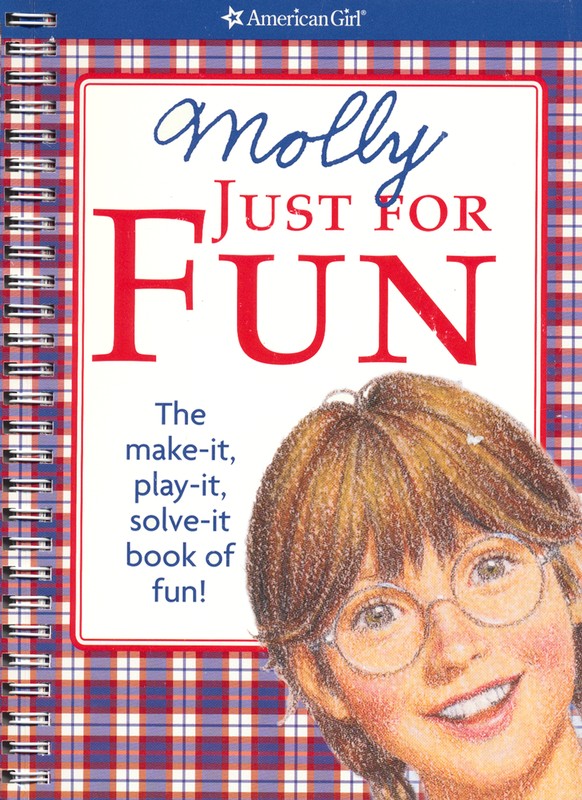
Molly - Just for Fun: The Make it, Play It, Solve It Book of Fun

My 9 going on 10 year old niece L'naya was visiting me this past spring break.  She has always spent her school vacations with me and one of the things she really enjoys is playing with my daughter's American Girl doll Molly (which is now 9 going on 21.)

Before L'naya arrived, I had gone to a bookstore to see if there were any new Molly books that we didn't already own.  I bought one called Molly Just for Fun and put it away for a rainy day while my niece was visiting.  Well, weather being what it has become lately, we never saw a single raindrop, so I just gave it to her.

Molly Just for Fun is exactly what it is described as: a make-it, play-it, solve-it book of fun - in other words, an activity book.  I thought that since L'naya was learning about World War II and the Holocaust this year in school, it might be fun to see what kinds of things kids did back them.

I was wrong!

Molly Just for Fun is basically an expensive book, $12.95, of do-once-then-become-bored activities.  The first activity is called Sticker Sudoku.  You solve the puzzle using pictures from Molly's 1940s life instead of numbers.  And I am pretty sure that no one had even heard of Sudoku back then.  L'naya did like learning how to make a secret code, but I could have shown her that - I learned this particular method when I was a kid.  Very few of the activities call for a child to use their imagination or involve any of the arts and crafts projects kids usually enjoy so much.

So I am sorry to say, I would not recommend Molly Just for Fun.  Much better is Molly's Cookbook: A Peek at Dining in the Past with Meals You Can Cook Today.  This is an old 1994 edition that belonged to my daughter when she was young and was published by The Pleasant Company.  

Molly's Cookbook really does teach kids about food during the war when shortages and rationing made life so very difficult.   And there lots of fun recipes like Volcano Potatoes and Deviled Eggs, both of which we have often enjoyed.

Molly's Cookbook is not to be confused with Molly's Cooking Studio, a newer, more high priced book published after The Pleasant Company was sold to Mattel.  And even though Molly's Cookbook is not longer published, it is easily available online, sometimes as low as 25¢.  This is a wonderful book for adults and kids to work together in the kitchen.  Kids learn not just about food in the war, but also how to prepare simple but tasty food and basic kitchen safety.

In my house the all-time favorite recipe in Molly's Cookbook is a breakfast dish called Toad in the Hole which I learned how to make in Girl Scouts when we called them Sunshine Eggs.


Enjoy!

Non-Fiction Monday is hosted this week by The Nonfiction Detectives

Monday, April 9, 2012

World War II: On the Home Front by Martin Gitlin

World War II: On the Home Front is described as an Interactive History Adventure.  It begins with an explanatory chapter giving a brief introduction about how and why World War II began for the United States.  Then the reader is supposed to choose a story path to follow.

There are three path choices: a woman living in New York City, with one child and a husband who is serving in the Armed Forces overseas; a 12 year old boy living in San Diego; or a wounded African American veteran from the segregated south.  At the end of each chapter, the reader can make more choices and as the story progresses can more fully experience what it might have really be like for either the woman, the boy or the soldier.

Depending on which path the reader chooses, there is a possible 7 endings for each one.  Everything depends on the choices made, yet in the end the reader comes away with a pretty good overview of what life on the American home front in World War II.

Title: Twice a Patriot!
Sound complicated?  I thought so, too, and yet when I sat down to read this book, I found it really quite interesting and novel and not hard to figure out.  I liked the interactive element of the book, found the pictures and posters were appropriate to what was being experienced in the chapter where they appear and I liked going back and exploring a new and different path for each character.  History and concepts were explained clearly and concisely, and there is also a timeline a glossary, suggestions for further reading, and a well done index, making it a well-rounded book.

I also really liked that the author makes suggestions for paths that the readers can do themselves: explore life as a German or Italian American, as a man declared 4F or the famous people who entertained the troops.  The war affected people differently and this books helps make that clear.  The interactive element is furthered by suggesting that kids create paths for these or other additional experiences.

World War II: On the Home Front is perfect book for homeschooling or classroom use when studying the war.

This book is recommended for readers age 9-12.
This book was purchased for my personal library.

Non-Fiction Monday is hosted today by Ana's NonFiction Blog

Monday, February 27, 2012

A Picture Book of Anne Frank by David A. Adler, illustrated by Karen Ritz


It is my turn to host Non-Fiction Monday today, so please simply leave your link in the comments section below and I will update throughout the day.  
Today I have chosen a book by David A. Adler, who is one of my favorite children’s authors and who is an extraordinarily prolific writer.  No only has he written numerous Can Jansen mystery books for young readers, but he has also a number of biographies and Holocaust books.
In his Holocaust books, Adler has always managed to take a frightening subject like the Holocaust and make it accessible to children without trivializing it.  A Picture Book of Anne Frank is an excellent example of his ability.
This biography is meant as an introduction for readers who may be too young to know much about the Holocaust and may not ever know who Anne Frank is.  It covers all the important aspects of Anne’s life, from her birth in Frankfurt am Main, Germany on June 12, 1929 to her death in March 1945 in Bergen Belsen Concentration Camp.  
Interestingly, Adler does not make any one area of Anne’s life more importance than any other area.  Often, writers will stress the diary, hiding in the attic or her personality and even her crush on Peter Van Daan, but here she is presented as a whole person, and these things, while important, are aspects of her life, no one thing is what defines Anne.  I like that as an introductory biography.  
Accompanying the text are illustrations by Karen Ritz.   A Picture Book of Anne Frank was her first picture book assignment and, she writes, the first time the Holocaust was illustrated in picture book form so teachers did not have to resort to historical photographs to teach young children about the horrors of the Holocaust.  For this book, she used watercolor to portray the story, and included graphic pencil drawing to look like photos of Anne’s life, which were based on actual photographs.  
The mixing of Karen’s art mediums and David Adler’s text are an excellent, effective way of writing about Anne’s life in this highly recommendable book.


This book is recommended for readers age 6 and up.
This book was borrowed from the Wakefield Branch of the NYPL.


An activity guide for A Picture Book of Anne Frank is available here.


And be sure to visit David Adler's website for more information about his many books, as well a Karen Ritz's website to see more of her outstanding artwork.


A Picture Book of Anne Frank
David A. Adler, author
Karen Ritz, illustrator
Holiday House 
1993
29 Pages


Be sure to check out these excellent Non-Fiction reviews:


Jeff at NC Teacher Stuff has an iPad App review at http://ncteacherstuff.blogspot.com/2012/02/nonfiction-monday-polar-bear-horizon.html

Natalie is offering a review of Raggin' Jaxxin' Rockin' and an interview at http://bibliolinks.wordpress.com/2012/02/27/raggin-jazzin-rockin/

The Swimmer Writer has a review on A Leaf Can Be,,, at http://theswimmerwriter.blogspot.com/2012/02/wonder-of-leaves.html

Tara has a review at A Teaching Life on two picture books at
 http://tmsteach.blogspot.com/2012/02/nonfiction-monday-and-ya-roundups.html

Lisa at Shelf-employed has a special announcement about Kidlit Celebrates Women's History Month at http://shelf-employed.blogspot.com/2012/02/womens-history-month-blog.html

Peggy at Anatomy of NonFiction also has an interview with the author of A Leaf Can Be... at
http://anatomyofnonfiction.blogspot.com/2012/02/interview-with-laura-purdie-salas.html

At SimplyScience, Shirley has a post on Filling the Earth with Trash at
http://simplyscience.wordpress.com/2012/02/22/filling-the-earth-withtrash/

At the Jean Little Library, Jennifer has a review on Prairie Dong's Hideaway at
http://jeanlittlelibrary.blogspot.com/2012/02/nonfiction-monday-prairie-dogs-hideaway.html

Myra tat Gathering Books has a review of My Hands Sing the Blues at
http://gatheringbooks.wordpress.com/2012/02/27/my-hands-sing-the-blues/

Scope Notes offers a review of Giant Squid at  
http://100scopenotes.com/2012/02/27/nonfiction-monday-giant-squid-by-mary-m-cerullo/

Books4Learning has a review of Multiply on the Fly at http://books4learning.blogspot.com/2012/02/picture-book-math-science-multiple-on_27.html

Today, Laura Thompson has an interview with Cynthia Levinson, author of We've Got a Job: the 1964 Birmingham Children's March at http://lauriethompson.com/2012/02/27/interview-author-cynthia-levinson/

Jeanne at True Tales & A Cherry On Top is featuring Magic Trash - A Storu of Tyree Guyton and his art at http://jeannewalkerharvey.blogspot.com/2012/02/magic-trash.html

Heidi at Geo Librarian is highlighting All the Water in the World at http://geolibrarian.blogspot.com/2012/02/nonfiction-monday-all-water-in-world-by.html.

Amanda at A Patchwork of Books talks about What We Wear: Dressing Up Around the World at
http://apatchworkofbooks.blogspot.com/2012/02/non-fiction-monday-what-we-wear.html

Over at Ms. Yingling Reads you can find reviews on both Little Rock Girl and Quarter Horese Are My Favorite at http://msyinglingreads.blogspot.com/2012/01/greenberg-david-t.html

At Apples with Many Seeds Tammy is looking at 13 Art Inventions Children Should Know at
http://applewithmanyseedsdoucette.blogspot.com/2012/02/breaking-ground.html

At Booktalking, there are two books you might like - Underground and Fort Mose and the Story of the Man Who Built the First Free Black Settlement in Colonial America at http://wp.me/pa8jB-1n6

And finally, Nonfiction Book Blast offers What Lies Beneath? Exploring the Subterranean Fury of Plate Tectonics at http://wp.me/p1o4au-eG

Caryl's first non-fiction Monday post is about Candace Fleming's Amelia Lost at http://leaningtowerofbooks.blogspot.com/2012/02/book-8-amelia-lost-life-and.html

Beth at Literary Chicken takes a look at Girl Hero: Claudette Colvin Twice Towards Justice at
http://libraryfrog.blogspot.com/2012/02/girl-hero-claudette-colvin-twice.html

Monday, October 24, 2011

Irena’s Jars of Secrets by Marcia Vaughan

Marcia Vaughan's book, Irena's Jars of Secrets, is an informative look at the life of a brave, young resistance worker in the face of great danger.

Irena Sendler was a pretty young girl living in Warsaw, Poland when the Nazis invaded her country. Late in 1940, they forced Warsaw’s more than 400,000 Jews into some crowded, run down buildings, separated from the rest of that city by a 7 foot brick wall the Nazis had built, where they began their fight for survival in the Warsaw Ghetto.

Irena Sendler, a young social worker, and the daughter of a physician who had been willing to treat poor Jews during a Typhus outbreak years earlier, decided to follow in her father's footsteps and try to help ease the suffering of the Jews behind the wall.

Against this background, Vaughan tells the story of this remarkable young woman who risked her own life over and over to try to save others. By now, most of us know about Irena smuggling activities – bringing clothing, food and medical supplies into the ghetto, and sneaking children out and to safety. To keep track of the children, whose names had to be changed so they could pass as Christians, she wrote down their real name and their false identity and buried them in jars in the hope that they could some day be reunited with their families.

Irena’s smuggling activities came to an end when she was betrayed to the Gestapo in 1943. She was sentenced to death but, despite being tortured, never betrayed any her secrets, including the location of the jars that had the potential to destroy so many lives in the hands of the Nazis.

Irena Sendler as a young girl
Vaughan’s biography about Irena Sendler is presented in very accessible language, detailing how she began her work on her own, and later joining Zegota, a secret organization for helping Jews. She also includes some personalized narratives of Jews deciding to send their child into the unknown with Irena, rather than face deportation. Vaughan gives a real sense of the despair, desperation and even the ambivalence these parents must have felt about turning their children over to Irena without a real guarantee of their safety.

The narrative is enhanced by the excellent oil paintings of illustrator Ron Mazellan throughout the book. Mazellan paintings reflect the dark uncertain times that people experienced under the Nazis. Yet, for all their emotional content, the paintings are done in a kind of soft focus, powerful without being frightening and detracting from the narrative.

Irena’s Jars of Secrets is an excellent addition to the ever growing body of Holocaust literature for younger readers. I think it is important that children know there were some people acting unselfishly and courageously amid so much cruelty. This important story is a must read for anyone teaching or just interested in the Holocaust.

This book is recommended for readers age 6-11
This book was a received as an E-ARC from Netgalley.com

Yad Vashem named Irena as one of The Righteous Among The Nations in 1965

Irena Sendler's obituary from the New York Times
(I had a teacher in junior high who told us to always read the obits in the newspaper because you can learn so much about a person there and it has really been true, which is why I sometimes include them)

Non-Fiction Monday is hosted this week by Apple with Many Seeds


Irena's Jars of Secrets
Marcia Vaughan
Lee & Low
Available 11/1/2011
40 Pages

Monday, September 19, 2011

Women Heroes of World War II: 26 Stories of Espionage, Sabotage, Resistance and Rescue by Kathryn J. Atwood

In Women Heroes of World War II, Kathryn Atwood has written a very moving account of 26 strong, courageous women who stood up to the Nazi scourge at great risk to their own lives. Some joined underground resistance movements in Nazi-occupied countries, others rescued Jews and Allied soldiers caught behind enemy lines or worked as spies, mingling with the enemy to gather useful information. And all of their stories are amazing.


In Poland, 19-year-old Irene Gut worked for a high ranking German officer in his villa. She was able to hide 12 Jews in the basement of the house, right under his nose. When he found out, he offered to keep quiet, but at a high price. Irene realized that the fate of 12 human beings rested on whether or not she would accept the offer.

Sophie Scholl, a college student in Munich, Germany wasn’t much older than Irene when she began her Resistance activities. Along with 10 others including her brother Hans, Sophie belonged to the White Rose (die Weiße Rose.) The group wrote and distributed six extensive anti-Nazi leaflets urging people to denounce Hitler’s government in word and deed. Anti-Nazi behavior was considered treason, punishable by death. Sophie and the other members of the White Rose knew the consequences of their actions, but continued their activities.

Other women in Women Heroes of World War II were surprises to me, for example, Josephine Baker and Marlene Dietrich. Josephine Baker, an African-American, had lived in Paris for many years after leaving the US in part because of the racism she encountered here. As an entertainer, Josephine had the perfect cover for a spying. Before France fell to the Nazis, Josephine did some espionage working for the Deuxième Bureau, a French intelligence agency. Her celebrity status allowed her to mingle at parties where she would listen in on conversations and acquire much need information

Marlene Dietrich, though German born, was an American citizen who worked against the Nazis and volunteered to entertain troops for the USO, often at great risk to herself. Sometimes, she was so close to the front lines, she could hear gunfire and bombs going off. When she started to use her signature song, Lilie Marlene, in English for the troops, the Nazis were livid, that had been their World War I song.

These are just a few examples of the lives of the extraordinary women who risked everything to help others in very dangerous situations that are included in this book. Though every story is different, the women were motivated by the same thing: when the time came, they did what they felt was right.

Women Heroes of World War II is a well written, well researched book. Ms. Atwood profiles the resistance activities of women from eight countries: Germany, Poland, France, The Netherlands, Belgium, Denmark, Great Britain and the United States. There is also a brief summary of the way in which each country entered World War II. This information really helps the reader appreciate the dangers and obstacles these woman faced. Each woman’s story is also supplemented with additional material, for example, passages from the leaflets written by Sophie Scholl and the White Rose, or the edict issued when Denmark was forced to surrender to the Germans. At the end of every woman’s story is a list of resources where the reader can go to find more information about her. The beauty of the organization of this book is that it can be read from cover to cover, as I did, or in parts. Each narrative stands on it own. This makes it ideal as a teaching tool and I can’t recommend it highly enough.

Women Heroes of World War II is recommended for readers age 12 and up.
This book was purchased for my personal library.

Women Heroes of World War II
Kathryn J. Atwood
Chicago Review Press, 2011
266 pages

See Goodreads for an interesting story about how Kathryn Atwood touched history while writing Women Heroes of World War II.

A longer version of this review can be found at Kidlit Celebrates Women's History Month 2011

Non-Fiction Monday is hosted this week by Tales from the Rushmore Kid

Monday, August 29, 2011

Surviving the Angel of Death: the Story of a Mengele Twin in Auschwitz by Eva Mozes Kor and Lisa Rojany Bucceri

Almost from the moment 10 year old twins Eva and Miriam Mozes stepped out of the cattle car that brought them to Auschwitz, they were separated from their mother, father, and older sisters, never to see them again. Eva comments over and over on the constant smell that permeated Auschwitz from the gas chambers, but even as she instinctively knows that this is the fateful death that the rest of her family had immediately met, she continues to hope they could somehow survive.

The girls were put into a barracks with all the other twins chosen for the sadistic, inhuman medical experiments of Dr. Josef Mengele, the Angel of Death. Eva, the stronger of the twins, takes it upon herself to look after and care for her sister Miriam. Like all of Mengele’s twins, Eva and Miriam were allowed to keep the clothing they arrived in, as well as their hair, but they were forced to scrounge and “organize” for anything else that would help them survive, even as they were being experimented on.

The strength and resourcefulness of these two girls amazed me. Once day, for example, Eva was given a shot that Miriam was not also given. During the night, she began to run a high fever, within 48 hours her legs were swollen and covered with red patches. Despite the pain and chills these caused, Eva was determined to stand for roll call and not go to the infirmary, since the only way out of it was death and they knew that if one twin died, the other would be killed. She missed roll call thanks to an air raid, but was soon sent to the infirmary to die anyway. On a visit with other doctors, Mengele indicated she had only two weeks to live. But Eva was determined not to be sent to the gas chamber, even though she was not fed or given water. Desperately thirsty, each night, she would crawl on all fours to the end of the infirmary barracks to a water faucet, determined to live. After two weeks, Eva’s high fever broke. But she had to learn how to manipulate the thermometer to fool Mengele into thinking her temperature was normal. Unfortunately, when Eva returned to the barracks and Miriam, she discovered that, because the doctors believed that she would die, her sister had been subjected to injections that caused to her to quite listless and which ultimately stunted the growth of her kidneys.

Both of these 10 year old sisters managed to stay alive in Auschwitz, despite Mengele’s horrendous genetic experiments. Their story is a testament to courage and determination, which will, hopefully, be especially interesting to young readers. And, although I am a firm believer in forgiveness, even I am amazed that Eva was able to eventually find it within herself to forgive Mengele. I’m not sure I could or would go that far. Mengele, after all, was the arbiter of life and death at Auschwitz.

Surviving the Angel of Death: the Story of a Mengele Twin in Auschwitz is told in a straightforward manner, neither too graphic to scare readers nor so sketchy that it diminishes the level of cruel, heartless treatment Mengele’s twins were subjected to. The writing style is intimate and informal, as though Eva Mozes were telling her story to Lisa Rojany Bucceri and I was allowed to listen in. It never gets pedantic, and there is never a sense of self-pity. I suspect Eva is still the same strong feisty fighter now that she was at 10. The book also contains a number of personal family photos of the Mozes family, some from before the war, some from after, as well as pictures their life after the war. There are also general photographs of Auschwitz.

After the war, Eva lived in Israel for a while, and then moved to Terre Haute, Indiana with her husband, Michael Kor, another concentration camp survivor and with whom she had two children. She still lives in Terre Haute, where she founded the Candles Holocaust Museum in 1995.
 
This book is highly recommended for readers age 12 and up.
The book was a received as an E-ARC from Netgalley.com.

An excellent and extensive Teacher’s Guide to Surviving the Angel of Death: the Story of a Mengele Twin in Auschwitz, created by Natalie Dias Lorenzi, is also available.

Ara Pacis Initiative presents an interesting profile of Eva that appeared in Vanity Fair Italia in 2010.

NB The photo on the cover of this book was taken by the Russians when they liberated Auschwitz.  The photo shows Eva on the left and Miriam on the right.  It was, however, a staged photo-op, in which the twins were told to wear the striped clothing of Auschwitz prisoners, something Mengele's twins did not have to do.

Non-Fiction Monday is hosted this week by Capstone Connect

Monday, June 13, 2011

Primary Sources Teaching Kit World War II by Sean Price

I found this thin book while looking for something else in the library and pulled it from the shelf to look at it. It turned out to be a unique type of activity book for teaching grades 4-8 about the Second World War.


The book relies on primary source documents for relating to the war.  The book suggests that a teacher using this workbook begin by teaching students the difference between a primary and a secondary source document. The benefits of using primary sources for students is that as they learn how to interpret what they are looking at they become active historians rather than simply passive receivers of information (and usually someone else’s interpretation of history.)

The first part of the book contains teaching note on the various areas to be looked at, including teaching suggestions. This is followed by a reproducible page (see example below) that the students can use for evaluating each document they use.


The rest of the book contains the also reproducible primary source documents (see example below), beginning with pages from Adolf Hitler’s Mein Kampf, his plan for Germany written before he seized power.  Using Hitler's book is something I have never seen before in other workbooks, but I think it is important to understand an enemy and how he thinks.  Other topics covered are the Hitler Youth, movies and songs of the time, Auschwitz, and Roosevelt’s Day of Infamy speech, including his handwritten changes and corrections.


This workbook also includes a timeline, a glossary and two reproducible world maps and a wonderful K-W-L chart for students use.

The real value of this book lies in the teacher’s ability to go beyond what is covered and include topics of their choice, while still using the basic ideas and document evaluation page. This also means that the teacher can use it with older students who are ready for more complex topics of the war.

I really liked this book when I found it. I think most students enjoy history much more when they are actively engaged with it. I know my own imagination really took off when I saw this useful workbook.

Primary Sources Teaching Kit World War II was published by Scholastic in 2004 and may not be easy to purchase, but can certainly be gotten through a school’s or public library’s InterLibraryLoan program.

This book is recommended for readers age 10-14
This book was borrowed from the Mid-Manhattan branch of the NYPL

Non-fiction Monday is hosted this week by Books Together

Monday, May 16, 2011

The Cat with the Yellow Star: coming of age in Terezin by Susan Goldman Rubin with Ela Weissberger

Theresienstadt, or Terezin as it was commonly called, is probably best remembered as the ‘showcase’ camp among all the Nazi concentration camps. Part camp, part ghetto, conditions in Theresienstadt were appalling for the most part and it also served as a major deportation center. Deportations, Ela Weissberger writes in The Cat with the Yellow Star, were called “being sent to the East” and the inmates of Terezin thought that meant they were going east to work; they didn’t have any idea it meant being sent to a concentration camp like Auschwitz. But Terezin was also the promoted by the Nazis as a cultural center and many of the inmates were among some of the most well-known Jewish members of the arts throughout Europe in the 1930s.

The Cat with the Yellow Star is the true story of Ela Weissberger and her life before, during and after the part of her childhood that she spent in Terezin.

Ela and her family were living in the Sudetenland when the Nazis took control of this area of Czechoslovakia. The family decided to move to Prague, but not before her father, Max Stein, was arrested by the Nazis for speaking out against Hitler. Ela never saw him again.

Not long after arriving in Prague, Jewish children were prohibited from to attend school, all Jews were forced to wear a yellow star, and in 1941, deportations began. In 1942, Ela, age 11, and her family were sent to Terezin. For a while, Ela lived with her mother in a barrack, but her mother soon sent her to live in a barrack designed for girls only. There were 28 girls altogether and began to make Ela lots of friends. The caretaker in her barrack, Tella, was very strict about hygiene even under the terrible conditions of the camp, making sure the girls kept the barrack clean, the bedding was aired out everyday to fight the bedbugs and lice they were plagued with and having the girls wash daily even if the water was ice cold.

But Tella also taught them songs and made sure they did their schoolwork, both of which were forbidden and accomplished in secrecy. Also forbidden was any descriptions of the camp, whether in writing or drawing, but the well-known artist Friedl Dicker-Brandeis was also in Terezin and brought the children art supplies to use under her supervision.

Also in Terezin was composer Hans Krása, who had written the children’s opera Brundibar as an anti-Nazi work. In 1943, he reworked it and it was announced that Brundibar was going to be performed. Ela was cast to play the part of a cat. The Nazi officers were very capricious about allowing cultural activities, but play was allowed to rehearse several times in the summer on 1943. Brundibar was preformed a number of times during 1943-1944. Sadly, as children were deported, their parts were taken over by other kids. Ela, however, was fortunate enough to have never been deported and therefore, never missed any of the 55 performances that were given and always played a cat.

Original performers in Terezin's production of Brundibar
In 1944, both the Danish Red Cross and the International Red Cross was allowed to visit Terezin. Of course, the camp was cleaned up and temporarily turned into a “model camp” for the visitors. Among the things the Red Cross visitors were shown was a performance of Brundibar. The Nazis managed to fool the visitors completely with their ruse.

Unfortunately, after this visit, deportations increased considerably and soon there were only three girls left in the barrack besides Ela. Then, in the early spring of 1945, hundreds of people suddenly began streaming into the camp. They were the survivors of the Death March from Auschwitz to Terezin. Among them was Ela’s old friend Helga. Helga told Ela about what life was like in an extermination camp and Ela finally understood what the meaning to “sent to the East” meant. On May 3, 1945, Terezin was liberated and turned over to the International Red Cross.

Ela Weissberger lived in Terezin for 3 ½ years, making many friends there. After the war, she lived in Israel and later, she moved to Brooklyn, NY. On a trip to Europe in the 1970s, she discovered her friend Helga living in Vienna. A reunion of the girls from Ela’s barrack was arranged and they discovered that altogether 15 of them had survived.

Brundiabar seemed to have been lost to history, until renewed interest in it began in 1987. Since then it has been preformed fairly frequently, and Ela has been able to attend performances many times. Ela also spends time speaking to school groups about her experiences in Terezin.

The Cat with the Yellow Star is an excellent book for young readers containing a wealth of information. There are photographs of Ela’s family, copies of the art work she produced in Terezin and some wonderful pictures of her with her friends after they founded each other again in the 1970s. This was an interesting first-hand account of life in a ghetto/concentration camp that was always different from the others. Theresienstadt stands as an example of how clever the Nazis were at deception and propaganda. It was a place that they used to deflect interest away from what they were doing in the other camps and yet, of the 10,632 children sent to Terezin, only 4,096 survived.

A very nice compliment to The Cat with the Yellow Star is the 2003 story of Brundibar retold by Tony Kushner (Angels in America) and illustrated by Maurice Sendak. Unfortunately, the opera's composer Hans Krása was sent to Auschwitz and killed in October 1944 at the age of 45.


This book is recommended for readers age 9 to 12.
This book was borrowed from the Webster Branch of the NYPL.

An interesting interview with Ela Weissbergermay be found at Jweekly.com 

Holiday House offers an excellent Educators Guide for The Cat with the Yellow Star.

Non-fiction Monday is hosted this week bySimplyScience Blog

Monday, May 2, 2011

The Children We Remember by Chana Byers Abells

This week is Holocaust Remembrance Week, a time for remembering the victims of the Holocaust, and especially the 1.5 million children who perished. There are many good books about the Holocaust for young readers and today I have chosen The Children We Remember by Chana Byers Abells.

Using photographs from the archives of Yad Vashem and an absolute minimum amount of text, Ms. Abells has created a picture book based on photographs arranged chronologically as a way of creating a story about what happened to Europe's children before, during and after the Holocaust.

She begins even before the Nazis came to power, showing photos of Jewish children engaged in daily activities similar to what any child would be doing, and not very different from what children still do everyday – learning in school, praying in synagogue, playing with friends.

When the Nazis come to power, the photos take a turn, showing how life had changed for Jewish children – now they are dressed in clothing bearing a yellow star, their schools are closing, and their synagogues are being burned, they are no longer allowed to play.

This is followed by photos of the roundups of families, life in the ghetto, then separation from family and death for many. At the end, there is a small photo gallery of children who did not survive, followed by photos of children who did manage to either escape or simply survive their untenable circumstances.

It is a simple but powerful book that still manages to end on a note of hope.

In a New York Times article, Ms. Abells described how the book took its form while she was working in the archives of Yad Vasherm:

“She found herself setting some pictures of children aside. ‘I laid them out one night after work. It was almost as if the pictures told me a story, which I put together in the hope, I think, that someone would want to use the material. Then, I guess, I looked at the pictures and began to write little titles that described the pictures. I wanted the words to reflect the pictures, not the other way around.’”  (September 8, 1986)
The photographs chosen for this book are not so terribly graphic that they would frighten children, in fact, that was intentionally avoided. Each photo is of a different child, yet they as well as the reader are tied together by the text.  The book makes clear the very real and very scary implication being that without out vigilance, the Holocaust could happen again – to anyone but that might not be apparent to younger readers.  In a classroom, it is an excellent way to begin a discussion of present day instances of genocide.

The Children We Remember is an excellent choice for parents or teachers to begin to broach the topic of the Holocaust to young children. There is an outstanding lesson plan by Ruth Markind utilizing both Abell’s The Children We Remember and David Adler’s One Yellow Daffodil: a Hanukkah Story which may be found at Holocaust Education Lesson Plan Template

Yad Vashem, the Holocaust Martyrs’ and Hereos’ Remembrance Authority located in Jerusalem, Israel, has a wealth of Holocaust information and material available online for parents and teachers.

This book is recommended for readers 8 and up.
This book was borrowed from the Webster Branch of the NYPL.

This book was read a part of the Holocaust Remembrance Week event hosted by The Introverted Reader 


Non-Fiction Monday is hosted this week by Jean Little Library