Showing posts with label From the Archives. Show all posts

Sunday, January 13, 2019

From the Archives: A Patriotic Schoolgirl by Angela Brazil

I've had another bookcase collapse, and so I'm done with Ikea bookcases and am now using industrial shelving, which I don't like one bit, but luckily it's just a temporary solution. My Kiddo has been home since Thanksgiving and helped me put things back in order, and in the process, we found a bunch of books that had been shelved behind other books. These were old copies of books published for girls just before and during WWII that I had used for research years ago. There were also a few older books from WWI. And sure enough, I got pulled into rereading Angela Brazil's WWI book A Patriotic Schoolgirl. Published in London in 1918 by Blackie & Son, it is just one of many of Brazil's boarding school books.

A Patriotic Schoolgirl begins just as Marjorie Anderson, 15, and her sister Dona, 13, are about to be sent off to boarding school. Marjorie is an energetic, outgoing girl but one who is prone to acting impulsively. She's already been to boarding school before, so she's looking forward to being at Brackenfield College, playing hockey and making friends. Dona is much shyer and reserved, content to live in Marjorie's shadow, has no interest in sports, doesn't make friends easily, and would much rather continue to be home schooled. As for the rest of the family, they are described as "a large and rambling family." Father is a soldier serving in France; older sister Nora is already married; Bevis is in the Navy on board the HMS Relentless; Leonard is serving in the trenches somewhere in France; Larry has just been conscripted and is going into training; Peter, 11, has been away at boarding school for three years and is returning there again; Cyril is also off to boarding school, and only youngest Joan will stay at home.

Due to her own work, Mrs. Anderson must send the girls to Brackenfield alone on the train. After missing their connecting train to London, making them 2 hours late, they meet a kind soldier who helps them with their unwieldily belongings. Unluckily, when they part at Euston Station and the teacher meeting them sees them speaking with a soldier, Miss Norton takes an immediate dislike to both girls.

Put into separate houses at school, at first "life seemed a breathless and confusing whirl of classes, meals, and calisthenic exercises, with a continual ringing of bells and marching from one room to another." Eventually, however, Marjorie and Dona find their way. Marjorie makes friends with the other girls in her dormitory, even convincing them to pull a few pranks, while Dona finds herself attracted to the more solitary study of Natural History and Photography.

A Patriotic Schoolgirl is basically the story of Marjorie's overcoming her impulsive nature and assimilating into boarding school life. She really loves a good prank, which usually gets her into trouble. But one episode involving a letter she impulsively writes to a soldier has some serious consequences, including a near expulsion. She is told that she has broken school rules and "transgressed against the spirit of the school" with her 'vulgar correspondence." Marjorie has always been extremely patriotic, she "followed every event of the war keenly, and was thrilled by the experiences of her soldier father and brothers. She was burning to do something to help - to nurse the wounded [as her older cousin Elaine does], drive a transport wagon, act as secretary to a staff-officer, or even be telephone operator over in France." Marjorie just wants more than anything to do her bit for her country, which is why she wrote the letter to a soldier in the first place, never dreaming he would write back.

When a new girl, Chrissie Lang, arrives after the Christmas break, Marjorie finds a new best friend in her. Chrissie is overly interested in hearing about the soldiers in Marjorie's family, as well as learning about the nearby P.O.W. camp. When suspicious happenings in school are noticed, it appears there might a spy in the school. But is it Miss Norton, aka the Acid Drop, who has her own secret, or could it be someone else. And Marjorie is determined to find out just who it is.

I really love a good boarding school story and, for the most part, this one really suited me. A Patriotic Schoolgirl is a marvelous window into the requirements, customs, and rituals that surround boarding schools at that time. Brazil goes into great detail about these things and, I have to be honest, just reading the requirements of what each girl was expected to bring with her boggled my mind.

And Brackenfield College is a strict school with a hard-nosed headmistress, one that for most of the book feels like a good fit for Dona, but definitely not for Marjorie. In the end, though, Marjorie learns to adhere to school values and principles, to comport herself accordingly, and to find a more gentlewomanly outlet for her patriotism. I do wonder at this message, however.

It was fun to revisit A Patriotic Schoolgirl and if you would like to read it, too, you can download a copy at Project Gutenberg, along with 27 other books by Angela Brazil.


Going through all those books, I also found a copy of Five Jolly Schoolgirls, a 1941 WWII book by Angela Brazil that I also haven't read in years, so maybe it's time to revisit that one, too.

You can read more about Angela Brazil, her life and her books HERE

This book is recommended for readers age 11+
This book was purchased for my personal library

Sunday, January 28, 2018

From the Archives #30: Three Books by Munro Leaf


Most of us are familiar with Munro Leaf’s iconic anti-bullying-be-yourself book The Story of Ferdinand, especially now that it has once again been made into a movie. Ferdinand, you may recall, is a bull who refuses to fight, preferring instead to peacefully smell the flowers. Ferdinand was written in 1936, and since it takes place in Spain, critics quickly equated it with the Spanish Civil War (1936-1939). In fact, the story of the “peaceful” bull was burned by the Nazi’s and banned in General Francisco Franco’s fascist Spain, bellicose countries where Ferdinand was considered to be anti-fascist and subversive for attempting to promote a pacifist agenda. 

When the Untied States entered WWII after the 1941 attack on Pearl Harbor, Leaf enlisted in the Army and while serving, he wrote two books that offer suggestions for ways in which children could participate in the war effort as the country quickly mobilized for war. After all, everyone wanted to do their bit for the war effort, including children. And, it was felt that the best way to help war-time anxieties in the young was to take advantage of their youthful energy and natural desire to help.

In his book, A War-Time Handbook for Young Americans, Leaf offers suggestions for kids age 7 and up on what they can do. The book's objective are clearly laid out in the book’s blurb:

"Munro Leaf knows that boys and girls from seven or eight up are interested in their country's war and have a right to be. He tells them what they want to know about constructive war-time behavior - incidentally good citizenship for peace-time, too. He gives dozens of practical suggestions - based on actual plans of Government Departments, and made joyful and inviting by his own lively drawings in red and black - for things boys and girls can properly do to help their country in this crisis. He tells them how they can become a real part of the job that every American citizen must share to bring Victory and Peace.

"In the family, in the neighborhood, in the community, this book will create new cooperation, new interest, new spirit, in giving boys and girls their part in the big job. It is their hat, too, and they are eager to put it on. The book will help parents, organizers and teachers to know how to use the vast energy and eager spirit of millions of young American citizens."


The suggestions are simple - from keeping themselves strong and healthy, maintaining a cheerful attitude, helping to create a harmonious atmosphere at home by doing chores cheerfully, to gathering scrape metal and paper, working in community gardens, learning first aid, running errands, and simply by being a good neighbor and a good citizen. 

A War-Time Handbook for Young Americans, along with the same kind of quirkily illustrated black and red girl and boy stick figures was quickly followed by shorter book called My Book to Help America, published “at the suggestion of the U.S. Treasury Department.” Essentially a shortened version of the Handbook, it reiterates the ways kids can get involved in the war effort. The difference is that this is a book that have another purpose:


At the very end of the book was a Savings Bond booklet that kids could use to paste their stamps in each time they bought one, and once they read $18.75 in stamps, they could trade their booklet in for a savings bond, worth $25.00 at maturity in 10 years.

Kids actually did embrace they suggestions Leaf makes in these books, though how far their actual influence went can't really be measured. Still, it goes to the power that books have to teach and inspire action in young readers. And yes, the Axis powers also used these kinds of propaganda tools to influence and inspire their young readers.

Needless to say, of the three books here, The Story of Ferdinand is fortunately still a beloved children's book.

The Story of Ferdinand by Munro Leaf, illustrated by Robert Lawson
1936, Viking Books, 72 pages;

A War-Time Handbook for Young Americans written and illustrated by Munro Leaf
1942, Frederick A. Stokes, 64 pages

My Book to Help America written and illustrated by Munro Leaf
1942, Whitman Publishers, 32 pages

Tuesday, December 12, 2017

From the Archives #29: Comrades of the Air by Dorothy Carter


                      ***Contains Spoilers***

I’ve been laid up with an injury lately and was looking for a comfort read among my old 1940s wartime novels, and just as I reached for The Highland Twins at the Chalet School, I noticed Dorothy Carter’s book Comrades of the Air. Since I have read two books about Russian women pilots in WWII this year, Night Witches by Kathryn Lasky and Among the Red Stars by Gwen C. Katz, I pulled it out instead and decided to reread it - it was not exactly a comfort read but it is exciting.

Dorothy Carter wrote six books about Marise Duncan, a young aviatrix, and her flying adventures. The first three novels take place before the war, and the last three involve Marise in some wartime activity. In Sword of the Air, for instance, Marise is ferrying planes to France and finds herself spying for British Intelligence by working in a Messerschmitt factory (and becoming fluent in German rather quickly). In the third book, Marise Flies South, she is flying bombers to Australia and finds herself tackling the Japanese. Both of these books are difficult to find and when you do, they usually cost a fortune. I don't own either one.

Comrades of the Air is the second of the wartime novels, also hard to find, and also expensive. The story begins when Marise discovers that some of her male pilot friends are leaving for Russia on a secret mission. Marise’s dad works for British Intelligence and is away somewhere on assignment, while her mom stays home taking care of some evacuees. Not to be left out, Marise convinces her superiors that she is quite capable of ferrying a much needed plane to an aerodrome in Russia. The Russians are short supplies since since the Nazis are attempting to invade Russia.

Arriving at an aerodrome near Moscow, Marise meets siblings Katya and Ivan Vanevska. Though neither are pilots, the do fly combat missions, she as an air gunner, Ivan as a navigator. And much to Marise’s surprise, not only are her pilot friends based at the same aerodrome, but so is her father, Captain Duncan. Unfortunately, their reunion is short lived when the aerodrome is attacked by the Nazis and Captain Duncan is knocked unconscious and seriously injured. After the attack, the four remaining undamaged planes are quickly loaded up with personnel and take off. Marise flies one of the planes with Katya as gunner and Ivan as navigator, and her still unconscious father.

But when the planes are attacked by enemy aircraft, and Marise’s plane is damaged, she is forced to land on the coast of the White Sea. After camouflaging the plane, the group builds a shelter to protect them from the elements and any chance of being seen by the enemy. Food is scarce, so while Ivan is out hunting, he comes upon an enemy outpost. They witness a steamer being attacked by a German U-boat and soon rescue a Swedish woman and her two children, the only apparent survivors. 

It now becomes clear that they will have to leave and try walk the 80 or so miles to Archangel. But before leaving, Marise manages to steal some food from the Nazis under cover of darkness. Having built a kind of sledge to transport Captain Duncan, the group takes off. Luckily, the falling snow covers their tracks. Eventually, they run into a woodsman who takes them in and feeds them. After sometime, he leads them to the nearest village, about 15 miles away. Unfortunately, the village is occupied by Nazis, who are stealing warm clothes, blankets and food from the villagers to be sent back to Germany. The woodsman returns to his cabin, and sure enough the group is captured by the Nazis. The Swedish woman and her children, however, are sent out into the cold, while the rest of the group is placed under arrest (they are taken in by a woman villager).

Meanwhile, Marise’s pilot friends have finally figured out that her plane never arrived after the evacuation of the Moscow aerodrome, and decide it’s time to start searching. 

Having pillaged the village and rested, the Germany convoy is ready to leave, and the plan is to send their prisoners to Germany to be questioned by the Gestapo. Under heavy guard, it looks like there is no possibility of escape, especially with Captain Duncan so badly injured. But, when a plane is spotted overheard, Marise guesses from the way it is being flown, it can be no one other than her friend Jim Grant. Flying low, the plane causes considerable damage to the convoy. Unfortunately the plane is also shot down and while everyone else assumes the pilot is dead, Marise is convinced that if it is really Jim Grant, he has survived. Thanks to the attack and damage, the Nazis are distracted trying to get things up and running again, so a plan is formulated for Marise to escape the lorry they are being held in to look for Jim. 

Sure enough, Jim has survived and Marise finds him. The two come up with a plan to rescue Captain Duncan, Katya, and Ivan using ammunition Marise had taken from a damaged lorry. Marisa finds her way back to the lorry with the prisoners, and the plan is that she will drive it away from the convoy as quickly as she can, while Jim uses the stolen ammunition to attack the Germans. It all going according to plan, but suddenly the noise from the attack stops and there is again the fear that Jim had been killed. But no, Jim had radioed the aerodrome when he saw the convoy and given them directions to it, not knowing that Marise and the other were also in one of the lorries.  

Far fetched as it sounds the plan actually works, the Allied bombers attack the convoy and everyone escapes with their lives. Back home in England, Marise tells her mother that going through the experiences has with Katya and Ivan, they are now comrades - comrades of the air.

Although Comrades of the Air has a pretty preposterous plot, it is still a fun, fast novel. Carter seems to have been aware that women pilots in Russia, unlike their English counterparts, took part in combat, information Marise is surprised to learn. Interestingly, Carter never refers to Russia as the Soviet Union, even though the Revolution is mentioned, and Katya is an enthusiastic supporter of it and a true comrade.

Dorothy Carter, whose real name was Eileen Marsh was a prolific writer who wrote under a number of pen names.  According to Stephen Bigger’s post about her on his blog 1930-1960, Eileen Marsh wrote 120 books between 1935 and 1948 under 16 different names. You might also be interested in Stephen's blog post about Comrades of the Air, too. If you even see any of the three wartime Marise Duncan novels at a reasonable price, you might want to snatch them up. 

This book is recommended for readers age 10+
This book was purchased for my personal library

Wednesday, April 22, 2015

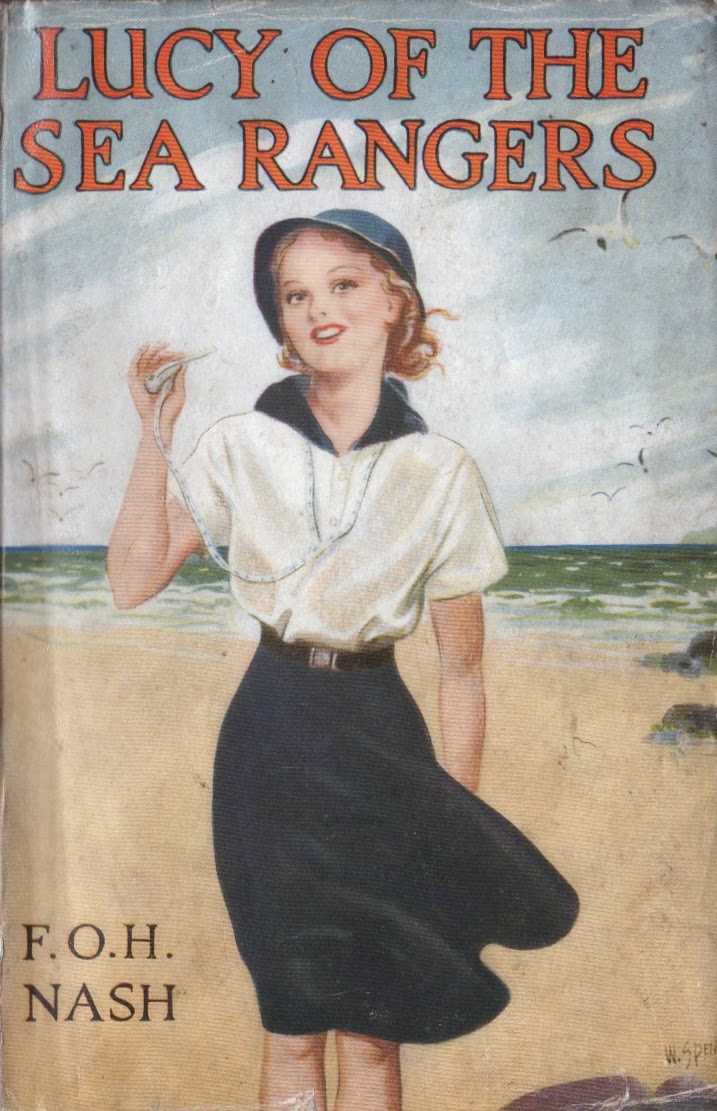
From the Archives #28: Lucy of the Sea Rangers by F.O.H. Nash

I don't get sick often, but when I do, I like to read comfort books.  Usually that means an old book I have read before that just makes me feel good.  So at the beginning of February, when I found myself home with a respiratory infection, I started to reach for an old Nancy Drew or Chalet School book, but decided to reread Lucy of the Sea Rangers.  I love old books about Girl Scouts and Girl Guides and have a small but nice collection of them.

In this novel, Lucy Butler, 16, is a Sea Ranger, a branch of the Girl Guides, but living in London, she and the other Rangers have never had any real sea experience.  The Blitz is just beginning, so when the department store she works in is damaged by a bomb, Lucy is off to the small village of Sea Bay in Somerset to live with her Aunt Nell and help out in her shop.  Best of all, Sea Bay is located right on the beach.

It doesn't take long for word to spread among the village girls that Lucy is a Sea Ranger.  And although Lucy misses her best friend and fellow Ranger Sally, who is still in London,  she manages to meet and become friends with a girl named Betty, who also has lots of Guide experience.  Before long, they two girls have cobbled together a patrol for the local girls.

One afternoon, Aunt Nell tells Lucy that Mr. Grant, who runs a large guest house and golf course, needs some clerical help and Lucy immediately thinks of her friend Sally.  Wouldn't it be grand if Sally came to live with Aunt Nell and could work for Mr. Grant.  On her way to talk to Mr. Grant about this, Lucy and Betty see a small plane crash land on the edge of the golf course.  Out come a man, a woman and a young boy claiming they had just escaped from Holland and the Nazis.

Feeling sorry for the family, the Vanhuysens are quickly given jobs and help from the trusting villagers.  But when a fire threatens to destroy the club house on Mr. Grant's gold course, Lucy becomes suspicious of the Vanhuysens when she finds herself suddenly surrounded by fire with no way to escape and realizes that Mrs. Vanhuysen is responsible to it.  Perhaps this refugee family isn't who or what they claim to be, after all.

Aside from the possible spy family story line, which is somewhat interesting, the novel provides a lot of Guide and Ranger information, from how patrols were formed, naming them, ranks and activities, to making uniforms.  And of course, there is the usual collection of girls with different personalities for added interest.  In fact, the reviewer for the Times Literary Supplement wrote of Lucy of the Sea Rangers that aside from the spy business "...which is distressingly inevitable by now, there is a healthily ordinary atmosphere about this story." (TLS November 20, 1943).

Lucy of the Sea Rangers is a fun look at guiding during the war in England and a bit of history not many people know about.

This book is recommended for readers age 9+
This book was purchased for my personal library

You probably know that Queen Elizabeth and her younger sister Princess Margaret were Girl Guides when they were young, but did you also know that Queen Elizabeth became a Sea Ranger in 1943?


Two books that may be useful to anyone interested in Guiding in fact and fiction are
How the Girl Guides Won the War by Janie Hampton  and
True to the Trefoil: A Celebration of Fictional Girl Guides by Tig Thomas, editor


Saturday, December 21, 2013

From the Archives #27: I Go by Sea, I Go by Land by P. L. Travers

By now, you have all probably heard of a new Disney film called Saving Mr. Banks about getting Mary Poppins author P. L. Travers to agree to letting Walt Disney make a movie of her most popular book.  But P. L. Travers wrote lots of other books besides her Mary Poppins novels and one of those books covered the three month period August to October 1940 during WWII.

I Go by Sea, I Go by Land was written in 1941 and is the story of the evacuation of two English children, Sabrina Lind, 11 and her brother James Lind, 8.  The first part of the novel, I Go by Sea, begins when Sabrina is given a diary to record her adventures once it is decided that she and James are to be evacuated by ship to America now that the Germans are actually dropping bombs on England.

After detailed accounts of getting passports, tickets, packing and goodbyes, the two children arrive in London for the train that will take them to the dock to board ship (not named but they are most likely leaving from Liverpool).  At the London train, along comes a family friend named Pel, who writes book, with her baby son Romulus.  Pel will be escorting the children to America.  Sabrina and James aren't the only evacuees on the ship - there are over 300 others being sent to Canada by the British government.

Sabrina is an observant child, giving more detailed accounts of sea sickness, other passengers, meeting and befriending one of the government evacuees, and of the convoys that are escorting them across the Atlantic.  It is a long but uneventful journey and when they arrive in Canada, the second part of the novel, I Go by Land, begins.

After some sightseeing in Canada, Pel, Sabrina, James and Romulus fly to La Guardia Airport in New York, where Sabrina and James are met by their mother's old friend, Aunt Harriet and her husband, Uncle George and their children Georgina, 13, and Washington, 17.  Pel and Romulus are staying in Manhattan, but Aunt Harriet lives in the suburbs.

The rest of the novel is Sabrina's description of the touristy things that they do for the first few weeks before school starts.  Their visit to the Statue of Liberty, and to the 1939 World's Fair just before it closed because of the war.  These visits are wonderfully detailed by Sabrina and totally worth reading, especially since she describes walking up to the Statue of Liberty's crown, something that visitors haven't been allowed to do in a long time.

The rest of the novel is about school, worrying about everyone back in England and ends on a rather upsetting note on James's 9th birthday when they are told by Pel that their beloved old home has been partially damaged by a bomb, though everyone is safe.

This is, indeed, an odd book.  There is not a real story, just descriptions of what happens for three months.  Yet, it is written with such historically realistic detail that it can draw you in completely.  In fact, it is so realistic, and given the friend's name was Pel, I did a little research and discovered that P. L. Travers did indeed travel to New York in August 1940, though only with her own son Camillus.  There were about 300 evacuees on board ship at the time, bound for Canada but Travers had nothing to do with them.  So, she only have to invent 11 year old Sabrina to turn her experience into an interesting children's story. And it is truly a window into a short but pivotal time in WWII for civilians.

And Travers did an excellent job of it, especially since, unlike Pel, she was not a happy, easy going person and Camillus was not the happy, quiet, content baby that Romulus is.

I Go by Sea, I Go by Land has lots of black and while pencil illustrations by Gertrude Hermes, an artist that Traversactually befriended on board ship in 1940 and remained friends for a while after arriving in America.

The title, I Go by Sea, I Go by Land is take from an old English bedtime prayer.

As much as this is an interesting book for young readers, you should be warned - the adults in the book smoke and have cocktails and a few more things are said that may not be PC by today's standards.

This book is recommended for readers age 11+
This book was purchased for my personal library

This is book 14 of my 2013 Historical Fiction Reading Challenge hosted by Historical Tapestry

Saturday, November 2, 2013

From the Archives #26: N or M? by Agatha Christie

I realized the other day that I was woefully behind in completing my Cruisin' with the Cozies reading challenge and the year is too fast coming to an end.  So I went off to the library to see what was there and imagine my surprise when I came across an Agatha Christie mystery set in WWII.  I have read Christie but it has be mostly limited to Hercule Poirot and Miss Marple mysteries.  I was totally unfamiliar with her Tommy and Tuppence novels but was very pleased to discover N or M?

It is 1941 and Tommy and Tuppence Beresford, a middle aged married couple, feel their espionage services are unwanted now that Britain has gone to war because they are 'too old.'  But when it is discovered that two German agents, one male code name N and one female, code name M, are organizing fifth column activities from a seaside guest house named Sans Souci, Tommy, but not Tuppence, is asked by Mr. Grant from the Ministry to spend some time there working undercover.  The danger of losing the war, he tells Tommy:
"...is the danger of Troy - the wooden horse within out walls.  Call it the Fifth Column if you like.  It is here, among us.  Men and women, some of the highly placed, some of them obscure, but all believing genuinely in the Nazi aims and the Nazi creed and desiring to substitute that sternly efficient creed for the muddled easy-going liberty of our democratic institutions."
The plan, then, is to tell Tuppence he is off to Scotland to do some boring office work for the Ministry.  Imagine his surprise when he arrives at Sans Souci and discovers Tuppence is already there.

And, in true Christie style, Sans Souci is the perfect wooden horse, presenting a cast of innocent looking men and women, any of whom could be N or M.  There is the mysterious proprietor Mrs. Perenna and her war-hating daughter Sheila in love with Carl von Deinin; the German refugee Carl von Deinen, whose two brothers are in concentration camps, and whose father has already died in one, and mother has died of fear; Mrs.  O'Rourk, a rather nosey heavy set woman with beard and mustache, who had a antiques shop in London, now lost in the Blitz; the elderly perpetually knitting for the troops Mrs. Minton;  the young Mrs. Sprot, whose husband sent her out of London with her daughter, Betty, 3 fearing for thier safety in the air raids; the elderly hypochondriacal, wheelchair-bound Mr. Cayley and his weak wife; and finally, Major Bletchley, all army, all country.  Into this come a very suspicious looking Polish woman, as well as the local ARP warden and former navy man, Commander Haydock.

N or M could easily be any one of these characters.  But nothing is as it seems here, and the trick is not to be taken in by appearances.  As always, Christie has you guessing til the end; well, if truth be told, only in regard to the male N.  The female agent M was pretty easy to figure out.

I found Tommy and Tuppence Beresford to be charming, engaging characters. though for me, not quite as engaging as Peter Wimsey and Harriet Vane.  But it is certainly an entertaining, light, rather witty novel, and I thoroughly enjoyed it, despite guessing M early on.  And N or M? proves that Christie can write a good spy thriller as well as her wonderful crime fiction.

And because there is a 3 year old character, Christie once again makes good use of children's books and nursery rhymes throughout, such as Goosey Goosey Gander, one of Betty's favorites.

Original 1941 UK
edition
N or M? was published in March 1941.  It is one of two that Christie penned during the war, the other novel being a Miss Marple story called The Body in the Library in 1942.  It is the third of five Tommy and Tuppence novels, spanning the years 1922 to 1973.  Unlike her other detective characters, Tommy and Tuppence age over the course of the novels.  And though they describe themselves as old in N or M?, they are really only middle-aged, but are still bright, witty, charismatic characters who would most likely appeal to teen readers just getting into mysteries.

There is an interesting addendum to N or M? that was just made public in February 2013.  It seems that MI5 (then the Military Intelligence Agency) investigated Christie because of her use of the name Bletchley for one of her characters.  After all, Christie was friends with Dilly Knox, who was a codebreaker at Bletchley Park.  But Bletchley Park and the code breakers were a secret.  Did Knox give her inside information?  Christie's explanation for choosing the name is priceless:
"Bletchley? My dear, I was stuck there on my way by train from Oxford to London and took revenge by giving the name to one of my least lovable characters."
You can read the article about this in the Guardian HERE 

This book is recommended for readers age 15+
This book is an E-Book borrowed from the NYPL via Overdrive

You can discover more about Agatha Christie and her many books at the official Agatha Christie website HERE

This is book 3 of my Crusin' with the Cozies Reading Challenge hosted by Socrates Book Reviews
This is book 12 of my 2013 Historical Fiction Reading Challenge hosted by Historical Tapestry

Wednesday, July 17, 2013

From the Archives #25: The Quest of the MIssing Map by Carolyn Keene

What did girls read during WWII when they wanted to get away from the war?  Well, one of the things they liked to read were the same books that Laura Bush, Hilary Rodham Clinton, Oprah Winfrey, Sonia Sotomayor, Ruth Bader Ginsburg, Gayle King, Diane Sawyer, Nancy Pelosi, as well as Congresswoman Pat Schroeder, filmmaker Pamela Beere Briggs, SEC Chairwoman Mary Jo White, and Federal Judge Roslynn R. Mauskopf, American Girl Molly McIntire and I read, and maybe you did, too.

What am I talking about?
None other than Nancy Drew, the teenage girl detective who wore frocks and drove a roadster.  And, now that American Girl is going to retire Molly and her friend Emily Bennett, an evacuee from the London Blitz, I thought I would have a look at the Nancy Drew book that sat on Molly's night stand all these years.  

The Quest of the Missing Map was published in 1942, shortly after the US entered WWII.  The quest begins when Hannah Gruen, the Drew housekeeper, asks Nancy to help the Smiths, a family that she used to work for.  They are in possession of half of a map given to Mr. Smith by his father, a sea captain indicating a small uncharted island in the Atlantic where he had buried a treasure.  Now, needing money, the Smiths would like to find the other half of the map.  That half had been in possession of the twin brother of Mr. Smith but the twins had lost track of each other over time.

The search for the lost brother leads Nancy to a widow, Mrs. Chatham and her young daughter Trixie living on an estate not far away.   The estate had originally been owned by an inventor and there are all kinds of secrets places hidden away, especially in a small cottage on the grounds.  And as it turns out, the widow had been married to the lost twin brother, now deceased.

But, of course, Nancy isn't the only one who is suddenly looking for the treasure map.  Leaving the Smith home, Nancy realizes she is being followed by a Mr. Bellows, who had tried to buy the Smith's half of the map earlier  Later, the Smith home is robbed of the map.  The Smiths are upset, but Nancy had drawn a copy of the now missing half of map.  Unfortunately, she is overheard by a couple who also want to find the treasure when she tells the Smiths about her copy.

Later, at a college dance Nancy is attending with boyfriend Ned Nickerson, the couple kidnap her to try to get the map, though Nancy manages to easily get away.  But Nancy soon discovers that a clue may be in a ship model that Mrs. Chatham had sold.  Unfortunately, the crooks also learn about this, but again Nancy makes a copy of what she finds after hunting down the ship model.

The quest for the map begins to take dangerous turns and Nancy is in turn kidnapped twice, tied up, knocked out and robbed.  And ironically, no one really knows if there is a real treasure to be found or if this is just a wild goose chase.

Treasure or no treasure, this is an exciting Nancy Drew story.  There is a lot more action than I remembered, but one thing is for certain - Nancy is one cool headed character and we often get to witness her logical reasoning.  Though she consults her father, lawyer Carson Drew, occasionally, she is a very competent, feisty, independent 18 year old, and it doesn't hurt that she has that nice blue roadster for getting around.  Small wonder Nancy had such an impact on the lives of so many girls.

It is often said that Nancy Drew's world is never impacted by realities such as the Depression of the 1930s or World War II.  And that was how I remembered the series.  So imagine my surprise when I came across two war related references.  While exploring, Nancy and her friend George found two letters and a machine of some kind in a secret tunnel on Mrs. Chatham's estate.  One of the letters mentions the machine might be of interest to the War Department (pgs 76-89).   Later, an old man tells Nancy "War bickering...Yes, there's plenty of it these days.  What the world's a-coming to I don't know." (pg 141

Most of the Nancy Drew books I read were hand-me-downs which is how I ended up with some old original editions belonging to I don't know who.  But I am pretty certain I read the same edition as the book on Molly McIntire's nightstand.  Take a look at the title page:

Click to enlarge and read

The Quest of the Missing Map is the first time I have reread a Nancy Drew book since I was about 10 years old.  I can't say it was my favorite story, but I'm not sure I want to reread any more Nancy Drews.  I think I would rather let my romanticized memory of the books remain intact.   Sometimes that is just the better thing to do.

This book is recommended for readers age 9+
This book is part of my personal library

The New Yorker Magazine published an interesting article by Meghan O'Rourke from 2004 called Nancy Drew's Father (her creator/publisher Edward Stratemeyer not Carson Drew) in which she writes about Nancy's beginnings and her continues success.

The Quest of the Missing Map was ghost written by Mildred Wirt Benson, who wrote many of the early books in the Nancy Drew series.  You can find out more about Mildred and the other books she wrote HERE 

This is book 2 of my 2012 Cruisin' with the Cozies Reading Challenge hosted by Socrates' Book Review

This is book 5 of my Pre-1960 Classic Children's Books Reading Challenge hosted by Turning the Pages

Friday, May 24, 2013

From the Archives #24: Snow Treasure by Marie McSwigan, illustrated by Mary A. Reardon

One day they weren't there and the next day, Norway was swarming with Nazis, even up by the cold, cold Arctic Circle in the little town of Riswyk, where winter lasts for most of the year.  But just before their arrival;, Peter Lundstrom, 12 almost 13, knows that something is up among the adults in Riswyk.

His father, a banker, and Uncle Victor, a fisherman, and other townsmen have devised a plan to get Norway's gold out of the country and to America so that it never falls into the hands of the Nazis.  And, Peter learns, it involves not only him, his younger sister Lovisa and friends Helga Thomsen and Michael Berg, but all of Riswyk's children age 10 and up.

The plan is that every child would take four bars of gold on their sleds 12 miles to where Uncle Victor's camouflaged boat is at anchor in the nearby Fjourd.  They would bury the gold in the snow and build a snowman over their gold bars.  The townsmen figured no one would question sledding children.  After burying their gold, the children would head over to a nearby farm where they would be given dinner and a place to sleep.  And during the night, Uncle Victor would come and fetch the gold with his first mate, Rolls.

And the plan works - though not as quickly as they had planned.  The weight of the gold bars is too much for the younger kids and they are forced to take less than planned each time.  So the whole operation stretched out to six weeks instead of three.  And of course, this gives the Nazis time to cause problems.

For one, even though the schoolteacher ls serving in the Norwegian army, the Nazi commandant decides the children should return to school.  A noticed is posted, but before school even resumes, a mysterious illness breaks out among the younger children.  The doctor manages to convince the commandant that the 'epidemic' is highly contagious and could easily spread to his men and that he advised the children not infected to stay outdoors as much as possible.

But one day, Helga tells Peter she has heard noises and felt like she was being watched for the last few days.  Worried, Peter and his mother find Uncle Victor's boat and warn him about this Nazi spy.  Sure enough, while building their snowman army over the gold shortly the next day, the Nazi soldier shows up.  Luckily, Uncle Victor and Rolls were right there and capture the soldier, taking him to the hidden boat.

The soldier tells them that his name is Jan Lasek and he is from Poland, but was taken by the Nazis when they invaded his country because he can speak many languages.  He was forced into a Nazi uniform, but really just wants to go with Uncle Victor to America.

But the next day, the Nazis are out looking for him and when the children refuse to answer any of their questions, the commandant gets angry and is just about to discover Lovisa's buried gold when Peter hits him in the ear with a snowball.  Taken into Nazi custody and locked in a cell, Peter decides saving the gold was worth anything the Nazis can do to him.

Will Peter be able to escape the Nazis before they take any action against him?  Or was moving all that gold in vain?

Snow Treasure was written in 1942, after Marie McSwigan read a newspaper article about Norway's gold being smuggled out of the country.  In her Forward, she describes what she believed to be true about the children who delivered the gold on their sleds to a waiting ship.  However, over time this story has been questioned and it seems there is no proof that it is true.  And so at the end of the book, an additional note is included to that effect.

I really wanted to like this story as much as I did the first time I read it, but now, reading it as an adult with more knowledge of WWII, the story was too slow moving and felt almost too naive for today's reader.  I also thought that the writing sounded dated and it made the story of moving millions of dollars in Norwegian currency on sleds for six weeks past the Nazis not not feel very dangerous or really exciting, the more so because I didn't really connect with any of the  characters.

On the other hand, on the March 15, 1942 the New York Times reviewer wrote:
It is a story of courage and wits and grim determination, and though the most tragic aspects of the invasion have no place in it, it makes plain to readers of 9 to 12 the treachery and arrogance with which the enemies of three-quarters of the world are trying to stamp out freedom.
Snow Treasure is richly illustrated with a number of black and white illustrations by Mary A. Reardon in what appears to be either pencil or charcoal.  This wasn't one of the best books I have read about Norway in WWII, and while I still like the idea of the story, I just don't like the actual story as enthusiastically as I used to.  However, this is one of those novels that designed to show children that no matter what they can make a difference and for that reason, I think it is worth reading.  And it is an excellent example of how a community can come together to achieve a goal.

A useful Teacher's Guide is available for Snow Treasure here


This book is recommended for readers age 9+
This book was purchased for my personal library

This is book 4 of my 2013 Pre-1960 Classic Children's Books Reading Challenge hosted by Turning the Pages

Monday, April 8, 2013

From the Archives #23: Biggles Defies the Swastika by Captain W.E. Johns

Not long ago I reviewed a book by John Boyne on my blog Randomly Reading called The Terrible Thing that Happened to Barnaby Brocket.  This was a really good fantasy novel about a boy who floats and must be weighed down to stay on the ground.  Barnaby has a dog named Capt. W.E. Johns, which caused me to laugh when I read that.  There is no explanation why that is the dog's name, but I (and others, I am sure) know exactly who Johns is.

Captain W.E. Johns was a very prolific writer with 169 books to his credit.  But he is probably best known for two of his series books: 96 'Biggles' books for boys and 11 'Worrals' books for girls.  Worrals, or Joan Worralson, flies for the Women's Auxiliary Air Force, part of the RAF.  I reviewed Worrals of the W.A.A.F in 2011.  Biggles, or James Bigglesworth, learned to fly in World War I and continued flying right into World War II and beyond.

Biggles Defies the Swastika (#22 in the series and written in 1941), begins in April 1940.  A Major with the RAF, Biggles has been doing some work in Oslo when he wakes up one morning to discover that the Nazis have invaded Norway.  Fortunately, Biggles has false identity papers naming him as Sven Hendrik, allowing him to pass as a Norwegian who supports the Nazis until he can get to his plane and out of Norway.  Arriving at the aerodome in Boda on a stolen Nazi motorcycle, Biggles finds it is under Nazi control now.  Somehow, Biggles fools the Germans into thinking he is a quisling who speaks fluent German and is made a leutnant on the spot by the German commandant there.  Now under a safe cover, Biggles gets himself to the Swedish border on a his stolen motorcycle and crosses over to safety.

But not for long.  At the British Consul, he is told to return to Norway to do some ntelligence spying and that his friends and fellow fliers Ginger and Algy will contact him as soon as possible.  Back in Norway, he hears that the Germans are looking for a British pilot named Bigglesworth who was spotted in Oslo and wanted by the Germans.  Luckily, as Sven Hendrik, Biggles is ordered to look for himself and given a Gestapo pass that will allow him freedom to get around without question.

Biggles soon discovers that his old nemesis Oberleutnant Erich von Stalhein is in Norway and is desperate to capture him.  Biggles calls Gestapo headquarters and tells them he has information that Bigglesworth is in Narvik and he is on his way there.  But along the way, he runs into some captured British sailors.  He tells them he's really a British pilot and concocts a plan for them to tell their captors that they saw Bigglesworth escape.  In Narvik, Biggles finds other British POWs, including his old friend Algy, who was sent over to help him.  He manages to free all the prisoners, but is then ordered back to Boda Aerodome to be questioned by von Stalhein.

Before that can happen, Biggles is ordered to Stavanger airfield by the British to gather intelligence about Nazi defenses there and then to go to Fjord 21, where he runs into his other old friend Ginger.  It is time to get out of Norway now that they have the needed intelligence, but Biggles refuse to go with Algy.  Meanwhile, Algy, after being freed at Narvik has returned to Boda to find Biggles.

Biggles returns to Boda, finds Algy and they make their way to Fjord 21, Ginger in his plane and escape, only to find that the Fjord is now occupied by Nazis and that Ginger is missing.  But not for long. Ginger tries to rescue Biggles and Algy, but things go wrong and Algy is again captured by the Nazis.  Biggles, with the help of his Gestapo pass, learns that the British warships are sailing right into a trap.  He can do nothing about it though because of growing suspicion about who he really is.  He accepts a ride in a water plane back to Boda and von Stalhein, because he has no choice.  During the flight, Biggles overtakes the pilot.  Flying low enough for the German to jump into the water, Biggles orders him out, but not before telling him they must get together after the war and have dinner together (yes, he really did say that).

***SPOILER ALERT***

Now flying a German plane, Biggles is attacked by none other than Ginger.  But then Ginger is attacked by a German plane and goes down.  Luckily, Biggles is able to rescue Ginger, tells him about the trap the British warships are heading into and has Ginger drop him off to find Algy.  Ginger delivers his warning, sets off to find Biggles and Algy, but is captured by the Germans.  Meanwhile, Bigglesand Algy are also captured by von Stalhein at Boda.  But when Ginger arrives with his German captor, the three of them manage to overpower him, steal a German plane and fly safely off to England and further adventures - lots of them!

All this action/adventure tokes place in only a few days.  The back and forth between Oslo, Boda and Stavanger were a bit like watching a ping pong games with airplanes, but I never got confused, in part because of the simplicity of the writing.  It is not great literature, is sometimes politically incorrect and everyone smokes, but Johns seems to have understood his young readers.  There is just action, constant movement, and a feeling of being in control, something young readers probably found comforting in wartime Britain.

If you are going to read them for the first time, don't take them too seriously, just have some fun, after all, they feel a bit campy nowadays.  And I thought the rivalry between Biggles and von Stalhein had shades of the later rivalry between Snoopy and the Red Baron.  I did, however, learn that anti aircraft flak was refered to as archie, as in 'you will probably run into lots of archie when you fly a German Dornier over Britain.'

While I have read most of the Worrals books, I seem to only have Biggle Defies the Swastika - but I have two copies of it, somehow.  And both smell like they just came out of my gram's attic.  Luckily, since Biggles is still somewhat popular, now editions of his books have become available recently, for your reading pleasure.

Johns with his novels
Biggles has has lots of influence on people's lives.  Here are some examples:
A Life of Biggles by Hilary Mantal
I Longed to Fly with Biggles by John Crace
Good Eggs and Malted Milk: Has Biggles Stood the Test of Time by Giles Foden

More information on Biggles and his creator Captain W. E. Johns can be found Collecting Books and Magazines (a great site for all kinds of information about kids books from the past.

This book is recommended for readers age 12+
This book was purchased for my personal library

This is book 3 of my 2013 Pre-1960 Classic Children's Books Reading Challenge hosted by Turning the Pages

Thursday, January 10, 2013

From the Archives #22: The Long Way Home by Margot Benary-Isbert

It's 1945, World War II has just ended, Germany is in chaos and retired schoolteacher Sabine Quendlein has discovered a small sickly boy left in her garden by a desperate mother and former student who wasn't able to take care of him.  Trying desperately to nurse him back to health, nothing in her poor stock of food helps, until an American soldier shows up at the door.  Larry Sherman takes a real interest in the boy, Christoph, and the teacher.  He brings them a steady supply of American rations smuggled from the Army, and finally Chirstoph begins to thrive.

But then Larry has to leave.  Sabine Quendlein's house is located in eastern Germany and as per the agreement at the Yalta Conference, she now lives under Soviet rule.  But Larry promises her that as soon as possbile, he will send for Christoph to come live with him and his new French wife, Denise, in Chicago.

This promise has to be continously postponed because Denise is having emotional problems adjusting to her new life in the US.  Then, in 1953, at age 13, Christoph begins to get involved with some dangerous political stuff.  Many of the young people living in the Eastern Zone of Germany were tired of Soviet oppression and groups of student Freedom Fighter were organized.  The village's mayor, another former student, visits Miss Quendlein and tells her about Christoph's activities and warms that the authorities are on to him.  And so it is decided, Christoph must sneak over the border into the Western Zone and travel to America.

Christoph unwillingly bids farewell to his Aunt Sabine and sets off on foot for the first leg of his long journey to Chicago.  This journey includes his escape under the barbed wire border fence, a slippery climb down a rock quarry on the other side in pouring rain, where he received a serious injury resulting in a scar down the side of his face, a stay at a castle full of actors and actresses, a stay with some Quaker relatives of Aunt Sabine's, an ocean crossing in a ship, a stay with a Quaker family in New York, and finally a train ride to Chicago.

In Chicago, Denise is still haveing adjustment troubles, made all the more difficult by the two adopted war orphans and the one natural child she and Larry have and for whom she can't manage to properly care.  Larry arranges for Christoph to live with a family he knows who own a restaurant, and where he can work evenings as a dishwasher, along with the owner's children.

As he travels from East Germany to Chicago and beyond, Christoph has many adventures and discovers many new things, some of which amaze him, some of which confuse him.  But as she always does, Benary-Isbert mixes a certain kind of innocent, almost ideological and really sentimental view of the world with harsh, sometimes jolting reality.  And again, as with The Ark and Rowan Farm, it results in a story that you really like and that makes you think.

It seems that a trademark of Benary-Isbert's writing is to provide lots of small, everyday details about her characters, the lives they have and the circumstances under which they live.  In The Long Way Home, this results in an clear, realistic picture of post-war life, not just in Germany, but in the US as well, something most readers might not remember or even know about, and bringing it all to life once again.  Young readers weren't even alive when the fall of communism in East Germany and the dismantling of the wall that separated east and west became history on November 9, 1989.

And I had to laugh out loud when I read the following passage and thought to myself Plus ça change, plus c'est la même chose (the more things change, the more they remain the same):
"The boys looked sloppy.  It seemed to be the fashion for them to wear their jeans so low on their hips that a patch of skin on their backs appeared when they stooped." (pg 122) 
The Long Way Home was published in 1959.

I so thoroughly enjoyed reading this book and really appreciated how Benary-Isbert ever so causaly let readers of The Ark and Rowan Farm know what became of the characters in those novels.

This book is recommended for readers age 11+
This book was borrowed from a friend
Originally written in German, this book was translated by Richard and Clara Winston.

This is book 2 of my Historical Fiction Reading Challenge hosted by Historical Tapestry
This is book 1 of my Pre-1960 Classic Children's Books Reading Challenge hosted by Turning the Page

Wednesday, August 29, 2012

From the Archives #21: Rowan Farm by Margot Benary-Isbert

Rowan Farm is the sequel to The Ark, which was reviewed here in May, and continues the story of the Lechow family, Pomeranian refugees who have had to resettle in the Hesse area in Germany after the war.  It begins precisely where The Ark left off, in January 1948.  The war has been over for almost three years, but the effects are still being felt everywhere.   Most things continue to be rationed, everyone is still hungry and cold all the time and much of the country still bears the scars of wartime destruction "Ruins rose into the clear winter air like broken teeth...To the left was the cemetery, torn up by bombs; to the right the ruins..." (pg 9)

All the Lechows from the first novel are still around in this second work: Dr. and Mrs. Lechow, Matthias, 17, Andrea, 13, Joey and adopted Ull, both 7, but the story is still centered mainly on Margret, 15.  Margret still loves working as a kennel/stable maid for Mrs. Almut, who also breeds champion Great Danes as well as running a small farm with her son Bernd, who had returned from a prisoner of war camp the previous summer.

The story begins with two important events: first is the arrival of the new school teacher, Christoph Hühnerbein, a 20 year old war veteran with a disabled leg and an amputated arm; and second, Margret's rescue of a badly abused Shetland pony from the slaughterhouse and her nursing it from near death to heath.

Both of them are perfect metaphors for Germany at the end of the war and its endeavors to rebuild itself  after the horror of its Nazi past.

Despite his disability, the new teacher soon has his students well in hand.   When he hears about the Wetz Farm, which had taken a direct hit from a bomb during the war that killed the family and destroyed the house and everything near it,  Hühnerbein comes up with the idea of cleaning it up to see what is reusable, and build what is called "rammed earth housing"with it for returning homeless veterans, most of whom had been in Russian prisoner of war camps.  And much of the work is done with the aid of Margret's little Shetland pony, named Mignon, "after the poor, unhappy little gypsy child in [Goethe's] Wilhelm Meister." (pg 30) The project of supported by everyone except the mayor, who plans to put a stop to it.

Meanwhile, Margret also meets an American Quaker, Mrs. Coleman, who is in Germany to help out with the refugee problem and who has a farm with her husband in Pennsylvania.  Now that the war is over, she and her husband want to start breeding Great Danes again, so she has a genuine interest in the dogs being bred at Rowan Farm.  Naturally, she and Margret hit is off and she offers Margret a position in America.

Life is further complicated when a beautiful young woman from Frankfurt comes to visit her relatives, and both Matthias and Bernd loose their hearts to her, even though it was clear that Bernd had always been attracted to Margret, but too shy to do anything about it.  Margret is hurt by Bernd's behavior and decides to wash her hand of him and men in general.  But will that resolve really last or will it simply give her the push she needs to go to America with Mrs. Coleman?

Once again, Benary-Isbert has taken difficult topics and presented them in the gentlest manner in a story that is told so well geared for her young readers but without being overly graphic.  Unlike in The Ark, she does talk more about the Nazi past, especially with regard to the 15 and 16 year olds who were drafted into the German army towards the end of the war and then found themselves homeless and unable to adjust to life again.  Besides Bernd Almut, Benary-Isbert includes the story of two boys, Karl and Alfred.  These two boys ran away from east Germany, whose Russians occupiers are sending former teen soldiers to work and mostly likely die in Uranian mines.  They are hired at Rowan Farm and become the first two veterans to live in the rammed housing at Wetz Farm, but when they hear the mayor is going to report them to the Russians, they run away.  Alfred gets caught stealing and Karl is found dead by suicide.  Their stories are very compelling and point to a postwar problem not usually addressed in YA literature.

So again, as in The Ark, Benary-Isbert has given the reader the bad and the good together, to remind them that this is life and, like the continuous birth of new animals on the farm, life goes on.  I wrote about The Ark that it is almost an overly sentimental story, yet people are surprised by how much they like it when they are finished.  The same can be said of Rowan Farm.

This book is recommended for readers age 12+
This book was borrowed from a friend.

This is book 11 of my Historical Fiction Challenge hosted by Historical Tapestry.

*From the Archives used to be called That's the Way it Was Wednesday.

Wednesday, July 25, 2012

From the Archives #20: Kitty Carter, Canteen Girl by Ruby Lorraine Radford

Last year, I reviewed Pamela G by Florence Gunby Hadath about a English schoolgirl, her friends and the mobile canteen they drive around the countryside providing hot tea, sandwiches biscuits and whatever else was needed by the soldiers who were practicing maneuvers in the area before shipping out.

Once the US entered WWII, canteens were set up all over the country to do basically the same thing - provide coffee, sandwiches and, of course, the famous Red Cross donuts.  Working in the canteen was one of the ways that girls and women could do their bit for the war.  And that is exactly was Kitty Carter discovers when she meet a handsome young sailor, Brad Mason, at a Community Chest drive picnic on Palmetto Island in the beginning of Kitty Carter, Canteen Girl.

Kitty had wanted to join the WAVES, but if she did there would be no one to look at her brother Billy, 6, not with her father in the Navy and her mother already dead.  Canteen service, Brad explains, is perfect for just that kind of situation.  It is what his younger sister is doing while in junior college.  He immediately introduces Kitty Mrs. Pearson, in charge of canteen training and luckily, a new class is starting at the beginning of the next week.

No sooner does Kitty finished her weeks long Red Cross training and she is thrown into an emergency.  A big fire at the island's fish cannery and lots of now homeless people to care for.  But both Kitty and Brad think this was not an accidental fire and they decide to investigate.  After all, someone saw a dark figure running away from the scene the same night that Kitty and Brad witnessed a sailor's shoe spontaneously catch fire from a stray cigar ash, as though it has accelerants on it.

More strange events follow on the heels of this, and before long Kitty and Brad are totally convinced that there is something going on that involves some of the Navy people working in the Naval hospital on the island.  This also happens to be where Kitty's father is stationed as the hospital's Chief Pharmacist's Mate.  The hospital is the center of life on the island.

Naturally, Kitty's canteen duties help advance the investigation, even if they don't know what they are looking for exactly.  But Kitty's suspicions increase when she notices an officer playing chess with enlisted men - rank is important in the Navy and this just isn't done.

Eventually, Brad and Kitty begin to suspect that someone is sneaking supplies to German submarines not far from shore when bread from a local bakery is found in a captured sub.  This suspicion is reinforced when they take Billy in a picnic to Terrapin Island and he finds a constructed lookout in the tallest tree facing the ocean.

Later, the plot thickens even more when a troop train passes through while Kitty is on canteen duty.  A soldier wants to know if anyone knows Terrapin Island and Kitty responds yes.  He has money from the island's owner for the 100 year old black man, Uncle Mose, who has been living there his entire life, having been born there when the large island home was a plantation.  Kitty gets the owner's name and address, so she can write and tell him that Uncle Mose has been moved to a dreadful hut on the island after the owner rented the island to a Mr. Beeson, a very nasty piece of work, instead of the nice home he was supposed to be living in.

Things are almost put on hold when Billy gets seriously ill, but when she confesses her suspicions to her father at Billy's bedside and mentions Beeson, who comes to the hospital to pick up food scraps for his pigs, her dad thinks she may actually be on to something.  Mind you, she and Brad still don't know what they are investigating.

Well, one hurricane later and the mystery is solved.  It seems the chess playing officer was playing chess to keep the Chief Commissary Steward (or cook) away from the hospital kitchen.  That way, an enlisted sailor name Punaro could sneak supplies, food and medical items, out to Beeson, on the excuse of picking up his,, pig food.  Beeson would take the supplies to Terrapin Island and watch for the Nazi subs.  And it turns out that Kitty's father is actually stationed there to investigate this mystery of the disappearing supplies, as is a Nurse Dawson, whose brother had left the post of Chief Pharmacist's Mate in disgrace when he was supposedly unable to find out who was behind the thefts.

Not only does everything end well, but love is in the air, too.   Mr. Carter and Nurse Dawson become more than just colleagues, they were planning on getting married.  And of course, that is what is implied about Brad and Kitty.

Kitty Carter, Canteen Girl was a lot of fun to read because it was the same kind of benign mystery that you find in Nancy Drew books, where no ones life is ever in real danger, but there is enough excitement to hold you attention.  And despite it focusing on the mystery, there is a lot of information about what it was like to be a canteen girl.  It must have been a very welcoming sight to members of the armed forces to be greeted at every train stop with hot coffee and fresh food.  And to know that their USOs would always be a welcome respite for them.

Kitty Carter, Canteen Girl was part of a series of eight book published around 1943/44 by Whitman Publishing Company as part of their "Fighters for Freedom" series.  The writing in these novels is far from wonderful and the plots tend to be a little thin, but their real purpose was, of course, as propaganda pieces.  Still,  they are worth reading even now if only to see how a wartime mentality was created and maintained for boys and girls in WWII.

On the other hand, the Red Cross still does the important work of helping people whenever they are needed.

Wednesday, May 16, 2012

From the Archives #19: The Ark by Margot Benary-Isbert


I found The Ark to be an oddly pleasant story about a family trying to survive in post-war Germany, not the subject of too many YS novels.   And even thought it was originally written and published in Germany in 1948 under the title Die Arche Noah, and not translated and published in English until 1953, I felt it qualified for a That's The Way It Was Wednesday post..  Some of the books content comes from Benary-Isbdert's own experiences in Germany at the end of the war.

The Ark center's on the Lechow family: Mother, eldest son Matthias, 16, Margaret, 14, Andrea, 13 and Joey, 7, but is, for the most part, Margaret's story.  It is October and the Lechow's have been refugees for a long time, after fleeing west from their home in Pomerania just ahead of the Russian Army at the end of the war.  Now, after two years of living in refugee camps, they have finally been assigned two rooms in the home of elderly Mrs. Zerduz, and though she can't do anything about it, she has made it clear that Mrs. Lechow and her children are not welcome.

Little by little the Lechow's settle into their new, more stable home.  Joey is finally enrolled in school, where he immediately meets a best friend and fellow adventurer Hans Ulrich, an orphan.  Andrea is offered a full scholarship at a private girls school, Margaret stays home and helps with the house and shopping (she doesn't want to return to school) and Matthias is assigned to work in construction, where he meets a best friend and fellow musician, Dieter.

And Mrs. Lechow uses her considerable skill as a seamstress to make some additional money.  All in all, life has take a turn for the better for the Lechow's.  Even Mrs. Zerduz begins to feel very attached to the family.  But they still haven't heard from Dr. Lechow, a POW in a Soviet labor camp; Matthias would rather be an apprentice to a gardener than work in construction; and animal-loving Margaret would rather work on a farm.

Just before their first Christmas in their new home, the children, with Dieter, go out caroling and end up at the lovely Almut farm.  One thing leads to another and pretty soon Matthias is taken on as an apprentice and Margaret as a kennel maid.  Both of them are ecstatically happy with this arrangement, plus they get to live in an old railroad car that Mrs. Almut had purchased many years ago.  They fix it up into a lovely home that can sleep eight people and pretty soon find themselves with both human and animal visitors. For that reason, Margaret decides to christen it "The Ark"

The Ark is an easy to digest novel about the hardships people faced after the devastation of war.  Yet, there is no real mention of Germany's recent Nazi past and what went on under their domination, with one exception where it is made known that the Lechow family did not support this government and its policies.  On the other hand, Benary-Isbert does not ignore the realities of life too much either - there are abundant shortages with rationing is still in effect, so there is hunger, homelessness, people die, animals die, and children don't always thrive.  Margaret, for example, had a twin brother Christian whose war related death always left a void in her life.  Yet, there are also pockets of happiness and kindness and the idea that we can create our own areas of contentment and satisfaction even in the midst of chaos and ruin.

The Ark was one of the first books to be published as a way of dealing with the aftermath of Hitler's Reich.  Benary-Isbert handled the topic well, considering there was probably still a lot of anti-Germany sentiment around and many other countries were still in the throes of recovery from the war as well.  The story takes place in an unspecified town in the Hessian area of Germany under the control of the Americans, whose short appearance in the novel in not particularly flattering, but, oh well, I probably wouldn't much like my occupiers either.  There had been an underground arsenal of weapons in that area during the war and it had sustained considerable damage in the last days of the war when bombing caused the arsenal to explode.  Many of Benary-Isbert's post war descriptions reminded me of that area.

This is almost an overly sentimental story, and people always seem surprised by how much they like the novel, despite that.  I also found that to be true and, it turns out,  there is a sequel to The Ark called Rowan Farm, which I am now looking forward to reading.

This book is recommended for readers 12+
The book was borrowed from a friend.