Showing posts with label Pre-WWII. Show all posts

Monday, June 6, 2022

The Memory Keeper of Kyiv by Erin Litteken

If you have been following the invasion of Ukraine by Putin's Russian army, you may find this to be a very interesting and compelling story, even though the events take place in 1930s Ukraine. The story introduces readers to Katya in 1929, 15 and surrounded by a loving family, and a future husband name Pavlo she is passionately in love with, and a table filled with an abundance of wonderful Ukrainian food, breads (Ukraine is, after all, the breadbasket of Europe). and delicacies. 

Six months later, in January 1930, Joseph Stalin begins his invasion of Ukraine, which was already part of the Soviet Union, but his goal is to get rid of the Ukrainians by starving them to death. Stalin's activists encourage the people to join them and become part of their collective farming scheme, but Katya's family resists. Those not joining the collective have high taxes inflicted on them, then their food, farming equipment, and farm animals are taken in lieu of the tax money the Russians know they don't have. The resisters begin to disappear. As things become worse, Katya's father is arrested. And it is decided she will marry Pavlo, and her sister Alina will marry his brother Kolya. But when Pavlo hears that a resistance movement is being put together in the next village, he decides he must go and fight.

Flash forward seventy years to Illinois. Cassie, a widow who lost her husband a year earlier in a car accident while take their daughter out for ice cream, has all but withdrawn from life. But then her mother convinces her to move in with her Ukrainian grandmother, whom she calls Bobby, because of her age and her recent odd behavior. Cassie hears her taking to herself, and then begins to find food hidden all around the house and yard. She also finds a diary her grandmother has been writing in, but it is in Ukrainian. Luckily, there is an unattached, handsome man named Nick living down the street who is friends with her grandmother and who knows Ukrainian. Eventually, her grandmother decides that her story needs to be told and gives Cassie permission to work on it with Nick. 

Ultimately, the two stories, told in alternating chapters, come together, and I don't think you will be very surprised to hear that Katya and Bobby are the same person. If I sound like I am making light of this novel, I am not, I just don't want to give too much away, and there is a lot going on. I found myself so drawn to young Katya's story, but some of the details were really difficult to read. I knew that Stalin was cruel, but I didn't know that he had committed genocide through starvation in Ukraine (the Ukrainian word for this is the Holodomor). I felt exactly like Cassie when she learned what her grandmother had survived "How did I not know about this?" And it certainly compelled me to do some research of my own to find out more about the Holodomor.

On the other hand, I have to be honest and say I wasn't particularly interested in Cassie's story. As soon as I read about Nick, I knew where things where going to go. So yeah, that part was predictable. But she was a good vehicle for adding more information about Bobby into the story. Trauma just doesn't go away and Bobby's life after she left Ukraine up to the present needed to be included.

The Memory Keeper of Kyiv is a book that I definitely recommend and I believe it will appeal to history geeks like myself, to anyone who have been following events in present day Ukraine, and there is even enough romance for fans of that genre.

Thank you, NetGalley and Boldwood Books for granting me a review copy of this book. 

Sunday, January 16, 2022

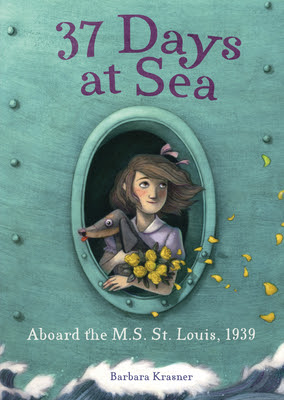
37 Days at Sea: Aboard the M.S. St. Louis, 1939 by Barbara Krasner

This is the second book by Barbara Krasner that I have read about the 938 European Jews who set sail in 1939 aboard the M.S. St. Louis hoping to escape the Nazis and find safety in Cuba. The first book was called Liesel's Ocean Voyage. It is a fictionalized story based on the real experiences of Liesel Joseph Loeb (1928-2013) and I highly recommend it, and in fact, I would read it in tandem with 37 Days at Sea to get a broader picture of a voyage that began with so much hope ended in such disappointment. 

Here, Krasner introduces readers to Ruthie Arons, 12, from Breslau, Germany. The decision to leave and eventually settle in America came shortly after Kristallnacht, when their beautiful home was ransacked by Nazis who broke into Jewish homes and businesses all over Germany, stealing, breaking and destroying everything in their path. 

Now, onboard the M.S. St. Louis, missing the family they had to leave behind, Ruthie, a somewhat mischievous girl thinks that  "Adventure/ across the Atlantic Ocean beckons." And indeed it does, when she quickly makes friends with Wolfie, a twelve-year-old Jewish boy traveling with his mother and whose father is already living in Havana.

Secure in the knowledge that they have the necessary papers to enter Cuba, people on the ship enjoy a wonderful voyage of good food, entertainment, and friendliness, including Captain Schroeder. And although the crew wear their NSDAP pins, there is a problem with only one, Kurt Steinfelder. Ruthie's mother suffers from seasickness and her father, an attorney, is busy with some other business, so that leaves her plenty of time to hang out with Wolfie, exploring the ship and getting into mischief: "Grown-up, watch out. We/ are a band of trouble,/ and by we, I mean/ Wolfie and me." (pg 24)

There is a, however, a very concrete reminder of what was left behind in Germany, when a group of men with shaved heads come on board and Ruthie's father must explain to her about concentration camps and the arrest of so many Jewish men on Kristallnacht, including him. Some were released, others sent to camps, released with the promise never to return.

After two weeks at sea, on the fifteenth day, the M.S. St. Louis enters Havana, Cuba but it doesn't take long to realize that there is more trouble ahead for these Jewish refugees. No one is allowed to disembark and enter Cuba, including Wolfie and his mother, even though his father is already there. Negotiations take place, the United States refuses to help and eventually the ship is forced to return to Europe. Needless to say, the trip back is nothing like the trip to Cuba.

37 Days at Sea is written in free verse from Ruthie's first person point of view, which gives it an interesting perspective. Ruthie may have experienced some of the cruelty of the Nazis in Breslau, but she was younger and her parents seem to have been able to shield her from some of the worst events. The trip to Cuba and the return to Europe makes this a kind of end of innocence story, but the beginning of understanding the seriousness of what was happening to the Jews in Europe for Ruthie (and hopefully today's reader).    

Krasner used a few different poetic forms, and although the free verse is sometimes a little off, it is still an important book for young readers, especially in the lower middle grades. She really knows how to build the excitement and expectation of landing in Cuba and being free to come and go as they please as the ship travels to its destination, and the disappointment and dejection the passengers feel when they are forced to go back. The first half of the books is devoted to the trip to Cuba, and the second half covers the trip back, which I think is an important part of the story to include. 

Back matter includes an Author's Note, a Timeline of Events, suggestions for Further Information including Films, Oral Testimonies, and Books.

This book was a digital version purchased for my personal library.

Saturday, January 9, 2021

Charles's Bridge by Sandra Novacek, illustrated by Nicole Lapointe

Charles's Bridge by Sandra Novacek, 
illustrated by Nicole LaPointe
Ten21 Press, 2021, 36 pages
Available January 12, 2021

It's 1938 and Charles Novacek, 11, his parents, and sister are being forced to leave their home in Hrachovo, then part of western Czechoslovakia and recently occupied by Nazi soldiers, and relocate to Náměšť nad Oslavou, Charles's father's hometown in eastern Czechoslovakia.* Charles desperately wants to take his precious art supplies with him, but his father is adamant about leaving them behind. There simply is no room for them in the cattle car that carrying their belongings. After all, they are not the only family being evacuated. 


Lonely and homesick, sharing a room with his sister, and being made fun of because of his Slovakian* accent when he speaks Czech. Charles spends his afternoons roaming the nearby forest, fishing and looking for good hiding places once the imminent war begins. One day, Charles notices a beautiful bridge spanning a river. With it's impressive statuary of archangels lining the bridge on either side, Charles fervently wishes he could paint this magnificent bridge. If only he had his art supplies!  


But with paper and paint in short supply and war coming, painting this beautiful bridge, or anything else, seemed an impossible dream. Or was it? A few days later, on one of his solitary walks, Charles's notices some wet clay in the river bank, and suddenly he has a brilliant thought. Could he make his own paint using all natural ingredients and begin painting again? Using the clay from the river, plus some of the different herbs and vegetables in his mother's garden, and finally being given some paper used by the town barber, Charles cobbles together paints and brushes and is finally able to paint the bridge he has come to admire so much. 

Charles's Bridge is a wonderful story of creativity, ingenuity, and resilience and ingenuity in the face of all odds. Charles need to paint, to express himself through his art, and to help him through his isolation and loneliness should be a real inspiration to young readers. When I read this to my young readers, I didn't go into the reasons the Novacek's had to leave their home, but the kids did understand that the family was forced to leave (we've read enough refugee stories and talked about them a lot recently). What really impressed them was the way that Charles managed to make his own paint and brushes. In a time when so many kids feel isolated because of Covid-19, I think they felt as though they had found a fellow traveler in Charles.   

* For those who may have forgotten some pre-WWII history, the Novacek family were forced to leave their home because of the Munich Agreement. This was the 1938 agreement between Germany, Britain, and France that allowed Adolf Hitler to annex the mostly German Sudeten territory in Czechoslovakia in the hopes of avoiding war. 

Be sure to read the Author's Note to find out about the fate of the original painting of Charles's bridge and its painter. I should mention that the author, Sandra Novacek, was married to Charles and it was he who told her about how he came to paint the bridge. 

This book is recommended for readers age 5+
This book was a PDF copy gratefully received from Rachel Anderson at Ten21 Press

You can read more about Charle's life in Border Crossings: Coming of Age in the Czech Resistance, written by Charles Novacek and also published by Ten21 Press. 

Tuesday, September 1, 2020

Letters from Cuba by Ruth Behar

It's 1938 and Papa has been in Cuba for three years, working to save money to bring the rest of his family there from Poland and away from the  increasing Nazi threat to Jews. Normally, it would be the eldest son, Moshe, who would be the first child to join his father, but 11-going-on-12-year-old Esther Abraham, the eldest daughter, makes such a convincing case to Papa, that she is chosen to join him, much to her mother's consternation. 

But, on her own, Esther travels through Poland, Nazi Germany, and Holland, boards a ship to cross the Atlantic, only to learn that the first stop is Mexico, not Cuba and that she will be the only passenger when they leave port. But Esther, being a naturally friendly girl, has made friends with the animals on board, spending time with them until they reach Havana, Cuba and the next delay.

In the end, Papa is there and, before they head to the town where he lives, he has to conduct some business, introducing Esther to Zvi Mandelbaum. It turns out Papa's job in Cuba is as a itinerant peddler, not the shopkeeper his family thought he was, and he gets his wares from Mandelbaum, who immediately gives Esther a pair of sandals so she can take off her hot woolen stockings. 

From the moment Esther began her trip, she decided to write down "every interesting thing that happens" in letters for her younger sister Malka. That way when the rest of the family are finally in Cuba, they can read the letters and it will be as if they had been together the whole time. (pg 2) The result is detailed descriptions of the people Esther meets, the places she goes, and her daily life with Papa.

Esther is friendly, outgoing, and smart, picking up Spanish quickly. And she is also quite enterprising, helping her father sell the items he is given by Mandelbaum. Despite being the only Jews in the town of Matanzas, almost everyone friendly and giving, accepting her and her father. But after Esther sews herself a new dress to wear in the hot Cuban weather, she soon begins a successful trade as a dressmaker to help make money to bring her family to Cuba. 

Their lives in Cuba are basically pleasant and enjoyable, filled with new friends of diverse backgrounds, including Manuela and her Afro Cuban grandmother, and the Changs from China, as well as the local doctor and his wife, Señora Graciela. It is she who gives Esther a sewing machine that helps her begin her dressmaking business. But Cuba are not without its Nazi sympathizers, including the doctor's brother, Señor Eduardo. He wants to start a Nazi party in Cuba with an anti-immigrant agenda to get rid of the Jews there.

As the situation in Europe becomes more perilous for the Jews there, it becomes more and more imperative to get the money to bring the whole Abraham family to Cuba. 

Esther's letters to Malka are quite detailed. And though the story may not be the kind of exciting tale we are accustomed to from this period in history, it is still a wonderful window into a life we don't often read about. Small wonder it reads so authentically. Behar based this novel on her grandmother's experience of traveling to Cuba in 1927 to join her father. Like Esther, her family had lived in Govorvo, Poland. And like Esther, one beloved family member didn't make to Cuba. 

I enjoyed reading Letters from Cuba a lot. Sometimes I just don't want a lot of action and an epistolary novel like this is just the ticket for an evening of reading during COVID-19 time. Esther is a great character - a bold feminist yet respectful of her elders, especially Papa, and her religious traditions. I can't even imagine letting an 11-year-old girl travel from Poland to Cuba, part of the way in Nazi territory, all by herself. She is a character with perseverance, fortitude, and a maturity beyond her age, as well as a pretty good business woman.

Behar includes an extensive and very interesting Note from the Author about her family and how they settled in Cuba, and her research for writing this book. There is also a list of Resources for further reading.

An Educator's Guide is available to download courtesy of the publisher Nancy Paulsen Books HERE

This book is recommended for readers age 10+
This book was an EARC gratefully received from Nancy Paulsen Books through NetGalley

Sunday, June 16, 2019

I Survived the Hindenburg Disaster, 1937 (I Survived Series #13) by Lauren Tarshis, illustrated by Scott Dawson

It's Monday, May 3rd, and Hugo Ballard, 11, is about to embark on an exciting journey flying from Germany to New Jersey on the Hindenburg, one of two zeppelins crossing the Atlantic Ocean in 1937. Hugo had already had one big adventure, living in Kenya with his mom, dad, and younger sister Gertie for a year. But now Gertie is sick with malaria and needs to get home to NYC for the right medicine as quickly as possible and the zeppelin could get the family there in only three days.

The Hindenburg is big, almost as big as the Titanic, but it's a highly flammable gas, hydrogen, that gets the zeppelin off the ground and flying. And that's a pretty scary thought for Hugo and Gertie, but almost immediately, Hugo makes a new friend, Martha Singer, or Marty as she prefers. Marty is a zeppelin pro, this is her eight Atlantic crossing in one, thanks to her dad who works for the company. "It's magical" she tells Hugo, and indeed, it seems to be so. Even Gertie is looking and feeling better.

The next morning, Tuesday, May 4th, at breakfast, however, Hugo's good feelings about being on the smooth-riding zeppelin with a new friend are somewhat diminished by the appearance of Nazi Colonel Joseph Kohl, known for his viciousness (even Gertie thinks he looks like a snake) and two other Nazi officers. When they leave, one of the passengers says that he believes the Nazis are looking for a spy on board the zeppelin.

On Wednesday, May 5th, the day before the zeppelin is scheduled to arrive at the airfield in New Jersey, Mr. Singer offers to show Hugo and his dad around the ship, even taking them into its main body, usually off limits to passengers. While there, Mr. Singer hears a terrible, unfamiliar growling noise. Alarmed, he starts to call the ship's captain, when Hugo realizes it is none other than their dog, Panya, who was put into the cargo hold for the trip. But their tour is interrupted with news that Gertie is once again very sick. After a long, scary night, Gertie's finally fever breaks and the only thing she wants is Panya.

But when Hugo sneaks down to get the dog, he sees someone else there. Is this the spy who is sneaking German secrets back to the United States? Apparently Colonel Kohl thinks so, too. After threatening Hugo with his gun, he manages to get away and get Panya to Gertie. But does an even deadlier fate await the Ballad family when the Hindenburg suddenly erupts in flames while landing?

A WWI Recruiting Poster
I Survived the Hindenburg Disaster, 1937 is, like all the I Survived books, very exciting with themes of courage, resilience, and the importance of family. And Tarshis is genius at being able to weave these into a gripping tale in the midst of a dangerous historical event without distorting any of the history. She has included lots of information within the story about zeppelins, how they work and their use, even during World War I when they were used to drop bombs on civilians in both France and England. I knew airplanes were used for that, but I didn't know about zeppelins.

Nor does she shy away from Nazi violence or cruelty and yet it is never gratuitous. In this novel, Colonel Kohl is portrayed as the kind of cold-blooded Nazi who would not think twice about shooting Hugo to get what he wants. But Tarshis also always makes sure to surround her protagonist with kind people, too, as she does here with Hugo's parents, Mr. Singer, and Marty. And her protagonists are also kind people. Hugo risks a lot to make his sister happy, but he knows what he has to do. And when the ship erupts in flames, his first thought is how to save his family.

Tarshis has also included even more information about zeppelins and the Hindenburg disaster in her back matter, beginning with the question "Would you want to ride on a zeppelin? To which my answer would be unequivocally no, thank you, although I do appreciate the excitement and spectacular views of such a ride. There is also a section about the possibilities of why the Hindenburg disaster happened (to this day, no one knows), More Hindenburg Facts, and a Selected Bibliography.

I Survived the Hindenburg Disaster, 1937 is one of four books that are focused on World War II, beginning with I Survived the Bombing of Pearl Harbor, 1941, I Survived the Nazi Invasion, 1944, and I Survived the Battle of D-Day, 1944. Each excellent and informative, and age appropriate.

This book is recommended for readers age 7+
This book was provided to me by the publisher, Scholastic Press

If you would like to know more about zeppelins, be sure to visit airships.net

And if you are curious about what Hugo saw on his tour of the Hindenburg, this is the best example of the inside of it I could find (you can even see the catwalk where Hugo had to walk to get Panya for Gertie):


Tuesday, March 22, 2016

A Tiny Piece of Sky by Shawn K. Stout

It's only June, but the summer of 1939 does not look very promising as far as Frankie Baum, 11, is concerned.  Her sister and best friend Joan, "the just-barely-older of the two," is getting to spend the summer at Aunt Dottie's farm in New Jersey, where Frankie is sure she will be having the best summer ever, while she's stuck at home in Hagerstown, MD with older sister Elizabeth, called Princess by their parents.

And ever worse, Frankie is expected to work in her father's newly purchased restaurant, a long neglected Alpine-style relict of years ago, now with only weeks to get it cleaned up and running again to become his dream of "An Eating Place of Wide Renown."  Opening day is planned for July 5th.  Sure enough, at the restaurant, Frankie is sent to the kitchen to work, a dirty, messy job, while Princess gets to work the cash register.

Frankie is vaguely aware of war talk among the townspeople, of anti-German feelings that are beginning to brew, but she has never really considered her family to be German, even though her father's parents immigrated from Germany.  But when Hermann Baum is approached by the cigar smoking president of the Chamber of Commerce, Mr. Sullen Waterford Price, and refuses to let himself be bullied into becoming at paid member of the chamber, he makes a formidable enemy, one all too aware of his German roots.

Price is also running for mayor of Hagerstown, so when Hermann also refuses to put his election poster in his front window, Price begins looking for just the dirty information he needs to start spreading rumors that Hermann Baum is quite possibly a spy and Nazi sympathizer.

To make matters even more complicated, Hermann decides to throw his own  pre-opening day Fourth of July party for friends, family and even his African American staff and their families.  Hermann has always treated his kitchen staff fairly, despite living in a state where Jim Crow is in effect.  That, coupled with the German flyer that has mysteriously fallen into the hands of Mr. Price, are all that is needed for a boycott of Hermann's party.

Frankie has overheard quite a bit while working in the kitchen, and decides to do some investigating of her own about what is going on.  But she also finds herself doubting her father's innocence.  When no one shows up at her father's party, she goes to the town's celebration to try and find out what is going on.  When Hermann shows up looking for her, he collapses.  And the Baum family's life is changed forever.

A Tiny Piece of Sky is a wonderful coming of age story.  Frankie's character develops slowly over the course of the novel as she encounters different people and situations.  The story is told in the third person by an omniscient narrator in a rather conversational style, and who seems to be right in the thick of things, more aware of what is going on in the world than Frankie is.  To get some of Frankie and even Joan's mindset, there are also first person letters they write to each other, which tend to create more mystery about Hermann Baum's heritage than information.

The story takes place over June, July and August 1939.  There aren't many pre-World War II home front stories for young readers, making this all that much more interesting.  Stout looks at both racism and xenophobia through the lens of Frankie's summer.  Frankie hasn't really paid attention to the racism and discrimination towards the African American community in Hagerstown, until she starts working in the restaurant.  But the character of Mr. Stannum, the restaurant's new manager, opens her eyes when she witnesses the way he treats the black kitchen staff with such cruelty and contempt, even refusing to allow them to use the bathroom he uses.  

You  also don't find many books for young readers that are about the kind of treatment that German Americans experienced in the 1930s and 1940s as the possibility of war with Germany became more of a possibility.  Most people don't realize they were also discriminated against. though to a far lesser extent than Japanese Americans.  What makes this an interesting theme here is that Stout shows how easily people can change their attitudes towards of friends and even fathers when doubt begins to take hold.  For that reason,  A Tiny Piece of Sky is not just good historical fiction, but also resonates so loudly in today's world. 

The other part of what makes A Tiny Piece of Sky such an interesting, realistic novel is that much of the material comes from Shawn Stout's own family and the restaurant they owned in Hagerstown, which she writes about in her Author's Note at the end of the novel.  Be sure to read it when you read this excellent novel.

Teachers can find an extensive Teaching Guide for A Tiny Piece of Sky HERE

This book is recommended for readers age 9+
This book was borrowed from the NYPL

Used with permission: the original menu from Shawn Stout's grandparent's restaurant.
Click to enlarge and check out the prices listed.


Friday, October 30, 2015

Conspiracy of Blood and Smoke by Anne Blankman

Conspiracy of Blood and Smoke is the sequel to a book I read and reviewed last year called Prisoner of Night and Fog.  I wasn't too crazy about that book, but I am pleased to say that I liked the sequel much more.

Prisoner of Night and Fog takes place in 1931 Munich, Germany.  Gretchen Müller, part to the inner circle of young girls in the Hitler entourage, has discovered that her father, a strong Hitler supporter, had been deliberately killed in the 1923 Munich Beer Hall Putsch by a fellow Nazi.  Gretchen is determined to solve mystery of who would have done such a thing with the help of Daniel Cohen, handsome reporter for the Munich Post.  It also didn't take long for Aryan Gretchen and Jewish Daniel to find they were very attracted to each other despite their differences. And yes, they solve they mystery together.

Conspiracy of Blood and Smoke picks up their story in 1933 England.  Forced to flee Germany after solving her father's murder, Gretchen is living in London with a loving family and going to school, and Daniel is working for the Oxford Mail, writing the society column.  But when Daniel receives a telegram that his cousin Aaron has been attacked by Nazis and is in critical condition, he immediately returns to Germany to get justice to his cousin.

On January 30, 1933 Hitler is named Chancellor by President Hindenburg.  One month later, February 27, there is a fire in the Reichstag, the seat of government.  Hitler blames the Communists for it, even though it has most likely been done by the Nazis for the purpose giving Hitler a strong reason for forcing the passage of the Enabling Act, a piece of legislation that would give him complete power, turning Germany into a Nazi dictatorship.

Then, when Gretchen receives a mysterious telegram telling her that Daniel is in trouble, that he is wanted for murder, and possibly dead, she decides to risk capture by the Nazis and returns to Germany to find him.  There, an old newspaper friend of Daniel's tells Gretchen that the Nazis claim Daniel has killed a young women named Monika Junge and that he had also been beaten and robbed of his money and false identity papers a few days ago, but no one has seen Daniel since.  Next, she calls her old friend Eva Braun and asks her to find out if Daniel has been arrested. Eva tells her no, but that Gretchen must get out of Munich, Hitler is still after her for what she uncovered about him while trying to find out who murdered her father.  Ironically, the murder of Monika Junge leads Gretchen and Daniel right back to the Reichstag fire in an unexpected way.

Gretchen gets on a train to Berlin, and (perhaps a little too conveniently) runs into Daniel.  The two travel together to Berlin and what follows in a exciting journey through Berlin's underbelly and her higher echelons of government as Gretchen and Daniel try to clear his name of the murder charge the Nazis have leveled against him before the passage of the Enabling Act.  Once the Enabling Act is passed, it will be impossible to solve the mystery surrounding Monika Junge's murder because anyone who could help would immediately be arrested (the Enabling Act passed on March 23, 1933).

Blankman used the Reichstag fire and the Enabling Act to create a real nail-biting story.  She also effectively mixes real people from that time with her fictional characters, though there is a fine line between what really may be and what she includes, case in point: what Monika Junge knows and why it is dangerous for a certain important Nazi is pure fabrication.  But she does do a great job of showing why the events she includes are so important in understanding Germany at that time.

But as much as this is an historical fiction mystery utilizing time, place, people and events quite well , it is also a romance novel.  Gretchen and Daniel are very much in love, and that's great.  It doesn't overwhelm the overall story too much, but I have to be honest and say that this romance has gone on since 1931, Gretchen and Daniel have found themselves sleeping together many times when their lives have been in danger and nothing intimate has happened.  It's even mentioned in Chapter 16.  I had to ask myself if this is realistic and I don't think it is, not even for those times.

Blankman also brings in another interesting element of reality to the story - he organized crime syndicate, the Ringvereine, which is something you don't hear about very often.  I've heard of it, but don't know that much about it, only that they did exist and were very protective of their own - and Monika Junge was one of their own.

My only objection to the novel was the end, but I don't want to resort to spoilers, especially not at the end of a story, so you'll just have to read it know what I mean.

Do read the Author's Note at the end to fully appreciate all the history incorporated into this novel, and Blankman's Selected Bibliography for further information.

This book is recommended for readers age 14+
This book was borrowed from the NYPL

Tuesday, July 7, 2015

Mischief and Malice by Berthe Amoss

It's 1941 and in New Orleans, Addie Agnew, 14, is a girl with a vivid imagination and some big growing pains.  Addie had been living with her Aunt Eveline in a house that she loved and that contained all her memories.  But when Aunt Eveline passed away, Addie was forced to move next door and live with her Aunt Toosie, Uncle Henry and her cousin/rival Sandra Lee.  But luckily for Addie, her strong Catholic faith and the communion of saints allows her to keep a running conversation with Aunt Eveline, who was and still is her moral compass.

Addie has always been best friends with Tom, a next door neighbor, but when his father Louis suddenly shows up, she falls head over heels in love with the older man, despite the fact that he had deserted Tom and his mother ten years ago.  And after Louise asks Addie to go to the train to pick up Tom, she is sure he feels the same way about her.  Tom, however, refuses to speak to his father and friction flares between him and Addie over it.

Meanwhile, a family has rented out the house that Addie lived in with Aunt Eveline.  Addie discovers their real home is a plantation called Oakwood, just north of New Orleans, so they are not planning on remaining in the house for long.  And they have a daughter, Norma Jean Valerie, who is rather thin and sickly.  She's Addie's age, and soon the two girls are friends.

Addie's life revolves around her family, her friends, her school, an upcoming dance that she doesn't want to go to and a Christmas play she is helping the nuns at her Catholic school put together, and of course, boys, crushes, and being in love with an older man and with always trying to best Sandra Lee and never succeeding.  It all sounds like pretty normal stuff, until Addie overhears a strange conversation between Louis and Mrs. Valerie.  Realizing they are up to something, their conversation leads her to do some investigating on her own, and pretty soon she has a real mystery on her hands to try and solve.  And, it turns out, the mystery involves her directly and the house she loves so dearly.  How could she possible have any connection to Louis and Mrs. Valerie's connivances?  She never met the Valeries before and Louis has been gone since she was four years old, much too young to get involved with anyone's schemes. Or is it?

And to top all that, the Japanese bomb Pearl Harbor and the US enters World War II.

Mischief and Malice is a sequel to a book called Secret Lives, written 30 years ago.  I hadn't read Secret Lives, so when I first started reading Mischief and Malice I was a little lost among all the names and Addie's relatives and their back story, but it didn't take long to catch on.  I think that is because it is written in the voice of a very chatty, lively 14 year old with lots of thoughts that are really explanations for the benefit of the reader.

Addie Agnew is the first person narrator and her thoughts and observations contain a certain honesty not often found in many coming-of-age characters but very well defined here.  Her confusions, her crushes, and conscience all make up a nice well rounded character.  Addie is a typical teenaged Catholic girl and her religion is a real part of her life.  She reminded me so much of some of my friends at that age who were Catholic.  

I did love the competition between Addie and her cousin Sandra Lee.  That reminded me of my sister and me when we were growing up.  But I also loved how they could pull together when the situation called for a united front.

The mystery isn't really a big deal and comes towards the end of the novel, but Mischief and Malice is a wonderful work of historical fiction giving us a window into life just before the US entered the war.  War was certainly on people's minds, in reality and in this story, but took a backseat to everyday life before Pearl Harbor.

I had a lot of fun reading Mischief and Malice and kudos to Berthe Amoss for taking up Addie's story again.  Will there be a third Addie story?  I hope so.

This book is recommended for readers age 10+
This book was sent to me by the publisher, Ig Publishing

Friday, October 24, 2014

Ashes by Kathryn Lasky

Life is pretty comfortable for Gabriella Schramm, 13, called Gaby by friends and family.  Living in 1932 Berlin, her upper middle class family is better off than most Germans at the time.  Her father is a renowned scientist, teaching astronomy at the University, and is friends with Albert Einstein.  Her mother, an former pianist who gives lessons at home now, hob nobs with Baba, a well-respected Jewish society columnist for the only newspaper in Berlin that isn't pro-Nazi.  Gaby's older sister, Ulla, is scheduled to begin studying at a conservatory in Vienna next year.  And Gaby, who loves to read anything she can get her hands on, including Ernest Hemingway, Jack London, Mark Twain and my personal favorites Rainer Maria Remarque and Erich Kästner, is looking forward to reading Heinrich Heine's poetry in Gymnasium after summer vacation.

But things are beginning to change, both within Gaby's family and all over Germany.  First, Ulla insists on remaining in Berlin for the summer instead of going to the family's lakeside vacation home, claiming she has a bookkeeping job at the cabaret where her boyfriend Karl, an engineering student, works.  But when Karl and Ulla come to visit, Gaby begins to suspect that Karl is a Nazi supporter.  She had already suspected the same thing of the family housekeeper, Hertha and the man who maintains their Berlin apartment building.  In fact, Gaby has noticed a significant increase in the number of Brown Shirts (SA) and Black Shirts (SS) all over Berlin despite the ban on them.

Back in school after vacation, Gaby and her best friend Rosa are overjoyed to begin studying literature with the very beautiful, kind, well-dressed Frau Hofstadt, who is picked up everyday by a mysterious limousine.  But, at home, the talk is more and more about the political situation, which in 1932 is all over the place, though everyone is relieved when the Nazis loose seats in the Reichstag (Parliament), hoping that that will be an end to Hitler and his Nazi party.

But that's not what happens at all and through all kinds of twists and turns, Hitler is named Chancellor by President Hindenburg at the end of January 1933.  And with amazing speed, Gaby watches her previously safe, happy world fall completely to pieces.

The period 1919-1933 was such a complicated time in German history and politics.  The Nazis referred to it as the Kampfzeit, the time of struggle to gain acceptance and power for their radical policies.  Lasky covers only 1932-1933 in Ashes and kudos to her for successfully tackling it in a novel for young readers.  There is lots of talk about events that actually happened, and Lasky provides enough information to understand it without overwhelming or boring the reader.

Ashes is a well-written novel, and although it is a little slow in places, given the time and place of the action, it is indeed a worthwhile read.   I particularly loved that each chapter begins with a quote from a book Gaby loves and which foreshadows what happens in that chapter.  And since Gaby witnesses the Nazi book burning on May 10, 1933, it is all the more poignant a reminder of some of what was lost in that tragic event.

The novel is told from Gaby's point of view, which gives us her very subjective, but very astute observation, not only of what is happening around her, but how she thinks and feels about it all,  A fine example of that is when she witnesses her former math teacher, Herr Berg, being removed from her school by the Nazis for being Jewish, and disappears.  The reader feels her shock, disgust, sadness and  despair all at the same time.

Some of the scenes may feel a little cliche and I am not the first person to realize that Karl resembles Lisle's Hitler Youth boyfriend from The Sound of Music, and that there is a scene similar to one in Cabaret, in which everyone in an outdoor Biergarten joins a Hitler Youth in singing a Nazi song.  But, these scenes also make a necessary point (and people have traditionally joined in singing in Biergartens in Germany, it wasn't just a Nazi thing to show support).

Ashes is a nice contribution to the body of Holocaust and World War II literature and on its own, a very interesting book about a very complex time made accessible by good research and skillful writing.

This book is recommended for readers age 11+
This book was purchased for my personal library

Wednesday, February 8, 2012

The FitzOsbornes in Exile by Michelle Cooper

At the end of The Brief History of Montmaray, the first book in the (thus far) trilogy about the FitzOsbornes, royal family of the Kingdom of Montmaray, they were running for their lives in the midst of a Luftwaffe attack.  Book 2, The FitzOsbornes in Exile, continues following these royals after their safe arrival in London as recorded by Sophia FitzOsborne in her journal. 

Now, it is 1937 and the FitzOsbornes have found refuge at Aunt Charlotte’s Milford Park estate in Dorset.  Sophie has been looking forward to making her debut in society, excited more by the elaborate parties and the beautiful gowns. Veronica, her beautiful cousin, couldn’t care less about making her debut and instead is focused on getting Montmaray away from the Germans, Henry, short for Henrietta and Sophie’s younger sister, is up to her usual tricks, even managing to acquire a pet pig named Estella. Toby, the future king of Montmaray, is more interested in Simon Chester than school or his monarchy, and Simon, son of housekeeper Rebecca Chester and the late King of Montmaray, has just been made Lord Chancellor in an attempt to appease his claim on the Montmaravian throne.  
Needless to say, this all makes for some interesting reading.  Oh yes, and wealthy Aunt Charlotte rules over the FitzOsbornes with an iron hand, doing her best to get Sophie, Toby, and Veronica married off to suitable partners, and away from ideas of returning to Montmaray, and getting Henry under control and more girlish.

Sophie continues to journal about the everyday things in the lives of the FitzOsbornes, providing a window into 1930s English upper class society and politics.  And Sophie is the ideal chronicler of all that goes on around her.  She is shy and quiet around people, becoming the girl no one notices, but also the girl who takes in everything she observes and uses it for, as Simon Chester learns, rather Machiavellian purposes.  

Of course, with the world on the brink of war, politics is everywhere in The FitzOsbornes in Exile. with lots of mentions of real-life characters like Unity Mitford, the Mitford sister who likes wearing her Swastika badge everywhere, British Fascist Sir Oswald Mosley and his Blackshirts, and Kathleen “Kick” Kennedy, Sophie’s new friend and daughter of Ambassador Joseph Kennedy.  And if these are unfamiliar names, don’t worry.  Cooper makes it all very clear and intelligible for readers who might not be so familiar with this time period.  And you would think that the assassination attempt on Veronica for her strong anti-Fascist opinions, a target of the Fascist movement in Britain, but, well, I’ll leave the crazed assassination bit for you to discover yourself.

Of course, there is also plenty of humor.  My favorite bit being when Henry and her Girl Guide patrol of evacuated Basque girls are invited to Buckingham Palace for tea, along with several other Guide patrols.  Things quickly go downhill for Henry when she graphically explains to Princess Elizabeth how the Germans could annihilate London should war be declared, much to the horror of many of the Guides present and Queen of England herself.  After all, England was maintaining a policy of appeasement and the delusion that they were still friends with Germany.  In fact, England’s early refusal to take Germany seriously is demonstrated throughout The FitzOsbornes in Exile.

Australian Edition
All in all, The FitzOsbornes in Exile a very worthy sequel to The Brief History of Montmaray, though somewhat more of a historical novel than the first book.  It is still witty and fun, and there is plenty of action and adventure to satisfy.  The book covers pre-war Britain, beginning in January 1937 and continuing through August 1939, less than two weeks before war is declared.  But, do not be despaired wondering if the FitzOsbornes will ever get their island kingdom back - there is a third book, aptly names The FitzOsbornes at War.  It is being released in Australia and New Zealand in April 2012, lucky ducks, and in England and North America in October 2012.  Umm..I wonder how much the postage from Australia to the US is?  Tempting!  

This book is recommended for readers age 12 and up
This book was purchased for my personal library

For more information on the FitzOsbornes books, including the forthcoming The FitzOsbornes at War (you can read an excerpt there) please visit Michelle Cooper’s website.

The FitzOsbornes in Exile received the following well deserved honors:

Listed in the 2012 Best Fiction for Young Adults by YALSA, a division of the American Library Association.
Named in the 2012 Rainbow Books list of 'quality books with significant and authentic GLBTQ content', compiled each year by the American Library Association.
Named one of the Best Teen Books of 2011 by Kirkus Reviews.
Shortlisted for the 2011 Ethel Turner Prize for Young People's Literature (NSW Premier's Literary Awards)
Longlisted for the 2011 Gold Inky Teenage Choice Award
Notable Book for Older Readers in the 2011 Children's Book Council of Australia awards
Shortlisted for the 2010 Western Australian Premier's Young Adult Book Award

Friday, November 25, 2011

When Hitler Stole Pink Rabbit by Judith Kerr

First published in 1971, I have chosen Judith Kerr’s children’s classic When Hitler Stole Pink Rabbit to read for the fourth week of the German Literature Month challenge.  Kerr was born in Berlin in 1923.  Her family chose to flee Germany just before the Nazis came to power because her father, Alfred Kerr, a well-known writer, had openly criticized this regime.  When Hitler Stole Pink Rabbit is Kerr’s autobiographical novel about their flight.

The book begins just before the March 1933 election.  Things are pretty good for Anna, 9, and her older brother, Max.  They do well in school and enjoy playing with their friends.  They are Jewish, but secular Jews.  But one day her father disappears and Anna learns that he has traveled to Prague.  He had been warned that he would be a wanted man by the Nazis depending on what happened in the upcoming election.   

A few days before the election, the Reichstag Fire occurs and it is decided that the rest of the family would now travel to Switzerland to meet up with him.  All household goods are packed and put into storage, including all the toys and games that belong to the children.  Their Onkle Julius, who happens to have had a Jewish grandmother, but thinks he is safe and that the Nazis won’t last anyway, is sorry to see them go, but expects the family back with a short time.

The train to Switzerland is a harrowing adventure.  There is always the fear that the passports will be questioned or worse, taken from them, barring entry to Switzerland.  But everything goes well and the family arrives in Zurich and are all reunited.  They soon learn that the Nazis had shown up at their home in Berlin to collect their passports the morning after the election that gave Hitler supreme power in Germany. 

The formerly well off family suddenly finds themselves very poor and Anna’s father can find very little work as a writer/journalist.  Despite their neutrality, the Swiss don’t want provoke the Nazis right across the border.  Nevertheless, Anna and her family remain in Switzerland for about a year, living in two small, inexpensive rooms at a Gasthof.  It is very pleasant there; in fact, the only unpleasant incidents are from German visitors who refuse to let their children play with Jews.

It is later decided to move to Paris, in the hope of getting more paid work.  Once again the family find themselves living in a small, inexpensive apartment.  There are many adjustment difficulties, such as Max and Anna are expected to attend school and learn French at the same time.  Food and money are scarce, and everyone is beginning to get on each other’s nerves.  But they make friends with the Fernand family, which gives them some social outlet.  Eventually, the family makes it way to London, where things are expected to work out better for the family. 

When Hitler Stole Pink Rabbit is an uncomplicated book, told from the point of view of a child, which Kerr was when she lived through these events.  Yet, if you read between the lines, it is a much more multifaceted story for anyone who knows something about the history of that period of time in Nazi Germany.   And Onkle Julius is typical of many people who believed that things would get better, that heritage didn’t count and by the time they realized the danger they were in, it was too late to leave Germany.

I did feel that Kerr’s depiction of what life is like as a refugee may have been a little too rose-colored, and since I felt that the character of Anna never really grew, so she saw everything rather naively.  The incidents where the family faced some serious danger from the Nazis were well done, but the day to day existence of having no money and being cold, hungry or afraid were really skimmed over.   On the other hand, Kerr is a self-proclaimed optimist and I am not.  Yet, I do feel that this is a book that should be read by both children and adults.

This book is recommended for readers age 9 and up.
This book was purchased for my person library.

This is book 4 of my German Literature Month challenge hosted by Lizzie's Literary Life and Beauty is a Sleeping Cat

When Hitler Stole Pink Rabbit 
Judith Kerr
Penguin Group
2009, 1971
192 Pages

Saturday, November 19, 2011

A Song for Summer by Eva Ibbotson

The choice for the third week of the German Literature Month challenge was to pick an Austrian or Swiss writer to read. So I chose A Song for Summer by Eva Ibbotson.  Most people think that Eva Ibbotson is a British novelist and she was.  But she is also an Austrian novelist, and though she left Vienna in the early 1930s because of Hitler and the Nazis, her love for Austria is almost always evident in her novels.

A Song for Summer is no exception.  Londoner Ellen Carr has been raised by her mother and two aunts, all intellectuals and suffragettes, who desired Ellen to follow in their footsteps.  But Ellen’s heart lies outside academics; she is much more attracted to the domestic sciences.  So, after graduating from the Lucy Hatton School of Cookery and Household Management, Ellen takes a job as matron in a rather unconventional boarding school in Halllendorf, Austria.

The school is completely at sixes and sevens, but within a week Ellen has set it to rights.  And because this is an Ibbotson story, all the characters, teachers and students, are extraordinarily eccentric, who succumb to Ellen’s ministrations without sacrificing any of their personality.  And Ellen finds that she herself is attracted to the quiet, mysterious gardener, Marek Tarnowsky.  

But Marek, it turns out, had more than one secret.  For one, he is a resistance worker.  He and his friend Professor Steiner drive around in Steiner’s van to various countries rescuing Jews and smuggling them to safety, doing this under the guise of collecting folk songs from these places.  Marek has been searching for another old friend, Isaac Meierwitz, a Jewish music conductor who had been put into a concentration camp and had managed to escape.  When a rescue is finally attempted, it ends in two gunshots.  Each man believes the other has been shot.  Meierwitz wanders for hours looking for Steiner’s van, but ultimately, after days of walking and hiding, he makes his way to the school, finding succor there – Ellen hides him in plain sight by pretending he is her new chef apprentice.
Marek’s other secret is that he is a world famous composer, pursued by an aging, jealous, possessive soprano, Brigitta Seefeld, with whom he had once had an affair.  But Marek has now decided to live in America, causing heartbreak in both Ellen and Brigitta.  If the road to true love is rocky, for Ellen Carr the road is strewn with boulders and Nazis. 
Whenever I read an Ibbotson novel I feel as though I have entered not a fantasy world, but a parallel universe.  A Song for Summer is not exactly conventional historical fiction.  Yes, the threat of Nazism hangs over Europe and she acknowledges this repeatedly, but the school in Hallendorf seems to be devoid of any kind of direct Nazi threat, as there was in The Dragonfly Pool, and though there certainly were Austrians who supported Hitler early on, they did not live near Hallendorf.  One would at least expect some representative of the Reich to be throwing his weight around, even though the majority of this novel is played out prior the Austria’s annexation to Nazi Germany (the very short Part II is set during the war and the even shorter Epilogue is in 1945, just after the war’s end.)  

I have always enjoyed Ibbotson’s unconventional cast of characters and A Song for Summer doesn’t disappoint on that score.   And I have also always enjoyed the way Ibbotson plays around with opposites in her characters – such as the soul sucking behavior of renowned singer Brigitta Seefeld, the shy, weak Kendrick Frobisher’s pretentiousness, the untalented FitzAllen stealing a Brecht property to gain fame, and the self-important behavior of people who think they are better than others when they clearly are not.  Ibbotson’s portrayal of these characters is totally spot on.

A Song for Summer is a wonderful historical romance novel, something I seldom read, but enjoyed thoroughly.  It was originally written in 1997 and marketed as an adult novel, but was recently reissued as a Young Adult book.  And I believe it is a novel that won’t disappoint adult or YA readers.

This book is recommended for readers 12 and up
This book was purchased for my personal library

This is book 3 of my German Literature Month challenge hosted by Lizzie's Literary Life and Beauty is a Sleeping Cat
A Song for Summer
Eva Ibbotson
Speak
2011
397 Pages


Monday, November 14, 2011

From the Archives # 15: Emil and the Detectives by Erich Kästner

This is the second week of the German Literature Month challenge and for that we were supposed to read a crime novel.  I considered a lot of different choices, but decided on Emil and the Detectives for one simple reason.  That reason is that it is a book I haven’t read since forever and I really like Erich Kästner.

Emil and the Detectives is a pretty straightforward story.  Young Emil is being sent off to Berlin to visit relatives for a week long holiday.  He is taking the train and carrying money, which his mother instructs him to give to his grandmother when he arrives in Berlin at the Friedrich Straße and not to lose it on the way.
The train ride lasts a number of hours and Emil finds himself in a full compartment.  One of the women knows someone from Emil’s hometown and asks him to carry her regards to him when he returns home.  After a while, Emil finds he is in the compartment with only one other person, a man with a mustache and a bowler hat who introduces himself as Mr. Grundeis.  

Mr. Grundeis makes Emil feel very uncomfortable, and he must fight to stay awake because of that.  But eventually he succumbs, believing the money is safe, pinned to the inside of his jacket.  However, when he awakens, much to his horror, he finds the money is gone and sees Mr. Grundeis getting off the train at the Tiergarten station.  Emil quickly gathers his belongings together and follows him, sure that he in the person who stole his money.  

Emil follows Mr. Grundeis to a café where, while he is spying on him, he meets another boy named Gustav.  He explains the situation to Gustav, adding that he cannot call the police because he himself had committed the crime of drawing a red nose and mustache on the statue of the Grand Duke in his hometown of Neustadt.  Gustav offers to help Emil get his money back and soon produces 24 other children, all ready to help.  What follows is priceless. 

Since Emil already knows the identity of the person who stole his money, the novel isn’t a classic ‘whodunit’; it doesn’t involve any of the usual detection methods of finding a criminal.  What it does do is present a highly organized, well run effort on the part of the “detectives” in trapping and capturing the thief who stole Emil’s 140 Marks.  But don’t think this is a classic coming of age story, it isn’t.  It is just an adventure in the lives of these kids, and at the end, they go home unchanged, but satisfied.

Emil and the Detectives is considered to be the first children’s book featuring a child detective and it is Kästner’s best known and most loved children’s book, published continuously since 1928.  He hated the Nazis and they didn’t like him much.  All his books were burned on May 10, 1933, because they were considered to be contrary to the German spirit.  The only exception was Emil and the Detectives.  I guess the Nazis figured that this group of 24 detectives was too clever to renounce.  

What I really like about this book is that Kästner seems to have had a high regard for children, portraying them as clever, thoughtful individuals capable of rationally planning and carrying out a way of catching a thief, but still able to commit childish pranks such as Emil’s indiscretion with the statue of the Grand Duke.  But for the most part, Kästner expects his child characters to be uncorrupted and to act morally and they don’t disappoint.  

Even if you are not familiar with Emil and the Detectives, Kästner is a familiar writer to us.  In 1949 he wrote Das doppelte Lottchen.  Walt Disney found this story and produced the 1964 movie The Parent Trap with Hayley Mills and again in 1998 with Lindsay Lohan, based on it.  Emil and the Detectives was also made into a movie in 1964, but it apparently wasn’t very good.  

There are not many translations of Emil and the Detectives, and in fact, a new and better ones really needs to be done.  In one translation, Emil's last name Tischbein is translated as Tabletoe, which isn't even correct, it should be Tableleg - Avoid this translation at all costs!!   The English edition I read was published by Barnes and Noble and it was terrible, but Emil continued to be Emil Tischbein.  It did  completely anglicized the story, so expressions like topping or tophole are found and the Marks are turned into British Pounds.  Of course, it would be best to read it in the original German, which is wonderful, but not always possible. And don't overlook the wonderful illustrations by Walter Tier.  Though the translation may leave much to be desired, they always stick to the Tier illustrations.


This book is recommended for readers age 8 and up
This book was purchased for my personal library

This is book 2 of my German Literature Month challenge hosted by Lizzie's Literary Life and Beauty is a Sleeping Cat

Emil and the Detectives
Erich Kästner
Barnes and Noble
1998
102 Pages

Sunday, November 6, 2011

From the Archives # 14: The Oppermanns by Lion Feuchtwanger


I am pleased to say, that The Oppermanns by Lion Feuchtwanger is my premiere Crossover entry.  It is a compelling, poignant novel written in late 1933 about a prosperous Jewish family’s first year living in Berlin under Nazi rule. The family consists of three brothers and one sister: Gustav, Martin, Edgar and Klara, and with the exception of unmarried Gustav, their spouses and children. They had inherited the three generations old family business of making inexpensive furniture and they have always thought of themselves as intelligent, educated Germans.

The novel begins on November 16, 1932. It is Gustav Oppermanns 50th birthday but he wakes up with a very vague uneasy feeling. Since he is a totally non-political man and hasn't paid very close attention to what is happening in Germany, he cannot identify the cause of his unease. Following some self-examination, he realizes that he has actually become indifferent. Disturbed by this insight, he writes out a postcard to send to himself, moving words from the Talmud that in the end will be an important driving force in Gustav’s life:

Dear Sir

Take note of this for all your life:
It is upon us to begin the work,
It is not upon us to complete it.

Yours very truly,
Gustav Oppermann
The Nazis have been gaining ground and things are beginning to change in Germany because of it. For the first time in its history, the Oppermann’s furniture business is forced to take on an approved Aryan partner in order to keep it running. This is a move that contributes to their eventually losing it altogether. Not long after that, Edgar, a prominent surgeon known for a very successful cure he developed called the Oppermann Treatment, is forced out of his clinic, falsely accused of mistreating his Aryan patients. But saddest of all is the story of Berthold, the 17 year old son of Martin and his non-Jewish wife, Liselotte. Berthold finds himself faced with an increasingly hostile Nazi teacher and his student followers when he refuses to “aryanize” a history report. Young and idealistic, Berthold is eventually driven to suicide.

Ultimately, the family is forced to flee Germany and Gustav goes into exile in Switzerland. He, like Feuchtwanger, had never taken Hitler seriously in the beginning. After all, how could this silly little man with the funny mustache, who couldn’t even write a good German sentence in Mein Kampf, rule a country like Germany? But after Berthold’s suicide, his eyes are opened and he begins to read everything he can about events in Germany. Gustav eventually makes the decision to return to Germany under a false identity and see for himself just what is happening and to records these things.

As he travels around Germany, he collects all kinds of examples of Nazi abuses, but one day he is caught, arrested and sent to a concentration camp.

What makes The Oppermanns so interesting is that it has the distinction of being the first story of its kind to tell about life under the Nazis and how it affected people opposed to Hitler. Feuchtwanger had based this story on reports he heard from people who had fled Germany for what they thought would be the safety of France and it is probably one of Feuchtwanger's better novels, at least in my opinion. Feuchtwanger had himself taken refuge in Paris when Hitler became chancellor of Germany and friends warned him not to return home – the Nazis had already been searched his home and he was on the list of banned books that were subsequently burned. Feuchtwanger remained in France until 1940 when he was arrested and placed in an internment camp for future deportation to a concentration camp and certain death. He is one of the artists that were rescued by Varian Fry (see my review In Defiance of Hitler: the Secret Mission of Varian Fry by Carla Killough McClafferty.)

The Oppermanns is a straight forward story that, when reading it with hindsight, contains a great deal of prescience, almost prophetically so. As a work of historical fiction, it is a good book for YA readers because it is not a complicated or terribly sophisticated work, requiring a great deal of background knowledge to make it understandable. This accessibility would have a great deal of appeal to a high school age reader interested in history, or those who simply like historical novels. When The Oppermanns was first published in the United States, it was extraordinarily popular, spending a good number of weeks on the NYTimes Bestseller List.  However, in the American version the ending was changed from the original German, which is unfortunate since I think the ending Feuchtwanger wrote made The Oppermanns a more powerful book. Nevertheless, it is still a very worthwhile book to read.

This book is recommended for readers’ ages 14 to adult
This book was purchased for my personal library.

This is book number 1 of my German Literature Month Challenge hosted by Lizzy’s Literary Life and Beauty is a Sleeping Cat

Wednesday, June 1, 2011

From the Archives #11: Sons of the Dragon by Phyllis Ayer Sowers

Like Pearl S. Buck, Phyllis Ayer Sowers spent much of her life living in China and other Asian countries and has written several books for children set in these countries. Sons of the Dragon was written in 1942. It is basically about how the Second Sino-Japanese War, began in 1937, affected lives of two families, but actual story begins in a few years earlier.

The novel follows two mains characters who come from similar backgrounds, but who experience the Second Sino-Japanese War in different but intertwined ways. Moonflower, 14, lives in the walled ancestral home of the Ching family and Wu Liang, 18, who is the son of the family Wu, the rival of the Ching’s in Chun-ko, in central China. Liang no longer lives at home after joining the Chinese army of General Chiang Kai-shek.

Though the book begins with a happy occasion, the marriage of Moonflower’s older sister Lotus, talk of war has already filtered into the isolated lives of the Ching family, yet they choose to ignore it and continue their quiet lives behind the walls of their estate.

After Lotus leaves to live with her husband and his family, as custom dictates, word comes that Eddie Ching, Moonflower’s older brother, will be returning home from his studies in Shanghai for a visit. Eddie, now quite Westernized, is also full of talk of war and criticism of General Chiang’s pre-1937 policy of co-operation with the Japanese.

Three more quiet years pass in Chun-ko, and Lotus comes to visit, to tell the family that she is moving to Nanking because of her husband’s high position in the Central Government of Chiang Kai-Shek there. Soon after, Moonflower travels to Shanghai with her family to meet a possible husband. They stay in the International Quarter of Shanghai, but the trip is cut short when the Battle of Shanghai begins in August 1937. The Ching family return to Chun-ko, only to discover that there has also been bombing there. By now, Eddie Ching has left school and joined the Chinese Army. He eventually is shot by a Japanese soldier and dies. His family doesn't receive this devasting news until much later.
Wu Liang is also in the Chinese army and, like Eddie Ching, he is angry and impatient with General Chiang’s attitude towards the Japanese, but becomes even angrier when he learns that Peiping (now Beijing) is being bombed by them. In the army, he is engaged in committing act of sabotage against the advancing Japanese whenever possible. While carrying secret documents by plane to the government in Nanking, Liang finds himself near home when the plane crashes. He discoveres that the Wu ancestral home has been burned to the ground by the Japanese, with no survivors. He runs into Moonflower and there is an instant attraction, but he must leave to deliver the documents he is carrying to Chiang Kai-Shek in Nanking.

As the war progresses, more bad news arrives from Lotus, who writes that she and her family are being evacuated to Hankow, since the Japanese have threatened to destroy Nanking after taking it over and in December 1937, this threat does result in the massacre of Nanking.

As the fortunes of the Ching family begin to diminish and the Japanese move closer, they are forced to flee Chun-ko in a small boat with the help of Liang. They end up living outside the walls of a city with Moonflower’s selfish, sneaky sister in law, Silver Breeze, who appears to be working for the Japanese (yes, I know, who is Silver Breeze?  She apparently was married to an older Ching brother who died before the novel began.)

This can be a complicated novel, particularly for those of us not as familiar with the Second Sino-Japanese War as we probably should be. It certainly isn’t quite as interesting as Lisa See’s more recent Shanghai Girls, in which much of the action also occurs in 1930s China.  I found the timeline in the beginning of Sons of the Dragon somewhat confusing and the flowery, often metaphorical language seemed unnatural. At one point, for example, Liang is asked the time, looks at his western-style watch and replies “Nearly the Hour of the Rat. That train is as slow as a lame donkey” (pg 39) I thought the language was a stereotypical portrayal of the way Chinese people spoke based on Western expectations. 

Prior to World War II, China was a very patrilineal society and the names of the characters indicate this. Grown male characters names were simply Romanized versions of their Chinese name, like Wu Lliang or Ching Li, Moonflower’s father. The female character names and any young boys were direct translations of the character with no Romanization, so you names like Moonflower, Lotus, Small Perfection (the son of Lotus), or Little Worthless. One would never call an adult male Big Perfection.

The novel is illustrated throughout with both black and white pen and ink drawings and a few color illustrations.  They were done by the author's sister Margaret Ayer, a writer and illustrator in her own right. 
This is from the inside cover of Sons of the Dragon.


For today’s reader, historically, it is an interesting look at this part of China’s past. Culturally, however, I am afraid there may be many inaccuracies in the portrayal of Chinese society.

See Chiang Kai-Shek for more information on his life.
See Second Sino-Japanese War 1937 for a more historical perspective on this war, including a very helpful map.

This book is recommended for readers 13 and up.
This book was purchased for my personal library.

This is book 1 of my East and SouthEast Asia Challenge hosted by Violet Crush
This is book 8 of my Forgotten Treasures Challenge hosted by Retroreduxs Reviews