Showing posts with label Chapter Book. Show all posts

Sunday, August 4, 2019

Sunday Funnies goes on a Blog Tour: Dear Justice League by Michael Northrop, illustrated by Gustavo Duarte

So, you all know how so many favorite Superheroes were a mainstay for American youth during WWII, right? Back then, the Justice League was formed and called the Justice Society of America (JSA), but eventually, morphed into the Justice League of America (JLA). In 2011, the JLA was reintroduced as the Justice League (JL), and that's pretty much where it stands today.*  The name may have been changed over time, but the members not so much - there's Superman, Batman, Wonder Woman, Hawkgirl, Aquaman, the Flash, Green Lantern, Cyborg.

All of this brings us to Dear Justice League. Here are America's great superheroes, seemingly perfect in every way, but haven't you ever wondered if their lives are really as perfect as they seem. Don't they have any faults, or screw up once in a while, maybe make a wrong decision, or perhaps even have some good advice for the rest of us?

Yes, they do and you can find it all between the covers of this delightfully silly, sometimes serious look at some of the Justice League's not so spectacular adventures as they answer emails from some of their fans.

One boy wants to know if Superman is super all the time, so Superman recounts a time he flew into a building because he was texting while flying (twf). This set off a series of hilarious events that he tries to handle all over Metropolis, ending in Superman getting a ticket for, what else, twf.


Does Wonder Woman have any advice for an 10-almost-11-year old? You bet she does, and it involves her 11th birthday and some cake.

Or how about Batman, always so brave, so fearless, has he ever been scared? asks a boy about to go to a new school and afraid he's going to be picked on the way he was at his old school.

Dear Justice League is divided into nine chapters, one for each Superheroes' story and a final chapter that ties it all together. There is a storyline running through each chapter that connects each story to the others involving a insectoid that escaped Hawkgirl's mighty mace. Insectoids are giant mantis-like alien bugs from the planet Molt-On and can replicate very quickly and easily so it's important for the Justice League to deal with them. But as insectoid's keep replicating exponentially, can they be stopped, even by Superheroes?

This is such a fun book to read, and I know young fans of the Justice League will love it. It has a very energetic, tongue-in-cheek text, but nothing really over the heads of young readers. And Duarte's colorful cartoon-like illustrations will no doubt appeal to kids. I liked that the Superheroes take the time to answer kid's email questions, and the way some of the stories circled back to the email writer to show how the advice they got helped them.

It seems that most kids go through a phase of being totally into Superheroes and this is geared perfectly for the age when that usually happens, a time when kids are out in the world because of school and activities and life is beginning to get more complicated and a little Superhero fantasy helps. I know my Kiddo went through a Superhero phase (and probably hasn't outgrown it yet, if truth be told).

Dear Justice League is a fun definite-must-read book for fans, and ideal for introducing kids to the Superhero realm, and might even hold appeal for reluctant readers.

This book is recommended for readers age 8+
This book was an EARC received from the publisher

Be sure to visit the other stops on the Dear Justice League Blog Tour:


*If you really want to read the complicated history of the Justice League, you can find it HERE

Sunday, June 16, 2019

I Survived the Hindenburg Disaster, 1937 (I Survived Series #13) by Lauren Tarshis, illustrated by Scott Dawson

It's Monday, May 3rd, and Hugo Ballard, 11, is about to embark on an exciting journey flying from Germany to New Jersey on the Hindenburg, one of two zeppelins crossing the Atlantic Ocean in 1937. Hugo had already had one big adventure, living in Kenya with his mom, dad, and younger sister Gertie for a year. But now Gertie is sick with malaria and needs to get home to NYC for the right medicine as quickly as possible and the zeppelin could get the family there in only three days.

The Hindenburg is big, almost as big as the Titanic, but it's a highly flammable gas, hydrogen, that gets the zeppelin off the ground and flying. And that's a pretty scary thought for Hugo and Gertie, but almost immediately, Hugo makes a new friend, Martha Singer, or Marty as she prefers. Marty is a zeppelin pro, this is her eight Atlantic crossing in one, thanks to her dad who works for the company. "It's magical" she tells Hugo, and indeed, it seems to be so. Even Gertie is looking and feeling better.

The next morning, Tuesday, May 4th, at breakfast, however, Hugo's good feelings about being on the smooth-riding zeppelin with a new friend are somewhat diminished by the appearance of Nazi Colonel Joseph Kohl, known for his viciousness (even Gertie thinks he looks like a snake) and two other Nazi officers. When they leave, one of the passengers says that he believes the Nazis are looking for a spy on board the zeppelin.

On Wednesday, May 5th, the day before the zeppelin is scheduled to arrive at the airfield in New Jersey, Mr. Singer offers to show Hugo and his dad around the ship, even taking them into its main body, usually off limits to passengers. While there, Mr. Singer hears a terrible, unfamiliar growling noise. Alarmed, he starts to call the ship's captain, when Hugo realizes it is none other than their dog, Panya, who was put into the cargo hold for the trip. But their tour is interrupted with news that Gertie is once again very sick. After a long, scary night, Gertie's finally fever breaks and the only thing she wants is Panya.

But when Hugo sneaks down to get the dog, he sees someone else there. Is this the spy who is sneaking German secrets back to the United States? Apparently Colonel Kohl thinks so, too. After threatening Hugo with his gun, he manages to get away and get Panya to Gertie. But does an even deadlier fate await the Ballad family when the Hindenburg suddenly erupts in flames while landing?

A WWI Recruiting Poster
I Survived the Hindenburg Disaster, 1937 is, like all the I Survived books, very exciting with themes of courage, resilience, and the importance of family. And Tarshis is genius at being able to weave these into a gripping tale in the midst of a dangerous historical event without distorting any of the history. She has included lots of information within the story about zeppelins, how they work and their use, even during World War I when they were used to drop bombs on civilians in both France and England. I knew airplanes were used for that, but I didn't know about zeppelins.

Nor does she shy away from Nazi violence or cruelty and yet it is never gratuitous. In this novel, Colonel Kohl is portrayed as the kind of cold-blooded Nazi who would not think twice about shooting Hugo to get what he wants. But Tarshis also always makes sure to surround her protagonist with kind people, too, as she does here with Hugo's parents, Mr. Singer, and Marty. And her protagonists are also kind people. Hugo risks a lot to make his sister happy, but he knows what he has to do. And when the ship erupts in flames, his first thought is how to save his family.

Tarshis has also included even more information about zeppelins and the Hindenburg disaster in her back matter, beginning with the question "Would you want to ride on a zeppelin? To which my answer would be unequivocally no, thank you, although I do appreciate the excitement and spectacular views of such a ride. There is also a section about the possibilities of why the Hindenburg disaster happened (to this day, no one knows), More Hindenburg Facts, and a Selected Bibliography.

I Survived the Hindenburg Disaster, 1937 is one of four books that are focused on World War II, beginning with I Survived the Bombing of Pearl Harbor, 1941, I Survived the Nazi Invasion, 1944, and I Survived the Battle of D-Day, 1944. Each excellent and informative, and age appropriate.

This book is recommended for readers age 7+
This book was provided to me by the publisher, Scholastic Press

If you would like to know more about zeppelins, be sure to visit airships.net

And if you are curious about what Hugo saw on his tour of the Hindenburg, this is the best example of the inside of it I could find (you can even see the catwalk where Hugo had to walk to get Panya for Gertie):


Friday, April 19, 2019

My Best Friend: The Evacuee by Sally Morgan, illustrated by Gareth Conway

Young readers can follow two friends as they experience the first year and a half of World War II in completely different circumstances in this epistolary chapter book and discover just what it was like for kids at that time.

Londoners Harriet Hale, 11, and Teddy (Edward) Wilson, 10, have always been best friends and comic book lovers. In fact, they have even been working on their own comic book for a while now, working on it inside the Anderson shelter in Harriet's backyard. But Teddy has a secret and Harriet doesn't find out what it is until she receives a letter on 1st August 1940 and learns that her best friend has been evacuated to America. What a blow! Not only that, but he took Harriet's newest Beano comic book with him.

Meanwhile, Harriet is left in London, and although most of the other kids there have been evacuated to the countryside, Harriet is staying home with her mum. Soon, Harriet and Teddy begin corresponding with each other and their letter exchange is how readers learn what is going on in their lives.

Remaining in London means that Harriet must contend with the fear that Hitler is getting ready to invade the England. And that means that he has already begun to heavily boob London, even Buckingham Palace takes a hit. But for Harriet, the scariest is when the Underground shelter she and her mum are in takes a direct hit, and people begin stampeding out of the shelter, scaring her enough that for a while she refuses to shelter in the Underground whenever the air raid sirens go off.

For Teddy, life in Dayton, Ohio with the Mayer family isn't very eventful, but there is plenty to eat and no fear of invasion or bombs. There is also baseball, and while it's not cricket, it's still kind of fun for him. But even though the Mayer family really likes him, Teddy can't help but feel homesick. At first he believed he would be home by Christmas, but when that didn't happen the time stretched out longer and longer, until finally in 1945, he can return home.

The aren't many chapter books written about World War II, so I'm always curious to read one when I find it. I found My Best Friend: The Evacuee to be chock full of factual information and presented in such a way that an 11 year old would experience what is happening around them. Beside that direct hit on the Underground station where Harriet was, readers will learn how Teddy was able to be evacuated to America, and why that program had to be stopped when one of the ships was torpedoed in the Atlantic by a German submarine.

Sally Morgan has really captured the intensity of Harriet's fear and Teddy's homesickness, and has packed this story with historical facts that really make it an interesting work. It is a story that was written to commemorate the 80th anniversary of the start of WWII this year, and it is an excellent work for introducing young readers to this dark period on two different home fronts, without graphic descriptions. I like that Morgan pays homage to the women who did so much for the war effort, include Harriet's Aunt Lucy, who loves puzzles and is clearly working at code breaking at Bletchley, and her sister who may or may not be a land girl, but is definitely working on a farm.

There is lots of back matter, including a WWII timeline, and brief bios of relevant people from history who are mentioned in this book. 

My Best Friend: The Evacuee is an excellent addition to WWII books for young readers.

This book is recommended for 7+
This book was sent to me by the author, Sally Morgan


Tuesday, March 19, 2019

I Survived the Battle of D-Day, 1944 (I Survived Series #18) by Lauren Tarshis

Lauren Tarshis's I Survived series has introduced young readers to a variety of significant, but scary events that have occurred in both recent and distant history through a young eyewitness protagonist. With the same themes of courage and resilience the protagonist didn't realize they possessed, they become active participants in these events, providing the reader with an exciting fast-paced story and lots of historical background information. In her latest book, Tarshis takes her readers to France's Normandy coast just before and after the D-Day invasion on June 6, 1944.

Living there in the town of Le Roc, Paul Colbert, 11, has waited and waited for the Allied Forces to come and rescue France from the hands of the Nazis and end the war. After France had fallen to the Nazis in 1940, his father had been arrested and sent to a German prison camp; then his best friend Gerard and his family were arrested by the Nazis because they were Jewish and had disappeared. Later, Paul had seen his favorite teacher, Mr. Leon, being pursued and shot by Nazi soldiers for being in the resistance, and he watched in horror as his hero sank into a river.

But just as he is beginning to lose hope, it's Paul's turn to be a hero when he discovers an American paratrooper caught in a tree and injured. Paul knows that helping this man is dangerous if the Nazis catch him, especially with Nazis soldiers nearby looking for the paratrooper. But despite his fear, Paul climbs the tree and frees the American, whose name he learns is Sergeant Victor Lopez. But now, the wounded Victor needs a safe place to hide and Paul knows just where to take him. The old, crumbling Castle Le Roc isn't a place anyone wants to be in, what with the all the stories that told about it, and Paul knows how to get there so the Nazis don't discover them. So, imagine Paul's surprise when they are greeted at the castle by a man pointing a rifle at them.

Little does Paul realize that he has stumbled into a resistance hideout and that his life is about to change. Not only does he discover Mr. Leon is still alive and working for the resistance, but so is his mother. At the moment, resistance fighters all over France are waiting for the code that will let them know the D-Day invasion, what Mr. Leon called "the largest invasion by sea in the history of the world," is happening. And now even Paul has a part to play in it.

I Survived the Battle of D-Day, 1944 was written to commemorate the 75th anniversary of the D-Day invasion on June 6, 2019. It is the 18th novel in the I Survived series and like the 17 that came before it, it is an exciting novel that will not let readers down. And while the main focus is on the anticipated Allied invasion, the novel also introduces young readers to the important work of the French resistance and the dangers involved in that kind of work.

Some of the descriptions of Nazi cruelty toward their enemies, and some of the scenes of the Normandy coast during the invasion are a little more graphic than most books written for this age group, though none of it is gratuitous. But, as with all of the novels I've read in the I Survived series, the writing is excellent and completely accessible and there is lots of kid appeal. Paul is a sympathetic character, and readers will no doubt relate to his fears, but also cheer his bravery.

This is a serious story told about a dangerous time, but Tarshis includes some lightheartedness in the form of Ellie, the carrier pigeon who accompanied Victor to France and whose job it was to fly back to England and let them know he had arrived safely. But Ellie isn't about to abandon Victor, even after he is at Castle Le Roc. Good thing, she turns out to be a lifesaver and a real hero, too. 

Tarshis has included a lot of back matter for curious kids, including a letter from the author to her readers about writing this book, answers to some questions about D-Day, and other points of interest to young readers, an overview of the vehicles used for the invasion (which I also found very informative), a Timeline, a list of books for Further Reading and a Selected Bibliography.

I Survived the Battle of D-Day, 1944 is a solid edition to the I Survived series, and is sure to appeal to kids who like exciting stories, historical fiction and/or WWII novels.

This book is recommended for readers age 7+
This book was sent to me by the publisher, Scholastic Press

Wednesday, August 22, 2018

G.I. Dogs: Judy, Prisoner of War (G.I. Dogs #1) by Laurie Calkhoven

Judy is an English Pointer born in Shanghai, China in 1936. She's a curious pup and, at only three weeks old, she escapes her kennel and has some wild adventures in Shanghai, including her first run-in with Japanese soldiers, who kick her out of their way. By the time she gets back to the kennel, her brothers and sisters have all gone to homes, and the kennel owner decides to keep Judy.

At six months, however, Judy finds herself an official member of the British Royal Navy, on a gunboat patrolling the Yangtze River. English Pointers are supposed to be good hunting dogs, but that isn't Judy's skill. Instead, Judy turns out to be an excellent watchdog, able to sense oncoming danger long before any humans do. A helpful skill on the dangerous, pirate infested Yangtze River.

By the time WWII officially begins in 1939, Judy is on another gunboat, the HMS Grasshopper, sailing between Singapore and Hong Kong. When the U.S. enters the war in December 1941, everything changes. In early 1942, the Japanese occupy Singapore and the HMS Grasshopper is ordered to evacuate British women and children, but on their way to safety, the boat is hit by a bomb and Judy is trapped below deck.

Rescued, she finds herself on an island with the survivors, but no food or water. Luckily, Judy's keen senses discover an underground fresh water stream. Eventually they are rescued, and Judy and surviving men of the Grasshopper make the long trek to Sumatra, where they had hoped to get a ship to India, but instead find themselves prisoners of the Japanese.

Life in their Japanese prison camp is hard, particularly so for Judy. She hadn't liked Japanese soldiers since she was a puppy in Shanghai and they would kick her out of their way, and things never got better. If the men are given little to eat and drink, there is nothing for Judy, and beatings are common for all POWs. Judy learns to fend for herself, sharing whatever she catches with the other POWs, and learning to hide from the Japanese.

Both Judy and her special human, Frank Williams survive life as Japanese POWs and after the war, they go to live in England. Bored, Frank gets a job in Africa, and Judy spends her remaining years exploring the African bush there.

Judy, Prisoner of War is a fictionalized version of Judy's true story, and it is told from Judy's point of view. This is a nice chapter book that isn't overly graphic in describing the horrendous treatment of the POWs held captive by the Japanese, even though they were known for their particular cruelty. What the book does focus on instead is the loyal relationships that developed between Judy and the different special humans in charge of her.

Judy was clearly a very intelligent dog, otherwise she probably would never have survived the events she lived through, but I think at times, Calkhoven may give her a little more reasoning power than dogs actually have. Yet, it doesn't take away from the story, and is there for the readers understanding. And Judy is sure to endear herself to young readers, especially when they see how sensitive and comforting she was to the youngest victims of the war.

Be sure to read the back matter and look over the photographs to find out more about Judy and her wartime experiences.

Judy, Prisoner of War is a nice introduction to historical fiction, and the role of dogs in wartime situations. It would also be a great read aloud. 

This book is recommended for readers age 7+
This book was provided to me by the publisher, Scholastic Press

Tuesday, March 13, 2018

Ranger in Time: D-Day: Battle on the Beach by Kate Messner, illustrated by Kelly McMorris

This is the 7th Ranger in Time novel in this series, but I have to confess, it is the first one I've read. The overall premise is simple: Ranger is a golden retriever that has been trained as a search-and-rescue dog but has failed to pass the official test. It seems he keeps getting distracted by squirrels. Ranger lives with Luke and his sister Sadie. One day, while playing in the garden with Luke, Ranger finds a mysterious first aid kit complete with a strap that can go around his neck. Whenever the first aid kit begins to hum, Ranger knows that somewhere, someone is in trouble, and once he has the kit around his neck, Ranger will be transported through time to help whoever needs him.

This time Ranger is transported to Normandy Beach just as the D-Day invasion is beginning. Walt Burrell, an African American soldier in the 320th Barrage Balloon Battalion, is also at Normandy Beach, packed tightly in a landing craft waiting to storm the beach. As part of the 320th, Walt's job is to hoist up the giant barrage balloons once the beach has been secured so that enemy planes can't fly over and bomb the American soldiers.

Meanwhile, Leo Rubinstein is living on a farm just beyond Normandy Beach. Leo is going by the name Henri Blanc to hide his Jewish identity from the Nazis. On the morning of the invasion, the Blanc family prepares to take shelter from the constant barrage of bombs and gunfire. But Leo gets caught in a bomb hit in the house while looking for his sister's cat.

Ranger finds himself on Normandy Beach next to Walt, who figures they brought a dog along to sniff out landmines. At first, Ranger doesn't know why he was sent to this chaotic place, but when Walt realizes his friend Jackson didn't make it to the beach, man and dog race back to the water to rescue Jackson and, thanks to Ranger, two other men.

But even after all that, Ranger knows his work isn't done. Dodging gunfire and avoiding Nazis soldiers, Ranger makes his way to the Blanc farm, where he finds Leo, who is unhurt but knocked out. But when his sister's cat runs away towards the beach, Leo follows and there is nothing Ranger can do to stop him.

Back on the beach, it is still absolute mayhem, with gunfire, shelling, and bombs going off, and then there are the landmines all over the area. But Ranger isn't trained to sniff out landmines. Can Ranger, Walt, and Leo survive the allied invasion?

I've always enjoyed Kate Messner's other books and I really enjoyed reading this one. I found the writing to be clear, with straightforward descriptions, realistic characters and lots of excitement. I think Messner has captured the feeling of finding oneself in the midst of a very scary, very chaotic situation, whether man, boy, or dog.

Ranger in Time is the ideal chapter book for all readers, but the excitement of a time traveling dog and the places he finds himself in may entice even the most reluctant readers. To her credit, Messner makes sure Ranger is always a dog - he doesn't think in words, but goes by his instincts and what he recognizes from his training, making it an even more interesting story. Sometimes, even Ranger doesn't know why he is somewhere, until trouble presents itself.

There is lots of historical fact woven into this D-Day story, and Messner has included a list of sources she used, as well as a list of books for further reading. And while Walt is a fictional character, he is based on a real life hero of the 320th Barrage Balloon Battalion named William Dabney. You can find out all about him and all the other the research Kate Messner did for D-Day: Battle on the Beach in the back matter or you can read it online HERE.

This book is recommended for readers age 7+
This book was purchased for my personal library


Saturday, July 23, 2016

Brave Like My Brother by Marc Tyler Nobleman

Told in a series of letters written to his younger brother Charlie in Cleveland, Joe relates as much as he can about what life in the army is like after the attack on Pearl Harbor.  The letters begin in June 1942 and run through August 1944, detailing the brother's trials and triumphs.  At first, both brothers are dealing with bullies who are making their already difficult live more difficult.  But Joe is also dealing with uncomfortable conditions in England where he is training for the D-Day invasion.

Most of the letters are from Joe to Charlie and cover things like spending Thanksgiving with an English family who, he is sure, have used all their rations to make a dinner for him.  Or the constant rain and mud and the problems with Matt, an arrogant bully.  Of course, there is the stray dog who adopts these GIs, and catching a German spy that gets them in trouble instead of the praise they expected.

Along the way, Joe makes references to what Charlie has written about things at home and there is a lot of talk about Superman and what makes a hero.  Superman, you may remember, was created by two friends living in Cleveland, namely Jerry Siegel and Joe Shuster.

Like all epistolary novels, the reader is asked to fill in a lot of blanks, but by the end of the book, young readers will really understand what does make a person a hero but begging the question - which brother is the hero or are they both?  Definitely, something to think about.

This is a good book for younger readers interested in WWII (and I am always surprised to discover how many of them there are), and is especially good for classroom use.  There are lots of interesting references that could lead to some wonderful discussions and classroom activities.  Of course, it would be a nice book for kids to read on their own, as well.   The language is simple, there are no difficult concepts that could confuse young readers and no wartime violence that might upset some sensitive kids.

One thing that did bother me was the part where Joe writes to Charlie about a secret mission he was on with his nemesis, Matt. They were assigned to drive an army vehicle to another base and not stop or look at the tarp-covered cargo they were carrying.  Well, as it happens that's when they caught that German spy, and needed to use the tarp so they could walk in torrential rain to the base, leaving the vehicle behind.  To his surprise, Charlie realizes that the cargo is an inflatable jeep, to be used to fool the enemy during the D-Day invasion. Inflatables were indeed used and part of what was called the Ghost Army, but I seriously doubt that Charlie would be writing home about it, given all the previous mention of censors reading letters. The information in that letter would never have made it to Cleveland.

But the Ghost Army is pretty interesting, so I could actually overlook this questionable section of the novel in order to introduce the topic to kids.  After all, what could be more intriguing to young readers than the idea of a ghost army.  I posted a link to this article in The Atlantic about the Ghost Army, but I'll include it again HERE, too.

This book is recommended for readers age 7+
This book was sent to me by the publisher, Scholastic Press

Wednesday, January 28, 2015

Magic Tree House Super Edition #1: Danger in the Darkest Hour by Mary Pope Osborne, illustrated by Sal Murdocca

One warm June day, Jack and Annie, siblings living in Frog Creek, PA, receive a message via carrier pigeon.  The message is from their friend Teddy, asking them to come to Glastonbury, England immediately, their help is needed.

When Jack and Annie arrive in Glastonbury, they are met by Teddy who tells them they have arrived on June 4, 1944, two days before the D-Day invasion at Normandy, France by the Allies forces and the beginning of the end for the Nazis.

Teddy and Kathleen, who iare really young enchanters from Camelot, have been made agents in the Special Operations Executive (SOE) by Winston Churchill to do undercover work in countries occupied by the Nazis.  But now, Kathleen is still in Normandy, France and needs to be rescued, but they only clues to her whereabouts is a coded riddle she sent Teddy by carrier pigeon.

Jack and Annie's job is to parachute into France and find Kathleen within 24 hours - they need to be gone by the time the invasion begins.  Jack and Annie are told to try to find members of the French Resistance to help them, but to avoid the Nazis, who are everywhere.  But when they land in a French field, they are spotted and chased by Nazis using a dog.  Jack and Annie hide in a barn, calm the dog down and are found by a man and his wife, whose sons were members of the Resistance.

The couple feeds them, and help to figure out the riddle from Kathleen, then they give Jack and Annie two bikes and some money, and send them on their way.  The road to Kathleen is fraught with both friend and foe, but eventually the two find her and now, they must figure out how to get her back to England. It seems Teddy forgot to give them the magic wand Kathleen needs, since her innate magic seems to have disappeared.  Not only that, but Kathleen has acquired some fellow travelers she is determined to get out of France, a group of very young Jewish orphans, which means a bigger, more noticeable plane will be needed for the rescue.  Oh yes, and a large vehicle to get all of them to the pickup point.  And there is only a few hours left before the invasion begins, with all its bombing and shooting.

Can everyone be rescued in time and will Jack and Annie find their way back to Frog Creek?

This is an interesting chapter book.  It is longer than the previous Magic Tree House books and the subject matter is much darker.  And since the magic wand was forgotten, Jack, Annie and Kathleen have to rely on their own skills to solve problems and figure out how to escape France before the invasion.

Osborne gently introduces the reader to Hitler and the Nazis, and though she never uses the word Holocaust, Teddy does tell Jack and Annie that "[the Nazis] have killed countless innocent civilians, including millions of Jewish people." (pg 25)  This may sound a little watered down, but consider the age of the reader and that for many this may very well be an introduction to that "darkest hour" of modern history.

i didn't expect to really like this book, but I did.  With a willing suspension of disbelief, I found the story compelling and exciting, and I felt it was very clear that Osborne is comfortable with her characters and knows her audience.  Things do work out nicely in the end, which is OK when you have magic on your side (and yes, there was some surprising magic used in the end).

At the back of the book, there is a "Track the Facts Behind Jack and Annie's Mission" that includes lots of information ranging from the use of pigeons in war, the German Enigma machine, and other interesting facts, all age appropriately described.

Besides the colorful cover illustration, showing Jack, in all his fear, and sister Annie parachuting into France, there are some wonderful black and white double page illustrations throughout the book, all done by Magic Tree House illustrator Sal Murdocca.

I have to confess, I have never read a Magic Tree House book before this.  Sure, my Kiddo and all her cousins read and loved them when they were in elementary school.  So did the kids in my classes, which made me happy since most of them were not yet reading at grade level.  But I did hear Mary Pope Osborne speak at a BEA Children's Author Breakfast one year, so I knew that author Mary Pope Obsorne is a very generous donor of her books to kids who might not otherwise get copies of them.  And I could help but wonder how many kids have become readers thanks to the Magic Tree House books?

You can read a two chapter sample of Danger in the Darkest Hour HERE

This book is recommended for readers age 7+
This book was borrowed from the NYPL

Wednesday, July 23, 2014

A Time to be Brave by Joan Betty Stuchner

Ever since the Nazis invaded Denmark, David Nathan, 10, and his best friend Elsa Jensen have been hungry, despite the fact that his dad is the best baker in all of Copenhagen.  But the Nazis have been helping themselves to whatever they want since 1940, and that includes anything that they fancy in Nathan's Patisserie

Now, it is September, 1943 and David is looking forward to Rosh Hashanah and his mother's special honey cake all month long.  The Jewish New Year is always a family celebration shared with Elsa's family.   If only he thought his sister might be there, but university studies keep her at school more and more.

Or so David's mother tells him whenever he asks about Rachel.  But on their way home from school one afternoon, Elsa tells David her secret - Rachel and Elsa's cousin Arne are in the Resistance, doing whatever they can to sabotage the Nazis.

That very afternoon, when he arrives at his father's bakery, David is asked to deliver 6 éclairs to Arne's house and to make sure all 6 get there.  But no sooner does David leave the shop, when he is stopped by two Nazi soldiers who insist on seeing what he has in his bakery box.  Seeing the éclairs, each soldier helps himself to one.

Finally, David is able to deliver the remaining four éclairs to Arne, who immediately dips his finger into each, finally pulling out a piece of paper from the last one.  All David can make out is the word train.  A few days later, David's father tells him that a train has been sabotaged by the Resistance, and David proudly realizes he had actually played a role in that.

And at last Rosh Hashanah arrives.  The longed for honey cake has been made, but when David and his father are sitting in the synagogue, the Rabbi announces that the Nazis are planning to round up Denmark's Jews that very night and advises everyone to go home and prepare for their escape.

Well, we know the end of this story because we know that Denmark's citizens did not allow the Nazis to capture most of that nation's Jewish citizens, and so we know that David and his parents escape to Sweden with the help of their friends the Jensens.  But, of course, young readers may not know this.

A Time to be Brave is a nice easy reader chapter book that provides a good introduction to what happened in Denmark in World War II.  It is the perfect book for a young reader who is not quite ready for Number the Stars.

The writing is simple. never condescending, the story is straightforward and the characters well-drawn. There is nice back matter, too, including a map of Denmark and Sweden, a World War II timeline, explanations of who Victor Borge is (yes, he in mentioned in the novel), the Resistance, King Christian X (an important figure to the Danish people during the war), and a recipe for honey cake (that I may have to try making).

If A Time to be Brave sounds vaguely familiar, it is because it was originally published in 2008 under the title Honey Cake.  I suspect it has been reissued under the new title because it now has "updated content that emphasizes Common Core and renewed interest in nonfiction" even though the story is fiction.  It is, however, based on a true story.

This book is recommended for readers age 7+
This book was provided by the publisher


Wednesday, July 16, 2014

I Survived #4: I Survived the Bombing of Pearl Harbor, 1941 by Lauren Tarshis

Living in New York City, Danny Crane, 11, and his best friend Finn were always in trouble.  Danny's father had skipped out before he was born, so his mother worked as a nurse by day and cleaned offices at night to support them and was often not home.  There are just too many kids in Finn's family for anyone to keep an eye on him  The two boys skip school, sneak into the movies, and pretty soon, they were hanging out with gangster Earl Gasky.

So, in late1941, Danny's mother takes a nursing job at the hospital at Hickam Air Force base on Oahu, Hawaii.  Danny hasn't been living in Hawaii for very long before he hatches a plan to stowaway on a ship bound for San Francisco on December 7th, and from there, he plans to cross the country riding the rails back to Finn and the life he loves and wants.

On the morning of December 6th, Danny meets his new neighbors when toddler Aki Sudo wanders into the Cranes backyard.  The Sudos are a family of Japanese descent that had been born in Hawaii.  And Aki Sudo may only have been 3 years old, but he knew every plane the Americans had in their Air Force, thanks to the detailed drawings his fisherman father drew for him.

Danny likes the Sudos, but he is still determined to get back to Finn and NYC.  Yet, on the morning of December 7th, Danny is having a hard time getting out of bed and setting his plan in motion.  Thinking about his mother and how she will feel when she discovers him gone, Danny is jolted out of bed by little Aki's cries.  Planes, swarms of them, are coming and they aren't American.  Suddenly, as the two boys are heading to the Sudo home, they hear loud explosions followed by fire and smoke.  Pearl Harbor is under attack.

Returning Aki to his mother, Danny decides he needs to get the Hickam, to find his own mother.  But along the way, there is another round of bombing, and shooting.  Then, Danny meets Mack, a  lieutenant and pilot of a B-17.  Mack likes Mrs. Crane, but Danny was resentful of that.  Now, though, with a bullet wound to his arm, he and Danny try to make their way to Hickam together.

But, will the two be able to survive the rain of bullets and bombs the Japanese pilots are unleashing on all of Pearl Harbor?

I Survived the Bombing of Pearl Harbor is the 4th book in this popular, action packed I Survived series for boys about boys living in different time periods and facing different historical disasters and making them real coming of age stories.  And, like the others, it won't let the reader down.  There is plenty of real historical information couched in the fictional story of Danny and since Danny more or less sees the attack on Pearl Harbor from a distance, the descriptions of it are realistic, but not so graphic they will upset the age appropriate reader.

One of the side issues that Lauren Tarshis addresses in this particular story is how easy it was for boys like Danny to fall into the wrong kind of life.  Danny is at an age when friends can be all important, so the reader sees how he is torn between staying with his mother and his loyalty to his friend and partner in crime Finn.  These two friends were on their way to being in real trouble when Mrs. Crane moved Danny to Hawaii.  Juvenile delinquency was a problem back then because so many parents, like Mrs. Crane, had to work long hours, often at two jobs.  Doing little things for someone like Earl Gasky was just the beginning.  Both boys are at an age when they could have gone either way and I wondered what happened to Finn, left in NYC.

Since I Survived the Bombing of Pearl Harbor is a work of historical fiction, the author has included lots of back matter for further exploration.  There is a lengthy Q&A about the actual attack, a Pearl Harbor Time Line, Pearl Harbor facts and resources for reading other books about kids caught in the bombing of December 7, 1941.

In addition, the publisher of the I Survived series, Scholastic, has put a Teacher's Guide online that is compatible with Common Core State Standards and it can be downloaded HERE

This book is recommended for readers age 7+
This book was purchased for my personal library

Friday, January 31, 2014

I Survived #9: I Survived the Nazi Invasion, 1944 by Lauren Tarshis

Living inside the Jewish ghetto in Esties, Poland is difficult for everyone, but especially for Max Rosen, 11, and his younger sister Zena.  Their mother had died a while ago, and then, the Nazis had taken away their father in the middle of the night.  The children are scared and hungry.  Before she disappeared, his Aunt Hannah had told Max not to let the Nazis take his hope away, too, but that is pretty hard to keep hold of now.

When Max and Zena noticed a bush full of ripe raspberries just outside the barbed wire fence that surrounded the ghetto, they couldn't resist them.  But they couldn't reach any, so, with the coast clear of any Nazi soldiers,  Max decides to slip under the barbed wire just for a moment to get some berries for Zena.  And those berries are good, right up until the moment that a Nazi soldier points his rifle at Max's head.

Barking commands, the Nazi marches Max away from the ghetto.  On the way, Max and the soldier hear a noise and both realize that Zena is following them.  When the soldier aims his rifle at her, Max, with sudden, angry strength, throws himself at the soldier, who falls and gets shot in the leg when his rifle goes off.  Max and Zena take off as quickly as they can run.

They decide to rest in a wheat field, but are woken up by a farmer with a rifle, who orders Max and Zena to follow him.  But the farmer has kind look in his eye and tells them they have to go, the Nazis will be searching the area soon, a train load of supplies had been blown up that night and they were angry and  looking for the people who did it.  He feeds them, then takes them to his hayloft, where there is a secret compartment for them to hide in.

Sure enough, the Nazis arrive, bringing their vicious dog to sniff out anyone hiding.  But the farmer seems to be on good terms with them and, after they do a cursory search, he manages to get the Nazis out of the barn.

Shortly after they drive off the farmer lets the kids out of their hiding place and, what a surprise, after he removes two planks of wood, out step three shadowy figures, each with a rifle over their shoulder.  Surprised, Max realizes that they are the men who blew up the train.  But that isn't the only surprise these resistance fighters have for Max and Zena.

I Survived the Nazi Invasion, 1944 is the 9th book in the I Survived series by Lauren Tarshis.  Like its eight predecessors, it is intentionally told from the point of view of a young person, much like the one who would be reading this book.  Though he is often afraid and confused by what is happening, Max is, nevertheless, a nice role model of strength and resilience in the face of fear and danger for readers of this book.  And a great older brother, always conscious of having to watch out for and protect his younger, still impetus sister.

But the other part of this story are the partisans.  What courageous people, to risk everything, to live in secrecy in the forests and woods of Europe in order to help thwart the Nazis.

I Survived the Nazi Invasion, 1944 is chapter book with very fast-paced action.  There is some violence in the novel, but it is kept to a minimum and not terribly graphic.  This is historical fiction, but when I read the part of the title that says "the Nazi Invasion, 1944" and then discovered that Max and Zena were living in a ghetto in Poland, I was sent back to my history books.  I thought all the ghettos were liquidated by 1943, but it turns out the some ghettos in Poland were actually converted to concentration camps until the people in them could be moved to a death camp.  So, I did, indeed, learn something new in this novel.

The novel is well-written, the characters fleshed out mostly by Max's memories of what life was like before the Nazis invaded, so we also get to know what his father and his Aunt Hannah were like back then.  There are some coincidences in the story, which I never find realistic, even though I know they do happen...occasionally.

This is a nice book for young readers who like historical fiction, who are interested in WWII and who may be learning about the Holocaust in school.  There is a nice, age appropriate Holocaust and World War II timeline, as well as a list of resources for readers who may want more information, and includes a link to the Jewish Partisans Educational Foundation where you can read about what real Jewish partisans did to sabotage the Nazis, a resource I used all the time.

This book is recommended for readers age 7+
This book was received as an E-ARC from Netgalley 

This book will be available February 25, 2014

Friday, January 3, 2014

In the Year of the Boar and Jackie Robinson by Bette Bao Lord, illustrated by Marc Simont

It is the Year of the Dog (1946), the war is over and China is no longer an occupied country.  In Chungking (now Chonqing), members of the House of Wong are preparing to celebrate Chinese New Year when a letter arrives from Brooklyn, NY that will change the life of Sixth Cousin AKA Bandit and her mother forever.

And so as the Year of the Dog became the Year of the Boar (1947), Sixth Cousin Bandit beomes Shirley Temple Wong and soon she and her mother were sailing off to their new life.  Arriving in Brooklyn, Shirley finds herself living in a small third floor apartment.  And it wasn't long before she is enrolled in P.S. 8, regretting that she hadn't bothered to learn any English from the records her father had sent from America as her mother had done.

Confused and anxious, Shirley is put into Mrs. Rappaport's 5th grade class.   She begins be feel very lonely and isolated because she doesn't know English or American games and no one really wants to play with her once they discover that.  When her father buys her roller skates, roller skating proves harder to do than she had expected and she gives it up.  When Shirley proves to be a poor stickball or stoopball player, she is left out of the game.  One day, she gets into a fight with Mabel, the tallest, toughest girl in class, but Shirley stands her ground despite two black eyes.

Seeing her eyes, her parents insist on reporting it to the police, but on the way, Shirley notices Mabel is following them and she determines to say nothing about the fight.  Impressed by Shirley's silence, Mabel takes her under her wing and teaches her how to roller skate, and play ball.  And she introduces Shirley to the thrill of the Brooklyn Dodgers and Jackie Robinson, the first African American baseball player to play in the major leagues.

Though no without its trials and tribulations, Shirley life has definitely taken a turn for the better.  But there is a big surprise in store for her before the Year of the Boar comes to an end.

Though this novel may feel a little dated, it remains a wonderful story for any young reader who may also be an immigrant to the US.  It is, after all, a tale of coming to terms with two cultures - that of your own and that of your adopted country.  And to her credit, Bette Bao Lord has really captured some of the difficulties involved in adjusting to a new life in a new country, showing us that it isn't always easy.  Perhaps she was drawing on her own experience of coming to the US as an 8 year old.

Lord does include a nice, though subtle tip of the hat to Shirley's two cultures - because this novel starts at the beginning of the Chinese New Year, the chapters are divided into months of the year 1947, with both the English word and the Chinese character given for each month.

I loved her depictions of Brooklyn and the fact that Shirley goes to a public school, where she has the opportunity to meet all kinds of different kids - Latino, African American, Jewish among others.  This kind of diversity was how it was when I was in school in Brooklyn and why I sent my Kiddo to public school.  And the Brooklyn Dodgers - well, people were still taking about them when I was a kid even though they had long ago moved to LA.

So in respect of New York, Lord did indeed get it right, but I had a little problem with what felt like a romanticized picture of China and the House of Wong.  The war hit China pretty hard and Chungking (Chonqing) was very badly bombed.  I seriously doubt there were family compounds like the House of Wong left.   Perhaps it was done to show the difference between the two cultures that are so much a part of Shirley's life and who she is.

The colorful cover and the black and white illustrations at the beginning of each chapter were whimsically illustrated by the late Marc Simont.

Regardless, this is still a wonderful post war novel for young readers.

This book is recommended for readers age 7+
This book was purchased for my personal library

Monday, February 4, 2013

26 Fairmount Avenue: The War Years by Tomie dePaola

Last year, Tomie dePaola won The Society of Illustrators Lifetime Achievement Award and his extensive interview with Lee Wind on the SCBWI blog reminded me that I still haven't read Tomie's books about his home front experiences during World War II.  He wrote about them in the last four of the eight books that make up his 26 Fairmount Avenue series, subtitled The War Years.

This post probably contains spoilers


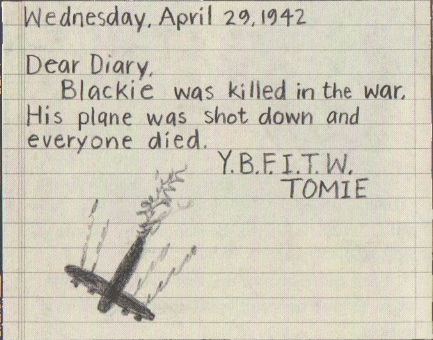
In Book 5, Things Will Never Be the Same, begins in January 1941, first-grader Tomie had just received his two best Christmas presents - a Junior Flexible Flyer sled and a diary with a lock and key, and so Book 5 begins with his very first diary entry.  With all the charm, honesty and bluntness of a very precocious and artistic 6 year old, Tomie takes us through the year 1941, diary entry by diary entry.  Each chapter begins with a short diary entry and the rest of the chapter goes into more depth everything that was going on at the time.  And 1941 is an exciting year for Tomie.  Through his diary, Tomie presents a wonderful picture of what life was life in that year preceding America's entry into the war.  Things he writes about include the day to day family life of the dePaola family, and the world of a first grader, for example, learning about President Roosevelt and the March of Dimes, and not being able to swim in the summer because of a Polio scare; the excitement over seeing Disney's Fantasia in the theater, his disappointment over who is second grade teacher is, about his tap dancing lessons which he loves, and of course all the holidays over the course of the year.  But all this changes on December 7, 1941.  Tomie writes in his diary:


As the dePaola's listen, along with the whole country, to the radio announcer talking about the attack on Pearl Harbor, Tomie's mother says to her family, "Things will never be the same."

Unlike Things Will Never Be the Same, which covers a whole yearBook 6, I'm Still Scared, diary entries only cover one month, December 7, 1941 to December 31, 1941, but is is a powerful month for second grader Tomie.  Not quite understanding what has happened and the implications of war, Tomie is a scared little boy and to make matters worse, no one really wants to explain what's going on to him.  Luckily for him, after listening to Roosevelt's speech on the radio, the family go to visit Tomie's grandparents and his grandfather, Tom, takes some time he talk to him about his fears.  But life had indeed changed.  At school, there were air raid drills, and at home, an air raid shelter had to be created in the basement just in case.  And Tomie had to contend with being called the ENEMY because of his Italian heritage.  War was everywhere.  Even at the movies showing a children's feature, the newsreels showed London in the Blitz, and Tomie realized it was the first time he had seen what war was like.  At the end of December, young Tomie is still scared.

Book 7, Why?, begins on January 1, 1942 and runs until April 29, 1942.  In his new diary, Tomie gives more details of his day to day life.  He writes about his excitement about being able to stay up late for New Year's Eve, of going to help in his grandfather's grocery store, and of his first surprise air raid drill at school.  But his real trouble comes when his teacher starts teaching the kids to write in cursive and refused to allow Tomie, a lefty, to hold the pen in a way that worked for him.  And Tomie talks more about his older brother Buddy and how angry/annoyed Buddy gets with him.  But perhaps saddest of all are the entries about his cousin Anthony A/K/A Blackie.  Blackie was a favorite cousin who had joined the Army Air Corps.  Tomie seemed able to adjust to everything involving the war - like rationing and air raid drills - but the news of Blackie's death is just incomprehensible to him.  In the end, he is left asking himself Why?

Book 8, For the Duration, is the final book in the 26 Fairmount Avenue series and begins on May 1, 1942 and runs through... Well, that's hard to say.  It seems that early on, Tomie's diary key disappeared.  While there are not more diary entries, Tomie still talks about his life and in 1942, patriotism is in full swing.  At school, Tomie gets very sad and runs out of the room when the class starts singing the Army Air Corps anthem.  At dancing school. there is a lot so rehearsing for a wonderful recital, but there are also bullies in the schoolyard who take his new tap shoes and start tossing them around.  And there are victory gardens and ration books and helping again in his grandfather's grocery.  Things between Tomie and his brother Buddy get worse and in the end, it is Buddy who has taken the diary key.  But one thing Tomie learns to understand completely is that some things disappear (chewing gum, fireworks) and other thing come into being (war bonds, war stamps), all "for the duration."

The 26 Fairmount Avenue series is an extraordinary group of chapter books recalling Tomie dePaola's early life living in Meridan, Connecticut.  For the most part, they are a series of vignettes told in great detail and include whimsical illustrations by Tomie thoughout the books.   Much of what Tomie writes is funny, charming, sad and so typical of kids that age.  Though I haven't reviewed for first four books here, I would really recommend the whole series to anyone who is a Tomie dePaola fan.  My only gripe is that we are left hanging about Buddy and the diary key.

And if you are a Tomie dePaola fan, be sure to read Lee Wind's interview with him:
Part 1 can be found here
Part 2 can be found here
Part 3 can be found here

These books are recommended for readers age 7+
Things Will Never Be the Same was borrowed from the Children's Center of the NYPL
I'm Still Scared was borrowed from the Yorkville Branch of the NYPL
Why? was borrowed from the Morningside Heights Branch of the NYPL
For the Duration was borrowed from the Bank Street College of Education Library

Nonfiction Monday is hosted this week by Tammy at Apples With Many Seeds


Thursday, November 8, 2012

The Secret Heroes by Carla Mishek and Margo Sorenson

Family history is one of those projects that kids always seem to get in elementary school.  I assigned family history often enough to my 4th graders.  It is a wonderful way to help kids connect to their past and to appreciate what their parents, grandparents and often great grandparents may have experienced.  Sometimes these assignments yield surprising results for a student.  That is certainly the case in The Secret Heroes.

When 5th grader Sam begins his new school, nothing would have pleased him more than to have his zaydeh (Yiddish for grandfather) around to help him adjust.  Instead, he sits off by himself, drawing pictures of the kids playing baseball, a game his zaydeh was helping him to play better.  But now zaydeh was dead, and Sam found himself living in his mother's hometown, the place his zaydeh had settled in when he came to this country.

Zaydeh had been in a concentration camp when the Germans made all the prisoners march into the mountains to hide them before the American soldiers arrived.
Sam loved to hear his zaydeh's stories about how it was a Japanese American soldier who had rescued him in the snow after he had tripped and fallen.  Now, all Sam had was an old, blurry photo of his grandfather and the Japanese American soldier and the stories he knew so well.

When his teacher assigns a family history project for Heritage Day, Sam decides to do his on his zaydeh.  Meanwhile, Sachi, the girl who sits next to Sam in class, invites him to play baseball with her and her friends during lunch recess.  Sachi is really nice and a really go player, but Sam shies away from playing knowing he doesn't play well.  But Sachi is persistent and really wants to be friends with Sam.  So when Heritage Day arrives, Sam is in for a very big surprise when he sees Sachi's project.

It is often difficult to find a good chapter book for introducing the idea of concentration and internment camps to children without being so graphic that young readers get scared off learning about these things.  Or conversely, making it sound so benign that they lose interest.  Mishek and Sorenson have managed to hit a happy median with The Secret Heroes.

With a great deal of sensitivity and care, Mischek and Sorenson have managed to convey the inhuman treatment of the Jews by the Nazis, the conditions in the concentration camps, how the inmates helped one another survive and the Death Marches near the end of the war to try to cover up their shameful deeds.  And with the same care, they introduce kids to the internment camps where the US contained the Japanese who were living in the United States.  And they learn about the 522nd Field Artillery Battalion made up of the Japanese American soldiers who volunteered to fight for  their country and who were the soldiers who liberated the Dachau concentration camp.

And since this centers on a family history project, the novel also includes lots of information about Sam and Sachi's cultures.  Throughout the book, words that might not be familiar to young readers are written in bold letters and can be found in a glossary at the end of the book.  There is also an Afterword that gives the history of the Japanese and Japanese Americans during World War II.

I would highly recommend The Secret Heroes for any young reader who may want to learn about their own heritage, whether Jewish or Japanese, and as a supplement to a class learning about family history and/or World War II.  This is a wonderful, inspiring story of bravery and friendship over cultures and generations.

This book is recommended for readers age 7+
This book was sent to me by the author.