Saturday, October 1, 2022

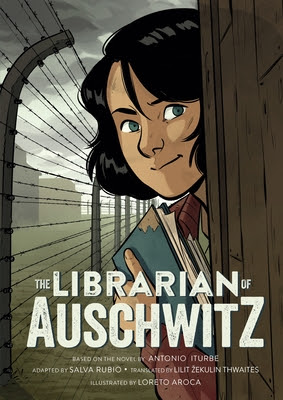
The Librarian of Auschwitz: The Graphic Novel based on the Novel by Antonio Iturbe, adapted by Salva Rubio, illustrated by Loreto Aroca, and translated by Lilit Žekulin Thwaites


Available January 3, 2023
I loved reading comics as a kid and I wasn't above reading a Classic Comic or two or maybe more instead of the book the comic was based on. In school, I was an undiagnosed dyslexic and reading was sometimes difficult. So it stands to reason that as an adult and a teacher, I'm a big fan of books done in graphic format. They are just what some readers need instead of a large and for them, for whatever reasons, unwieldy novel. And for others, they are just a fun way to read. But, the graphic needs to be well done, and in today's world, most of the time, they are. Which is why is pains me to say that I did not like The Librarian of Auschwitz: The Graphic Novel.

This graphic novel is the same story as the novel by the same name and written by Antonio Iturbe, so I'm not going to summarize it again. Suffice it to say it is the story of teenage Dita Adlerova, who was first sent to the Theresienstadt ghetto in Czechoslovakia with her parents and other Jews, and who were all later transferred to Auschwitz-Birkenau. There, they were living in a separate area of Birkenau, called BIIb and referred to as the Theresienstadt Family Camp. These Jewish prisoners were allowed to keep their clothing and their hair wasn't shaved, though living conditions were still as deplorable as in other parts of Auschwitz. If you haven't read the novel, you can read what I originally wrote HERE. The novel is a big book but one that is totally worth spending time with, IMHO. 

Back to the graphic. First, let me begin by saying I did like the art. I found the full color cells were clearly and cleanly drawn in such a way that it was easy to follow the story. The illustrator did a great job at capturing the full range of intense emotions felt by the prisoners of Auschwitz as well as the hate and disgust exhibited by their Nazi captors. Interestingly, none of the characters, Jewish, gay, or Nazi, were portrayed as stereotypical. 

And it wasn't so much that I found the graphic novel to be bad, just lacking. I read the novel back in 2017 and so I'd forgotten some details. Reading the graphic, I found myself confused about a few of the things that went on in Auschwitz and that impacted the main character, Dita, personally. I also didn't feel the importance of the eight books that made up the library was made plain, and how Dita so lovingly cared for them, nor did I feel the reverence with which the borrowers of these books felt for them. 

Some of the characters, like Dita and Fredy Hirsch, as based on the actual people, and of course, so are some of the Nazis like Adolf Eichmann and Josef Mengele, known as the Angel of Death for his experiments of the prisoners in Auschwitz. There is a great epilogue at the end of the book that does go into detail not just about what happened and the people involved.

Ultimately, though, I found this version of The Librarian of Auschwitz to be simplistic and a little stiff. I realize that taking a large novel and synthesizing it down to just 144 pages is not easy task and this was a valiant effort. It just didn't work for me. 

Tuesday, September 20, 2022

Mother Daughter Traitor Spy by Susan Elia MacNeal

Mother Daughter Traitor Spy is a home front novel like no other home front novel I've ever read. It begins in 1940 on such a high note as Veronica Grace, aspiring journalist, is graduating from Hunter College (my alma mater) and about to begin working as a guest editor for Mademoiselle magazine after winning their annual competition. 

But all that comes to a crashing end when Mademoiselle's editor in chief calls on graduation night and tells Veronica will not be welcomed as their guest editor after learning about an affair she had with a married man, who happened to be married to a woman, Mrs. Applebaum, whose father is a "titan of New York City publishing." In a call to Mrs. Applebaum, Veronica is told she will never get a job in publishing in New York City, and to just get out her the city.

When Veronica tells her mother and her Uncle Wally what happened, it is decided that she and her mother, Mrs. Violet "Vi" Engle Grace, would immediately leave NYC for Santa Monica, California. There, they could live in her uncle's summer cabin rent free. 

Vi's husband had been in the Navy, but she's been widowed for the last 6 years earlier. She's an accomplished seamstress and embroiderer and has considered opening her own atelier. Her parents were both born in Germany and needless to say, both Veronica and Vi look like perfect Aryan woman. 

It doesn't take long for the Grace women to be approached by some of the other woman of German descent, who wish to have Vi do some embroidery for them - swastika's and other Nazi symbols. Meanwhile, Veronica is having trouble getting a job in journalism and is referred to a Mr. Donald McDonnell who needs someone to take dictation and type. It turns out McDonnell and his wife Harriet produce a pro-Nazi tabloid and other Nazi propaganda. Veronica, who does not support the Nazis in any way, tries to report what she learns to the FBI, who don't seem very interested in Nazis, instead focusing on communists per instructions from J. Edgar Hoover. 

Discouraged and annoyed at the FBI, Vi makes a call to one of her husband's colleagues in the Navy, Commander Ezra Zabner, to tell him what they suspect about their new acquaintances. Zabner is interested and introduces Vi and Veronica to Ari Lewis. Lewis, along with his friend Jonah Rose, are trying to learn what fifth columnists like McDonnell and his fellow Nazis are up to and they enlist Veronica and Vi to gain the confidence of these traitors,while they are in reality spying on them and reporting back to Ari and Jonah. A dangerous job for this mother and daughter? You bet, but it makes for some very exciting reading. 

When I said that this book is a home front novel like no other, what I meant is that rather being a story  about fifth columnists and quislings, MacNeal takes the reader right into the heart of one such America First group to give them a clear picture of how those groups worked, their anti-Semitic beliefs, their efforts to keep America out of the war in Europe, and how they recruited more members through the connections that Veronica and Vi make once they get to California. Persuasion propaganda is an interest I developed as a student in Hunter College (thank you, Serafina Bathrick, "Propaganda and the Mass Media") and continue to have an interest in, so this novel was right up my alley. This is, to say the least, a well researched, well written novel that I found I couldn't put down.

Mother Daughter Traitor Spy is based on a real mother-daughter team, Sylvia and Grace Comfort, as are all the other main players, giving the story the in-depth sense of authenticity because so much of the Grace's undercover work and the content of America First's beliefs are taken from reality. Added to this is such a strong, almost cinematic sense of time and place, that I felt transported back to 1940s New York and California. MacNeal's use of fashion throughout adds even more flavor to the book's historicity.  

I have to admit that I was a little disappointed when I first heard that MacNeal's next book was going to be a stand alone novel and not a Maggie Hope mystery, which I've been enjoying since Maggie first appeared. But Mother Daughter Traitor Spy has turned out to be a thrilling spy novel about two courageous women involved in some extraordinary work, and yes, there is some love interest, too. By the end, I found myself wondering if MacNeal would perhaps grace her fans a sequel to Veronica and Vi's story. Maybe? 

Thank you, Katie Horn at Random House Group, for providing me with a copy of this novel to review.

Monday, September 12, 2022

Resist: One Girl's Fight Back Against the Nazis by Tom Palmer

A few years ago, I read a book called Dutch Girl: Audrey Hepburn and World War II by Robert Matzen, so I knew about her experiences during the war. What I didn't know when I started reading Resist, the new WWII book by Tom Palmer, was that it is a fictionalized story inspired by Audrey's life during the war. 

It's 1943, and Edda, 15, has a sheaf of illegal resistance newsletters stuffed inside her socks to be delivered to certain addresses. The delivery is her first her first resistance assignment and Edda is nervous, knowing if she were caught, it would mean death at the hands of the Nazis. Edda volunteers at the hospital, and had  asked Dr. Hendrik Visser't Hooft, a leading figure in the resistance, if she could help there, too. Years of studying ballet in England had given Edda an excellent memory, and she proved herself able to easily memorize the addresses for the newsletter delivery.

The Nazis had been occupying the Netherlands since 1940, forcing Edda's brother Alex to go into hiding to avoid being picked up by the Nazis and sent to a slave labor camp in Germany, and her Uncle Otto was one of 460 men who had been arrested and executed by the Nazis. So imagine Edda's stunned surprise when she sees her mother's name listed as a Nazi sympathiser in the newsletters she's carrying. How could Edda possible prove that her mother wasn't a collaborator?

When Dr. Visser't Hooft asked Edda if she would be interested in dancing as part of an evening of entertainment, a secret performance done after dark, to raise money to help people in hiding. she thinks this would help prove her mother's support for the resistance. But when she asks her mother's permission, Edda was told no, she could not participate, it is just too dangerous. After the Germans pick up her other brother Ian, 17, to send to Germany, Edda's mother has a change of heart and gives her permission to perform. On the way home from the performance, Edda finally asks her mother why she had been listed as someone not to be trusted and is relieved to learn that her mother feels it was a mistake to support Hitler and is now on the side of the resistance.

By 1944, the Dutch are hearing on illegal radios that the Allies are moving closer to Holland. But the Germans are getting desperate and are stealing most of the food for themselves and letting the Dutch starve. When the British finally arrive not far from Velp, everyone begins to hope the war will end for them soon. But the British are defeated, as is the hope of the Dutch. Then, one day, Edda is caught by German soldiers along with other girls her age. Afraid she would be sent to Germany like her brother Ian, Edda takes a chance and runs away, knowing how to avoid the soldiers because her resistance activity had taught her all she needed to know about the streets of Velp. 

When her mother hears what happened, Edda is sent to the cellar for her own safety with the rest of her family as the war continues above them. Early one morning, there's a knock on their front door,  and after her mother and grandfather go see who it is, they return with a box of food, apparently from the American army. Could it be that the war and the Nazi occupation in the Netherlands is finally coming to an end? And will Edda ever see her brother Ian again?

Resist is an interesting story, in part because I knew it was inspired by Audrey Hepburn's family and her resistance work. More importantly, however, Palmer shows his readers, without being too graphic, just what it was like for the Dutch people under Nazi occupation - the cruelty of the Nazi soldiers, the disregard for the lives of the Dutch people, and the extent of the starvation they were subjected to. 1944 was infamously known as the Hunger Winter. And just as importantly, the strength of the Dutch during that time. At one point, Edda, already an accomplished dancer, even gave ballet lessons to the local children. 

Palmer's portrayal of Edda is sensitive and I think true to who the real Audrey Hepburn was. He has brilliantly captured her thoughts, her fears for herself and her family, her anger at the Nazis for what they have done to her beloved country, friends and neighbors, and her need to resist the occupiers. These are the same qualities that followed Audrey Hepburn throughout her life, and lead her to do so much humanitarian work as well as acting.  

Back matter includes information about Audrey Hepburn as the inspiration for Edda, the occupation and starvation of the Netherlands, resistance activity there, a bit about Audrey Hepburn and Anne Frank, Audrey Hepburn and her work with UNICEF. and finally, Tom Palmer's research for this novel, including several biographies of Audrey Hepburn, and recommended children's books, such as Tamar by Mal Peet, among others. 

Resist is published by Barrington Stoke known for their books that are adapted for dyslexic and reluctant readers. and as a dyslexic, I can't recommend them highly enough.

Friday, September 2, 2022

Agent Most Wanted: The Never-Before-Told Story of the Most Dangerous Spy of World War II by Sonia Purnell

Virginia Hall may have been born into a family that believed they were obligated "to restore the family to the heights of Baltimore society" but she had no intention of obliging her mother's wish of marrying into money. Virginia was too free spirited to settle down into a society marriage. She loved excitement and living in NY while attending to Barnard College provided her with plenty of that. Virginia was also able to go to Paris when she  was 20, enjoying the art, literature, and meeting all kinds of interesting people, and travelling around Europe for several years. 

When Virginia returned home in 1929, she immediately applied for at job at the State Department, hoping for a diplomat position. Despite stellar qualifications, the State Department rejected her application, but she did get a not-terribly-interesting post, first in Warsaw, Poland and later in Smyrna, Turkey, both at the U.S. Embassies. While in Turkey, she had a shooting accident and lost her left leg below the knee as a result. 

Undeterred, and despite an uncomfortable prosthetic leg, Virginia was determined to return to Europe, and got another posting with the US Consulate in Venice, Italy. But with fascism on the rise in Europe, in 1936, Virginia again applied for a position as a diplomat. This time, with the help of President Roosevelt, she finally found herself as part of the US legation in Tallinn, Estonia in 1938. But after a year of secretarial work, Virginia resigned. When Hitler invaded Poland in 1939, she planned on going to London, but instead ended up in Paris, where she signed up as an ambulance driver with the French Ninth Artillery Regiment. 

A chance meeting with someone who was impressed with her courage and who had connections, led Virginia to Nicolas Bodington, senior office in the French section of Britain' s newly formed Special Operations Executive. After some hesitation, Virginia was off to learn the basics she would need to become an effective intelligence agent for the British in France. When she arrived in southern  France, she registered at an American correspondent with the Vichy government. 

Despite the pain caused by her artificial leg, the danger of being a spy, and being isolated in a hostile environment, Virginia Hall managed to accomplish amazing things for the duration of the war. Once she arrived in Vichy, France, Purnell meticulously documents Virginia's resistance work, both her successes and her failures, answering the question: How did Virginia Hall became the agent most wanted and why the German Gestapo considered her to be the most dangerous woman in Europe during WWII?

Though nonfiction, the history of Virginia Hall's life during WWII reads like a thrilling novel, full of dangerous adventures and frustrations befitting the life of a spy. Virginia's is a story that has been relatively untold up to now. Purnell, in this biographical work, shows how Virginia was continuously belittled, often rejected, and discriminated against because of her disability, yet she never gave up pursuing her dreams, and how, despite everything, she may have been one of the best spies in WWII.

This is a book that will appeal to young readers who are history and WWII buffs. Back matter includes Chapter Notes and a select Bibliography. Agent Most Wanted is a young readers adaptation of Purnell's original book A Woman of No Importance

Sunday, August 21, 2022

American Shoes: A Refugee's Story by Rosemarie Lengsfeld Turke and Garrett L. Turke

In 1930 Rosemarie Lengsfeld, affectionately called Rosel by her family, was born in New York City to parents who had emigrated to the United States from Germany and were awaiting their final citizenship papers. Despite that, they decided, in 1935 when Rosel was four-years-old, to return to Germany to visit family in Breslau. It was to be only a short stay, but lasted longer than expected, so when it came time to return to the US, the family discovered that their tickets would not be honored. Adolf Hitler, then Chancellor of Germany, had closed the borders so that German citizens could not leave the country. At first, Rosel enjoyed being with her extended family in Germany, and her parents soon welcomed baby Eleonore into the family. But when the war began, the family found themselves struggling to stay alive without enough food to eat amid bombing by the Allied Forces. 

Finally, in 1946, with the war over, Rosel received a letter telling her she could return to the United States. Convinced that this would include her parents and now nine-year-old Eleonore, the family showed up at the American Embassy and were told only Rosel, 15, could return home, since she was the only American citizen - her parents and sister were German citizens. 

Making a snap decision to go it alone and hopefully find a way to bring her parents and sister to the United States, Rosel finds herself traveling across the ocean on a 10 day trip aboard the SS Marine Flasher, a former troop transport ship along with other American citizens who were stuck in Germany and "surviving Jews and other displaced persons..." On board ship, Rosel meets the mysterious Liesel, another American with German parents, a few years older Rosel, who is traveling with her brother Kurt. She also meets David, a talented musician who lost his entire family in the Holocaust. As the ship gets closer and closer to the United States, Rosel begins to fear that no one will believe that she is American, that she will be branded as a Nazi because of her German accent. 

It is during this journey at night when she is alone in her bunk bed that the reader discovers what life was like for Rosel, her family and others living under the horrors of Hitler's dictatorship before and during the war. Interestingly, she never talked about her experiences until she was 85 years old and therefore it is all based on her memories, but told in the first person from her 15 year-old perspective, and, in my opinion, making her something of an unreliable narrator. Even so, it's hard to imagine a 15-year-old making the kind of decision Rosel was forced to make that day in the Embassy, leaving her parents and sister behind, traveling alone to who knows what future, and at the same time, dealing with the trauma of the war as it returned night after night on the trip to the US. But Rosel's story is definitely one of courage and a different kind of true WWII story in that it is told from the point of an American child. It is often not an easy book to read, but I found it hard to put down. 

American Shoes is a book that will appeal to readers interested in WWII, the post war experience, especially the experiences of Americans can in Nazi Germany, and war-related trauma. Back matter includes maps, a glossary, an author's commentary on WWI, WWII, and the Holocaust, and thoughts by the author's son about writing this book, as well as extensive Discussion Questions.