Showing posts with label Activity Books. Show all posts

Friday, April 10, 2015

Top Secret Files of History: Spies, Secret Missions & Hidden Facts from World War I by Stephanie Bearce

In October 2014, I reviewed a book called Top Secret Files of History: Spies, Secret Missions, & Hidden Facts from World War II.  It is such an interesting book, and I discovered all kinds of new information about the hidden workings and wartime secrets that helped end the war.   Now, the author, Stephanie Bearce has followed it up with a similar book about World War I.

Bearce has once again culled little known information about WWI and combined it with more well-known details and events in a book that will fascinate young readers.  For instance, they will read about the secret society, the Black Hand, formed by the Serbian Army for the purpose of freeing Serbia from being ruled by Austria-Hungary, which led to the assassination of Archduke Franz Ferdinand of Austria and his wife and the start of WWI.

And then, in the section on Spies, there is the prospector/mining engineer Howard Burnham, who had lost part of his leg before the war in an accident.  Working for the Allies, Harry traveled into German territory to do learn enemy troop positions.  Howard has a photographic mind and didn't need to put anything on paper.  In addition, he cleverly hid his surveying tools in his prosthetic leg and no one was ever the wiser.  Readers will also read about brave women like Nurse Edith Cavell and Nurse Marthe Cnockaert, whose professions helped them spy for the Allies.  After the war, Cnockaert went on to write spy novels.

One of my favorite stories in the Special Missions section are the dazzle ships.  Radar was unknown in WWI, and the Germans had developed their submarines or U-boat to such an extent that Allied ships were being successfully torpedoed by them.  A British naval officer named Norman Wilkinson came up with a unique way to confuse the Germans: camouflage the ships by painting the bright geometric patterns so the U-boats couldn't zero in on their position.  See what I mean:

HMS London (1918 Public Domain)
Spies, Secret Missions & Hidden Facts from WWI is chockablock with interesting facts, people and events.  Towards the end of the war, as planes were being used more and more, the French were afraid that Paris would be bombed.  What to do?  Readers will discover the unusual solution the French come up with in this book.  And speaking of airplanes, remember the World War I flying ace, Snoopy and his foe, the Red Barron.  Well, readers will meet the read Red Barron in the section on Secret Forces.

And they will learn about some secret weapons that were used, like carrier pigeons and dogs, and Little Willie, the tank that was able to put an end to trench warfare.  How?  Here's a hint:

The newly invented tank could easily cross over a trench 
Like it companion book, this one is also divided into five sections: Secrets, Spies, Special Missions, Secret Weapons and Secret Forces, each packed with all kinds of interesting information, and within that, readers will find inserts with even more unusual facts.  And at the end of each of the five sections, there are activities and projects for kids to do that corresponds to the topic covered.

A Bibliography of Books and Websites is included for further exploration.  Like Bearce's book on WWII, this volume is also sure to please young history buffs, or anyone else who like a good secret.

This book is recommended for readers age 9+
This book was sent to me by the publisher, Prurock Press


Saturday, October 18, 2014

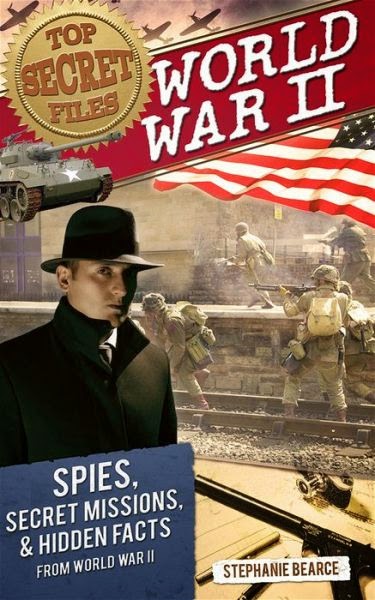
Top Secret Files of History: Spies, Secret Missions, & Hidden Facts from World War II by Stephanie Bearce

World War II is like an iceberg - the parts of it that we read about in history books or even learn in the classroom are really just the tip of the iceberg.  Below the surface, hidden from sight, are all kinds of secrets, deceptions and subterfuge that helped win the war.  So, what are some of them?

Well, Stephanie Bearce has culled some of the more interesting aspects of wartime secrets and put them together in this small, but very interesting book.  Young readers will learn not only how one became a spy for England, training in the grand estates around the country requisitioned for that purpose, but they will read about the Ghost Army that fought the war with rubber trucks, tanks, planes and weapons.  Rubber?  That's right.  And that's not all they did.

Kids will how read about how an Australian journalist turned spy called The White Mouse became a bane of Nazi existence because of her ability to give them the slip while working with the French resistance.   Or how one man, Christopher Hutton, invented the silk map, making life so much easier for Allied pilots and parachutists, because their maps were now so lightweight and indestructible.  Hutton went on to invent other useful things for soldiers, including a special Monopoly game that could be sent to POWs and contained escape equipment.

There is lots of interesting information about secret missions, like, exactly what Julia Child was cooking up during the war.  Or the secret city that really didn't exist but did exist, and designed to fool the Japanese.  And readers will learn all about Rat Bombs, Bat Bombs and Doodlebugs.

But my personal favorite was the section on Code Talkers.  I've always liked codes and ciphers, especially the Enigma (one of these days I am hoping to post instructions for making a simplified Enigma out of a Pringles container).   And I, like many of you, have heard of the Navajo Code Talkers, but never really understood how the coding worked.  Bearce gives a short history about this special group of men, and how they devised their code, and includes a simplified dictionary for solving her Code Talker's Challenge.

In fact, in each of the five sections that the book is divided into there are corresponding projects that kids can do or things they can make, such as a simple spy obstacle course or a fingerprint kit, or even a book safe.

Scattered throughout each chapter are sidebars of even more interesting information or facts that will intrigue readers, such as how Ian Fleming came up with the name Jame Bond for his famous agent 007.  And at the back, you will find Bibliography and a list of websites where readers can get additional information on all the topics covered.

Spies, Secret Missions & Hidden Facts from World War II is sure to please budding history buffs and anyone else who just likes a secret.

This book is recommended for readers age 9+
This book was sent to me by the publisher

A 5 copy giveaway of Spies, Secret Missions & Hidden Facts from World War II is going on over at Goodreads until October 28, 2014, so head on over there if this sounds like a book you would like to own.

Tuesday, October 30, 2012

Halloween Special: Meet Molly by Valerie Tripp and Have a Molly Halloween


The original Meet Molly
Meet Molly is the first novel of the six Molly McIntire series books from American Girl.  Molly is 9 year old and living on the American home front during World War II.  Her father, Dr. McIntire, had joined the Army when war was declared and is stationed in England, where he is caring for wounded soldiers.  Molly's mother is doing her bit working for the Red Cross.  Molly has a sister Jill, 14, a brother Ricky, 12, and a brother Brad, 5.  Molly's two best friends are Linda and Susan.

It is 1944 and the war is still raging in Europe and the Pacific.  The country is feeling the effects of rationing and shortages, so people really have to be clever and economical about coming up with Halloween costumes and treats.  As the story opens, Molly has been sitting at the dinner table for over 2 hours with a plate of cold turnips in front of her.  Molly, a rather headstrong girl, had refused to eat the turnips and Mrs. Gilford, just as headstrong, refused to excuse her until they were gone.  Molly spent her table time dreaming of the beautiful Cinderella costume she was planning to wear for Halloween, IF her mother would buy the yards of fancy material needed and IF she agrees to sew it for Molly.  This dream, however, quickly hits reality the next day when her best friends are less then enthusiastic about being the ugly stepsisters to Molly's Cinderella.

The newest Meet Molly
But Mrs. McIntire saves the day when she suggests the girls go as Hawaiian hula dancers and shows them how to make a costume using crepe paper, paint and strips of newspaper.  All three girls are very happy with this costume, and go off trick or treating after school, and collecting lots of goodies by the end of the day.  The only problem is Ricky, who has planned his revenge on the girls for having teased him about his crush on Jill's friend Dolores earlier.  And after he ruins their costumes and their treats when he douses them with water, the girls decide to declare war on Ricky and to get their revenge on him.

There are, of course, lessons to learn in Meet Molly about fighting, peace and sharing - good lessons in general but here also very apropos of the time.

In this nicely done chapter book, Valerie Tripp has managed to get much of life on the home front onto Molly's Halloween story.  There is Mrs. Gilford's Victory Garden that didn't do as well as hoped because of the excessively hot summer; Mom's job that takes her away from home so much of the time; missing Dad and wondering whether he is alright and of course, wanting things to be the way they used to be.  And at the end of the novel, there is short "A Peek into the Past" which covers the cause of the war and tells something about how life really was for kids like Molly on 1944 home front.


I love a good activity book and a nice companion to Meet Molly is Have a Molly Halloween, an activity book for making the kinds of Halloween treats, games, and decorations Molly might have made in 1944, along with instructions for making Molly's Hawaiian hula costume and her brother Ricky's pirate outfit.  There are a total of 37 activities in the book along supplies for making six crafts, including beads, pipe cleaners, and stickers.  All of the activities are easy and fun for kids to make.  Have a Molly Halloween is currently out of print but you can still find it online, and often with the craft supplies intact and for a reasonable price.

These are two favorites we did in my house over the years:


The trick or treat bags were especially popular and we also bought some small brown paper bags, decorated them with Halloween designs, fill them with some candy and tied it all up with twine to give to any trick or treaters who can to the door.  It was a lot of fun and a nice family project.

Halloween wasn't really celebrated during World War II, certainly not the way it is nowadays.  Sugar was rationed, limiting the kinds of treats people could give to kids.  Popcorn balls and donuts were very popular, as were apples, which were never rationed.  With the country at war, some tricks would have just been too mean to play on people and rationing took care of things like soaping windows or toilet papering trees.  And of course the blackout meant NO lights, so evening trick or treating was out of the question.  Instead, many people chose to just have parties at home, doing things like dunking for apples, pin the tail on the devil and other easy to do games.  And what could be better in a darkened world than  telling scary ghost stories.  Scouts, churches and other organizations also threw parties for kids, either after school or on the weekend.  Wherever the party, it was a chance for kids to demonstrate their creativity coming up with costumes and decorations using whatever was at hand, unless you were one of these kids who were lucky enough to have a popular Army, Navy, Air Force kid-sized uniform or the ever popular nurse costume to wear.

From Have a Molly Halloween
However you choose to celebrate the day,

I Wish Everyone a Happy, Safe, Fun-filled Halloween

Monday, April 16, 2012

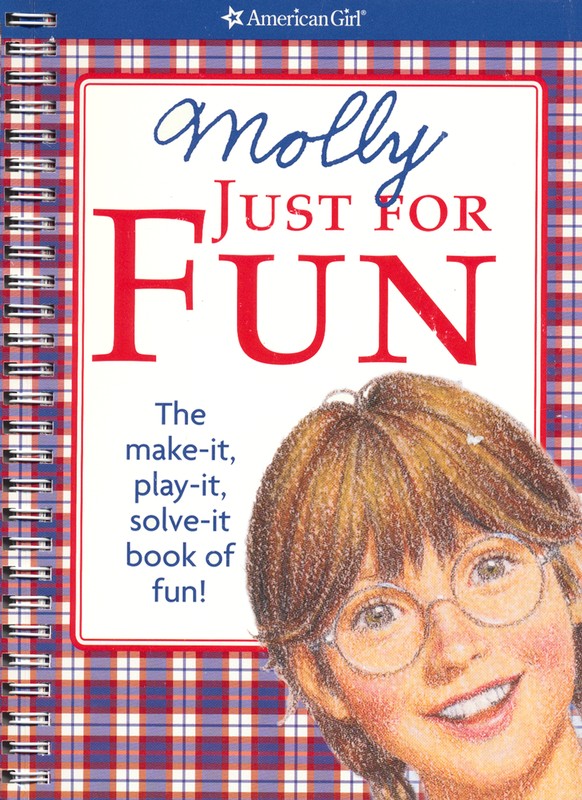
Molly - Just for Fun: The Make it, Play It, Solve It Book of Fun

My 9 going on 10 year old niece L'naya was visiting me this past spring break.  She has always spent her school vacations with me and one of the things she really enjoys is playing with my daughter's American Girl doll Molly (which is now 9 going on 21.)

Before L'naya arrived, I had gone to a bookstore to see if there were any new Molly books that we didn't already own.  I bought one called Molly Just for Fun and put it away for a rainy day while my niece was visiting.  Well, weather being what it has become lately, we never saw a single raindrop, so I just gave it to her.

Molly Just for Fun is exactly what it is described as: a make-it, play-it, solve-it book of fun - in other words, an activity book.  I thought that since L'naya was learning about World War II and the Holocaust this year in school, it might be fun to see what kinds of things kids did back them.

I was wrong!

Molly Just for Fun is basically an expensive book, $12.95, of do-once-then-become-bored activities.  The first activity is called Sticker Sudoku.  You solve the puzzle using pictures from Molly's 1940s life instead of numbers.  And I am pretty sure that no one had even heard of Sudoku back then.  L'naya did like learning how to make a secret code, but I could have shown her that - I learned this particular method when I was a kid.  Very few of the activities call for a child to use their imagination or involve any of the arts and crafts projects kids usually enjoy so much.

So I am sorry to say, I would not recommend Molly Just for Fun.  Much better is Molly's Cookbook: A Peek at Dining in the Past with Meals You Can Cook Today.  This is an old 1994 edition that belonged to my daughter when she was young and was published by The Pleasant Company.  

Molly's Cookbook really does teach kids about food during the war when shortages and rationing made life so very difficult.   And there lots of fun recipes like Volcano Potatoes and Deviled Eggs, both of which we have often enjoyed.

Molly's Cookbook is not to be confused with Molly's Cooking Studio, a newer, more high priced book published after The Pleasant Company was sold to Mattel.  And even though Molly's Cookbook is not longer published, it is easily available online, sometimes as low as 25¢.  This is a wonderful book for adults and kids to work together in the kitchen.  Kids learn not just about food in the war, but also how to prepare simple but tasty food and basic kitchen safety.

In my house the all-time favorite recipe in Molly's Cookbook is a breakfast dish called Toad in the Hole which I learned how to make in Girl Scouts when we called them Sunshine Eggs.


Enjoy!

Non-Fiction Monday is hosted this week by The Nonfiction Detectives

Monday, June 13, 2011

Primary Sources Teaching Kit World War II by Sean Price

I found this thin book while looking for something else in the library and pulled it from the shelf to look at it. It turned out to be a unique type of activity book for teaching grades 4-8 about the Second World War.


The book relies on primary source documents for relating to the war.  The book suggests that a teacher using this workbook begin by teaching students the difference between a primary and a secondary source document. The benefits of using primary sources for students is that as they learn how to interpret what they are looking at they become active historians rather than simply passive receivers of information (and usually someone else’s interpretation of history.)

The first part of the book contains teaching note on the various areas to be looked at, including teaching suggestions. This is followed by a reproducible page (see example below) that the students can use for evaluating each document they use.


The rest of the book contains the also reproducible primary source documents (see example below), beginning with pages from Adolf Hitler’s Mein Kampf, his plan for Germany written before he seized power.  Using Hitler's book is something I have never seen before in other workbooks, but I think it is important to understand an enemy and how he thinks.  Other topics covered are the Hitler Youth, movies and songs of the time, Auschwitz, and Roosevelt’s Day of Infamy speech, including his handwritten changes and corrections.


This workbook also includes a timeline, a glossary and two reproducible world maps and a wonderful K-W-L chart for students use.

The real value of this book lies in the teacher’s ability to go beyond what is covered and include topics of their choice, while still using the basic ideas and document evaluation page. This also means that the teacher can use it with older students who are ready for more complex topics of the war.

I really liked this book when I found it. I think most students enjoy history much more when they are actively engaged with it. I know my own imagination really took off when I saw this useful workbook.

Primary Sources Teaching Kit World War II was published by Scholastic in 2004 and may not be easy to purchase, but can certainly be gotten through a school’s or public library’s InterLibraryLoan program.

This book is recommended for readers age 10-14
This book was borrowed from the Mid-Manhattan branch of the NYPL

Non-fiction Monday is hosted this week by Books Together

Monday, March 28, 2011

World War II Days: Discover the Past with Exciting Projects, Games, Activities, and Recipes by David C. King, illustrated by Cheryl Kirk Noll

World War II Days: Discover the Past with Exciting Projects, Games, Activities, and Recipes is intended to give kids a sense of what life was like for young people during the war. There are 30 projects altogether, all with instructions and an explanation as to why they would be of interest to kids during the war. There is even a glossary at the end for words that may be unfamiliar to children.


The activities are presented as the book follows a year in the life of two families in 1942, and is divided into seasons. We meet the Donato family in the Spring and Summer. Frank Donato, 11, lives in an apartment in San Francisco with his parents, grandparents and sisters Julie, 6, and Theresa, 18.

The book moves from life in a city to life on a Minnesota wheat farm belonging to the Andersen family during Autumn and Winter. Shirley Andersen, 12, lives there with her parents, and 7 year old brother Edmund. Her older brother, Karl, joined the army air corps as soon as America entered the war, and the two farmhands joined the army shortly after that.

Each project, activity or recipe begins with a short historical introduction about what life was like for either Frank or Shirley. Since Frank lives in a city, he doesn’t have the land for an in the ground Victory Garden, but instructions are given for making one in a window box. This project also includes gardening tips and a recipe for a Victory Salad.

When Shirley’s brother Karl comes home from the army air corps on leave, he teaches Shirley and her friend Jodie how to make secret codes. There are a few examples of code projects, such a deciphering and communicating in secret codes that anyone can do.

One of my favorite projects is making a periscope. I remember doing this very same project in school for a science project and loving it.

The recipes are easy, but do require adult assistance. There is a recipe for Coney Island hot dogs, which I found tempting, even though I don’t eat hot dogs.

There are even directions for making games that children played during the war such as Ludo and Sea Battle, with instructions about how to play.

I have always liked activity books, and I guess I still do. When we had book fairs in school, I always bought at least one book with projects for kids to do and did many of them. Most kids get a great deal of satisfaction when they successfully complete a project and when I was teaching, I always gave an extra credit project that involved making something. I found that even the children who were really struggling with academics always responded to this kind of activity.

This book is highly recommended, and can even be adapted to the classroom use. In a way, it reminded me of the old Molly’s Craft Book from American Girl, which is probably still around here somewhere, and which we used quite a bit at one time. David C. King has written a number of books that cover different important periods in American history, all in the same format as this one, and I found all to be just as well done and interesting as World War II Days: Discover the Past with Exciting Projects, Games, Activities, and Recipes.

This book is recommended for children age 8 to 12.
This book was borrowed from the NYPL’s Children’s Center at 42nd Street, NYC.

Non-Fiction Monday is hosted this week by Practically Paradise