Showing posts with label Comic Books. Show all posts

Tuesday, September 8, 2020

Mask (The League of Secret Heroes) Book 2 by Kate Hannigan, illustrated by Patrick Spaziante

I was really excited to read Cape, book 1 of The League of Secret Heroes trilogy, so I was really looking forward to reading book 2. And Mask does not disappoint. Set during WWII, which happens to be the golden age of comic books, the League of Secret Heroes is part comic book, but mostly novel, and consists of Josie O'Mally (Cape), a white Irish American girl from New York City, Akiko Nakano (Mask), a Japanese American girl from San Francisco, and Mae Crumpler (Boots), an African American girl from Chicago. When the three of them meet, they discover that together their individual superpowers can be released. And it's a good thing because all their comic book superheroes like Zenobia and Hauntima are either gone or merely ghosts of their former selves and losing their powers quickly.

After defeating the Hissler in Philadelphia, a Hitler follower who was trying to get coding secrets, the three girls a/k/a the Infinity Trinity have teleported themselves to San Francisco. This used to be Akiko's home until President Roosevelt's Executive Order 9066 for the roundup of all persons of Japanese ancestry who were then transported to internment camps. This included Akiko's family, who were sent to the Manzanar, where they still are. Except for her brother who is serving in the Japanese American 422nd Infantry Regiment and her mother who is missing.

But our superheroes no sooner arrive in San Francisco, then they receive a coded message and head to San Francisco Bay, were the navy has docked several ships, to try to decipher it. Then, just as Akiko thinks she's spotted her mother walking with a suspected spy in the crowd, a parade of bagpipers go by, and she loses her. The parade is followed by a giant blimp flying overhead, navigated by Side-Splitter, and dropping bomb balloons. Suddenly, there are a lot of clowns, all dressed alike, swarming the waterfront, ready to do Side-Splitter's bidding. And Side-Splitter knows just who the Infinity Trinity is. After a battle between them on the waterfront, the girls finally head to the new League of Secret Heroes headquarters, thinking Mrs. B had been the one to leave the coded not for them.

It turns out that two crack cryptologists, Genevieve Grotjan and Elizabeth Friedman, had left the note, hoping for the Infinity Trinity's help decoding some messages they were sure was a business owner sending secret codes to the enemy. Between Akiko's missing mother, the balloon bombing Side-Splitter and his minions of devoted clowns, and now decoding a spies messages, Josie, Akiko, and Mae have a lot to work on. If only their favorite superheroes were able to help. 

Mask is every bit as exciting as Cape. Hannigan has managed to blend fantasy and reality in such a way that the adventure never stops nor does the suspense. And just as she had in Cape, she's brought in a number of historical figures (Elizabeth and Genevieve and Noor Inayat Khan, and Velvalee Dickinson) and believably blended them into the story - but never loses the comic book feeling that is so much a part of this series.

But at the same time that the Infinity Trinity, Side-Splitter, (and the Hissler from the first book) are perfect comic book characters, there is a lot of history to be found woven throughout the adventure. America's internment camps, the racism directed a Japanese Americans, the magnitude of what they lost when Executive Order 9066 went into effect, the 422nd infantry Regiment are all a part of Akiko's story. The idea for the bomb balloons may sound far fetched but they also stem from reality. How? Read the Author's Note to find out about this and other interesting facts that have been worked into the story. 

This is a second book in a series and there is always the question of whether book 2 will stand alone. I found that whenever the story referred back to the first book, there was enough background information that if you haven't read it, you wouldn't get lost. 

If you are looking for a fun work of historical fiction, Mask (and Cape) are sure to please. 

You can find some probing discussion questions and activities courtesy of the publisher Simon & Schuster HERE

This book is recommended for readers age 9+
This book was an eARC gratefully received from NetGalley

Saturday, June 3, 2017

Sunday Funnies #24: Introducing Wonder Woman

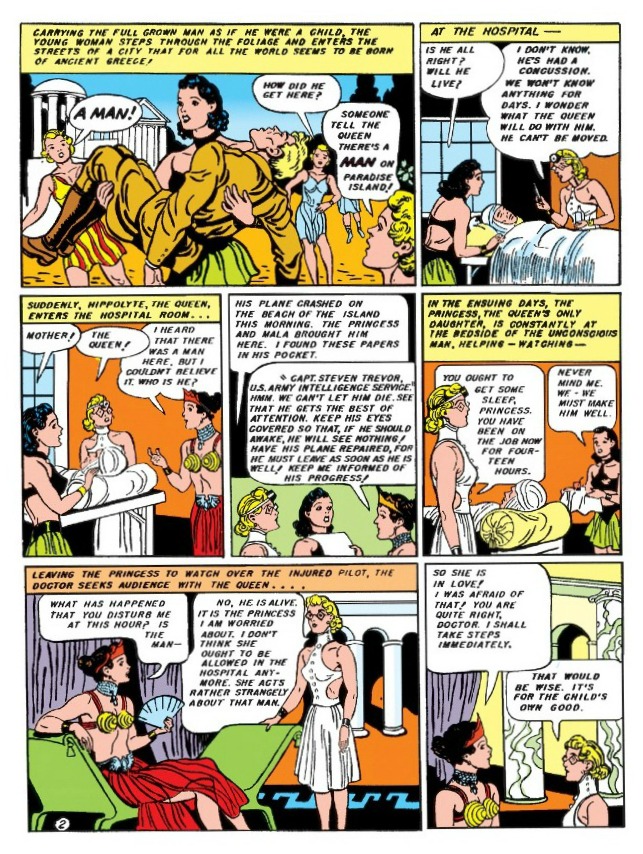
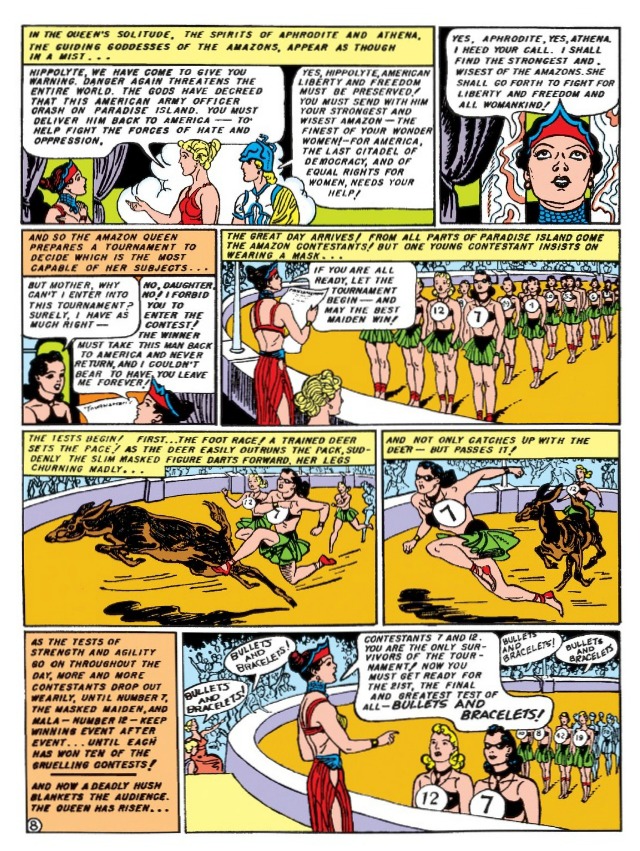
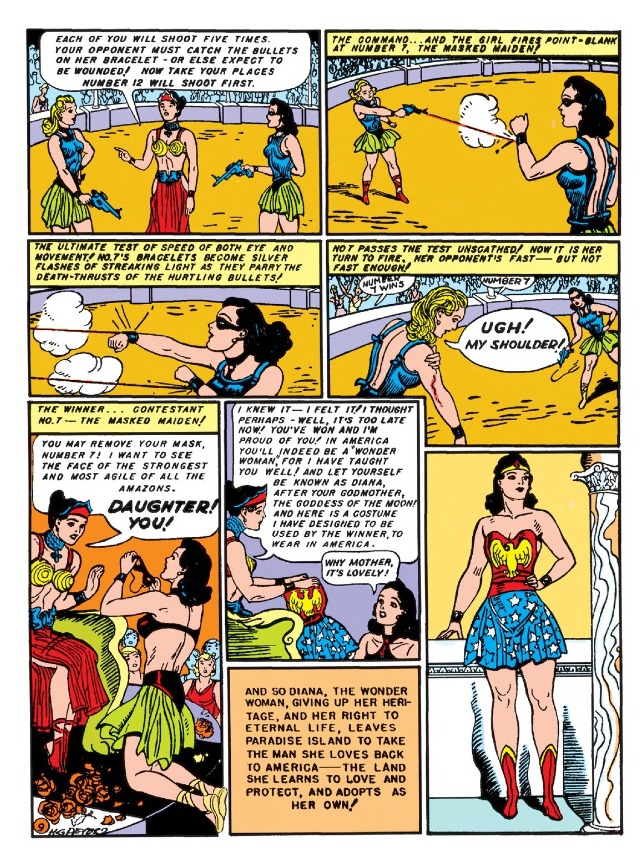
Today is Wonder Woman Day, and so I thought I would introduce everyone to her original story as it was written in December 1941, just as the United States entered World War II. Wonder Woman made her first appearance in the December/January 1941 issue of All Star Comics #8, and was published by DC Comics.

Wonder Woman was created by Dr. William Moulton Marston, writing under the name Charles Moulton. Marston had a PhD in psychology and was a big believer in the newly invented lie detector, even writing a paper on how deception could be measured by blood pressure. He also believed in the superiority of women, and, in 1940, Dr. Marston wrote an important article called "Don't Laugh at the Comics."

This constellation of ideas lead to a part time job at DC Comics, where he was able to suggest an idea for a new super hero character, a super-heroine.

As you can see, the cover of All Star Comics #8 makes absolutely no mention of Wonder Woman, instead the two newest members of The Justice Society of America, Starman and Dr. Midnite, were given introductory billing. But, it was Wonder Woman who found real, lasting favor with readers. It only took a few issues before she was inducted into The Justice Society, and only six months until she was given her own comic book, Wonder Woman #1.

So how did Wonder Woman get from her home on Paradise Island to the United States?

But, after hearing that her daughter, the Princess, might be in love with the injured American captain, her mother, Queen Hippolyte, tells her the story of how they ended up on Paradise Island. In ancient Greece, the women of Amazonia were a foremost nation, until Hercules, the strongest man in the world, decided to conquer Amazon. Queen Hippolyte challenged him to one-on-one combat, knowing she would win because of the Magic Girdle she had been given by Aphrodite, the Goddess of Love. Queen Hippolyte won the match, but Hercules managed to steal her Magic Girdle, and was able to overcome and enslave the women of Amazonia. Queen Hippolyte called upon Aphrodite for help, and she did save them on the condition that they sail to another island, leaving the man-made world forever, and establishing a world of their own, but the women must always wear the bracelets that they were forced to wear while in captivity to remind them to keep aloof from men. 

To keep their promise to Aphrodite, the American pilot must leave Paradise Island as quickly as possible.  Queen Hippolyte shows her daughter the Magic Sphere, given to her by the Goddess of Wisdom, Athena, by which she can monitor the world that they left behind, the world of the American captain, a world from which she can also gain all the knowledge of arts, sciences and languages to make a more superior world on Paradise Island for themselves. 

Together, she and her daughter, look at the world that the American captain comes from and how he ended up on Paradise Island.


Wonder Woman went on the fight the Axis powers for the remainder of the war and has continued fighting bad guys ever since. She has had several make-overs since her first appearance in 1941, but the original is still my favorite, even if it does seem a bit naïve by today's standards.

If you would like to know more about Wonder Woman's history, I can't recommend a better, more fascinating in-depth book than The Secret History of Wonder Woman  by Jill Lepore.

There are any number of anthologies available if you want to read old Wonder Women comics, without the high cost of an original. My favorite is Wonder Woman: The War Years 1941-1945 edited by Roy Thomas.

Sunday, July 20, 2014

Sunday Funnies #17: What the heck are Canadian Whites?

I learned something new this week when I read Jacqueline Guest's novel The Comic Book War.  Canada, as you probably know, entered WWII two years before the United States did.  But wars cost money and in order to conserve Canada's balance of trade with the United States, Parliament passed War Exchange Conservation Act on December 6, 1940.

What this meant for fans of American comic book living north of the 49th Parallel was that there would be no more importation of such comic favorites as Superman, Batman or relative newcomer Captain Marvel.

To make up for this deficit, Canadian publishers scrambled to start producing their own superhero comic books.  In March 1941, Maple Leaf Publishing introduced the first issue of Better Comics and the first Canadian-created superhero Iron Man, created by Vernon Miller, formerly of the Disney Studios.  Iron Man was indestructible, having super strenght and was amphibious to boot.  He had originally lived on an island in the South Pacific, but an earthquake had obliterated all the inhabitants save him.  When the war started, Iron Man decided to throw his lot in with the Allies.  Like Iron Man, all the content in Better Comics was original and the stories were often serialized to keep customers coming back for more, but it seems to have been relatively successful, continuing to publish through the war.

August 1941 saw the publication of Triumph Adventure Comics by Hillborough Studio.  Founded by three artists, Triumph Adventure Comics introduced Canada's first Canadian-created, true Canadian superhero: Nevlana of the Northern Lights.  She was the child of a mortal mother and the King of the Northern Lights, Koliak the Mighty.  Nelvana could fly and travel at the speed of light by riding on a light beam from the Aurora Boralis.  Over time, more powers were written into the stories as they were needed.  It should also be noted that Nelvana arrived on the comic book scene a full four months before her American counterpart Wonder Woman.
Triumph Adventure Comics #1 August 1941; Triumph Comics March 1942
Nelvana continued to appear in Triumph-Adventure Comics until February 1941, for a total of 7 issues.  When her creator, Adrian Dingle, left Hillborough, he went to Bell Features taking Nelvana with him.

Bell Features was a very successful comic book publisher.  They were very Canadian focused and that was what readers really wanted during the war.  Besides Nelvana in Triumph, there was the Penguin in WOW Comics.  Unlike Batman's nemesis by the same name, WOW's Penguin spent his time fighting evil, especially the evil that was the Axis powers.  He was a master spy, a detective, an expert marksman, excellent at hand to hand combat and once you saw his face, you knew you didn't have long for this world.  And his identity was often speculated about but never revealed.

Bell also published Dime Comics and in February 1942, another true Canadian hero made his appearance.  Johnny Canuck was the creation of a 16 year old boy name Leo Bachle.  Johnny Canuck, a captain in the allied Air Force was also endowed with super strength.
Dime Comics February 1942 introducing Johnny Canuck
Last, but not least, we come to Educational Projects of Montreal.  Educational Projects introduced Canadian Heroes into the mixed of superheroes, focusing on real people who were real heroes.  Needless to say, this kind of comic books didn't really go over well with kids who were used to much more daring, dangerous and exciting fare for their heroes.
Canadian Heroes #1 November 1942 and #5, March 1943 introducing Canada Jack
And so Education Projects decided to forgo the real, focus on the fictional and so Canada Jack was created for the March 1943 issue of Canadian Heroes.  Canada Jack was just an ordinary guy without superpowers but he was an expert gymnast at the top of his form.  He actually became popular enough with kids that The Canada Jack Club was formed and kids were encouraged not only to join the club, but to do work to help the war effort.  Then, each month a different member and their war activities were spotlighted in the comic book.

Members spotlighted in Canadian Heroes V. 4 #6 December 1944 
But alas, this golden age of Canadian comic books was not to last beyond the end of the war, when the War Exchange Conservation Act was not longer needed and once again, American comic books flooded the Canadian markets with the kind of glitzy comics that the Canadian publishers just couldn't compete with.

So, what are they called Canadian Whites?  The covers may have looked just like the kind of four color covers you would find on American comics, but that is where the similarity ends.  The stories inside were all done in black and white, as you can see from some of the examples used here.

In 1995, the Canadian Post Office issued a set of 5 stamps commorating comic book heroes.  These included WWII superheroes Superman, Johnny Canuck and Nelvana, as well as Captain Canuck and Fleur de Lys from the 1970s and 1980s.


Source:
Bell, John. Invaders from the North: How Canada Conquered the Comic Book Universe.  Toronto: Dundum, 2006.

Most images used are public domain.

Saturday, July 12, 2014

The Comic Book War by Jacqueline Guest

It's 1943 and Robert Tourand, 15, misses and worries about his three older brothers who are off fighting in Europe with the Canadian armed forces.   So when he finds a small piece of a meteorite, it becomes a kind of magical charm for him.  Thanks to it, Robert soon, he begins to see and believe a cosmic connection between what his brother write about from the front line in their letters, and the heroes in the comic books he obsessed with.

And so, he pairs brother to comic according the their parallel experiences: favorite brother Patrick is assigned The Maple Leaf Kid, brother James and Sedna of the Sea go together because James could use her wisdom, brother George, a pilot, is paired with flying ace Captain Ice.  Their assignment: to keep his brother's safe.

It all works nicely until his mother finds a pair of torn pants and decides Robert need to be taught a lesson.  Now, she decides, his weekly allowance, his only means of buying the newest editions of the comic book that contain secret messages about his brothers, would be better spent on war stamps.  Now, Robert needs to figure out a new way to make sure he can buy his three favorite comics every month.

And it seems that ever since his found his magical piece of the universe, luck has been with him.  When his teacher announces that the student who collects the most fat for the war effort will win four completely filled books of war stamps, valued at $4.00, Robert thinks he's found the answer to funding his comic addiction.  But despite his best efforts, he didn't expect such stiff competition from Crazy Charlie (Charlene) Donnelly, a girl as much on a mission as Robert.

So, when fat collection doesn't yield the needed money, Robert decides to take a job as a telegram delivery boy.  Trouble is, Crazy Charlie has the same idea.  They are both hired, and as more and more telegrams need to be delivered, Charlie seems to be able to get around Calgary some much faster than Robert on her dilipated second hand bike compared to his sleek newish Raleigh.  Robert is so busy thinking about his comic books, he never bothers to ask Charlie about herself.  Nor does he think about what is in the telegrams he is delivering, until one arrives at his house in Charlie's hands.

At first, I didn't much care for The Comic Book War.  I found Robert to be a very unappealing character, too focused on himself and completely lacking in empathy for anyone else.  Ironically, Robert and Charlie are both loners, outsiders that could have been friends from the start, if Robert had been able to see beyond himself.  But as I continued to read, I began to see Robert in a different light, as a person who could actually have some compassion for the recipients of the telegrams he was delivering.

I also thought that Robert was a little too old to be so obsessed with comic books, even for the WWII time frame.  But this is, after all, a coming of age novel.  I began to think about how kids will use all kinds of ways to cope with fear, loss and trauma.  Robert keeps his fear about his brothers (and about growing up) from overwhelming him using magical thinking (always a good defense mechanism) that his comic book heroes will keep his brothers (and him) safe.

Charlie, who was much more in touch with reality, was a good contrast to Robert, despite her own problems in life.  I would have actually liked to have read more about Charlie, who is a story in her own right.

It is always interesting to find a Canadian story about kids in WWII because they have such a distinct perspective.  Canada was still part of the British Commonwealth in 1939, and even though it declared war on the Axis powers independently of Britain, it sent troops overseas to fight with the British Expeditionary Forces and the RAF.

Two nit-picky things did bother me.  Kids did not carry their school books to school in backpacks back them.  They used school bags or carried them in their arms.  And I did wonder about why lights were left on so freely at night.  I thought all of Canada had blackout precautions during the war.  But I could be wrong on these.

This book is recommended for readers age 11+
This book was received from the publisher

Wednesday, June 12, 2013

The Adventures of Superman: it's Man of Steel Day!

Today is Man of Steel Day because supposedly if you visit your local comic book retailer you can get a free copy of the All Star Superman @1 Special Edition comic book and maybe if you are lucky, free Man of Steel posters and bags.   It's all really just promo for the Man of Steel movie which opens on Friday.

This is a rather glamed up Superman and I know lots of people are looking forward to the new Man of Steel movie, including my own Kiddo.  But I'm just an old fashioned girl who still likes the old Superman comics books and newspaper strips.  Superman, as you probably know, was the brain child of Jerry Siegle and Joe Schuster in the 1930s.  In June 1938, Superman first appeared in Action Comics #1, and by 1939, the Man of Steel had his own comic book.  Once World War II broke out, it didn't take Superman long to become a hero and a defender to "truth, justice and the American way" for kids (and grownups) who were already hooked on both the comic book and the 15 minute radio show that aired almost everyday.

Action #1 June 1938 and Superman #1 1939
Superman ran as a serial on radio from February 12, 1940, syndicated on NYC's WOR, and later, it was on the Mutual Network, where it was broadcast from August 31, 1942 to February 4, 1949.  Called The Adventures of Superman, the 15 minute show usually ran late in the afternoon so kids could listen after school.  And kids loved it.

Superman is 75 years old now and over 1000 episodes of his radio show, The Adventures of Superman, is now in the public domain, which means you, too, can listen to this downloadable bit of pop culture history either on ITunes or the Internet Archive and best of all, it's all free.

Here, for your listening pleasure, is the very first episode called, appropriately enough, The Baby from Krypton.


And well, OK, I will probably go see the new movie Man of Steel, too.  Meanwhile,


Sunday, May 12, 2013

Sunday Funnies #10: Donald Duck and his Victory Garden

First, I would like to wish everyone

A Very Happy Mother's Day!

Second, I would like to wish my kiddo 

A Very Happy Birthday!

I hope you and Lipeng do something fun today.

Third, since I live in the city, I only have a little herb garden in my window, but today I have spent the morning chasing the birds away from it (a chicken wire fence is in the making), but since I reviewed a book about the importance of Victory Gardens in WWII and it is pretty much planting time, I thought I would post this old Donald Duck comic about birds and Victory Gardens.  Donald's Victory Garden first appeared in this edition of Walt Disney's Comics and Stories April 1943 #31 (in color, not B&W):


Page 1 (click to enlarge and read)
Page 2 (click to enlarge and read)
Page 3 (click to enlarge and read)
Page 4 (click to enlarge and read)
Page 5 (click to enlarge and read)
 Page 6 (click to enlarge and read)
 Page 7 (click to enlarge and read)
 Page 8 (click to enlarge and read)
Page 9 (click to enlarge and read)
 Page 10 (click to enlarge and read)


Maybe I will print some of these out and attach them to a Popsicle  stick and put them in my window box to keep away the birds.

HAPPY GARDENING!

Tuesday, April 16, 2013

Mister Orange by Truus Matti

Front Cover of Mister Orange
Racing along New York City streets one March 1945 day, Linus Muller stops to catch his breath when his attention is suddenly arrested by a familiar face on a poster.  Noting the address on the poster, Linus changes course and sets off for it instead.

Flashback to September 1943: Linus is 12 years old and has just inherited his older brother's shoes and his job delivering groceries for his parent's shop.  In fact, with six kids and a war on, everything is a hand me down, except for Linus's older brother Albie, who is off to war now that he is old enough to enlist.  Linus has also inherited Albie's bed and has been made caretaker of Albie's superhero comic books collection, a love they shared, as well as Albie drawing of his own superhero Mr. Superspeed, with whom Linus keeps a running conversation while he makes his deliveries.

As Linus begins his life as a delivery boy, he meets all the customers and quickly learns their quirky ways, like Mrs. DeWinter who always has another task waiting for Linus to do when he brings her groceries.  His job takes him all over the Upper East Side of Manhattan, an area Linus knows like the back of his hand.  Late in the afternoon, on his first day, his mother hands Linus a crate of oranges and tells him to deliver them to 15 East 59th Street.  Little did Linus know this would be his most interesting monthly delivery.

Living there is an elderly painter with a difficult to remember name and a studio that has stark white walls, except for the groups of brightly colored squares and rectangles here and there.  Linus started called the painter Mister Orange and it turns out that Mr. Orange had recently arrived from Nazi-occupied Holland to escape Hitler's oppressive control on the arts.

Meanwhile, brother Albie is still excited to go to war and ships out to Italy as soon as basic training is over.  At first, Albie's letters are still filled with enthusiastic descriptions about being a new recruit and the friends he has made.  From Italy, he asks Linus to play a rather harmless practical joke on a friend's mother for her birthday and leave a card from her son at the same time.  Linus carries out his mission with stealth, but then Albie's next letter is more somber and sad, as he reports his friend has fallen in battle.

Linus understands how it feels to lose a friend.  It appears that he is losing his best friend to an older boy who dislikes Linus as much as Linus dislikes him.

And so his visits to Mr. Orange become a bright spot in his life and it is there that the two talk about life.  Angry at the reality of war that Albie describes, Linus decides that comics and superheroes are imaginary escapes from all the horrors in life and rejects them completely.  Now he doesn't even have the voice of Mr. Superspeed to accompany him.   But as Mr. Orange talks to him about his painting and even teaches him how to dance the boogie woogie, he also tells Linus about the importance of imagination, especially during wartime: "If imagination were as harmless as you think...then the Nazis couldn't be so scared of it." (pg 122)  All the while, Mr. Orange works on his latest painting, a freedom he would not have had if he has remained in Europe.

Can Mister Orange help Linus through this difficult time?

Originally written in Dutch and skillfully translated by Laura Watkinson, Mister Orange is itself a wonderful historical fiction work of imagination that skillfully portrays the daily hustle and bustle of life in one New York City neighborhood during WW2 as Linus makes his deliveries.  I grew up in Brooklyn and Manhattan at a time when Mom and Pop grocery stores were still common (my brother's first job was delivering groceries), and if you had a fight with your best friend, you just went over to their house to make up - just the way Linus does - very simple, very easy.    So I know that this and more  of Mister Orange is pretty spot on.  And so is the Action Comic that Linus buys for Albie - November 1943 No. 66.  Matti has done her research well.

But the friendship between Mister Orange and Linus would be unusual, though maybe not impossible.  In a way, however, it is a nice example of how even a short lived friendship can impact our lives, in this case from September 1943 to February 1944.

Mister Orange is a nice coming-of-age story that unfolds slowly and steadily, but should still engage young readers, though probably not everyone.  Linus is a thoughtful, introspective, observant boy who really loves life, at least until reality comes knocking and he finds his world terribly shaken.

I put Mister Orange on hold at the library based only on the cover and knowing it was a WW2 story because I loved the cover of the American edition.  Piet Mondrian (1872-1944) is one of my favorite abstract painters, so as soon as I saw the cover, I knew he would be in the story somewhere, someway.  Jenni Desmond, the illustrator of Mister Orange, has really captured both the motion of the city as Linus travels around and the sense of movement that Mondrian's painting reflect, so that it becomes such a wonderful mixture of Linus's life, and Mondrian's painting, which is as it should be.  I found myself going over it again and again after I finished reading the book.

In the back on the book is a section called Mister Mondrian.  This FYI section describes his life and the paintings he did while live in New York City.  The painting that he was working on during Linus's visit was his never completed Victory Boogie Woogie, see here:
Victory Boogie Woogie by Piet Mondrian
Mondrian's studio had an immediate, deep impact on Linus and helped him realize hope for the future.  Here, though, are photos of that studio, almost exactly as Linus describes them (right down to the orange crates):

 (click the images to enlarge them)

There are some who think this book would not appeal to young readers, but I think they will enjoy reading about Linus and his life, and the person who helped him work things out for himself.

This book is recommended for readers age 9+
This book was borrowed from the Webster Branch of the NYPL

Sunday, March 11, 2012

Sunday Funnies #6: Comics for Defense


One of the ways that the government financed World War II was by selling war bonds.  Beginning in December 1942, a series of eight war bond drives began, the last one held in December 1945.  Advertising for the sale of war bonds was donated and, when it was all over, more than $156 billion was raised in the 8 bonds drives held, despite the fact that money was so tight for the average citizen.  
To encourage already strapped people to buy war bonds, the government employed all kinds of publicity.  Movie stars, radio stars, singing stars and sports stars were all enlisted to help, often appearing at massive rallies or sporting events during bond drives.

Left: a bond drive on Wall Street
Center: 1943 three day Cavalcade of Stars bond drive
(how many stars do you recognize?)
Right: 1943 Brooklyn Dogers war bond honor card


Kids were also encouraged to do their bit for the war and to buy bonds at school.  But how do you get kids to part with their hard won nickels and dimes?  One way was by having some of their favorite comic book/scomic strip characters sound the appeal.  And these characters all got into the swing of it, as you can see here:


Batman, Superman and a host of other superheroes, as well as
Willie and Joe by Bill Mauldin, a particular favorite comic strip
during the war

Jane Arden was a reporter like Lois Lane and Brenda Star
who was involved in the war from the very beginning
Even Santa was enlisted to sell war bonds to children:


Coming Attractions: Walt Disney and friends.

Thursday, October 6, 2011

And now for something completely different…..

One of the things I always find fascinating about many of the books I read regarding the various home fronts created by World War II is that they are so often based on actual events. But not necessarily the big events – most have their foundations in smaller, more local incidents. And that is what makes they so fascinating – at least to me, since my interest is always the impact of the war on the lives of people on the home front. This is also why I like to read and write about books that were written during the war – no one knew the outcome so they have a whole different perspective.


And life on the home front naturally involved the popular culture of the time – radio programs, popular songs, food under rationing conditions, advertisements and, of course, comic strips of the time. Recently, I was at the library researching Superman and called up a book called Boys of Steel: the Creators of Superman, a fascinating 40 page book for young people interested in Superman, illustrated by Ross MacDonald and written by Marc Tyler Nobleman.

Now Marc Tyler Nobleman has written a book called 30 Minutes over Oregon. It is a World War II story about a very real, little known event. So I was pretty psyched to read and review this book when I heard about it, but it turned into a ‘not gonna happen’ situation. Why? Well, according to Marc, and, despite the fact that various children’s book editors had very positive things to say about the book, “no publisher has acquired this picture book manuscript. The most recurring reason I’m told is because nonfiction—especially nonfiction about someone who is not a household name—doesn’t sell.”

Apparently, they don’t know about Non-Fiction Monday

So, what’s a writer to do? Appeal to the book blogging world, of course. Here’s the deal:

Marc would like you to cruise on over to his website, Noblemania: the stories behind the stories I write and read the story behind 30 Minutes over Oregon in his post called Picture Book for Sale and please, please when you are done, leave a comment – but be honest. If you don’t think the book would work, say so.

And while you are reading, be sure to check out all eleven of the book covers designed by various people, from professional illustrators to kids with an interest.  They are all fabulous.


Left cover by Brad Sneed
Right cover by Alex, age 9
 
You might want to swing by The Happy Accident and see what Greg Pincus has to say about all this.

Wednesday, August 17, 2011

Lily Renée, Escape Artist: From Holocaust Survivor to Comic Book Pioneer by Trina Robbins, illustrated by Anne Timmons and Mo Oh

It seems only natural that the biography of a comic book artist should be told in a graphic book. Lily Renée Wilhelms was the 14 year old daughter of well to do Jewish parents in 1938 Vienna, Austria. The family had many friends in Vienna, but when Austria became part of Germany that year, they lost not just their friends, but eventually everything they owned.


In 1939, Lily was invited to by her English pen pal to come live with them. She became part of the Kindertransport before it ended in September 1939. England should have been a refuge for Lily, but her pen pal’s mother turned out to be a rather cruel woman who expected her to do all the housework and shopping. She also neglected to feed her during the day, so Lily was forced to live only on high tea in the evening.

Eventually she ran away and took work as a mother’s helper for various doctor’s families. But in 1940, England considered people of German and Austrian descent to be Enemy Aliens and they were placed in internment camps. Again, Lily was forced to run away, to London, where she is encouraged to turn herself in to the police. Because she is still a minor, Lily is again placed on another Kindertransport, this time to the United States.

Sadly, up until now, she had no idea what had become of her parents, but she is told that her parents are in now New York, so when her ship docked, the family is finally reunited.

Away from the war and the Nazis, the Wilhelms family begins to adjust to living in New York City. Lily works as an artist for catalogues, but soon her mother encourages her to apply for a job at Fiction House Comics. From there she worked her way up, from eraser to penciling a character named Jane Martin, to getting her own character, Senorita Rio.

As a long time lover of comic books, I thought this graphic memoir was quite well done. The story of Lily's life was clearly presented, and there were short but thorough explanation of some of the events that impacted the lives of her and her parents. My only problem was the timeline. Sometimes, I felt I was led to think some of Lily’s experiences lasted longer than they turned out to be.

At the end of the book is section called ‘More about Lily’s Story.’ This includes a short glossary of German to English terms that are used, followed by a section that gives the reader broader explanations of many of the different things in Lily’s world that they might not be familiar with, ranging from such topics as the difference between Nazi Concentration Camps and British Internment Camps to a description of the Automat, an inexpensive eatery that no longer exists.

The artwork in Lily Renée, Escape Artist: From Holocaust Survivor to Comic Book Pioneer is excellent. The drawings are clearly and cohesively done, portraying the events that impacted the Wilhelms family, as well as their reactions. The colors are vivid and somehow seem so appropriate for the period this memoir covers.

The author, Trina Robbins, is herself a comic book artist, one of the founders of the all-women’s comic book ‘Wimmen’s Comix.’ She is also a writer and historian of feminist pop culture. She is a co-founder of Friends of Lulu (of Little Lulu fame, my favorite comic book), which is dedicated to women and comics.

On the whole, I think that Lily Renée,Escape Artist : From Holocaust Survivor to Comic Book Pioneer would be an excellent story for middle grade readers who are curious or are learning about the Holocaust, and I would recommend this graphic biography to anyone with an interest.

This book is recommended for readers age 9-12.
The book was a received as an E-ARC from Netgalley.com. It will be released on 11/1/2011.

More information about Lily Renee may be found at Woman in Comics

Lily in 2007

Sunday, July 31, 2011

Sunday Funnies #4: Captain America: the First Avenger *The Movie Storybook* adapted by Elizabeth Rudnick

Cover Art from original Captain America comic,
March 1941
This week, the movie Captain America: the First Avenger knocked Harry Potter and the Deathly Hallows Part II right out of its first place box office standing. No doubt, everyone wants to see the newest superhero on the block. New? Captain America?

Cap has been around since his first comic book in March 1941.

But I have to admit, even though I know Cap is an old superhero, I was curious, too. The comic book Captain America was created as a World War II hero, 8 months before the United States entered the war. Weakling Steve Rogers allows himself to be injected with a serum invented by Dr. Reinstein* that, before everyone’s eyes, turns him into a superhuman, the first of what is to become a corps of super-agents that “will makes them a terror to spies and saboteurs!” (pg 5 of the original 1941 comic) But the US Army has already been infiltrated by spies and saboteurs, and President Roosevelt inadvertently gave the OK for one of them to get into the lab as an observer to Steve Rogers’ transformation. When he sees how successful the serum is at creating a superhuman, he pulls his gun and shoots the scientist who created the serum and the remaining bottle of serum. Captain America’s first feat of heroism takes place right in the lab that created him. Afterwards, as his alter ego, Steve Rogers, he poses as an ordinary soldier in the US Army at Camp Lehigh, while Captain America becomes a “powerful force in the battle against spies and saboteurs!” (pg 7 of the original 1941 comic)

Cap then acquires his side kick, Bucky Barnes, at Camp Lehigh. Bucky is the regiments mascot, but when he accidentally discovers Steve in Captain America, Cap has not choice but to make Bucky his partner.

Captain America's arch enemy appeared to be George Maxon A/K/A  Red Skull, an American industrialist turned Nazi, but he turned out to only be an agent of the real Red Skull, Johann Schmidt, who didn’t appear in the comic books until October 1941.

I have never been a big Captain American fan, older versions of Superman were more my thing, so I went off to the New York Public Library on 42nd Street and 5th Avenue so I could read the original comics books on microfiche there and familiarize myself with the early version of this superhero (and if you have an interest and you are in NYC, you can do the same thing.)

Now, knowing the genesis of Captain America, and suspecting even America’s youngest readers could possibly get caught up in the movie, I was ready to tackle the book especially for younger readers. Captain America: the First Avenger is totally movie related, complete with an abundance of movie stills to augment the story.

The story begins in Tonsberg, Norway in 1942 and Red Skull has just stolen the Tesseract, a crystal with contains the power of the gods. Meanwhile, far from Norway, in Manhattan, puny Steve Rogers is once again attempting to enlist in the US Army. He goes to the movies and ends up in a fight with a really big, unpatriotic guy until his best friend Bucky, already in the army, comes along and helps Steve out.

Steve and Bucky go to the World Exhibition of Tomorrow to see the inventions of a rich industrialist named Howard Stark. Howard takes Steve to a pavilion, where the famous German doctor Erskine of the Special Scientific Reserve (SSR), US Army, (magically) has Steve’s army file. He offers Steve a chance to become a soldier, and sends him off for training a Camp Lehigh. Of all the puny recruits Dr, Erskine sent to basic training, Steve is to only one who makes it through. He is brought to SSR headquarters, placed in a man-shaped contraption and given a series of injections. The contraption is closed, but soon a new Steve Rogers is formed. But one of the witnesses is an enemy agent and he kills the doctor and destroys the remaining serum.

(Captain America comic page courtsey of Comic Vine); Photo from Captain America:
The First Avenger, page 21
Quite a difference becoming a superhero in 1941 and 2011

Steve discovers he now has superpowers and can do amazing things, but ends of as a propaganda tool performing super-feats onstage. In Italy, performing for the troops, he realizes what a joke he had become.

Meanwhile Johann Schmidt, Red Skull, has been causing havoc all over Europe and has captured Steve’s friend Bucky and his regiment, holding them prisoners to work in his factories. Steve Rogers decides Captain America needs to do something about this.

The question with a movie, and a book based on a movie, is not so much will the hero succeed, but can he do what he needs to as a superhero and still leave the possibility of a sequel open.

Captain America: the First Avenger is not a great book, but it is only meant to be an entertaining action-adventure story and it succeeds at that. The storyline is much more sophisticated now and there is not mention of Nazis or the Führer, as there was in the original comics. There is just the intimation that Red Skull is German and involved in an ambiguous war being fought in Europe. There is more text in this book than I would have expected, and it is accompanied by lots of glossy pictures from the movie that is sure to please younger readers. In fact, by the time kids see this book in a store, the new image of Captain America, and probably Bucky and Red Skull, should be totally familiar to them.

I can recommend this book, but not highly.

This book is recommend for readers age 7-10.
This book was purchased for my person library.

*Dr. Reinstein is modelled on Albert Einstein, the German-Jewish scientist who emigrated to the US from Germany in 1933 when the Hitler came to power.