Saturday, June 11, 2022

Lines of Courage by Jennifer A. Nielsen

It should have been an exciting visit to Sarajevo with his father, but
instead Felix Baum, a 12-year old Jewish boy, witnesses the assassination of Archduke Franz Ferdinand and his wife, and feels he is a coward for not warning anyone when he saw the assassin with a hand grenade. Returning home, the Baums are visited by Major Dressler and his daughter Elsa from Germany, who gives Felix the gift of a carrier pigeon . War is soon declared, and Felix's father is called up. Learning that the Russians are coming, Felix and his mother try to leave Lemberg, but instead run into the cruel Russian Captain Garinov. Felix manages to irritate Garinov and pays dearly for it. Luckily, Elsa and her mother rescue Felix and his mother, enabling them to escape to Vienna.

Kara Webb, 13 almost 14, wants to be a Red Cross nurse more than anything, just like her mother. Allowed to accompany her mother on the Red Cross Ambulance train traveling throughout France picking up the wounded at Casualty Clearing Stations, Kara may only act as an orderly, never leaving the train. When the Germans begin using poison gas, the number of wounded increase, then the rail line are destroyed, so everyone has help carry soldiers from the battlefield to the train. When an orderly is injured, Kara is finally allowed to help. But when she rescues and hides an injured enemy soldier named Baum, she is no longer allowed to do anymore work on the train, even after Sergeant Baum leaves. Reaching Verdun around Christmas, Kara meets Juliette Caron, selling items to get money for her family to bribe a German guard to get her father out of their prison. Kara buys a bright red hat, but gives it right back to Juliette.  

Juliette and her family try to leave Verdun, but are soon caught by the Germans. Juliette manages to hide in the woods, but the Germans set up camp so close she can't run away without being seen. After falling asleep, she wakes up on Kara's Red Cross train, but now she doesn't know where her mother and two younger brothers are. After two months, Juliette leaves the train, searching for her family and hoping to free her father. In Lille, she runs into an old friend, Monique, who brings her home, but double crosses Juliette, taking her money. Then, the girls are captured by Germans and taken to a farm to work. Monique does help Juliette escape the farm, but then she runs into Major Dressler, who knows and admires her father. Dressler lets her go instead of sending her back to the farm, and she finds herself back on the ambulance train with Kara. Two months later, Juliette is on the road again, looking for her family when she sees an injured young boy and rescues him, bringing him to the cave she has found shelter in. 

The boy's name is Dimitri Petrenko, 14, and he's been serving in the war under Captain Garinov, now a Bolshevik who intensely dislikes him for supporting the Tsar. Garinov sends him into no man's land to get a rifle, where he is knocked unconscious and left for dead. After Juliette nurses him back to health, he returns to his unit, knowing what he now wants is freedom. But as soon as Garinov sees him, he orders Dimitri to lead a charge, one that costs him dearly. When news of the Russian Revolution reaches the trenches. Garinov refuses to fight anymore, wanting to return to Russia. After Garinov's mutiny, Dimitri finds himself fighting with the French in Belgium, where he is taken prisoner by the Germans. Taken to Major Dressler's home to work in Freiburg, Dimitri runs into Captain Garinov, also a prisoner. When Garinov finds an old medal in Dimitri's pocket, he tries to get him in trouble, but Elsa Dressler recognizes the medal as belonging to Felix's family. Convinced he didn't steal it, Major Dressler arranges for Dimitri to be driven to the French border and released. Meanwhile, Garinov has stolen a horse from Dressler and run away. 

The medal that is found on Dimitri is a red thread running through this story and connecting each of the main characters to each other. Felix refused the medal when his father offered it to him. Sergeant Baum had taken it with him to war as a reminder of his own father's courage. He had given it to  Kara, who gave it to Juliette. Later, Juliette gave it to Dimitri and Elsa had recognized it. 

The novel begins in 1914, with the assassination of the Archduke and goes through to November 11, 1918, the end of the war. It is a well-researched work and includes information I did not know, for example, the Red Cross Ambulance Train.

But...
I've always enjoyed Jennifer Nielsen's historical fiction for young readers, but I'm sorry to say, for me, this is not one of her best books. Writing a story about five very different characters from different countries who are connected to one another and including Dressler and Garinov in the mix is hard to do because so much much depends on coincidences not found in reality. And the novel is so filled with coincidences plus the improbability of its five characters running into each other the way they do was just too hard for me to believe. Nielsen does include some interesting WWI history in the story and in her Author's Note, but the multiple story lines overwhelmed me. I felt like she had five short stories and decided to turn it into a novel by knitting them together using a medal from an earlier Austrian conflict, but it just didn't work for me.

I think that given what is going on in Ukraine right now, this would be an interesting novel for anyone interested in history and especially WWI as long as the coincidences doesn't bother them. It is of note that so many young teens were asked to do the job of adults in this war. I can't imagine sending 14-year-olds to war, but I know it could happen again. 

Thank you to Edelweiss+ and Scholastic Press for providing me with a digital review copy of this novel.

Monday, June 6, 2022

The Memory Keeper of Kyiv by Erin Litteken

If you have been following the invasion of Ukraine by Putin's Russian army, you may find this to be a very interesting and compelling story, even though the events take place in 1930s Ukraine. The story introduces readers to Katya in 1929, 15 and surrounded by a loving family, and a future husband name Pavlo she is passionately in love with, and a table filled with an abundance of wonderful Ukrainian food, breads (Ukraine is, after all, the breadbasket of Europe). and delicacies. 

Six months later, in January 1930, Joseph Stalin begins his invasion of Ukraine, which was already part of the Soviet Union, but his goal is to get rid of the Ukrainians by starving them to death. Stalin's activists encourage the people to join them and become part of their collective farming scheme, but Katya's family resists. Those not joining the collective have high taxes inflicted on them, then their food, farming equipment, and farm animals are taken in lieu of the tax money the Russians know they don't have. The resisters begin to disappear. As things become worse, Katya's father is arrested. And it is decided she will marry Pavlo, and her sister Alina will marry his brother Kolya. But when Pavlo hears that a resistance movement is being put together in the next village, he decides he must go and fight.

Flash forward seventy years to Illinois. Cassie, a widow who lost her husband a year earlier in a car accident while take their daughter out for ice cream, has all but withdrawn from life. But then her mother convinces her to move in with her Ukrainian grandmother, whom she calls Bobby, because of her age and her recent odd behavior. Cassie hears her taking to herself, and then begins to find food hidden all around the house and yard. She also finds a diary her grandmother has been writing in, but it is in Ukrainian. Luckily, there is an unattached, handsome man named Nick living down the street who is friends with her grandmother and who knows Ukrainian. Eventually, her grandmother decides that her story needs to be told and gives Cassie permission to work on it with Nick. 

Ultimately, the two stories, told in alternating chapters, come together, and I don't think you will be very surprised to hear that Katya and Bobby are the same person. If I sound like I am making light of this novel, I am not, I just don't want to give too much away, and there is a lot going on. I found myself so drawn to young Katya's story, but some of the details were really difficult to read. I knew that Stalin was cruel, but I didn't know that he had committed genocide through starvation in Ukraine (the Ukrainian word for this is the Holodomor). I felt exactly like Cassie when she learned what her grandmother had survived "How did I not know about this?" And it certainly compelled me to do some research of my own to find out more about the Holodomor.

On the other hand, I have to be honest and say I wasn't particularly interested in Cassie's story. As soon as I read about Nick, I knew where things where going to go. So yeah, that part was predictable. But she was a good vehicle for adding more information about Bobby into the story. Trauma just doesn't go away and Bobby's life after she left Ukraine up to the present needed to be included.

The Memory Keeper of Kyiv is a book that I definitely recommend and I believe it will appeal to history geeks like myself, to anyone who have been following events in present day Ukraine, and there is even enough romance for fans of that genre.

Thank you, NetGalley and Boldwood Books for granting me a review copy of this book. 

Tuesday, May 24, 2022

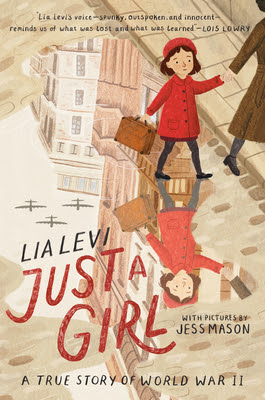
Just a Girl: A True Story of World War II by Lia Levi, pictures by Jess Mason, translated from the Italian by Sylvia Notini

Born in 1931 in Turin, Italy, Lia lived a pretty comfortable life with her parents, younger  sisters Gabriella and Vera, and Maria, their nanny. Lia was a shy girl so when Mussolini declared that Jewish children could no longer attend Italian schools, she is quite happy. That is, until she finds out that she would be attending a Jewish school. It isn't long before Lia's father loses his job because he is Jewish and the family is forced to live on their savings. 

When war is declared by Germany, Italy joins with Hitler and goes to war also. Within three hours of declaring war, French planes are dropping bombs in Turin. When Lia is in third grade, the family savings run out, and her Papa needs to find a job, but no one is allowed to hire Jews. The family decides to move to Milan, but when a promised job for Papa falls through, they are on the move again. This time, they are off to Rome.

Lia and her sisters have a grandmother who isn't Jewish and their first summer living in Rome, they are sent to stay with her during their summer vacation for three months. But the following summer, the war is getting closer to Rome, with the Americans landing in Sicily. And one night, they wake up to learn that Mussolini is no longer Italy's prime minister. Which should have been good news for Italy's Jews, except the Germans moved in and occupied the country. And where the Italians weren't always so good about enforcing Mussolini's laws, the Germans are quick to enforce Hitler's. 

Lia's parents decide to send her and her sisters to  live in a Catholic boarding school for safety's sake. By now, Lia is in her second year of middle school. She is given a false last name, Lenti instead of Levi, and must learn Catholic prayers. Then, in October, Lia's mother shows up at the school. She tells them that the Germans raided the Jewish quarter in Rome and took everyone away, but she doesn't know where her husband is. Luckily, they are all able to spend the rest of the war living at the boarding school.

This memoir, translated from the Italian by Sylvia Notini, is told in simple language though the deprivations, fears and anxieties the family experienced are made very clear. Graphic details are not included, and has caused one of my colleagues to complain that she felt it diminished the Holocaust. I don't agree. It is a unique story, but it is one person's actual experience and until Mussolini was removed from office, things were not as bad for Italian Jews as for Jews in Nazi occupied countries. 

I did like reading Lia Levi's recollections about living through the war. I thought she included a lot of small, but interesting details about what life was like for her family which are parts of history the books don't always tell you about. And Levi used two voices to tell her story - one is the first person account of young Lia and the other is the first person memories of the older Lia giving more information that the younger Lia wouldn't have known, but which helps readers to understand what was happening. My only complaint is that the timing was hard to follow. There aren't many dates mentioned and a timeline would have been very welcome. 

This is a poignant narrative, full of love, laugher, sadness, and loss, but an ideal way to introduce the Holocaust to young readers. And, right now, I think these stories need to be told and read.

Wednesday, May 18, 2022

Alias Anna: A True Story of Outwitting the Nazis by Susan Hood with Greg Dawson

When her 13-year-old granddaughter Aimée wrote her a letter asking about what life was like for her when she was the same age in 1940, Zhanna Arshanskaya Dawson didn't know how to answer her. There was so many long-buried horrors, so much humiliation, so much running to escape capture by the Nazis. But a granddaughter has a right to know and so that part of her family's history unfolds in this gripping free verse biography. 

Ukrainian born Zhanna was a headstrong little girl who used to love wandering the streets of Berdyansk, a resort town on the Sea of Azoz. One day, while wandering, she heard a small band playing music in a funeral procession and fell in love with what she heard. But the Arshanskaya home was already filled with the music of, among others, Rossini, Vizet and Tchaikovsky. Because Zhanna was so headstrong about wandering the streets, her father decided maybe piano lessons would rein her in. Soon the five year old was playing Chopin, Brahms and Beethoven. It didn't take long to realize that Zhanna had a true gift for music. 

But Joseph Stalin, the ruthless dictator of the Soviet Union, had a plan to modernize Ukraine and get rid of the old ways through starvation - in what was the "breadbasket of Europe" people were starving to death as part of Stalin's Five-Year Plan. When Zhanna was eight and her sister Frina was six, the family, having hit hard times, was forced to leave Berdyansk to live in Karkov. Yet, despite now living in poverty, their father had high hopes that both Zhanna and Frina could audition for two spots with scholarships at a renowned music conservatory. Both musically gifted girls were immediately accepted and it was here that Zhanna found her signature piece, Chopin's Fantaisie-Impromptu. This piece of sheet music became her most prized possession, carried all through WWII.

Musically things improved for the family, but financially things got worse and then, in 1941, the Nazis attacked the Soviet Union and the country was officially at war. The Germans wanted all of the Soviet Union, but without its Jews. Shortly after arriving in Kharkov, the Nazis order Jews to gather in the center of town to prepare for evacuation. In snow and numbing cold, the Jews, now prisoners of the Nazis, were marched through the streets to an abandoned tractor factory. After a few weeks of living in abysmal conditions, the prisoners were rounded up and march to Drobitsky Yar. Suspecting what was about to happen, Zhanna's father bribed a young guard to let her escape. When the guard looked away, her father whispered "I don't care what you do. Just live." It was the last time Zhanna saw her parents, but not her sister. 

Finding refuge at a friend's home, Zhanna was reunited with her sister. But Frina refused to talk about how she had gotten away and what happened to their family. Now, the sisters were on their own, and they could be easily recognized by the people in Kharkov who had been to their concerts. What they needed were new names and identity papers. But to get the papers, they would have to be admitted into an orphanage. It was easy to become Anna Morozova and her younger sister Marina, finding places in an orphanage was not so easy. But first, they had to get out of Kharkov. 

Could the sisters survive the war, running and hiding from the cold-blooded Nazis and collaborating Ukrainians, doing what needed to be done to "just live" as their father had said?

Susan Hood has a way of making a person's history come to life in her lyrical, well-researched verse biographies (see Lifeboat 12) Reader's come away knowing not just Zhanna and Frina's struggles and how they were able to survive, but also some needed background history of the Ukraine under Stalin and later, Hitler.  

Interwoven throughout the poems are quotes from Zhanna herself, taken from her oral history recorded by the William Breman Jewish Heritage Museum, as well as from interviews with her son, Greg Dawson. Other quotes used are well-documented in Hood's copious Back Matter. Most of Zhanna's story is written in free verse, I liked that Hood also included various poetic techniques and poetic forms, which always adds a certain level of energy and richness to a work written in verse that mirrors the musicality of the two talented sisters.   

And, of course, there are recent events in Ukraine that make us realize that the past is never past. The attempted invasion of the independent state of Ukraine by Russia has brought not just the geography of this nation to the fore, but also some of its history dating back to World War II when the Nazis invaded. For example, knowing that the Russians had bombed Ukraine's Holocaust memorial at Drobitsky Yar and reading about it in this book made me that much more aware of the dangers of greedy dictators (Stalin, Hitler and Putin) and the 16,000 Jews who were murdered in that ravine, including Zhanna and Frina's family, where the now damaged memorial stands in Kharkiv. 

Alias Anna: A True Story of Outwitting the Nazis is a true testament to the courage, cleverness, persistence, talent and strong will to survive of both Zhanna and Frina. And perhaps a warning from the past for us all to heed.

Friday, May 6, 2022

Great or Nothing by Joy McCullough, Caroline Tung Richmond, Tess Sharpe and Jessica Spotswood

My first memory of Louisa May Alcott's Little Women is my older sister sitting in an easy chair in the living room and crying her eyes out while reading the book. When I asked why she was crying, she just said "You'll see." And I did indeed  discover why a few years later when I read Little Women in fourth grade. And I've never re-read it. But I have been enjoying some of the new retellings like So Many Beginnings by Bethany C. Murrow, More to the Story by Hena Khan, and Meg, Jo, Beth and Amy by Rey Terciero, among others. The latest retelling, Great or Nothing, takes place during a war like the original, but this time it is World War II.

The story begins in the spring of 1942. The United States has entered the war and people are still adjusting to the change. And that includes the March sisters, who are also still reeling from the recent death of their sister Beth. Now, their father is has enlisted as a Navy chaplain, Marmee is overly involved in charity work, and Laurie is a pilot stationed overseas. Laurie had asked Jo to marry him before he left, but she said no. Jo loved Laurie just not romantically. Then, she and Meg had harsh words. Jo couldn't understand why Meg would give up everything for math teacher John Brooke, and Meg couldn't understand why Jo had refused to marry Laurie. 

Unable to write after Beth's death and needing to get out of the house after her fight with Meg, Jo is living in a boarding house, while working in a factory producing airplanes. But when she meets Life reporter Charlotte "Charlie" Yates, and helps her write a story about the airplane factory, she realizes that she also needs to sort out her feelings for Charlie.

Meanwhile, Meg is still at home with Marmee, continuing to teach, content to wait for John, whom Amy called "that boring old fuddy-duddy," to come home and to get married. But when an old "friend" decides Meg needs to party, to have some fun, and to meet other more exciting men, she begins to question whether she would really be happy in a quiet marriage with John.  

Amy, who has been crushing in Laurie since she was a child, is supposed to be studying art in Montreal. Instead, unknown to her family, she has decided to join the Red Cross. At first turned down for being too young, Amy fortuitously finds another girl's application and uses that at another recruiting station, where she is accepted. After training, Amy is sent overseas with other recruits to work in a mobile canteen, where they serve coffee and donuts to American servicemen in London. And she runs smack into Laurie.  

And Beth? She's there, a spectral poetic voice following her sisters adventures, providing insight, and giving unheard, unheeded advice about life in between the chapters. 

Needless to say, as the story unfolds, it is clear that each sister has some big problems to deal with and some big challenges they need to overcome while navigating the war and their profound grief. 

I really enjoyed reading Great or Nothing, finding it a thoughtful, appealing story that could be seen as simply a YA wartime romantic novel, but it is actually more elevated than that. Racial and sexist issues are introduced in both Meg and Amy's stories. Meg has a student who is Japanese American and Amy encounters an African American soldier who is not totally accepted by everyone, including Amy's friend Edie. And then there is Jo, who finally figures out who she is and why she didn't have romantic feelings for Laurie.  

I also enjoyed some of the details included, like Victory Gardens, Victory Red lipstick, and of course, how women arranged their hair in Victory rolls, as well as the impact that shortages and rationing had on everyone. There isn't a lot of action to this story, but plenty of coming-of-age drama. And if I remember right, there wasn't much action in the original Little Women. I also felt that the original message about the importance of family bonds wasn't lost in this novel, even though the March sisters were scattered for much of the story. Sometime, you just need to get away from the security of home family to find yourself and appreciate what you have.  

The story is told in alternating chapters, each character written by a different author who a different voice and point of view to each of the March sisters. In case you are wondering who wrote who - Beth is written by poet Joy McCullough, Amy by Caroline Tung Richmond, Jo by Tess Sharpe and Meg by Jessica Spotswood.  

Lastly, there are some delightfully wonderful Easter eggs to be found throughout Great or Northing. Happy hunting!