Tuesday, October 8, 2019

At the Mountain's Base by Traci Sorell, illustrated by Weshoyot Alvitre

At the Mountain's Base by Traci Sorell,
illustrated by Weshoyot Alvitre
Kokila, 2019, 32 pages
"At the mountain's base
grows a hickory tree.
Beneath this sits a cabin."

And in this cabin lives a Cherokee military family. Watched by her grandchild, a worried grandmother weaves together red, gold, green, and black threads while sitting by an old wood burning stove where there is something warm and nourishing cooking in a well-worn pot. The women in the family sit with her and together they sing and worry, too. Over their shoulder, is a picture of a woman in military dress.

The family sings a song of protection for the woman in the photo, a pilot flying in WWII. The perspective changes to show the woman pilot involved in that battle, protecting and defending her country, and offering up her own prayerful plea for peace. Hovering over her is the spirit of her families prayers for her safe return.

Again the perspective changes back to the cabin at the mountain 's base, under the hickory tree. There, too, the spirit of her families prayers and and the family awaiting the pilot's return.

Using soft, very spare, lyrical language, Sorell and Alvitre manage to convey so much to the reader about this family and the love they have for each other, and especially their family member in such a dangerous situation. Within the circularity of the story, the old and new are seamlessly woven together, and reflected in the different generations of women in the cabin. The threads of the grandmother's traditional Cherokee finger weaving are wonderfully juxtaposed with the newness of Native American women flying planes for the military. 

One of the things I loved about the artwork for At the Mountain's Base is the way the grandmother's threads wrap around the illustrations, binding the family together even when they are apart. The palette of earth tone red, greens, browns, yellows have a generous amount of white space that really helps call attention to the specific details on each page.

The Author's Note pays homage to the Native women who have served in battles and conflicts over time, and to those active service-members in today's military.  Her main focus is on Ola Mildred Rexroat, a Oglala Lakota pilot who was one of 1,074 Native women who served in the WASPs (Women Airforce Service Pilots) in WWII.

 At the Mountain's Base a celebration of Cherokee women and of the unsung women who make history. It isn't often enough that I get to write about Native Americans in WWII, let alone a woman, so I was very happy to discover this beautiful picture book and I think you will enjoy reading and exploring it, as well.

This book is recommended for readers age 6+
This book was purchased for my personal library

Sunday, September 29, 2019

True Brit: Beatrice - 1940 (Book 1 in the Far and Away trilogy) by Rosemary Zibart

It's September 1940, the Blitz is already in full swing, and the last thing 12-year-old Beatrice Sims wants is to be sent away to Santa Fe, New Mexico for safety while her family, parents and older brother, stay behind in London. An upper middle class girl, Beatrice travels in first-class comfort, first by train, then by ship across the Atlantic Ocean, and finally, by train across the United States from New York to New Mexico.

Before she leaves London, her father suggests Beatrice think of her trip as an adventure and herself as an explorer, giving her a red leather notebook to fill with all the different and interesting things she will see and do and experience while away. Her mother, however, is convinced that the war would be over by Christmas and Beatrice would come home.

Arriving in Lamy, New Mexico, Beatrice finds herself alone in a small train station, with only a sleeping cowboy on a bench. Eventually, Clem Pope arrives with two chickens and a beat up truck named Maude. Clem is the local practical nurse, the only one around now that the world was at war and everyone expected the US would be in it soon enough. Her house is comfortable but nothing like Beatrice is accustomed to.

The first day of school, Beatrice meets Esteban, son of Delores, who helps Clem in the house, and Arabella, who introduces her to her new surroundings as only a 12-year-old would know them. But soon enough, Beatrice discovers that Esteban and his friends think she is faceta, a spoiled little Princess. Beatrice is upset by this nickname, especially because she really likes Esteban. Hurt that the kids think about her that way, she also discovers and can't understand that many Americans don't want to get involved in the war in Europe or help England in its fight against the Nazis.

But when Beatrice decides the change her reputation, she discovers it isn't as easy as she would have liked. After a few unfortunate incidents, things aren't looking good. It will take one big life-or-death incident to really turn things around for Beatrice, not just how others see her, but, more importantly, how she begins to see herself.

True Brit is the first book in Rosemary Zibart's trilogy about the different experiences of young people from war-torn countries during WWII, now living on the American home front. It is an engaging story, one I found I couldn't put down. And I thought Zibart really did a great job in depicting Beatrice's culture shock as she begins to adjust to her new surroundings. I could understand how Beatrice felt since I was once a New York City girl who found myself living in a desert area for four years.

Zibart also looks at the class differences between Beatrice and Arabella and most of the kids they are in school with, kids who are native, biracial, and poor by comparison. Yet, neither one is presented as better than the other, but accepted for who they are as people. In that regard, readers see how the stereotype ideas Beatrice arrives in New Mexico with about the land, culture and people are dispelled as she gets to know and understand her new surroundings better. Beatrice does records her adventures in the red notebook her father gave and these entries give the reader more insight and information than even Beatrice's first-person narration does.

Of course, True Brit are some humorous moments - her first hot dog with mustard and relish, her first milkshake, and American slang - is all A-okay. But it is the eye-opening experiences that she has that really make a difference. Beatrice arrived in New Mexico, very much a fish out of water, a self-involved, pampered and privileged girl who expected to be taken care of by servants much the way her mother is. And yet, despite her flaws, I found Beatrice to be a likable character who really grows and comes appreciate her new, temporary (?) home.

Astute readers who are also fans of The Lion, The Witch, and the Wardrobe by C.S. Lewis will like the scene on the train station where Beatrice sees and envies a girl named Lucy and her siblings getting on another train to stay with great-uncle in the country. Interestingly, Beatrice recalls that scene later in the book as she wishes she could be a comfortable as Clem is in her new setting, and envying those four children again.

True Brit is an interesting, informative book that gives readers another detailed look at the life of a young girl in WWII who finds herself in a totally different land and culture than what she is accustomed to.

You can download an Activity and Discussion Guide courtesy of the publisher, Kinkajou Press, HERE

This book is recommended for readers age 9+
This book was sent to me by the publisher, Kinkajou Press

Saturday, September 21, 2019

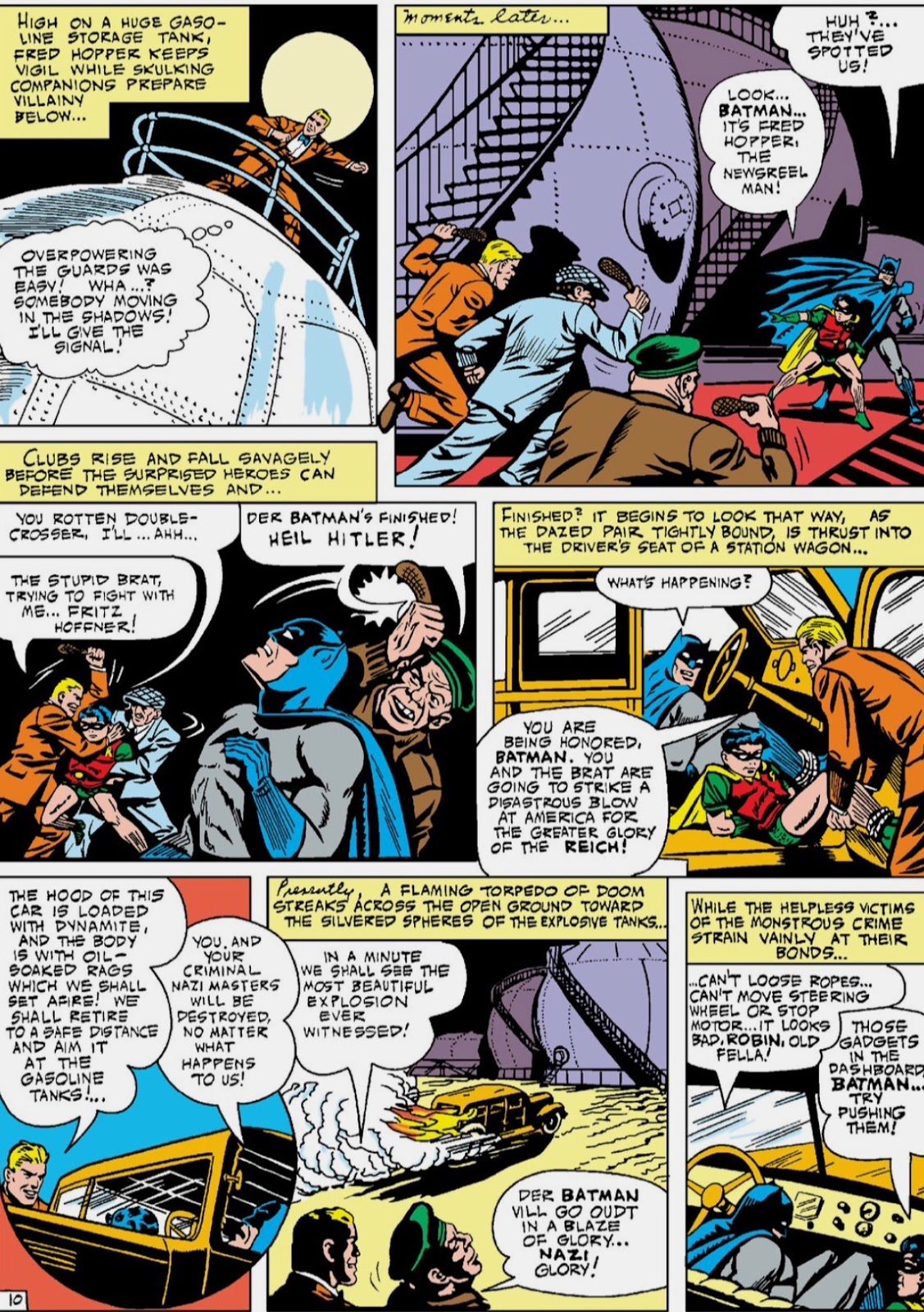
Sunday Funnies #31: Batman with Robin in Swastika Over the White House


Have a Happy Batman Day!

I know it's Saturday, but I thought I'd do a Sunday Funnies post anyway since today is Batman Day, celebrating 80 years of the Caped Crusader and my Kiddo's favorite Superhero. This Batman story is called "Swastika Over the White House." It's from Batman Vol. 1, No. 14 and was published in January 1943. It's one of the few stories that actually relate to the war, although Batman and Robin lots of other things to help the war effort.


Fred Hopper a/k/a Fritz Hoffner may have fooled the other cameramen, but now he has orders to get rid of Batman. As luck would have it, Batman and Robin were coming by the Gotham City Newsreel offices that very day to help with the nation's war effort. Suddenly, a car appears and shots are fired at the dynamic duo.


The young Nazi spy may not have gotten rid of Carson, but he does manage to swap out their camera footage of the shipyard to give to his superiors, along with footage of bomber plants, including gasoline storage tanks. Meanwhile, Bruce Wayne and Dick Grayson, in reality Batman and Robin, have suspicions about the cameramen, so that night, out comes pair in the Batmobile, to check on the industrial suburbs of Gotham City.


Friday, September 20, 2019

A Boy Is Not a Bird by Edeet Ravel


Living in Zastavna, Romania, 11-year-old Natt Silver, a Jewish boy with asthma, has had a pretty comfortable life. He has a loving family, a best friend named Max Zwecker, and he can already speak five languages: German, Ukrainian, Romanian, Hebrew, and Yiddish. The only thing that makes life difficult is the presence of Iron Guard, a nationalist, anti-semitic Romanian movement whose members resemble those of the Hitler’s Brownshirts. When the Iron Guard comes to town, everyone hides.**

Then in the summer of 1940, just like that the Iron Guard is gone, replaced by Soviet soldiers. Even the teachers at Natt’s school are replaced with Communist teachers. Life without the Iron Guard is better until the Communists arrest Natt’s father, along with 15 other men. While he’s in jail, Natt and his classmates are taught how to be Pioneers, causing him to be torn between love for his father, now considered an enemy of the Soviets, and being a good Pioneer. 

While his father is in jail, Natt is sent to stay on a farm with friends of the family for his safety. But in the summer of 1941, when Natt is taken into custody and questioned about his mothers whereabouts, he honestly can’t tell them what they want to know. After a few days, his mother shows up, gets Natt released and they go home - to pack. Natt’s father has already been sent to a gulag in Siberia, and now Natt and his mother are being exiled to Siberia, along with thousands of others, all labeled as an “enemy of the people.” 

A Boy Is Not a Bird is an eminently readable novel, in part because the author starts Natt off as a kid who just wants to belong, and who wants to be the best Pioneer he can be. He often misreads people and their motives, leading him to believe that everything will eventually be OK. Part of the reason Natt can hold on to his innocence for so long is that there are enough kind people in his life that really like this winsome 11-year-old. Interestingly, his best friend Max is just the opposite of Natt. Max's cynicism is the window of reality that Natt lacks, but that the reader needs. 
Natt, it turns out, is a wonderful observer but also an unreliable narrator.

It is, however, sad to see that little by little, Natt's innocence is striped away by the actions and behavior of others. As I read Natt's first person narration of what is happening around him, his naiveté reminded me so much of Felix from Morris Gleitzman’s Once series. 

A Boy Is Not a Bird is a fictionalized story based on the ones the author's fifth grade teacher, Mr. Halpern, used to tell her class, about his childhood in Soviet occupied Zastavna. The novel ends with Natt's still on the train to Siberia, his future unresolved,  But take heart, this is only the first part of a planned trilogy. And I can't wait to read the rest. 

This book is recommended for readers age 9+
This book was an EARC received from Edelweiss Plus

**FYI: In 1939, Nazi Germany and the Soviet Union signed a non-aggression treaty generally referred to as the Molotov-Ribbentrop Pact. One of the things the pact did was define boundaries where each country had influence. But not long after Adolf Hitler invaded Poland on September 1, 1939, and effectively disregarding the Pact, Joseph Stalin launched also invaded Poland. As a result, new borders were drawn and in the summer of 1940, the formerly Romanian territory of Bukovina was divided between the USSR in the north, and Romania in the south. The Soviets demanded Bukovina in the north because it was mostly Ukrainian, whereas the southern part of Bukovina was mostly Romanian. And that is where this story begins.

Wednesday, September 11, 2019

Sergeant Billy: The True Story of the Goat Who Went to War by Mireille Messier, illustrated by Kass Reich

We are pretty familiar with the story about the bear cub named Winnie who was adopted by a lieutenant in WWI and whose story became Winnie-the-Pooh. And then there's Stubby, a stray dog who became the mascot of the 26th Infantry Division, went to war and became a decorated hero, as did Rags, a Parisian mongrel adopted by radio operator James Donovan. But did you know there was also a goat who was borrowed by some Canadian soldiers from a little girl named Daisy in Saskatchewan when their train made a stop there.

Daisy wasn't really happy to lend her goat to the soldiers of the Fifth Battalion who were going off to war, but they promised to bring him back, and so she agreed, and "that's how Billy's extraordinary story began."

And what a story it is. Private Billy proved to be an able soldier, training, marching, crawling and running like any other soldier, and even getting laggers back on track, not to mention being a great comfort and morale booster. But when it came time to ship out, the colonel said it was a no go for Private Billy. His fellow soldiers had other plans, though, buying an crate of oranges (which they quickly ate) and packing Private Billy into the empty crate to sneak him on to their ship. The plan worked and luckily, Private Billy was a good sailor.

Once at the front lines, Billy also adjusted well to trench life. Nothing bothered him - not the cold, not the mud, not the noise, not the bad food, not even the rats. He continued to be a great comfort and morale booster, especially to nervous new recruits and to homesick soldiers. Of course, Billy was a goat, after all, and he was known to occasionally chow down on some important secret documents, and sentenced to jail for spying. But when morale fell, he was quickly released. Billy also saved lives on the battlefield, butting soldiers back into the trench to avoid an exploding shell.

By the end of the war, Private Billy was promoted to Sergeant Billy, and awarded the Mons Star for bravery in the face of danger. And "that's how Sergeant Billy became a decorated war hero." Happily, Billy survived the war and was returned to a somewhat older Daisy in Saskatchewan.

War is an ugly business and it's a difficult topic to introduce kids to. Luckily, there are some excellent books that can help parents and teachers broach this subject with young readers. And Sergeant Billy would be a great choice with which to do that. I say this because the first thing that struck me about Sergeant Billy is how focused it is on the goat and not on the soldiers or some of the real horrors of war. In this way, the story offers a gentle introduction to war while at the same time it makes it very clear that war is not fun despite having a goat mascot.

Messier's writing is simple, direct, and age appropriate, though none of the technical terms are explained (for example, Billy got trench foot, but what is that? my young readers asked). And Reich's uncomplicated gouache illustrations in a palette of army browns and greens work in absolute harmony with the text.

Sergeant Billy and his life on the front lines while in the Canadian army is based on a true story, and readers will find plenty of informative back matter that includes photographs of the real Billy and information about animals in war.


And for kids who really like heroic animal stories, pair Sergeant Billy with these other true stories from WWI: Fly, Cher Ami, Fly! The Pigeon Who Save the Lost Battalion by Robert Burleigh, Finding Winnie: The True Story of the World's Most Famous Bear by Lindsay Mattick, Winnie: The True Story of the Bear Who Inspired Winnie-the-Pooh by Sally M. Walker, Stubby the Dog Soldier, World War I Hero by Blake Hoena, Rags: Hero Dog of WWI, a true story by Margot Theis Raven, and Stubby: A True Story of Friendship by Michael Foreman

This book is recommended for readers age 5+
This book is an EARC received from NetGalley