Monday, February 11, 2013

His Name was Raoul Wallenberg: Courage, Rescue and Mystery During World War II by Louise Borden

In January, I was very pleased to learn that Louise Borden and her book His Name Was Raoul Wallenberg had been named winner of the 2013 Sydney Taylor Book Award for Older Readers by the Association of Jewish Libraries.  The Sydney Taylor Book Awards are given annually to those outstanding works that authentically portray the Jewish experience.

Born into a relatively well-to-do family of bankers in Stockholm, Sweden in 1912, Raoul Wallenberg was always excited and curious about everything and his endeavors were encouraged and supported by his family.  At age 11, he traveled alone from Sweden to Turkey on the Orient Express to visit his grandfather, Gustaf Wallenberg, Sweden's minister to Turkey.  And at age 19, he left Sweden to attend college at the University of Michigan, majoring in Engineering.  When he returned to Europe, Raoul spent time travelling and as he did, he began to hear stories from Jews who has escaped Hitler's Germany, stories about new laws, beatings and even murder inflicted on Jews by the Nazi government.

Raoul had taken a job and was an excellent salesman, helped by his ability to speak different languages.   But pretty soon the world was at war.  As he watched country after country fall to Nazi occupation, he worried about Sweden's neutrality.  Denmark and Norway, close neighbor, had already fallen to the Nazis.  When roundups and deportations were announced in Denmark in 1943, Sweden gave permission for Danish Jews to enter the country, saved by the many Danish fisherman willing to sail them there.  Swedish freedom and neutrality remained intact.

Hungary was also a country with a large Jewish population, but it was not a neutral and in 1944, it, too, became a Nazi occupied country.  Roundups and deportations of Hungarian Jews began and many went to the Swedish embassy seeking visas to Sweden.  But the War Refugee Board in America wanted a neutral Swede to organize some relief for the Jews in Hungary.  Raoul Wallenberg, with his  many languages and skill as a salesman, was just the person they needed.

Wallenberg devised a legal looking Protection Pass or Schutzpass that were like Swedish passports and protected the bearer from deportation.   Wallenberg even created a single Schutzpass that protected whole families.  But the Schutzpass, which probably saved around 20,000 people, was only one way Wallenberg worked to help Hungarian Jews.

Ironically, the man who worked tirelessly to save Jews, was picked up by the Soviet military in Hungary and on January 17, 1945, he was last seen being driven away in a Soviet car, and was never to be heard from again.

The details of Wallenberg's life and the work he did saving Jews in Hungary are all nicely detailed in-depth in Borden's free verse biography of this incredible man.  His Name Was Raoul Wallenberg is beautifully put together, divided into 15 sections, each one chronicling a period of Wallenberg's life with a wealth of supporting photographs and other documents that give a comprehensive picture of his life as he grows and changes and even goes beyond his disappearance up to the present.   As you will discover when you read the Author's Note at the back, Borden had the privilege of working closely with his family over many years and so had much more personal insight into the real child and man that was Raoul Wallenberg than biographers are generally privy to.  And that shows throughout the book.

But His Name Was Raoul Wallenberg is more than just a biography, it is a shining example of one man who rose to the challenge at a very bleak time in history and who made a difference in the world, saving so many Hungarian Jews from certain death.  Borden has written a book that is a fine addition to the whole body of Holocaust literature and anyone interested in the Jewish experience at that time.

Raoul Wallenberg was named Righteous Among The Nations by Yad Vashem in 1963 in Israel.

Come back tomorrow for an interview with Louise Borden.

This book is recommended for readers age 12+
This book was purchased for my personal library

You can find more information about Raoul Wallenberg at his alma mater, the University of Michigan, here

You can find more on Raoul Wallenberg and the plight of Hungarian Jews at the United States Holocaust Memorial Museum here

Be sure to visit Louise Borden's website here

This review also appears on my other blog Randomly Reading

Nonfiction Monday is hosted this week byAbby the Librarian


Thursday, February 7, 2013

Double Victory: How African American Women Broke Race and Gender Barriers to Help Win World War II by Cheryl Mullenbach

February is Black History Month and way back in 2011, I looked at a book about African American soldiers in World War II called The Double V Campaign: African Americans and World War II by Michael L. Cooper.  The Double V Campaign demanded that African Americans who were risking their lives fighting for freedom and democracy abroad should be given full civil rights at home - Victory at home AND abroad.   Cooper's book is an interesting, well-researched book, but it doesn't tell the whole story of the Double Victory Campaign.  The Double V campaign was also waged on the home front, and women played a very important part.

In her book, Double Victory: How African American Women Broke Race and Gender Barriers to Help Win World War II, Cheryl Mullenbach brings together the lives and work of a number of strong, brave women in four areas: women who worked in the war industry,  women who became political activists, women in the military, volunteers and of course, women in entertainment.

Here are only a few of the many stories covered in Mullenbach's book:
High school teacher Layle Lane was asked by A. Philip Randolph, a Civil Righs leader, to help organize a March on Washington in 1941 to end discrimination in employment, since most defense plants would not hire African Americans.  The march never happened, but Lane was in on the talks with President Roosevelt that led to the issuance of Executive Order Number 8802, which meant if you discriminate, the Fair Employment Practices Committee can investigate you.  It wasn't perfect, but it was a start.

Pauli Murray, a female law student, let students from Howard University in peaceful direct action sit-in at a restaurant that refused to serve African Americans.  Three by three the students entered, sat and asked for service.  When that was refused, they stayed seated and began to quietly study.  Police couldn't arrest them because by not being served, they weren't breaking the law.  The owner closed for the day, but when he reopened the next day, the students held a peaceful picket outside and after a few days of lost business, the Whites Only sign came down.

The women who joined the WAAC (Women's Army Auxiliary Corps) once it was opened to African Americans discovered the racism and segregation followed them into the military, just as it had followed men of color.  Nevertheless, the women soldered on and succeeded.  And eventually, Charity Adams even became the first African American woman officer in the WAACs and commanded the 6888th Central Postal Battalion (see Mare's War by Tanita Davis for an interesting and accurate fictional account of one women's experience in the 6888th).

Star power carries a lot of weight and in WWII it was not different.  When the Hollywood Victory Campaign was formed, actress Hattie McDaniel was asked to be in charge of "Negro talent" section.  Hattie, who had won an Academy Award in 1940 for playing Mammy in Gone with the Wind, helped to organize black entertainers to perform in the segregated all black units of the armed forces.  This work required the entertainers would need to meet frequently, usually at Hattie's house.  But she lived in a restricted area, meaning no blacks allowed.  So when the white homeowners filed a legal complaint, Hattie fought back and won.

Lena Horne, one of my favorite singers, was a favorite during the 1930s and 1940s and she was also part of the Hollywood Victory Campaign.  Mullenbach tells about the time on a southern USO tour, Lena performed one night to a white only audience, and the next morning in the mess hall, she was to perform for the black soldiers.  But in the front row were German POWs.   She left the stage, stood in front of the black soldiers, back to the Germans and sang.  She ended up quitting the USO tour over this, but continued entertaining soldiers throughout the war.

These are just a few of the many interesting women included in Double Victory: How African American Women Broke Race and Gender Barriers to Help Win World War II.  It is a well-researched, nicely presented book with lots of supporting photographs and detailed back matter.   It is intelligently written, yet very accessible for young readers.  The fact that she introduces us to ordinary women doing extraordinary things in wartime makes it all the more valuable.  And while it is good to know that anyone can make a difference, not just famous people, it is also nice to read about the contributions of so many African American women, which are often overlooked.

Kathryn Atwood started a narrative about women and their courageous acts in WWII in her work Women Heroes of World War II and Cheryl Mullenbach has extended that narrative to include African American women in Double Victory: How African American Women Broke Race and Gender Barriers to Help Win World War II.

This book is recommended for readers age 12+
This book was an E-ARC from Net Galley

For more on the Double Victory Campaign, see Newspapers - The Pittsburgh Courier and
Fighting For Democracy - African Americans


Monday, February 4, 2013

26 Fairmount Avenue: The War Years by Tomie dePaola

Last year, Tomie dePaola won The Society of Illustrators Lifetime Achievement Award and his extensive interview with Lee Wind on the SCBWI blog reminded me that I still haven't read Tomie's books about his home front experiences during World War II.  He wrote about them in the last four of the eight books that make up his 26 Fairmount Avenue series, subtitled The War Years.

This post probably contains spoilers


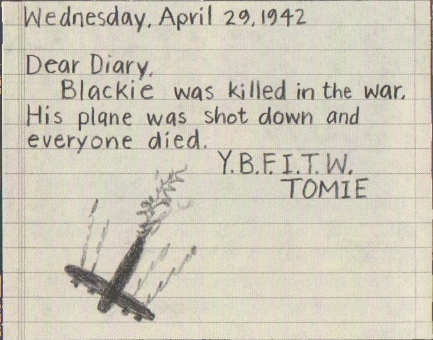
In Book 5, Things Will Never Be the Same, begins in January 1941, first-grader Tomie had just received his two best Christmas presents - a Junior Flexible Flyer sled and a diary with a lock and key, and so Book 5 begins with his very first diary entry.  With all the charm, honesty and bluntness of a very precocious and artistic 6 year old, Tomie takes us through the year 1941, diary entry by diary entry.  Each chapter begins with a short diary entry and the rest of the chapter goes into more depth everything that was going on at the time.  And 1941 is an exciting year for Tomie.  Through his diary, Tomie presents a wonderful picture of what life was life in that year preceding America's entry into the war.  Things he writes about include the day to day family life of the dePaola family, and the world of a first grader, for example, learning about President Roosevelt and the March of Dimes, and not being able to swim in the summer because of a Polio scare; the excitement over seeing Disney's Fantasia in the theater, his disappointment over who is second grade teacher is, about his tap dancing lessons which he loves, and of course all the holidays over the course of the year.  But all this changes on December 7, 1941.  Tomie writes in his diary:


As the dePaola's listen, along with the whole country, to the radio announcer talking about the attack on Pearl Harbor, Tomie's mother says to her family, "Things will never be the same."

Unlike Things Will Never Be the Same, which covers a whole year, Book 6, I'm Still Scared, diary entries only cover one month, December 7, 1941 to December 31, 1941, but is is a powerful month for second grader Tomie.  Not quite understanding what has happened and the implications of war, Tomie is a scared little boy and to make matters worse, no one really wants to explain what's going on to him.  Luckily for him, after listening to Roosevelt's speech on the radio, the family go to visit Tomie's grandparents and his grandfather, Tom, takes some time he talk to him about his fears.  But life had indeed changed.  At school, there were air raid drills, and at home, an air raid shelter had to be created in the basement just in case.  And Tomie had to contend with being called the ENEMY because of his Italian heritage.  War was everywhere.  Even at the movies showing a children's feature, the newsreels showed London in the Blitz, and Tomie realized it was the first time he had seen what war was like.  At the end of December, young Tomie is still scared.

Book 7, Why?, begins on January 1, 1942 and runs until April 29, 1942.  In his new diary, Tomie gives more details of his day to day life.  He writes about his excitement about being able to stay up late for New Year's Eve, of going to help in his grandfather's grocery store, and of his first surprise air raid drill at school.  But his real trouble comes when his teacher starts teaching the kids to write in cursive and refused to allow Tomie, a lefty, to hold the pen in a way that worked for him.  And Tomie talks more about his older brother Buddy and how angry/annoyed Buddy gets with him.  But perhaps saddest of all are the entries about his cousin Anthony A/K/A Blackie.  Blackie was a favorite cousin who had joined the Army Air Corps.  Tomie seemed able to adjust to everything involving the war - like rationing and air raid drills - but the news of Blackie's death is just incomprehensible to him.  In the end, he is left asking himself Why?

Book 8, For the Duration, is the final book in the 26 Fairmount Avenue series and begins on May 1, 1942 and runs through... Well, that's hard to say.  It seems that early on, Tomie's diary key disappeared.  While there are not more diary entries, Tomie still talks about his life and in 1942, patriotism is in full swing.  At school, Tomie gets very sad and runs out of the room when the class starts singing the Army Air Corps anthem.  At dancing school. there is a lot so rehearsing for a wonderful recital, but there are also bullies in the schoolyard who take his new tap shoes and start tossing them around.  And there are victory gardens and ration books and helping again in his grandfather's grocery.  Things between Tomie and his brother Buddy get worse and in the end, it is Buddy who has taken the diary key.  But one thing Tomie learns to understand completely is that some things disappear (chewing gum, fireworks) and other thing come into being (war bonds, war stamps), all "for the duration."

The 26 Fairmount Avenue series is an extraordinary group of chapter books recalling Tomie dePaola's early life living in Meridan, Connecticut.  For the most part, they are a series of vignettes told in great detail and include whimsical illustrations by Tomie thoughout the books.   Much of what Tomie writes is funny, charming, sad and so typical of kids that age.  Though I haven't reviewed for first four books here, I would really recommend the whole series to anyone who is a Tomie dePaola fan.  My only gripe is that we are left hanging about Buddy and the diary key.

And if you are a Tomie dePaola fan, be sure to read Lee Wind's interview with him:
Part 1 can be found here
Part 2 can be found here
Part 3 can be found here

These books are recommended for readers age 7+
Things Will Never Be the Same was borrowed from the Children's Center of the NYPL
I'm Still Scared was borrowed from the Yorkville Branch of the NYPL
Why? was borrowed from the Morningside Heights Branch of the NYPL
For the Duration was borrowed from the Bank Street College of Education Library

Nonfiction Monday is hosted this week by Tammy at Apples With Many Seeds


Saturday, February 2, 2013

The 2013 Bank Street Children's Book Committee Awards


Well, this is award season and now that the Newbery's have been selected, I would like to announce the next most important awards (ahem! ahem!).  They are the 2013 Bank Street Children's Book Committee Awards.  Each year the committee awards three awards: one for outstanding fiction, one for outstanding poetry and one for outstanding non-fiction.

And the 2013 winners are:

2013 Josette Frank Award (Fiction) 
Wonder by R. J. Palacio

Ten-year-old Auggie Pullman, who was born with extreme facial abnormalities and was not expected to survive,  goes from being home-schooled to entering fifth grade at a private middle school in Manhattan, which entails enduring the taunting and fear of his classmates as he struggles to be seen as just another student.


2013 Flora Stieglizt Straus Award (Non-Fiction)
Beyond Courage: The Untold Story of Jewish Resistance During the Holocaust by Doreen Rappaport

Twenty-one brilliantly detailed accounts illuminates the defiance of tens of thousands of Jews across eleven Nazi-occupied countries during Word War II. In answer to genocidal madness that was Hitler's Holocaust, the only response they could abide was resistance, and their greatest weapons were courage, ingenuity, the will to survive and the resolve to save others or to die trying.


2013 Claudia Lewis Award (Poetry)
National Geographic Book of Animal Poetry: 200 Poems with Photographs that Speak, Soar, and Roar! Edited by J. Patrick Lewis

Beautiful photography compliments and extends the 200 enchanting poems about animals written by some of your favorite poets, such as Robert Frost, Emily Dickinson, Carl Sandburg, our old favorite Anonymous, even Vita Sackville West (who knew!) and of course, our Children's Poet Laureate and editor of this lovely volume, J Patrick Lewis.

Congratulations to the winners!

This post was originally published on my other blog Randomly Reading so if you receive this twice, my apologies.

Thursday, January 31, 2013

Greenhorn by Anna Olswanger, illustrations by Miriam Nerlove

Greenhorn is a heart-warming story of two outsiders who become life-long friends.  With lovely folk art type illustrations by Miriam Nerlove, the story is set in a Yeshiva, a boarding school in Brooklyn, NY in 1946 and narrated in the first person by Aaron, a student there and a boy who speaks with a stutter, to the annoyance/amusement of the other boys in the school.

One day, the Rabbi interrupts a class during their recess to announce that twenty boys from Poland, who, unlike their parents, survived the Holocaust, will soon be arriving at the school.

After the Polish boys arrive, one of them, Daniel, is assigned to Aaron's room, already crowded with three boys.  The other boys don't really welcome their new roommate, and start going after him for being skinny and not speaking.  They nickname him Greenhorn, but there is not affection in the name.  Aaron realizes that Daniel doesn't speak English and asks if he understands Yiddish.  At first, Daniel doesn't respond to any of the boys, except with fear when they bring up the Nazis.

Eventually, the Polish boys all start speaking English, except Daniel, who, it turns out, does know Yiddish and will only speak it.  Yet, no matter what kind of friendly overtures are made to Daniel he never joins in.  Nevertheless, Aaron keeps trying to be friends with Daniel.  One day, while the boys are picking on him because of his stutter, Daniel comes to Aaron's defense - in English.

Things get better after that, but not much and the other boys begin to really focus on the little box Daniel carries around with him, even putting it under his pillow at night.  One night Aaron notices that the box had fallen on the floor, opened and the content had fallen out.  It looked like a rock to Aaron, but when he asked Daniel about it, he received no reply.  "F-F-Friends don't keep secrets from each other." Aaron tells him.  But Daniel was sleeping.

But what's in Daniel's box that he carried all the way from Poland and never let out of his sight?  Was this the end of Aaron's attempts to be friends?

Most American children really didn't comprehend how conditions were in Europe for Jews during the war.  Of course, by 1946 they had heard about what happened in concentration camps, but it was still hard for them to grasp the full measure of things.  To her credit, Anna Olswanger has depicted this aspect of life even in a place like a Yeshiva.  But I think she has done an outstanding job of depicting the kind of trauma kids who were caught of in the actual events and who lost parents, siblings and other relatives suffered from.  It seems like it would be just unimaginable, but you do get the idea from this short but powerful story.

Healing is a long hard road, but this is a story of friendship and it is based on a true event.  The boy Aaron grew up to be Rabbi Rafael Grossman.  He lost touch with the real life "Daniel."  But one day, while visiting Israel, he ran into him again, "Daniel" had become a pediatrician, working and living in Israel.

And yes, eventually Aaron/Rabbi Grossman did find out what was in Daniel's box and why it was so important.

This is just my feeling but, although this is a story written for readers around 9+ years old, I think it might be a good idea for them to read this little book with some supervision.  Not that the events involved are described in graphic detail, but some of what the Nazis did to people is not always covered in books for kids.  That being said, it would still highly recommend it.

This book is recommended for readers age 9+
This book was sent to me by the publisher.

A discussion guide for teacher's can be found here
A discussion guide for parents can be found here

The author, Anna Olswanger, has written a very interesting guest post about Greenhorn over at Cynsations

There is a Goodreads Greenhorn Givaway running until February 17 and you enter to win a copy here