Tuesday, July 19, 2022

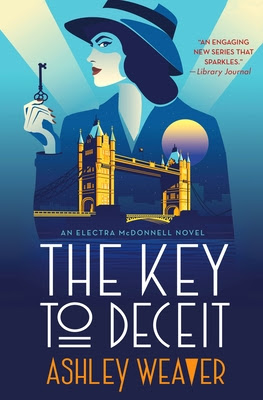
The Key to Deceit (An Electra McDonnell Novel #2) by Ashley Weaver

It's September 1940 and it's only been a few weeks since Ellie McDonnell helped the handsome, aristocratic Major Gabriel Ramsey break  into a house to retrieve some important blueprints before they could be given to the Nazis in A Peculiar Combination. Naturally, she's antsy for another chance to work with Major Ramsey, but first a little background information for those who haven't discovered this great series: Ellie was raised by her Irish Uncle Mick in London after her mother was arrested and imprisoned for supposedly killing Ellie's father, Uncle Mick's brother. Uncle Mick is a locksmith by day, and He, his three sons and Ellie were a safe crackers by night until Major Ramsey caught them in the act and gave the McDonnell family an ultimatum: live on the straight and narrow and help in the war effort or go to prison. I guess you can figure out which choice they made.

Luckily, Ellie doesn't have to wait long for the Major to need her safe cracking skills. A woman found dead floating in the Thames is wearing a curious bracelet - it's a thick cuff that is locked to the wearer's wrist. Ellie is a little queasy about picking the lock on the wrist of a dead woman and stalls by going over her clothing, which was new and expensive. Once Ellie has picked the lock open, they determine it contains a miniature camera. Major Ramsey dismisses Ellie and sends her home, but not for long. Turns out the clothing description helped them determine that the woman was doing something underhanded - there was a bag of precious gemstones hidden in her coat. 

Ellie and her sorta, kinda boyfriend Felix Lacey call on a pawnbroker friend to help them identify and figure out the source of the gems, the women, now identified as Myra Fields, had hidden in her coat. Myra was engaged in espionage for the Germans and the photographs she had taken would be very useful to the Germans should they ever begin bombing London. They also learn that she had been staying in a boarding house run by a Mrs. Paine. 

Ellie and Major Ramsey decide to visit the boarding house as an engaged couple and cousin of Myra's, to see what they can find. And in the midst of gathering evidence of a possible spy ring, the Nazis begin bombing London. Once bombing begins, not knowing who is part of the spy ring or how large it is makes the need to capture the spies taking pictures of possible bombing sites and their ring leader even more imperative. 

There's a lot going on in this novel and it moves at a pretty quick pace, but it is by no means overwhelming. In fact, some of it is a nice break from the mystery at hand. First, there is the relationship between Ellie and Major Ramsey. She is feisty, and can be a buster, while he is aristocratically uptight. Yet, there is chemistry brewing between them and Ellie's family would be pleased a punch to see her involved with him. And Ellie does think about it, but wait, what about Felix? He's so sweet and things could get more serious between them and he is more her sort, criminally speaking. Then, there is the case of Ellie's mother, who maintained her innocence right up until her death from the flu epidemic. Can Ellie find a way to clear her mother's name? And of course there are the everyday changes that war brings on in people's lives. I just love details. 

All in all, I found The Key to Deceit an enjoyable mystery, with lots of details and good plotting so that when the culprit was finally revealed, I was surprised.  The fact is that I was a little skeptical about the Electra McDonnell series when I first heard about it, but after reading these first two novels, I can't wait for the third book. 

Thank you, NetGalley, for supplying me with an EARC.

Monday, July 11, 2022

The Lion Above the Door by Onjali Q. Raúf

Every year for my birthday, I throw a few books I want to read into a shopping cart and say Happy Birthday to myself. One of the books I chose for my last birthday was The Lion About the Door. It's a contemporary WWII story by Onjali Q. Raúf, who have become a real favorite author of mine. 

Leo Kai Lim and his best friend Sangeeta Singh are both looking forward to their class trip to the RAF Museum and Rochester Cathedral (in Kent). They've been studying WWII in school and even though the two friends know that they are probably the only ones in their class who don't have a personal connection to anyone who fought in WWII, they are excited to see the planes on display. Leo's parents are from Singapore, and Sangreta is Indian descent. 

Leo and Sangeeta are the only two kids in their school who look like them and of course, there is a bully named Toby who never tires of going after Leo. He's kind of an Eddie Haskell character in that he acts sweet and innocent in front of teachers and parents, but all that changes in the school yard and sometimes in class. He makes fun of the Singaporean food Leo brings for lunch, pushes and shoves him and the morning of the school trip, Toby hits Leo hard several times with a tennis ball. As a bruise developed on his leg, Leo thinks about the bruise inside him that never seem to heal, getting hit over and over. Leo is convinced his inner bruise will only heal if "something big and unexpected and brilliant happened." But the chances of that happening were zero as far as he was concerned, after all, he and Sangeeta "were too different for brilliant things to ever happen to us. And the bruise knew it." (pg27) 

But imagine the surprise Leo gets when he sees the name Leo Kai Lim DFC and a golden lion above it carved into the marble with other names of other soldiers who were WWII heroes. Stunned by this discovery, Leo promises to find out all he can about this soldier. 

Back at school, Leo's teacher Mr. Scott announces that for Remembrance Day, their class has been selected to take part in TV's Real Kidz Rule competition, a program everyone loves. For Leo, it becomes the perfect opportunity to research all he can about Leo Kai Lim DFC and keep his promise. Unfortunately, finding information about this hero pilot of WWII turns out to be quite difficult. Sangeeta is also excited about the competition since it will give her an opportunity to research Indians who participated in the war for the British named Singh, as well as the contributions of Indian women. Could good things be coming Leo's way finally? Will his bruice have a chance to heal? Or is Leo headed for a big disappointment?

I really enjoyed reading The Lion Above the Door and found myself reluctant to put it down when I had to do other things. Leo's first-person narration is appealing and so endearing in its innocent truthfulness, even as Raúf threw themes of family and family history, cultural underrepresentation, contemporary and historical racism, perseverance, courage, and teamwork his way, but all with a sensitive hand and a combination of seriousness and humor. 

And because this is a Onjali Q. Raúf novel, there is one surprising turn of events when Olivia Morris, the coolest most popular girl in class offers to help Leo and one very zany episode when Leo and Sangeeta break into the RAF museum. 

I did like that Raúf allowed her characters to be flawed. For example, Leo had trouble with his dad's never standing up for himself or Leo until he learns why, and Mr. Scott is not always the most culturally sensitive person but he does learn to be more aware of it thanks to Leo and his project.

Back matter in this book includes information on racism and prejudice, now and during WWII, as well as the real forgotten heroes WWII included in this book.

The Lion Above the Door is one of my better birthday books and I highly recommend it to anyone who is interested in WWIIs ignored heroes, or for anyone concerned about cultural underrepresentation. Both Leo Kai Lims are heroes in my book. 

Sunday, July 10, 2022

Where I've been...


One of the ways I put myself through college and grad school was by doing freelance research for other people. And I've had a lot of interesting jobs, have met some really great people, and my fees paid the bills. I learned my way around a number of libraries in New York City, including the research branch of the NYPL (my favorite), the NYPL for the Performing Arts, Columbia University, Columbia Law School, Hunter College (which at that time had a phenomenal library), Hunter School of Social Work Library, the Library of Congress (my second favorite), among others. I also did research for graduate students who, for one reason or another, needed assistance (one student needed someone who knew Latin) or who were unable to do their own (usually through Student Disability Services). 

I had kind of given up freelance research when I began teaching. Now, I only teach part-time, so when the opportunity to do some research for someone came along, I realized how much I missed doing it and accepted the job. It sounded kind of easy and interesting - researching this person's family history, something I'd done before and I've always loved working in the Irma and Paul Milstein Division of United States History, Local History and Genealogy, part of the research branch of the NYPL. It's very peaceful and the librarians are always so helpful. 

What I wasn't expecting was how involved I would get in this latest project. It's turning out to be absolutely fascinating...and time consuming. But the good news is that I have been doing lots of reading and will be posting my reviews more frequently (I hope).

Wednesday, June 29, 2022

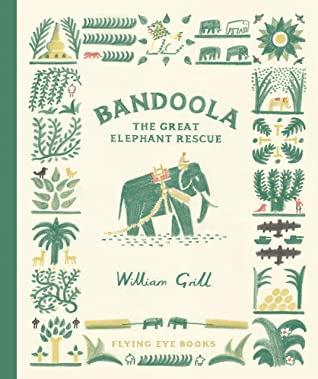
Bandoola: The Great Elephant Rescue written and illustrated by William Grill


Bandoola: The Great Elephant Rescue
written and illustrated by William Grill
Flying Eye Books, 2022, 80 pages

I wanted to read this book before I knew anything about it simply because it is about Asian elephants, I loved the colors and arrangement on the cover and it is by William Grill. What I didn't know is that it is also an interesting true World War II story, as much as it is about James Howard Williams and the elephant he bonded with. 

Grill begins by giving some background information about animal and forest life in Myanmar (formerly Burma) and the important role Asian elephants have always played in its economy, especially when it came to harvesting and transporting of timber. 
After serving in World War I, Williams applied for a job with the Bombay Burma Trading Corporation. He became the overseer involved in cutting down and transporting the giant teak trees found in Myanmar and responsible for 70 work elephants. Impressed by these animals, Williams took the time to learn all about them. Here Grill digresses with a series of 2 page spreads giving general information about elephants, facts about elephant behavior and history, a description of the demanding job of being a timber elephant, the job of the ooziers or the men who are elephant riders, trainers and keepers and an accounting of how the timber is transported, how elephants are captured and trained, and introduces readers to Po Toke. 

Po Toke was a young oozier who raised a young calf named Bandoola with a kindness and patience unusual for that time.. Po Toke introduced Williams to Bandoola and the three of them had an instant connection and bond. Seeing how well Bandoola responded to Po Toke's gentle training, he and Williams opened an elephant school devoted to training elephants compassionately. The school was soon followed by an elephant hospital. 

But, by now the Second World War had begun and in 1942, the Japanese began an invasion of Myanmar, putting elephants, ooziers and everyone else in the camp in danger. 
In 1944, Williams was order to evacuate and travel to Assam, India where he would be safe. But Williams wasn't willing to leave the elephants in his care to their fate at the hands of the Japanese army. It was decided that a party "of 64 women and children, 53 elephants, 40 armed soldiers, 90 ooziers and assistants, and four British military officers" would also leave the Myanmar jungle and travel to safety. To get to safety, they would face "190 kilometres [about 118 miles] of perilous jungles, with countless towering mountains, as well as the very real threat of attacks from tigers or human enemies." 
How did they get across those mountains? To help readers understand just what an arduous journey Williams and his party faced, Grill details the difficult terrain in a 2 page spread. The terrain was difficult, but a wall of rock felt like a real impasse. And Williams came up with an impossible plan - build an elephant stairway, with Bandoola leading the way. 

Amazingly, Williams' plan worked and the arrived in India three weeks after leaving Myanmar. 

I found this to be such a fascinating story that I've reread it a number of times, even renewing my library copy several times (I think it might be time to buy my own copy). The text is spare but no word is wasted, with Grill letting the illustrations tell half the story. Yet, he has really captured the bond between Williams, Po Toke and Bandoola. The escape and rescue of the elephants is a thrilling and scary part of the story, especially when I think about those magnificent animals walking on a narrow path on the side of the mountain, with a sheer drop if any had lost their footing.

Grills illustrations are done using color pencils and are mainly in shades of greens and yellows which really give you a sense of being in a jungle. Other pages are done in pinks and blues reflecting the jungle's amazing sunsets. Grill points out that Williams' compassionate approach to the training and care of elephants is still being used today, but that elephants are still not completely safe. But though the elephant population has diminished, Grill ends on a hopeful note for the future relationship of man and elephant. 

Back matter consists of an illustrated glossary, an appendix and suggestions for further reading, as well as a variety of websites. I highly recommend this book.

Sunday, June 19, 2022

World War I: The Great War to End All Wars by Julie Knutson, illustrated by Micah Rauch

I don't think that anyone expected World War I to be as far-reaching and as devastating as it was. Now, though, as it recedes into history, it becomes more and more important to understand how be began, how it expanded and what the cost was in terms of human life. You can read novels about the war, like the one I recently reviewed, Lines of Courage by Jennifer A. Nielsen, but no matter how good they are, they can only provide a limited idea of what WWI was like. And that is true for nonfiction works about this war, or any war, for that matter. What sets this new work from Nomad Press apart from so many other books about WWI for young people is the stress on using primary sources. In her introduction, Knutson talks about their importance and how primary sources used in this book can be accessed using the provided QR codes found throughout the book, or, if you don't have a smartphone, the links to websites where the information comes from.

To understand just how the world ended up in a war that began on 28 September 1914 and was supposed to end by Christmas, Knutson takes the reader back to the globalizing world of the 19th century in Chapter One, Alliances Between Nations. She shows that some of the factors that led to WWI in the late 1800s were the unification of Germany, making it a stronger, more powerful country; new and better advanced military technologies and the itch to test them out; disenfranchised groups, such as workers and women, organizing, making them a strong enough force to throw the balance of power off in many countries; the rise of nationalist groups; and the economics of the Industrial Revolution that helped the rich grow richer, and the poor remain poor. 

Chapter Two, The Dominoes Fall, looks at impact the 1914 assassination of Archduke Franz Ferdinand and his wife in Sarajo by a Bosnian Serb political activist had on the already strained relationship between the Austrian-Hungarian Empire and Serbia. Feeling that Serbia needed to be put in its place, Franz Joseph, the reigning monarch of Austria-Hungary, issued an ultimatum to Serbia - aside from taking responsibility for its terrorist activity and issuing an apology, Serbia would agree to be annexed by Austria-Hungary. The ultimatum already had the support of Germany, and both empires knew that Britain, France and Russia would never support it. And they were right - Knutson shows quite clearly how quickly Europe mobilized and sides were taken.

In Chapter Three, All's Not Quiet on the Western Front, Knutson explores the war beginning with the invasion of Belgium by Germany's powerful military with the intention of using Belgium as a way in to conquer France. The fighting was brutal and bloody, even with the help of the British. Soldiers dug deep  trenches across No Man's Land from each other, and though the war didn't end by Christmas, it was the year of the famous Christmas Truce. 

Chapter Four, Old Strategies, New Tech, Knutson shows that despite all kinds of new weapons, that from 1915 to 1917, neither side on the Western Front made any real advances since both sides had these new, powerful weapons. It was a war the introduced air power, U-boats, and tanks, but also a poison gas that not only destroyed the enemy, but settled in the land and water making them lethal. Gas masks were developed for protection but the gas lingered in the air. Armored vehicles, or tanks, were also developed to enable crossing No Man's Land areas. And U-boats were used for torpedoing ships carrying supplies. 

While the war raged on the Western Front, Chapter Five looks at The Eastern Front and Revolution in Russia. Russia may have been part of the Allied forces, but as Knutson shows, they left a trail of starvation, death and destruction as they advanced. Russian troops were particularly brutal towards Jewish residents wherever they went, believing that Jews were "to blame for the wrongs of the world." (pg. 79) Additionally, the Ottoman Empire, which had never trusted Armenian Christians, claimed they were to blame for losses during the winter of 1914-1915. Arrests and executions of intellectuals and community leaders began, and later women, children and the elderly were forced to relocate in the Syrian desert, resulting in the deaths of thousands. Then, Knutson describes how, in 1917, Russian revolutionaries fed up with the Tsar and the war began protesting aided by former soldiers who were now police officers. Once the Tsar's rule was toppled, a provisional government was set up, led by Vladimir Lenin, and the Bolshevik revolutionaries refused to continue taking part in the war. 

Chapter Six, Neutral No Longer, looks at the United States participation in WWI. Up until 1917, the US had remained neutral, though they did send supplies to the Allied countries. What happened that cause America to finally enter the war? According to Knutson, the US had a policy of staying out of European politics since George Washington's farewell address. Because of that, it didn't maintain a strong military and was not prepared for war. But in 1915, a German U-boat torpedoed and sunk the passenger ship the RMS Lusitania, and by 1917, Germany let the world know that from now on merchant and passenger vessels were fair game. This was followed by the Zimmermann telegram, sent from Germany to Mexico and promising that if the US entered the war, and Mexico sided with Germany, they would help Mexico recover lost territory in Texas, New Mexico and Arizona. Now, many Americans wanted the US to enter the war, but as it shown, not all of them.

Chapter Seven, A Fragile Peace, focuses on how peace was finally brokered and what that meant after everyone stopped fighting. An accounting shows that the number of human lives lost because of this war was staggering and not always on the battlefield. But, as is also shown, the war changed "the economic and social character of the world." (pg 115) The dollar became the new global currency, women received the vote, but African American soldiers were welcomed home with increased violence from whites who were afraid they would claim rights and take jobs away. And sadly, peace wasn't to last before the world found itself at war again.

Overall, Knutson has shown how World War I had a far reaching impact of the world in general and individuals on every continent in ways that make this complicated war really understandable for young scholars.   

Like the previous books in this Inquire & Investigate series, this is an interactive text that invites readers to dig deeper into each aspect covered to really understand what the war was like for those who experienced it. Along with photographs and maps, each chapter has sidebars with additional information and vocabulary labs, key question, and prompts for more exploration. There are also pages with projects about different aspects of the war to inquire about and investigate: 
In addition to the projects found within the chapters, the is a timeline and map in the front matter and an extensive Glossary, a list of Books and Websites for further exploration, a Selected Bibliography and a QR Code Glossary. 

I can't recommend this book highly enough.