Friday, October 18, 2013

The Extra by Kathryn Lasky

Like all the Gypsies living in Vienna in early autumn 1940, Lilian "Lilo" Friwald, 15, had been required to register at the police station along with her father, a master clockmaker and mother, a talented lace maker.  But now, as kids in Lilo's school began to disappear, she remembered the rumors about Gypsies being rounded up in eastern Austria and sent to internment camps.  But although the Friwalds were also of Gypsy descent, they were settled Sinti, not like the Roma who were more nomadic.

But not long after the SS show up at their door,  the Friwalds find themselves in Buchenwald Concentration Camp, where Lilo and her mother are separated from her father.  

In Buchenwald, Lilo meets Django, already a veteran of three other camps.  She quickly learns he is also a master at "organizing" - obtaining hard to come by things like food, clothes, and even information about Lilo's father.  But Buchenwald is only a short stay and soon Lilo, her mother and Django are sent to Maxglan Concentration Camp, a work camp near Salzburg, Austria.

Shortly after arriving at Maxglan, the prisoners are called out for what they think is just another endless roll call.  What a surprise for Lilo when she saw Hitler's favorite filmmaker, Leni Riefenstal, walking among them, tall and elegant.  Riefenstahl was looking for Gypsies who looked Spanish to act as extras for her new movie Tiefland. Lilo, her mother and Django were all among the chosen.

Would this prove to be a lucky opportunity for survival until the war ended for the three new movie extras?

I was very excited when I read about this book and was lucky enough to receive an ARC of it at this years BEA.  The story is based on a true experience and to my knowledge, an aspect of WWII that has never been explored in MG/YA literature.

The basic story is pretty good.  Kathryn Lasky has presented a new and interesting view of the plight of the Romani under the Nazis through Lilo, her family and the other prisoners.  She doesn't sugar coat their experience, and there are parts that are difficult to read because they really make you feel the capriciousness of life as a victim of the Nazis.  On the other hand, through Lilo's experiences, Lasky does include people who were willing to risk their lives to help whenever they could.

Lilo was a great female character.  The reader can really see her development from a naive, scared schoolgirl to a young woman who courageously decides that the Nazis were not going to decide her fate, regardless the outcome.  AND she doesn't need Django to help her carry out her decision.  

I also liked Lasky's portrayal of Riefenstahl.  Riefenstahl was a very self-centered person and a demanding, perfectionist filmmaker, and that really came out in The Extra.  She did, indeed, use Romani from Maxglan in Tiefland, and for years afterward, claimed she did not know the fate of the extras after their part in the film was completed.  Riefenstahl certainly contributed many excellent techniques to the art of filmmaking, but I personally never believed her denials about anything having to do with the Nazis.  Still, there was ambiguity surrounding the extras in the film and that comes out in the novel as well.

What bothered me:
This part is really hard to write because I have such respect for Kathryn Lasky as a writer.  What didn't work for me was the time changes Lasky took for the sake of storytelling.  Now, I have read lots of books where this is done.  But usually the time change is not so drastic.  Throughout The Extra, Django talks about extermination camps and people being sent east to be killed in them.  The Extra begins in autumn 1940 and by June 1941, filming for the Romani was pretty much wrapping up.  During this whole time, there were no extermination camps.  The first extermination camp was Chelmo and it wasn't operational until December 1941.  Additionally, as a group, Romani were not sent to extermination camps until December 1942 when they were sent to Auschwitz.  Using work camp would have been much more authentic and they were just a scary.  Work camps had been around since 1933 when Dachau was opened and the idea behind them was to simply work prisoners to death and replace them with new ones, and people did know about this practice in 1940.

I wouldn't not recommend this book because of the time change, but I would hope that readers will take the time to read the Author's Note at the back of the book.

This book is recommended for readers age 12+
This book was an ARC received at BEA 2013

You can read more about the Nazi treatment of Gypsies at the Shoah Resource Center

Lilo's character is based on two young woman that were film extras (and who were the only members of their families to survive the Nazis).  Anna Blach was Riefenstahl's horse riding stand-in.  However, Lilo was modeled more on an extra named Rosa Winter.  You can read more about Anna Winter HERE.

Tiefland wasn't completed until 1954.


Tuesday, October 15, 2013

Ronnie's War by Bernard Ashley

Told in four vignettes, Ronnie's War is about the wartime experiences of Ronnie Warren, whose father is off fighting for Britain. It begins on the first day of the war and ends on VE day.

The first vignette, Blitzkrieg,  begins on the first day of the Blitz and Ronnie, 11, decides that today is the day he will not go with his mum to visit boring Auntie Edna.  Instead, he just rambles through the day, but when the Luftwaffe arrives along with fear, Ronnie risks everything to get to his mum and make sure she is OK.  When he gets to his auntie's, the house is on the verge of collapsing and no one will let him near it.  Still, Ronnie manages to get himself inside and finds his mum and auntie under a piles of debris.  But his mum is still alive, and Ronnie manages to get her out of a slim opening with the help of a fireman just before the whole thing collapses.

The second vignette, Top Bunk Boy, begins after Ronnie's mum has recovered from her injuries and begun doing war work.  Ronnie finds himself evacuated to Lancashire and billeted with a woman whose only interest is her son, Eric, an stutterer who runs hot and cold.  Neither are very welcoming and Ronnie finds the same reception at the new school he begins attending.  In fact, on his very first day, he receives three hard raps on his knuckles with a ruler from his sadistic new teacher for not adding 'Sir' when he correctly answered a question.

Things were any easier for Ronnie at home, but eventually he proves himself to be a stand-up boy to the other kids and also manages to settle a couple of scores that weren't even his to settle.  And he begins to notice girls, well, one girl in particular.  But when his mum receives news that his dad is missing in action, presumed dead, Ronnie finds himself back in London until July 1944, when the *doodlebugs start arriving.

In vignette three, The American Captain, Ronnie, now 14 and in his last year of school, and his mum are off to Essex to stay with his Uncle Len and his father, whom Ronnie calls Uncle Will.  His mum gets a job at an American bomber base, and the two settle in.  But Uncle Will is a cantankerous old man, with lots of prejudices.  When Ronnie says that he had met a girl named Evie in school, a girl he finds himself very attracted to, he is forbidden to see or speak to her by Uncle Will, because she is of Italian descent and he still considers them the enemy, even though the Italians had already lost the war and surrendered.

And it looks like his mum may be too attracted to the handsome American captain who conveniently brings her home every night.  But what about his dad?  Sure, there had been no word about him in four years, but Ronnie isn't about to give up hope, why is his mum?

The fourth and last vignette, Man of the House, finds Ronnie and his mum back in their old flat in London.  Ronnie has left school, and much to his mother's disappointment, has taken a deadend job rather than an apprenticeship, so he can buy a motor bike to go visit Evie in Essex  But it is hard to celebrate VE day when there has still been no word about his dad.  Will they ever find out his fate?

In each vignette, set against the background of the war, we witness Ronnie's personal coming-of-age 'battles' as he grows from a boy to a young man.  I say battle, because Ronnie seems to be put into positions of physically fighting a little too often as a way of earning respect.  His dad had taught him how to box properly, so while he did fight, it was never dirty fighting and not his choice of resolution.  On the whole, however, Ronnie is a very engaging, personable character, as is his mum.

I have to say, I quite enjoyed Bernard Ashley's writing style.  Ronnie's War has an intimate style so that I somehow felt that Ashley was telling me Ronnie's story personally.  And by dividing the book into four vignettes, Ashley is able to give the reader not just Ronnie's story but a nice in-depth portrait of what of what life was like on the home front for many people in all its mundaness punctuated by fear and anxiety during air raids.

Ronnie's War would also get my "Most Refreshing" award simply for the wonderful relationship Ronnie and his mum have.  It was really nice to read. And, from the way Ronnie thinks about his dad, I imagine they also had the same kind of easy, comfortable relationship.

Ashley has just come out with a new WWII book, called Jack and the German Spy, which I am looking forward to reading and I expect I will be exploring much more of Ashley's writing in the near future.

Another bonus, Ronnie's War is a book that will will definitely have appeal to both boys and girls.

This book is recommended for readers age 9+
This book was purchased for my personal library

*Doodlebug was the nickname the British gave to the German V-! or Vergeltungswaffe.  Doodlebugs, also called buzz bombs, looked like airplanes, but had no pilot, instead they ere simply bombs with wings.  They were very fast, and made a distinct buzzing sound.  A V-1 flew until it were out of fuel.  Then they simple dropped from the sky and explored where they landed.  If the buzzing stopped over where you were, you were in trouble.  There was only about 10 seconds before it exploded, not really time to get away to safety.

Anatomy of a Doodlebug


Thursday, October 10, 2013

Listening for Lucca by Suzanne LaFleur

When 13 year old Siena's family moves from Brooklyn to Maine for a quieter life, they hope the move will help her 3 year old brother Lucca begin to speak again.  It isn't that he can't speak, he just stopped one day and Siena has always worried that it was her fault.

Siena also has an odd obsession - she collects abandoned things - a lost hair clip, a abandoned toy, all kinds of things that she keeps on a shelf in her room.  And she also sees things that others don't, and has some very realistic dreams.  In fact, one recurring dream takes place in a house, which turns out to be the very house her family has just moved into.  After moving in, Siena and Lucca immediately sense that the house has a haunted feeling.

Siena finds an old abandoned pen while fixing up her room with the initials SEA.  After putting in some ink, Siena tests out the pen and uncontrollably begins to write My name is Sara Elizabeth Alberdine in a completely different handwriting. 

And it doesn't take long after finding the pen for Siena to start have dreams about a boy fighting in World War II.   She soon learns that the boy is Joshua Alberdine, older brother to Sara.  Sara is rather young and pushed around by their rather mean cousin Jezzie.  When Sara catches Jezzie stealing money from her mother's purse, Jezzie takes Sara to the ocean, tells her she can not speak again if she wants her brother Joshua to be safe and come home.  She takes a key, turns it and Sara immediately stops speaking.

The pen which only writes Sara's thoughts gives Siena hope that if she can find out what happened to Sara, Joshua and Jezzie, she might be able to help her brother speak again.  But when Joshua comes home suffering from a rather serious case of PTSD, finding the answer may be harder than Siena thought.  How can she possible go back in time to reach out to Joshua?

Listening for Lucca did hold my attention throughout the novel, but in the end, I was somewhat disappointed with it.  The writing was fine, the characters were well-drawn, and for the most part the action, though a little slow, was good.  Yet, in the end, I realized I had some big problems with the story.

But for some reason, I never really got the sense place, of the Maine seacoast and the town that the family moved to, of what should be a wonderful old Victorian house, so I don't feel like I really ever situated them, not in the house, not outside the house.  Maine is such a wonderfully descriptive place that it was too bad it didn't get play a bigger part.  Nor did I get a sense of where Joshua was fighting in WWII.

Joshua came back from the war in pretty bad shape emotionally and mentally.  He basically took to his bed, a shell of the fun-loving person he had been before the war.  And while they didn't call it PTSD back then, combat stress was still recognized as a serious problem.  I am afraid Joshua's recovery was just too pat and trivialized his whole experience.  Yes, he loved his sister, but one just doesn't snap out of a serious trauma the way he did.

The ending - just too pat, too easy.

Most of Listening for Lucca was OK, so I wouldn't not recommend it.  It will, undoubtedly, have a great deal of appeal to lots of middle grade readers, especially since there is the hint of a budding romance in Siena's very near future.

This book is recommended for readers age 9+
This book was borrowed from a friend

Saturday, October 5, 2013

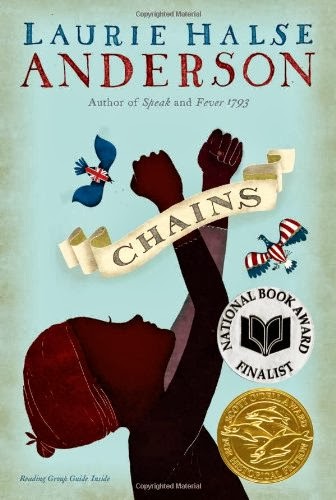
Chains by Laurie Halse Anderson

I bought Chains ages ago, but never got around to reading it.  It was actually the book that motivated me to participate in the 2013 American Revolution Reading Challenge over at War Through the Generations.  And yet, it still sat on the shelf.  So naturally, when Anna and Serena, the hosts of War Through the Generations, announced that there was going to be a Chains read-along, I jumped at the chance to sign up.  AND I AM SO GLAD I DID!  But now that I have read the book, I can't understand what took me so long.

Chains is the story of a young slave girl who yearns for freedom.  Isabel, 13, and her younger sister Ruth are quickly sold by a greedy nephew for the money they will bring after their somewhat benevolent owner, Miss Fitch, passes away.  But Miss Fitch had promised them freedom after her death and Isabel can't get that promise out of her head.

Now, as the American Revolution begins, the sisters find themselves in a Loyalist household in New York City at the mercy of a cruel mistress, Mrs. Lockton.  The Locktons, who know their bread is buttered on the side of the Loyalist and King George III, despise the Patriots who want independence from and everything they stand for.

It isn't long before Isabel meets Curzon, a slave working for the Patriots, and known for the red tricorn hat he is always seen wearing.  Curzon convinces Isabel to spy on Mr. Lockton, and report anything she hears that might be useful to the Patriots.  Isabel isn't very enthusiastic about doing this, but when she is given the devastating news that Mrs. Lockton has sold Ruth, she changes her mind.  It had just been discovered that Ruth suffers from seizures and the very ignorant, superstitious Mrs. Lockton believes that they are a sign that the devil is in Ruth.

Curson proves to be a good friend to Isabel, although she has very mixed feelings about him, the war between the Patriots and the Loyalists and which side would be most beneficial to her in terms of getting her freedom.

As the war heats up, so does Isabel's determination to find her sister and, as she is told by an elderly slave known as Grandfather, to find the way to cross her own River Jordan* to freedom.

Chains is written in the first person, so we always know exactly what is going on in Isabel's mind, how she perceives everything around her and, most poignantly, how she feels about the things that happen to her.  But by spying on Mr. Lockton and his friends, we are also given a certain amount of insight into the Loyalist side of things.

Isabel is a very strong willed girl and Mrs. Lockton knows it and is determined to break that will and so she is constantly trying to tighten the chains of slavery that bind Isabel.  Yet, it takes a while for the realization that Mrs. Lockton cannot chain her soul to really sink in to Isabel's consciousness, even though all her actions had always already proven it to be true.  Her strength in the face of Mrs. Lockton, her wavering between the Patriots and the Loyalists, her determination and her innate sense of kindness despite everything all make Isabel such an exemplary protagonist.

In fact, Anderson has created a whole cast of characters in Chains who play their parts to perfection.  Set against the backdrop of New York City,  Anderson has written a brilliantly crafted novel in which the fictional walk through the historical and it is spot on.  Anderson has even turned New York into a character in its own right, by staying true to the history of the time (NB: I used to teach New York history to my 4th graders and it was my favorite thing to teach).

One of the things I really liked about Chains were the quotes used at the beginning of each chapter.  These quotes are from actual sources of the time that help situate the reader and gives the novel a real feeling of authenticity.

I don't think I could possibly recommend this book highly enough.

This book is recommended for readers aged 14+
This book was purchased for my personal library

Laurie Halse Anderson has excellent teaching resources for Chains, including a section on how to put on a colonial tea (with some really good recipes).  You can find it HERE

This is book 3 of my 2013 American Revolution Reading Challenge hosted by War Through the Generations

This is book 10 of my 2013 Historical Fiction Reading Challenge hosted by Historical Tapestry

*I was talking to a friend about Chains and she said she didn't get the River Jordan reference, which is a reference to the God's command that after the death of Moses, Joshua would lead the Israelites out of slavery in Egypt to freedom in the promised land by crossing the River Jordan.

Wednesday, October 2, 2013

It's Cybils Nomination Time!


Yes, it is that time of the year again - time to nominate your favorite books for a Cybils Award.  And it is so easy to do, too.

Just head over to the Cybils website, have a little look around, then click on the nomination form.  Easy as pie!

What's eligible?  Books published in Canada or the United States (luckily some of those great UK and Australian are also published here) between October 16, 2012 and October 15, 2013. 

Nominations close on October 16, 2012, so hurry up.  You don't want your favorites left behind!