Monday, November 15, 2021

How War Changed Rondo by Romana Romanyshyn and Andriy Lesiv

How War Changed Rondo
written and illustrated by 
Romana Romanyshyn and Andriy Lesiv
translated from the Ukrainian
Enchanted Lion Books, 2021, 40 pages

Three friends,  Danko, a bright light with a shiny transparent heart, Fabian, a red balloon dog with a knot for a nose, and Zirka, a paper origami bird covered with notes and sketches of his journeys, loved living in Rondo. Rondo was a place with clear air, where residents grew and tended flowers everywhere, and lived in distinctive houses. In other words, Rondo was a pretty great place to live.

Rondo was especially famous for its flowers and there large greenhouse where there was a collection of rare plants and flowers that could sing. Concerts were often held in the greenhouse, and the town anthem, Mozart's Rondo alla Turca, was always played for residents and visitors alike. 

One ordinary day, Danko and Fabian were on their way to meet Zirka, who had just returned from a trip with new stories. But, whispers had begun...war was on its way to Rondo and leaving a path of death and destruction everywhere it went. No one in Rondo knew what war was, but soon, everything there was dark and ugly. War planted black flowers (bombs) and prickly weeds so that no light could shine through, causing Rondo's beautiful flowers to stop singing. 

The three friends resisted war, but Danko, Fabian, and Zirka were all hit by the stones (bullets) that war sent out. How could the three friends ever defeat war, especially now that they were all wounded - Danko's heart had cracks, one of Fabian's legs was pierced by a prickly weed, and the edges of Zirka's wings were burned? When Danko decides to try to provide light to the flowers in the greenhouse, he realizes that war is afraid of light and so he, Fabian, and Zirka rally the other residents of Rondo in an effort to produce a powerful enough light to finally defeat war. 

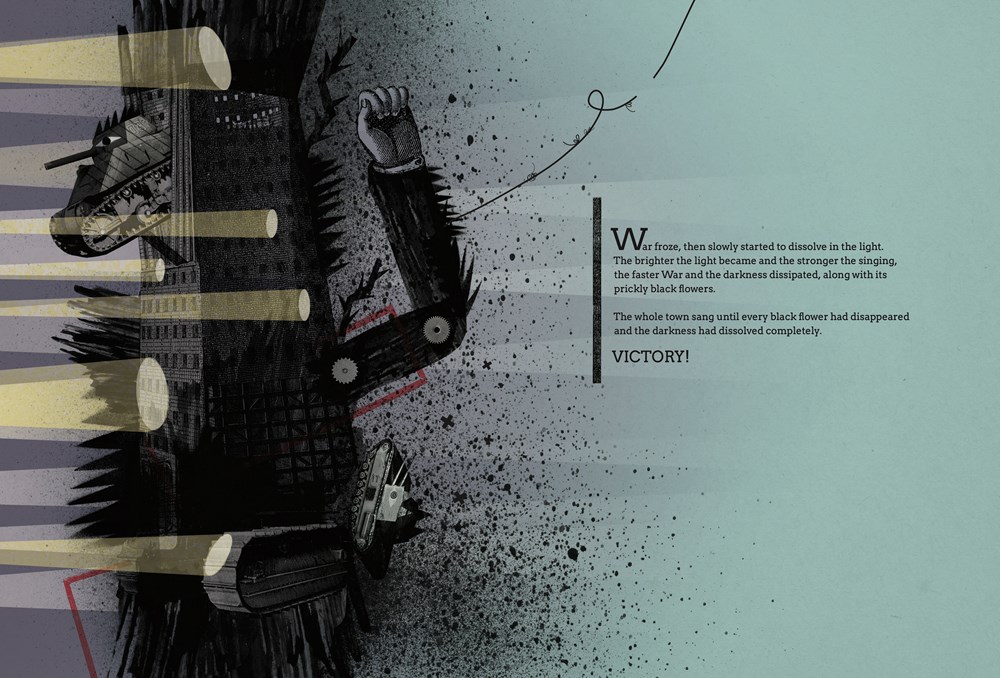
War is finally defeated, and Rondo is repaired and rebuilt. The flowers in the greenhouse begin to sing again, but the poppies that had grown all around town no longer grew in different colors. Now, they only grow in one color - red.
    
The interesting thing about How the War Changed Rondo is that war itself isn't the focus, but rather how it impacts the lives of Rondo and its residents during and after the fighting is over. Here we see the lasting effects of injuries received in the war on Rondo. Because, even though Rondo is repaired, its residents of are forever changed. Now, they know what it is like when their beloved flowers stop singing, they will  have to live with sad memories of loved lost friends and relatives, as well as with the physical wounds that were inflicted on them by war, including Danko with his cracked heart, Fabian with his injured leg, and Zirka with his singed wings.  

The thing about war and children, like the residents of Rondo, is that they don't usually know or understand what war is, where it comes from or how it starts, but they do know the fear and destruction it brings with it. And that is something that will never leave them. In the end, readers might be left scratching their heads and wondering why would anyone want to have war. I'm adult and I still wonder that. 

Mixed-media illustrations in this picture book for older readers harmonize brilliantly with the text, going from pale green and a golden yellow to darkness followed by that same pale green with building tinged in a sooty black - another physical manifestation of the lasting impact of war. Interestingly enough, there are only two illustrations where a human arm is seen, first dropping bombs, later retreating, yet none of Rondo's citizens are human. It really brings out the point that only humans start wars. 

This book is recommended for readers age 8+
This book was purchased for my personal library

Sunday, November 7, 2021

I Saw a Beautiful Woodpecker: The Diary of a Young Boy at the Outbreak of World War II by Michal Skibinski, illustrated by Ala Bankroft

I Saw a Beautiful Woodpecker: 
The Diary of a Young Boy at the Outbreak of World War II
by Michal Skibinsky, illustrated by Ala Bankroft,
translated from the Polish by Eliza Marciniak
Prestel Publishing, 2021, 128 pages

Here is an uncomplicated book that captures the summer before WWII began in the notebook of a young boy. Eight-year-old Michal was give a school assignment for the summer holidays to write one sentence in a notebook about something that happened to him each day. The purpose of the assignment was to provide a means for practicing his penmanship and being moved up to the next grade was contingent on faithfully keeping this notebook. Michal's entries begin on July 15, 1939 and end on September 12, 1939. There are not entries for every single day but there are entries for most of them. 

According to the note at the end of this book, Michal lived in Warsaw, Poland. At first, his entries sound like a wonderfully idyllic summer vacation and are about things he observed in nature, like the beautiful woodpecker he saw, and the people he spent time with - his parents, brother Rafal, their nanny, and their  grandparents. 

But gradually, Michal's entries begin to get darker, until September 1, 1939 when he notes that war has begun. On September 6, 1939, he writes that a bomb was dropped near where he was staying. Because he was limited to one sentence per day, readers can only speculate on how he must have felt that day.

What interesting to note about this book, however, is how innocent most of Michal's entries are, even as the adults in his family were fully aware of trouble coming and taking precautions to get him and his brother out of harm's way according to the note at the end of the book. On July 26, 1939, Michal writes that a plane flew over where he was staying (this is the cover image). On the surface, this seems innocent enough, but one wonders if it was a reconnaissance plane from Nazi Germany, given the coming invasion of Poland.

Each entry is a two-page spread containing the date and the entry, but set against the background of Ala Bankroft's incredible painted almost impressionist illustrations reflecting Michal's observations. The colors are bold greens, browns, and blues reflecting nature and as war arrives, become darker, almost black, losing most of their color.  

I Saw a Beautiful Woodpecker is an unique document of its time as experienced by a child who probably didn't know what war is or that it was on his doorstep, even as he began his entries. Yet, the truth of his experience is in the simple declarative sentences with which he seems to have unwittingly witnessed the coming war through his young, innocent eyes.  

This book would be a great classroom/home school addition for anyone teaching the history of WWII.    

This book is recommended for readers age 7+
This book was gratefully received from Casey Blackwell at Media Masters Publicity 

Sunday, October 31, 2021

Ruta Sepetys Between Shades of Gray: The Graphic Novel adapted by Andrew Donkin, art by Dave Kopka, colors by Brann Livesay

Ruta Sepetys Between Shades of Gray: The Graphic Novel
adapted by Andrew Donkin, art by Dave Kopka, colors by Brann Livesay
Philomel/Penguin Teen, 2021, 160 pages

I can't believe it has been 10 years since I first read Between Shades of Gray. It was one of those books that introduced me to a new aspect of WWII and it had such a profound influence on me when I read it, one that has stayed with me ever since. Although the novel is still certainly well worth reading, so is the new graphic novel about what happened to 15-year-old Lina Vilkas and her family. 

Lina is arrested by the Soviet secret police or NKVD along with her mother and younger brother, Jonas, taken from their home in Kaunas, Lithuania on the night of June 14, 1941. Loaded into a truck along with other families that had been rounded up, the Vilkas soon find themselves at a remote train station, where other truckloads of arrested Lithuanians are arriving. 

Everyone is put into crowded cattle cars that just sit there for days. During that time, Lina meets Andrius and the two sneak out together at night. Lina is hoping to find her father since they don't know what has happened to him. Just before the trains leave the station, she finds her father in another train.

The family is happy to know he is still alive even if they don't know what will happen to him. When their train finally leaves the station, they spend the next 42 days traveling to a remote area of Siberia, where they are forced to sign a paper that convicts them of crimes against the Soviet Union (their crime - simply being Lithuanian) and sentences them to 25 years of labor. 

Life in Siberia is hard, the winters are brutal and the degradations constantly inflicted by the Soviets make things even more difficult. Over time, Lina and Andrius find that they are attracted to each other, but often harsh conditions come between them. Eventually, they are separated when Lina and her family are sent to another prison camp in Siberia, where she finds life with Andrius even harsher. 


Lina manages to document everything that happens to her, her family, and everyone else using her artistic talent and drawing it all on whatever paper she could find and using whatever material she could draw with. She also manages to send letters to her father in another prison camp in the hope that they will reach him. But can her dream of her family being reunited after the war keep Lina's hopes and spirits up long enough to survive?

I'm always skeptical of novels that have been turned into graphic formats. It feels like a novel has so much depth that could easily get lost. But I am glad to say that Between Shades of Gray: The Graphic Novel has made the transition successfully and it is all thanks to the wonderful images that really capture so much of what happened to Lina and her family. The text is spare yet spot on, and the images are so detailed and should be throughly explored for what they have to say, too. Take, for example, this image of the chaos at the train station as truckloads of arrested Lithuanians are forced into the waiting cattle cars: 
The confusion, fear, harsh treatment and Soviet threat is all there on people's faces and in their body language.

Between Shades of Gray: The Graphic Novel is an excellent addition to the history WWII. The Soviet treatment of citizens of countries they occupied during WWII isn't as well known as the history of the cruel treatment of Jews and political enemies by the Nazis and a graphic novel just may be what some readers are most comfortable with, although I highly recommend the original novel, too. 

This book is recommended for readers age 13+
This book was an eARC gratefully received from NetGalley

Monday, October 18, 2021

Boy From Buchenwald: The True Story of a Holocaust Survivor by Robbie Waisman with Susan McClelland

Boy From Buchenwald: The True Story of a Holocaust Survivor
by Robbie Waisman with Susan McClelland
Bloomsbury, 2021, 288 pages

In 1942, 11-year-old Romek Waisman was marching to work at a munitions factory in Poland when a SS officer pulled him out of line and ordered him to get in a truck headed for a death camp. Like all the other men already in the truck, Romek had been ill. But fate stepped in and Romek was given another chance to live. 

In April, 1945, American troops liberated the Buchenwald Concentration Camp, where Romek had eventually been sent. He was one of a 1,000 children who had survived the Holocaust and placed under the protective services of the Oeuvre de Secours aux Enfants or OSE. In June 1945, Romek, along with 426 other boys, including Elie Wiesel, was sent by train to Écouis, France, where they could be rehabilitated. Ironically, the boys were dressed in Hitler Youth uniforms that had been found in a storage room in Buchenwald so that they could discard their striped lice infested camp pajamas. On the trip to Écouis, many of the French people who saw them, mistook who they were and began throwing rocks at them.

At Écouis, there was plenty of food, clean sheets and bathrooms, but after years of starvation and mistreatment, the boy were somewhat feral. That, combined with anger, caused them to behave violently at times, to steal, and to hoard. 

In between learning how to adjust to life after living under Nazi oppression for so long, Romek slowly regains memories of his loving family and his happy childhood before the Nazis invaded Poland and his experiences working in the munitions factory and later in Buchenwald. Throughout his ordeal, Romek held on to the idea that after the war and liberation, he would return to his home in Poland, where his family would all be there waiting for him. Much of his journey, then, is about coming to terms with the reality of what happened.

At one point, Romek's older sister is found and he journeys back to Germany to see her, but when she tells him she will be married soon and moving to Palestine, he returns to Écouis. There, he also meets a wealthy French couple Jean and Jane Brandt, who want him to meet their children. Jane begins taking Romek on cultural excursions, but when they offer to adopt him, he declines. 

After finally accepting the fact that only he and his sister survived, in 1948, at age 17, Romek emigrated to Canada, to begin a new chapter in his life and where he changed his name to Robert (Robbie) Waisman. Robbie married and had children, but it was many years before he could speak about his experiences under the Nazis. 

Boy From Buchenwald is a riveting read, and certainly one that is needed now as more and more survivors of Nazi atrocities are dying off. Robbie tells his story in an almost stream-of-consciousness manner, which might be confusing to some readers since it isn't always linear. And many of the incidents that Robbie writes about may also be difficult for them, but, despite that, this is a book that should be read and discussed. Robbie and his friends were so traumatized by what they experienced, yet they were still able to go on and lead productive lives. Ultimately, then, this book is quite inspiring and shows just how strong the human instinct to survive can be. 

Pair this book with Survivors Club: The True Story of a Very Young Prisoner of Auschwitz by Michael Bornstein for another important survivor story.

This book is recommended for readers age 10+
This book was an eARC gratefully received from NetGalley

Wednesday, October 13, 2021

War by José Jorge Letria, illustrated by André Letria, translated from the Portuguese by Elisa Amado

War is a thoughtful, honest though grim look at the common factors all wars share, from its first glimmerings to its end and beyond. 

l
War written by José Jorge Letria,
illustrated by André Letria, 
translated from the Portuguese by Elisa Amado
Greystone Kids, 2021, 64 pages

Beginning with black endpapers that lighten only slightly on the first two-page spread, readers will begin to realize that the idea of war begins in darkness by those who would capitalize on our fears, symbolized here by snakes, spiders, and other crawling insects creeping and slithering through a landscape of leafless trees. These fears are then picked up by a large black hawk who carries them to one who had a wish for war. 

And he who wishes for war, motivated by hate, ambition, and spite, internalizes those fears, then uses them to infect the people over whom he rules. Soon, as "war saddens, crushes, and silences," books are burned, factories are built for the war effort, and "war begets shadowy, iron children" who can easily be indoctrinated into becoming an army of obedient soldiers.

But, in the end, all wars leave behind nothing but silent destruction after all the bullets are shot, all the bombs are dropped, and most of the people are killed. But don't be fooled, war isn't over, just turn the page to another almost black wordless two-page spread that carries the shadows of people's fears, those same snakes, spider, and other crawling insects just waiting...for another person wishing for war and filled with hate, ambition, and spite.

Readers will find a powerful indictment of war in what appears to be a simply written, simply illustrated book that is anything but simple. The images are done in a somber palette of war-like browns, blacks, grays, and greens, and printed on heavy paper. There are 14 wordless double-page spreads, and 17 double-page spreads that contains one single sentence, which means that in only 17 sentences, all the horrors of war are emotionally  conveyed. Interestingly, though this book clearly is not about one particular war, there is much to it to compare with World War II. 

A thought-provoking, sober picture book for older readers, War will likely generate many conversations and questions from thoughtful readers when used in a class, library or home school setting. 

This book is recommended for readers age 7+
This book was purchased for my personal library