It all begins with a bicycle in a store window. Richard Fuller, 15, decides that is what he wants but knowing his laundress mother could never afford to buy it for him, he is determined to earn the money himself.
Richard begins with a job picking fruit and generally helping out an elderly farmer, than moves on to delivering bread with Mr. Black, the baker in Niagara Falls, Ontario. Both men take Richard under their wing, so to speak, but it is Mr. Black who initiates Richard into the life of a soldier. Mr. Black invites Richard to the opening ceremonies at a Canadian Army Summer Camp where he is the cook. Later, knowing that Richard is underage, Mr. Black uses his influence to get Richard into the camp under the name of someone who couldn't make it.
It turns out that Richard is quite good at signaling and enjoys his two weeks of playing soldier, taking much of what is thrown at him in stride, and not being terribly bothered that the other men, who smoke, drink and gamble. are older than he is.
Not long after he returns home, Canada finds itself at war with Germany and Richard, still under the influence of Mr. Black, decides to enlist, but under his own name not the assumed name of summer army camp. And because he is a known face at the enlistment office, Richard manages to enlist using just his library card. Unfortunately, his actions lead to an estrangement with his mother.
Eventually, Richard is shipped overseas, but that first year of war was a quiet one, earning the name the phony war. But again, Richard takes it all in his stride, and excels at what he does. Though he misses his mother, his spirits are buoyed by the support he gets from Mr. and Mrs. Black and from Amy, his next store neighbor who provides a humours bit to the novel. Amy keeps knitting socks for Richard, but they always seem to get lost along the way. She finally comes up with a great plan for definitely getting the next pair of socks to him - it is such a good plan, even Richard is afraid to open the package.
But eventually the phony war ends and the Blitzkrieg begins and the reality of war really hits very close to home for Richard.
In her Author's Note, Maruno explains that many of the episodes and incidents she includes in Kid Soldier were based on details gotten from her father's diary, which give the novel a very tangible sense of historical reality. Her father, like Richard, also participated in the army's summer camp under the same name as Richard - Chester Lee Huston. It is hard to believe that a 15 year old boy could get away with enlisting, but it did happen, even in WWII.
I found Kid Soldier to be an interesting novel. The fact that a boy as young as 15 could be accepted into the army so easily is a very scary thought, but the idea of child soldiers always is and is something that still occurs in some parts of the world. This was also an especially interesting novel because it was about a Canadian boy's experience of the war and books about that aren't as numerous as American or British books, even though the Canadians fought just as hard and suffered so many causalities.
The novel is well-written with well defined characters. Written in the third person, the voice of the narrator is engaging, and the character of Richard is very likable, making this an very readable novel.
This book is recommended for readers age 13+
This book was an E-ARC from Netgalley.com
Tuesday, July 9, 2013
Wednesday, July 3, 2013
Movie Matinee #3: Felicity, an American Girl 1775
This review contains spoilers
It is spring 1775 in the British colony of Williamsburg, Virginia and it is also Felicity Merriman's 10th birthday. Not your average girl of the time, Felicity loves horses and would rather ride her horse through the fields and pastures of Williamsburg than help out at home.
But her mother is determined that Felicity learn how to be a proper gentlewoman and signs her up for classes that will give her the skills she will need. There, she meet Elizabeth Cole and her snooty older sister Annabelle. Felicity and Elizabeth become immediate friends, though Annabell looks down on the Merrimans because Felicity's father is a merchant, not a gentleman.
Of course, gentlewoman lessons involve learning how to make and serve tea properly, but tea has already become a point of conflict between the loyalists, those who are loyal to the crown, and the patriots, who want independence from Britain because of the high tax on tea without any representation in Parliament. The Merrimans, including their 15 year old apprentice Ben, are patriots while the Coles and Felicity's grandfather are loyalists.
Felicity has also fallen in love with a spirited mare she names Penny. Penny is being abused by her owner, Jiggy Nye, who is trying to tame her. Felicity is convinced she can tame Penny and begins to sneak out at night to try. And she eventually succeeds. But when she hears Jiggy Nye yell in a fit of anger that anyone who came ride his horse, is welcome to her, Felicity takes him at his word. Accused of horse theft, Felicity must later return Penny to Jiggy Nye. That night, Felicity again sneaks out and frees Penny.
Meanwhile, apprentice Bee has gone missing. But summer has come and the Merrimans are off to visit grandfather, who surprises Felicity when he gives her Penny. One day, Felicity overhears bounty hunters looking for Ben, who they say ran away to join General Washington's troops. She takes Penny and find the injured Ben, convincing him to come to her grandfather's and to ask for her father's forgiveness.
Returning to Williamsburg, Felicity learns that the father of her friend Elizabeth has been imprisoned for being a loyalist. Felicity's father sees no reason for his arrest and promises to try to get him out of prison. While visiting him, Felicity also sees Jiggy Nye in the same cell. Feeling pity for him, she brings him a blanket and some food.
Over the course of not quit a year, Felicity grows from a self-centered, impulsive girl who wants nothing more than to be independent to a thoughtful girl who cares about others, but there is still much in store for her. Both her mother and Penny have pregnancies that result in life-threatening births. Felicity manages to take care of the house and family maturely, efficiently and responsibly while her mother's life hangs in the balance. And when Penny's foal is a breech birth, Felicity has the wisdom to turn to the one person who can help her - Jiggy Nye.
There are lots of historical elements in Felicity besides being an engaging coming of age story. The two sides, patriot and loyalist, are explained clearly in the context of the story so that young viewers will have no trouble understanding the events that led to the American Revolution. And in keeping with the themes of freedom, independence, and responsibility, the practice of apprenticeship is also clearly presented. Apprenticeship was a legal contract to learn how to do something, and when Ben ran away, regardless of his ideological reasons, he broke the law by reneging on this contract. The grandfather's reaction when Ben returns, that he should be imprisoned, give a good idea of how serious an apprenticeship was.
Felicity is an excellent movie, that may appeal to boys as well as girls. It certainly was a hit over and over in my house whenever my niece L'naya visited. We spent a lot of time drinking tea and talking about loyalists and patriots. And in case Felicity looks familiar to you, it is because she is played by a 13 year old Shailene Woodley, whose acting career has really taken off in the last few years.
![]() |
| Shailene Woodley |
This movie is recommended for viewers age 7+
This movie was purchased for L'naya by me.
Although the American Girl Felicity doll was retired a few years ago, you can still access lots of fun stuff and information about Felicity's world and the movie at the following web addresses:
This is part of my 2013 American Revolution Reading Challenge hosted by War Through the Generations
Happy Independence Day!
Monday, July 1, 2013
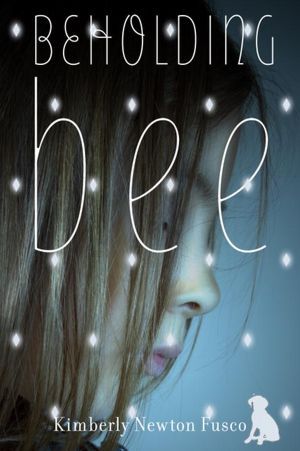
Beholding Bee by Kimberly Newton Fusco
It is 1942 and the effects of WWII are beginning to be felt in the traveling carnival where 12 year old Bee tends the hot dog stand. Most of the men are gone - drafted or enlisted, and now sugar and gasoline being rationed and life in the carnival is getting harder and harder for the owner, Ellis.
Bee has lived in the back of a hauling truck with Pauline ever since she was 4 and her parents were killed in an accident. Ellis wants to put her into the sideshow. Bee has a diamond-shaped birthmark that covers one side of her face and he is sure people will pay good money to gawk at it. Pauline has always protected Bee from this fate, but when Ellis sends her to Poughkeepsie to work in a stationary show, life becomes much harder for Bee. Luckily, just as she needs someone to hold on to, a little dog the color of butterscotch that she names Peabody comes into Bee's life.
All Bee has really ever wanted is a permanent home and family, and now at Ellis's mercy and with Pauline gone, she realizes she must find that for herself. So one morning, Bee runs away from the carnival with Peabody and Cordelia, a little piglet from the show. And then she comes upon it - the absolutely perfect gingerbread house where two elderly ladies are living and waiting for her. But wait, one of those ladies is familiar to Bee, she has seen her off and on before whenever things had gotten tough.
Bee moves in but it doesn't take long to realize something isn't quite right about Mrs. Potter and Mrs. Swift. They certainly provide for her, even if they don't eat much, and they make sure she begins school, even if she is put in a 'special' class of kids separated from the 'regular' kids. There, Bee makes a best friend, Ruth Ellen, a girl with a brace on her leg because of polio, and a worst enemy, Francine, a girl who continuously bullies her because of the 'diamond' on her face.
But more and more, Bee is bothered by the fact that only she and Peabody can see her caretakers. One the one hand, it causes Bee problems with the nosy neighbor who thinks she's living in the house alone and the school principle who wants them to come to school for a meeting. One the other hand, Bee loves these two odd ladies and doesn't like to be reminded that they came to help her and won't be able to stay forever.
Still, life is ever so much better for Bee now, except for the bullying over the birthmark so that she stills feels the need to cover up by pulling her hair tightly over it "like a curtain." But sometimes, at home or at Ruth Ellen's, Bee forgets about her birthmark.
But then Mrs. Potter and Mrs. Swift begin to visibly fade away. Was life in her gingerbread house too good to be true for Bee? Or will she find the strength and courage to fight for the home and family that she wants so badly?
Beholding Bee is one of those Middle Grade novels I couldn't put down. Bee, the book's first person narrator, tells her story in short, sometimes very short, chapters and in language so conversational it feels like she is speaking directly to you and only you. Sometimes when she is speculating on a thought or idea, or when she is trying to figure out why someone has done something, her voice has an endearing quality I don't find often enough in Middle Grade novels.
And there is a lot going on in this wonderful coming of age story - issues around bullying, inclusion in school, self-esteem, self-reliance, courage. Pauline has always protected her, especially from bullies, but now Bee is, essentially, on her own and must learn to take care of herself, even if that does mean making mistakes along the way.
This is a home front novel and there are some wonderful WWII references throughout the book giving the setting a real feeling of the time. But the one realistic aspect that always gets to me in these books are the way they make you realize how very, very vulnerable children, are especially during a war. Had Bee not found the courage to run away from a greedy adult who just wanted to exploit her, she would most certainly have ended up a carnival side show attraction with no one to stand up for her and stop it.
I have always like fantasy and sci-fi, but nothing pulls me into a book quite like magical realism. And so I loved Beholding Bee. Set so completely in reality, you begin to wonder about Mrs. Potter and Mrs. Swift. Ghosts from the past? Figments of Bee's imagination? I guess you will just have to read Beholding Bee and decide for yourself.
One more thing - Peabody is definitely the dog of my dreams.
This book is recommended for readers age 9+
This book was purchased for my personal library
Tuesday, June 25, 2013
Top Ten Tuesday #11: Top Ten Books I've Read So Far in 2013
This weeks topics is Top Ten Books I've Read So Far in 2013
Picking my Top Ten in any category is usually hard for me. Either I can't come up with ten things or I end up with way too many. But this weeks Top Ten list took me no time at all to figure out. And it was NOT what I was expecting. Some are old, some are new, all are favorites.
They are listed in no particular order of favoritism.
1- Etched in Clay: The Life of Dave, Enslaved Potter and Poet by Andrea Cheng
Cheng has imagined the life of this quiet rebel who lived in the 19th centur in a unique and
informative way in this free verse YA novel.
2- Maggot Moon by Sally Gardner, illustrated by Julian Crouch
This year's Carnegie medal winner, it is a YA story set in an oppressive dystopian 1950s England about a severely dyslexic boy who finds the courage to rebel.
3- Hokey Pokey by Jerry Spinelli
I loved this MG book set in a metaphoric world of children's play and watching the main character as he comes of age in the course of one symbolic day.
4- The Terrible Thing that Happened to Barnaby Brocket by John Boyne
In this MG novel, Barnaby's boringly normal parents, clearly Australian relatives of the Dursley's,can't stand that Barnaby refuses to be normal and continues to float. When his mother does the unspeakable and lets him go, Barnaby floats into all kinds of experiences with different people who accept who they are and teach Barnably to embrace who he is.
5- Navigating Early by Clare Vanderpool
An MG quest story about an unlikely friendship between two boys and the journey they take to find out who they are as they follow the twists and turns of the Appalachian Trail and Early, who is anumber savant, narrates a parallel quest story about Pi (yes, 3.14 Pi) that takes them all full circle.
6- Beholding Bee by Kimberly Newton Fusco (To Be Reviewed)
I just finished this wonderful MG story about 12 year old Bee, born with a diamond shaped birthmark on one side of her face, who just wants a home and family and the two aunts who help her, even though she and her little dog Peabody are the only ones who can see them.
7- Tamar, a Novel of Espionage, Passion and Betrayal by Mal Peet
A YA novel set in 1945 and 1995, this is a delicious story that is about identity - finding out who you are or even inventing who you are. Oh yes, it is also about spies, codes, love, betrayal and intrigue and one of the best of its kind.
8- After by Morris Gleitzman
This is the 4th novel about young Felix and his flight from the Nazis and takes the reader back to 1945 and Felix's life as a 13 year old partisan, finally able to fight the Nazis rather than just running from them. If you have already read Once, Then and Now, After will give you the sense of closure that you might need if you have been following Felix from the beginning.
9- The Lions of Little Rock by Kristin Levine
In this MG novel, Marlee Nesbit, so shy she can't speak to anyone outside her family, finally does find her own voice in 1957 Little Rock, Arkansas in a fight against discrimination and segregation.
10- Unspoken: A Story from the Underground Railroad by Henry Cole
This wordless picture book tells the poignant story of a young girl's compassion towards a run away slave by silently giving him food and helping him avoid capture one night.
I really needed a Top Eleven this week because my other favorite was:
Each Kindness by Jacqueline Woodson
A young girl repeatedly rebuffs the proffered friendship of a poor girl in her class, but when the girl doesn't come back one day, she recalls her own unkindness and how she could have done things differently. A nice look at bullying from the perspective of the bullier.
These are my favorites so far this year, what are yours?
Sunday, June 23, 2013
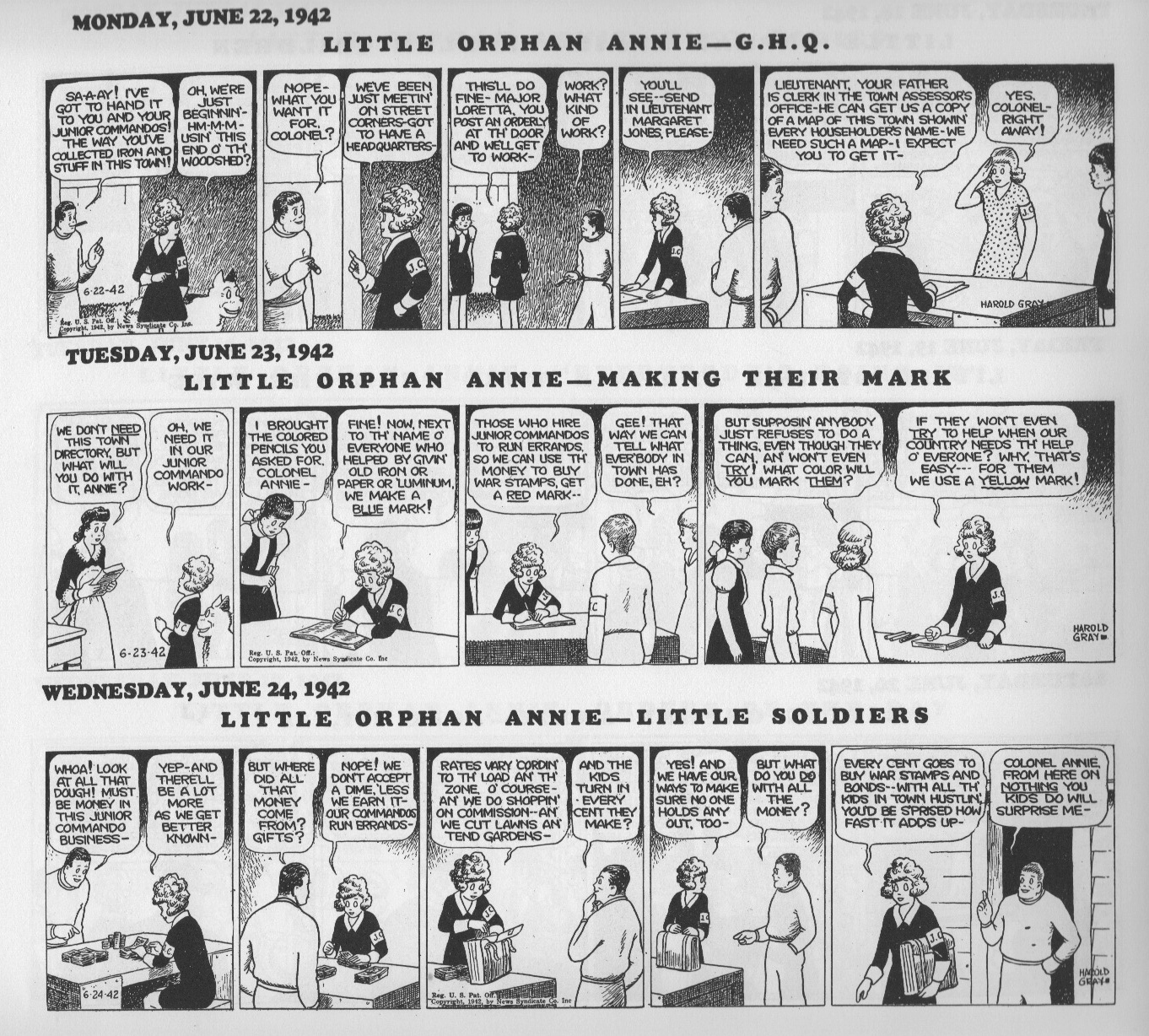
Sunday Funnies #11: Leapin' Lizards! June 1942 Little Orphan Annie Gets in the Scrap
"What are you doin' to help win the war, mister?"When the country went to war, so did America's "strippers" that is, the author's and illustrator's of the comic strips already enjoyed by millions of fans young and old. Little Orphan Annie was no exception. The gangster stories of the 1930s that had entertained readers were out and war service stories were in as Annie became a home front sweetheart.
And it didn't take Annie long to organize the Junior Commandos with her friends. And the idea caught on - before long there were thousands and thousands of real Junior Commandos all over the country, 20,000 in Boston alone. And even Dottie's little brother Burk in the novel Crystal City Lights embodied the Junior Commando spirit, despite being interned by the country he was helping. So, what is a Junior Commando? I think Dottie explains it best:
"Little Orphan Annie is organizing groups of kids all over the country to collect newspapers, scrap metal, and all kinds of stuff that can be reused for the war effort. They sell the scrap and then buy war stamps and bonds. Burk even made himself a special armband with "JC" written on it so everyone will know he's a Junior Commando just like Annie." (page 135)The Junior Commandos came into being on June 15, 1942 when Annie and her friend Loretta tell the other girls they have no time to play - they are busy doing war work and the rest is, as they say, history. And Annie and the Junior Commandos returned to the comic strip on and off as needed in the various storylines that ran throughout the war. But for now, I hope you enjoy the beginning of this pop culture phenomena:
![]() |
| Ckick to enlarge and read |
![]() |
| Click to enlarge and read |
![]() |
| Click to enlarge and read |
![]() |
| Click to enlarge and read |
From: Arf! The Life and Hard Time of Little Orphan Annie 1935-1945 by Harold Gray
Subscribe to:
Posts (Atom)