Wednesday, November 17, 2010

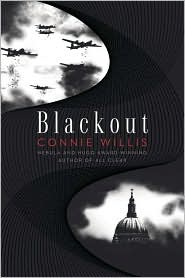
Blackout and All Clear by Connie Willis


I have just finished rereading Blackout and All Clear and find myself wishing that Connie Willis could have kept going. After reading these two books totaling 1,168 pages, I find I have become quite attached to the characters and had a hard time saying goodbye when I came to the end. They are just that good!

The books are based on a simple enough premise. In 2060 Oxford, history is studied by traveling back in time to observe, collect data and interpret events firsthand under the tutelage of Mr. Dunworthy, the history professor in charge of time travel. The story centers on three students interested in different aspects of World War II. Michael Davies, disguised as Mike Davis who wants to go to Dover as an American war correspondent to observe the heroism of the ordinary people who rescued British soldiers from Dunkirk; Merope Ward becomes Eileen O’Reilly, working as a servant to Lady Caroline Denewell in her manor at Backbury, Warwickshire in order to observe evacuees from London; and Polly Churchill becomes Polly Sebastian, a shop girl by day working in the fictitious department store Townsend Brothers on Oxford Street, who wants to observe how Londoners coped during the Blitz.

In Blackout and All Clear, Willis makes it clear that there are certain cardinal rules of time travel. First, the traveler may not do anything to alter a past event. But that was supposed to have been taken care of so that it couldn’t happen. In addition, an historian is not allowed to travel to a divergence point, a critical point in history that can be changed by the presence of the historian. Nor can a predetermined drop site open if there is a “contemp” nearby who might see what is going on. Furthermore, once they have arrived at their destination, the historian is required to return to 2060 Oxford and report in. If they don’t do this, a retrieval team is sent to bring them back to Oxford. One other thing, time traveling historians are not supposed to have contact with each other in the past.

That being said, Mike ends up in Dunkirk, saving a life and Eileen is prevented from returning to Oxford at the end of her stay by an outbreak of measles among the evacuees. Both ultimately travel to London, seeking Polly, hoping to use her drop to get back to 2060, but Polly’s drop has been compromised by a bomb and has stopped working. These extended stays do not result in the arrival of retrieval teams; but in much more complex adventures and worries. Have they altered the future unintentionally? Or unalterably? And if so, what does that mean for the future? And will the historians ever get back to 2060 Oxford?

In addition to Mike, Polly and Eileen, Willis has drawn some interesting supporting characters in Blackout and All Clear, all very different from each other and all of whom I found myself caring about. There is Sir Godfrey Kingsman, the well known actor who is part of the entourage in Polly’s bomb shelter, though he did get on my nerves with his constant quoting of Shakespeare, yet he was still endearing. He always referred to Polly as Viola from Twelfth Night because of the way she arrived at his bomb shelter her first night, and she was going by the last name Sebastian, the name of Viola’s twin brother, something to keep in mind as you read. And Colin Templer, 17 and besotted with love for Polly anf who had promised to rescue her if anything went wrong. Colin wants to go to the Crusades so he can use the paradox of time travel to close the four year age difference between himself and Polly. Eileen’s life was plagued by Alf and Binnie Hodbin, brother and sister urchins evacuated from London to Backbury, pranksters and troublemakers extraordinaire. Mike had Commander Harold, elderly captain of the Lady Jane who unofficially went across the English Channel to participate in the evacuation of soldiers from Dunkirk and changed the course of Mike’s time travel.

Connie Willis has done a brilliant job writing Blackout and All Clear, even though I know I will probably have to reread both books again to really appreciate them. When I first read Blackout, I didn’t pay close attention to the dates at the beginning of each chapter, so sometimes they were a little confusing. I found myself preoccupied with questions about why I was suddenly in 1944 or 1945 and who were Mary Kent and Ernest Worthing and how did this connect to Mike, Polly and Eileen?  Blackout sets up all the questions and All Clear answers them.

Throughout both novels, the three main characters are confused by what has happened to them, and the chaos of the period, such as not knowing when or where bombs may fall, adds to their sense of helplessness once Polly's knowledge of when and where bombs will fall is exhausted. As in the real war, anger, anxiety, confusion, fear, frustration and helplessness are exactly the array of emotions that the reader experiences along with Mike, Eileen and Polly. Yet, all is not doom and gloom. Willis balances these with instances of hope, courage, selflessness and heroism. She also injects some very comical scenes into the story, such as the angry bull and the deployment of rubber tanks in a muddy, foggy pasture to fool the Luftwaffe, or the constant antics of the Hodbins. And of course, there is the dry wit of the British and their ‘carry on’ attitude after a blitz attack. I really like the fact that Willis keeps the story focused on the plight of the stranded historians, rather than jarring the reader by going back and forth between them and Oxford 2060.

Blackout and All Clear are both chock full of action, information, comedy, tragedy and everything else that goes into making a great story. They are not really meant for YA readers, yet they are perfectly suitable for high school kids, and even some younger ones. So without reservation, I would definitely recommend Blackout and All Clear to readers in their teens and to everyone else. It is a wonderful a tale about survival and heroism.

These books were purchased for my personal library.

Willis described the blitz and the bombs that hit Oxford Street, where Polly worked, in amazingly realistic detail.  Check out the following for an online exhibition of the West End at War including photos and maps of the blitz in that area, the same area that plays a large part in Blackout and All Clear
 http://www.westendatwar.org.uk/index.aspx

The following has online information about the Docklands and East End during the war, another area highlighted by Connie Willis;
http://www.museumindocklands.org.uk/English/EventsExhibitions/Themes/DocklandsWar/


Thursday, November 11, 2010

Memorial Day 2010: From the Archives #4: Cherry Ames Veterans’ Nurse by Helen Wells

Today is Veterans’ Day in the United States and Remembrance Day (le jour de Souvenir) in Canada, a day for honoring veterans of all wars. It is celebrated on November 11th every year because that is the day the armistice became effective, ending the hostilities of World War I. In fact, in the US, it used to be called Armistice Day until 1954, when it was changed to Veterans Day to include all veterans of all wars. I have chosen Cherry Ames, Veterans’ Nurse specifically for this day.

Before her long and varied career history as a civilian nurse, Cherry Ames served in the armed forces. In Army Nurse, she joined the Army Nurse Corps, went through basic training and headed out to Panama City, to nurse wounded soldiers (see Cherry Ames, Army Nurse); in Chief Nurse, she helped organize a hospital evacuation on a Pacific island; in Flight Nurse, Cherry flew into battlefields to pick up wounded soldiers and bring them to hospital.

In Veterans’ Nurse, Lieutenant Ames is stateside, still in the Army but awaiting her discharge papers. Cherry is assigned to Graham Hospital, and though she lives in Nurses’ Quarters on the grounds, she is conveniently located 30 miles from her hometown of Hilton. Graham is a VA hospital specializing in bone injuries and, as the head of nursing Colonel Brown explains “Our job is to rebuild broken men, physically and mentally.” What she didn’t say was that
…each of these young men was wounded in the defense of his country – nor that to live and work again minus hands, arms, legs, eyes, or hearing was a terrific hurdle – nor that nurses here had to mend spirits as well as bodies, had to find useful and self-sufficient futures for these brave men. (pg 20)
Yet, Cherry knew this was exactly what she meant.

Cherry is a floater for two months, which means that she will go wherever she is needed, though that seems to be on the same ward with the same men throughout the novel. She is assigned to Building 7 (there are 6,000 beds and 100 buildings at Graham), where they are awaiting the arrival of new patients – men on stretchers, litters, and crutches, many wearing Purple Hearts pinned to their pajamas. Five men are assigned to Cherry’s care, but her most difficult patient is Jim Travers. Jim has lost his right leg in the war and is severely depressed about his future. He refuses to eat, to socialize with the other men, and call his mother to tell her what has happened and where he is.

Gradually, though, Jim does begin to improve, at least physically with the help of a Reconditioning Officer to increase his overall physical fitness, Occupational Therapy, where he learns skills for future employment, making beautifully crafted items of wood, and Rehabilitation Therapy, where he learns to adjust to the new artificial leg he is fitted with. Of course, Cherry’s excellent nursing care and cheerful optimism also helps him overcome his obstacles. When he finally masters his crutches, Jim is allowed to walk into the nearby village alone. Unfortunately, this doesn’t go well, but helps to show that pity can be very callous. While waiting to cross a street, he overhears two older women discussing him: “They whispered, what a shame, and wasn’t it too bad it was hopeless, and such a young man to go through life like that.” (pg 104) This is indeed a set back for Jim, who tells Cherry “A one-legged man, unable to do his old work, is an object of pity.” (pg 105) Jim's dark mood doesn’t last long, however. Cherry takes him home with her one weekend, where he is not treated as an object of pity.

There is a parallel story besides that of the wounded veterans. Cherry is introduced to the Demarests, a wealthy young couple with a 4 year old son named Toby and who are known for their generous hospitality towards the soldiers at Graham. Toby is bed-ridden due to a mysterious disease. His body is not able to absorb nutriments from food and he is wasting away. Cherry spends time at the Demarest home whenever she is able, visiting and telling Toby stories. One day, she shows up and discovers a new healthier Toby, thanks to a mysterious medicine his doctor has given him. At the same time, however, it is discovered that some very valuable amino acid medication is missing from the hospital supply room, despite being kept under lock and key. Cherry puts two and two together, and with the help of Jim, devises a plan to catch the thief and at the same time, bolster Jim’s confidence in himself.

Once again, Helen Wells did her homework and provides the reader with accurate, informative descriptions of what goes on in a VA hospital, albeit a bit sanitized for her young readers who might not be able to understand the dark psychological effects war can have on soldiers. To her credit, she made young readers aware of some very serious issues at the time when many probably were dealing with returning soldiers themselves. Wells mixed these issues in with some lighter fare, like the requisite love interest in the form of Captain Wade Cooper of the Army Air Force, an amusing teenage crush at home, descriptions of the pranks the nurses’ play on each other and the many squirrels on the hospital grounds who demand peanuts from everyone who crosses their path. Cherry Ames is still a fun though dated series and young readers will continue to discover her. Michelle Slatalia wrote a funny article in the New York Times called “Cherry Ames, My Daughters Will See You Now” which can be found at http://www.nytimes.com/2006/04/06/fashion/thursdaystyles/06Online.html

I hope you will all join me in honoring the men and women in the Armed Forces here and abroad. The Department of Veterans Affairs has an excellent website which includes resources for teachers and students at
http://www1.va.gov/opa/vetsday/ Stop by and check it out, and be sure to watch the short film located there.


And as an act of indulgence, I would like to dedicate this post to the veterans in my family and yours. And to Captain James Grace, whose name I wore on a bracelet when I was still too young to understand what war was all about:

Monday, November 8, 2010

I Am an American: a True Story of Japanese Internment by Jerry Stanley

This is an interesting book that has a story within a story, both of which are true. It is an account of Japanese internment in general during World War II and of Shiro “Shi” Nomnura, a young man who spent part of his youth in the Manzanar War Relocation Center in southern California.

Shi’s parents had immigrated to the US in 1900 and, with hard work, had been successful farmers in California when the Japanese attacked Pearl Harbor on 7 December 1941. Immediately after the attack, friends, neighbors and even politicians were supportive of the Issei, Japanese citizens who had immigrated here, and their Nisei children, who were American citizens of Japanese descent. But within a short time, fear replaced support and yielding to pressure, President Roosevelt signed Executive Order No. 9066 on 19 February 1942. This order enabled areas within the US to be declared military areas, from which certain persons could be excluded. Japan’s military successes in the Pacific resulted in more distrust of the Japanese in the US and the eventual opening of 10 internment camps enabled by Roosevelt’s executive order, despite their constant demonstration of patriotism.

Shi was a junior in high school when Pearl Harbor was attacked and at first his friends were very supportive, but as violence against Japanese and their non-Japanese friends increased, support decreased. All things Japanese became suspect, and Mary Kageyama, Shi’s future wife, remembered how she had helped burn her mother’s sheet music “throwing stack after stack of Japanese opera’s on fine rice paper into the blaze” afraid it would be considered evidence of espionage activit(pg 20)  Families burned many irreplaceable heirlooms, documents and Japanese mementos to avoid suspicion. When it was decided that the Japanese needed to be evacuated to relocation centers, they were given very little time to dispose of their belongings, since they were only allowed to bring a small amount of personal items to the camps. The Nomura’s had one friend, Ruby McFarland, who proved to be a loyal and helpful ally to many Japanese families, offering to store what she could. Opportunists showed up and bought everything they could for very little money.

The camps were hastily and poorly constructed, and set up like barracks. The northern camps were unbearably cold in winter, the southern camps insufferably hot in summer and all in the middle of nowhere. There was no privacy anywhere, including the bathrooms and the grounds were surrounded by fences, barbed wire and armed guards. Nevertheless, Shi figured out how to make the most of the untenable and humiliating circumstances he found himself in. At one point, he traveled to Montana with other internees to help save a famer’s sugar beet crop, and while there, finding freedom and friends. When he returned to Manzanar, he found many changes. Some Nisei were allowed to leave the camp to continue their education. And the US had had to rethink its attitude of distrust regarding the Japanese when the Army realized they needed Nisei who knew Japanese to work in intelligence, plus more soldiers for the war. Nisei did go on to fight quite honorably for their country, yet, after the war all Japanese had to fight the lingering prejudice against them.

I found this to be a very informative in-depth book and definitely worth reading. Like slavery, the internment of Issei and Nisei was not one of this country’s finest moments, but it is important to see and understand how things sometime spiral out of control when all are held responsible for the actions of some. The writing is clear and concise, and the photographs of the people and events are relevant enhancements to the text, including some of Shi and his friends. Interestingly, Executive Order 9066 was not rescinded until 1976 by President Gerald Ford.

Shi’s wife, Mary Kageyama, was called the Songbird of Manzanar because she had such a beautiful voice and sang at some of the socials and outdoor concerts there. As of July 2010, she is still living and singing. Shi Nomura passed away on 17 July 2000 at the age of 80.

I Am an American received the following well-deserved honors:
WINNER 1994 - School Library Journal Best Books of the Year
WINNER 1995 - Horn Book Fanfare
WINNER 1995 - ALA Notable Children's Books

Manzanar is now a national historic site under the jurisdiction of the National Park Service. The website may be found at http://www.nps.gov/manz/ and there is an interesting virtual museum online. Shi Nomura, who was curator of this museum, collected many of the interesting artifacts relating to camp life that may be seen there. The Educator Resource Box is an excellent source of all kinds of teaching material on the subject of Japanese internment.

I Am an American was borrowed from the Muhlenberg Branch of the New York Public Library
It is recommended for readers aged 9-14.

Non-Fiction Monday is hosted this week by http://www.shelf-employed.blogspot.com/

Wednesday, November 3, 2010

From the Archives #3: The Chalet School in Exile by Elinor Brent-Dyer

Elinor Brent-Dyer’s Chalet School series is about an international school set on the fictitious lake Tiernsee in the Tyrolean Alps of Austria and narrates the adventures of students and staff. The series begins in 1925 with the novel The School at the Chalet. and The Chalet School in Exile is number 14 in the series. The Anschluß or annexation of Austria into the German Reich on 12 March 1938 provided Brent-Dyer with some new and exciting material with which to continue the series. Altogether, she managed to write six books in which the war forms a part of the story to a greater or lesser degree.

The Chalet School in Exile begins in February 1938. Concerned about the widespread attraction of Nazism among Austrian youth, Madge (Bettany) Russell, the founder of the Chalet School, and her husband, Dr. James ‘Jem’ Russell decide to move the school across the lake near his sanatorium on the Sonnalpe for safety.

A plebiscite vote was supposed to be held in March to determine whether Austrians wished to remain independent or become part of the Reich, but it never happens. When the Nazis march in and take possession of Austria, parents start to make arrangements to remove their daughters from the school. Before anyone leaves, however, the students get together, form a peace league “and vowed themselves to a union of nations, whether they should ever meet again or not.” (55) The vow is signed by every girl at the Chalet School, but creates a problem of where to hide it, since it could put so many girls at risk should it somehow fall into the hands of the Gestapo:

“Many of the girls were well on in their teens, and, from all accounts, Hitler and his crew were perfectly capable of punishing them. Already there were whispers of concentration camps.” (56)
They decide to hide the paper in a cave and a picnic excursion to it is arranged, which includes Joey Bettany, Madge’s younger sister and former Chalet School student, Dr. Jack Maynrd from the sanatorium, and several students including Robin Humphries, the Russell’s ward. On the way, they meet Frau Eisen and her son Hermann, who gives them the Heil Hitler greeting instead of the traditional Tyrolean Grüss Gott. Hermann notices an envelope in Robin’s pocket and decides it might be important. After a while, Hilary and Robin decide to slip off to the cave. When they don’t return, the group begins to get very worried. Joey finds Hermann at the cave, who admits he had followed the two girls and had seen them enter it. Though they search the cave, they find no evidence of Hilary or Robin having been there. The Peace League Pledge was definitely not in the place they had intended to hide it in.

Once in the cave, Hilary and Robin realize that they have been followed, decide not to leave the Peace League Pledge there and find another way out of it. On their way back to the picnic area they meet Dr. Gottfried Mensch, who drives them home. Two hours later Joey is carried into the Russell’s home by Dr. Maynard and that night, they become engaged.

In late April a man from the Gestapo shows up with an arrest warrant to take everyone from the picnic to Innsbruck, where they have been accused of espionage against the Reich. Joey refuses to go and the British Consul is called in to deal with the Gestapo agent. Ultimately, only Jack Maynard goes to Innsbruck. The Consul, however, suggests that they close the school or move it elsewhere, and warns that it is only a matter of time until the sanatorium is closed by the Nazis.

The Gestapo detains Jack Maynard for a week and when he returns, Jem tells him of the plan to move the school again, advises him to marry Joey quickly and get her and Robin out of the country. Before leaving, a group of girls, including Joey and Robin, along with science mistress Nell Wilson decide to do some shopping in town. Everyone is careful about what they say and do after the incident with the Gestapo until late afternoon. While having coffee in a Gasthaus, Joey notices a skirmish out on the street and sees
“an old man with a long, grey beard, plainly running for his life. A shower of stones, rotten fruit and other missiles followed him. Stark terror was in his face, and already he was failing to outdistance his pursuers.” (119)
Robin, recognizing the man as Herr Goldmann, the Jewish jeweler, runs out of the Gasthaus, followed by Joey and the rest of the party. They surround Herr Goldmann,, but when Joey reminds the leader of the gang of the kindness he was shown by Goldmann and his wife in his time of need, he retorts
‘He’s a Jew! Jews have no right to live!’ declared Hans Bocher sullenly. ‘Give place, Fräulein Bethany, and hand over the old Jew to us! Better take care, or you’ll be in trouble for this. Let him go! We’ll see to him!’ (120)
Miss Wilson, meanwhile, drags Robin and Goldmann into the Gasthaus and persuades the owner to let Goldman escape through his back door. Then she pushes Robin at the owner and tells him to get her to the Sonnalpe at once. When Miss Wilson returns to the street, she sees the girls surrounded by an angry crowd, but the parish priest, Vater Johann, is also there and indicates that they should all to follow him into the church. Once inside with the door barred, they all know they are safe only for a moment. Vater Johann leads them to a hidden trapdoor, tells them to go down and follow the path which leads to the mountain-side. After wandering through the tunnel for hours, they finally come to what Joey recognizes as the cave that Robin had discovered. All are much relieved, but to everyone’s amazement, and as if to underscore the danger of the fearful situation they have all been in, Miss Wilson’s rich chestnut hair has turned snow white. It is decided that it is too dangerous for this group to stay at the Sonnalpe and that they, along with Jack Maynard and Gottried Mensch as guide, must flee Austria as soon as possible and the adventures continue from here.

The Chalet School in Exile is a novel full of adventure and surprises and accurately conveys the cruelty of Nazism and the Gestapo and the fear they could instill in people who opposed them. But it also sent a message of courage and solidarity in troubled times, in the form of strong friendships among the girls, pride in being Chalet School girls and the Peace League Pledge in defiance of Nazism.  After writing thirteen novels with such a beautiful, tranquil setting as the Austrian alps, it must have been terribly difficult for Brent-Dyer to have her idyllic if imaginary school setting ruined by the Nazis, but she went on to invent other settings almost as lovely.

Although it is part of a series, The Chalet School in Exile can be read as a standalone novel and is probably one of the best in the series, though I liked the next one, The Chalet School Goes to It just as much. The series was popular among adolescent girls when it was written and today still has a very large fan base of readers of all ages. The novel was first published in 1940, and there are lots reprints, some terribly abridged. Girls Gone By Publishers reissued the original text in 2003 and again in 2009 for the 70th Anniversary of the outbreak of World War II.

This book was purchased for my personal library.

Monday, November 1, 2010

One Thousand Tracings: Healing the Wounds of World War II written and illustrated by Lita Judge

The invasion of Poland on September 1, 1939 is usually the date given for the beginning of World War II, and August 15, 1945, VJ Day, is considered to be the end of the war. But wars begin long before the first shots are fired and end long after the last ones are sounded. One Thousand Tracings is a story about the immediate aftereffects of the war. The author, Lita Judge, writes in the Author’s Notes that she had found a box containing hundreds of foot tracings in her grandmother’s attic and when she asked her mother about it, she was told the story that follows for the first time.

Her grandparents, Fran and Frederick Hamerstrom, had received a letter from friends in Germany around Christmas 1946 saying that they were starving; they had no food, no clothing and no shoes. Her grandmother packed up a box with canned goods, socks, sweaters and her own winter coat and sent it off to these friends, the Kramers in Germany. She received a thank you letter from Dr. Kramer, but he asked that she send no more to them, that others needed help too. In his letter were foot tracings of ten families in need of shoes. Again, shoes that matched the tracings were found and sent off. More and more names and foot tracings were added to the lists that were sent from Europe.

By June 1947, the Hamerstrom’s had the tracings of 1,000 feet. Lita’s mother and grandmother knitted in the evenings to send socks with the shoes and clothing, and collected hand me downs from anyone willing to donate. Mrs. Hamerstrom and her daughter searched for shoes or boots everywhere, including unclaimed shoes in repair shops. The shoes were cleaned, new laces were put on them, socks and other items were enclosed in the packages. This went on until, finally, by May 1948 conditions in Europe were much improved and there were far fewer tracings being sent.

In the Author’s Notes, Judge also writes that Fran Hamerstrom and her husband were ornithologists and that they were part of the effort that fellow scientists had started to help those in need after the war. Altogether, over 3,000 care packages were sent to 15 European countries, thanks to these scientists.

This is a short, but very moving story. Watercolor is one of my favorite mediums and the watercolor illustrations in this book, done by Judge, are quite lovely, with an almost impressionistic feel to them. In sharp contrast, Judge has included collages of the very real foot tracing, photographs and letters sent to the Hamerstroms from Europe.

Lita Judge has an interesting website about One Thousand Tracings at http://tracings.litajudge.com/

One Thousand Tracings has received the following well deserved honors:

Book Links Lasting Connection of 2007
New York Public Library 100 Books for Reading and Sharing 2007
Society of School Librarians (SSLI) 2007
Cybil Award Finalist for Nonfiction Picture Books 2007
Winner of the IRA Children's Book Award 2008
ALA Notable Children's Book 2008
Michigan Notable Book 2008
NAPPA Gold Medal
Winner of the IRA Children's Book Award 2008
Jane Addams Children’s Book Award Honor 2008
NCTE Notable Children’s Books in the Language Arts
Bank Street Best Books of the Year 2008
CCBC Choices 2008
IRA Teachers' Choices for 2008
IRA Notable Book for a Global Society
Storytelling World Resource Award 2008

This book is recommended for readers’ age 5 to 9.
This book was borrowed from the 67th Street Branch of the New York Public Library.

* One of the people the Hamerstroms developed a lasting friendship with due to this project was Dr. Konrad Lorenz, who contributed to the theory of imprinting. Imprinting occurs when young birds or chicks become attached to the first moving object they see after breaking out of their egg. Anyone who has sat through a Psych 101 class may remember the pictures of Lorenz and the baby ducks following him around.


Non-Fiction Monday is hosted this week by http://connect.capstonepub.com/