Saturday, February 23, 2013

2013 Children's Book Week Poster and Bookmark with a Puzzle

The poster and bookmark for this year's Children's Book Week (May 12-19, 2013) has been released and they are, as always, wonderful.  The poster was done by Brian Selznick, author/illustrator of  The Invention of Hugo Cabret and Wonderstruck.

The poster very cleverly pays homage to two of Selznick's fellow author/illustrators and legends in their own right - Remy Charlip and Maurice Sendak - both of whom we lost in 2012.  The little parachuting boy reminds us of the cover of Charlip's classic book Fortunately, a story about the good and bad things that happen on a young boy's trip to a surprise party in Florida.

And of course, if you look closely, you can see that the boy is holding a copy of Sendak's Where the Wild Thing Are.

The accompanying bookmark this year was done by fellow author/illustrator Grace Lin, whose wonderful work Where the Mountain Meets the Moon was a 2010 Newbery Honor book.  The bookmark has the same sense of Chinese tradition that pervades Lin's work and makes it so awesome.  What is really special about this bookmark is that it comes with instructions for drawing a dragon's face using letters of the alphabet.  AND along the same line, the face of the bookmark contains a puzzle - finding the hidden letters in the image.

Can you find the letters?  Click to enlarge

You can download and print Grace's lovely bookmark (and the answer to the puzzle) here 

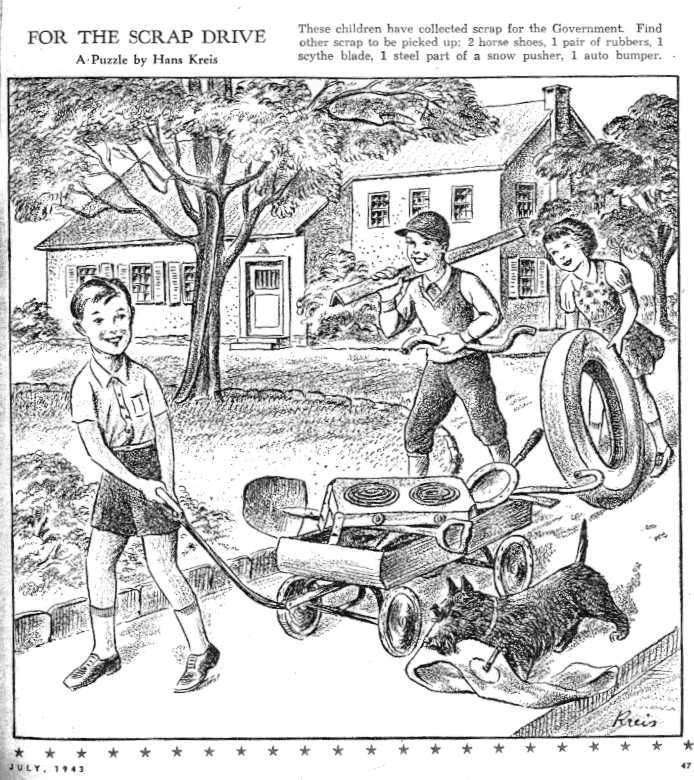
I used to love Hidden Object Puzzles when I was a kid.  They always came in some comic books, or kid's magazines like Highlights, Jack and Jill, or Children's Playmate, and in our Weekly Reader.  Thinking about this, I remembered I have a few issues of Child Life that were published during the war and sure enough, they all contained the Hidden Object Puzzle.  Here, then, are three puzzles for your solving enjoyment (click each one to enlarge it).

This one is pretty easy - from February 1943

This was a little harder - from January 1943
I found this one more difficult - from July 1943 (OK, I confess
this had me stumped for a long time)
To see posters Children's Book Week from1939 to 1945 see my previous post here

Thursday, February 21, 2013

Courage Has No Color: The True Story of the Triple Nickles by Tanya Lee Stone

I first heard about the Triple Nickles when I read the book Jump into the Sky by Shelly Pearsall, the story of a young African American boy whose father was a paratrooper in 555th Parachute Infantry Battalion, or the Triple Nickles.

Now, Tanya Lee Stone's Courage Has No Color tells the true story of the Triple Nickels, America's first and only all black unit of paratroopers in World War II.  She begins their story by describing in graphic detail what it feels like to jump out of an airplane and parachute back to earth, to give you an idea of the level of courage it takes to be a paratrooper.  It is not something I think I would want to ever do.    

From there she writes about the kind of treatment black soldiers received in the military: segregated and relegated to service work and treated like servants.  It was demeaning and demoralizing to the men who joined the military to fight for their country and freedom.  One man, Walter Morris, a first sergeant in charge of Service Company of The Parachute School, saw how being treated like servants was affecting the men serving under him.  Morris devised a plan to teach his men how to feel like soldiers again.  It was his plan to teach them what they needed to know to become paratroopers.  And so after the white serviceman were finished practicing for the day, and the black servicemen arrived to start cleaning up after them, they also began their training.  And someone noticed how well they learned what was needed to become a successful paratrooper.  Pretty soon, the First Lady Eleanor Roosevelt, long a proponent of equality, got into the act.

In 1941, The 99th Pursuit Squadron, or the Tuskegee Airmen, was formed and the men trained to be the country's first African American aviators.  And in 1943, these airmen were finally sent into combat overseas.   But the 555th Paratrooper Infantry Battalion was finally formed in February 1943.  Though trained as paratroopers, the Triple Nickles would never be used in combat, instead they were sent to Oregon to fight fires.  Turns out those fires were started by balloons sent over by Japan for that very purpose.

All of this and much more about the people and history of the 555th is detailed in Courage Has No Color, including an in-depth explanation of how they got their name - yes, there more to it than just 555.  It is a fascinating book covering this little known aspect of the United States military and World War II and an exceptional contribute to the history of African Americans in this country.

Stone has done an exemplary job of gathering primary source material, including interviews with some the of members of the 555th and lots of archival photographs, to bring to life the courage and heroism of these men and their accomplishments even against all odds.  Included is a very eyeopening timeline of the desegregation and the Triple Nickles,

Sadly, the United States Military was not desegregated until 1950.

This book is recommended for readers age 10+
This book was obtained from the publisher

Oh yes, remember that description of jumping out of an airplane I mentioned, well, you too can experience what it is like to be a paratrooper by reading it here.

A very useful teaching guide including Common Core connections, can be downloaded here.

Sunday, February 17, 2013

WOW! An Award and...


I would like to give a big Thank You to Barbara over at March House Books Blog for giving my blog this Very Inspiring Blogger Award.  Barbara, as you may or may not know, has one of the loveliest blogs on the block and I love visiting it and seeing all the wonderful images she post there from old books and postcards. 


Thank you so much, Barbara, I am delighted to accept this award.  

Of course, there are some conditions:

✔ Display the award logo on your blog.
✔ Link back to the person who nominated you.
✔ State 7 things about yourself.
✔ Nominate other bloggers for this award and link to them.
✔ Notify those bloggers of the nomination.

I have listed 7 things about myself so often, I have nothing to add, so here is a compilation from the past with updates:

1- I am ashamed to say that I have lived in New York City all my life and have never visited the UN, 
    the Statue of Liberty or taken the Circle Line, but I pass by them a lot.  This is sadly still true.
2- I love cats, but prefer black cats.  Alas, I no longer can have cats because of severe allegories.
3- I always wear my socks inside out because the seam at the toe annoys me so much.  Still true.
4- I collect snow globes.  I added two new ones this past year.
5- Snoopy has been my muse since I was 10 and I still have the first Snoopy that started it all (see
    photo below)
6- My favorite comfort food is still a peanut butter and jelly sandwich with a bowl of Campbell’s 
    chicken noodle soup.  Still true and something I eat a lot since Newtown.
7- I never eat dessert if it doesn’t have chocolate in or on it.  Still true.

My nominations:


Perogies & Gyoza

We Sat Down

Secrets & Sharing Soda


Original Snoopy 

Now for the bad news: not long ago I had an extensive email exchange with Joyce over at The 3 R's - Reading, 'Riting & Research about comment verification and I said I didn't use it because I didn't get much spam.  Well, the spammer gods must have heard me say that and wham! more comments from our old enemy Anonymous than ever.  Sooo...I am going to use word verification for a while, which means until it annoys me as much as the line in my socks (see above #3)

Friday, February 15, 2013

Passing through Havana: A Novel of a Wartime Girlhood in the Caribbean by Felicia Rosshandler

It is December 1939.  In a lavish apartment in Antwerp, Belgium,  9-year-old Claudia Rossin, along with her parents, relatives and others, are listening to a Polish refugee taking about the Nazi invasion of Poland and the horrors that they brought with them.  But Claudia doesn't fully understand the implications of Anton's story.  She is far too wrapped up in her unhappiness at being under the thumb of a detested French governess whose job it was to turn a very head-strong girl into a perfect social being.

And then in May 1940, despite Belgium's declarations of neutrality, the Nazis march in and before Claudia knows it, they are living under German occupation.  But Claudia's parents, Max, an insecure Polish businessman despite his success in business. and Suze, a socialite who knows and likes to entertain all the right people in her salons, remind blind to what is happening, despite being Jewish.

In October, racial standards and registration of all Jewish are imposed.  Suze goes to the Kommandant and manages to charm an extra two months out of him before they must register - two months to plot the family's escape.  And she does - charming the Salvadorian consul into signing questionable visas.

Armed with these questionable visas to El Salvador, the family travels in a first-class compartment of the Brussels-Paris Express.  But Paris that winter isn't wonderful and then, in June 1940, the Nazis arrive.  The family is ordered to leave France within 24 hours.  They head for Spain and board a boat heading to Havana, Cuba.  They have escaped in the nick of time - soon roundup and deportations of Jews would start in Belgium along with the rest of the Europe's Nazi occupied countries.

For Claudia, the two best things about Cuba are the warmth and no more French governess.  She is enrolled in a private Catholic school and, because of her blond hair and fair skin, accepted and welcomed by the other girls, never letting on that she is Jewish.

Away from the stresses of the war and the Nazis, life becomes more routine - school, parties, friends, fighting with her mother, trying to become a grown-up.  And after a few years, Claudia meets and finds herself attracted to a boy at a party.  Dieter Müller was born in Havana to German parents.  Claudia lets him believe she is also an Aryan German, born in Berlin: We are the perfect pair," he whispers to her.  Dieter is awed by the Hitler Youth, and Claudia tells him she used to dream about being picked to present flowers to the Führer.

On the surface, it does appear that Claudia and Dieter are the perfect pair, or are they?

Passing through Havana is an interesting look at the Jews who managed to escape to Cuba.  The novel is based on the author's real experiences as a young girl.  Claudia is a bit of a spoiled brat and Rosshandler's depiction of her conflicts with her mother and how they impact some of her youthful, rather defiant decisions are spot on.  But this is a coming of age novel, so it is a bit of a roller coaster ride towards maturity, as Claudia discovers who she is and begins to see reality without the romantically tinged rose-colored glasses of her pre-adolesence.

I really enjpyed reading about Cuba in the early 1940s and the experience of the Jewish community that formed among the refugees.  I don't know of many books about European Jews who fled to Cuba.  In 1939, only those with landing permits were allowed to disenbark in Cuba when the St. Louis arrived there.  The Rossins disembarked with the landing passes for El Salvador, with the intention of remaining in Cuba only until they could get to the United States - which finally happened after the war, hence the somewhat ironic title Passing through Havana.  Rosshandler also paints a very interesting picture of pre-Castro Havana among the upper class in her book.  Most of us don't remember that Cuba once had a striated society and there were some very wealthy, educated people as well as very poor.

Originally published in 1984, Passing through Havana is now being reissued as a Kindle book.

Passing through Havana should probably be read by more mature teens due to some sexual content.

This book is recommended for readers age 15+
This book was sent to me by the author

And in the spirit of Valentine's Day:
This book is autobiographical fiction - based on real life experiences.  Recently The Guardian ran an article about Felicia and a real teenage sweetheart - read how their story worked out over the years here

Teenage sweethearts Felicia and Edmundo Desnoes age 16
in Havana, Cuba

This is book 5 of my 2013 Historical Fiction Reading Challenge hosted by Historical Tapestry

Tuesday, February 12, 2013

His Name was Raoul Wallenberg - an interview with Louise Borden

Louise Borden author of His Name
was Raoul Wallenberg
Today I am very pleased and honored to welcome Louise Borden to Randomly Reading and The Children's War.  Louise and her book His Name was Raoul Wallenberg have been named winner of the 2013 Sydney Taylor Book Award for Older Readers by the Association of Jewish Libraries.  The Sydney Taylor Book Awards are given annually to those outstanding works that authentically portray the Jewish experience.

First, may I say congratulations on being given this award for writing such a fine biography of a real World War II hero.

Louise, can you tell us what being awarded the 2013 Sydney Taylor Book Award means to you?

It's quite an honor and was totally unexpected.  But I'm thrilled to think that other felt that my research and writing about Raoul was worthy of this wonderful award.  Awards are not my focus when I'm alone at my desk typing away but I think this one means that those on the committee believe in me and in the importance of Raoul Wallenberg's life story.  It is quite affirming and something I will carry into the future on the touch days when I'm staring down at a blank page.  Winning this award will not make writing easier but I'll think of my encouragers, and of Sydney Taylor, cheering me on.

First, may I say congratulations on being given this award for writing such a fine biography of a real World War II hero.

You have written on a variety of subjects, but you keep returning to stories about World War II in both fiction and non-fiction - The Little Ships, Across the Blue Pacific, The Greatest Skating Race, The Journey that Saved Curious George, and now His Name was Raoul Wallenberg.  Can you tell us what inspired you to write about Raoul Wallenberg?

I'd never heard of Raoul Wallenberg even though I studied history in college.  It wasn't until the 1980s that I read about him, and the mystery of his disappearance.  I was drawn to his character, his moral compass, his Swedish background, and his American education in architecture.  I'm not Jewish but I've read about the Holocaust and care deeply that we must always remember those who were lost and educate future generations.  I didn't know much about the events in Hungary until I started on my long path of research.  I hope that young readers will find Raoul Wallenberg's story and his actions (and those of other brave diplomats in Budapest) as compelling as I did.  Raoul and his colleagues are my life heroes.  What if they had stood by and done nothing during those dark days?

I know you have written books in free verse before, and it seems to be a form that is becoming more and more popular in both fiction and non-fiction.  Yet, when I read Raoul Wallenberg's story I was amazed at how much information you were able to convey without resorting to prose.  Can you tell us what prompted you to chose this form over prose?

All of my books are written in this style.  Sea Clocks and The Journey that Saved Curious George were subjects that also involved gathering a lot of complicated information and then making events and places and people accessible to today's young readers.  It took me two years to write the text about Raoul Wallenberg, shaping the structure and doing constant revision.  I wanted the power of his story to shine through and not have my readers get lost in dense paragraphs of dry writing.

I know historical fiction and non-fiction require a lot of research.  Could you tell us a little about the research process you used and any challenges you faced while writing His Name was Raoul Wallenberg?

His life is a complex story with an unknown ending, clouded by contradictions.  First I had to immerse myself in reading deeply and widely, sifting through inaccuracies that have been stated in various books  over the years.  I tried to use primary sources whenever possible.  Meeting with his family was very important, hearing their voices and recollections.  I went to Stockholm three times and Budapest twice - on my own nickel and perseverance.  That was a financial challenge!  The Wallenberg story was my "beautiful obsession".   You have to have a deep commitment to last through years of research.  I had three editors...so the book's structure changed and evolved.  I began these steps before Google was such a helpful presence to researchers.  Attending a Raoul Wallenberg Symposium in Budapest was also very helpful.  Andy Nagy helped me translate sections of some Hungarian books.  Gathering the photos was a challenge.  I think that this book contains more photos than any other book about Raoul Wallenberg.  I wanted kids to know that the players in the story looked like, and what the places looked like.  To them, World War II was lived in black and white...I want them to know that it was lived in color.

After reading His Name was Raoul Wallenberg, the thing that struck me the most was how you presented him as a real person and not just another distant historical figure.  For example, I love that you included information about Raoul's childhood and teen years.  The class picture you open with is priceless, as is the invitation to readers to also become a storyteller of his life.  As storytellers, what do you hope your young readers will take away from this book?

When I saw the school photo (that had never before appeared in a book). I knew that it was the key to finding the right place to begin such a complicated story.  Finding the right voice is always my quest.  I hoped that this photo )and that signature) would bring kinds immediately into Raoul's life.   I try to choose the most essential details - the ones that will connect with kids.  I gathered these from interviews regarding his childhood and teen years.  I'm 63 years old.  Young readers have much longer lives ahead of them.  I want them to be inspired by this man and by his character and actions.  I want kids to know that they too can make a positive difference in the world.  I want them to find their own heroes.  And I want readers to remember Raoul Wallenberg and to carry his story into their own futures.  We are all storytellers - kids will remember a great story and I hope they will tell others and use its power for good in their own lives.

Raoul Wallenberg's Class Picture @1921

One of the topics of WW2 that I have always hoped to see a kids book about are the Jewish Partisans, like the Bielski Partisans.  That being said, what particular ideas set the writing process in motion for you?  Do you have a current writing project and is there any future project of a historical nature that you would like to write about?

I've had about 26 books published.  More are fiction than nonfiction.  But in most I tend to focus on ordinary characters who do extraordinary things.  Courage, friendship, helping others, heroes, changing the world in a wonderful way - you will find these in the pages of my books.  I write about people who inspire me.

The Greatest Skating Race was entirely fictional but rooted in an authentic setting.  I wanted to write about that part of the world in wartime.  I wrote the fictional The Little Ships because I found the event of the Dunkirk rescue so dramatic.  When a person or place or event calls to me in a deep way, that is when I embark on writing about it - either fictionally or via nonfiction.  Along the way, I have met amazing people, and through my books I have made lifelong friends in other countries.  I've just finished a fictional book set in Italy during WW2.  And I went to France last September to see some places I've been researching for two years - another WW2 story.  Both of these books are, again, about the courage of ordinary people.  Long ago in college my senior research project focused on the European Response to Hitler/Resistance movements in WW2 in France, Holland, Denmark and Germany.  I'm sure your interest in the Bielski Partisans is founded in part on their extraordinary courage.  World War 2 affected millions upon millions.  Each had their own individual story.  Perhaps that is why you and I both find this tragic time so compelling.
When I finish my work-in-progress French story, I have yet another idea I am pursuing via research.  I gather books, etc and they sit on the back of my writing stove.  Then when I'm ready, I start a project.  I intersperse my WW2 books with books for younger kids.  Kindergarten Luck is such a book, that will be published by Chronicle.  Baseball is...will be published by S&S next year.

Thank you so much, Louise, for taking the time to visit Randomly Reading and for all the insights you have given us into your writing process.  I wish you all the best in the future.

This interview also appears on my other blog Randomly Reading

Please be sure to visit these other stops on the 2013 Sydney Taylor Book Award blog tour:

MONDAY, FEBRUARY 11, 2013

Ann Redisch Stampler, author of The Wooden Sword
Sydney Taylor Honor Award winner in the Older Readers Category
At Shelf-Employed 

Carol Liddiment, illustrator of The Wooden Sword
Sydney Taylor Honor Award winner in the Older Readers Category
At Ann Koffsky’s Blog 

Doreen Rappaport, author of Beyond Courage: The Untold Story of Jewish Resistance During the Holocaust
Sydney Taylor Honor Award in the Teen Readers Category
At Bildungsroman

TUESDAY, FEBRUARY 12, 2013

Linda Glaser, author of Hannah’s Way
Sydney Taylor Book Award winner in the Younger Readers Category
At This Messy Life 

Adam Gustavson, illustrator of Hannah’s Way
Sydney Taylor Book Award winner in the Younger ReadersCategory
At Here in HP 

Louise Borden, author of His Name was Raoul Wallenberg
Sydney Taylor Book Award winner in the Older Readers Category
At Randomly Reading 

Deborah Heiligman, author of Intentions
Sydney Taylor Book Award winner in the Teen Readers Category
At The Fourth Musketeer 

WEDNESDAY, FEBRUARY 13, 2013 

Sheri Sinykin, author of Zayde Comes to Live
Sydney Taylor Honor Award in the Younger Readers Category
At Read, Write, Repeat 

Kristina Swarner, illustrator of Zayde Comes to Live
Sydney Taylor Honor Award in the Younger Readers Category
At Reading and Writing

THURSDAY, FEBRUARY 14, 2013

Linda Leopold Strauss, author of The Elijah Door
Sydney Taylor Honor Award in the Younger Readers Category
At Pen and Pros 

Alexi Natchev, illustrator of The Elijah Door
Sydney Taylor Honor Award in the Younger Readers Category
At Madelyn Rosenberg’s Virtual Living Room 

FRIDAY, FEBRUARY 15, 2013

Blog Tour Wrap-Up at The Whole Megillah 

Visit The Association of Jewish Libraries blog and the official Sydney Taylor site