Showing posts with label WASPs. Show all posts

Monday, December 6, 2021

The Fearless Flights of Hazel Ying Lee by Julie Leung, illustrated by Julie Kwon


The Fearless Flights of Hazel Ying Lee
written by Julie Leung, illustrated by Julie Kwon
Little, Brown BFYR, 2021, 48 pages

Picture books biographies are such a wonderful way to introduce young readers to heroes they might otherwise never hear about, particularly America's diverse heroes. I recently introduced some young readers to this excellent picture book biography about Chinese American pilot Hazel Ying Lee, who found her story interesting and inspiring, sparking a conversation about finding and following one's passion.

Hazel was fearless as a young girl, and loved speed. She would run so fast it was like her feet never touched the ground, and she would always leave her brothers in the dust. Airplanes were a relatively new thing when Hazel was growing up, but whenever she saw a plane in the sky, she wondered what it would be like to be so fast and high off the ground.  

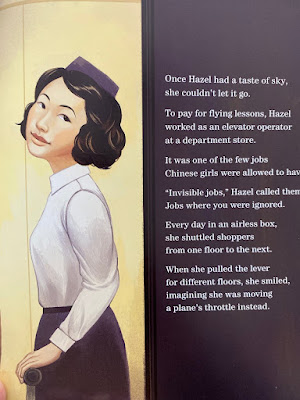
When she got older, Hazel finally got a chance to fly in an airplane, and knew she had found her passion. Although her family wasn't too happy about Hazel's decision to become a pilot, they ultimately accepted it. Unfortunately, people who were Chinese were discriminated against and weren't allowed to go anywhere they wanted, nor were they allowed to hold good paying jobs. Undaunted, Hazel worked as an elevator operator to pay for flying lessons.

And learn to fly is exactly what Hazel did. But no matter how good she was as a pilot, who would hire a Chinese girl? No one until 1941, when the Japanese bombed Pearl Harbor and the United States entered World War II. 

Now that all the country's male pilots were needed to fight, creating a home front pilot shortage, the military developed a program to train women called the Women Airforce Service Pilots or WASPs for short. And Hazel signed up immediately. Here she would test planes right off the assembly line to discover any defects in them, a dangerous task at best, but nothing mattered to Hazel except flying high in the sky and pushing her plane to go faster.

Sadly, in November 1944, a miscommunication caused Hazel's plane to collide with another plane. She died two days later. And when her family and fellow pilots wanted to honor her, they discovered that WASPs were considered to be civilians and Hazel received no military recognition. And despite being a hero, Hazel wasn't allowed to be buried in the whites-only cemetery her family chose in Portland, Oregon.

Writing a protest letter to Franklin Roosevelt about the treatment of heroes like Hazel, the Lee family ultimately won the right to bury her and her brother Victor, who died in combat around the same time Hazel died, in the cemetery, choosing the perfect place for her to be laid to rest - on the hillside with a clear view of the sky.

In this well written, well researched picture book biography, Leung highlights Hazel's passion for speed and flying without watering down the racial discrimination that Chinese people faced everyday and Hazel's determination to not let these things stop her. Julie Kwon's digitally created illustrations are, as you can see, clear, colorful and detailed. Back matter includes an Author's Note about Hazel's life and how she discovered Hazel's story. There are also resources for learning more about Hazel, including book, documentaries, websites, and museums. 

After I read Hazel's story to  a group of diverse 7-year-olds, it really generated some eye-opening conversation, all agreeing, in the end, that Hazel is an inspiration for all Americans. I think this really points to the importance of all people learning their histories in America and how they contributed to making this country what it is today.

This book is recommended for readers age 6+
This book was purchased for my personal library 

Sunday, January 7, 2018

Seized by the Sun: The Life and Disappearance of World War II Pilot Gertrude Tompkins by James W. Ure

It would seem that having been born in to a well-to-do New Jersey family, Gertrude Tompkins’ life should have been a happy one, free from care and stress. The third daughter of Vreeland and Laura Tompkins, right from the start, Gertrude stuttered just like her father. Vreeland dragged her to doctors throughout her childhood, trying all kinds of supposed cures for stuttering, and naturally, none worked except to make Gertrude miserable. School was especially difficult for her, and she made up excuses not to go whenever possible, finding solace in books and reading instead. 

After high school, Gertrude attended the Pennsylvania School of Horticulture for Women, where, though still feeling like an outsider, she found more acceptance than she had in her earlier school days. After graduating, Gertrude traveled abroad extensively, but returning home found herself feeling closed in and eventually moved into her own place in Greenwich Village, commuting to work in her father’s company in New Jersey everyday. 

During that time, Gertrude met Mike Kolendorski, a pilot in Eagle Squadron 71, and it was most likely Mike who introduced her to flying. After he left to fly for England, she began taking flying lessons, so when the United States entered WWII in 1941, and Gertrude learned that women pilots were needed to replace men now in service, she put in her application to become a part of the newly formed WASPs (Women’s Airforce Service Pilots).

It is speculated that Mike Kolendorski was the love of Gertrude’s life, but even her sister Elizabeth didn’t know for certain that this was true (Kolendorski was killed on a flying mission in 1941). Interviews with Gertrude’s fellow WASPs and friends yielded some information, and it was made very clear that she loved flying. 

At this point, the book not only explores Gertrude’s life in the WASPs, but also gives an in-depth history of how the WASPs began and it troubled existence. Gertrude was apparently a very private person, considering how little is known about her life. 

The book does do a great job of piecing together the life of Gertrude Tompkins. She apparently was a very private person, considering how little is known about her life, even by her sisters. It also does a great job giving a detailed account of the WASP and especially the poor treatment the women received from the men pilots and those in charge. There simply were no benefits for these courageous women who put their lives on the line in service to their country. They were forced to pay for everything they needed, while men were provided for, and they were also used to fly planes dragging a banner that was used for target practice with live ammunition and no health, medical, or death benefits if they are hurt or killed. Still, Gertrude and her fellow WASPs loved flying.

As the war began to turn in favor of the allies, and it looked like the end was coming, Ure speculates the Gertrude must have wondered what she was going to do afterwards. When a marriage proposal came from an old friend, Henry Silver, she reluctantly and unhappily accepted, mainly to please her father. Not long after, Gertrude disappeared shortly before taking off in a plane near Santa Monica Bay, California. Neither she nor her plane were ever found and what happened remains a mystery to this day.

I’ve read a number of fictional accounts of women who were WASPs during the war, (Flygirl, Velva Jean Learns to Fly, and Becoming Clementine) and I found that these fictional accounts about life as a female pilot corresponded really well with Ure’s factual information. I also thought he did a great job describing Gertrude’s life, though there was a lot of speculation wherever there were gaps. A number of searches for Gertrude have taken place, but to no avail and Ure theorizes on the possibilities of why nothing was ever found.

Do read Ure’s Afterword to discover how the book was put together. Additional back matter includes a list of Gertrude’s personal effects found in various footlockers and quarters, a Tribute to WASPs Killed in Service, detailed Notes, and an extensive Bibliography. 

This book is recommended for readers age 12+
This book was an EARC received from Edelweiss+

Wednesday, September 26, 2012

Becoming Clementine by Jennifer Niven

It has been almost a year since I reviewed Velva Jean Learns to Fly by Jennifer Niven.  As you may recall, Velva Jean married at 16, learned to drive and at 18, drove from North Carolina to Nashville by herself, leaving her husband and hoping to a sing at the Grand Ol' Opry.  Talk about coming of age.

But then World War II began and VelvaJean found herself in the WASP Program (Women's Airforce Service Pilots.)  Now, in Becoming Clementine, it is June 16, 1944, Velva Jean is 21 and a seasoned pilot.  So seasoned that she has just become the first woman to fly a B-17 Flying Fortress across the Atlantic Ocean to Preswick Airfield, Scotland.  Proud of her accomplishment, she also has an ulterior motive for accepting this challenge - her beloved brother Johnny Clay, a paratrooper, hasn't been heard from since October 18, 1943 and Velva Jean is on a personal mission to find him.

As luck would have it, Preswick has been short of pilots since D-Day, less than two weeks earlier and Velva Jean decides getting to Europe would be the best way to find Johnny Clay, so she convinces all relevant authorities to let her copilot a mission to France.  On July 13, she gets orders to fly to Roun, dropping supplies and a team of OSS agents and returning immediately to base.

Naturally, over France, the plane is hit by enemy ground fire and badly damaged though still flying.  Then, when they finally find the place to make their drop, they realize it has been compromised by Germans.  In an attempt to avoid them and singing "My Darling Clementine" to keep herself calm, the plane nevertheless crashes. Velva Jean's flight crew is killed.  The team of five she was to drop does survive, but, angry and disgusted, they want to leave Velva Jean behind and try to find their own way.

Well, they may have wanted to leave Velva Jean, but she was a woman with a mission and a strong will.  Eventually, the survivors meet up with a member of the resistance and that begins their journey through occupied France with the aid of the Underground, eventually ending in Paris.  Through all this, Velva Jean finds herself more and more attracted to the leader of the OSS team, Émile Gravais and eventually this becomes a mutual attraction.

In Paris, Velva Jean is given a new identity, Clementine Roux, an American who married a Frenchman, unable to return to the US after the war began and her husband was killed.  Now, she is pulled into the mission Gravais and his team are to accomplish - rescuing an important agent code-named Swan being held in a woman's prison in Paris.

Velva Jean alias Clementine's new mission: get herself picked up and sent to the same prison.  Is that what happens?  No, it isn't.  And don't think for a moment she has forgotten about Johnny Clay.

One of the things I found very interesting in Becoming Clementine was how difficult it was for Velva Jean to embrace her new identity as Clementine Roux.  It is a testament to her strong sense of who she is that made Velva Jean want to keep surfacing, even in the face of danger.

I did feel that some of the technical bits about planes and things like that could have used some editing, mostly because I have no idea what I was reading about.  Confession: I thought skipping those bits but actually read on, all the while realizing that my fear of flying was getting the best of me and that some readers would find this fascinating.

Becoming Clementine has something for everyone: excitement, espionage, romance (but not much sex, none explicit), action, but it also has violence, lots of it and cursing, lots of that, so be warned.  It is a gritty, fact-paced novel but I felt it may still have the same level of YA appeal that Velva Jean Learns to Fly had even since it is still a coming of age story of sorts.  After all she had been through, it was hard to realize the Velva Jean is only 22 by the end of this novel.

And yes, there will be a fourth Velva Jean novel in autumn 2013.

This book is recommended for readers age 18+ and sophisticated teens with an interest in WWII
This book was received as an E-ARC from Plume Paperback through Edelweiss

For another review of Becoming Clementine at So Much So Many So Few, followed by a wonderful interview with the author Jennifer Niven

This is book 13 of my Historical Fiction Reading Challenge hosted by Historical Tapestry.

Wednesday, August 1, 2012

Flygirl by Sherri L. Smith

More than anything else in the world, Ida Mae Jones, 18, wants to fly, but she can't.  Not because she doesn't know how, oh no, Ida Mae knows how to fly.  Her father had taught her how to fly his crop dusting plande long ago.  She can't fly because she doesn't have a license and even though she did everything correctly during her flying test, the instructor refused to pass her on principle - she was a woman.  But then the US enters World War II and for Ida Mae there will be no more flying even without a license with gas rationing.

But a new flying possibility opens up in 1943, when her younger brother Abel brings home an ad for female pilots in the new WASP (Women's Airforce Service Pilots) program headed up by Jackie Cochran.  Ida Mae gets very excited until she realizes two obstacles to joining the WASP program - she still doesn't have a license and she is black and the program was only open to white women.

Ida Mae was pretty determined, though.  For one thing, she was so fair that she could pass for white, though she had always chosen not to because it meant cutting herself off from friends and family completely.   As for her license, well, Ida Mae was lucky enough to be named after her father, Iden Mahé, so it was a simple matter of changing the name on his license and replacing his photo with one of her own.

And it worked - Ida Mae Jones was accepted into the WASP program in Sweetwater, Texas much to the chagrin of her mother at first.  But Ida Mae travels to Texas and begins her training.  And she discovers that passing is harder work than learning to fly all those big planes needed for war.  She also makes two close friends, Lily and Patsy, who never suspect anything about Ida Mae other than what she presents herself as and with whom she has lots of adventures and lots of fun while becoming a WASP (was irony in that sentence.)  But unfortunately passing also means that people talk freely in her presence and that includes their attitudes towards blacks.  And there is the intimation of a little romance with one of the pilots.

Much of the book focuses on Ida Mae's training and life in the WASP, but Smith gives the reader enough time with her family and friends from home to make us very sympathetic to what they must have felt when Ida Mae chose to turn her back on them in order to fly.  And by the same token, we really are made to understand what her choice cost Ida Mae herself.  And in the end we hare left asking the question if you deny who you truly, are can you be truly happy?  It is for the reader to decide after reading Flygirl.

Passing is not a very common theme in YA literature.  And in her Author's Notes, Smith writes that it is not known how many women in the WASPs may have passed for white in order to fly the way Ida Mae did.  There were certainly black woman like Bessie Coleman who were passionate about flying, but not many would be fair enough to pass and perhaps ever fewer would want to.  My heart went out to Ida Mae, she was such a sweet, likable character, but she clearly didn't realize what she was giving up.  Any my heart went out to her family and her best friend and supporter Jolene and what they lost with Ida Mae's decision.

Smith has written a story that will give the reader plenty of food for thought about what identity really is and can you successfully and satisfyingly alter who your are.  And as far as the WASP is concerned, she has done her job and carefully researched it so that Flygirl is an excellent example of historical fiction.

This book is recommended for readers 12+
This book was borrowed from the Webster Branch of the NYPL

A very helpful discussion guide for Flygirl is available here

For information on the WASP Program in WWII, including a biography of Jackie Cochran, please visit the National WASP World War II Museum

This is book 9 of my Historical Fiction Reading Challenge hosted by Historical Tapestry