Monday, July 30, 2012

The Good Liar by Gregory Maguire

The Good Liar begins in the present when three young girls are studying World War II in school and their assignment is to speak to someone who had lived through it.  They see an artist, Marcel Delarue, interviewed on TV and write him to ask if he would answer their questions since he lived through the war in France, only a child of 8 when Paris fell to the Nazis in 1940.  Marcel very graciously responds to their request, and begins writing a series of vignettes resembling the landscapes he paints.

Marcel, and his older brothers Pierre and René, lived in a small village with only their mother, their papa is away working.  The boys are really rambunctious and considered themselves to be quite good liars.  Lying was a contest with them to see who could come up with the best liar in a give situation.  They would lie to anyone about anything, sometimes doing it just for the sake of lying.

The war still feels very far from their small village of Mont-Saint-Martin when they receive a letter from Uncle Anton in Paris saying that the German soldiers are on their way and that he and friends might be need to stay with them awhile.  But in fact German soldiers show up in their village before Uncle Anton, two coming to the Delarue's door one day asking for help.  But the boy's mother is home and they lie and say she is in Chinon, taking caring of her mother.

By now, France had fallen and the north was occupied by German, even in Mont-Saint-Martin, but life went on as usual, except that there was never enough to eat unless you were a German soldier.  And finally in September 1941, Uncle Anton arrived along with his friend Madame Cauverian and her daughter Miriam.  Mother and daughter were Jews and life in France was not long safe for them, so the plan was to stay a week with the Delarues and then escape from France over Pyrénées into Spain and safety.  But Miriam became ill and the stay was prolonged.  Meanwhile, the boys beloved dog, Mirabeau went missing.

One morning, Marcel and René are sent one a mission to get some honey from an old farmer.  The trip on foot was long and when they got there, the farmer kept them all day long, so that by the time they returned home they discovered that the guests were gone, rounded up with the other village Jews to be interned.  Marcel and René were both angry that only Pierre has been home to say goodbye.  And sometime during that winter of 1941/42, Pierre stopped lying.

Since Pierre was no longer a playmate, that summer Marcel and René found themselves spending their days fishing and swimming in the company of one of the German soldiers who had come to the door.  Basically, just a young boy himself, the German taught them not just how to cast their fishing lines but provided lunch as well.  All was idyllic until Marcel fell out of a tree, injuring himself and the German took him home, running all the way.

It was then that the reason for the change in Pierre became apparent.  And it becomes clear why their otherwise careful, quiet mother had verbally attacked some German soldiers after the Jews in the village had been rounded up.  And it becomes evident who the best liar among the Delarues turns out to be.

And it is not who you would ever expect.

I read The Good Liar in one sitting because I could put it down.  It is a wonderful multi-layered middle grade book, ideal for introducing young readers to the events of World War II.  The characters are well-rounded and in many ways unique.  Marcel is quite artistic and gives the reader a most picturesque impression of the war and though he doesn't leave out the hunger, the cold, the danger and the round ups of Jews, each vignette carries an almost halcyon feeling, just like the pictures he painted of trees and bridges in his painting.  I kept wondering why he was doing this, until I got to the end.

Ironically, in the end, though, this small novel is a book about master liars is a book about truth.

This book is recommended for readers age 9+
This book was borrowed from the Webster Branch of the NYPL

You can find a very nice teaching guide for The Good Liar here.

Saturday, July 28, 2012

Weekend Cooking #21: Victory through Doughnuts


I read this 1944 book called Kitty Carter, Canteen Girl last week.  It's a novel about a young woman who joins the Red Cross Canteen Corps in World War II in her hometown.  It wasn't the best book I've ever read, but it did get me to thinking about how the Red Cross is always there for people whenever and wherever they are needed.

And they were certainly there in World War II providing the men and women in the Armed Forces with so many of the things they needed.  For example...

No sooner had the US entered the war and American soldiers were unfortunately sometimes taken prisoner.  In 1942, the Red Cross vowed to send one care package per week to every American POW.  In the first year of the war, they actually shipped out more that 1,000,000 care packages to the POWs.

That same year, the Red Cross collected over 1,000,000pints of blood and were asked if they could collect at least 4,000,000 in 1943.  I have no doubt they succeeded.

in the US, and later in Britain, the Red Cross opened and maintained clubs where soldiers could go to relax, have some refreshments, play some games, dance a little and chat with other soldiers and the volunteers.  These same volunteers would faithfully meet troop trains with coffee, sandwiches and doughnuts whenever they stopped at a railway station.

Clubs were so successful, that in 1942, the Red Cross introduced the clubmobile, a mobile canteen, for the servicemen and women stationed in Britain and coffee and doughnuts were always available.


Clubmobiles were important and very welcome throughout the war, especially at the front.  In fact, by July 1944, shortly after the Normandy Invasion, there were already 16 clubmobiles right on the beachhead serving coffee and doughnuts to tired, weary servicemen and plans for more.

Not surprisingly, by October 1944, there were a total of 84 clubmibiles close to the front lines, serving an average of 100,000 cups of coffee and 150,000 doughnuts every day.  The women volunteers who ran these clubs had to sleep in bedrolls underneath their vehicles at night.   

So, were the doughnuts really so good or was it the company that made them taste that way?  Now you can be the judge...

Red Cross Doughnuts

1 1/2 cups sifted flour
1/4    tsp    baking soda
1/4    tsp    salt
1/4    tsp    butter or substitute, melted
1/4    tsp    ginger
1/4    cup   molasses
1/4/   cup   sour milk (buttermilk)
1       egg   well beaten

Combine half of the flour with the soda, salt and ginger.
Combine the egg, molasses, sour milk and melted butter or substitute.
Blend with flour mixture and stir until thoroughly mixed and smooth.
Add remaining flour to make dough of sufficient to be rolled.
Roll, on floured board, to thickness of 1/4 inch.
Cut with a donut cutter.
Fry in deep hot fat (360 degrees) until lightly browned, about 2 03 three minutes.
Drain on brown paper.


This recipe came from the online American Red Cross Museum, which you may want to visit to learn more about what the Red Cross did in WWII.  And just in case these doughnuts put you in a party mood, there are also detailed instructions for having a Red Cross Canteen Party.

And Better Late Than Never...
On May 23, 2012, the Senate passed Resolution 471 "commending the efforts of the women of the American Red Cross Clubmobiles for exemplary service during the Second World War."

Weekend Cooking is a weekly event hosted by Beth Fish Reads


Wednesday, July 25, 2012

From the Archives #20: Kitty Carter, Canteen Girl by Ruby Lorraine Radford

Last year, I reviewed Pamela G by Florence Gunby Hadath about a English schoolgirl, her friends and the mobile canteen they drive around the countryside providing hot tea, sandwiches biscuits and whatever else was needed by the soldiers who were practicing maneuvers in the area before shipping out.

Once the US entered WWII, canteens were set up all over the country to do basically the same thing - provide coffee, sandwiches and, of course, the famous Red Cross donuts.  Working in the canteen was one of the ways that girls and women could do their bit for the war.  And that is exactly was Kitty Carter discovers when she meet a handsome young sailor, Brad Mason, at a Community Chest drive picnic on Palmetto Island in the beginning of Kitty Carter, Canteen Girl.

Kitty had wanted to join the WAVES, but if she did there would be no one to look at her brother Billy, 6, not with her father in the Navy and her mother already dead.  Canteen service, Brad explains, is perfect for just that kind of situation.  It is what his younger sister is doing while in junior college.  He immediately introduces Kitty Mrs. Pearson, in charge of canteen training and luckily, a new class is starting at the beginning of the next week.

No sooner does Kitty finished her weeks long Red Cross training and she is thrown into an emergency.  A big fire at the island's fish cannery and lots of now homeless people to care for.  But both Kitty and Brad think this was not an accidental fire and they decide to investigate.  After all, someone saw a dark figure running away from the scene the same night that Kitty and Brad witnessed a sailor's shoe spontaneously catch fire from a stray cigar ash, as though it has accelerants on it.

More strange events follow on the heels of this, and before long Kitty and Brad are totally convinced that there is something going on that involves some of the Navy people working in the Naval hospital on the island.  This also happens to be where Kitty's father is stationed as the hospital's Chief Pharmacist's Mate.  The hospital is the center of life on the island.

Naturally, Kitty's canteen duties help advance the investigation, even if they don't know what they are looking for exactly.  But Kitty's suspicions increase when she notices an officer playing chess with enlisted men - rank is important in the Navy and this just isn't done.

Eventually, Brad and Kitty begin to suspect that someone is sneaking supplies to German submarines not far from shore when bread from a local bakery is found in a captured sub.  This suspicion is reinforced when they take Billy in a picnic to Terrapin Island and he finds a constructed lookout in the tallest tree facing the ocean.

Later, the plot thickens even more when a troop train passes through while Kitty is on canteen duty.  A soldier wants to know if anyone knows Terrapin Island and Kitty responds yes.  He has money from the island's owner for the 100 year old black man, Uncle Mose, who has been living there his entire life, having been born there when the large island home was a plantation.  Kitty gets the owner's name and address, so she can write and tell him that Uncle Mose has been moved to a dreadful hut on the island after the owner rented the island to a Mr. Beeson, a very nasty piece of work, instead of the nice home he was supposed to be living in.

Things are almost put on hold when Billy gets seriously ill, but when she confesses her suspicions to her father at Billy's bedside and mentions Beeson, who comes to the hospital to pick up food scraps for his pigs, her dad thinks she may actually be on to something.  Mind you, she and Brad still don't know what they are investigating.

Well, one hurricane later and the mystery is solved.  It seems the chess playing officer was playing chess to keep the Chief Commissary Steward (or cook) away from the hospital kitchen.  That way, an enlisted sailor name Punaro could sneak supplies, food and medical items, out to Beeson, on the excuse of picking up his,, pig food.  Beeson would take the supplies to Terrapin Island and watch for the Nazi subs.  And it turns out that Kitty's father is actually stationed there to investigate this mystery of the disappearing supplies, as is a Nurse Dawson, whose brother had left the post of Chief Pharmacist's Mate in disgrace when he was supposedly unable to find out who was behind the thefts.

Not only does everything end well, but love is in the air, too.   Mr. Carter and Nurse Dawson become more than just colleagues, they were planning on getting married.  And of course, that is what is implied about Brad and Kitty.

Kitty Carter, Canteen Girl was a lot of fun to read because it was the same kind of benign mystery that you find in Nancy Drew books, where no ones life is ever in real danger, but there is enough excitement to hold you attention.  And despite it focusing on the mystery, there is a lot of information about what it was like to be a canteen girl.  It must have been a very welcoming sight to members of the armed forces to be greeted at every train stop with hot coffee and fresh food.  And to know that their USOs would always be a welcome respite for them.

Kitty Carter, Canteen Girl was part of a series of eight book published around 1943/44 by Whitman Publishing Company as part of their "Fighters for Freedom" series.  The writing in these novels is far from wonderful and the plots tend to be a little thin, but their real purpose was, of course, as propaganda pieces.  Still,  they are worth reading even now if only to see how a wartime mentality was created and maintained for boys and girls in WWII.

On the other hand, the Red Cross still does the important work of helping people whenever they are needed.

Sunday, July 22, 2012

Sunday Funnies #8: Calling All Girls

People always ask me if I collect WWII memorabilia/paraphernalia.  The answer is no, the only things I do own from that time are books and some magazines and they were originally purchased for a reason other than this blog.  I really only needed them for reading purposes, not as collector's items.  So, for example, I paid a mere $3.00 for this copy of Nurse Merton, Desert Captive because I needed it and didn't care that it was an old library copy that had not cover and was missing some front pages.

Nurse Merton, Desert Captive
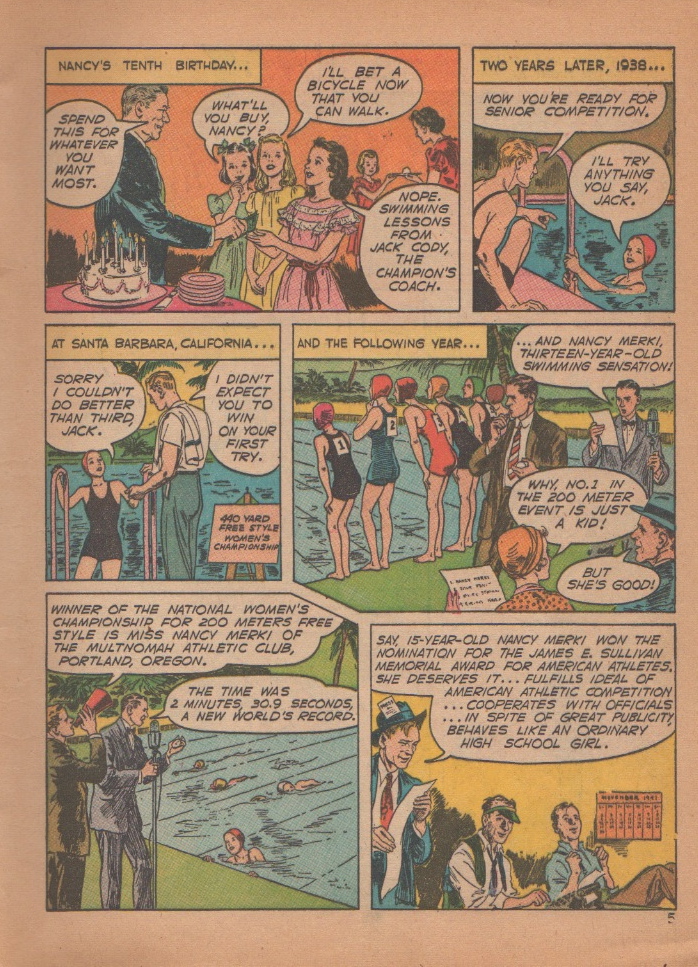
I also have a bunch of magazines for kids from that time and among them are some original issues of a magazine called Calling All Girls.

In July1941, the Parent's Magazine Institute began Calling All Girls for younger teenage girls.  Published on a monthly basis, each issue consisted of comics, fashion (but more along the lines of either sew it yourself or make do and update what you already own kind, not the buy-new-stuff kind of fashion,) stories and other articles that would be of interest to girls.

The United States didn't enter the war until December 1941 and it took Calling All Girls until sometime in 1942 to catch up with current events, but when it did, its pages were filled with war related articles, stories and comics.  Unlike those found in comic books or comic strips in the newspapers, the comics in Calling All Girls were always about girls or women and were designed to be informative.   I thought this one from July 1942 about infantile paralysis or polio was particularly good example of the type of comics found in this magazine.  It was both timely and interesting, since here had been polio epidemics in the 1930s and the 1940s, the March of Dimes had also been founded in 1935 and our wartime President Roosevelt was himself a victim of polio.
(Press images to make them larger)


By the way, Joyce Moyer Hostetter has written a wonderful novel about polio during the war called Blue (my review here) which you might also enjoy reading.


Thursday, July 19, 2012

Shadow on the Mountain by Margi Preus

Margi Preus has written lots of books for young people, including the Heart of a Samurai, a 2011 Newbery Honor Award winner.  This fall she has another wonderful book coming out about a young boys participation in the Norwegian Resistance in World War II.
Shadow on the Mountain begins in October 1940, five months after the German invasion and occupation of Denmark and Norway on April 19, 1940 and finishes just before the war ends.  It is written from the perspective of Espen, 14, his younger sister Ingrid, his former best friend Kjell and his newest enemy Askel.

While riding his bike one evening, Espen is stopped by a car full of Nazis. As they search his rucksack, Espen notices that Kjell is sitting in the car and wonders why.  Eventually, the soldiers let him go on his way, believing he is on his way to visit his uncle.  In reality, Espen is carrying coded information for the Norwegian Resistance, his first task as part of this group.  After successfully delivering his information, he receives his code name - Odin, after the Norse god.  And so begins Espen's new life as a boy to the world, an operative to the Resistance.

Ingrid has been keeping a diary of the events going on in her village since the Nazis arrival, even though it is illegal to write or read anything against the regime.  But Ingrid has also stolen some ration cards and uses them to help feed some of the starving prisoners held by the Germans.

Kjell denies having been in the German car when Espen was stopped, but seems to have sympathetic leanings towards the Nazis.  Or does he really?  Well, suddenly his grandmother has no trouble getting the medication she needs so badly despite shortages.

But there is no doubt that the naturally mean-spirited Askel is completely sympathetic to the Nazis and that he hates Espen, especially after the joke he played on him during a soccer game.  Now his goal is to move up the ranks with the Nazis and to catch Espen at the illegal activities Askel suspects him of taking part in.

The novel runs until the end of the war and follows the lives and activities of each of these characters, though it is Espen who is the novel's main protagonist.  Preus has set the tension bar quite high and succeeded in producing a well researched, well documented work of historical fiction that had me on the edge of my seat in a number of places.  Each passing year is introduced with a quote relevant to the situation in Norway, by either a Nazi or an anti-Nazi Norwegian and is followed they the activities of each of the four characters.

I read an uncorrected proof of Shadow on the Mountain, but when it is published in September 2012 it will be chock full of relevant photos, maps and other bit of archival information and I can't wait to see them.  There is also pronunciation guide for Norwegian names and words, followed by a brief history of the Germans in Norway in WWII and, because more Norwegians were not sympathetic to the Nazis, the resistance organizations that sprang up as a result.  Norway was important to the Nazi cause, and when Hitler talked about the perfect Aryans he was really speaking about the Norwegians, with their blond hair, blue eyes and fair skin.  It was his hope that Germany and Norwegians would marry and produce a real master race together.  All of this comes out in Shadow on the Mountain.

At the end of the novel, Preus has written about the events in the story and their real-life counterparts.  For example, Epsen was based on Erling Storrusten, a young boy in the resistance. whose fascinating story can be found here.  Also included is a time line and suggestions for further reading.

But my favorite piece of back matter in Shadow on the Mountain is called Bonus for Code Breakers.  Codes of all kinds play a part in many of the novels written about WWII, especially in resistance stories and here Preus explains how a particular code works and how kids can do it, as well as ways to make invisible ink.  I can remember doing these when I was a kid and learning to love the secret nature of codes.

I would say that All in all, this is a powerful suspense story, not to be missed by any who likes that kinds of historical fiction.

For more info on the Norwegian Resistance movement see Norway: War Resistance Peace

This book is recommended for readers age 12+
This book was received as an E-ARC from netgalley.com

This is book 6 of my European Reading Challenge hosted by Rose City Reader