Wednesday, December 29, 2010

The Entertainer and the Dybbuk by Sid Fleischman

I had a hard time getting into The Entertainer and the Dybbuk because I don’t like ventriloquists and their dummies. I have always found something creepy about them. But I pushed past my dislike and I am so glad I did.

The Entertainer and the Dybbuk begins in 1948 in Vienna, Austria amid the ruins of World War II. Freddie the Great is an ex-American serviceman who has decided to remain in Europe and is working as a third rate entertainer in third rate dives. His problem is that he isn’t a very good ventriloquist – his lips move. One night, he opens a closet door in his seedy hotel room and there, sitting on the floor, is a child with a faint glow about him. It is, in fact, the ghost of Avrom Amos Poliakov, a 12 year old boy killed by the Nazis. He explains to Freddie that he is a dybbuk, which is, according to Jewish folklore, the spirit of a dead person who takes possession of a living person in order to fulfill an earthy purpose. And Avrom has a very important earthly mission and Freddie owes him a favor - Avrom had saved his life during the war.

Little by little Avrom makes his presence known in Freddie’s act speaking as though he were the dummy and pretty soon Freddie has achieved some measure of success. Freddie no longer moves his lips, and can even drink a bottle of Perrier while the dummy speaks. The audience loves it. At first, Avrom is willing to go along with Freddie’s usual routine, but he soon begins to throw in facts from his life under the Nazis. And the audience continues to love the act. Freddie finally achieves real stardom in Paris, but now Avrom decides he can’t work on the Sabbath or Shabbes, so Friday and Saturday afternoon performances are cancelled. Yet they remain a success, so much so that when a reporter interviews Freddie, intrigued by his claim that his dummy is a dybbuk, Avrom willingly tells her his story.

Avrom and his younger sister Sulka had managed to elude the Nazis in Ukrainian for two years, but on August 22, 1944 the Nazis rounded up all the Jewish children for deportation. Avrom and Sulka escaped, but were hunted down by the SS. First they killed Sulka, and after a chase, Avrom was shot 6 times by SS Colonel Gerhard Junker-Strupp. The interviewer is amused, but doesn’t believe the story.

Avrom next tells Freddie that he had been killed two weeks before his Bar Mitzvah and he wants Freddie to find a Rabbi to complete it. Freddie figures that once he is Bar Mitzvahed he would be gone, but discovers that the dybbuk’s real purpose is to exact vengeance on Junker-Strupp now that Avrom is a man under Jewish law. And Avrom was not going to be stopped. It had taken him two years to track the Nazi down, and he had discovered the Junker-Strupp was in hiding as a Jewish Holocaust survivor, complete with a tattooed number on his arm. Given the zeal with which Avrom hunted his killer, the ending of this novel is not to be missed. And it is better than you might expect.

The Entertainer and the Dybbuk is a short but powerful book. It was Fleischman’s intention to honor the 1.5 million children killed during the Holocaust with this novel because “History is easy to forget. Does it matter in our contemporary lives if we toss aside what happened so long ago? If we forget – poof – history vanishes. The Holocaust vanishes. If we don’t know where we have been, how wise will we be in the future?” (pg 179)
Avrom’s story is delivered in pure Shtick or what Fleischman calls “the tough Jewish sense of humor” in his Author’s Note at of the book. (pg 179) Don’t be fool by that. Even though there is much satirical humor and it looks like an easy book, Avrom’s story is heartbreakingly sad. He is a character that has stayed with me since I finished reading the book in much that same way he stayed with Freddie – hauntingly so. But this is an excellent novel and I would highly recommend it.

This book won the 2008 Sydney Taylor Book Award for older readers.

This book is recommended for readers aged 11-14.
This book was purchased for my personal library.

For more information on Sid Fleischman and his works see his website at Presenting Sid Fleischman

Sadly, Sid Fleischman passed away on March 17, 2010 at the age of 90. His obituary may be found at
http://www.nytimes.com/2010/03/25/books/25fleischman.html?_r=1

Sunday, December 26, 2010

Book Blogger Holiday Swap

I would like to thank Michelle at The True Book Addict for the wonderful Book Blogger Holiday Swap gift. As you can see below, the package arrived just in time to go under the tree for Christmas morning.  Michelle sent a lovely 2011 wall calendar, which I desperately needed.  Each month has a picture from a classic children’s book such as Alice in Wonderland and Peter Pan.  Also enclosed were two medieval mysteries by P. C. Doherty that I have not read. Medieval mysteries are one of my favorite guilty pleasures, so I will be a happy reader - especially if the predicted blizzard really happens.
Thank you again, Michelle and I hope you have a very Happy New Year!

Wednesday, December 22, 2010

Some Holiday Books – Christmas

Christmas is almost here.  It is a season of hope, joy and miracles.  It is also the season of peace on earth, good will towards all men and that is my personal Christmas wish for all the world.


The Farolitos of Christmas: a New Mexico Christmas Story by Rudolfo A. Anaya, illustrated by Edward Gonzales. The story of a young New Mexican girl named Luz during World War II. Her father had been wounded a month before Christmas and is in a hospital. Her grandfather makes a promise to Santo Niño to light farolitos, or small lanterns, on Christmas Eve in exchange for the safe return of his son. But he is so ill and weak he cannot even chop the wood needed to make base for the candle lights that for the farolito, or small lantern.  A promise made to Santo Niño must be carried out only by the person who makes it.  Worried about both her father and grandfather, Luz finally figures out a new way to make the farolito that her grandfather can do without wood and it remains to be seen if Santo Niño honors his part of the promise.  This is wonderful book about an old Southwestern tradition and includes a glossary of Spanish used in the book.  Recommended for ages 5-9.

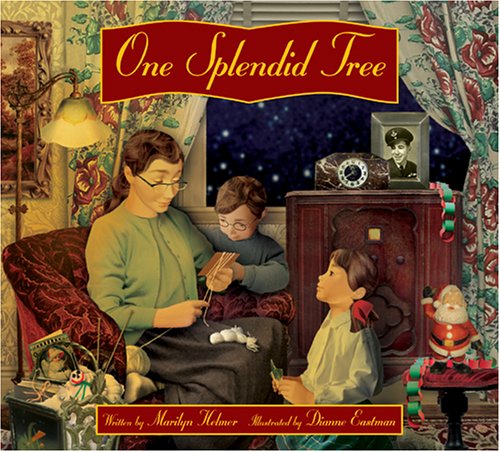
One Splendid Tree by Marilyn Helmer, illustrated by Dianne Eastman. This is the story of Hattie, her younger brother Junior and their mother as they try to adjust to living in an small apartment in the city during World War II. Their father is fighting in the army and their mother has taken a job in a factory to help support the family. With Christmas coming, there is no money or space for a tree and it just doesn't feel like Christmas.  One day, Junior finds an abandoned large potted fernlike plant in the hallway and thinks it will make an ideal makeshift Christmas tree.  At first, Hattie is against it, but remembers her dad saying Christmas is a time when magical things can happen.  She changes her mind and they enthusiastly decorate the tree with homemake decoration leaving it in the hallway so everyone in the building can enjoy it. This is the season of peace on earth, good will towards all mankind. Can their tree create that kind of feeling in a building where everyone goes about his/her own business and don’t bother with their neighbors?  Recommended for ages 4-8.

In the Dark Streets Shineth: a 1941 Christmas Eve Story by David McCullough. This is a rather odd, but nevertheless interesting book about what feels like totally unrelated things.  In late December 1941, Winston Churchill traveled to Washington DC to speak with President Roosevelt about the war.  It was less that a month since the US declared was against the Japan and her allies, Germany and Italy. While here he heard the hymn O Little Town of Bethlehem for the first time.  McCullough then gives the history of that hymn and also of the song I’ll be Home for Christmas, written especially for the war and at the time, the most popular Christmas song besides White Christmas. McCullough attempts to tie them to Churchill’s visit. There are photos of ordinary people and the Roosevelts celebrating Christmas, along with photos of Churchill's visit.  At the end of the book is a transcript of Roosevelt's and Churchill's Christmas Eve address to both nation.  It is a newly published very nice non-fiction book by a well known historian.  Recommended for readers aged 10 and up.

Captain’s Command by Anna Myers. The story of 12 year old Gail Harmon living in Stonewall, Oklahoma.  Before her father had left for the war, he had given Gail a golden retriever puppy, which she named Captain and told her to look after her Uncle Ned.  Uncle Ned had been blinded early in the war, and has been bitter and depressed ever snce. The family receives news that her father had been shot down over France and is now considered missing in action, but her mother who refuses to believe the worst has happened to her husband.  Each chapter begins with a bit about two airmen, shot down over France, one very badly wounded.  On Christmas they receive a letter from one of the airmen telling them how he and Gail's father had been hidden by some French farmer and that her father had died in their barn and was now buried there.  This new causes Uncle Ned become even more despairing and he decided to run away. Now it is up to Gail and Captain to find and help him. This is a story about family, kindness and sacrifice, and a Jewish Santa named Mr. Weise.  Recommended for readers ages 9-12.

Christmas Sonata by Gary Paulson, illustrated by Leslie Bowman. Paulson grew up during World War II and there is supposedly an autobiographical basis for this novel.  It is the story of a 6 year old boy whose father is away, fighting in Europe and whose mother has had to take a job in a laundry to help support the two of them. Christmas is coming and the boy still fervently believes in Santa until one day when he sees his mean, nasty neighbor dressed as Santa and drinking wine.  His belief in Santa and the magic of Christmas are destroyed by this.  Shortly afterwards, he and his mother travel to visit his cousin Matthew, Uncle Ben and Aunt Marilyn in Minnesota. Matthew, who is bedridden and dying, has also lost his belief in Santa and it will probably be his last Christmas.  But when Uncle Ben hears the boys talking, he decides to do something. Can he pull of a real Christmas miracle?  Recommended for ages 9-12.

Molly’s Surprise, a Christmas Story by Valerie Tripp. Part to the American Girls collection, this is the third story about Molly McIntire. It is almost Christmas, but Molly's father, Dr. McIntire, is away, working in a hospital in England and she is missing him very much.   Her grandparents are supposed to visit and bring a Christmas tree with them, but call to cancel the trip.  Their car has a flat tire and they can't get a new one because of the rubber shortage and there is no one who can fix it until after the holidays.  It looks to be a sad Christmas for the McIntire household until Molly and her sister Jill decide to pool their money and buy a rather sparse, but affordable tree for the family. A few days before Christmas, there is a wonderful snowfall and while playing in it, Molly and Jill find a box from their dad that had gotten buried under the snow.  They decide to hide it until Christmas. Finally on Christmas morning, the McIntires open the box and have more than one special Christmas surprise from Dr. McIntire.  Recommended for readers ages 8-12.


These are three book I haven’t own and haven’t read, but I believe they are very good stories and I include the publisher’s abstract (even though I don’t normally like to do that)

The Miracle Tree by Christobel Mattingley, illustrated by Marianne Yamaguchi. Separated by the explosion of the atomic bomb, a husband, wife, and mother carry on with their lives in the ruins of Nagasaki and are eventually reunited one Christmas by a very special tree.

The Angel with a Mouth-Organ by Christobel Mattingley, illustrated by Astra Lacis. Just before the glass angel is put on the Christmas tree, Mother describes her experiences as a little girl during World War II when she and her family were refugees and how the glass angel came to symbolize a new beginning in their lives.


Izzie: the Christmas that almost wasn’t by Budge Wilson. This is the second book of a trilogy in the Our Canadian Girl series. Izzie and her family are preparing for a special Christmas in their coastal Nova Scotia village. The year is 1941, and with soldiers, sailors, and ships crowding into nearby Halifax, World War II seems especially close at hand. But this year, despite the war and rationing, Izzie's grandparents, aunt, uncles, and cousins are coming to spend the holiday. When a terrible storm threatens to spoil everything, Izzie is bound and determined to save Christmas for everyone.

Saturday, December 18, 2010

Busting the Newbie Blues


1. When did you start your blog?
I began The Children’s War on June 11, 2010.

2. Why did you start your blog?
I have always had an interest in popular culture and when it came time to write my dissertation, I chose to write on popular fiction written for girls in Nazi Germany. I read over 100 novels written for girls’ from 1933 to 1945. When I was done, I the novels away with my collection of American and English books for kids on WW II that I have had since I was young, or had acquired over the years and it occurred to me it might be interesting to write a blog devoted to these kinds of books.

3. What has been the biggest challenge you’ve faced so far?
Probably the same challenges most new bloggers face – getting noticed and finding followers who are interested in what I am writing about. Also the technical side of blogging and getting things to look the way I want them to.

4. What do you find most discouraging about being a new blogger?
This is answered in part by question 3. Also, self promotion is difficult for me. I am a low-profile person by nature, and you can’t be that way to some extent with a blog. For example, I didn’t ask anyone the Cybils and missed out on the opportunity to participate. I could kick myself – but there is next year. Now, I ask questions and push myself to be out there in the blogosphere as much as possible.

5. What do you find most encouraging?
The most encouraging thing about blogging is the support from the wonderful people I have met since starting my blog. And other bloggers are so willing to give helpful advice if you need it. I also try to make my blog a resource that people can use, and when they comment on the additional information or the links I include, I feel very gratified.

6. What do you like best about the blogs you read? Have you tried to replicate this in your blog?
I like the reviews when I can tell that the bloggers are expressing themselves and not just copying from a promo or dust jacket. I also like a good clean layout, where things are easy to find. Sometimes a blog is so cluttered that I just navigate away from it. I did use a few blogs which I considered to be good examples in terms of layout as a template for my own blog.

7. What do you dislike about blogs you read? Do you try to avoid this?
The main thing I dislike is a blogger who writes “I loved, loved, loved the book” followed by a cut and paste from the publisher’s website. It tells me nothing about the book. I also do not like a blog with a black or dark background and colored text. I have eye problems and these are so hard to read.

8. Do you have any advice for new bloggers?
The best advice is to stick with it and have a lot of patience. Remember – Rome wasn’t built in a day. Join a few memes and/blog hops and decide which work best for you. I think the first six months to a year are for experimenting in ways to make your blog exactly what you want it to be. And be consistent with posts. I lose interest in blogs that have long periods of time between postings.

9. How did you bring your blog to the attention of so many people?
I joined Book Blogs and Kidlitosphere, since I do children’s and YA books. I also set up a twitter account and post on that. And I participate in some memes and comment on the blogs I read.

10. Is there anything else you would like to share about your experience?
Be yourself and have fun with your blog and don’t give up.

Thanks to Small Review for hosting this event.

Thursday, December 16, 2010

Don’t You Know There’s a War On? A Novel by Avi

Don’t You Know There’s a War On? provides an amusing look at the life of 11 year old Howie Crispers of Brooklyn, NY during the war, and narrated in a snappy conversational style by his 16 year old self in 1948. The story covers one week, from Monday to Monday beginning on 23 March 1943. Each day Howie and his best friend Denny stop to read the war headlines at a newspaper stand on their way to school and these headlines preface each chapter. The story is driven by two premises. First, Howie and Denny have both decided that the principle of their school, PS 8, is a spy. Second, they each have a serious crush on their teacher Miss Gossim, but have kept it a secret from each other – until now.

On Monday, Howie sees his principle knocking on the front door of a brownstone. Since he is convinced that Dr. Lomister is there on spy business, he feels it is his patriotic duty to spy on the spy. He manages to sneak into the house through the coal chute, winding up in the basement, but manages to get himself upstairs by using the dumbwaiter. Listening at a door, Howie is stunned by what he hears, which has absolutely nothing to do with espionage; and everything to do with the fact that Miss Gossim is going to be fired in a week. Howie escapes from the house and, despite being covered with coal dust, goes to school, arriving in time to see Miss Gossim called down to the principle’s office. It is obvious to Howie that she knows she has been fired when she returns to the classroom. Later in the afternoon, when Howie takes Denny to the brownstone he saw Dr. Lomister enter, they see Miss Gossim coming down the street. She knocks on the door, but no one answers and she leaves. Denny must go home, so Howie follows her and discovers where she lives.

On Tuesday, nothing much happens.

On Wednesday, Howie, his mom and sister Gloria receive a letter from his dad, who is in the merchant marines and sails convoys across the North Atlantic delivering war supplies. His father’s safety is a constant worry for Howie. Later that evening, there is a blackout, and since everyone must be off the streets, Howie is sent out to find Gloria and bring her home. While still out, he is asked by a Civil Defense warden to take a message to his commander, who conveniently is located near Miss Gossim’s apartment building. Caught out in the blackout by another warden, Howie lies and says he lives in her building. Since the warden stands and waits for him to go in, Howie is forced to ring Miss Gossim’s bell, and ends up spending the rest of the blackout with her in her apartment. He tells her he knows she has been fired, and how he found out. She confesses that she is a war bride, marrying someone she had only known a short time. Now she is pregnant and that is the reason she has been fired.

On Thursday, Howie tells Denny about his nighttime visit to Miss Gossim. When they still can’t come up with a workable plan to save her job, Gloria, a devoted fan of radio soap operas, solves the problem for him with an idea inspired by one of her favorite shows.

The rest of the novel involves preparing and instituting the plan. But does it succeed?

This is not really a book about the war as much as it is a book in which the war acts as a catalyst for setting things in motion. Howie speaks exactly like a kid from Brooklyn, and I know what that’s like because I was a kid from Brooklyn. Coal chutes and dumbwaiters existed long past their usefulness though they are pretty much gone now, but Howie gives a good description of them for the reader, along with any other things that might be unfamiliar to today’s kids. It was also a nostalgic read for me because so much of what went on in Howie’s life was similar to mine - the games he mentions, the school procedures, the different class monitors listed on the blackboard and the class picture at the back of the book. And why wouldn’t they be similar - Howie went to PS 8, I went to PS 249. But the difference was the war and Avi accurately and vividly portrays wartime daily life – the anxiety for loved ones in the Armed Services, the fear of Nazis spies, the impact and devastation that the death of a soldier can have on a family, the hardships of rationing, and the small pleasures like listening to stories on the radio, or Saturday morning kids shows at the movie theater. Avi’s descriptions of life in Brooklyn were so realistic that it didn’t surprise me to find out he grew up there too.

The book did bring out one antiquated practice in schools back then. Under normal circumstances, women were not allowed to teach after they married, but because of a teacher shortage during the war, that ban was lifted. However, a pregnant teacher, even if married like Miss Gossim, was not allowed to continue teaching under any circumstances.

Avi has always been a favorite in this house, and when I told Allison that I was reading a book of his, she began to wax nostalgic. And I can see why. I highly recommend Don’t You Know There’s a War On?

This book is recommended for readers aged 9-12.
This book was borrowed from the Webster Branch of the New York Public Library.