Thursday, November 25, 2010

I digress again...Weekly Geeks - Antique Books

This week the Weekly Geeks question is
The other day I was noticing the old books on my book shelf. Old, meaning books that were "born" a long long time ago. Books that were published AND printed a long long time ago. (Not simply books that have been sitting on our shelves forever!)And it made me wonder what old books other readers have in their collection.

So this week, write a post sharing with us what old antique books you may have on your shelves, and tell us the story behind them. Did you inherit from a relative? Are you a collector of old and rare books? Did you just discover a certain book in a used book store and couldn't pass it up? What's the very oldest book you have? Do you even like old books? Or do they creep you out? Do you read and enjoy your old books, or is it more a "look and don't touch" thing?

To which I reply
I have a lot of old books but none are what may be called antiquarian. For the most part, they are books I read as a child, either bought for me or handed down. None are valuable, except to me for sentimental reasons. I have a bunch of Nancy Drew books that were published in the 1930s and 1940s that can no longer be read because they are in such fragile condition. But they have had a good productive life, belonging to several cousins and a sister before they reached me. And I have 10 of the 12 Blythe Girls series from the 1920s and no idea where they came from, but I love them. And The Five Little Peppers books are there too. The one trait they all have in common is that they are series books and I have loved series books since the first one I read.

My two favorites are The Bobbsey Twins books and the Anne of Green Gables series because I have such great memories attached to them. My mother was a voracious reader as a girl and an adult and encouraged her own children to follow her example. When I was five I picked up a Bobbsey Twins book that belonged to my sister. She, being older, naturally had a fit when she found out that I had touched her stuff. So every Friday evening, my mother and I would walk down to Flatbush Avenue, in Brooklyn, to a little bookstore next to the old Dutch Reformed Church. I was allowed to purchase one book every week, but the deal was I would only get a new book when I completed the one I had previously bought. There were two things I loved about those Friday excursions. First, it was my special time with my mother, sans siblings. Second, I can still remember the smell those books have when they were opened. It was such a distinct smell, and even now when I dust them, the smell is still there. It must be a combination of the paper and ink. After a while, my reading expanded and I could buy Nancy Drew, Cherry Ames and series other books. You might ask why not just go to the library? They didn’t have this type of series books.

The story is a little different with Anne of Green Gables. When I was in the 4th grade, I became very sick and missed a several weeks of school. By the end of the second week, I think I was beginning to get on my mother’s nerves. I have never, to this day, been a good patient and my mother was a really patient nurse, so you can imagine what a pain in the neck I must have been was. I was left in the care of a neighbor one morning while my mother went off to do errands. It turned out that she had gone to the library and checked out Anne of Green Gables for me. This, she said, was her favorite book when she read it as a girl and she think I would also like it. I opened the book and fell in love. During this long convalescence, my mother hunted down the rest of the series, which the library didn’t have and I still have those books today. Before she passed away, she and I often reminisced about our book bond. A passionate love of reading is the one thing my siblings didn’t share with her (they had their own special bonds with her.)
I am always reminded of Eudora Welty words from “A Sweet Devouring when ever I looked at my collection of old series books:

“My mother took me to the public library and introduced me: ‘Let her have any book she wants, except Elsie Dinsmore.’ I looked at the book I couldn’t have and it was in a row. That was how I learned about the series books. The Five Little Peppers belonged, so did The Wizard of Oz, so did The Little Colonel, so did The Green Fairy Book. There were many of everything, instead of one. I wasn’t coming to the end of reading, after all – I was saved.”
This quote always makes me feel happy, as do my small collection of series books.  Here are some pictures of a few of them.


Wednesday, November 24, 2010

THANKSGIVING

I was having dinner with an old friend last week and Thanksgiving Day plans came up. My friend said he was not planning on doing anything special that day. He felt that Thanksgiving had become a commercialized sham and that even the settlers who came to this country only came for economic gain and exploitation. Well, what he said was partly true. My dad came from Wales because this country offered more economic opportunities. He found them here, and was forever grateful. My mother’s Quaker ancestors came here back in the 1600s for religious freedom, economic opportunity and to live peacefully. My thoughts turned to President Franklin D. Roosevelt’s Four Freedoms address, which I have read so many times. This was a speech delivered to congress on 6 January 1941, ten months before the US was attacked and entered World War II. In 1943, during some very dark days when the war was raging in Europe and Allied Forces were fighting and dying to preserve freedom in the world, Norman Rockwell painted a series of four pictures, inspired by Roosevelt’s Four Freedoms speech.

And so I excerpt them here because they are good thoughts for Thanksgiving:

“In the future days, which we seek to make secure, we look forward to a world founded upon four essential human freedoms.

The first is freedom of speech and expression—everywhere in the world.


The second is freedom of every person to worship God in his own way--everywhere in the world.


T he third is freedom from want—which, translated into world terms, means economic understandings which will secure to every nation a healthy peacetime life for its inhabitants—everywhere in the world.


The fourth is freedom from fear—which, translated into world terms, means a world-wide reduction of armaments to such a point and in such a thorough fashion that no nation will be in a position to commit an act of physical aggression against any neighbor—anywhere in the world.


That is no vision of a distant millennium. It is a definite basis for a kind of world attainable in our own time and generation. That kind of world is the very antithesis of the so-called new order of tyranny which the dictators seek to create with the crash of a bomb.”

A HAPPY AND PEACEFUL THANKSGIVING TO EVERYONE

Monday, November 22, 2010

In Defiance of Hitler: the Secret Mission of Varian Fry by Carla Killough McClafferty

Most people have heard of Oskar Schindler, the ethnic German who saved 1,200 Jews from certain death at the hands of the Nazis by employing them in his enamelware/ammunition factory, thanks to Thomas Keneally’s book Schindler’s List and Steven Spielberg’s movie based on the book. But not many have heard of Varian Fry, the 32 year old American who went to Marseilles, France in August 1940 to help rescue refugees stranded there after France fell to the Nazis. Many of these refugees had fled to France from Hitler’s Germany during the 1930s.

McClafferty details Fry’s mission beginning with a mob attack on Jews that he had witnessed on 15 July 1935 in Berlin, Germany. This left a deeply disturbing impression of Fry, and in 1940, three days after the armistice was signed between Germany and France, he attended a luncheon in NY about the situation of refugees. A collection was made at the luncheon that raised $3,000 and a private organization called the Emergency Rescue Committee or ERC was formed. Its purpose was to rescue Jews and non-Jews who were enemies of the German state and who were also well-known artists, scientists, musicians, and politicians. The list of almost 200 names included people like Marc Chagall, Max Ernst, Pablo Picasso, Henri Matisse and Lion Feuchtwanger. Feuchtwanger was a German writer who had written the first book about the life of a Jewish family in Berlin under the Nazis in 1933 called The Oppermanns (Die Geschwister Oppermann).

Taking the list of names and the $3000 donation money, Fry volunteered to go see what he could do about getting these renowned refugees out of occupied France. The job proved to be more than anyone had thought it would be. First, there was the problem of finding the people on the list, who were more than likely living scattered around the south of France under assumed names or, like Feuchtwanger, were in a French concentration camp awaiting deportation. And there was the problem of everyone having the right papers at the same time. Each family member had to have exit and entrance visas with the same dates, as well as travel visas to go through other countries. A valid passport was required everywhere and since all German Jews had become stateless with the passage of the Nuremburg Laws in 1935, they did not have and could not obtain a valid passport.

McClafferty describes in a very clear easy to understand way the complex problems Fry faced when he arrived in Marseilles and his trials and errors as he learned how to work around all the difficulties, done mostly with the help of very clever people and a lot of deception. And she chronicles the deterioration of Fry’s marriage as he became more involved with what he was doing. Fry began to believe that he was indispensable to the rescue operation, and this led not only to more problems with his wife, but also with the ERC. Fry’s original mission was to last only for a month, but by the end of that time he was too involved with what he was doing, and delayed his departure. Eventually, word go around Marseilles that he was there to help rescue people, and other refugees, ordinary people not on the list, began to show up outside his hotel. These people could only be helped with day to day expenses, not gotten out of France. So many refugees came to Fry that he had to hire some help and ultimately set up a relief organization called the American Relief Center or ARC.

It is unfortunate but in the end Fry was fired by the ERC and finally escorted out of France by the police in 1941. Yet he had accomplished much, getting at least 2,000 people out of France and away from the Nazis. In 1967, Fry was awarded the Cross of Chevalier of the Legion of Honor by France and was the first American named “Righteous among the Nations” in Israel in 1996, an honor give to non-Jews who helped Jews during the Holocaust.

This is an excellent look at a very courageous man, and McClafferty has done a commendable job detailing what is probably unfamiliar information to young readers. The story of Varian Fry and his refugees almost reads like a novel because of all the deceptions and clandestine exploits they were involved in to accomplish their job. McClafferty has included a detailed appendix and bibliography at the end for further exploration of this interesting man. She doesn’t say it, but her description of Fry when he returned home sounded very much like a man suffering from Post Traumatic Stress Syndrome, understandably given some the things he witnessed and the fear and tension he lived with for so many months, as did everyone under Nazi domination.

This book is recommended for readers age 9-14.
This book was borrowed from the 67th Street Branch of the New York Public Library.

In Defiance of Hitler: the Secret Mission of Varian Fry received the following well deserved honors:
2008 Society of School Librarians International Book Award Honor Book
2009 Orbis Pictus Recommended Title
2009 CCBC Choice (University of Wisconsin)

More information about Varian Fry may be found at the following websites:
http://www.almondseed.com/vfry/
http://www.holocaust-trc.org/fry.htm

Non-Fiction Monday is hosted this week by Practically Paradise

Friday, November 19, 2010

Book Beginnings on Friday: Blue by Joyce Moyer Hostetter

Book Beginnings on Friday is a meme created by Becky at Page Turners, and is now hosted by Katy at A Few More Pages  Anyone can participate; just share the opening sentence of your current read, making sure that you include the title and author so others know what you're reading. If you like, share with everyone why you do, or do not, like the sentence.

My book beginning comes from Blue by Joyce Moyer Hostetter

'If you ask folks around here what they remember about the year 1944,
    A child might say, "That was the year my daddy went off to fight Hitler."
    A mother might look off towards Bakers Mountain and whisper that     
    polio snatched up one of her young'uns.
    And the Hickory Daily Record will say that my hometown gave
    birth to a miracle.'
                                                     
These few beginning sentences are interesting because they remind people that the home front had more problems to deal with than those generally associated with war.  I am almost done with this book and will have a full post on it soon.

Wednesday, November 17, 2010

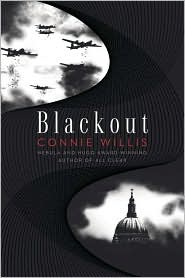
Blackout and All Clear by Connie Willis


I have just finished rereading Blackout and All Clear and find myself wishing that Connie Willis could have kept going. After reading these two books totaling 1,168 pages, I find I have become quite attached to the characters and had a hard time saying goodbye when I came to the end. They are just that good!

The books are based on a simple enough premise. In 2060 Oxford, history is studied by traveling back in time to observe, collect data and interpret events firsthand under the tutelage of Mr. Dunworthy, the history professor in charge of time travel. The story centers on three students interested in different aspects of World War II. Michael Davies, disguised as Mike Davis who wants to go to Dover as an American war correspondent to observe the heroism of the ordinary people who rescued British soldiers from Dunkirk; Merope Ward becomes Eileen O’Reilly, working as a servant to Lady Caroline Denewell in her manor at Backbury, Warwickshire in order to observe evacuees from London; and Polly Churchill becomes Polly Sebastian, a shop girl by day working in the fictitious department store Townsend Brothers on Oxford Street, who wants to observe how Londoners coped during the Blitz.

In Blackout and All Clear, Willis makes it clear that there are certain cardinal rules of time travel. First, the traveler may not do anything to alter a past event. But that was supposed to have been taken care of so that it couldn’t happen. In addition, an historian is not allowed to travel to a divergence point, a critical point in history that can be changed by the presence of the historian. Nor can a predetermined drop site open if there is a “contemp” nearby who might see what is going on. Furthermore, once they have arrived at their destination, the historian is required to return to 2060 Oxford and report in. If they don’t do this, a retrieval team is sent to bring them back to Oxford. One other thing, time traveling historians are not supposed to have contact with each other in the past.

That being said, Mike ends up in Dunkirk, saving a life and Eileen is prevented from returning to Oxford at the end of her stay by an outbreak of measles among the evacuees. Both ultimately travel to London, seeking Polly, hoping to use her drop to get back to 2060, but Polly’s drop has been compromised by a bomb and has stopped working. These extended stays do not result in the arrival of retrieval teams; but in much more complex adventures and worries. Have they altered the future unintentionally? Or unalterably? And if so, what does that mean for the future? And will the historians ever get back to 2060 Oxford?

In addition to Mike, Polly and Eileen, Willis has drawn some interesting supporting characters in Blackout and All Clear, all very different from each other and all of whom I found myself caring about. There is Sir Godfrey Kingsman, the well known actor who is part of the entourage in Polly’s bomb shelter, though he did get on my nerves with his constant quoting of Shakespeare, yet he was still endearing. He always referred to Polly as Viola from Twelfth Night because of the way she arrived at his bomb shelter her first night, and she was going by the last name Sebastian, the name of Viola’s twin brother, something to keep in mind as you read. And Colin Templer, 17 and besotted with love for Polly anf who had promised to rescue her if anything went wrong. Colin wants to go to the Crusades so he can use the paradox of time travel to close the four year age difference between himself and Polly. Eileen’s life was plagued by Alf and Binnie Hodbin, brother and sister urchins evacuated from London to Backbury, pranksters and troublemakers extraordinaire. Mike had Commander Harold, elderly captain of the Lady Jane who unofficially went across the English Channel to participate in the evacuation of soldiers from Dunkirk and changed the course of Mike’s time travel.

Connie Willis has done a brilliant job writing Blackout and All Clear, even though I know I will probably have to reread both books again to really appreciate them. When I first read Blackout, I didn’t pay close attention to the dates at the beginning of each chapter, so sometimes they were a little confusing. I found myself preoccupied with questions about why I was suddenly in 1944 or 1945 and who were Mary Kent and Ernest Worthing and how did this connect to Mike, Polly and Eileen?  Blackout sets up all the questions and All Clear answers them.

Throughout both novels, the three main characters are confused by what has happened to them, and the chaos of the period, such as not knowing when or where bombs may fall, adds to their sense of helplessness once Polly's knowledge of when and where bombs will fall is exhausted. As in the real war, anger, anxiety, confusion, fear, frustration and helplessness are exactly the array of emotions that the reader experiences along with Mike, Eileen and Polly. Yet, all is not doom and gloom. Willis balances these with instances of hope, courage, selflessness and heroism. She also injects some very comical scenes into the story, such as the angry bull and the deployment of rubber tanks in a muddy, foggy pasture to fool the Luftwaffe, or the constant antics of the Hodbins. And of course, there is the dry wit of the British and their ‘carry on’ attitude after a blitz attack. I really like the fact that Willis keeps the story focused on the plight of the stranded historians, rather than jarring the reader by going back and forth between them and Oxford 2060.

Blackout and All Clear are both chock full of action, information, comedy, tragedy and everything else that goes into making a great story. They are not really meant for YA readers, yet they are perfectly suitable for high school kids, and even some younger ones. So without reservation, I would definitely recommend Blackout and All Clear to readers in their teens and to everyone else. It is a wonderful a tale about survival and heroism.

These books were purchased for my personal library.

Willis described the blitz and the bombs that hit Oxford Street, where Polly worked, in amazingly realistic detail.  Check out the following for an online exhibition of the West End at War including photos and maps of the blitz in that area, the same area that plays a large part in Blackout and All Clear
 http://www.westendatwar.org.uk/index.aspx

The following has online information about the Docklands and East End during the war, another area highlighted by Connie Willis;
http://www.museumindocklands.org.uk/English/EventsExhibitions/Themes/DocklandsWar/