Tuesday, May 24, 2022

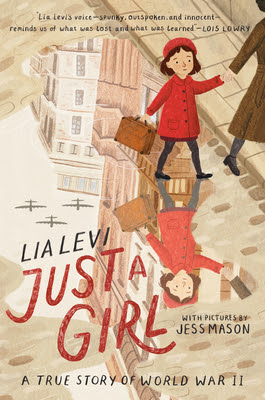
Just a Girl: A True Story of World War II by Lia Levi, pictures by Jess Mason, translated from the Italian by Sylvia Notini

Born in 1931 in Turin, Italy, Lia lived a pretty comfortable life with her parents, younger  sisters Gabriella and Vera, and Maria, their nanny. Lia was a shy girl so when Mussolini declared that Jewish children could no longer attend Italian schools, she is quite happy. That is, until she finds out that she would be attending a Jewish school. It isn't long before Lia's father loses his job because he is Jewish and the family is forced to live on their savings. 

When war is declared by Germany, Italy joins with Hitler and goes to war also. Within three hours of declaring war, French planes are dropping bombs in Turin. When Lia is in third grade, the family savings run out, and her Papa needs to find a job, but no one is allowed to hire Jews. The family decides to move to Milan, but when a promised job for Papa falls through, they are on the move again. This time, they are off to Rome.

Lia and her sisters have a grandmother who isn't Jewish and their first summer living in Rome, they are sent to stay with her during their summer vacation for three months. But the following summer, the war is getting closer to Rome, with the Americans landing in Sicily. And one night, they wake up to learn that Mussolini is no longer Italy's prime minister. Which should have been good news for Italy's Jews, except the Germans moved in and occupied the country. And where the Italians weren't always so good about enforcing Mussolini's laws, the Germans are quick to enforce Hitler's. 

Lia's parents decide to send her and her sisters to  live in a Catholic boarding school for safety's sake. By now, Lia is in her second year of middle school. She is given a false last name, Lenti instead of Levi, and must learn Catholic prayers. Then, in October, Lia's mother shows up at the school. She tells them that the Germans raided the Jewish quarter in Rome and took everyone away, but she doesn't know where her husband is. Luckily, they are all able to spend the rest of the war living at the boarding school.

This memoir, translated from the Italian by Sylvia Notini, is told in simple language though the deprivations, fears and anxieties the family experienced are made very clear. Graphic details are not included, and has caused one of my colleagues to complain that she felt it diminished the Holocaust. I don't agree. It is a unique story, but it is one person's actual experience and until Mussolini was removed from office, things were not as bad for Italian Jews as for Jews in Nazi occupied countries. 

I did like reading Lia Levi's recollections about living through the war. I thought she included a lot of small, but interesting details about what life was like for her family which are parts of history the books don't always tell you about. And Levi used two voices to tell her story - one is the first person account of young Lia and the other is the first person memories of the older Lia giving more information that the younger Lia wouldn't have known, but which helps readers to understand what was happening. My only complaint is that the timing was hard to follow. There aren't many dates mentioned and a timeline would have been very welcome. 

This is a poignant narrative, full of love, laugher, sadness, and loss, but an ideal way to introduce the Holocaust to young readers. And, right now, I think these stories need to be told and read.

Wednesday, May 18, 2022

Alias Anna: A True Story of Outwitting the Nazis by Susan Hood with Greg Dawson

When her 13-year-old granddaughter Aimée wrote her a letter asking about what life was like for her when she was the same age in 1940, Zhanna Arshanskaya Dawson didn't know how to answer her. There was so many long-buried horrors, so much humiliation, so much running to escape capture by the Nazis. But a granddaughter has a right to know and so that part of her family's history unfolds in this gripping free verse biography. 

Ukrainian born Zhanna was a headstrong little girl who used to love wandering the streets of Berdyansk, a resort town on the Sea of Azoz. One day, while wandering, she heard a small band playing music in a funeral procession and fell in love with what she heard. But the Arshanskaya home was already filled with the music of, among others, Rossini, Vizet and Tchaikovsky. Because Zhanna was so headstrong about wandering the streets, her father decided maybe piano lessons would rein her in. Soon the five year old was playing Chopin, Brahms and Beethoven. It didn't take long to realize that Zhanna had a true gift for music. 

But Joseph Stalin, the ruthless dictator of the Soviet Union, had a plan to modernize Ukraine and get rid of the old ways through starvation - in what was the "breadbasket of Europe" people were starving to death as part of Stalin's Five-Year Plan. When Zhanna was eight and her sister Frina was six, the family, having hit hard times, was forced to leave Berdyansk to live in Karkov. Yet, despite now living in poverty, their father had high hopes that both Zhanna and Frina could audition for two spots with scholarships at a renowned music conservatory. Both musically gifted girls were immediately accepted and it was here that Zhanna found her signature piece, Chopin's Fantaisie-Impromptu. This piece of sheet music became her most prized possession, carried all through WWII.

Musically things improved for the family, but financially things got worse and then, in 1941, the Nazis attacked the Soviet Union and the country was officially at war. The Germans wanted all of the Soviet Union, but without its Jews. Shortly after arriving in Kharkov, the Nazis order Jews to gather in the center of town to prepare for evacuation. In snow and numbing cold, the Jews, now prisoners of the Nazis, were marched through the streets to an abandoned tractor factory. After a few weeks of living in abysmal conditions, the prisoners were rounded up and march to Drobitsky Yar. Suspecting what was about to happen, Zhanna's father bribed a young guard to let her escape. When the guard looked away, her father whispered "I don't care what you do. Just live." It was the last time Zhanna saw her parents, but not her sister. 

Finding refuge at a friend's home, Zhanna was reunited with her sister. But Frina refused to talk about how she had gotten away and what happened to their family. Now, the sisters were on their own, and they could be easily recognized by the people in Kharkov who had been to their concerts. What they needed were new names and identity papers. But to get the papers, they would have to be admitted into an orphanage. It was easy to become Anna Morozova and her younger sister Marina, finding places in an orphanage was not so easy. But first, they had to get out of Kharkov. 

Could the sisters survive the war, running and hiding from the cold-blooded Nazis and collaborating Ukrainians, doing what needed to be done to "just live" as their father had said?

Susan Hood has a way of making a person's history come to life in her lyrical, well-researched verse biographies (see Lifeboat 12) Reader's come away knowing not just Zhanna and Frina's struggles and how they were able to survive, but also some needed background history of the Ukraine under Stalin and later, Hitler.  

Interwoven throughout the poems are quotes from Zhanna herself, taken from her oral history recorded by the William Breman Jewish Heritage Museum, as well as from interviews with her son, Greg Dawson. Other quotes used are well-documented in Hood's copious Back Matter. Most of Zhanna's story is written in free verse, I liked that Hood also included various poetic techniques and poetic forms, which always adds a certain level of energy and richness to a work written in verse that mirrors the musicality of the two talented sisters.   

And, of course, there are recent events in Ukraine that make us realize that the past is never past. The attempted invasion of the independent state of Ukraine by Russia has brought not just the geography of this nation to the fore, but also some of its history dating back to World War II when the Nazis invaded. For example, knowing that the Russians had bombed Ukraine's Holocaust memorial at Drobitsky Yar and reading about it in this book made me that much more aware of the dangers of greedy dictators (Stalin, Hitler and Putin) and the 16,000 Jews who were murdered in that ravine, including Zhanna and Frina's family, where the now damaged memorial stands in Kharkiv. 

Alias Anna: A True Story of Outwitting the Nazis is a true testament to the courage, cleverness, persistence, talent and strong will to survive of both Zhanna and Frina. And perhaps a warning from the past for us all to heed.

Friday, May 6, 2022

Great or Nothing by Joy McCullough, Caroline Tung Richmond, Tess Sharpe and Jessica Spotswood

My first memory of Louisa May Alcott's Little Women is my older sister sitting in an easy chair in the living room and crying her eyes out while reading the book. When I asked why she was crying, she just said "You'll see." And I did indeed  discover why a few years later when I read Little Women in fourth grade. And I've never re-read it. But I have been enjoying some of the new retellings like So Many Beginnings by Bethany C. Murrow, More to the Story by Hena Khan, and Meg, Jo, Beth and Amy by Rey Terciero, among others. The latest retelling, Great or Nothing, takes place during a war like the original, but this time it is World War II.

The story begins in the spring of 1942. The United States has entered the war and people are still adjusting to the change. And that includes the March sisters, who are also still reeling from the recent death of their sister Beth. Now, their father is has enlisted as a Navy chaplain, Marmee is overly involved in charity work, and Laurie is a pilot stationed overseas. Laurie had asked Jo to marry him before he left, but she said no. Jo loved Laurie just not romantically. Then, she and Meg had harsh words. Jo couldn't understand why Meg would give up everything for math teacher John Brooke, and Meg couldn't understand why Jo had refused to marry Laurie. 

Unable to write after Beth's death and needing to get out of the house after her fight with Meg, Jo is living in a boarding house, while working in a factory producing airplanes. But when she meets Life reporter Charlotte "Charlie" Yates, and helps her write a story about the airplane factory, she realizes that she also needs to sort out her feelings for Charlie.

Meanwhile, Meg is still at home with Marmee, continuing to teach, content to wait for John, whom Amy called "that boring old fuddy-duddy," to come home and to get married. But when an old "friend" decides Meg needs to party, to have some fun, and to meet other more exciting men, she begins to question whether she would really be happy in a quiet marriage with John.  

Amy, who has been crushing in Laurie since she was a child, is supposed to be studying art in Montreal. Instead, unknown to her family, she has decided to join the Red Cross. At first turned down for being too young, Amy fortuitously finds another girl's application and uses that at another recruiting station, where she is accepted. After training, Amy is sent overseas with other recruits to work in a mobile canteen, where they serve coffee and donuts to American servicemen in London. And she runs smack into Laurie.  

And Beth? She's there, a spectral poetic voice following her sisters adventures, providing insight, and giving unheard, unheeded advice about life in between the chapters. 

Needless to say, as the story unfolds, it is clear that each sister has some big problems to deal with and some big challenges they need to overcome while navigating the war and their profound grief. 

I really enjoyed reading Great or Nothing, finding it a thoughtful, appealing story that could be seen as simply a YA wartime romantic novel, but it is actually more elevated than that. Racial and sexist issues are introduced in both Meg and Amy's stories. Meg has a student who is Japanese American and Amy encounters an African American soldier who is not totally accepted by everyone, including Amy's friend Edie. And then there is Jo, who finally figures out who she is and why she didn't have romantic feelings for Laurie.  

I also enjoyed some of the details included, like Victory Gardens, Victory Red lipstick, and of course, how women arranged their hair in Victory rolls, as well as the impact that shortages and rationing had on everyone. There isn't a lot of action to this story, but plenty of coming-of-age drama. And if I remember right, there wasn't much action in the original Little Women. I also felt that the original message about the importance of family bonds wasn't lost in this novel, even though the March sisters were scattered for much of the story. Sometime, you just need to get away from the security of home family to find yourself and appreciate what you have.  

The story is told in alternating chapters, each character written by a different author who a different voice and point of view to each of the March sisters. In case you are wondering who wrote who - Beth is written by poet Joy McCullough, Amy by Caroline Tung Richmond, Jo by Tess Sharpe and Meg by Jessica Spotswood.  

Lastly, there are some delightfully wonderful Easter eggs to be found throughout Great or Northing. Happy hunting!

Saturday, April 30, 2022

A Sunlit Weapon (a Maisie Dobbs Mystery #17) by Jacqueline Winspear

It's October 1942, and Maisie Dobbs is now Mrs. Scott, having married her American beau Mark Scott, investigator with the U.S. Department of Justice and not a political attaché in the American embassy. And now that the United States has entered the war, Maisie just might need her husband's help with her new case. 

Jo Hardy is pilot with the Air Transport Auxiliary, or ATA, ferrying planes wherever they are needed in England. While flying a Spitfire to Biggin Hill in Kent, she heard a sound in the plane aft, as if she were hit by a bullet. Sure enough, circling back, Jo noticed a man standing outside a barn with a gun aimed skyward. A few days later, Jo and her friend Diana returned to the area, and to Jo's surprise, she discovered an African American soldier, Private Matthias Crittenden, bound and gagged. Taking him back to Biggin Hill, the soldier was immediately taken by the American MPs. It seems his white companion, Private Charles Stone, is missing and they think Mattias may have killed him. 

Jo's fiancee had been killed when his plane had crashed in the countryside. Now, after being shot at herself, and then hearing that another ATA pilot had crashed on her way to Biggin Hill two days later, Jo has her suspicions about what might have happened. And she turns to Maisie Dobbs in hopes of getting some answers.  As she begins her investigation, there seems to be two plotlines going on - who is shooting at planes and what happened to Michael Stone.  And the more Maisie investigates, the more these two plotlines begin to come together. 

Into the mix of plotlines comes Eleanor Roosevelt, in England to a goodwill tour and to meet with women doing war work, such as the pilots of ATA. This is a visit that Mark Scott is involved in, making sure that security is tight because there is a evidence of German plot to kill Mrs. Roosevelt. 

At the same time, Anna, Maisie's adopted daughter, has gone from being a happy 7-year-old who loved going to school and had lots of friends there to being a clingy, unhappy child with bruises on her body and who has lost all her friends and no longer likes school. It is another problem for Maisie to get to the bottom of. 

I found this 17th Maisie Dobbs mystery to be every bit as compelling and as rich and vibrant as the previous novels in this series. In fact, I actually found myself liking Maisie more and in a different way than she was in the previous books. Maisie seemed happier and less formal than before. Perhaps it is her American husband, and/or her adopted Italian daughter. whatever it is, I really like it. 

And because the American military are now in England, it is a good opportunity to explore racism and  segregation in the United States, both at home and abroad. I thought Winspear did a pretty good job of showing how the English were accepting of Black Americans in ways that the US, including the military abroad, were not, but also how the English had their own issues about race when Maisie's daughter became a target because of her dark hair and olive complexion, and assumed to be something she isn't. 

Winspear nicely brought in the work of the ferry pilots, showing the dangers these woman faced every time they got into a plane that carried no weapons they could use should they be attacked by a German plane, or even someone on the ground. And readers meet a group of Land Girls working on a farm to help with those chores. I was glad that the farmer they worked for turned out to be a good guy instead of one who took advantage of these young women. I loved all the little details Winspear threw in about both of these wartime jobs. 

On the whole, A Sunlit Weapon is imminently readable and I am still amazed at how, after 17 books, each one still feels fresh and exciting. I can't wait to read #18. 

Sunday, April 17, 2022

Always (Book #7 in the Felix and Zelda Family of Books) by Morris Gleitzman

I have to admit this was one tough book to read, mainly because I knew it was the end of the Felix and Zelda Family of Books. If you have read all 6 of the previous novels in this series, beginning with Once, you have gotten to know a mighty fine boy who grew up to be an outstanding man. 

Always, like book #3 Now, is not narrated by Felix alone but also by a young biracial boy named Wassim, living in Eastern Europe with his Uncle Otto now that he parents are both dead. Wassim owns a book his grandfather, Amon Kurtz, had given to him called William Does His Best by Richmal Crompton, along with a note that tells him if he is ever in big trouble to get in touch with Wilhelm Nowak. Wilhelm Nowak, readers of Then may remember, is the name on Felix's false identity card given to him by Genia and Amon was a reluctant Hitler Youth boy who had befriended Felix because of their mutual love of Richmal Crompton's books. Wassim knows that Wilhelm is really Felix Salinger, who, he learns, is 87-years-old and living in s retirement home in Australia. 

This is good because Uncle Otto, who by the way is white, is being used by a violent gang known as the Iron Weasels to store their stolen goods in his garage, and Wassim is being bullied by them because of being biracial. When things begin to heat up, and the Weasels almost kill Wassim, Uncle Otto, who knows about Felix, takes him to Australia and leaves him there.

Wassim tells Felix why he has come to him for help, and though Felix feels a strong bond with him, he is at first reluctant to return to Eastern Europe until the long racist arm of the Weasels extends into his personal life. But can an 87-year-old man and a ten-year-old boy fight a prejudice that is so rabid, so deeply rooted and just as violent as the Nazis had been? And can they also solve a mystery about property stolen by the Nazis and never found?

I couldn't wait to read this book, and even ordered it from England as soon as I could, then I read it in one sitting and afterwards I was sorry because it is the end of the Felix saga and I will miss looking forward to the next part of his story. 

This is an intriguing story and, yes, you have to suspend your disbelief in part of it, but that was ok for me. Wassim is an endearing, optimistic, hopeful boy, with lots of personality similarities to Felix when he was young. Felix knows that Wassim will be facing some real hard truths about his life when they return to Eastern Europe, but he's there for him and he knows that so is gruff Uncle Otto. There is a part of me that is hoping Gleitzman to carry on the Wassim story since I would like to know him better. 

Gleitzman does make a lot of references to the past Felix books, but I don't think that would be a problem for those who may not have read all of them. I'm not a big re-reader of books, but I am thinking I might re-read all seven Felix books. 

What really makes me sad is how Gleitzman has brought the same themes of racism, bigotry, and hated full circle,  and that they are still so much a part of our society.

Be sure to check out the other Marvelous Middle Grade Monday offerings, 
now being carried on by Greg at Always in the Middle